
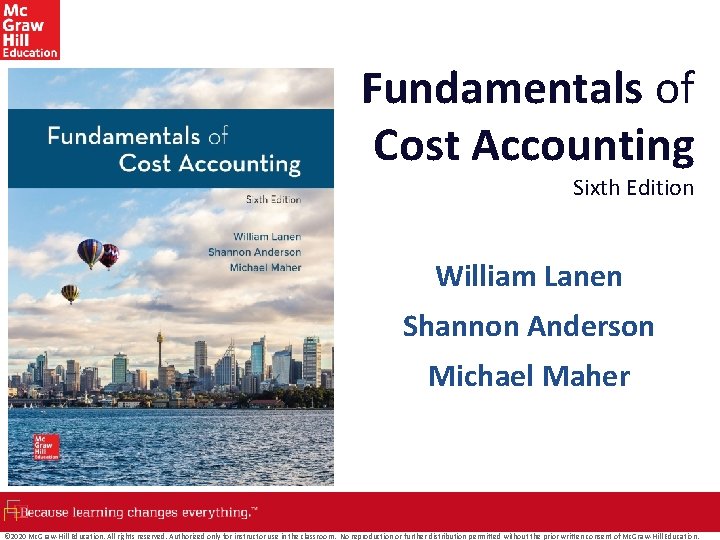
Fundamentals of Cost Accounting Sixth Edition William Lanen
- Slides: 36
Fundamentals of Cost Accounting Sixth Edition William Lanen Shannon Anderson Michael Maher © 2020 Mc. Graw-Hill Education. All rights reserved. Authorized only for instructor use in the classroom. No reproduction or further distribution permitted without the prior written consent of Mc. Graw-Hill Education.
Chapter 2 Cost Concepts and Behavior 2 -2 © 2020 Mc. Graw-Hill Education
Learning Objectives LO 2 -1 Explain the basic concept of “cost. ” LO 2 -2 Explain how costs are presented in financial statements. LO 2 -3 Explain the process of cost allocation. LO 2 -4 Understand how material, labor, and overhead costs are added to a product at each stage of the production process. LO 2 -5 Define basic cost behaviors, including fixed, variable, semivariable, and step costs. LO 2 -6 Identify the components of a product’s costs. LO 2 -7 Understand the distinction between financial and contribution margin income statements. 2 -3 © 2020 Mc. Graw-Hill Education
LO 2 -1 What is a Cost? LO 2 -1 Explain the basic concept of “cost. ” Cost is a sacrifice of resources. 2 -4 © 2020 Mc. Graw-Hill Education
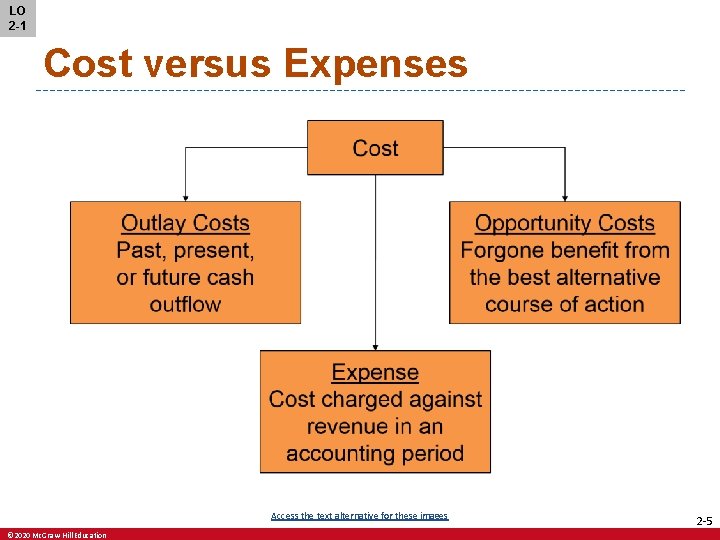
LO 2 -1 Cost versus Expenses Access the text alternative for these images © 2020 Mc. Graw-Hill Education 2 -5
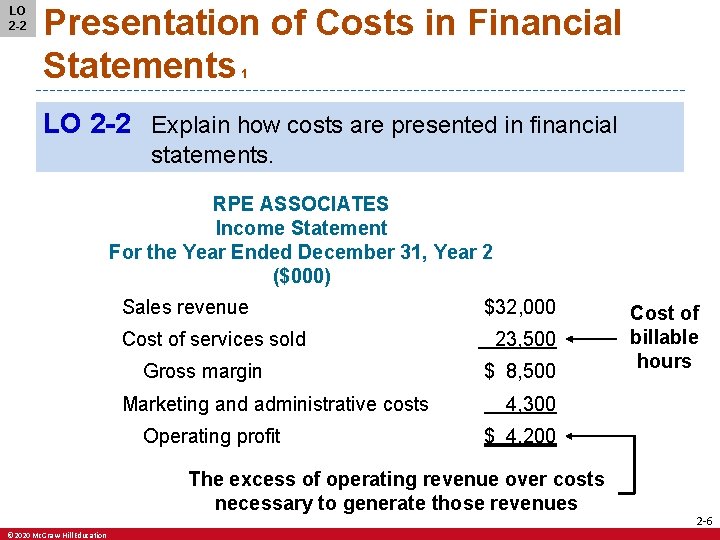
LO 2 -2 Presentation of Costs in Financial Statements 1 LO 2 -2 Explain how costs are presented in financial statements. RPE ASSOCIATES Income Statement For the Year Ended December 31, Year 2 ($000) Sales revenue Cost of services sold Gross margin Marketing and administrative costs Operating profit $32, 000 23, 500 $ 8, 500 4, 300 $ 4, 200 The excess of operating revenue over costs necessary to generate those revenues © 2020 Mc. Graw-Hill Education Cost of billable hours 2 -6
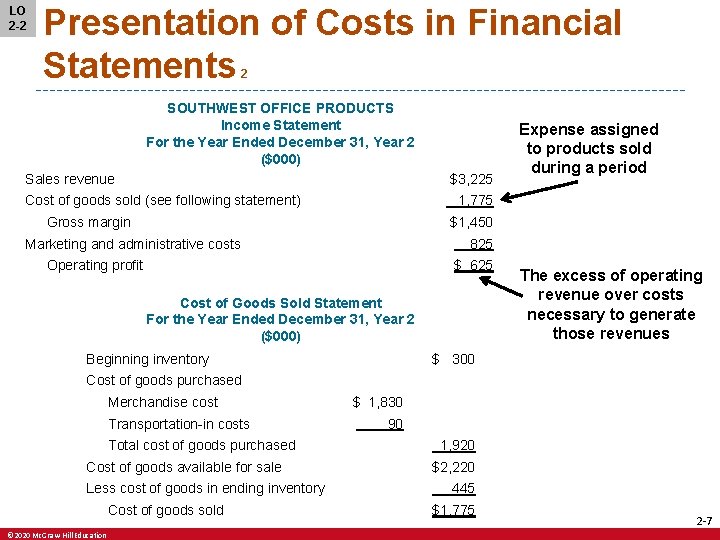
LO 2 -2 Presentation of Costs in Financial Statements 2 SOUTHWEST OFFICE PRODUCTS Income Statement For the Year Ended December 31, Year 2 ($000) Sales revenue $3, 225 Cost of goods sold (see following statement) Expense assigned to products sold during a period 1, 775 Gross margin $1, 450 Marketing and administrative costs 825 Operating profit $ 625 Cost of Goods Sold Statement For the Year Ended December 31, Year 2 ($000) Beginning inventory The excess of operating revenue over costs necessary to generate those revenues $ 300 Cost of goods purchased Merchandise cost Transportation-in costs Total cost of goods purchased Cost of goods available for sale Less cost of goods in ending inventory Cost of goods sold © 2020 Mc. Graw-Hill Education $ 1, 830 90 1, 920 $2, 220 445 $1, 775 2 -7
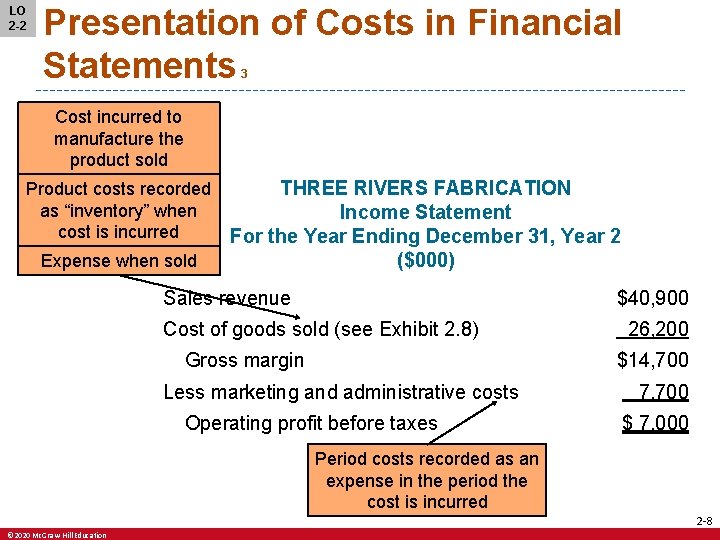
LO 2 -2 Presentation of Costs in Financial Statements 3 Cost incurred to manufacture the product sold Product costs recorded as “inventory” when cost is incurred Expense when sold THREE RIVERS FABRICATION Income Statement For the Year Ending December 31, Year 2 ($000) Sales revenue $40, 900 Cost of goods sold (see Exhibit 2. 8) Gross margin 26, 200 $14, 700 Less marketing and administrative costs Operating profit before taxes 7, 700 $ 7, 000 Period costs recorded as an expense in the period the cost is incurred 2 -8 © 2020 Mc. Graw-Hill Education
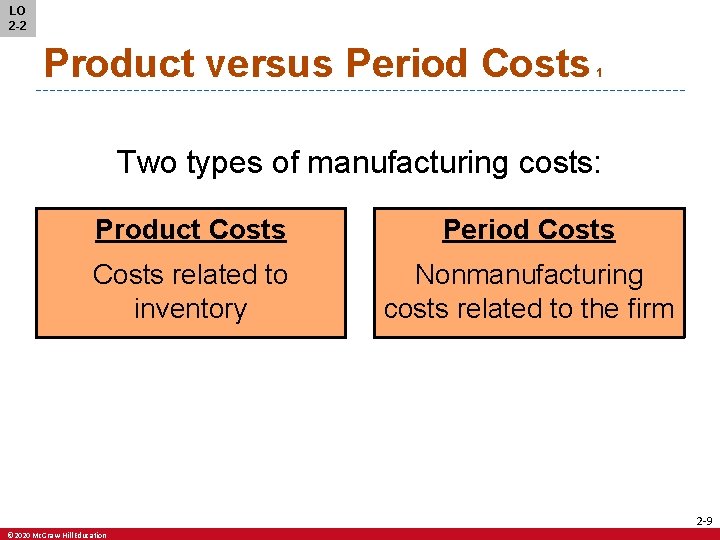
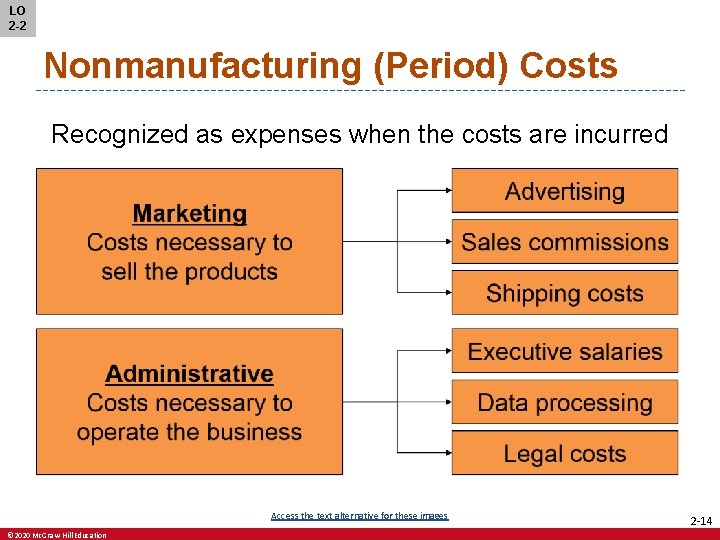
LO 2 -2 Product versus Period Costs 1 Two types of manufacturing costs: Product Costs Period Costs related to inventory Nonmanufacturing costs related to the firm 2 -9 © 2020 Mc. Graw-Hill Education
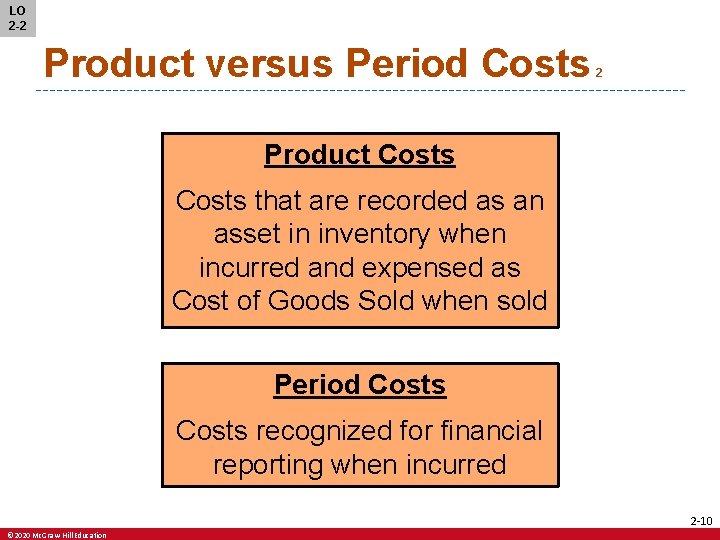
LO 2 -2 Product versus Period Costs 2 Product Costs that are recorded as an asset in inventory when incurred and expensed as Cost of Goods Sold when sold Period Costs recognized for financial reporting when incurred 2 -10 © 2020 Mc. Graw-Hill Education
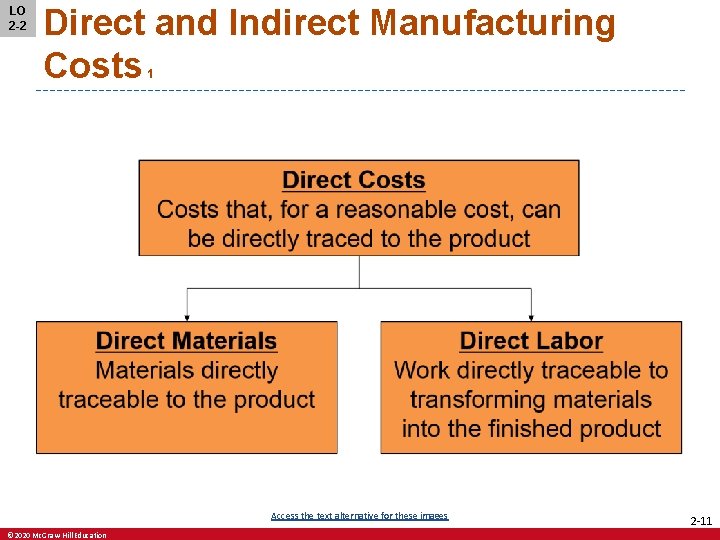
LO 2 -2 Direct and Indirect Manufacturing Costs 1 Access the text alternative for these images © 2020 Mc. Graw-Hill Education 2 -11
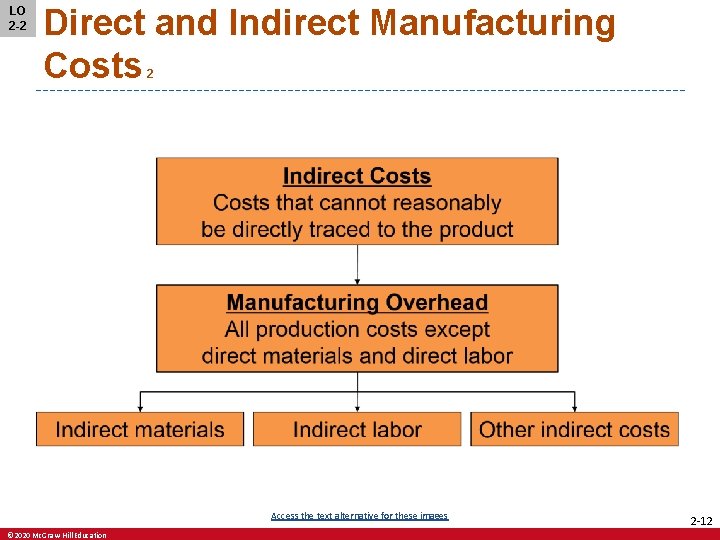
LO 2 -2 Direct and Indirect Manufacturing Costs 2 Access the text alternative for these images © 2020 Mc. Graw-Hill Education 2 -12
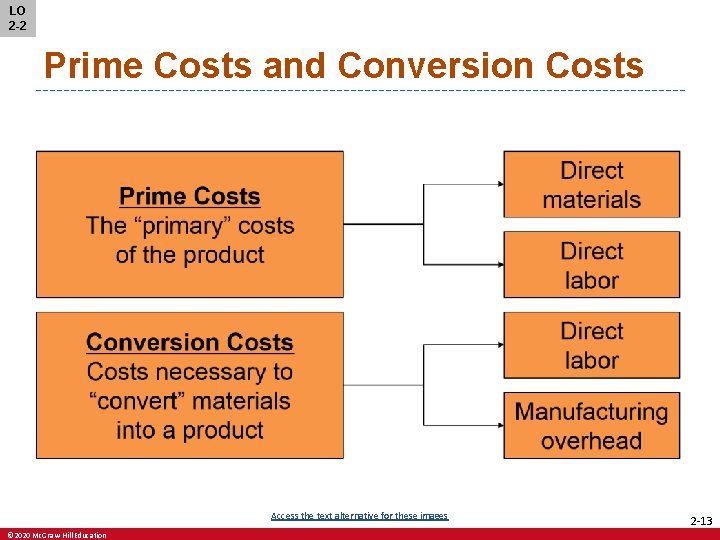
LO 2 -2 Prime Costs and Conversion Costs Access the text alternative for these images © 2020 Mc. Graw-Hill Education 2 -13
LO 2 -2 Nonmanufacturing (Period) Costs Recognized as expenses when the costs are incurred Access the text alternative for these images © 2020 Mc. Graw-Hill Education 2 -14
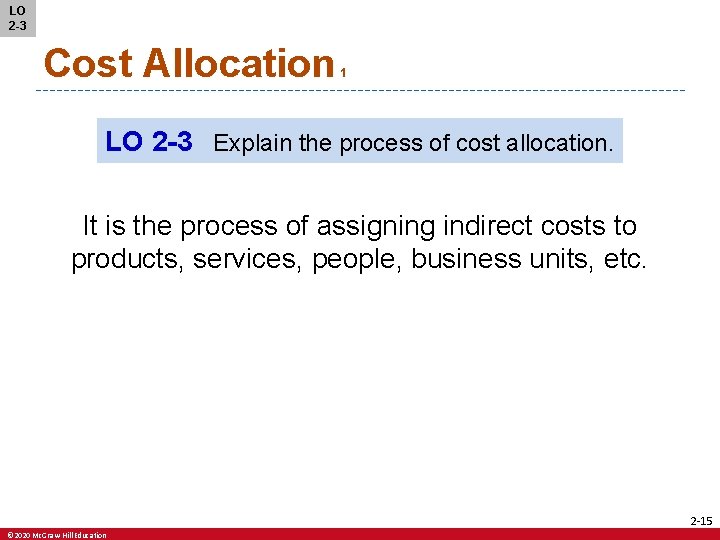
LO 2 -3 Cost Allocation 1 LO 2 -3 Explain the process of cost allocation. It is the process of assigning indirect costs to products, services, people, business units, etc. 2 -15 © 2020 Mc. Graw-Hill Education
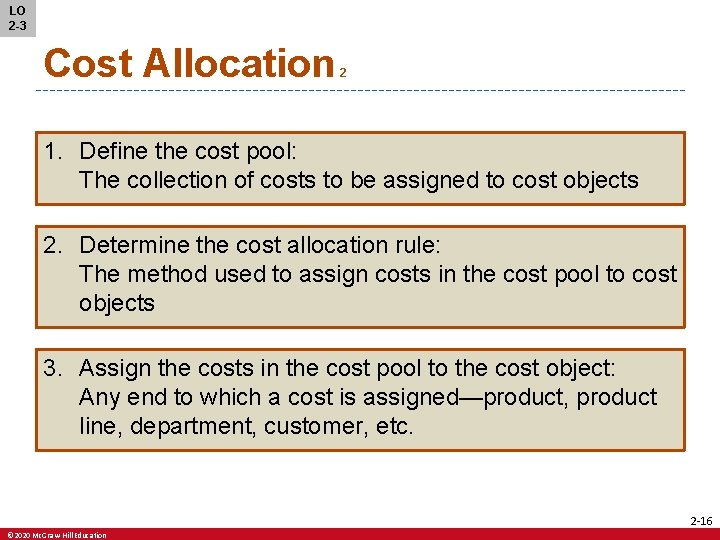
LO 2 -3 Cost Allocation 2 1. Define the cost pool: The collection of costs to be assigned to cost objects 2. Determine the cost allocation rule: The method used to assign costs in the cost pool to cost objects 3. Assign the costs in the cost pool to the cost object: Any end to which a cost is assigned—product, product line, department, customer, etc. 2 -16 © 2020 Mc. Graw-Hill Education
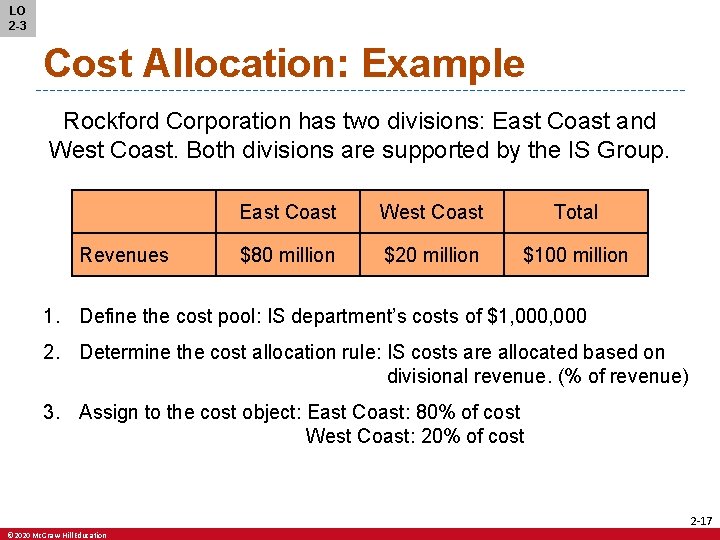
LO 2 -3 Cost Allocation: Example Rockford Corporation has two divisions: East Coast and West Coast. Both divisions are supported by the IS Group. Revenues East Coast West Coast Total $80 million $20 million $100 million 1. Define the cost pool: IS department’s costs of $1, 000 2. Determine the cost allocation rule: IS costs are allocated based on divisional revenue. (% of revenue) 3. Assign to the cost object: East Coast: 80% of cost West Coast: 20% of cost 2 -17 © 2020 Mc. Graw-Hill Education
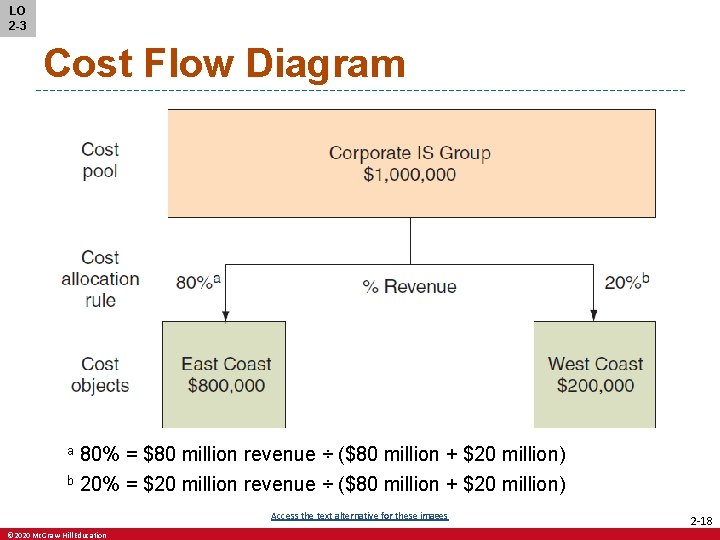
LO 2 -3 Cost Flow Diagram 80% = $80 million revenue ÷ ($80 million + $20 million) b 20% = $20 million revenue ÷ ($80 million + $20 million) a Access the text alternative for these images © 2020 Mc. Graw-Hill Education 2 -18
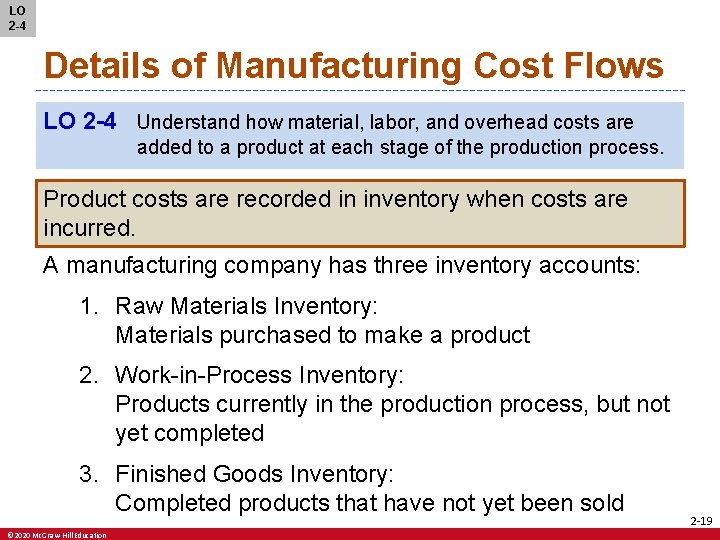
LO 2 -4 Details of Manufacturing Cost Flows LO 2 -4 Understand how material, labor, and overhead costs are added to a product at each stage of the production process. Product costs are recorded in inventory when costs are incurred. A manufacturing company has three inventory accounts: 1. Raw Materials Inventory: Materials purchased to make a product 2. Work-in-Process Inventory: Products currently in the production process, but not yet completed 3. Finished Goods Inventory: Completed products that have not yet been sold © 2020 Mc. Graw-Hill Education 2 -19
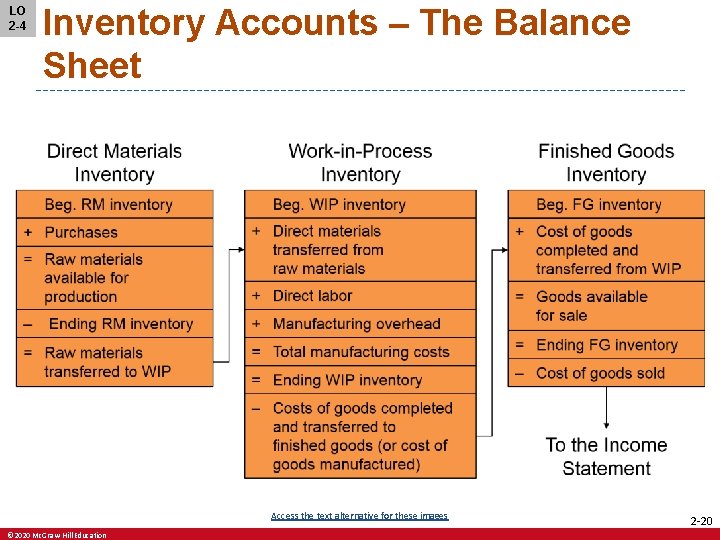
LO 2 -4 Inventory Accounts – The Balance Sheet Access the text alternative for these images © 2020 Mc. Graw-Hill Education 2 -20
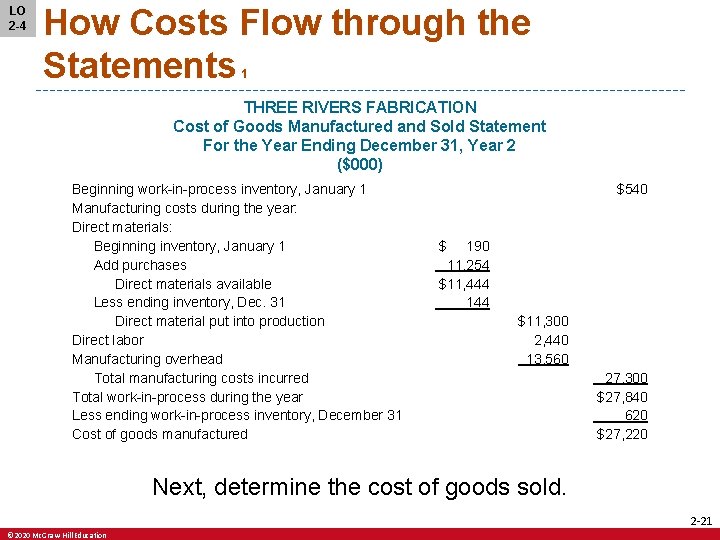
LO 2 -4 How Costs Flow through the Statements 1 THREE RIVERS FABRICATION Cost of Goods Manufactured and Sold Statement For the Year Ending December 31, Year 2 ($000) Beginning work-in-process inventory, January 1 Manufacturing costs during the year: Direct materials: Beginning inventory, January 1 Add purchases Direct materials available Less ending inventory, Dec. 31 Direct material put into production Direct labor Manufacturing overhead Total manufacturing costs incurred Total work-in-process during the year Less ending work-in-process inventory, December 31 Cost of goods manufactured $540 $ 190 11, 254 $11, 444 144 $11, 300 2, 440 13, 560 27, 300 $27, 840 620 $27, 220 Next, determine the cost of goods sold. 2 -21 © 2020 Mc. Graw-Hill Education
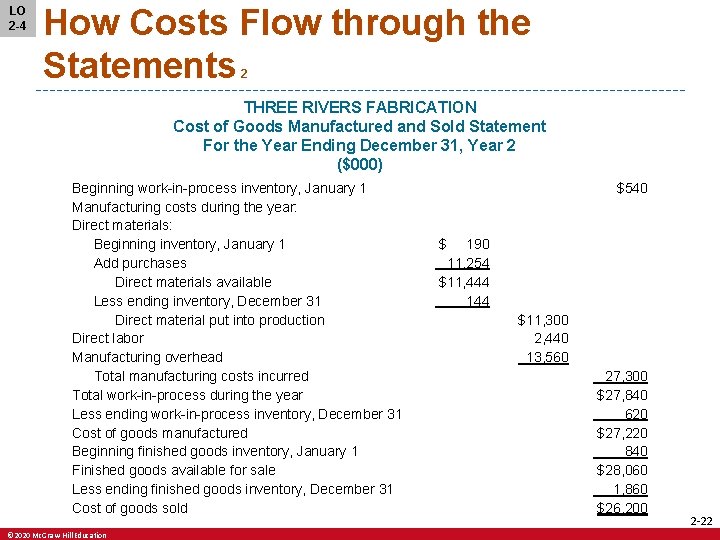
LO 2 -4 How Costs Flow through the Statements 2 THREE RIVERS FABRICATION Cost of Goods Manufactured and Sold Statement For the Year Ending December 31, Year 2 ($000) Beginning work-in-process inventory, January 1 Manufacturing costs during the year: Direct materials: Beginning inventory, January 1 Add purchases Direct materials available Less ending inventory, December 31 Direct material put into production Direct labor Manufacturing overhead Total manufacturing costs incurred Total work-in-process during the year Less ending work-in-process inventory, December 31 Cost of goods manufactured Beginning finished goods inventory, January 1 Finished goods available for sale Less ending finished goods inventory, December 31 Cost of goods sold © 2020 Mc. Graw-Hill Education $540 $ 190 11, 254 $11, 444 144 $11, 300 2, 440 13, 560 27, 300 $27, 840 620 $27, 220 840 $28, 060 1, 860 $26, 200 2 -22
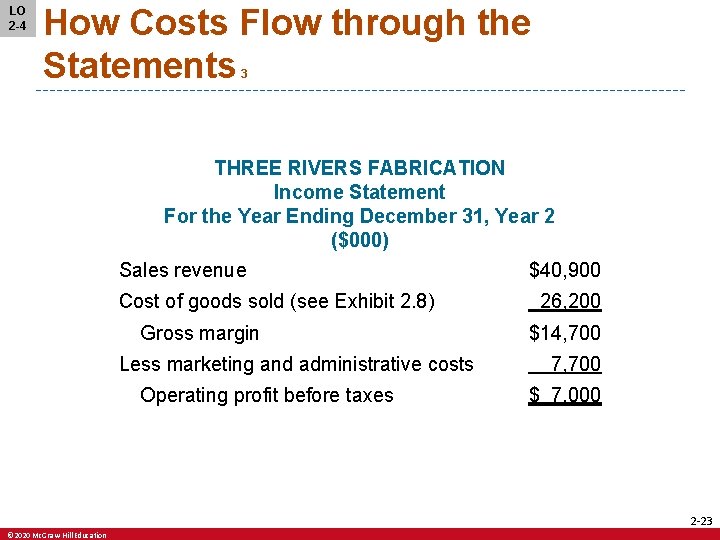
LO 2 -4 How Costs Flow through the Statements 3 THREE RIVERS FABRICATION Income Statement For the Year Ending December 31, Year 2 ($000) Sales revenue Cost of goods sold (see Exhibit 2. 8) Gross margin Less marketing and administrative costs Operating profit before taxes $40, 900 26, 200 $14, 700 7, 700 $ 7, 000 2 -23 © 2020 Mc. Graw-Hill Education
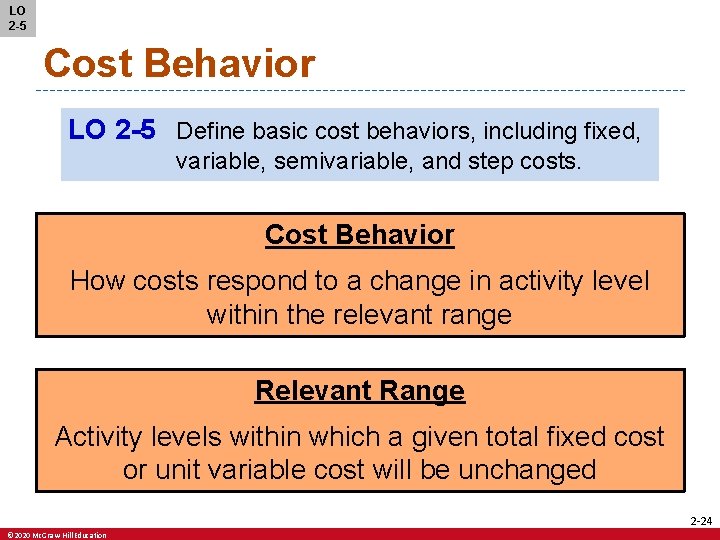
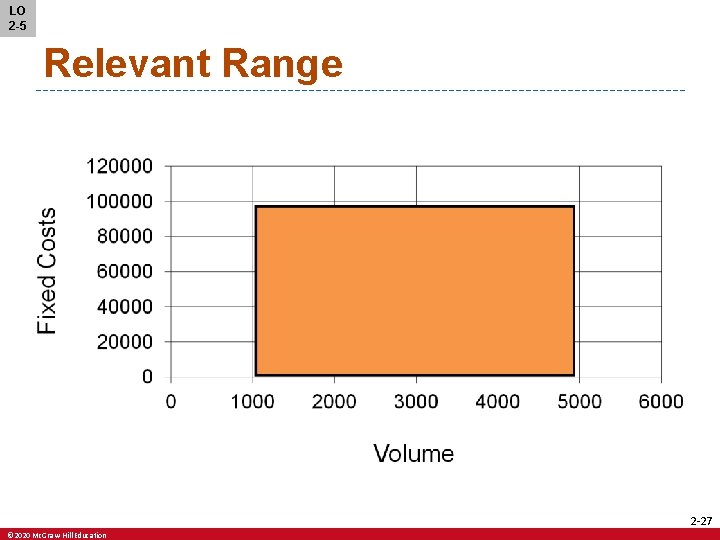
LO 2 -5 Cost Behavior LO 2 -5 Define basic cost behaviors, including fixed, variable, semivariable, and step costs. Cost Behavior How costs respond to a change in activity level within the relevant range Relevant Range Activity levels within which a given total fixed cost or unit variable cost will be unchanged 2 -24 © 2020 Mc. Graw-Hill Education
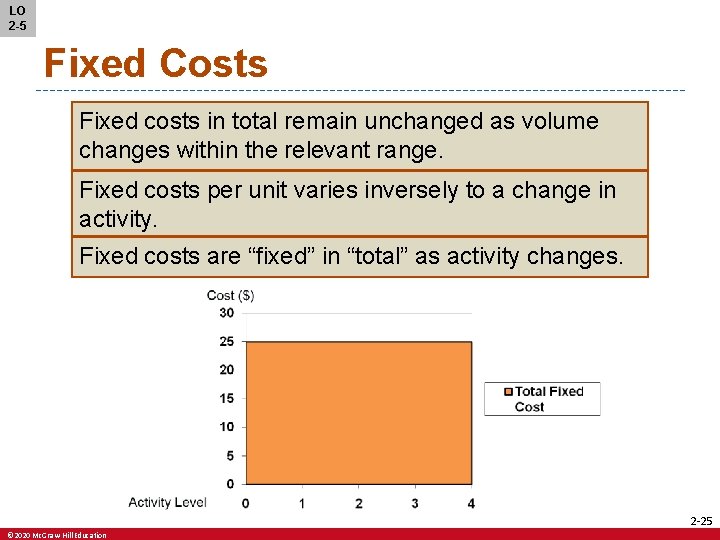
LO 2 -5 Fixed Costs Fixed costs in total remain unchanged as volume changes within the relevant range. Fixed costs per unit varies inversely to a change in activity. Fixed costs are “fixed” in “total” as activity changes. 2 -25 © 2020 Mc. Graw-Hill Education
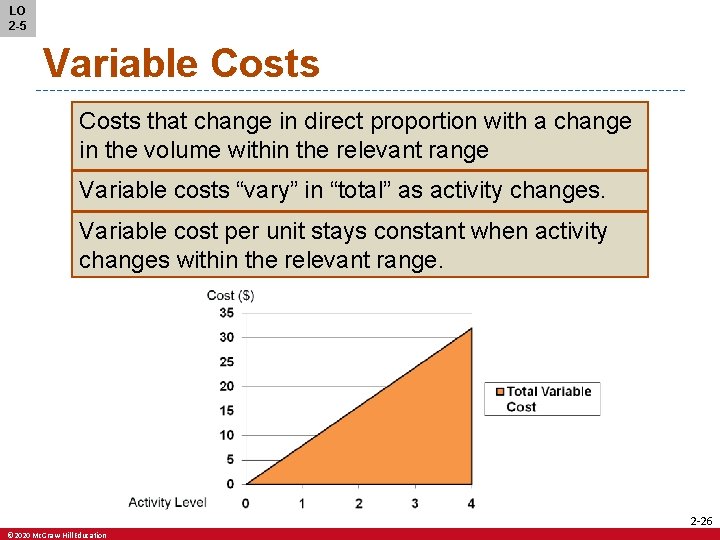
LO 2 -5 Variable Costs that change in direct proportion with a change in the volume within the relevant range Variable costs “vary” in “total” as activity changes. Variable cost per unit stays constant when activity changes within the relevant range. 2 -26 © 2020 Mc. Graw-Hill Education
LO 2 -5 Relevant Range 2 -27 © 2020 Mc. Graw-Hill Education
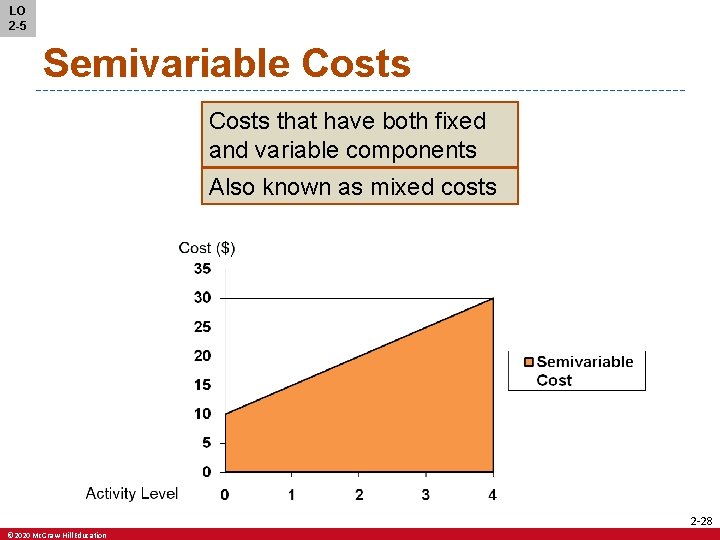
LO 2 -5 Semivariable Costs that have both fixed and variable components Also known as mixed costs 2 -28 © 2020 Mc. Graw-Hill Education
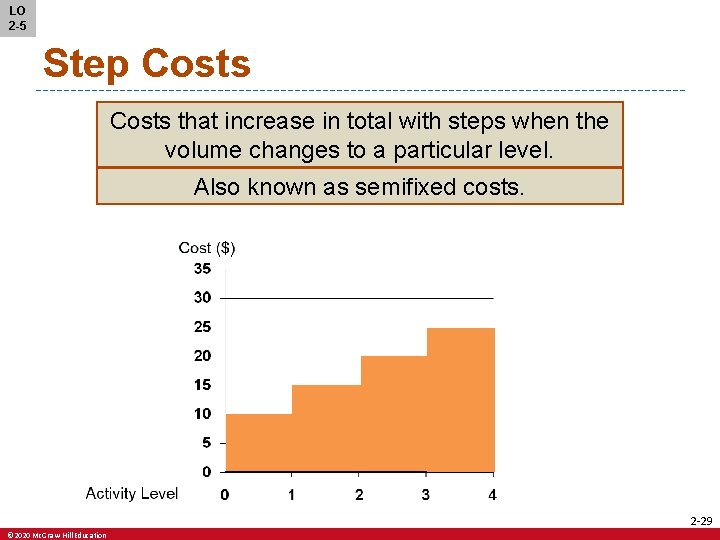
LO 2 -5 Step Costs that increase in total with steps when the volume changes to a particular level. Also known as semifixed costs. 2 -29 © 2020 Mc. Graw-Hill Education
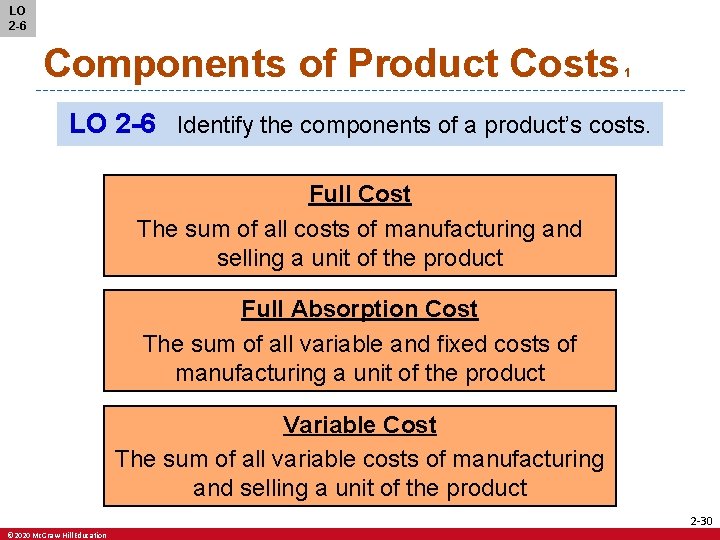
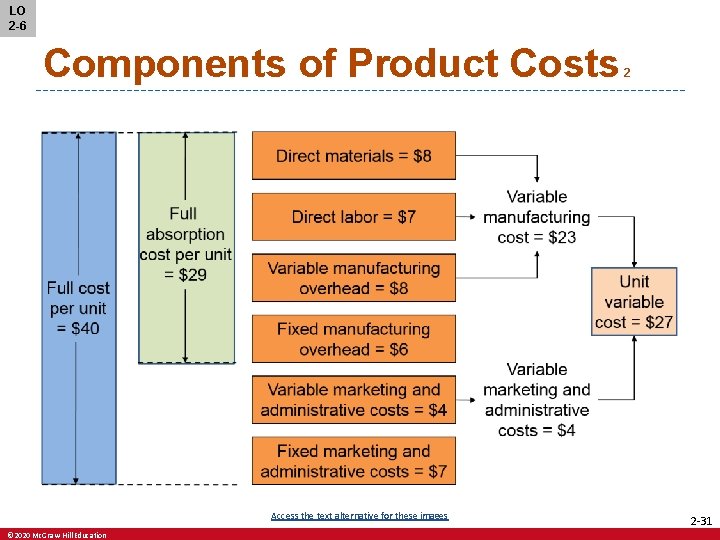
LO 2 -6 Components of Product Costs 1 LO 2 -6 Identify the components of a product’s costs. Full Cost The sum of all costs of manufacturing and selling a unit of the product Full Absorption Cost The sum of all variable and fixed costs of manufacturing a unit of the product Variable Cost The sum of all variable costs of manufacturing and selling a unit of the product 2 -30 © 2020 Mc. Graw-Hill Education
LO 2 -6 Components of Product Costs Access the text alternative for these images © 2020 Mc. Graw-Hill Education 2 2 -31
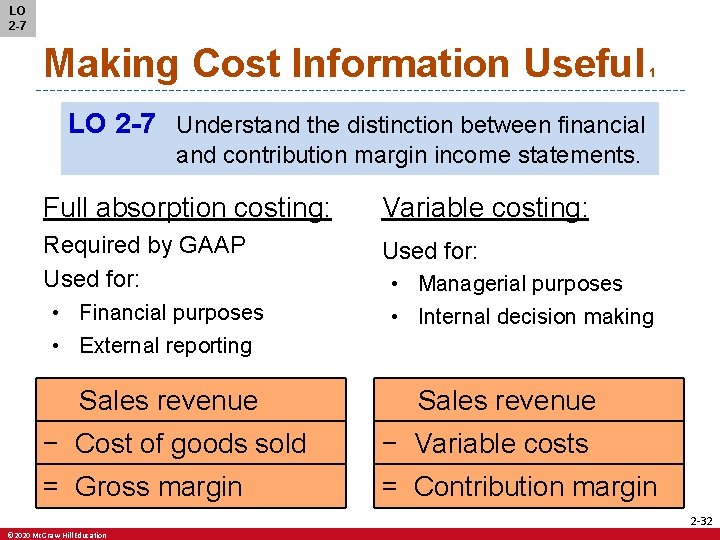
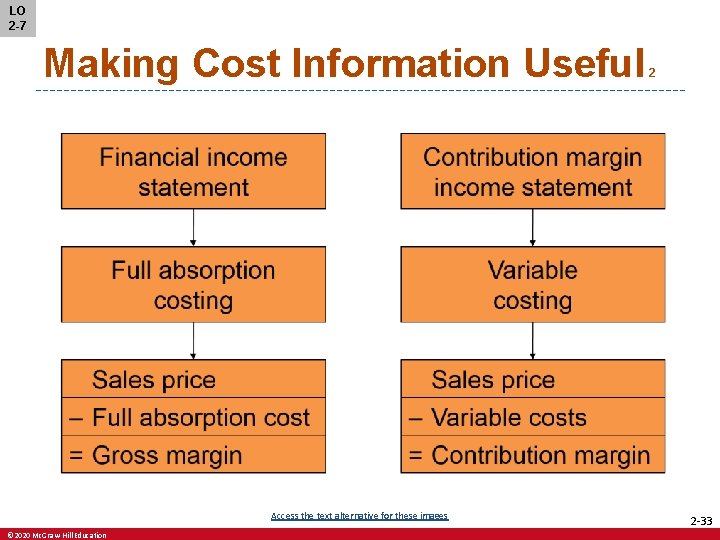
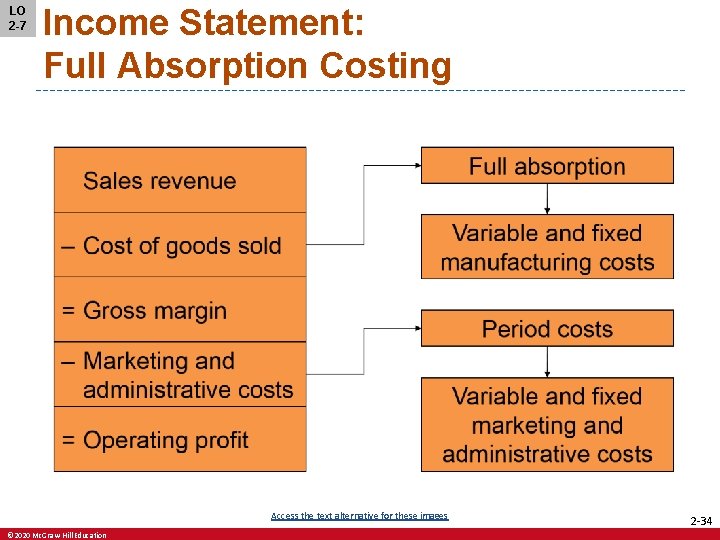
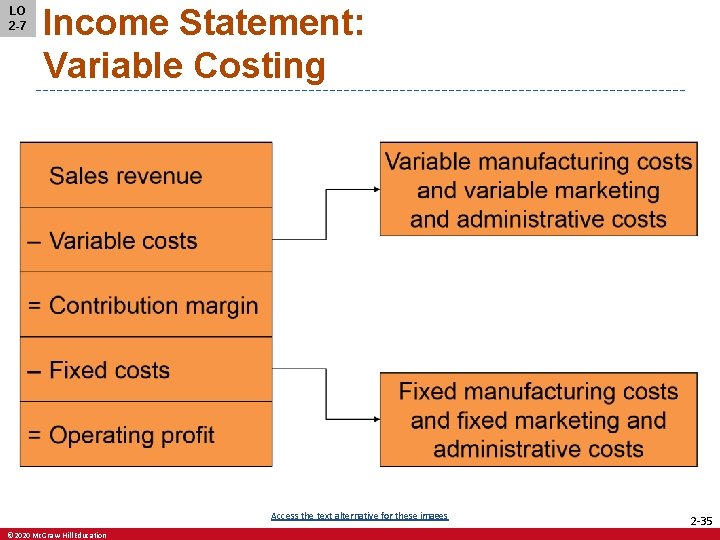
LO 2 -7 Making Cost Information Useful 1 LO 2 -7 Understand the distinction between financial and contribution margin income statements. Full absorption costing: Variable costing: Required by GAAP Used for: • Financial purposes • External reporting Sales revenue • Managerial purposes • Internal decision making Sales revenue − Cost of goods sold − Variable costs = Gross margin = Contribution margin 2 -32 © 2020 Mc. Graw-Hill Education
LO 2 -7 Making Cost Information Useful Access the text alternative for these images © 2020 Mc. Graw-Hill Education 2 2 -33
LO 2 -7 Income Statement: Full Absorption Costing Access the text alternative for these images © 2020 Mc. Graw-Hill Education 2 -34
LO 2 -7 Income Statement: Variable Costing Access the text alternative for these images © 2020 Mc. Graw-Hill Education 2 -35
End of Chapter 2 2 -36 © 2020 Mc. Graw-Hill Education