
Fundamentals of Cost Accounting Prepared By Miss Akshada
Fundamentals of Cost Accounting Prepared By Miss. Akshada Zurale (Assistant Professor) 1
Learning Objectives Ø Define and understand the meaning of Basic Cost Concepts Ø Illustrate the Prime Cost & Overheads Ø Understand Cost Allocation, Apportionment and Absorption of Overheads
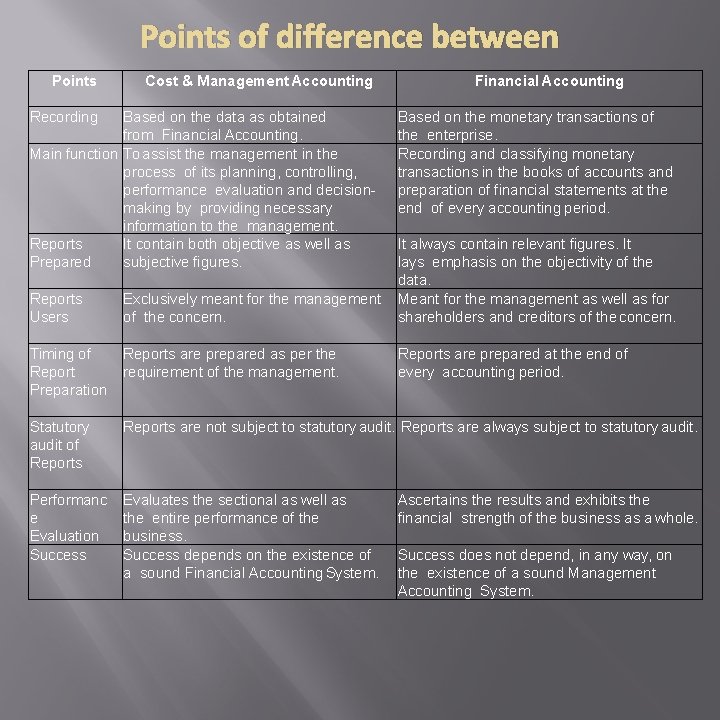
Points of difference between Points Cost & Management Accounting Recording Based on the data as obtained from Financial Accounting. Main function To assist the management in the process of its planning, controlling, performance evaluation and decisionmaking by providing necessary information to the management. Reports It contain both objective as well as Prepared subjective figures. Financial Accounting Based on the monetary transactions of the enterprise. Recording and classifying monetary transactions in the books of accounts and preparation of financial statements at the end of every accounting period. Reports Users Exclusively meant for the management of the concern. It always contain relevant figures. It lays emphasis on the objectivity of the data. Meant for the management as well as for shareholders and creditors of the concern. Timing of Report Preparation Reports are prepared as per the requirement of the management. Reports are prepared at the end of every accounting period. Statutory audit of Reports are not subject to statutory audit. Reports are always subject to statutory audit. Performanc e Evaluation Success Evaluates the sectional as well as the entire performance of the business. Success depends on the existence of a sound Financial Accounting System. Ascertains the results and exhibits the financial strength of the business as a whole. Success does not depend, in any way, on the existence of a sound Management Accounting System.
We are going to learn… Cost Accounting concepts, Cost Allocation, Apportionment and Absorption of Overheads
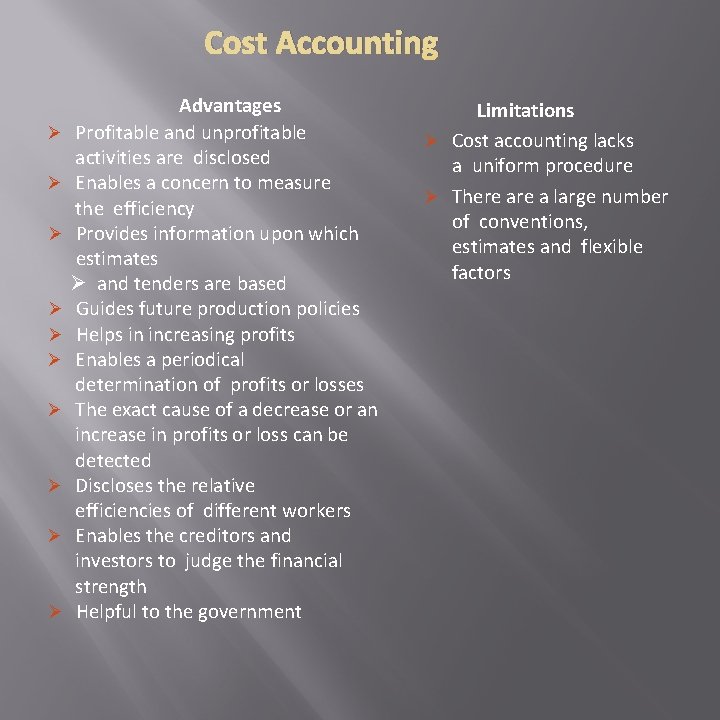
Cost Accounting Ø Ø Ø Ø Ø Advantages Profitable and unprofitable activities are disclosed Enables a concern to measure the efficiency Provides information upon which estimates Ø and tenders are based Guides future production policies Helps in increasing profits Enables a periodical determination of profits or losses The exact cause of a decrease or an increase in profits or loss can be detected Discloses the relative efficiencies of different workers Enables the creditors and investors to judge the financial strength Helpful to the government Limitations Ø Cost accounting lacks a uniform procedure Ø There a large number of conventions, estimates and flexible factors
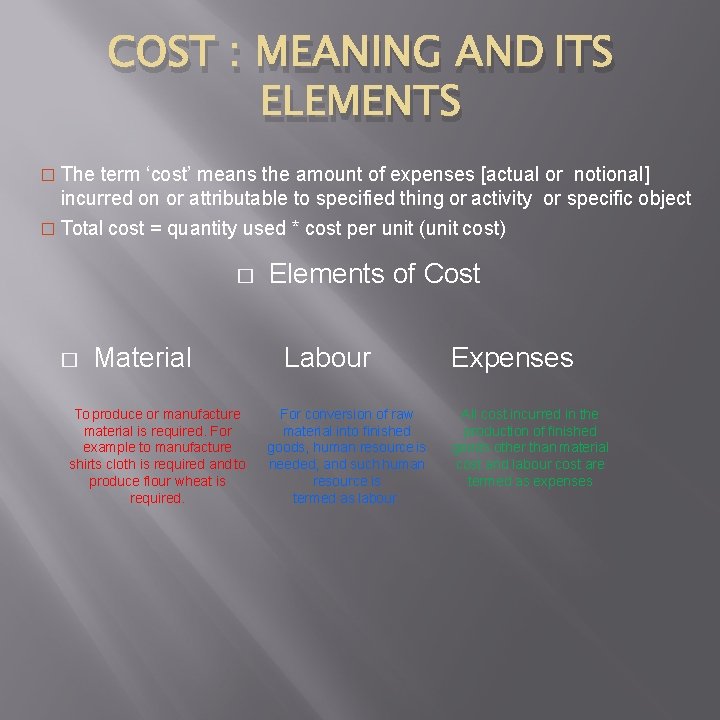
COST : MEANING AND ITS ELEMENTS � The term ‘cost’ means the amount of expenses [actual or notional] incurred on or attributable to specified thing or activity or specific object � Total cost = quantity used * cost per unit (unit cost) � � Material To produce or manufacture material is required. For example to manufacture shirts cloth is required and to produce flour wheat is required. Elements of Cost Labour For conversion of raw material into finished goods, human resource is needed, and such human resource is termed as labour. Expenses All cost incurred in the production of finished goods other than material cost and labour cost are termed as expenses

Elements of Cost Direct Material Indirect Material Ø Direct material is the material which can Ø Like direct material, another kind of material may be required for manufacturing but not directly. Ø Ø Indirect Material Ø Ø Ø be conveniently identified with or allocated to cost centers and cost units. It refers to the material out of which a Ø product is manufactured. Example: Ø Leather shoes are produced out of leather Ø Butter is produced out of milk Ø Steel utensils are produced out of stainless steel. Ø Timber is a raw for material furniture Ø Cloth for making garmentsmaking Ø Sugarcane for making sugar Ø Gold/ silver for making jewellery Direct material is a component of prime cost Direct material directly varies with the Ø Ø is that material be easily and which cannot conveniently identified and related with a particular product, job, process, and activity Example Ø Machines used for production require lubricants, jute and cotton Ø Consumable stores, oil and waste, printing and stationery Indirect material is a component of factory overhead. Indirect material does not varies Ø with the output.
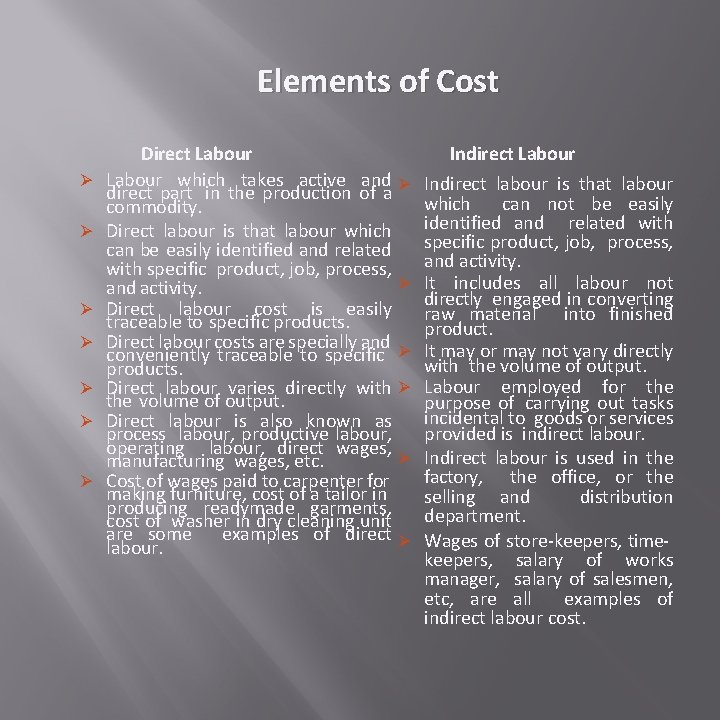
Elements of Cost Ø Ø Ø Ø Direct Labour which takes active and Ø direct part in the production of a commodity. Direct labour is that labour which can be easily identified and related with specific product, job, process, Ø and activity. Direct labour cost is easily traceable to specific products. Direct labour costs are specially and Ø conveniently traceable to specific products. Direct labour varies directly with Ø the volume of output. Direct labour is also known as process labour, productive labour, operating labour, direct wages, Ø manufacturing wages, etc. Cost of wages paid to carpenter for making furniture, cost of a tailor in producing readymade garments, cost of washer in dry cleaning unit are some examples of direct Ø labour. Indirect Labour Indirect labour is that labour which can not be easily identified and related with specific product, job, process, and activity. It includes all labour not directly engaged in converting raw material into finished product. It may or may not vary directly with the volume of output. Labour employed for the purpose of carrying out tasks incidental to goods or services provided is indirect labour. Indirect labour is used in the factory, the office, or the selling and distribution department. Wages of store-keepers, timekeepers, salary of works manager, salary of salesmen, etc, are all examples of indirect labour cost.
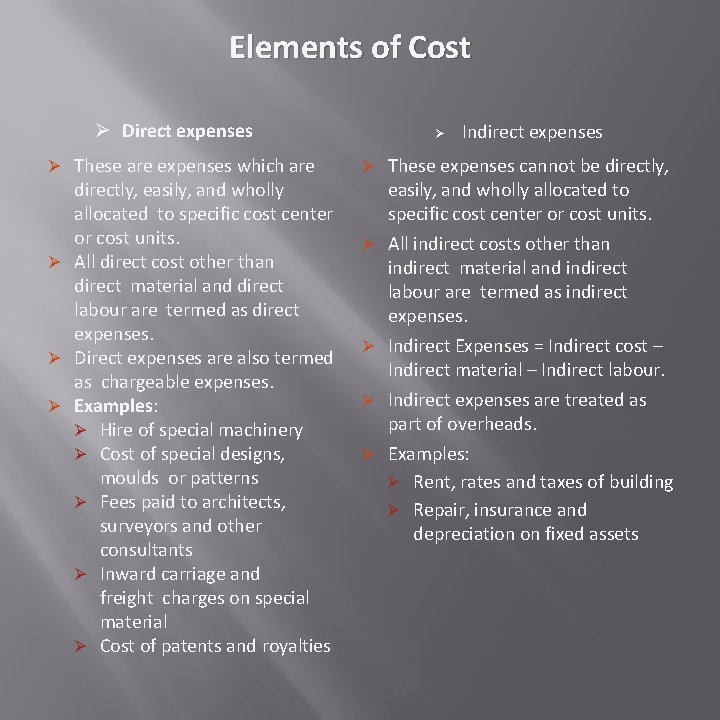
Elements of Cost Ø Direct expenses Ø These are expenses which are directly, easily, and wholly allocated to specific cost center or cost units. Ø All direct cost other than direct material and direct labour are termed as direct expenses. Ø Direct expenses are also termed as chargeable expenses. Ø Examples: Ø Hire of special machinery Ø Cost of special designs, moulds or patterns Ø Fees paid to architects, surveyors and other consultants Ø Inward carriage and freight charges on special material Ø Cost of patents and royalties Ø Indirect expenses Ø These expenses cannot be directly, Ø Ø easily, and wholly allocated to specific cost center or cost units. All indirect costs other than indirect material and indirect labour are termed as indirect expenses. Indirect Expenses = Indirect cost – Indirect material – Indirect labour. Indirect expenses are treated as part of overheads. Examples: Ø Rent, rates and taxes of building Ø Repair, insurance and depreciation on fixed assets
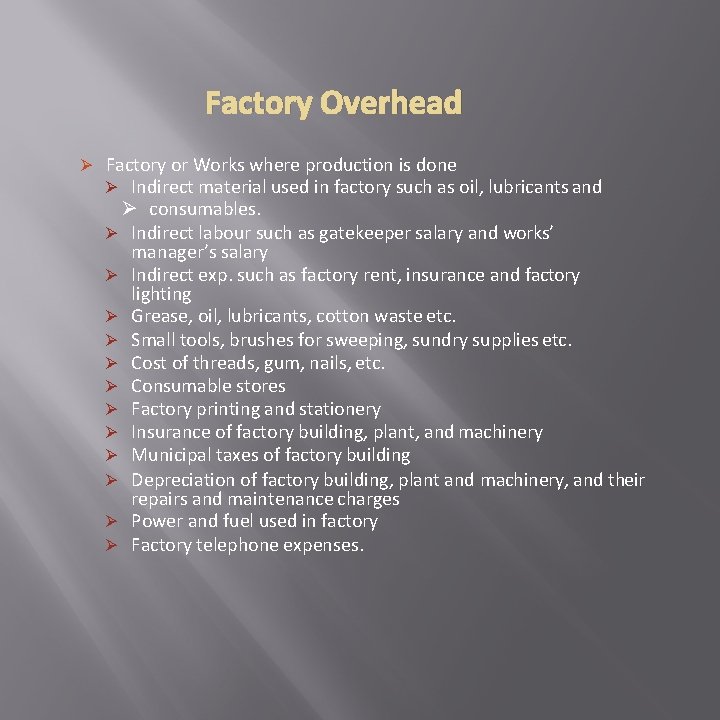
Factory Overhead Ø Factory or Works where production is done Ø Indirect material used in factory such as oil, lubricants and Ø consumables. Ø Indirect labour such as gatekeeper salary and works’ manager’s salary Ø Indirect exp. such as factory rent, insurance and factory lighting Ø Grease, oil, lubricants, cotton waste etc. Ø Small tools, brushes for sweeping, sundry supplies etc. Ø Cost of threads, gum, nails, etc. Ø Consumable stores Ø Factory printing and stationery Ø Insurance of factory building, plant, and machinery Ø Municipal taxes of factory building Ø Depreciation of factory building, plant and machinery, and their repairs and maintenance charges Ø Power and fuel used in factory Ø Factory telephone expenses.
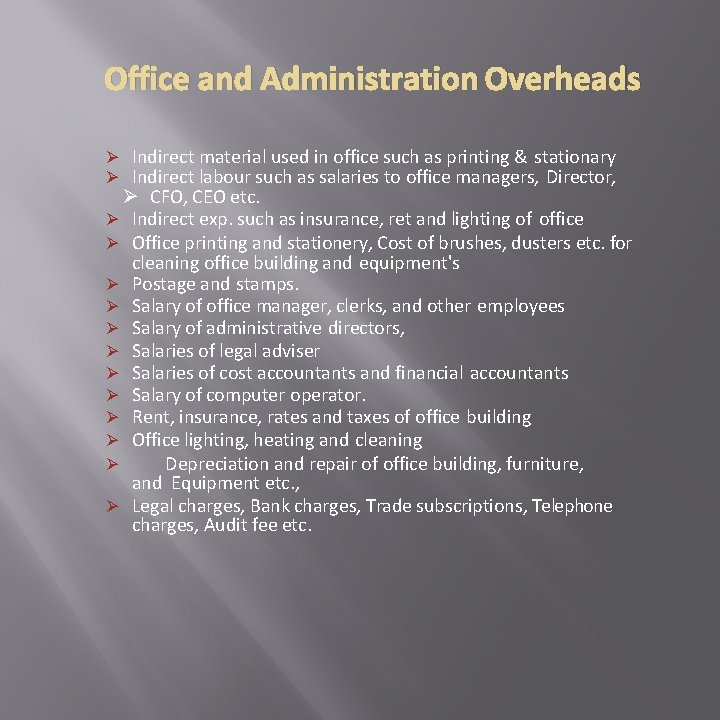
Office and Administration Overheads Ø Indirect material used in office such as printing & stationary Ø Indirect labour such as salaries to office managers, Director, Ø CFO, CEO etc. Ø Indirect exp. such as insurance, ret and lighting of office Ø Office printing and stationery, Cost of brushes, dusters etc. for cleaning office building and equipment's Ø Postage and stamps. Ø Salary of office manager, clerks, and other employees Ø Salary of administrative directors, Ø Salaries of legal adviser Ø Salaries of cost accountants and financial accountants Ø Salary of computer operator. Ø Rent, insurance, rates and taxes of office building Ø Office lighting, heating and cleaning Ø Depreciation and repair of office building, furniture, and Equipment etc. , Ø Legal charges, Bank charges, Trade subscriptions, Telephone charges, Audit fee etc.
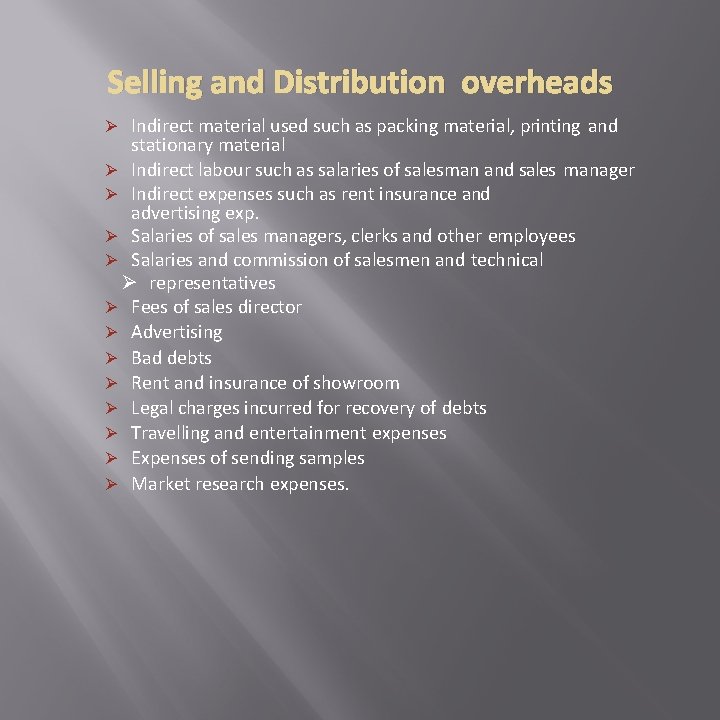
Selling and Distribution overheads Ø Indirect material used such as packing material, printing and stationary material Ø Indirect labour such as salaries of salesman and sales manager Ø Indirect expenses such as rent insurance and advertising exp. Ø Salaries of sales managers, clerks and other employees Ø Salaries and commission of salesmen and technical Ø representatives Ø Fees of sales director Ø Advertising Ø Bad debts Ø Rent and insurance of showroom Ø Legal charges incurred for recovery of debts Ø Travelling and entertainment expenses Ø Expenses of sending samples Ø Market research expenses.
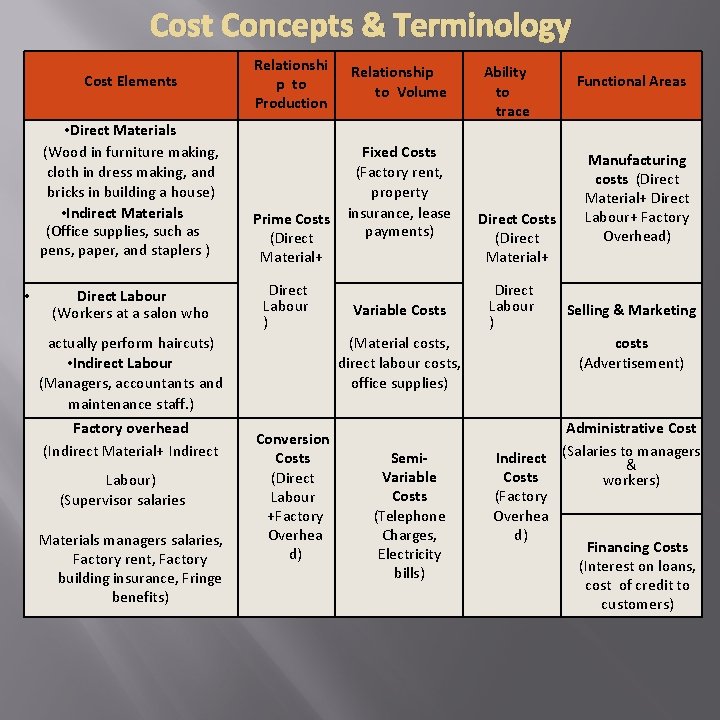
Cost Concepts & Terminology Cost Elements • Direct Materials (Wood in furniture making, cloth in dress making, and bricks in building a house) • Indirect Materials (Office supplies, such as pens, paper, and staplers ) • Direct Labour (Workers at a salon who Relationshi p to Production Prime Costs (Direct Material+ Direct Labour ) actually perform haircuts) • Indirect Labour (Managers, accountants and maintenance staff. ) Factory overhead (Indirect Material+ Indirect Labour) (Supervisor salaries Materials managers salaries, Factory rent, Factory building insurance, Fringe benefits) Relationship to Volume Fixed Costs (Factory rent, property insurance, lease payments) Variable Costs Ability to trace Direct Costs (Direct Material+ Direct Labour ) (Material costs, direct labour costs, office supplies) Conversion Costs (Direct Labour +Factory Overhea d) Semi. Variable Costs (Telephone Charges, Electricity bills) Functional Areas Manufacturing costs (Direct Material+ Direct Labour+ Factory Overhead) Selling & Marketing costs (Advertisement) Indirect Costs (Factory Overhea d) Administrative Cost (Salaries to managers & workers) Financing Costs (Interest on loans, cost of credit to customers)
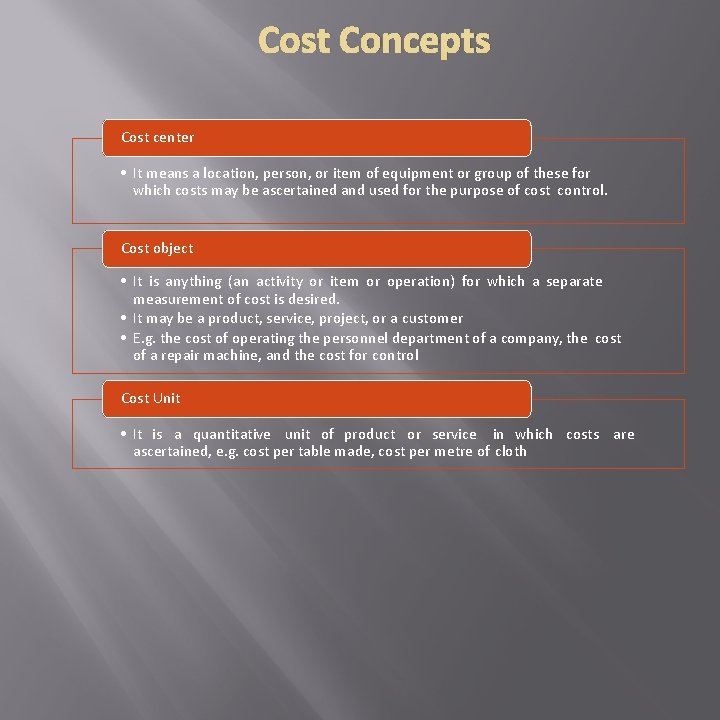
Cost Concepts Cost center 14 • It means a location, person, or item of equipment or group of these for which costs may be ascertained and used for the purpose of cost control. Cost object • It is anything (an activity or item or operation) for which a separate measurement of cost is desired. • It may be a product, service, project, or a customer • E. g. the cost of operating the personnel department of a company, the cost of a repair machine, and the cost for control Cost Unit • It is a quantitative unit of product or service in which costs are ascertained, e. g. cost per table made, cost per metre of cloth

Examples of Cost Unit Industry / Product Cost Unit Automobile Number of vehicles Cable Metres / kilometres Cement Tonne Chemicals / Fertilizers Litre / Kilogram / tonne Gas Cubic Metre Power - Electricity Kilowatt Hour Transport Tonne-Kilometre, Passenger- Kilometre Hospital Patient Day Hotel Bed Night Education Student year Telecom Number of Calls BPO Service Accounts handled Professional Service Chargeable Hours
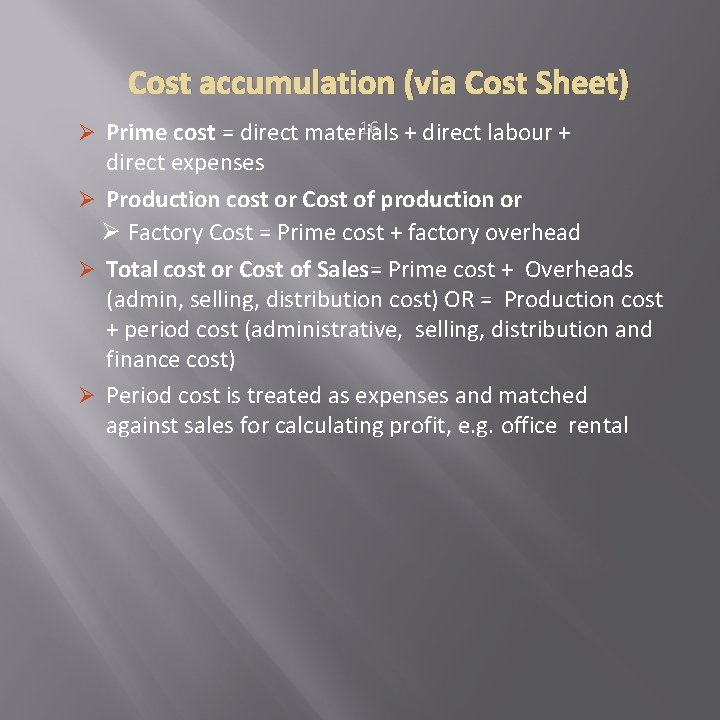
Cost accumulation (via Cost Sheet) 16 + direct labour + Ø Prime cost = direct materials direct expenses Ø Production cost or Cost of production or Ø Factory Cost = Prime cost + factory overhead Ø Total cost or Cost of Sales= Prime cost + Overheads (admin, selling, distribution cost) OR = Production cost + period cost (administrative, selling, distribution and finance cost) Ø Period cost is treated as expenses and matched against sales for calculating profit, e. g. office rental
Cost Sheet Ø Costs sheet is a document which provides for the assembly of the estimated detailed cost in respect of a cost centre or a cost unit. Ø It analyses and classifies in a tabular form, the expenses incurred on different items for a particular period.
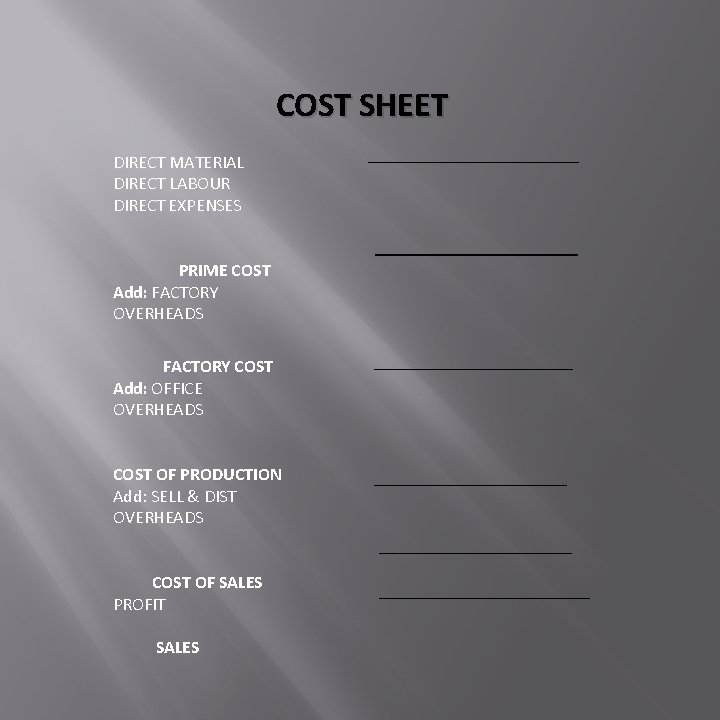
COST SHEET DIRECT MATERIAL DIRECT LABOUR DIRECT EXPENSES PRIME COST Add: FACTORY OVERHEADS FACTORY COST Add: OFFICE OVERHEADS COST OF PRODUCTION Add: SELL & DIST OVERHEADS COST OF SALES PROFIT SALES
Costing Methods
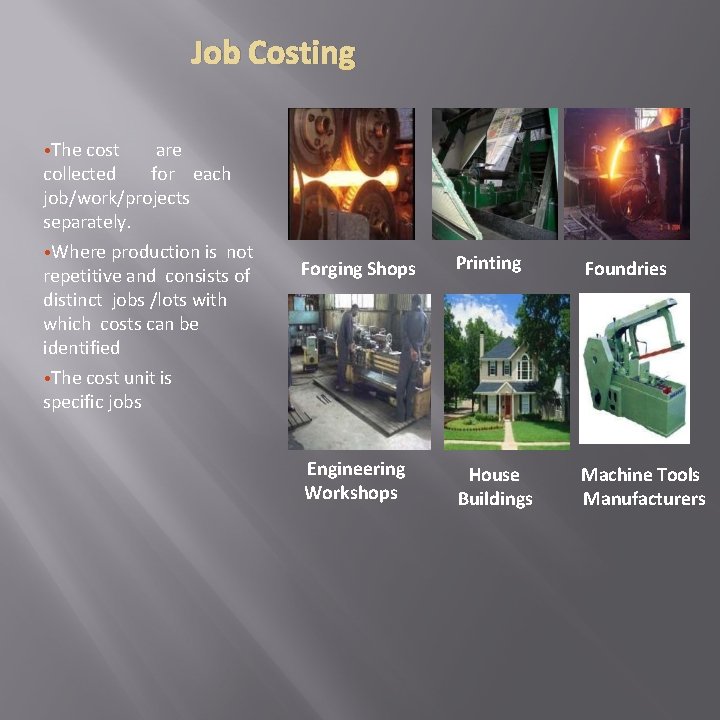
Job Costing • The cost are collected for each job/work/projects separately. • Where production is not repetitive and consists of distinct jobs /lots with which costs can be identified 20 Forging Shops Printing Foundries Engineering Workshops House Buildings Machine Tools Manufacturers • The cost unit is specific jobs
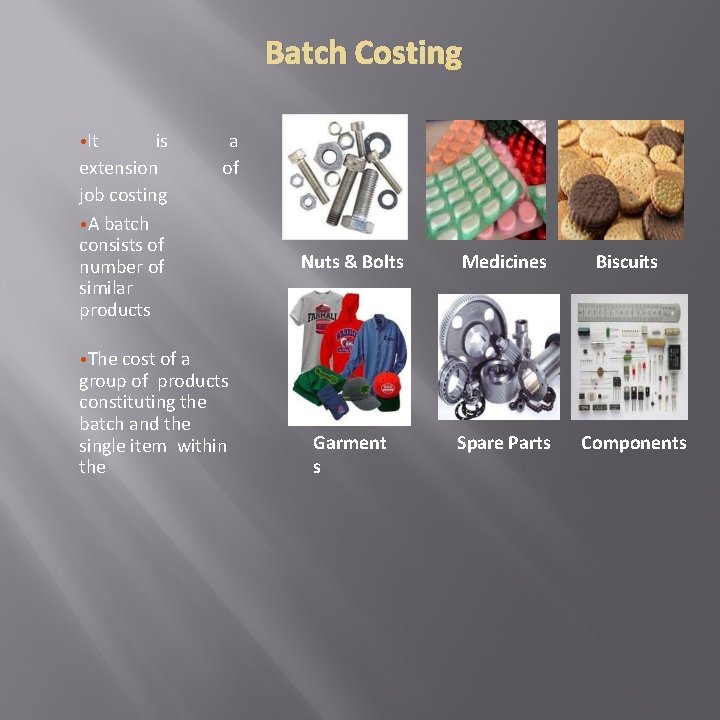
Batch Costing • It is extension job costing • A batch consists of number of similar products a of Nuts & Bolts Medicines Garment s Spare Parts Biscuits • The cost of a group of products constituting the batch and the single item within the Components
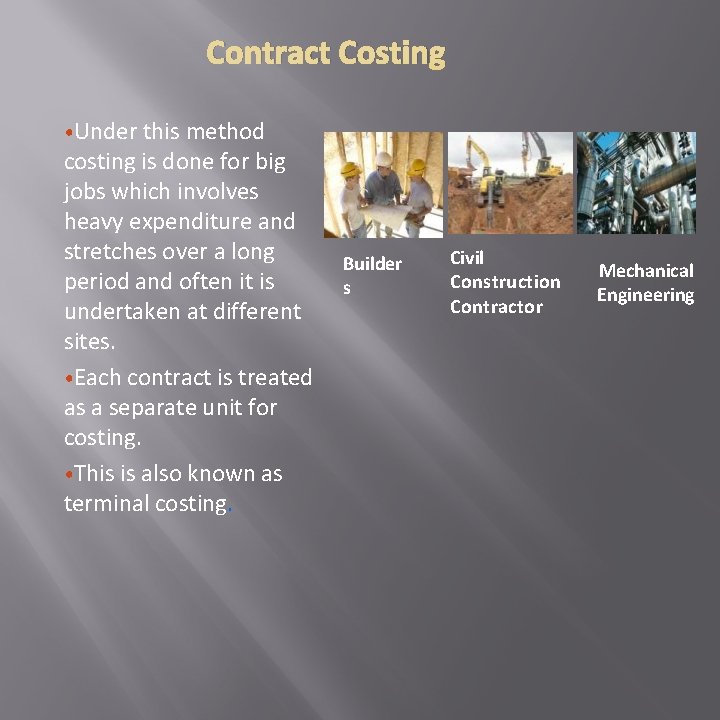
Contract Costing • Under this method costing is done for big jobs which involves heavy expenditure and stretches over a long period and often it is undertaken at different sites. • Each contract is treated as a separate unit for costing. • This is also known as terminal costing. Builder s Civil Construction Contractor Mechanical Engineering
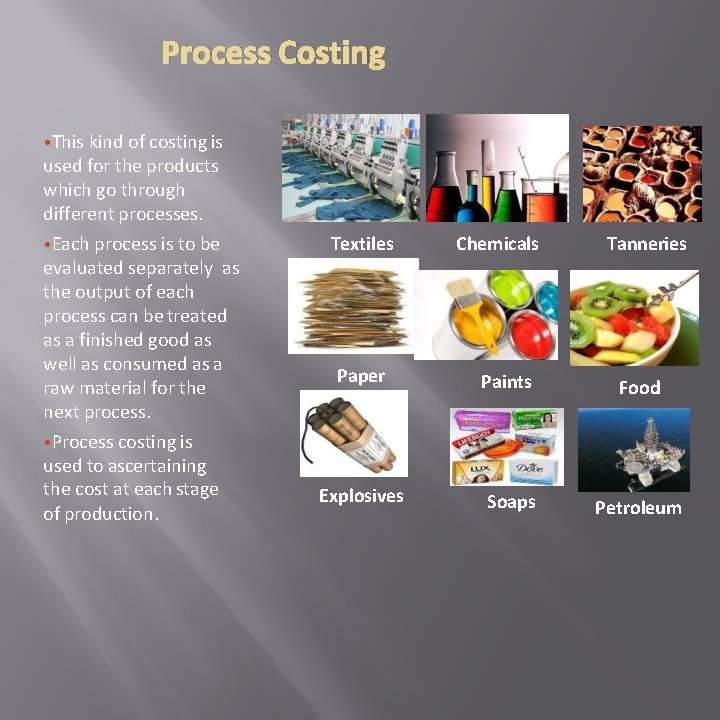
Process Costing • This kind of costing is used for the products which go through different processes. • Each process is to be evaluated separately as the output of each process can be treated as a finished good as well as consumed as a raw material for the next process. Textiles Chemicals Tanneries Paper Paints Food Explosives Soaps Petroleum • Process costing is used to ascertaining the cost at each stage of production.
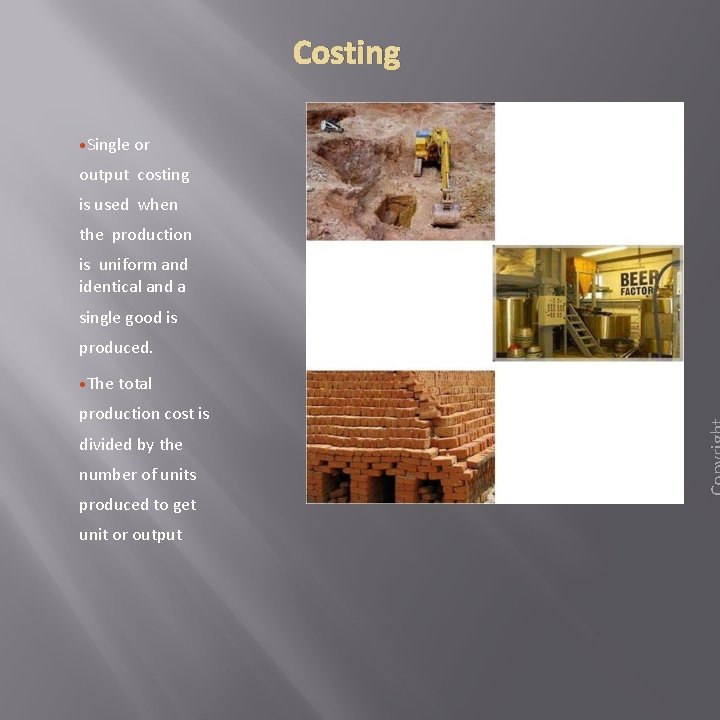
Costing • Single or output costing Mining is used when the production is uniform and identical and a single good is Breweries produced. • The total production cost is divided by the number of units produced to get unit or output Brick Making
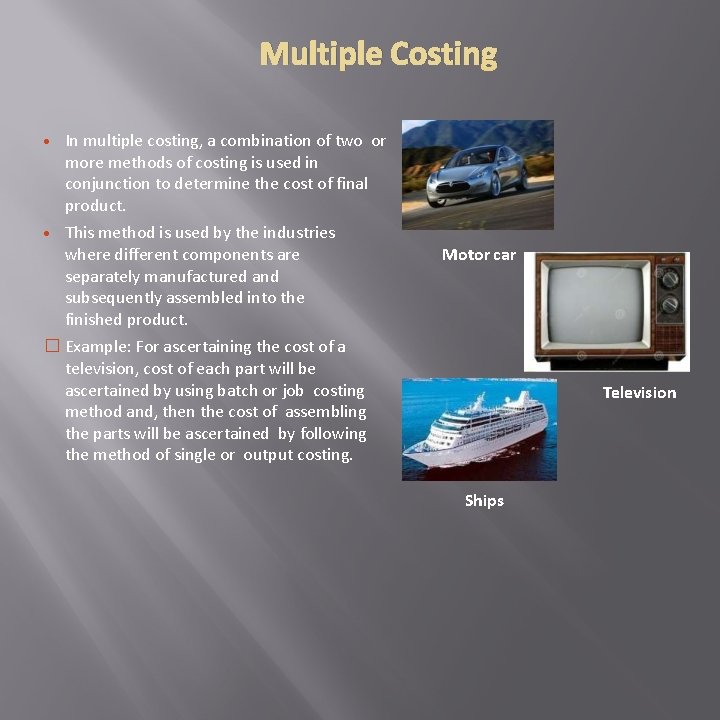
Multiple Costing • In multiple costing, a combination of two or more methods of costing is used in conjunction to determine the cost of final product. • This method is used by the industries where different components are separately manufactured and subsequently assembled into the finished product. Motor car � Example: For ascertaining the cost of a television, cost of each part will be ascertained by using batch or job costing method and, then the cost of assembling the parts will be ascertained by following the method of single or output costing. Television Ships
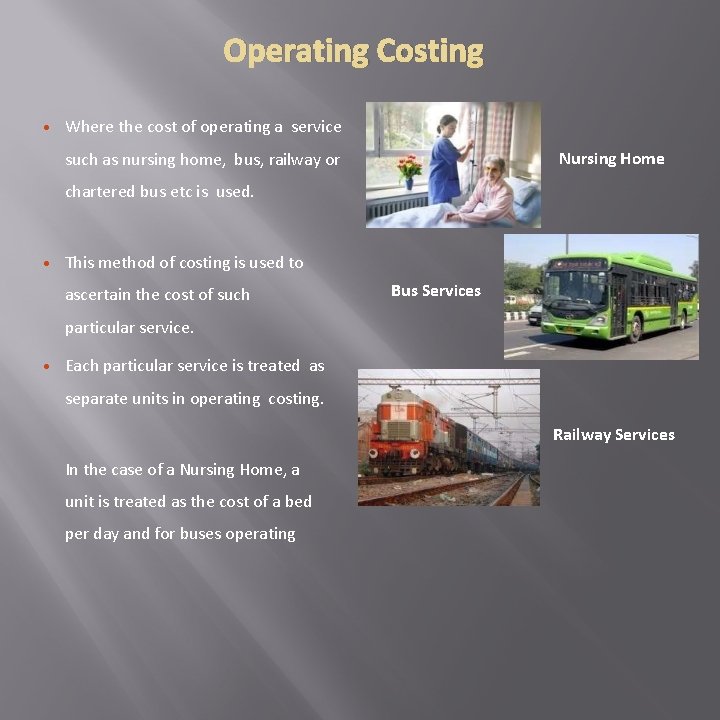
Operating Costing • Where the cost of operating a service Nursing Home such as nursing home, bus, railway or chartered bus etc is used. • This method of costing is used to ascertain the cost of such Bus Services particular service. • Each particular service is treated as separate units in operating costing. Railway Services In the case of a Nursing Home, a unit is treated as the cost of a bed per day and for buses operating
27 Costing Techniques
Uniform Costing 28 of costing. • This is not a separate method This is a system of using the same method of costing by a number of firms in the same industry. • It is treated as a common system of using agreed principles and standard accounting practices in the identical firms or industry. • This helps in fixation of price of the product and interfirm comparisons. •
Marginal Costing 29 Ø It is a technique of ascertaining cost used in any method of costing. Ø It arises due to change in volume of production, Ø i. e. variable cost only. Ø According to this technique, variable costs are charged to cost units and the fixed cost attributable to the relevant period is written off in full against the contribution for that period. Ø This technique is employed to ascertain the effect of change in volume/product mix and so on profit.
Absorption Costing Ø It charges all costs associated with 30 manufacturing a particular product, all variable as well as all fixed to operations/products/ processes. Ø It uses the total direct costs and overhead costs associated with manufacturing a product as the cost base. Ø Generally accepted accounting principles (GAAP) require absorption costing for external reporting.
Historical Costing 31 in which costs Ø It is system of costing are determined after they have been incurred. Ø It ascertains actual costs incurred in the past.
Standard Costing Ø Rather than assigning the actual costs of direct material, direct labor, and manufacturing overhead to a product, many manufacturers assign the expected or standard cost. Ø This means that a manufacturer's inventories and cost of goods sold will begin with amounts reflecting the standard costs, not the actual costs, of a product. Ø Manufacturers, of course, still have to pay the actual costs. Ø As a result there almost always differences between the actual costs and the standard costs, and those differences are known as variances.
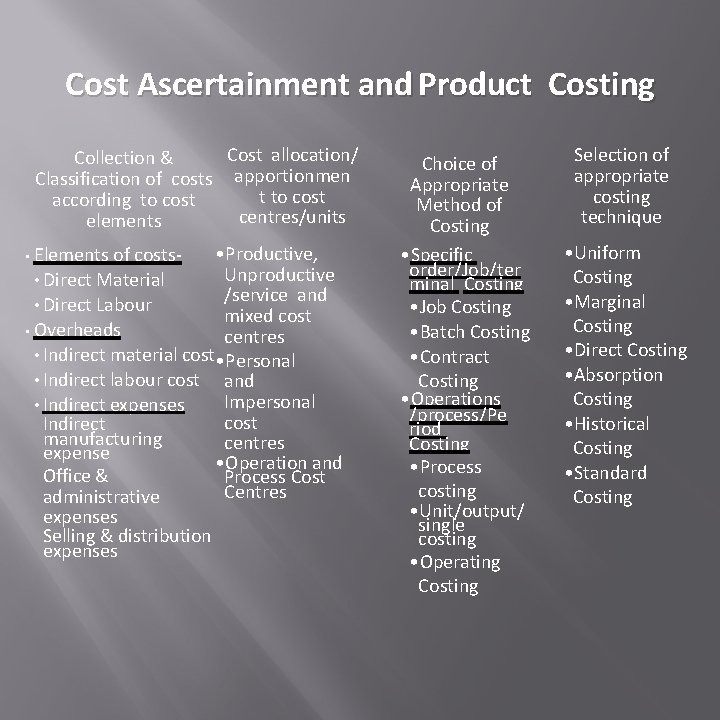
Cost Ascertainment and Product Costing Cost allocation/ Collection & Classification of costs apportionmen t to cost according to cost centres/units elements • Productive, Elements of costs. Unproductive • Direct Material /service and • Direct Labour mixed cost • Overheads centres • Indirect material cost • Personal • Indirect labour cost and Impersonal • Indirect expenses cost Indirect manufacturing centres expense • Operation and Office & Process Cost Centres administrative expenses Selling & distribution expenses • Choice of Appropriate Method of Costing • Specific order/Job/ter minal Costing • Job Costing • Batch Costing • Contract Costing • Operations /process/Pe riod Costing • Process costing • Unit/output/ single costing • Operating Costing Selection of appropriate costing technique • Uniform Costing • Marginal Costing • Direct Costing • Absorption Costing • Historical Costing • Standard Costing
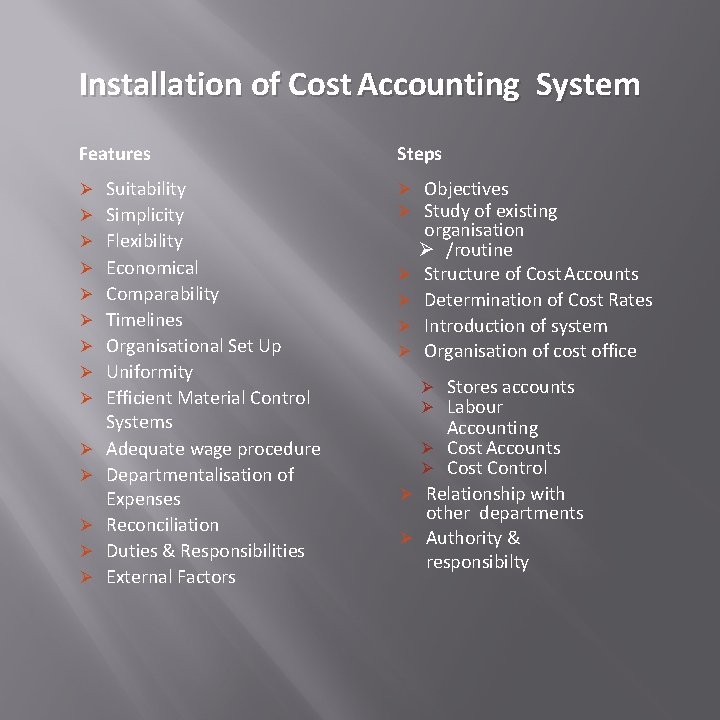
Installation of Cost Accounting System Features Steps Ø Suitability Ø Objectives Ø Study of existing Ø Simplicity Ø Flexibility Ø Economical Ø Comparability Ø Timelines Ø Organisational Set Up Ø Uniformity Ø Efficient Material Control Ø Ø Ø Systems Adequate wage procedure Departmentalisation of Expenses Reconciliation Duties & Responsibilities External Factors Ø Ø organisation Ø /routine Structure of Cost Accounts Determination of Cost Rates Introduction of system Organisation of cost office Ø Stores accounts Ø Labour Accounting Ø Cost Accounts Ø Cost Control Ø Relationship with other departments Ø Authority & responsibilty
Classification of Cost Ø Fixed Ø Variable Ø Semi-variable and Ø Step cost
Variable cost Ø It increases or decreases in direct proportion to levels of activity, but the unit variable cost remains constant Ø E. g. cost of food served in a restaurant, raw material, labor (per unit paid) Ø Also known as product cost. Ø Wages of labour, power and material cost are example of variable cost.
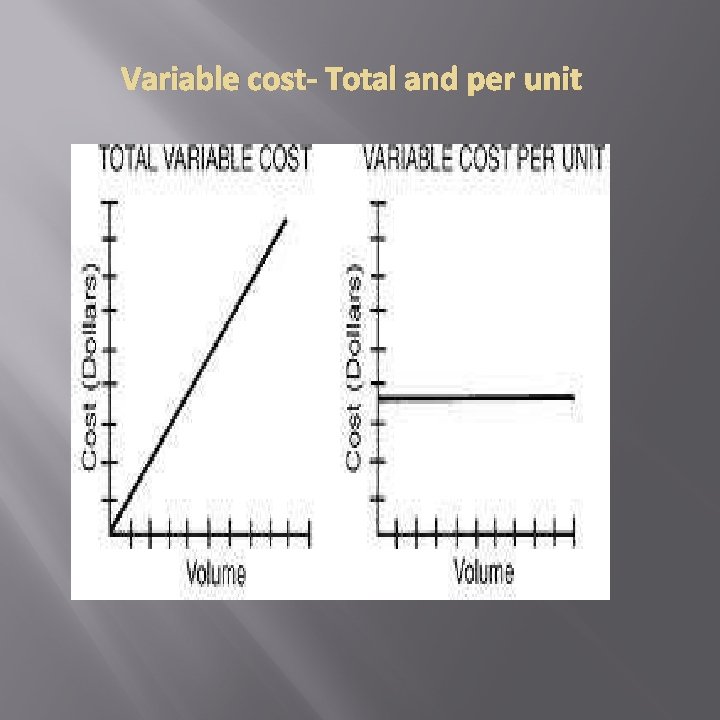
Variable cost- Total and per unit
Fixed cost 38 constant over a relevant Ø Total fixed cost remains range of activity level but unit fixed cost falls with an increase in activity volume. Ø Salary, rent, insurance are example of fixed cost
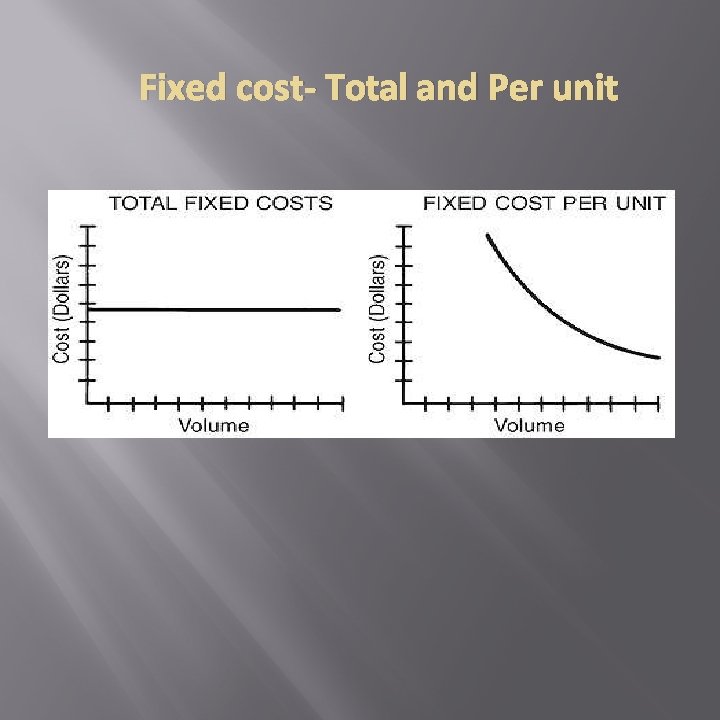
Fixed cost- Total and Per unit
Semi-variable cost 40 of both fixed and Ø It processes characteristics variable cost Ø It increases or decreases with activity level but not in direct proportion
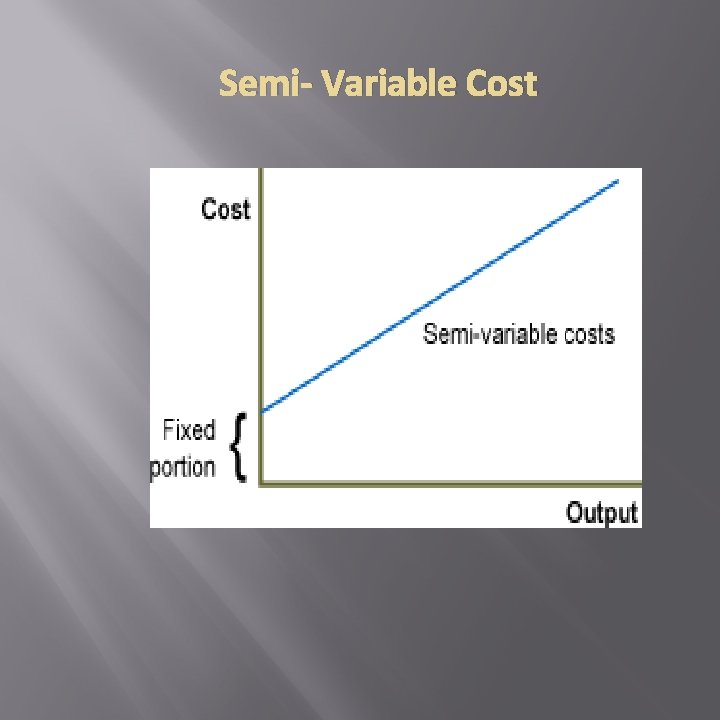
Semi- Variable Cost
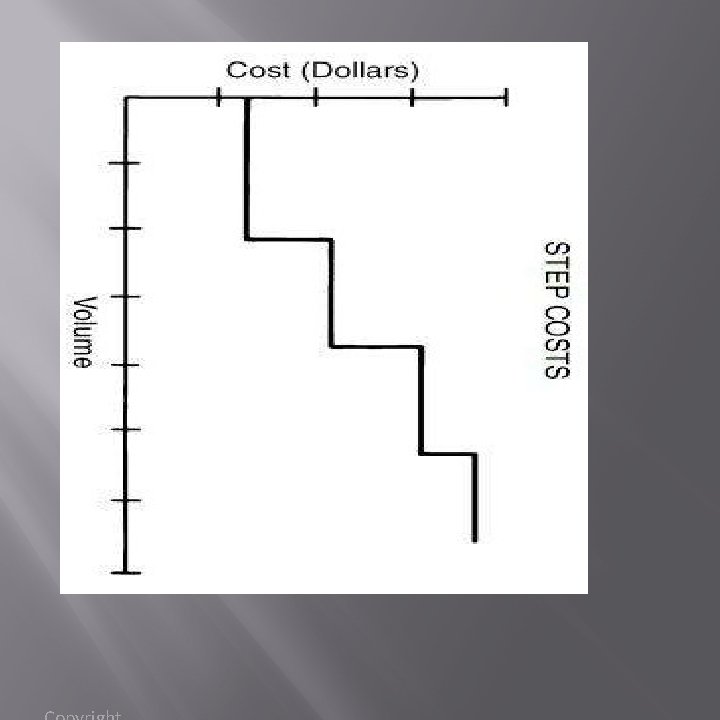
Step cost Ø It remains constant for a range of activity levels, then, on further increase in activity, the cost jumps to a new level and remains constant over a certain range until the next jump occurs
Product cost Ø Product cost are related to the goods purchased or produced for resale. Ø If the products are sold, the product cost will be included in the cost of goods sold and recorded as expenses in current period Ø If the products are unsold, the product costs will be included in the closing stock and recorded as assets in the balance sheet Ø Product cost includes direct material, direct labour, direct expenses, and manufacturing overheads.
Period cost Ø Period cost related to the operation of a business Ø They are treated as fixed cost and charged as expenses when they are incurred Ø They should not be included in the stock valuation Ø Period costs include all fixed costs and total administration, selling and distribution costs.
Relevant and Irrelevant Cost Ø Relevant costs are those costs which would be changed by the managerial decision. Ø For example, if a company is considering to close unprofitable retail sales shop, wages, salaries payable to the shop workers are relevant in this decision as they will disappear on closing of shop. Ø These costs wages, salaries, electricity are relevant for decision making. Ø On the other hand, prepaid rent, insurance or any other uncovered cost of any equipment which will have to be scarped are irrelevant cost which must be ignored.
Shutdown Costs Ø Shutdown costs are those costs which will gave to be incurred when plant is closed due to temporary non availability of material, labour or any other key ingredients. Ø Some fixed costs like deprecation of building, rent, maintenance will have to incur during that period and are called Shutdown cost. Ø Thus cost which have to incur even if there is no production are called Shutdown costs
Sunk costs Ø Sunk costs are historical or past costs. Ø These costs are costs which have been created or incurred by a decision that was taken in past that cannot be changed by any decision that will be made in future. Ø Investment in plant, machinery, building etc are prime example of such costs. Ø Since sunk cost cannot be altered by later decision, they are irrelevant for decision making
Controllable and Uncontrollable cots Ø Controllable costs are those can be influenced by the action of a specified member of the company. Ø Cost which can't be so influenced are uncontrollable costs.
Imputed or Hypothetical costs Ø Costs which don’t involve any cash outlay. Ø They are not included in the cost accounts but are important for consideration while making management decisions.
Differential, Incremental cost Ø The cost difference between two alternatives is termed as differential cost Ø Incremental is increase in the cost if increase the production by x number of units.
Out of pocket costs Ø Present or future cash expenditure regarding a certain decision which varies depending upon on the nature of decision made. Ø Own truck verus taking transport company.

Thanks….
- Slides: 53