
Fundamentals of Corporate Finance Fifth Edition Chapter 9




- Slides: 80
Fundamentals of Corporate Finance Fifth Edition Chapter 9 Fundamentals of Capital Budgeting Copyright © 2021 Pearson Education, Inc. All Rights Reserved.
Chapter Outline 9. 1 The Capital Budgeting Process 9. 2 Forecasting Incremental Earnings 9. 3 Determining Incremental Free Cash Flow 9. 4 Other Effects on Incremental Free Cash Flows 9. 5 Analyzing the Project 9. 6 Real Options in Capital Budgeting Copyright © 2021 Pearson Education, Inc. All Rights Reserved.
Learning Objectives (1 of 2) • Identify the types of cash flows needed in the capital budgeting process • Forecast incremental earnings in a pro forma earnings statement for a project • Convert forecasted earnings to free cash flows and compute a project’s NPV Copyright © 2021 Pearson Education, Inc. All Rights Reserved.
Learning Objectives (2 of 2) • Recognize common pitfalls that arise in identifying a project’s incremental free cash flows • Assess the sensitivity of a project’s NPV to changes in your assumptions • Identify the most common options available to managers in projects and understand why these options can be valuable Copyright © 2021 Pearson Education, Inc. All Rights Reserved.
9. 1 The Capital Budgeting Process • Capital Budgeting • Incremental Earnings Copyright © 2021 Pearson Education, Inc. All Rights Reserved.
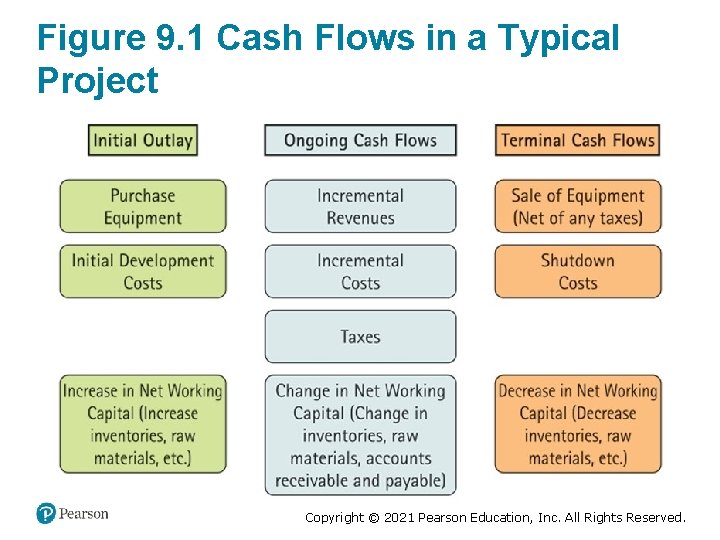
Figure 9. 1 Cash Flows in a Typical Project Copyright © 2021 Pearson Education, Inc. All Rights Reserved.
9. 2 Forecasting Incremental Earnings (1 of 8) • Operating Expenses Versus Capital Expenditures – Operating Expenses – Capital Expenditures Copyright © 2021 Pearson Education, Inc. All Rights Reserved.
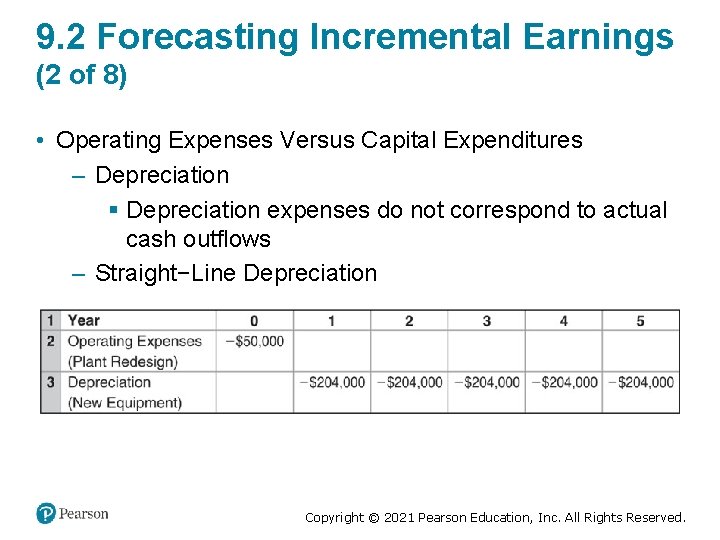
9. 2 Forecasting Incremental Earnings (2 of 8) • Operating Expenses Versus Capital Expenditures – Depreciation § Depreciation expenses do not correspond to actual cash outflows – Straight−Line Depreciation Copyright © 2021 Pearson Education, Inc. All Rights Reserved.
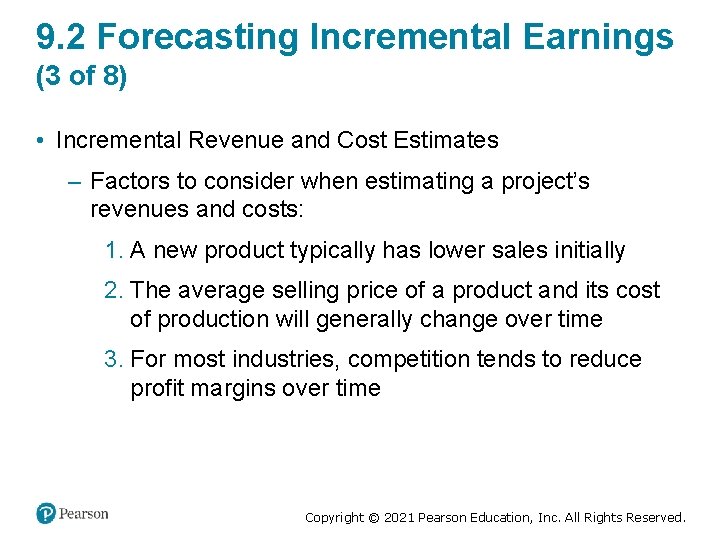
9. 2 Forecasting Incremental Earnings (3 of 8) • Incremental Revenue and Cost Estimates – Factors to consider when estimating a project’s revenues and costs: 1. A new product typically has lower sales initially 2. The average selling price of a product and its cost of production will generally change over time 3. For most industries, competition tends to reduce profit margins over time Copyright © 2021 Pearson Education, Inc. All Rights Reserved.
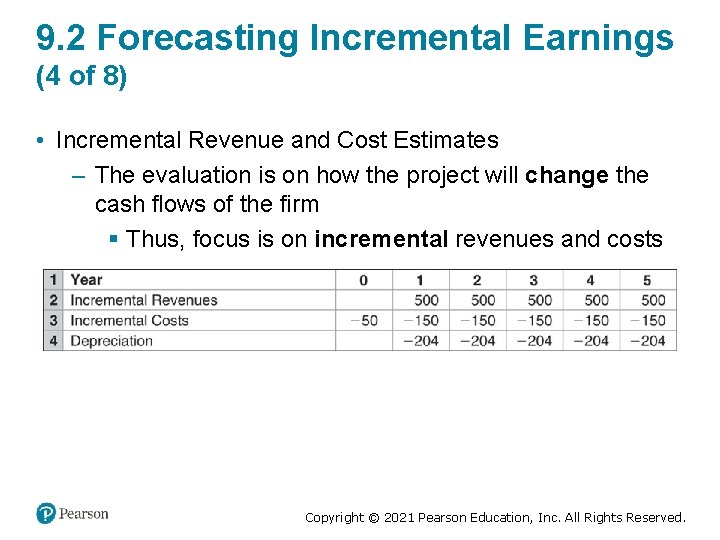
9. 2 Forecasting Incremental Earnings (4 of 8) • Incremental Revenue and Cost Estimates – The evaluation is on how the project will change the cash flows of the firm § Thus, focus is on incremental revenues and costs Copyright © 2021 Pearson Education, Inc. All Rights Reserved.
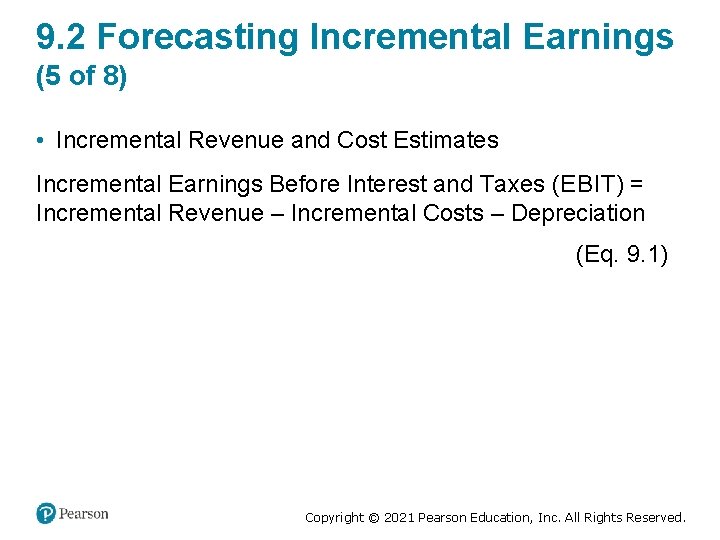
9. 2 Forecasting Incremental Earnings (5 of 8) • Incremental Revenue and Cost Estimates Incremental Earnings Before Interest and Taxes (EBI T) = Incremental Revenue – Incremental Costs – Depreciation (Eq. 9. 1) Copyright © 2021 Pearson Education, Inc. All Rights Reserved.
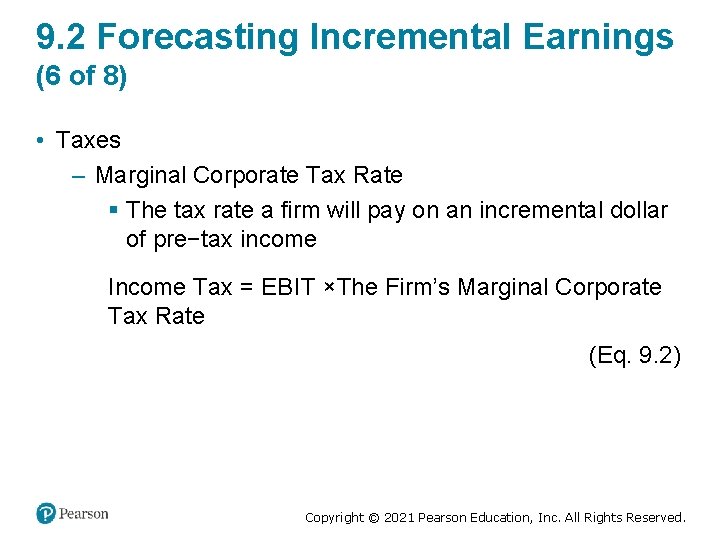
9. 2 Forecasting Incremental Earnings (6 of 8) • Taxes – Marginal Corporate Tax Rate § The tax rate a firm will pay on an incremental dollar of pre−tax income Income Tax = EBI T ×The Firm’s Marginal Corporate Tax Rate (Eq. 9. 2) Copyright © 2021 Pearson Education, Inc. All Rights Reserved.
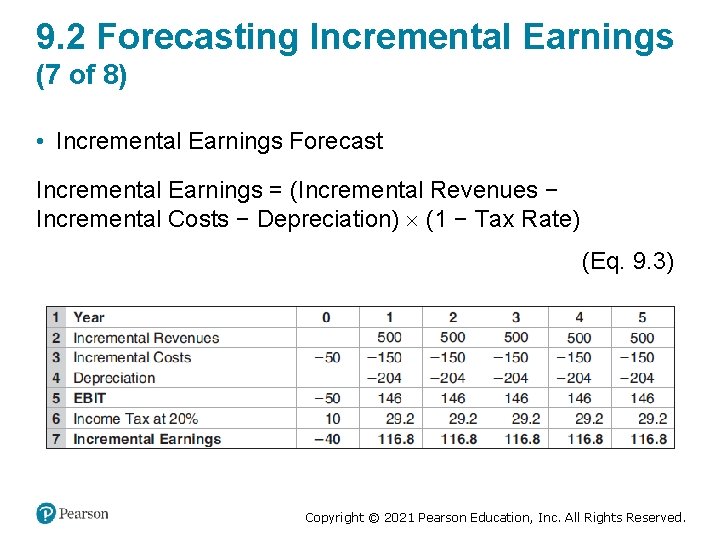
9. 2 Forecasting Incremental Earnings (7 of 8) • Incremental Earnings Forecast Incremental Earnings = (Incremental Revenues − Incremental Costs − Depreciation) (1 − Tax Rate) (Eq. 9. 3) Copyright © 2021 Pearson Education, Inc. All Rights Reserved.
Example 9. 1 Incremental Earnings (1 of 9) Problem: • Suppose that the managers of the router division of Cisco Systems are considering the development of a wireless home networking appliance, called Home. Net, that will provide both the hardware and the software necessary to run an entire home from any Internet connection. Copyright © 2021 Pearson Education, Inc. All Rights Reserved.
Example 9. 1 Incremental Earnings (2 of 9) Problem: • In addition to connecting computers and smartphones, Home. Net will control Internet−capable televisions, streaming video services, heating and airconditioning units, major appliances, security systems, office equipment, and so on. The major competitor for Home. Net is a product being developed by Brandt−Quigley Corporation. Copyright © 2021 Pearson Education, Inc. All Rights Reserved.
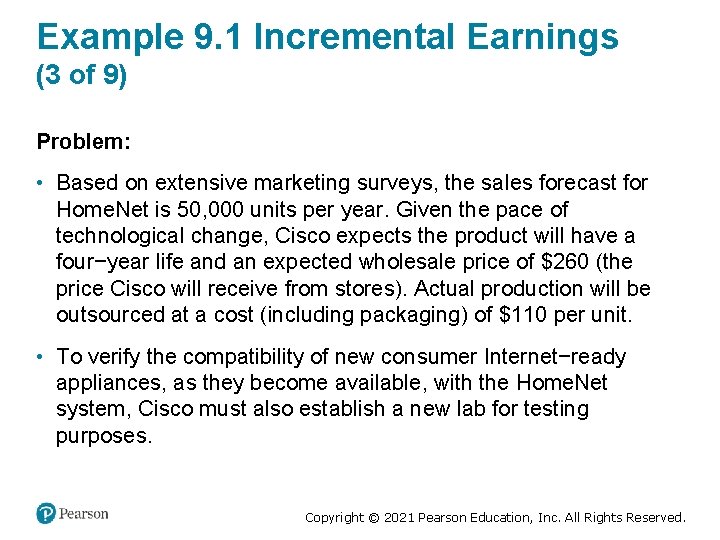
Example 9. 1 Incremental Earnings (3 of 9) Problem: • Based on extensive marketing surveys, the sales forecast for Home. Net is 50, 000 units per year. Given the pace of technological change, Cisco expects the product will have a four−year life and an expected wholesale price of $260 (the price Cisco will receive from stores). Actual production will be outsourced at a cost (including packaging) of $110 per unit. • To verify the compatibility of new consumer Internet−ready appliances, as they become available, with the Home. Net system, Cisco must also establish a new lab for testing purposes. Copyright © 2021 Pearson Education, Inc. All Rights Reserved.
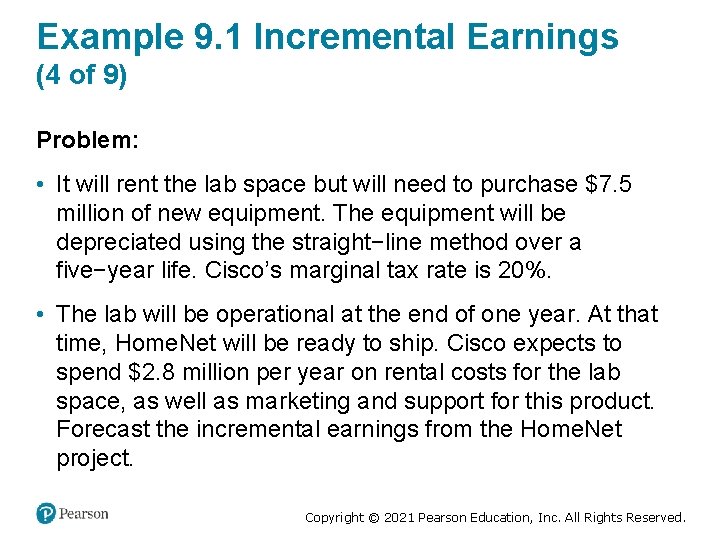
Example 9. 1 Incremental Earnings (4 of 9) Problem: • It will rent the lab space but will need to purchase $7. 5 million of new equipment. The equipment will be depreciated using the straight−line method over a five−year life. Cisco’s marginal tax rate is 20%. • The lab will be operational at the end of one year. At that time, Home. Net will be ready to ship. Cisco expects to spend $2. 8 million per year on rental costs for the lab space, as well as marketing and support for this product. Forecast the incremental earnings from the Home. Net project. Copyright © 2021 Pearson Education, Inc. All Rights Reserved.
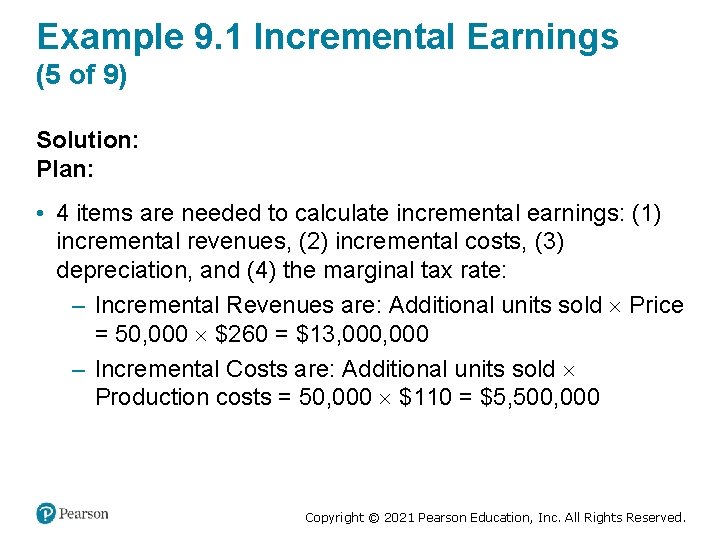
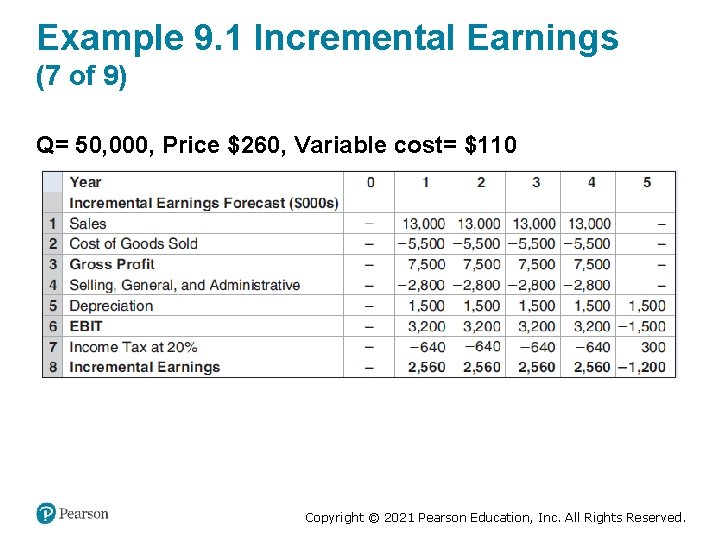
Example 9. 1 Incremental Earnings (5 of 9) Solution: Plan: • 4 items are needed to calculate incremental earnings: (1) incremental revenues, (2) incremental costs, (3) depreciation, and (4) the marginal tax rate: – Incremental Revenues are: Additional units sold Price = 50, 000 $260 = $13, 000 – Incremental Costs are: Additional units sold Production costs = 50, 000 $110 = $5, 500, 000 Copyright © 2021 Pearson Education, Inc. All Rights Reserved.
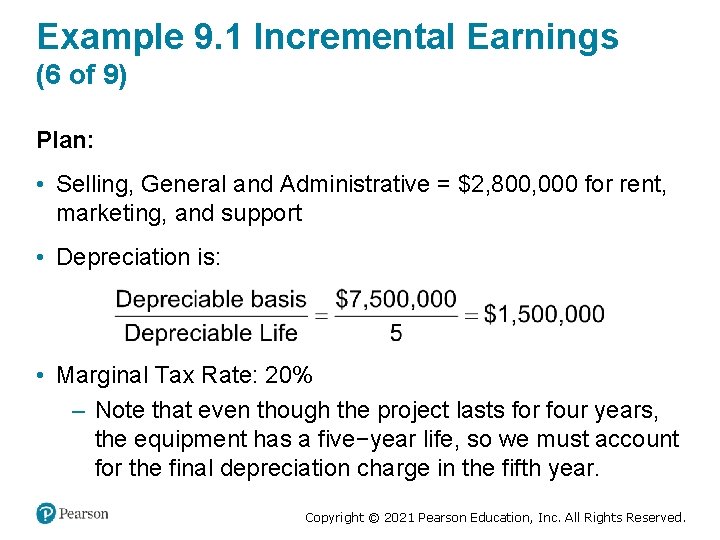
Example 9. 1 Incremental Earnings (6 of 9) Plan: • Selling, General and Administrative = $2, 800, 000 for rent, marketing, and support • Depreciation is: • Marginal Tax Rate: 20% – Note that even though the project lasts for four years, the equipment has a five−year life, so we must account for the final depreciation charge in the fifth year. Copyright © 2021 Pearson Education, Inc. All Rights Reserved.
Example 9. 1 Incremental Earnings (7 of 9) Q= 50, 000, Price $260, Variable cost= $110 Copyright © 2021 Pearson Education, Inc. All Rights Reserved.
Example 9. 1 Incremental Earnings (8 of 9) Evaluate: • These incremental earnings are an intermediate step on the way to calculating the incremental cash flows that would form the basis of any analysis of the Home. Net project. • The cost of the equipment does not affect earnings in the year it is purchased but does so through the depreciation expense in the following five years. Copyright © 2021 Pearson Education, Inc. All Rights Reserved.
Example 9. 1 Incremental Earnings (9 of 9) Evaluate: • Note that the depreciable life, which is based on accounting rules, does not have to be the same as the economic life of the asset—the period over which it will have value. Here, the firm will use the equipment for four years, but will depreciate it over five years. Copyright © 2021 Pearson Education, Inc. All Rights Reserved.
9. 3 Determining Incremental Free Cash Flow (1 of 6) • Converting from Earnings to Free Cash Flow – Free Cash Flow § The incremental effect of a project on a firm’s available cash – Capital Expenditures and Depreciation Copyright © 2021 Pearson Education, Inc. All Rights Reserved.
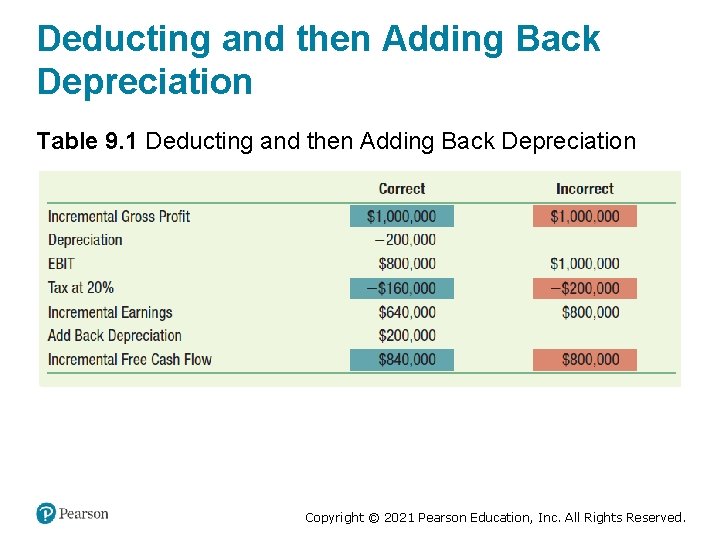
Deducting and then Adding Back Depreciation Table 9. 1 Deducting and then Adding Back Depreciation Copyright © 2021 Pearson Education, Inc. All Rights Reserved.
Example 9. 3 Incremental Free Cash Flows (1 of 4) Problem: • Let’s return to the Home. Net example. In Example 9. 1, we computed the incremental earnings for Home. Net, but we need the incremental free cash flows to decide whether Cisco should proceed with the project. Copyright © 2021 Pearson Education, Inc. All Rights Reserved.
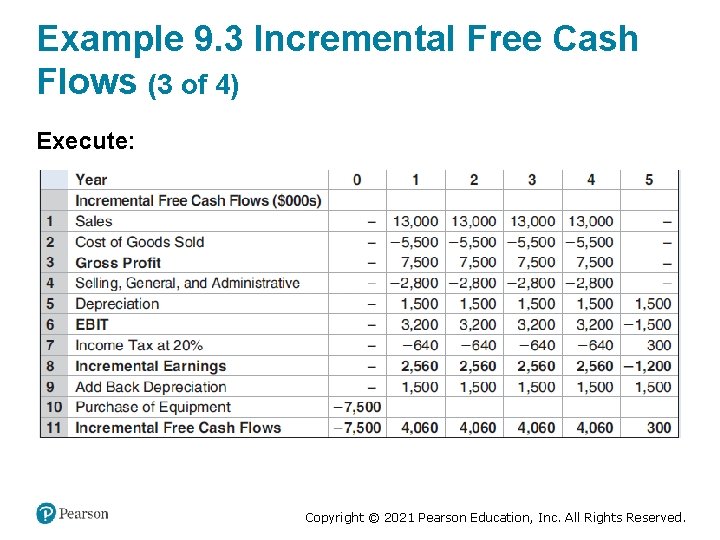
Example 9. 3 Incremental Free Cash Flows (2 of 4) Solution: Plan: • The difference between the incremental earnings and incremental free cash flows in the Home. Net example will be driven by the equipment purchased for the lab. • We need to recognize the $7. 5 million cash outflow associated with the purchase in year 0 and add back the $1. 5 million depreciation expenses from year 1 to 5 as they are not actually cash outflows. Copyright © 2021 Pearson Education, Inc. All Rights Reserved.
Example 9. 3 Incremental Free Cash Flows (3 of 4) Execute: Copyright © 2021 Pearson Education, Inc. All Rights Reserved.
Example 9. 3 Incremental Free Cash Flows (4 of 4) Evaluate: • By recognizing the outflow from purchasing the equipment in year 0, we account for the fact that $7. 5 million left the firm at that time. • By adding back the $1. 5 million depreciation expenses in years 1 through 5, we adjust the incremental earnings to reflect the fact that the depreciation expense is not a cash outflow. Copyright © 2021 Pearson Education, Inc. All Rights Reserved.
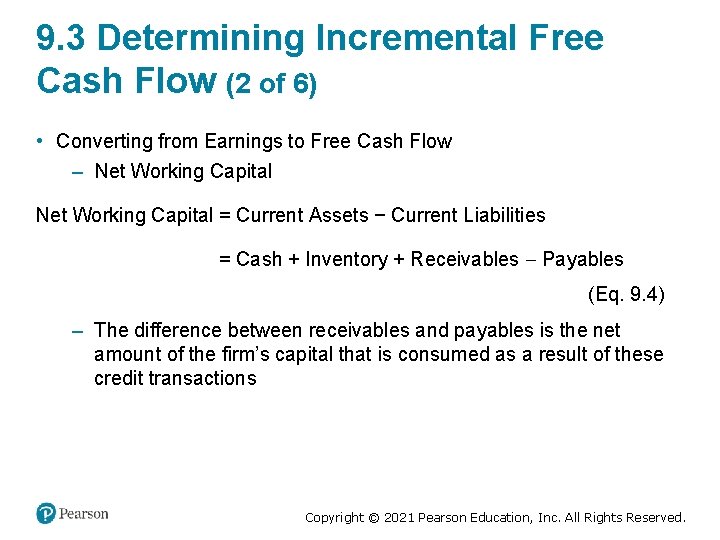
9. 3 Determining Incremental Free Cash Flow (2 of 6) • Converting from Earnings to Free Cash Flow – Net Working Capital = Current Assets − Current Liabilities = Cash + Inventory + Receivables Payables (Eq. 9. 4) ‒ The difference between receivables and payables is the net amount of the firm’s capital that is consumed as a result of these credit transactions Copyright © 2021 Pearson Education, Inc. All Rights Reserved.
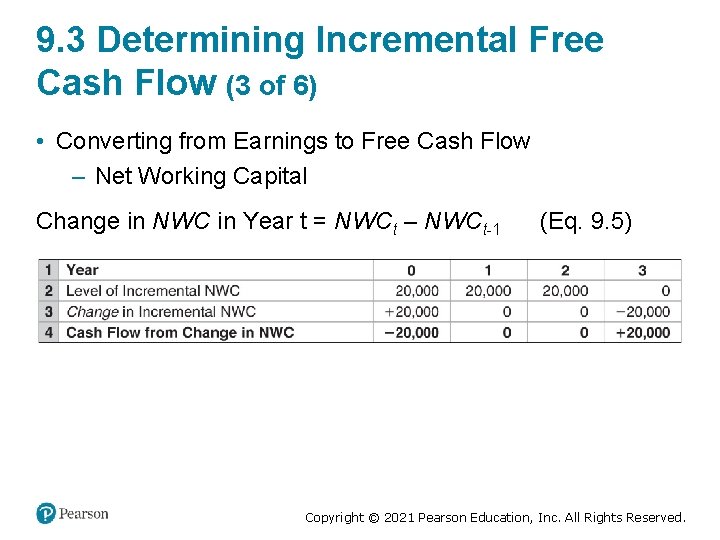
9. 3 Determining Incremental Free Cash Flow (3 of 6) • Converting from Earnings to Free Cash Flow – Net Working Capital Change in NWC in Year t = NWCt – NWCt-1 (Eq. 9. 5) Copyright © 2021 Pearson Education, Inc. All Rights Reserved.
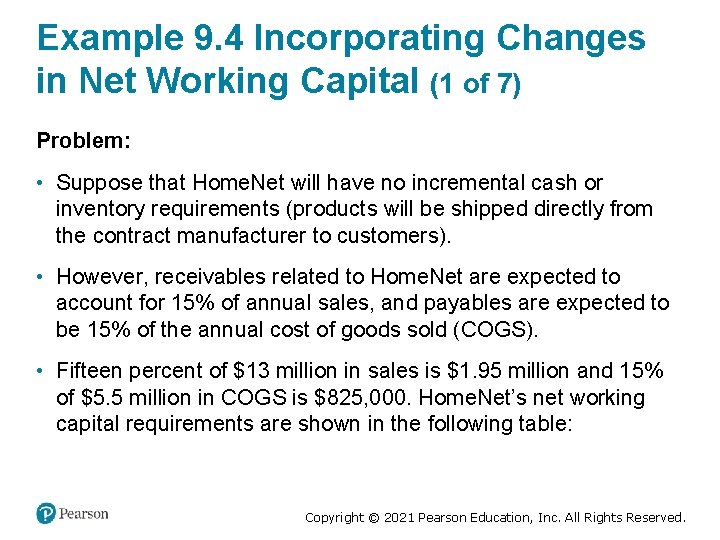
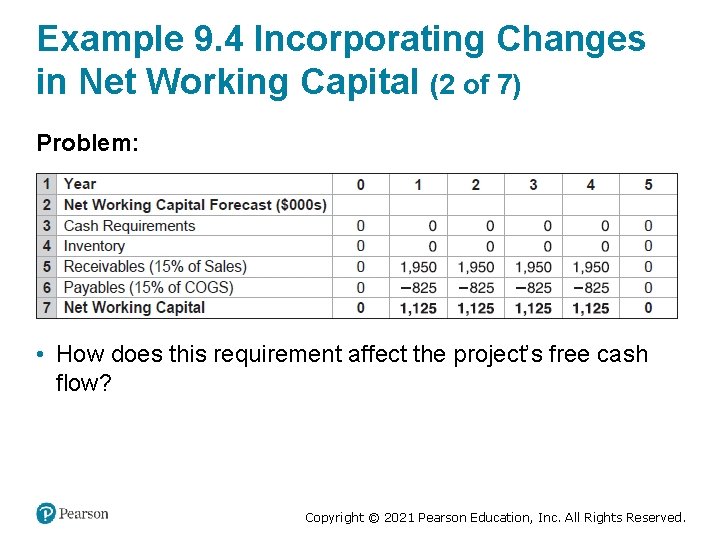
Example 9. 4 Incorporating Changes in Net Working Capital (1 of 7) Problem: • Suppose that Home. Net will have no incremental cash or inventory requirements (products will be shipped directly from the contract manufacturer to customers). • However, receivables related to Home. Net are expected to account for 15% of annual sales, and payables are expected to be 15% of the annual cost of goods sold (COGS). • Fifteen percent of $13 million in sales is $1. 95 million and 15% of $5. 5 million in COGS is $825, 000. Home. Net’s net working capital requirements are shown in the following table: Copyright © 2021 Pearson Education, Inc. All Rights Reserved.
Example 9. 4 Incorporating Changes in Net Working Capital (2 of 7) Problem: • How does this requirement affect the project’s free cash flow? Copyright © 2021 Pearson Education, Inc. All Rights Reserved.
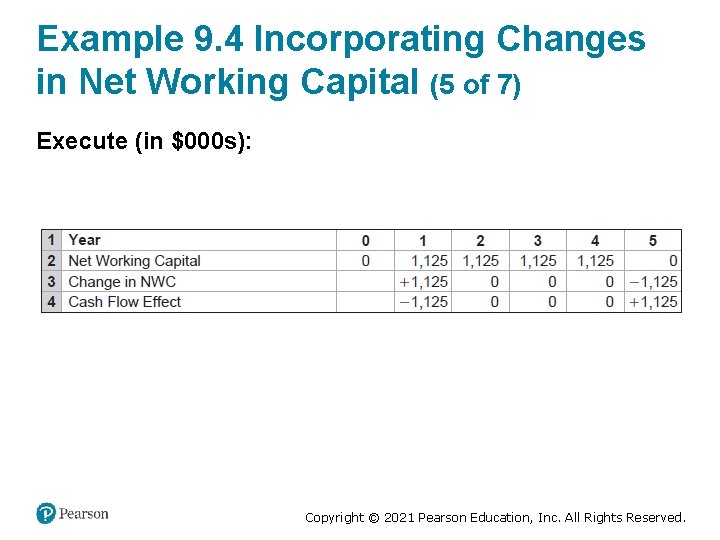
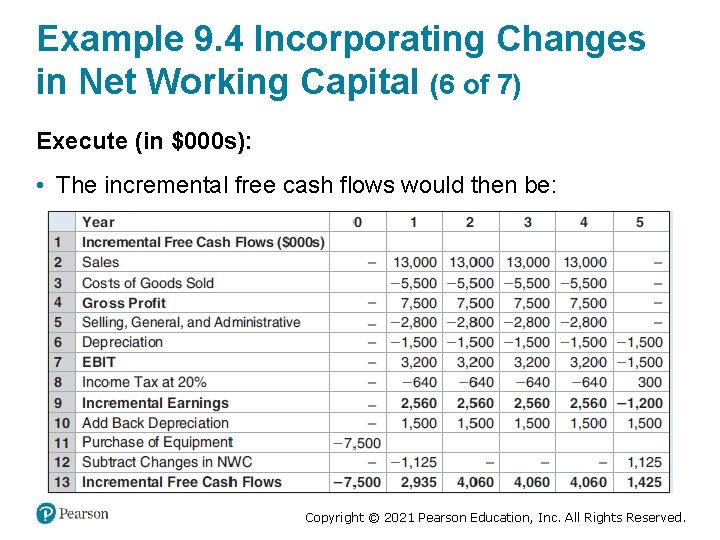
Example 9. 4 Incorporating Changes in Net Working Capital (3 of 7) Solution: Plan: • Any increases in net working capital represent an investment that reduces the cash available to the firm and so reduces free cash flow. We can use our forecast of Home. Net’s net working capital requirements to complete our estimate of Home. Net’s free cash flow. In year 1, net working capital increases by $1. 125 million. • This increase represents a cost to the firm. This reduction of free cash flow corresponds to the fact that in year 1, $1. 950 million of the firm’s sales and $0. 825 million of its costs have not yet been paid. Copyright © 2021 Pearson Education, Inc. All Rights Reserved.
Example 9. 4 Incorporating Changes in Net Working Capital (4 of 7) Plan: • In years 2– 4, net working capital does not change, so no further contributions are needed. • In year 5, when the project is shut down, net working capital falls by $1. 125 million as the payments of the last customers are received and the final bills are paid. We add this $1. 125 million to free cash flow in year 5. Copyright © 2021 Pearson Education, Inc. All Rights Reserved.
Example 9. 4 Incorporating Changes in Net Working Capital (5 of 7) Execute (in $000 s): Copyright © 2021 Pearson Education, Inc. All Rights Reserved.
Example 9. 4 Incorporating Changes in Net Working Capital (6 of 7) Execute (in $000 s): • The incremental free cash flows would then be: Copyright © 2021 Pearson Education, Inc. All Rights Reserved.
Example 9. 4 Incorporating Changes in Net Working Capital (7 of 7) Evaluate: • The free cash flows differ from unlevered net income by reflecting the cash flow effects of capital expenditures on equipment, depreciation, and changes in net working capital. • Note that in the first year, free cash flow is lower than unlevered net income, reflecting the up−front investment in equipment. In later years, free cash flow exceeds unlevered net income because depreciation is not a cash expense. In the last year, the firm ultimately recovers the investment in net working capital, further boosting the free cash flow. Copyright © 2021 Pearson Education, Inc. All Rights Reserved.
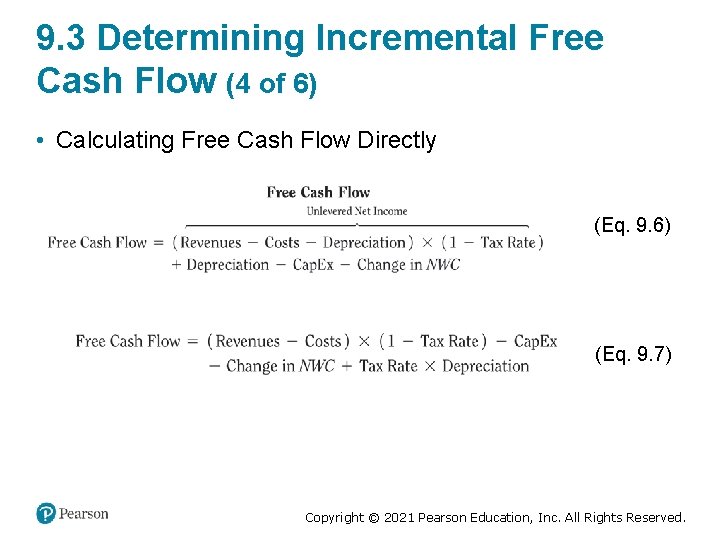
9. 3 Determining Incremental Free Cash Flow (4 of 6) • Calculating Free Cash Flow Directly (Eq. 9. 6) (Eq. 9. 7) Copyright © 2021 Pearson Education, Inc. All Rights Reserved.
9. 3 Determining Incremental Free Cash Flow (5 of 6) • Calculating Free Cash Flow Directly – Depreciation Tax Shield § Tax Rate x Depreciation Copyright © 2021 Pearson Education, Inc. All Rights Reserved.
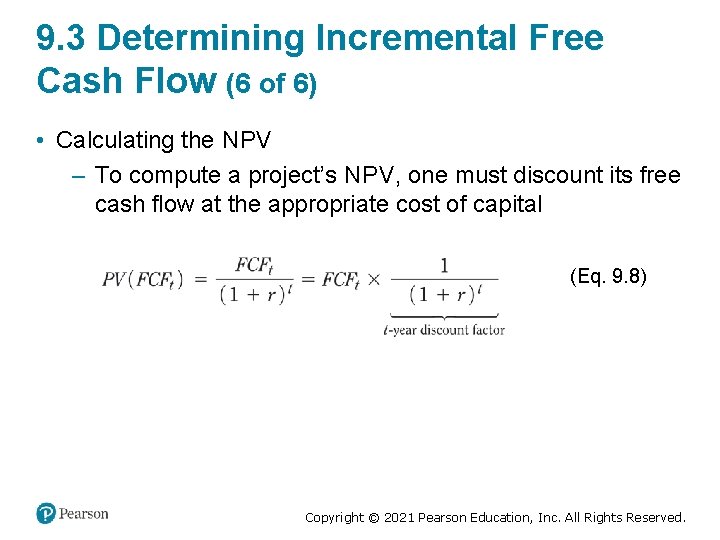
9. 3 Determining Incremental Free Cash Flow (6 of 6) • Calculating the NPV – To compute a project’s NPV, one must discount its free cash flow at the appropriate cost of capital (Eq. 9. 8) Copyright © 2021 Pearson Education, Inc. All Rights Reserved.
Example 9. 5 Calculating the Project’s NPV (1 of 4) Problem: • Assume that Cisco’s managers believe that the Home. Net project has risks similar to its existing projects, for which it has a cost of capital of 12%. • Compute the NPV of the Home. Net project. Copyright © 2021 Pearson Education, Inc. All Rights Reserved.
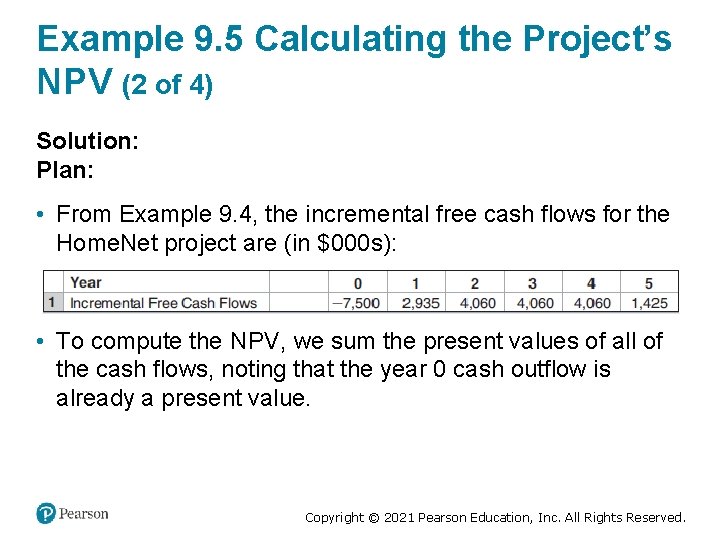
Example 9. 5 Calculating the Project’s NPV (2 of 4) Solution: Plan: • From Example 9. 4, the incremental free cash flows for the Home. Net project are (in $000 s): • To compute the NPV, we sum the present values of all of the cash flows, noting that the year 0 cash outflow is already a present value. Copyright © 2021 Pearson Education, Inc. All Rights Reserved.
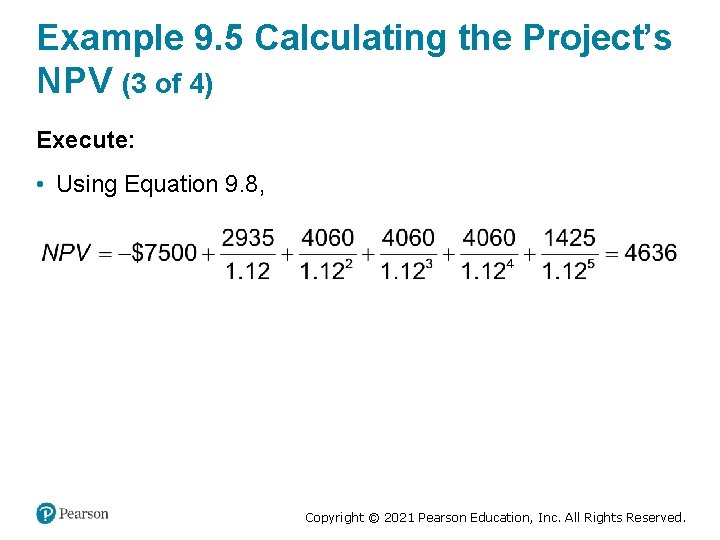
Example 9. 5 Calculating the Project’s NPV (3 of 4) Execute: • Using Equation 9. 8, Copyright © 2021 Pearson Education, Inc. All Rights Reserved.
Example 9. 5 Calculating the Project’s NPV (4 of 4) Evaluate: • Based on our estimates, Home. Net’s NPV is $4. 636 million. While Home. Net’s up−front cost is $7. 5 million, the present value of the additional free cash flow that Cisco will receive from the project is $12. 136 million. • Thus, taking the Home. Net project is equivalent to Cisco having an extra $4. 636 million in the bank today. Copyright © 2021 Pearson Education, Inc. All Rights Reserved.
9. 4 Other Effects on Incremental Free Cash Flows (1 of 5) • Opportunity Costs • Project Externalities – Cannibalization • Sunk Costs – Fixed Overhead Expenses – Past Research and Development – Unavoidable Competitive Effects Copyright © 2021 Pearson Education, Inc. All Rights Reserved.
9. 4 Other Effects on Incremental Free Cash Flows (2 of 5) • Adjusting Free Cash Flow – Time of Cash Flows – Accelerated Depreciation § MACRS – Modified Accelerated Cost Recovery System Copyright © 2021 Pearson Education, Inc. All Rights Reserved.
Example 9. 6 Computing Accelerated Depreciation (1 of 6) Problem: • What depreciation deduction would be allowed for Home. Net’s $7. 5 million lab equipment using the MACR S method, assuming the lab equipment is designated to have a five−year recovery period? For clarity, assume that the lab equipment is purchased and put into use in December of year 0, allowing the partial year depreciation in year 0. This means that year 0 is the first year of the MACR S schedule (year 1) in the appendix. (See the appendix to this chapter for information on MACR S depreciation schedules. ) Copyright © 2021 Pearson Education, Inc. All Rights Reserved.
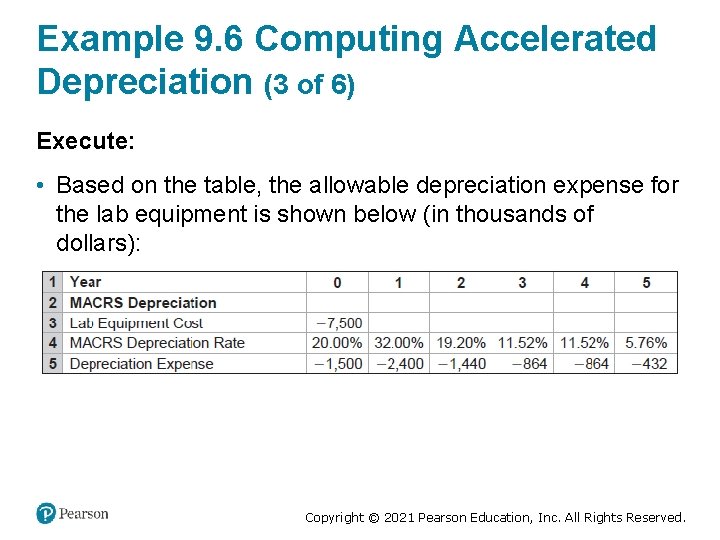
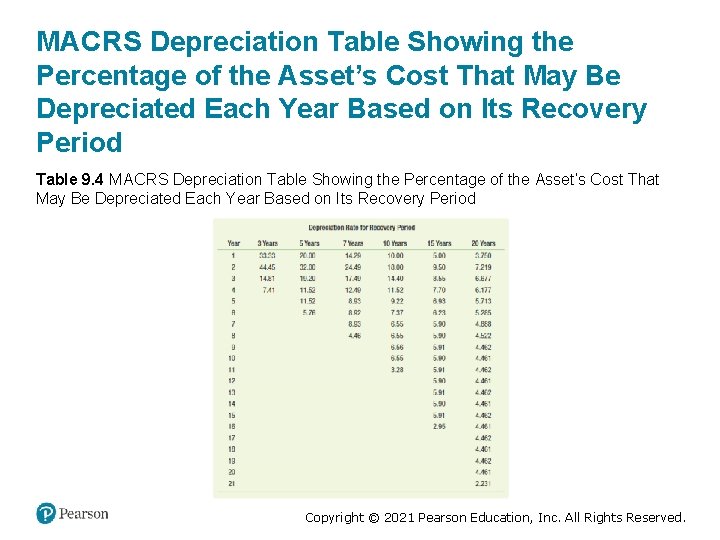
Example 9. 6 Computing Accelerated Depreciation (2 of 6) Solution: Plan: • Table 9. 4 (in the appendix) provides the percentage of the cost that can be depreciated each year. Under MACR S, we take the percentage in the table for each year and multiply it by the original purchase price of the equipment to calculate the depreciation for that year. Copyright © 2021 Pearson Education, Inc. All Rights Reserved.
Example 9. 6 Computing Accelerated Depreciation (3 of 6) Execute: • Based on the table, the allowable depreciation expense for the lab equipment is shown below (in thousands of dollars): Copyright © 2021 Pearson Education, Inc. All Rights Reserved.
Example 9. 6 Computing Accelerated Depreciation (4 of 6) Evaluate: • As long as the equipment is put into use by the end of year 0, the tax code allows us to take our first depreciation expense in the same year. Compared with straight-line depreciation, the MACRS method allows for larger depreciation deductions earlier in the asset’s life, which increases the present value of the depreciation tax shield and so will raise the project’s NPV. In the case of Home. Net, computing the NPV using MACRS depreciation leads to an NPV of $5. 094 million. Note that with 100% bonus depreciation, we can deduct the full $7. 5 million cost in year 0, accelerating the tax shield and increasing NPV even further. Copyright © 2021 Pearson Education, Inc. All Rights Reserved.
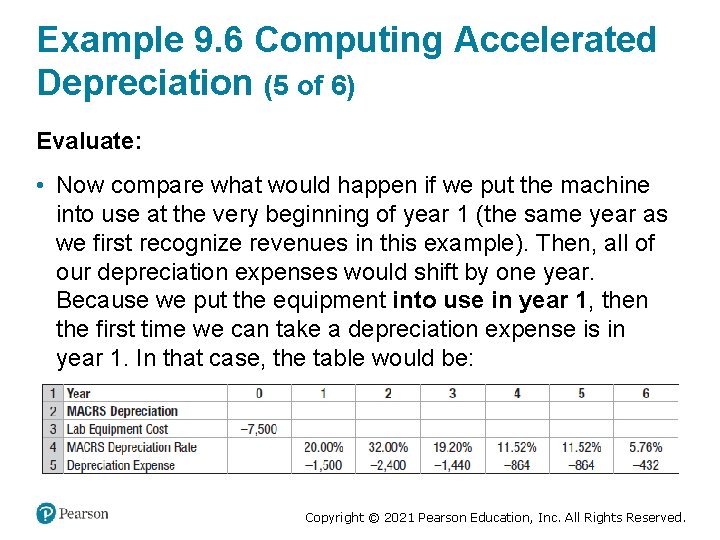
Example 9. 6 Computing Accelerated Depreciation (5 of 6) Evaluate: • Now compare what would happen if we put the machine into use at the very beginning of year 1 (the same year as we first recognize revenues in this example). Then, all of our depreciation expenses would shift by one year. Because we put the equipment into use in year 1, then the first time we can take a depreciation expense is in year 1. In that case, the table would be: Copyright © 2021 Pearson Education, Inc. All Rights Reserved.
Example 9. 6 Computing Accelerated Depreciation (6 of 6) Evaluate: • In this case, the NPV would be $4. 661 million because all of the depreciation tax shields are delayed by one year relative to the case where the equipment is put into use before year 1. Nonetheless, the NPV is still higher than in the case of straight−line depreciation because a larger percentage of the depreciation comes earlier. Copyright © 2021 Pearson Education, Inc. All Rights Reserved.
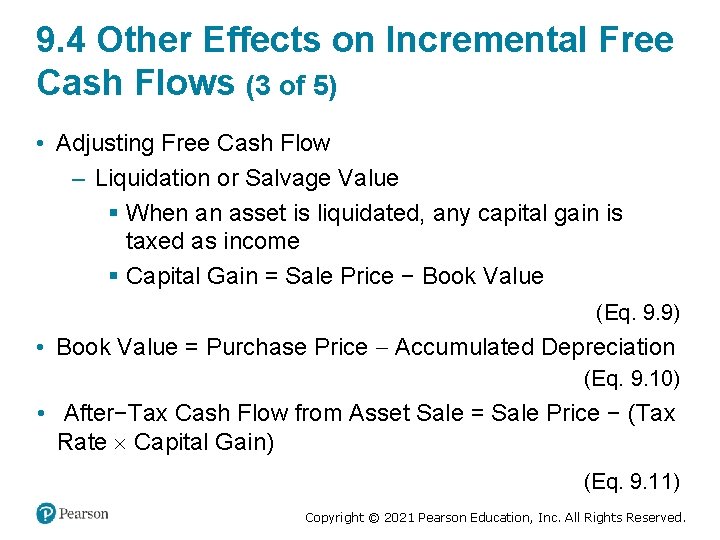
9. 4 Other Effects on Incremental Free Cash Flows (3 of 5) • Adjusting Free Cash Flow – Liquidation or Salvage Value § When an asset is liquidated, any capital gain is taxed as income § Capital Gain = Sale Price − Book Value (Eq. 9. 9) • Book Value = Purchase Price Accumulated Depreciation (Eq. 9. 10) • After−Tax Cash Flow from Asset Sale = Sale Price − (Tax Rate Capital Gain) (Eq. 9. 11) Copyright © 2021 Pearson Education, Inc. All Rights Reserved.
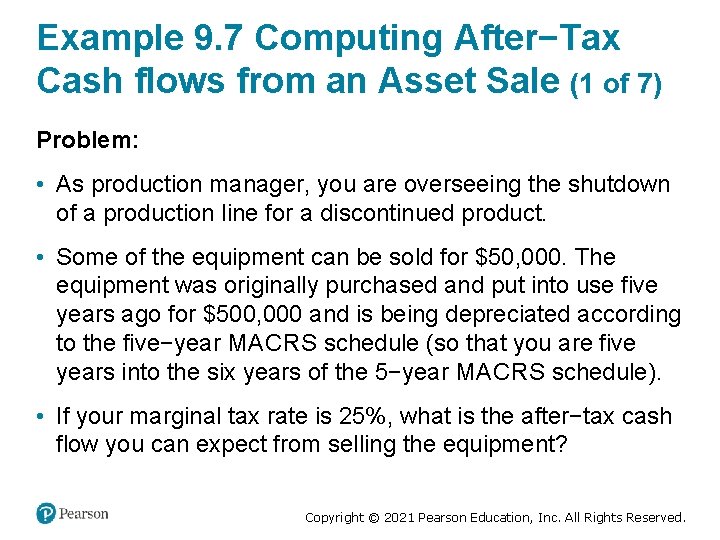
Example 9. 7 Computing After−Tax Cash flows from an Asset Sale (1 of 7) Problem: • As production manager, you are overseeing the shutdown of a production line for a discontinued product. • Some of the equipment can be sold for $50, 000. The equipment was originally purchased and put into use five years ago for $500, 000 and is being depreciated according to the five−year MACR S schedule (so that you are five years into the six years of the 5−year MACR S schedule). • If your marginal tax rate is 25%, what is the after−tax cash flow you can expect from selling the equipment? Copyright © 2021 Pearson Education, Inc. All Rights Reserved.
Example 9. 7 Computing After−Tax Cash flows from an Asset Sale (2 of 7) Solution: Plan: • In order to compute the after−tax cash flow, you will need to compute the capital gain, which, as Equation 9. 9 shows, requires you to know the book value of the equipment. • The book value is given in Equation 9. 10 as the original purchase price of the equipment less accumulated depreciation. Thus, you need to follow these steps: Copyright © 2021 Pearson Education, Inc. All Rights Reserved.
Example 9. 7 Computing After−Tax Cash flows from an Asset Sale (3 of 7) Plan: 1. Use the MACR S schedule to determine the accumulated depreciation. 2. Determine the book value as purchase price minus accumulated depreciation. 3. Determine the capital gain as the sale price less the book value. 4. Compute the tax owed on the capital gain and subtract it from the sale price, following Equation 9. 11, and then subtract the tax owed from the sale price. Copyright © 2021 Pearson Education, Inc. All Rights Reserved.
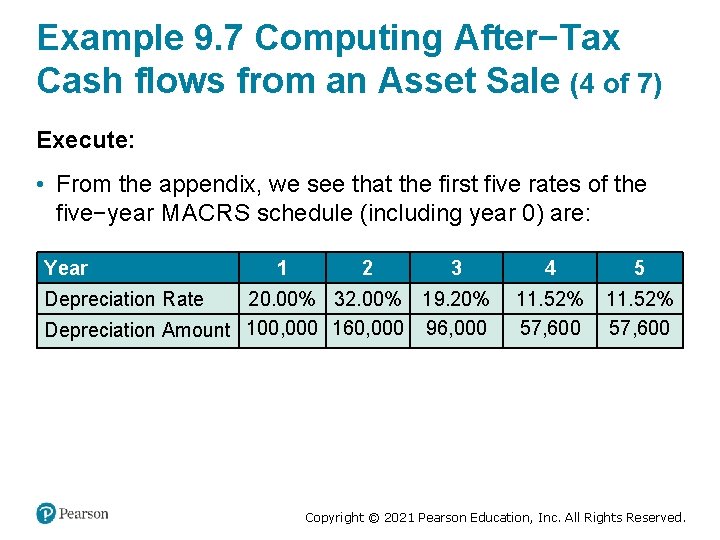
Example 9. 7 Computing After−Tax Cash flows from an Asset Sale (4 of 7) Execute: • From the appendix, we see that the first five rates of the five−year MACR S schedule (including year 0) are: Year Depreciation Rate 1 2 3 20. 00% 32. 00% 19. 20% Depreciation Amount 100, 000 160, 000 96, 000 4 5 11. 52% 57, 600 Copyright © 2021 Pearson Education, Inc. All Rights Reserved.
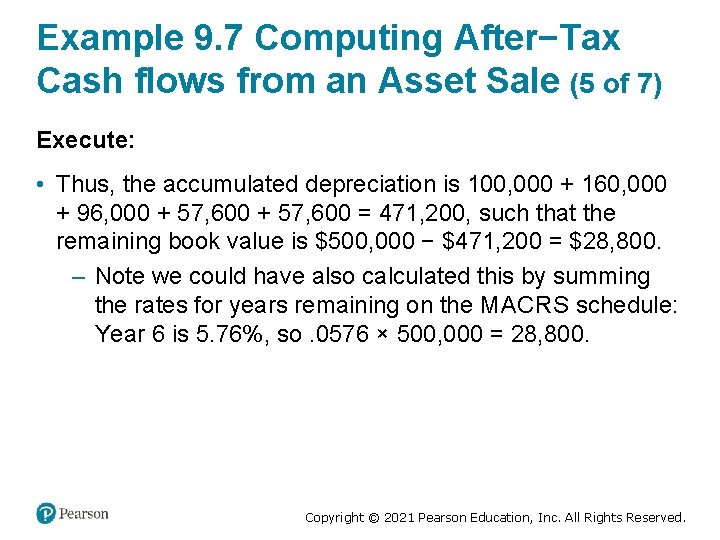
Example 9. 7 Computing After−Tax Cash flows from an Asset Sale (5 of 7) Execute: • Thus, the accumulated depreciation is 100, 000 + 160, 000 + 96, 000 + 57, 600 = 471, 200, such that the remaining book value is $500, 000 − $471, 200 = $28, 800. – Note we could have also calculated this by summing the rates for years remaining on the MACR S schedule: Year 6 is 5. 76%, so. 0576 × 500, 000 = 28, 800. Copyright © 2021 Pearson Education, Inc. All Rights Reserved.
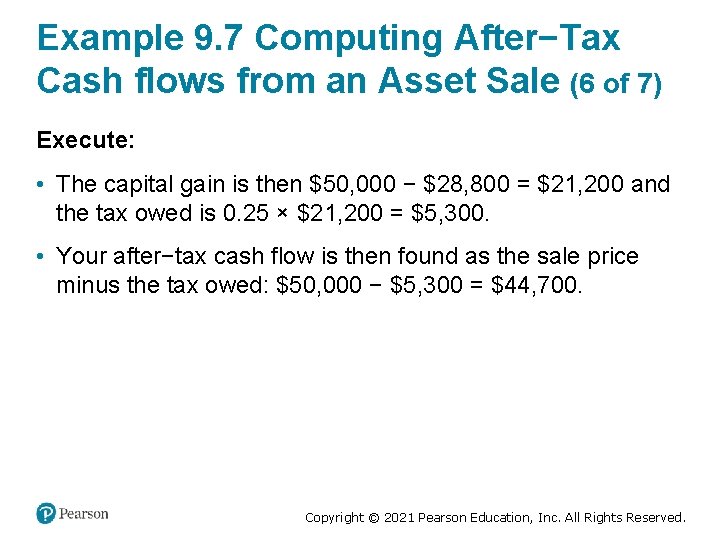
Example 9. 7 Computing After−Tax Cash flows from an Asset Sale (6 of 7) Execute: • The capital gain is then $50, 000 − $28, 800 = $21, 200 and the tax owed is 0. 25 × $21, 200 = $5, 300. • Your after−tax cash flow is then found as the sale price minus the tax owed: $50, 000 − $5, 300 = $44, 700. Copyright © 2021 Pearson Education, Inc. All Rights Reserved.
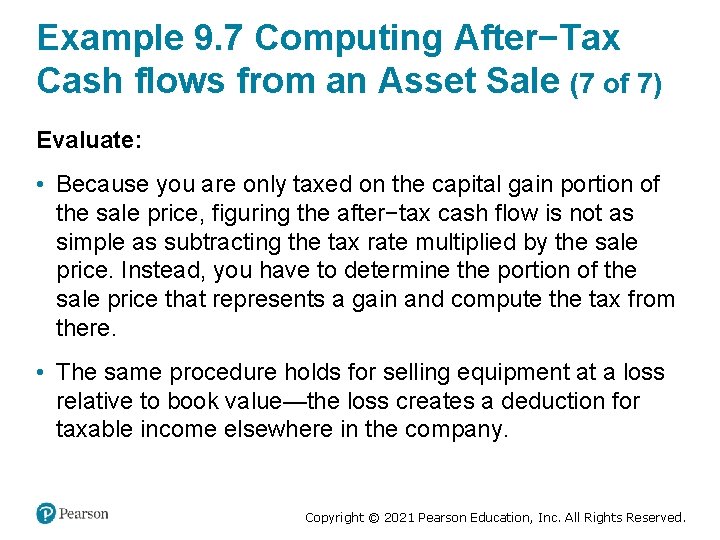
Example 9. 7 Computing After−Tax Cash flows from an Asset Sale (7 of 7) Evaluate: • Because you are only taxed on the capital gain portion of the sale price, figuring the after−tax cash flow is not as simple as subtracting the tax rate multiplied by the sale price. Instead, you have to determine the portion of the sale price that represents a gain and compute the tax from there. • The same procedure holds for selling equipment at a loss relative to book value—the loss creates a deduction for taxable income elsewhere in the company. Copyright © 2021 Pearson Education, Inc. All Rights Reserved.
9. 4 Other Effects on Incremental Free Cash Flows (4 of 5) • Adjusting Free Cash Flow – Tax Loss Carryforwards § Allow corporations to take losses during a current year and offset them against gains in nearby years Copyright © 2021 Pearson Education, Inc. All Rights Reserved.
9. 4 Other Effects on Incremental Free Cash Flows (5 of 5) • Replacement Decisions – Often the financial manager must decide whether to replace an existing piece of equipment § The new equipment may allow increased production, resulting in incremental revenue, or it may simply be more efficient, lowering costs Copyright © 2021 Pearson Education, Inc. All Rights Reserved.
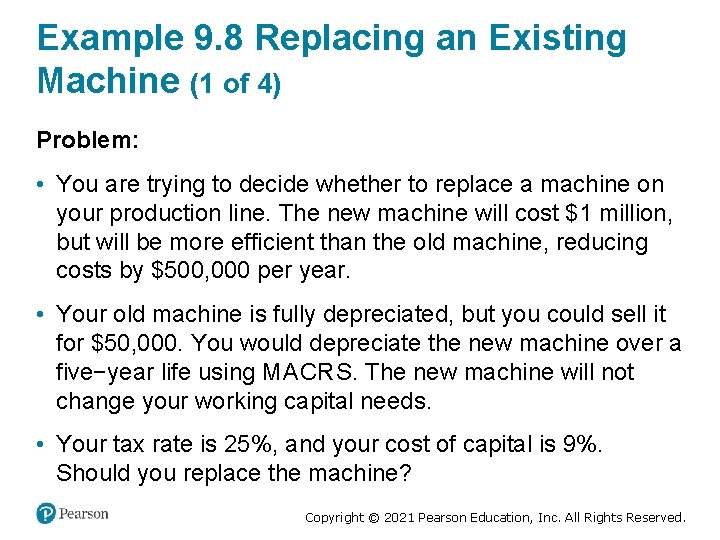
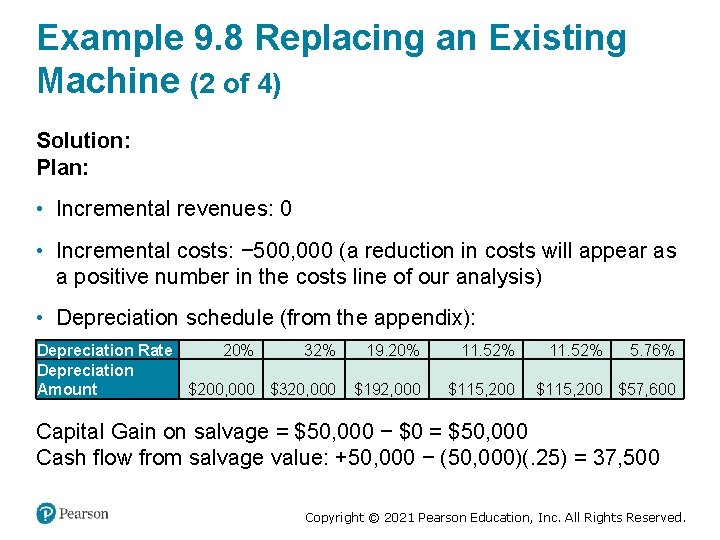
Example 9. 8 Replacing an Existing Machine (1 of 4) Problem: • You are trying to decide whether to replace a machine on your production line. The new machine will cost $1 million, but will be more efficient than the old machine, reducing costs by $500, 000 per year. • Your old machine is fully depreciated, but you could sell it for $50, 000. You would depreciate the new machine over a five−year life using MACR S. The new machine will not change your working capital needs. • Your tax rate is 25%, and your cost of capital is 9%. Should you replace the machine? Copyright © 2021 Pearson Education, Inc. All Rights Reserved.
Example 9. 8 Replacing an Existing Machine (2 of 4) Solution: Plan: • Incremental revenues: 0 • Incremental costs: − 500, 000 (a reduction in costs will appear as a positive number in the costs line of our analysis) • Depreciation schedule (from the appendix): Depreciation Rate 20% 32% Depreciation Amount $200, 000 $320, 000 19. 20% 11. 52% $192, 000 $115, 200 11. 52% 5. 76% $115, 200 $57, 600 Capital Gain on salvage = $50, 000 − $0 = $50, 000 Cash flow from salvage value: +50, 000 − (50, 000)(. 25) = 37, 500 Copyright © 2021 Pearson Education, Inc. All Rights Reserved.
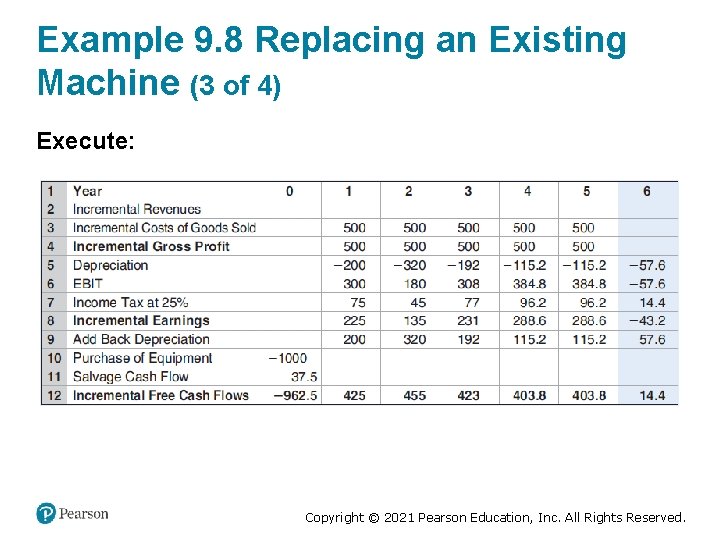
Example 9. 8 Replacing an Existing Machine (3 of 4) Execute: Copyright © 2021 Pearson Education, Inc. All Rights Reserved.
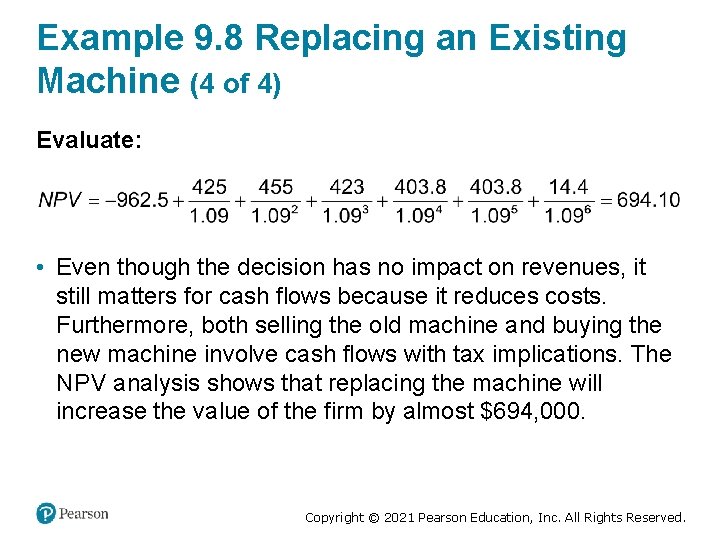
Example 9. 8 Replacing an Existing Machine (4 of 4) Evaluate: • Even though the decision has no impact on revenues, it still matters for cash flows because it reduces costs. Furthermore, both selling the old machine and buying the new machine involve cash flows with tax implications. The NPV analysis shows that replacing the machine will increase the value of the firm by almost $694, 000. Copyright © 2021 Pearson Education, Inc. All Rights Reserved.
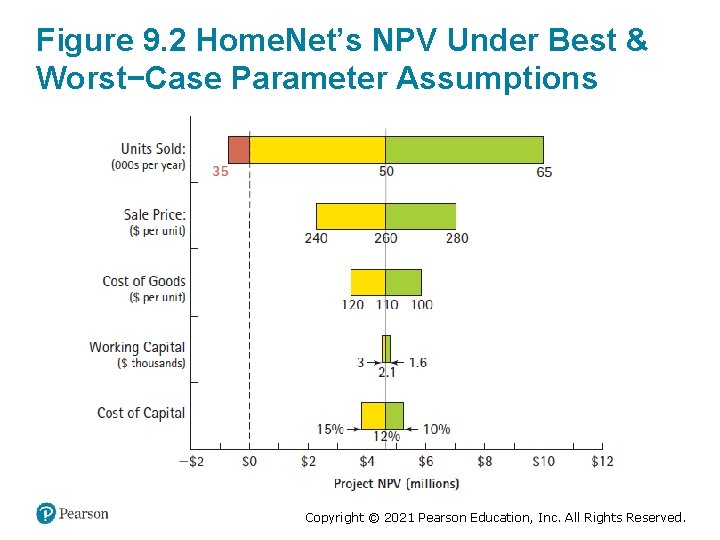
9. 5 Analyzing the Project (1 of 4) • Sensitivity Analysis – A capital budgeting tool that determines how the NPV varies as a single underlying assumption is changed Copyright © 2021 Pearson Education, Inc. All Rights Reserved.
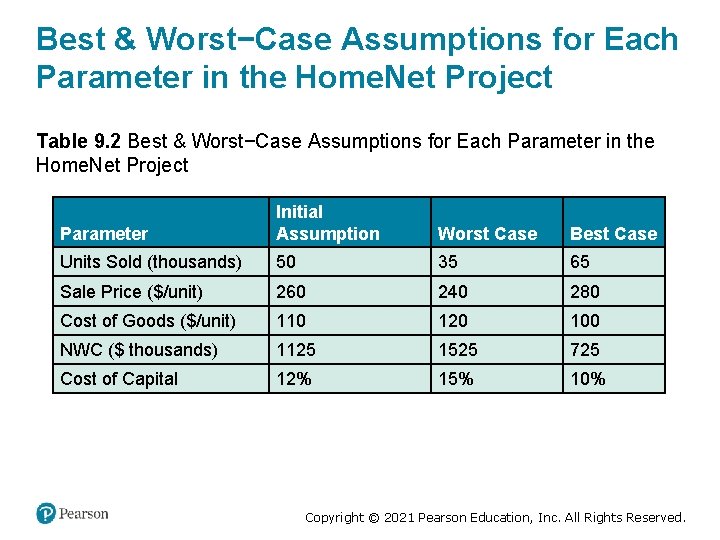
Best & Worst−Case Assumptions for Each Parameter in the Home. Net Project Table 9. 2 Best & Worst−Case Assumptions for Each Parameter in the Home. Net Project Parameter Initial Assumption Worst Case Best Case Units Sold (thousands) 50 35 65 Sale Price ($/unit) 260 240 280 Cost of Goods ($/unit) 110 120 100 NWC ($ thousands) 1125 1525 725 Cost of Capital 12% 15% 10% Copyright © 2021 Pearson Education, Inc. All Rights Reserved.
Figure 9. 2 Home. Net’s NPV Under Best & Worst−Case Parameter Assumptions Copyright © 2021 Pearson Education, Inc. All Rights Reserved.
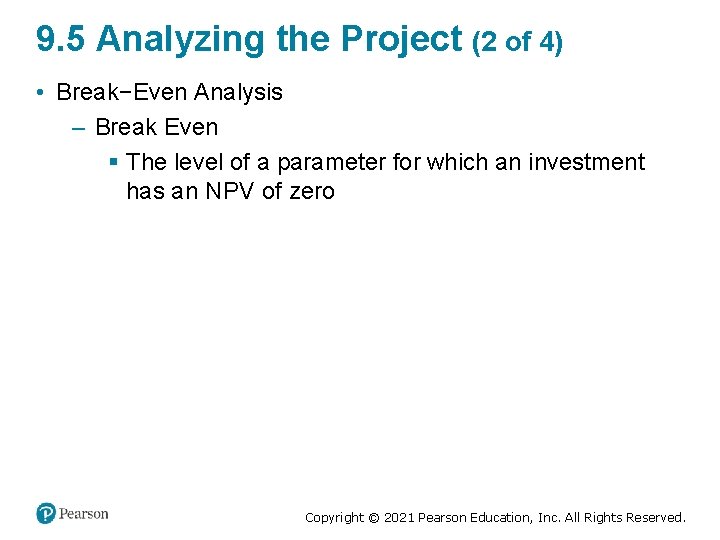
9. 5 Analyzing the Project (2 of 4) • Break−Even Analysis – Break Even § The level of a parameter for which an investment has an NPV of zero Copyright © 2021 Pearson Education, Inc. All Rights Reserved.
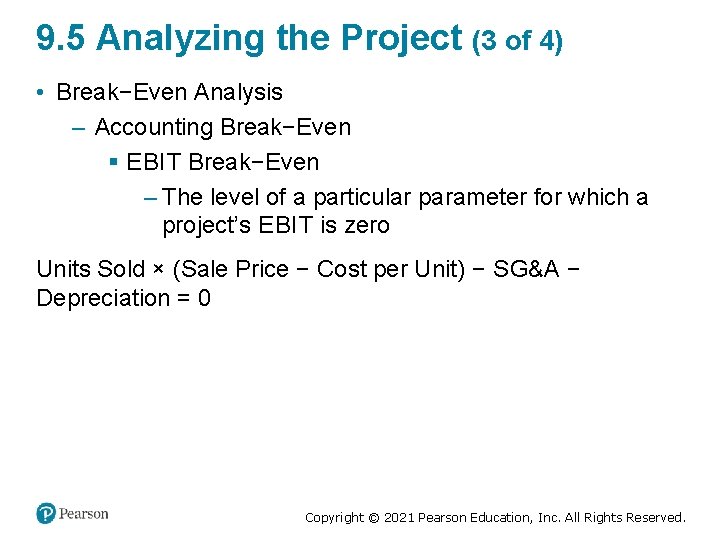
9. 5 Analyzing the Project (3 of 4) • Break−Even Analysis – Accounting Break−Even § EBI T Break−Even – The level of a particular parameter for which a project’s EBI T is zero Units Sold × (Sale Price − Cost per Unit) − SG&A − Depreciation = 0 Copyright © 2021 Pearson Education, Inc. All Rights Reserved.
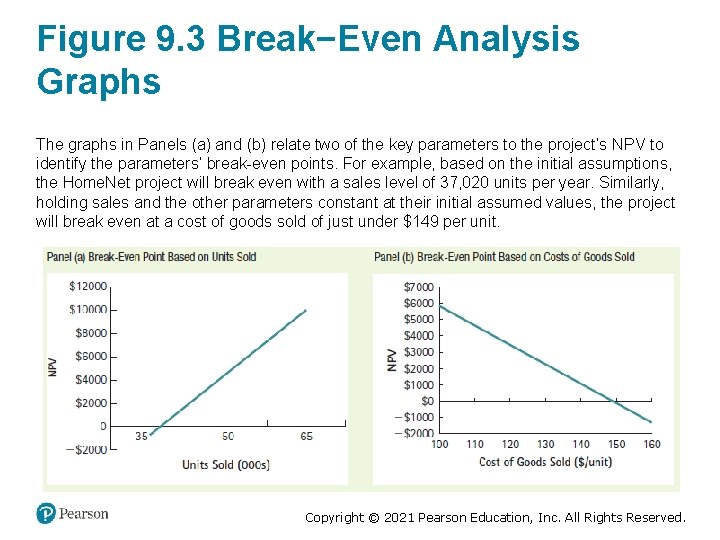
Figure 9. 3 Break−Even Analysis Graphs The graphs in Panels (a) and (b) relate two of the key parameters to the project’s NPV to identify the parameters’ break-even points. For example, based on the initial assumptions, the Home. Net project will break even with a sales level of 37, 020 units per year. Similarly, holding sales and the other parameters constant at their initial assumed values, the project will break even at a cost of goods sold of just under $149 per unit. Copyright © 2021 Pearson Education, Inc. All Rights Reserved.
9. 5 Analyzing the Project (4 of 4) • Scenario Analysis – A capital budgeting tool that determines how the NPV varies as a number of the underlying assumptions are changed simultaneously Copyright © 2021 Pearson Education, Inc. All Rights Reserved.
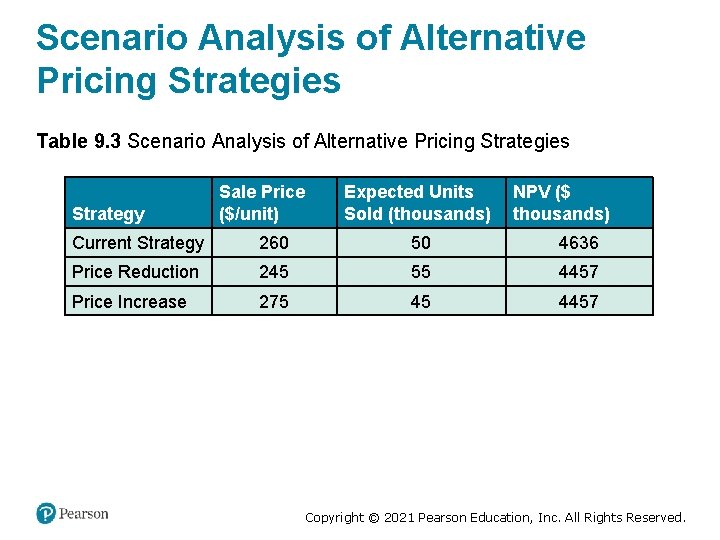
Scenario Analysis of Alternative Pricing Strategies Table 9. 3 Scenario Analysis of Alternative Pricing Strategies Strategy Sale Price ($/unit) Expected Units Sold (thousands) NPV ($ thousands) Current Strategy 260 50 4636 Price Reduction 245 55 4457 Price Increase 275 45 4457 Copyright © 2021 Pearson Education, Inc. All Rights Reserved.
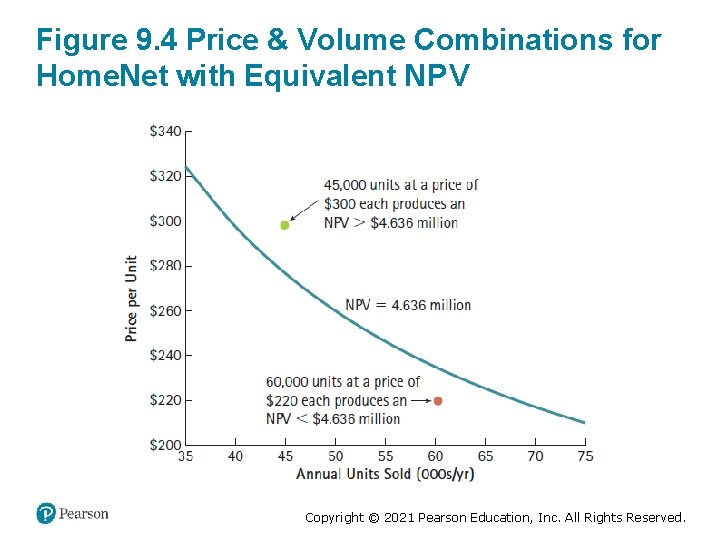
Figure 9. 4 Price & Volume Combinations for Home. Net with Equivalent N P V Copyright © 2021 Pearson Education, Inc. All Rights Reserved.
9. 6 Real Options in Capital Budgeting • Real Option – The right, but not the obligation, to take a particular business action • Option to Delay • Option to Expand • Option to Abandon Copyright © 2021 Pearson Education, Inc. All Rights Reserved.
MACR S Depreciation Table Showing the Percentage of the Asset’s Cost That May Be Depreciated Each Year Based on Its Recovery Period Table 9. 4 MACR S Depreciation Table Showing the Percentage of the Asset’s Cost That May Be Depreciated Each Year Based on Its Recovery Period Copyright © 2021 Pearson Education, Inc. All Rights Reserved.
Chapter Quiz (1 of 2) 1. What is capital budgeting, and what is its goal? 2. Why do we focus only on incremental revenues and costs, rather than all revenues and costs of the firm? 3. Why does an increase in net working capital represent a cash outflow? Copyright © 2021 Pearson Education, Inc. All Rights Reserved.
Chapter Quiz (2 of 2) 4. Explain why it is advantageous for a firm to use the most accelerated depreciation schedule possible for tax purposes? 5. How does scenario analysis differ from sensitivity analysis? 6. Why do real options increase the NPV of the project? Copyright © 2021 Pearson Education, Inc. All Rights Reserved.
Copyright This work is protected by United States copyright laws and is provided solely for the use of instructors in teaching their courses and assessing student learning. Dissemination or sale of any part of this work (including on the World Wide Web) will destroy the integrity of the work and is not permitted. The work and materials from it should never be made available to students except by instructors using the accompanying text in their classes. All recipients of this work are expected to abide by these restrictions and to honor the intended pedagogical purposes and the needs of other instructors who rely on these materials. Copyright © 2021 Pearson Education, Inc. All Rights Reserved.