
Fundamentals of Control Theory Hongwei Zhang hongweiiastate edu
![References n Control Theory Basics n n n [1] Joseph L. Hellerstein, Yixin Diao,](https://slidetodoc.com/presentation_image_h2/b99c8f3f564104953fe8a4b5c887f3b3/image-30.jpg "References n Control Theory Basics n n n [1] Joseph L. Hellerstein, Yixin Diao,")
- Slides: 31
Fundamentals of Control Theory Hongwei Zhang hongwei@iastate. edu, 515 294 2143 http: //www. ece. iastate. edu/~hongwei Acknowledgment: Joseph Hellerstein, Sujay Parekh, Chenyang Lu
Outline n Examples and Motivation n Control Theory Vocabulary and Methodology n Modeling Dynamic Systems n Transient Behavior Analysis n Standard Control Actions n Advanced Topics n Issues for Computer Systems
Outline n Examples and Motivation n Control Theory Vocabulary and Methodology n Modeling Dynamic Systems n Transient Behavior Analysis n Standard Control Actions n Advanced Topics n Issues for Computer Systems
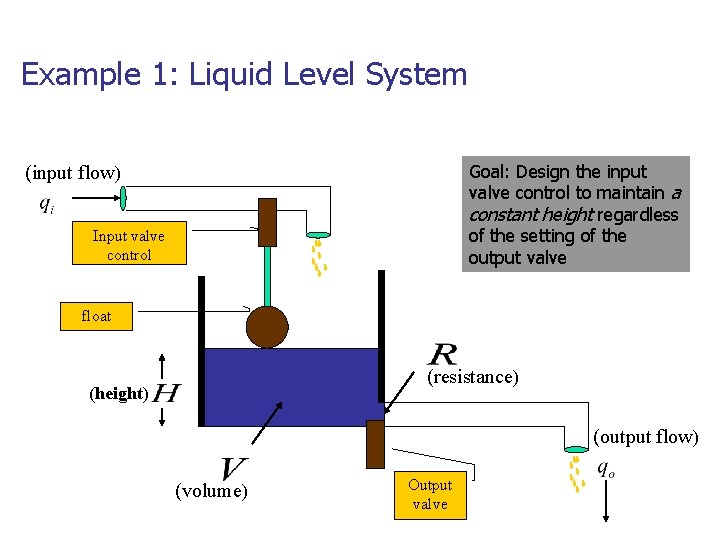
Example 1: Liquid Level System Goal: Design the input valve control to maintain a constant height regardless of the setting of the output valve (input flow) Input valve control float (resistance) (height) (output flow) (volume) Output valve
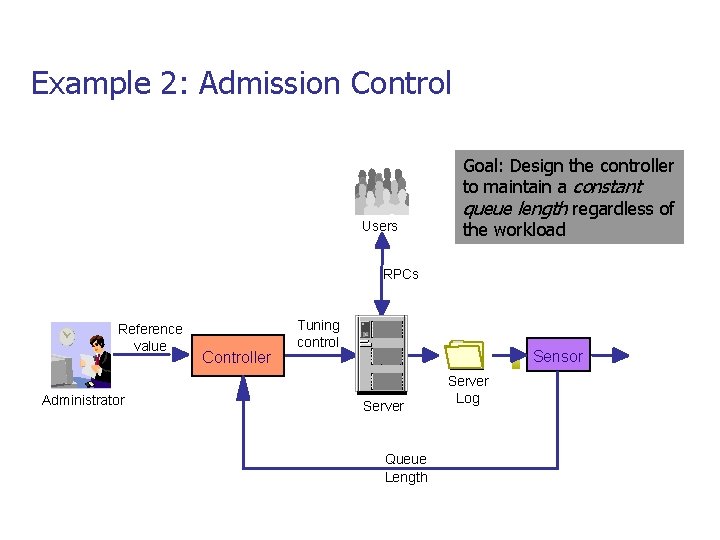
Example 2: Admission Control Users Goal: Design the controller to maintain a constant queue length regardless of the workload RPCs Reference value Administrator Controller Tuning control Sensor Server Queue Length Server Log
Open-loop control n Compute control input without continuous variable measurement n n Simple Need to know EVERYTHING ACCURATELY to work right n n n Cruise-control car: friction(t), ramp_angle(t) E-commerce server: Workload (request arrival rate? resource consumption? ); system (service time? failures? ) Open-loop control fails when n We don’t know everything We make errors in estimation/modeling Things change
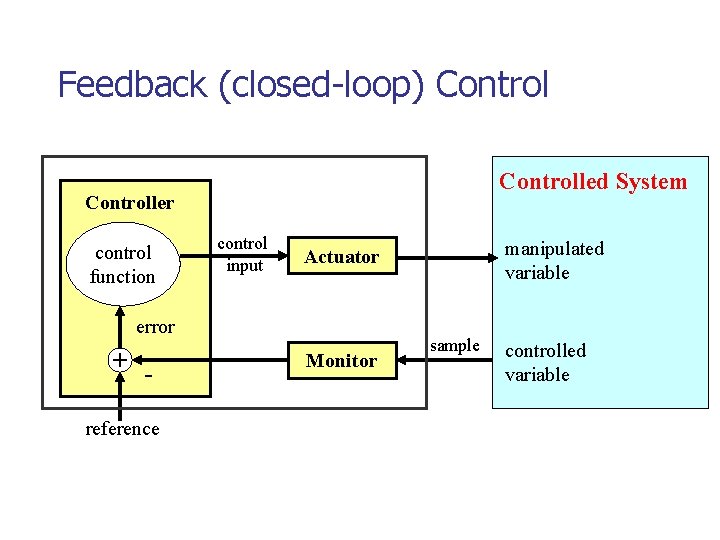
Feedback (closed-loop) Controlled System Controller control function control input error + reference manipulated variable Actuator Monitor sample controlled variable
n Measure variables and use it to compute control input n n More complicated (so we need control theory) Continuously measure & correct n n Cruise-control car: measure speed & change engine force E-commerce server: measure response time & admission control Embedded network: measure collision & change scheduling Feedback control theory makes it possible to control well even if n n n We don’t know everything We make errors in estimation/modeling Things change
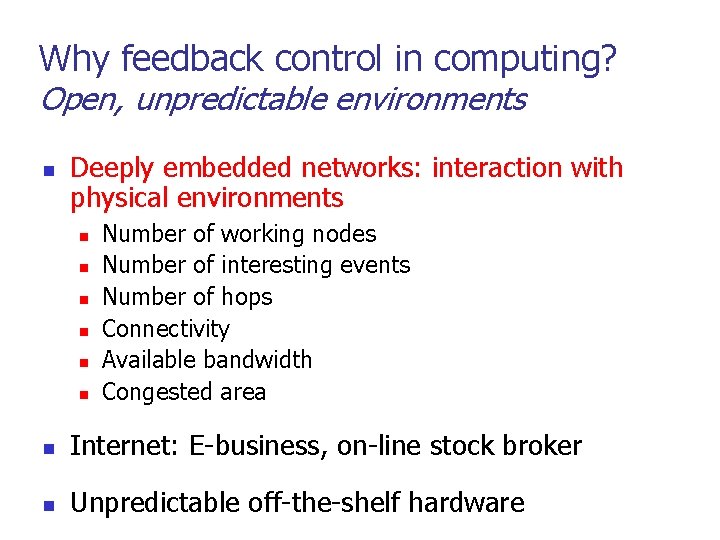
Why feedback control in computing? Open, unpredictable environments n Deeply embedded networks: interaction with physical environments n n n Number of working nodes Number of interesting events Number of hops Connectivity Available bandwidth Congested area n Internet: E-business, on-line stock broker n Unpredictable off-the-shelf hardware
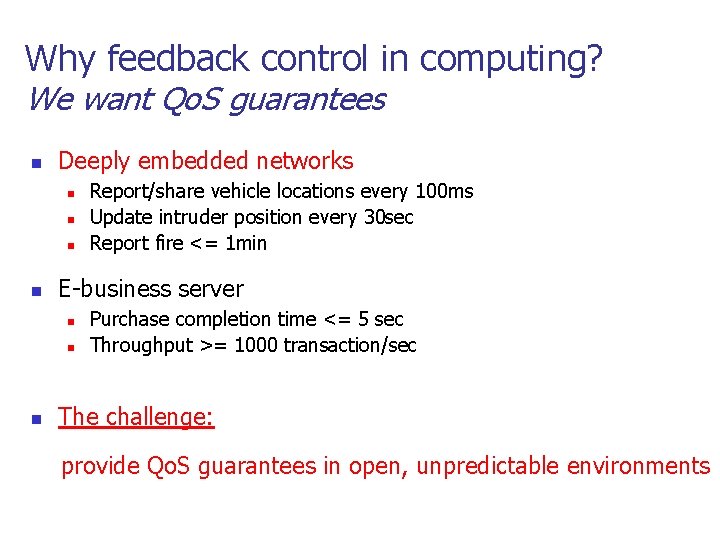
Why feedback control in computing? We want Qo. S guarantees n Deeply embedded networks n n E-business server n n n Report/share vehicle locations every 100 ms Update intruder position every 30 sec Report fire <= 1 min Purchase completion time <= 5 sec Throughput >= 1000 transaction/sec The challenge: provide Qo. S guarantees in open, unpredictable environments
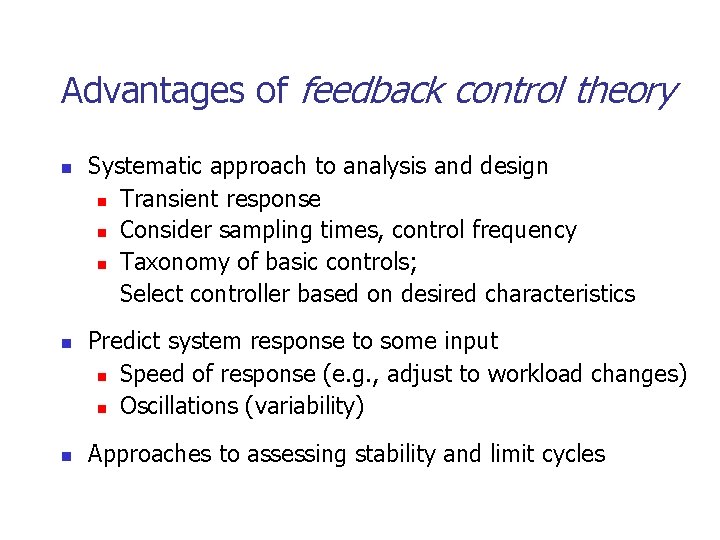
Advantages of feedback control theory n n n Systematic approach to analysis and design n Transient response n Consider sampling times, control frequency n Taxonomy of basic controls; Select controller based on desired characteristics Predict system response to some input n Speed of response (e. g. , adjust to workload changes) n Oscillations (variability) Approaches to assessing stability and limit cycles
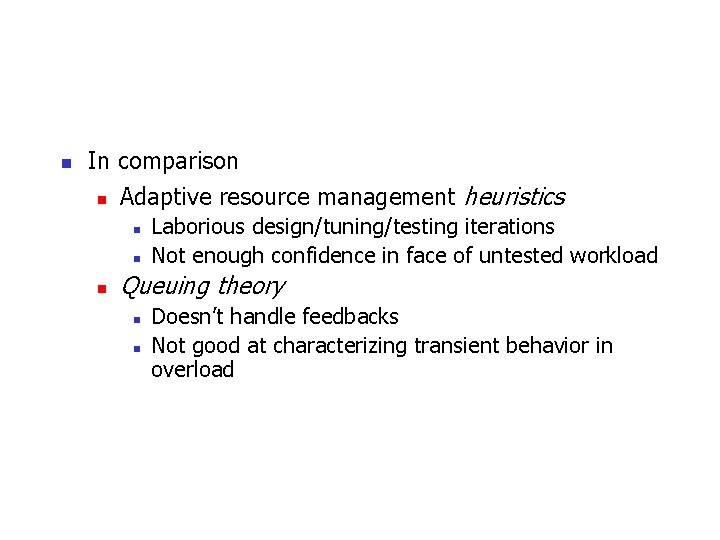
n In comparison n Adaptive resource management heuristics n n n Laborious design/tuning/testing iterations Not enough confidence in face of untested workload Queuing theory n n Doesn’t handle feedbacks Not good at characterizing transient behavior in overload
Outline n Examples and Motivation n Control Theory Vocabulary and Methodology n Modeling Dynamic Systems n Transient Behavior Analysis n Standard Control Actions n Advanced Topics n Issues for Computer Systems
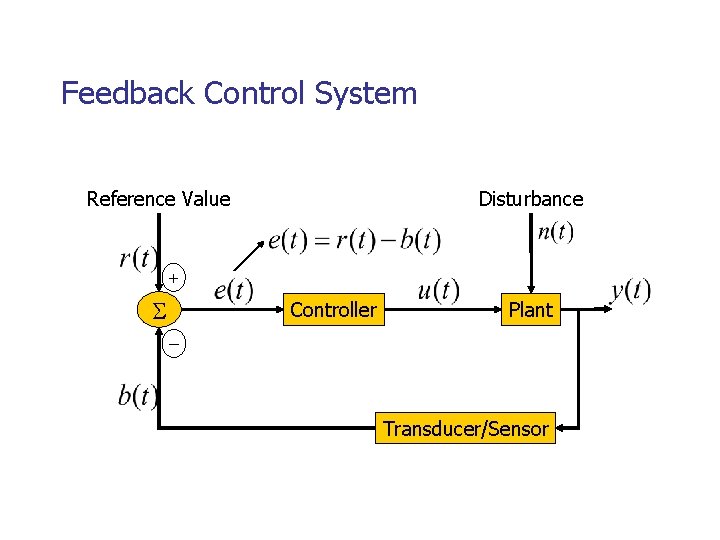
Feedback Control System Reference Value Disturbance + S Controller Plant – Transducer/Sensor
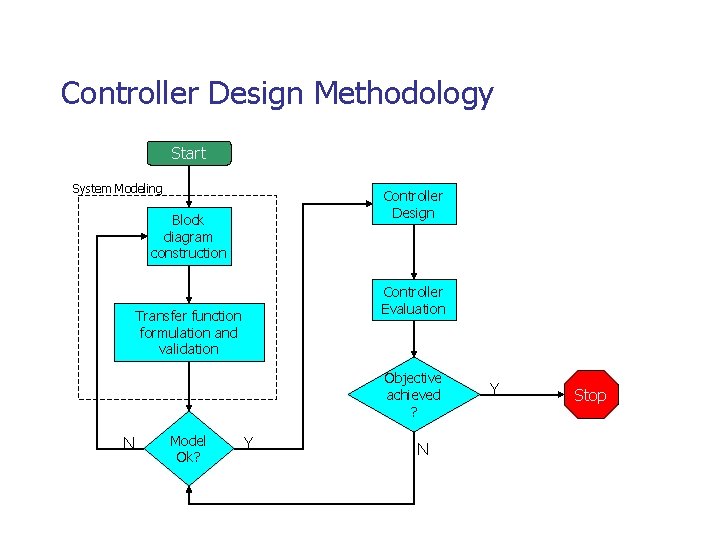
Controller Design Methodology Start System Modeling Controller Design Block diagram construction Controller Evaluation Transfer function formulation and validation Objective achieved ? N Model Ok? Y N Y Stop
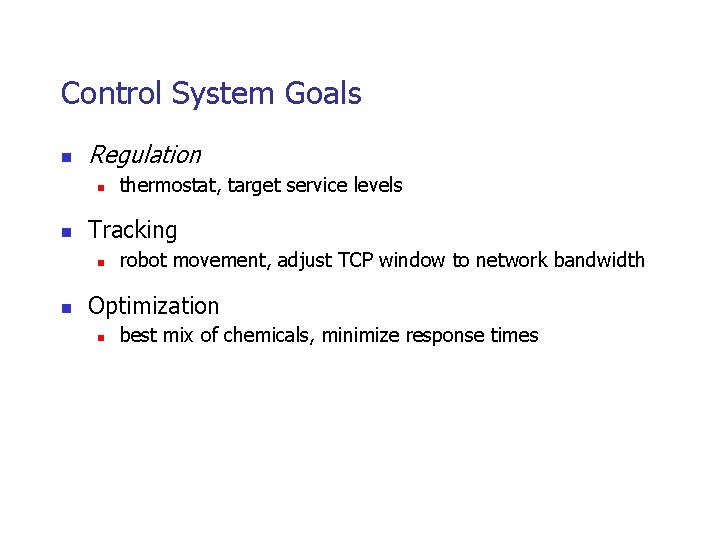
Control System Goals n Regulation n n Tracking n n thermostat, target service levels robot movement, adjust TCP window to network bandwidth Optimization n best mix of chemicals, minimize response times
Outline n Examples and Motivation n Control Theory Vocabulary and Methodology n Modeling Dynamic Systems n Transient Behavior Analysis n Standard Control Actions n Advanced Topics n Issues for Computer Systems
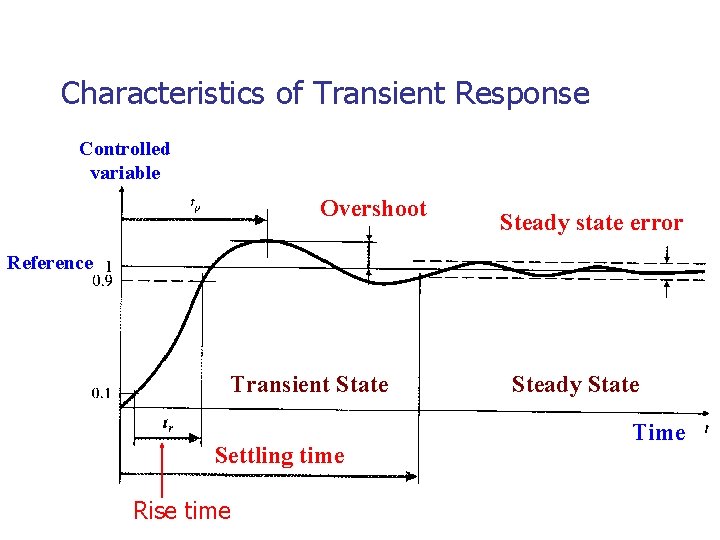
Objectives of Control for Computing Systems: SASO n Stability n Accuracy n Settling time n Overshoot
Characteristics of Transient Response Controlled variable Overshoot Steady state error % Reference Transient State Settling time Rise time Steady State Time
Outline n Examples and Motivation n Control Theory Vocabulary and Methodology n Modeling Dynamic Systems n Transient Behavior Analysis n Standard Control Actions n Advanced Topics n Issues for Computer Systems
Basic Control Actions: u(t)
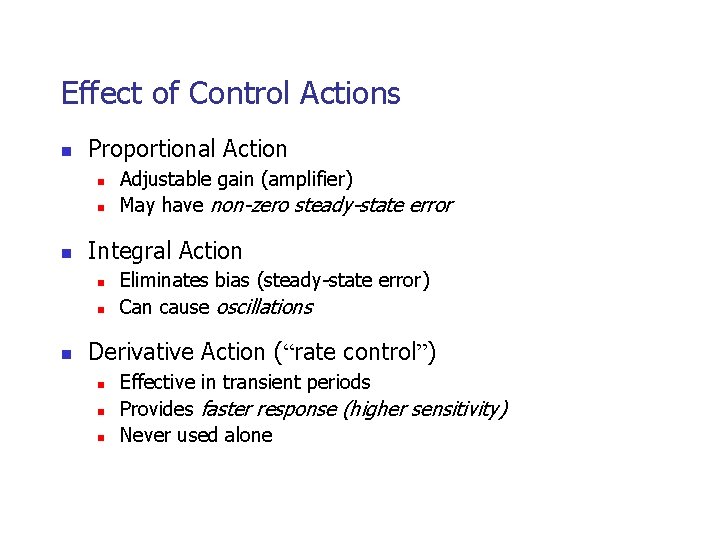
Effect of Control Actions n Proportional Action n Integral Action n Adjustable gain (amplifier) May have non-zero steady-state error Eliminates bias (steady-state error) Can cause oscillations Derivative Action (“rate control”) n n n Effective in transient periods Provides faster response (higher sensitivity) Never used alone
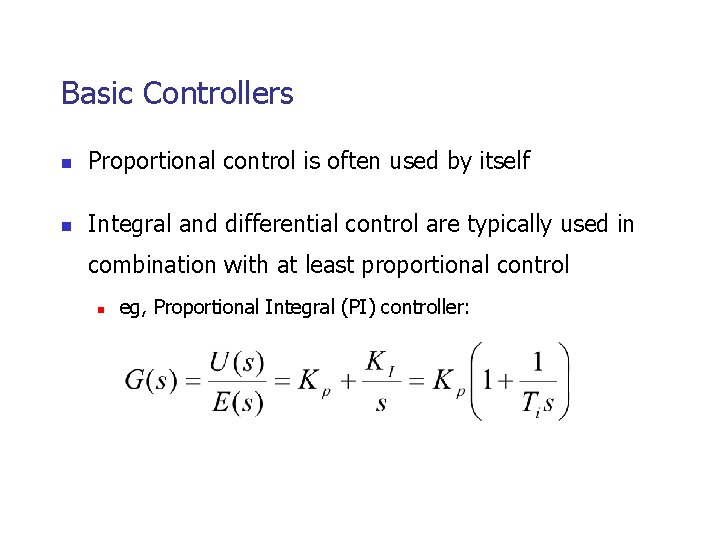
Basic Controllers n Proportional control is often used by itself n Integral and differential control are typically used in combination with at least proportional control n eg, Proportional Integral (PI) controller:
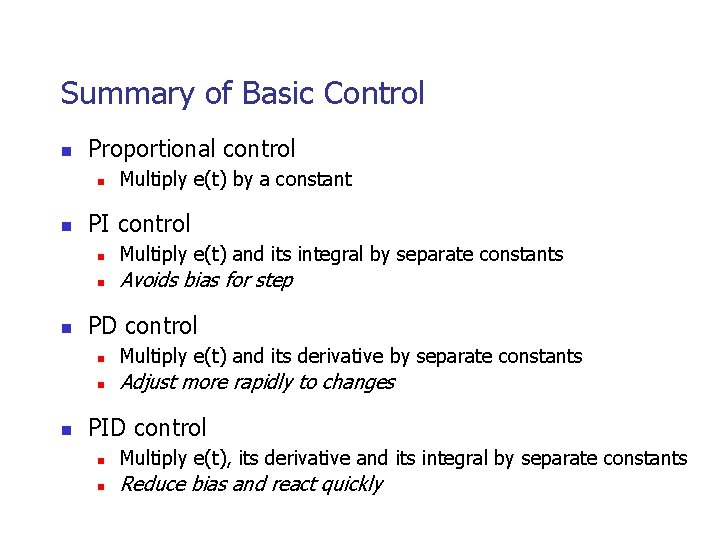
Summary of Basic Control n Proportional control n n Multiply e(t) by a constant PI control n Multiply e(t) and its integral by separate constants n Avoids bias for step PD control n Multiply e(t) and its derivative by separate constants n Adjust more rapidly to changes PID control n Multiply e(t), its derivative and its integral by separate constants n Reduce bias and react quickly
Outline n Examples and Motivation n Control Theory Vocabulary and Methodology n Modeling Dynamic Systems n Transient Behavior Analysis n Standard Control Actions n Advanced Topics n Issues for Computer Systems
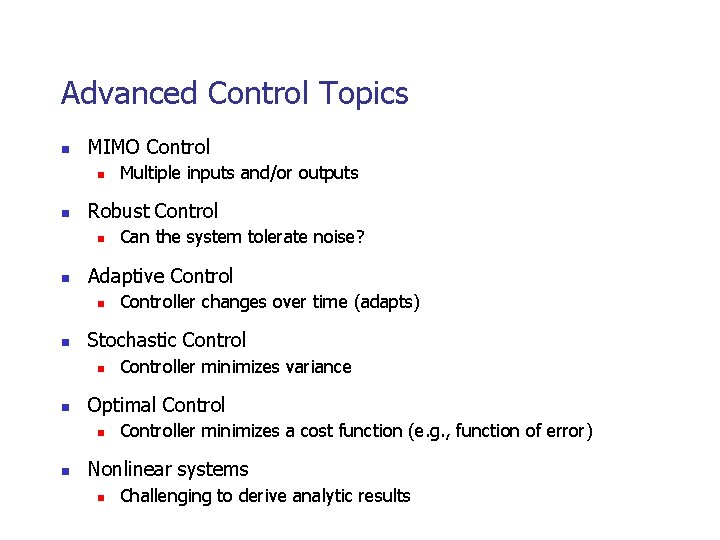
Advanced Control Topics n MIMO Control n n Robust Control n n Controller minimizes variance Optimal Control n n Controller changes over time (adapts) Stochastic Control n n Can the system tolerate noise? Adaptive Control n n Multiple inputs and/or outputs Controller minimizes a cost function (e. g. , function of error) Nonlinear systems n Challenging to derive analytic results
Outline n Examples and Motivation n Control Theory Vocabulary and Methodology n Modeling Dynamic Systems n Transient Behavior Analysis n Standard Control Actions n Advanced Topics n Issues for Computer Systems
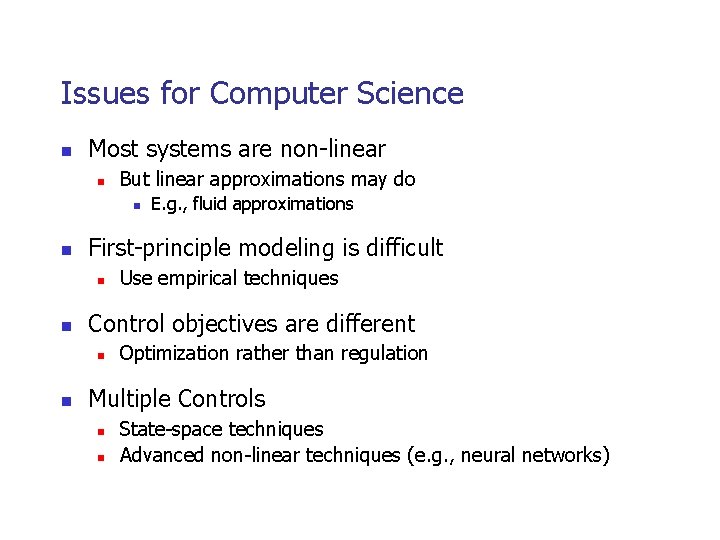
Issues for Computer Science n Most systems are non-linear n But linear approximations may do n n First-principle modeling is difficult n n Use empirical techniques Control objectives are different n n E. g. , fluid approximations Optimization rather than regulation Multiple Controls n n State-space techniques Advanced non-linear techniques (e. g. , neural networks)
Summary n Examples and Motivation n Control Theory Vocabulary and Methodology n Modeling Dynamic Systems n Transient Behavior Analysis n Standard Control Actions n Advanced Topics n Issues for Computer Systems
References n Control Theory Basics n n n [1] Joseph L. Hellerstein, Yixin Diao, Sujay Parekh, Dawn M. Tilbury, Feedback Control of Computing Systems, Wiley-IEEE Press, 2004. (ISBN: 978 -0 -471 -26637 -2) [2] G. Franklin, J. Powell and A. Emami-Naeini. “Feedback Control of Dynamic Systems, 3 rd ed”. Addison-Wesley, 1994. [3] K. Ogata. “Modern Control Engineering, 3 rd ed”. Prentice-Hall, 1997. [4] K. Ogata. “Discrete-Time Control Systems, 2 nd ed”. Prentice-Hall, 1995. Applications in Computer Science n n n n C. Hollot et al. “Control-Theoretic Analysis of RED”. IEEE Infocom 2001 C. Lu, et al. “A Feedback Control Approach for Guaranteeing Relative Delays in Web Servers ”. IEEE Real-Time Technology and Applications Symposium, June 2001. S. Parekh et al. “Using Control Theory to Achieve Service-level Objectives in Performance Management”. Int’l Symposium on Integrated Network Management, May 2001 Y. Lu et al. “Differentiated Caching Services: A Control-Theoretic Approach ”. Int’l Conf on Distributed Computing Systems, Apr 2001 S. Mascolo. “Classical Control Theory for Congestion Avoidance in High-speed Internet ”. Proc. 38 th Conference on Decision & Control, Dec 1999 S. Keshav. “A Control-Theoretic Approach to Flow Control”. Proc. ACM SIGCOMM, Sep 1991 D. Chiu and R. Jain. “Analysis of the Increase and Decrease Algorithms for Congestion Avoidance in Computer Networks”. Computer Networks and ISDN Systems, 17(1), Jun 1989
Assignment n Module 2 Quiz-B n Fundamentals of Real-Time Scheduling n Fundamentals of Control Theory