
Fundamentals of Cellular Communications and Networks Halim Yanikomeroglu
- Slides: 26
Fundamentals of Cellular Communications and Networks Halim Yanikomeroglu SYSC 4700 Lectures 15 (March 06) & 16 (March 08) 1
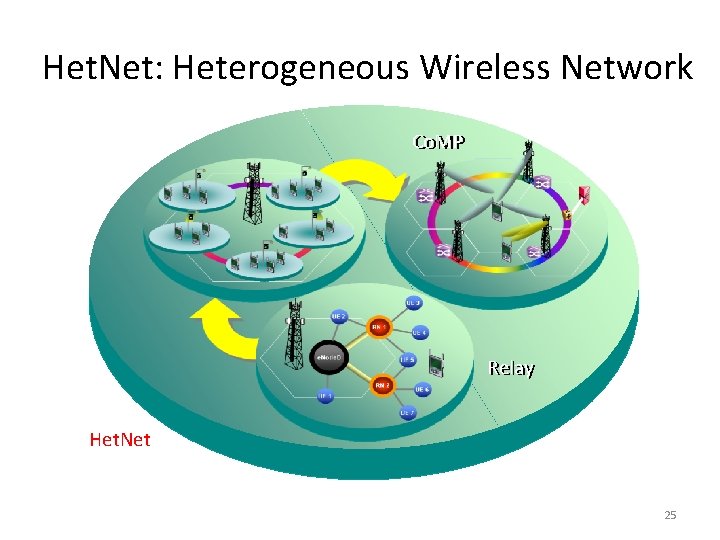
Objectives To learn some fundamental concepts in cellular communications such as • • Multiple access Channel reuse Clustering Cell-splitting Sectoring Interference Duplexing Heterogeneous cellular network 2
Multiple Access Schemes Dedicated medium vs shared medium Shared Medium • Random access (minimal protocol, no or minimal coordination) No or limited Qo. S guarantee Suitable for unlicensed bands • ALOHA • CSMA (carrier sense multiple access), aka listen-before-talk – used in Wi. Fi (802. 11) 3
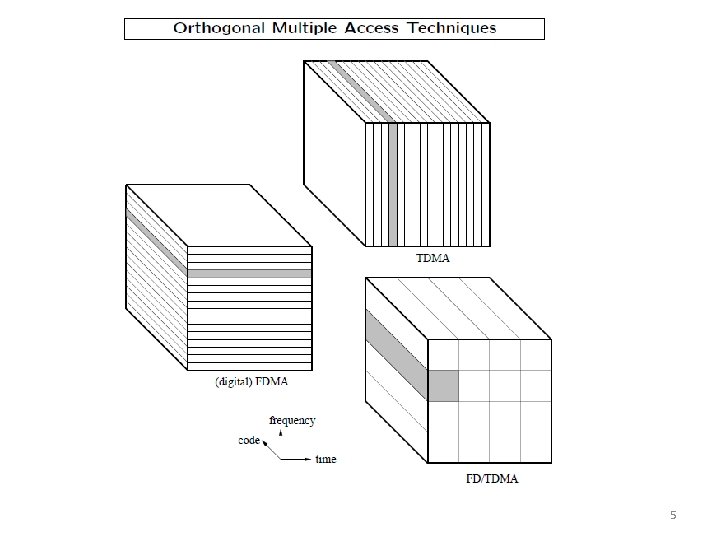
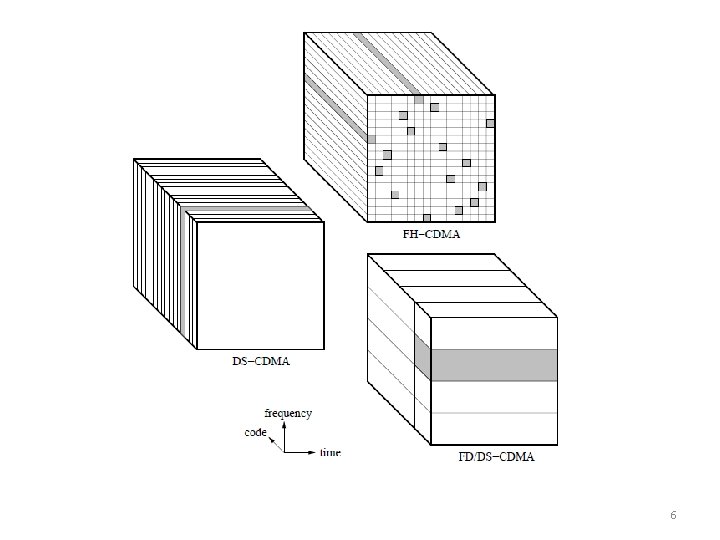
Multiple Access Schemes Dedicated medium vs shared medium Shared Medium • Random access (minimal protocol, no or minimal coordination) No or limited Qo. S guarantee Suitable for unlicensed bands • ALOHA • CSMA (carrier sense multiple access), aka listen-before-talk – used in Wi. Fi (802. 11) • Scheduled access (protocol for coordination overhead) Qo. S quarantee Suitable for licensed bands • TDMA (time-division multiple access) • FDMA (frequency-division multiple access), OFDMA – used in 4 G cellular • CDMA (code-division multiple access) – used in 3 G cellular 4
5
6
Wireless Cellular Networks
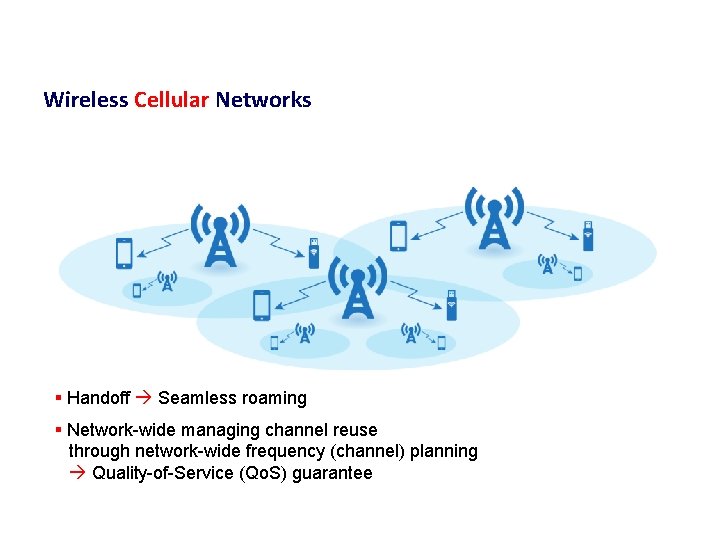
Wireless Cellular Networks § Handoff Seamless roaming § Network-wide managing channel reuse through network-wide frequency (channel) planning Quality-of-Service (Qo. S) guarantee
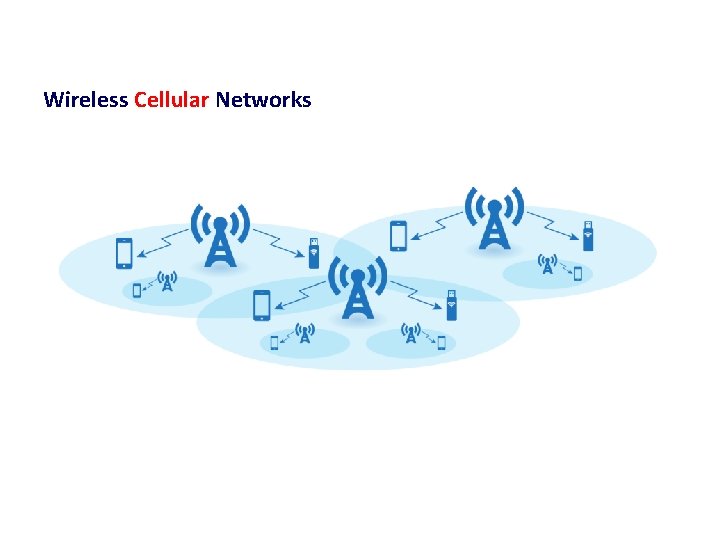
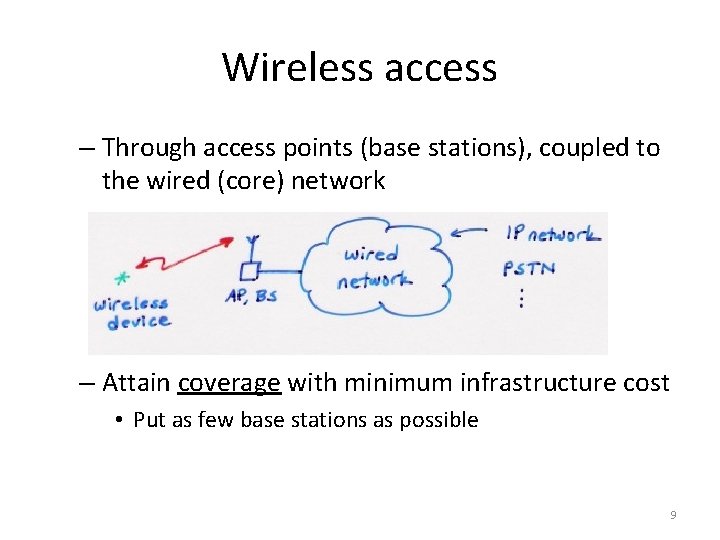
Wireless access – Through access points (base stations), coupled to the wired (core) network – Attain coverage with minimum infrastructure cost • Put as few base stations as possible 9
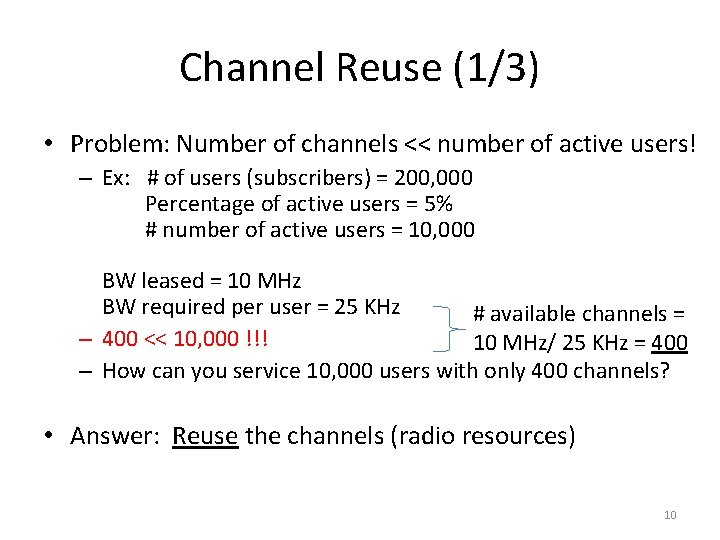
Channel Reuse (1/3) • Problem: Number of channels << number of active users! – Ex: # of users (subscribers) = 200, 000 Percentage of active users = 5% # number of active users = 10, 000 BW leased = 10 MHz BW required per user = 25 KHz # available channels = – 400 << 10, 000 !!! 10 MHz/ 25 KHz = 400 – How can you service 10, 000 users with only 400 channels? • Answer: Reuse the channels (radio resources) 10
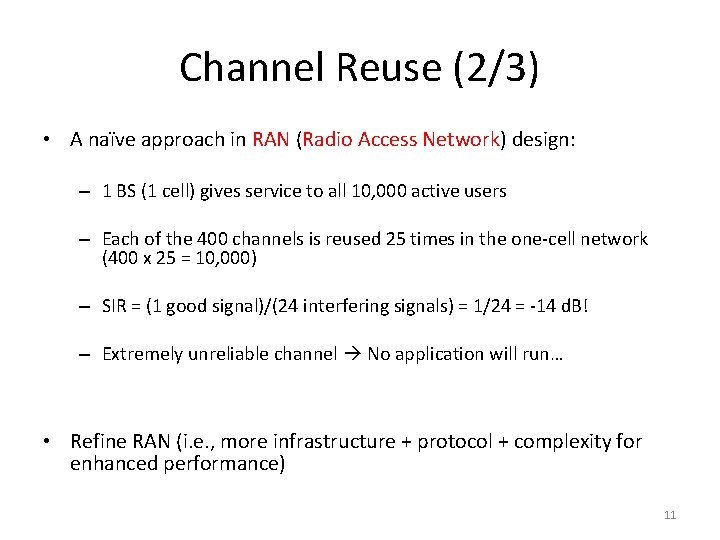
Channel Reuse (2/3) • A naïve approach in RAN (Radio Access Network) design: – 1 BS (1 cell) gives service to all 10, 000 active users – Each of the 400 channels is reused 25 times in the one-cell network (400 x 25 = 10, 000) – SIR = (1 good signal)/(24 interfering signals) = 1/24 = -14 d. B! – Extremely unreliable channel No application will run… • Refine RAN (i. e. , more infrastructure + protocol + complexity for enhanced performance) 11
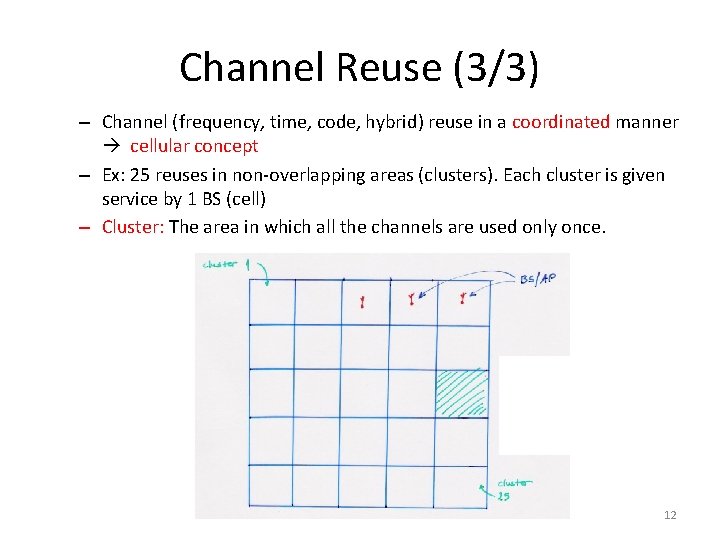
Channel Reuse (3/3) – Channel (frequency, time, code, hybrid) reuse in a coordinated manner cellular concept – Ex: 25 reuses in non-overlapping areas (clusters). Each cluster is given service by 1 BS (cell) – Cluster: The area in which all the channels are used only once. 12
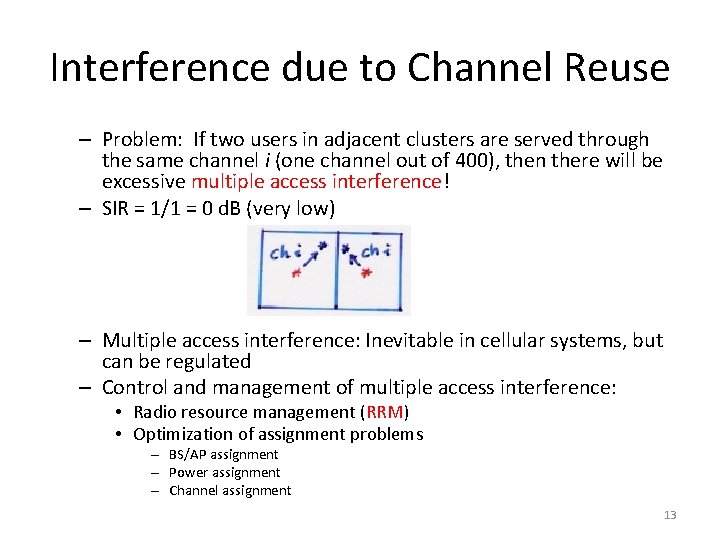
Interference due to Channel Reuse – Problem: If two users in adjacent clusters are served through the same channel i (one channel out of 400), then there will be excessive multiple access interference! – SIR = 1/1 = 0 d. B (very low) – Multiple access interference: Inevitable in cellular systems, but can be regulated – Control and management of multiple access interference: • Radio resource management (RRM) • Optimization of assignment problems – BS/AP assignment – Power assignment – Channel assignment 13
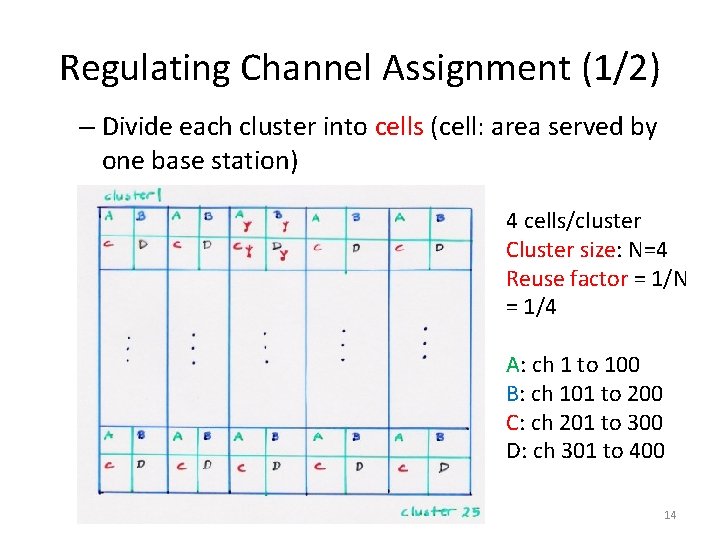
Regulating Channel Assignment (1/2) – Divide each cluster into cells (cell: area served by one base station) 4 cells/cluster Cluster size: N=4 Reuse factor = 1/N = 1/4 A: ch 1 to 100 B: ch 101 to 200 C: ch 201 to 300 D: ch 301 to 400 14
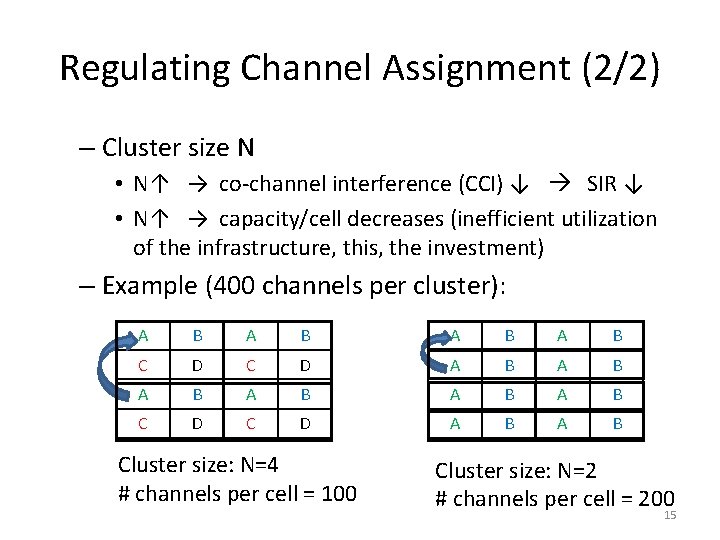
Regulating Channel Assignment (2/2) – Cluster size N • N↑ → co-channel interference (CCI) ↓ SIR ↓ • N↑ → capacity/cell decreases (inefficient utilization of the infrastructure, this, the investment) – Example (400 channels per cluster): A B A B C D C D A B A B Cluster size: N=4 # channels per cell = 100 Cluster size: N=2 # channels per cell = 200 15
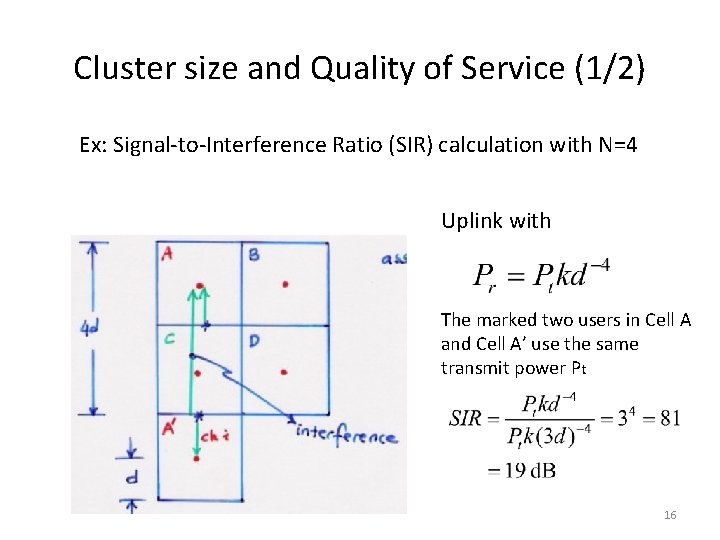
Cluster size and Quality of Service (1/2) Ex: Signal-to-Interference Ratio (SIR) calculation with N=4 Uplink with The marked two users in Cell A and Cell A’ use the same transmit power Pt 16
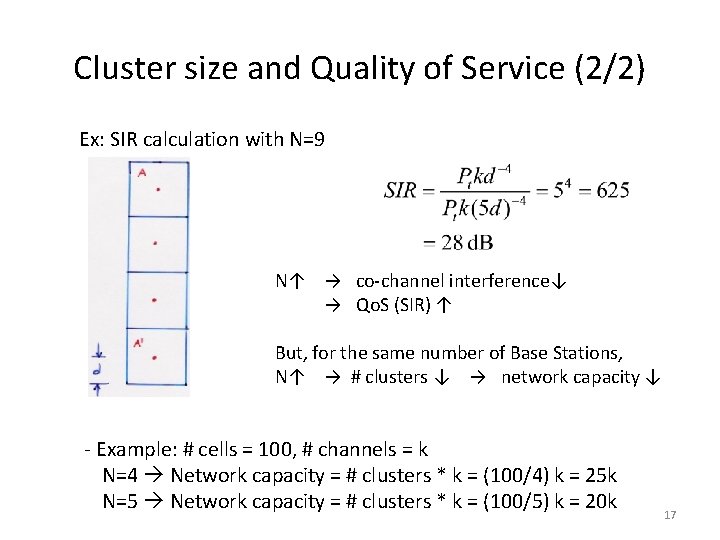
Cluster size and Quality of Service (2/2) Ex: SIR calculation with N=9 N↑ → co-channel interference↓ → Qo. S (SIR) ↑ But, for the same number of Base Stations, N↑ → # clusters ↓ → network capacity ↓ - Example: # cells = 100, # channels = k N=4 Network capacity = # clusters * k = (100/4) k = 25 k N=5 Network capacity = # clusters * k = (100/5) k = 20 k 17
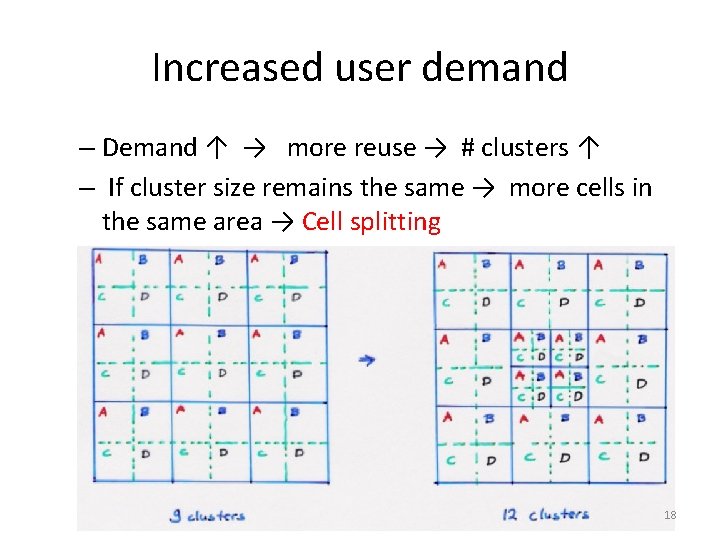
Increased user demand – Demand ↑ → more reuse → # clusters ↑ – If cluster size remains the same → more cells in the same area → Cell splitting 18
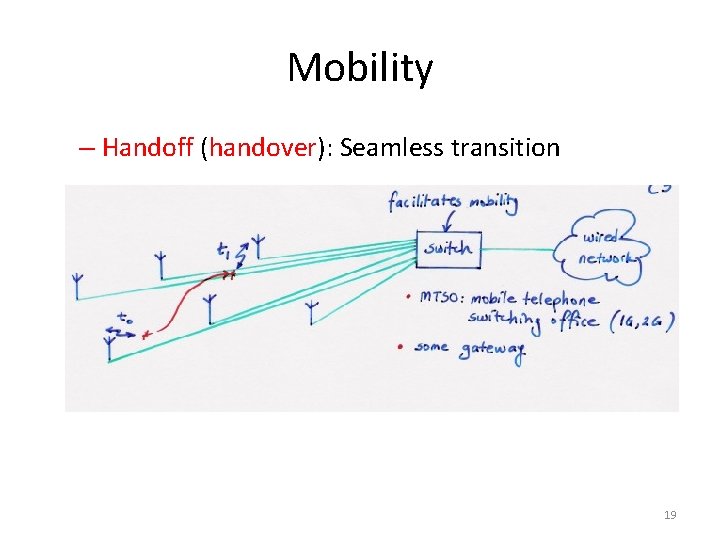
Mobility – Handoff (handover): Seamless transition 19
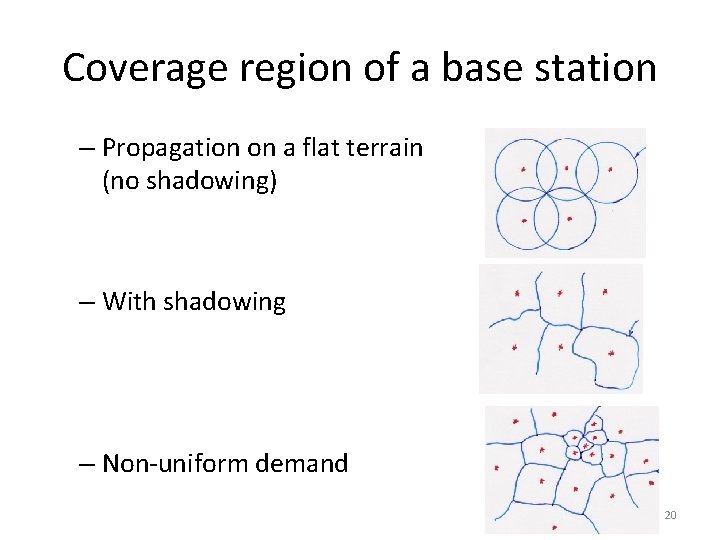
Coverage region of a base station – Propagation on a flat terrain (no shadowing) – With shadowing – Non-uniform demand 20
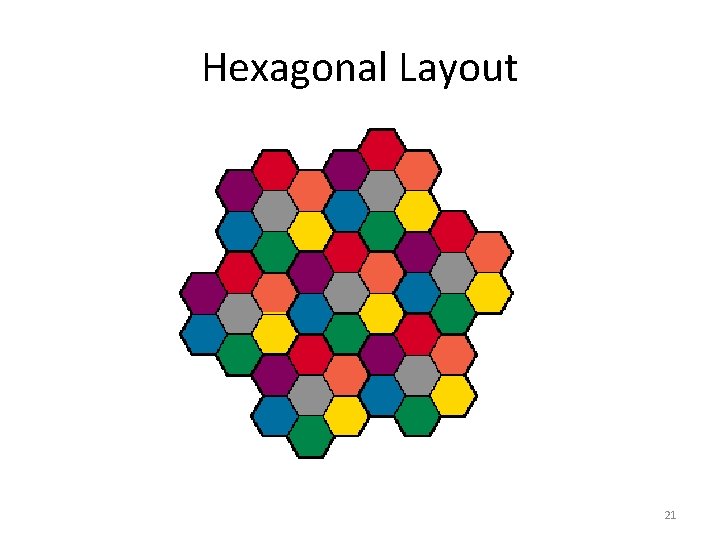
Hexagonal Layout 21
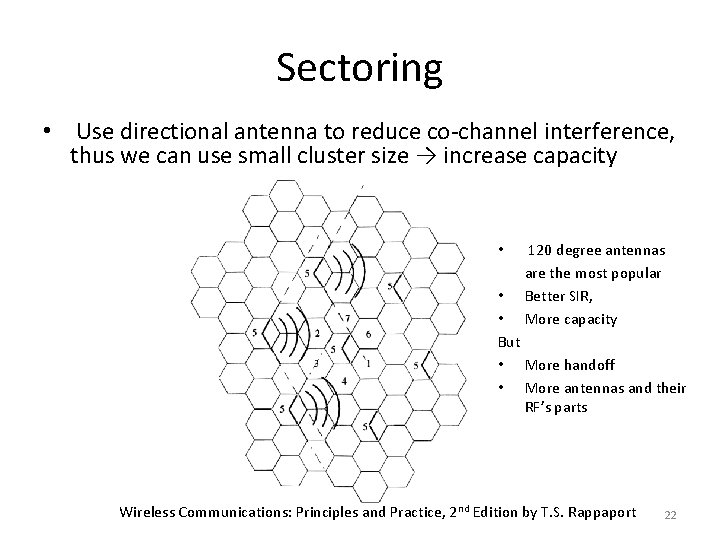
Sectoring • Use directional antenna to reduce co-channel interference, thus we can use small cluster size → increase capacity • 120 degree antennas are the most popular Better SIR, More capacity • • But • More handoff • More antennas and their RF’s parts Wireless Communications: Principles and Practice, 2 nd Edition by T. S. Rappaport 22
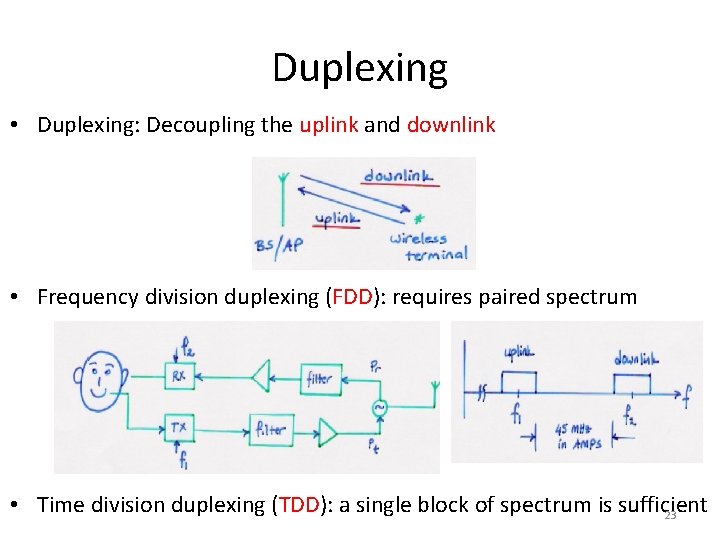
Duplexing • Duplexing: Decoupling the uplink and downlink • Frequency division duplexing (FDD): requires paired spectrum • Time division duplexing (TDD): a single block of spectrum is sufficient 23
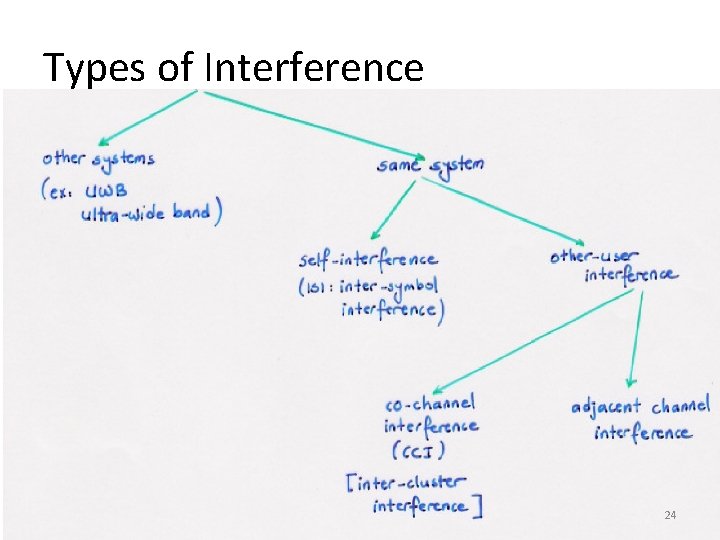
Types of Interference 24
Het. Net: Heterogeneous Wireless Network Co. MP Relay Het. Net 25
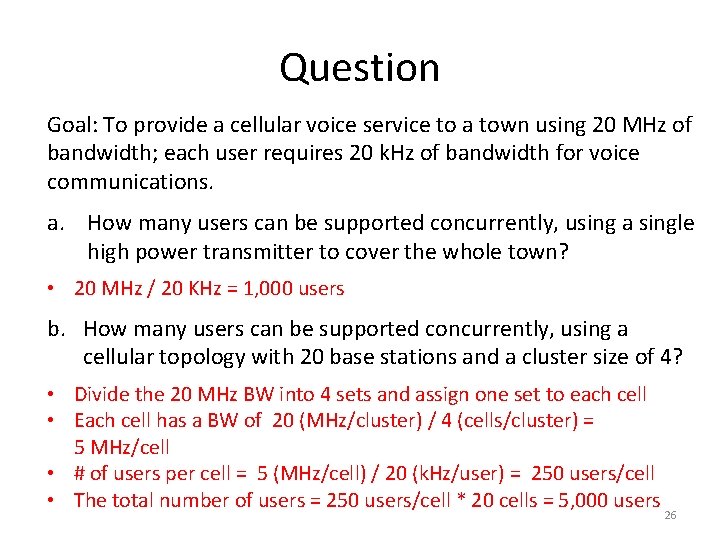
Question Goal: To provide a cellular voice service to a town using 20 MHz of bandwidth; each user requires 20 k. Hz of bandwidth for voice communications. a. How many users can be supported concurrently, using a single high power transmitter to cover the whole town? • 20 MHz / 20 KHz = 1, 000 users b. How many users can be supported concurrently, using a cellular topology with 20 base stations and a cluster size of 4? • Divide the 20 MHz BW into 4 sets and assign one set to each cell • Each cell has a BW of 20 (MHz/cluster) / 4 (cells/cluster) = 5 MHz/cell • # of users per cell = 5 (MHz/cell) / 20 (k. Hz/user) = 250 users/cell • The total number of users = 250 users/cell * 20 cells = 5, 000 users 26