
Fundamentals of Algorithms MCS 2 Lecture 11 Merge

- Slides: 7
Fundamentals of Algorithms MCS - 2 Lecture # 11
Merge Sort Using Divide & Conquer Strategy
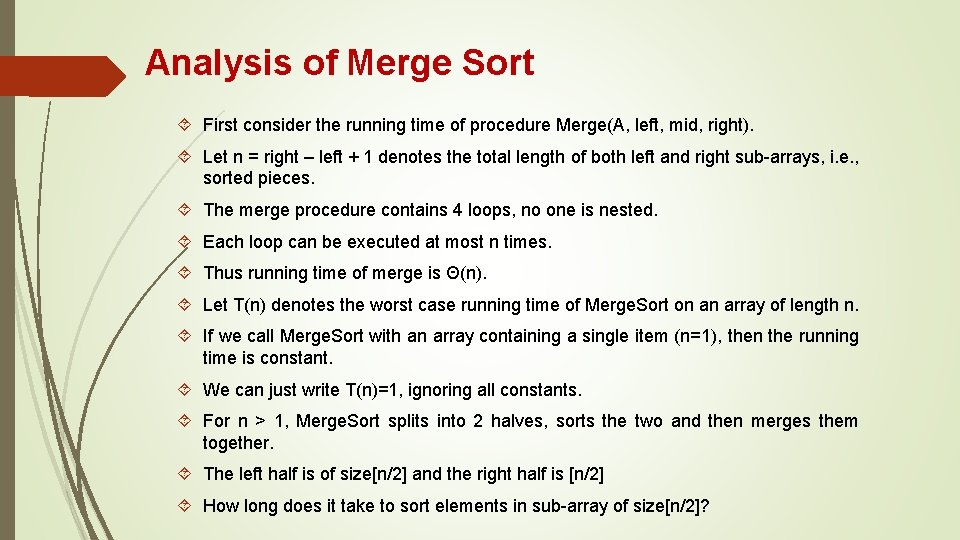
Analysis of Merge Sort First consider the running time of procedure Merge(A, left, mid, right). Let n = right – left + 1 denotes the total length of both left and right sub-arrays, i. e. , sorted pieces. The merge procedure contains 4 loops, no one is nested. Each loop can be executed at most n times. Thus running time of merge is Θ(n). Let T(n) denotes the worst case running time of Merge. Sort on an array of length n. If we call Merge. Sort with an array containing a single item (n=1), then the running time is constant. We can just write T(n)=1, ignoring all constants. For n > 1, Merge. Sort splits into 2 halves, sorts the two and then merges them together. The left half is of size[n/2] and the right half is [n/2] How long does it take to sort elements in sub-array of size[n/2]?
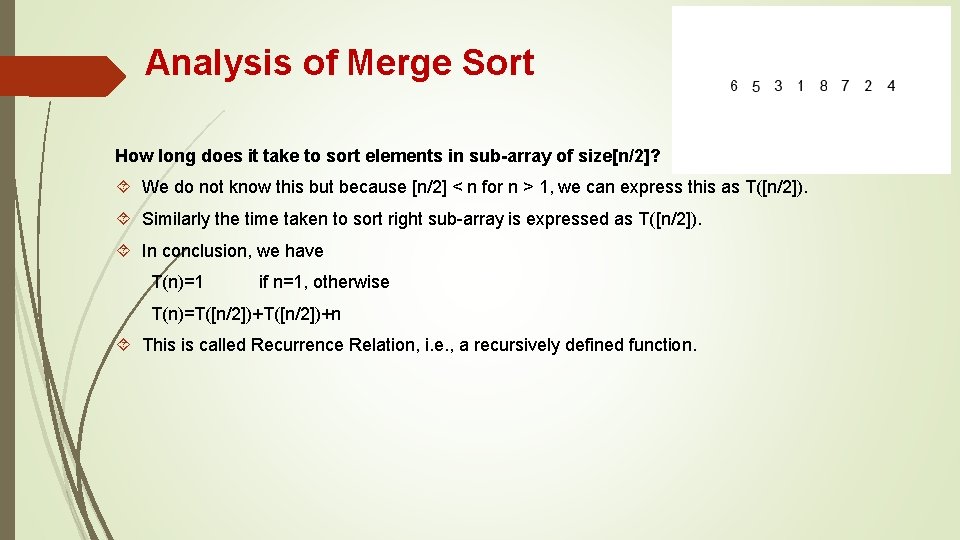
Analysis of Merge Sort How long does it take to sort elements in sub-array of size[n/2]? We do not know this but because [n/2] < n for n > 1, we can express this as T([n/2]). Similarly the time taken to sort right sub-array is expressed as T([n/2]). In conclusion, we have T(n)=1 if n=1, otherwise T(n)=T([n/2])+n This is called Recurrence Relation, i. e. , a recursively defined function.
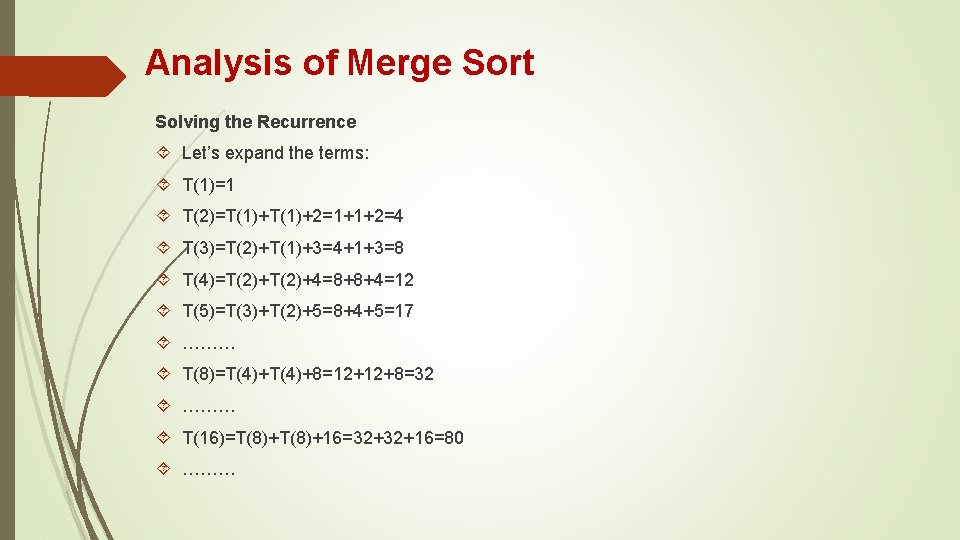
Analysis of Merge Sort Solving the Recurrence Let’s expand the terms: T(1)=1 T(2)=T(1)+2=1+1+2=4 T(3)=T(2)+T(1)+3=4+1+3=8 T(4)=T(2)+4=8+8+4=12 T(5)=T(3)+T(2)+5=8+4+5=17 ……… T(8)=T(4)+8=12+12+8=32 ……… T(16)=T(8)+16=32+32+16=80 ………
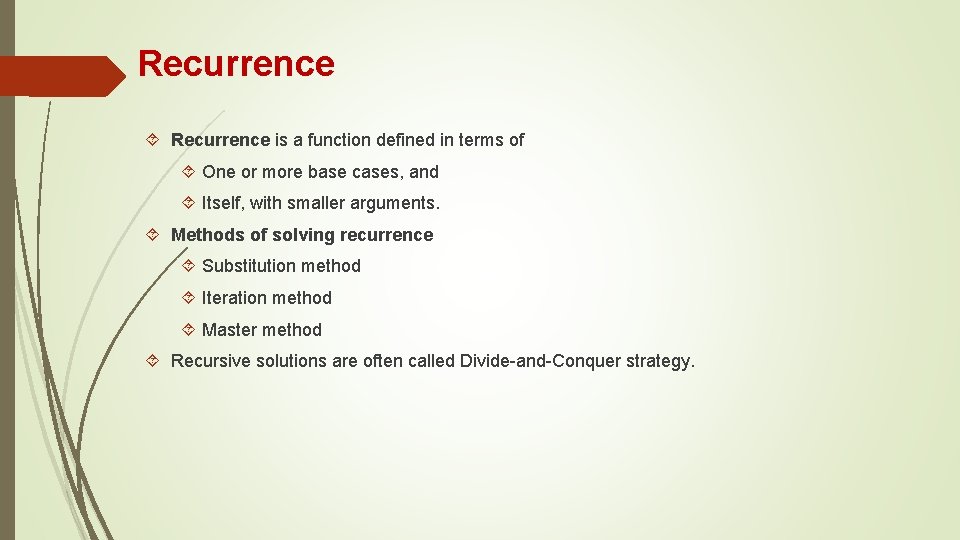
Recurrence is a function defined in terms of One or more base cases, and Itself, with smaller arguments. Methods of solving recurrence Substitution method Iteration method Master method Recursive solutions are often called Divide-and-Conquer strategy.
Good Luck ! ☻