
Fundamental Stock Analysis Models of Stock Valuation 2012
- Slides: 40
Fundamental Stock Analysis Models of Stock Valuation 2012 – Investments
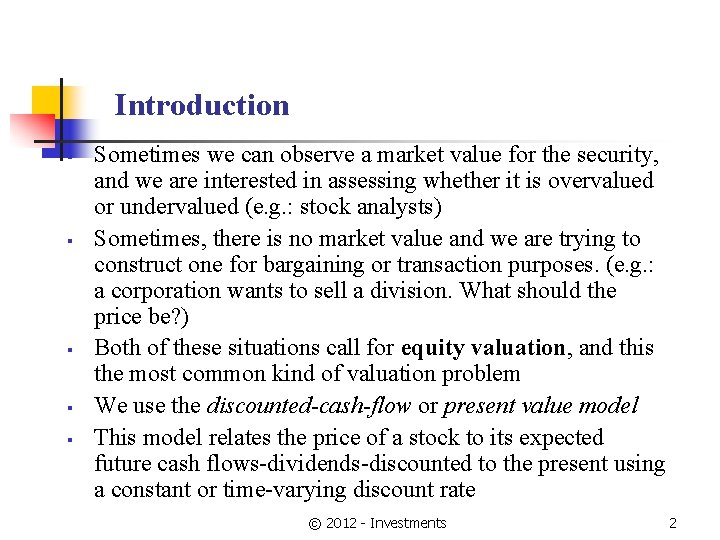
Introduction § § § Sometimes we can observe a market value for the security, and we are interested in assessing whether it is overvalued or undervalued (e. g. : stock analysts) Sometimes, there is no market value and we are trying to construct one for bargaining or transaction purposes. (e. g. : a corporation wants to sell a division. What should the price be? ) Both of these situations call for equity valuation, and this the most common kind of valuation problem We use the discounted-cash-flow or present value model This model relates the price of a stock to its expected future cash flows-dividends-discounted to the present using a constant or time-varying discount rate © 2012 - Investments 2
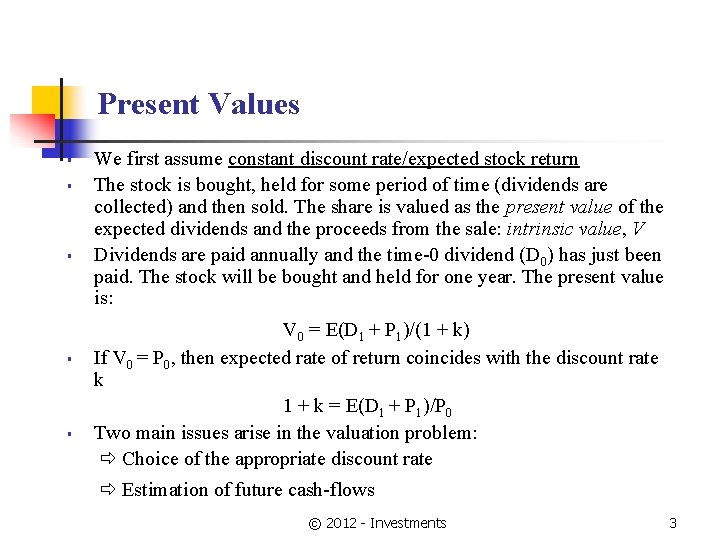
Present Values § § § We first assume constant discount rate/expected stock return The stock is bought, held for some period of time (dividends are collected) and then sold. The share is valued as the present value of the expected dividends and the proceeds from the sale: intrinsic value, V Dividends are paid annually and the time-0 dividend (D 0) has just been paid. The stock will be bought and held for one year. The present value is: V 0 = E(D 1 + P 1)/(1 + k) If V 0 = P 0, then expected rate of return coincides with the discount rate k 1 + k = E(D 1 + P 1)/P 0 Two main issues arise in the valuation problem: Choice of the appropriate discount rate Estimation of future cash-flows © 2012 - Investments 3
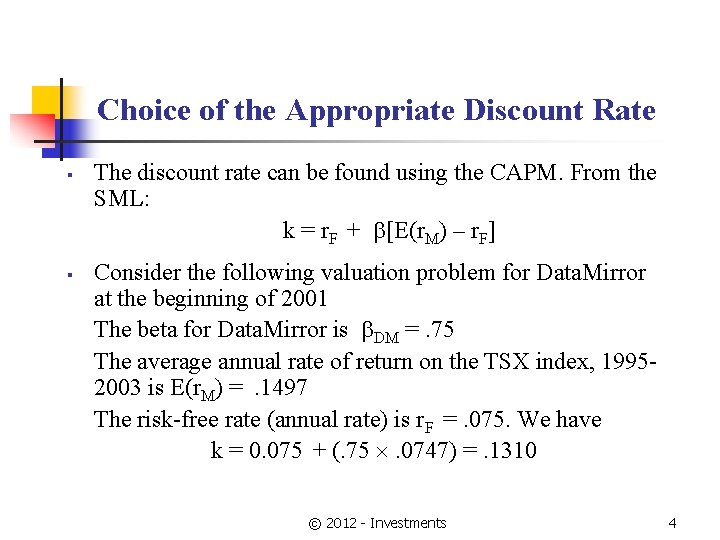
Choice of the Appropriate Discount Rate § § The discount rate can be found using the CAPM. From the SML: k = r. F + [E(r. M) – r. F] Consider the following valuation problem for Data. Mirror at the beginning of 2001 The beta for Data. Mirror is DM =. 75 The average annual rate of return on the TSX index, 19952003 is E(r. M) =. 1497 The risk-free rate (annual rate) is r. F =. 075. We have k = 0. 075 + (. 75 . 0747) =. 1310 © 2012 - Investments 4
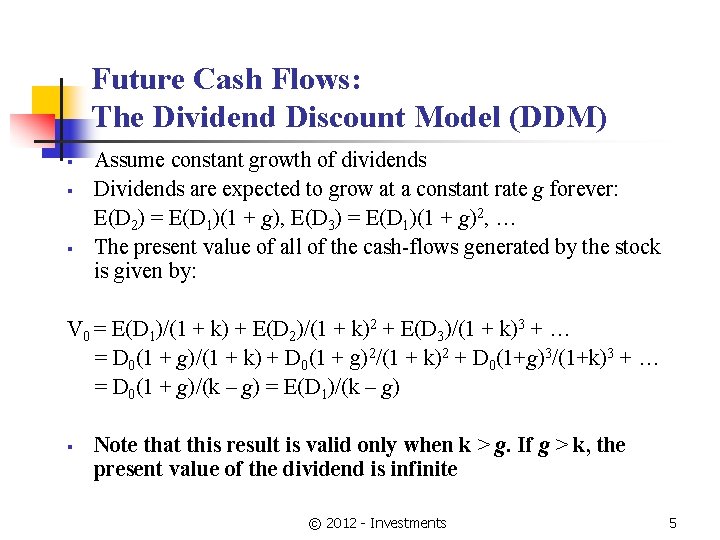
Future Cash Flows: The Dividend Discount Model (DDM) § § § Assume constant growth of dividends Dividends are expected to grow at a constant rate g forever: E(D 2) = E(D 1)(1 + g), E(D 3) = E(D 1)(1 + g)2, … The present value of all of the cash-flows generated by the stock is given by: V 0 = E(D 1)/(1 + k) + E(D 2)/(1 + k)2 + E(D 3)/(1 + k)3 + … = D 0(1 + g)/(1 + k) + D 0(1 + g)2/(1 + k)2 + D 0(1+g)3/(1+k)3 + … = D 0(1 + g)/(k – g) = E(D 1)/(k – g) § Note that this result is valid only when k > g. If g > k, the present value of the dividend is infinite © 2012 - Investments 5
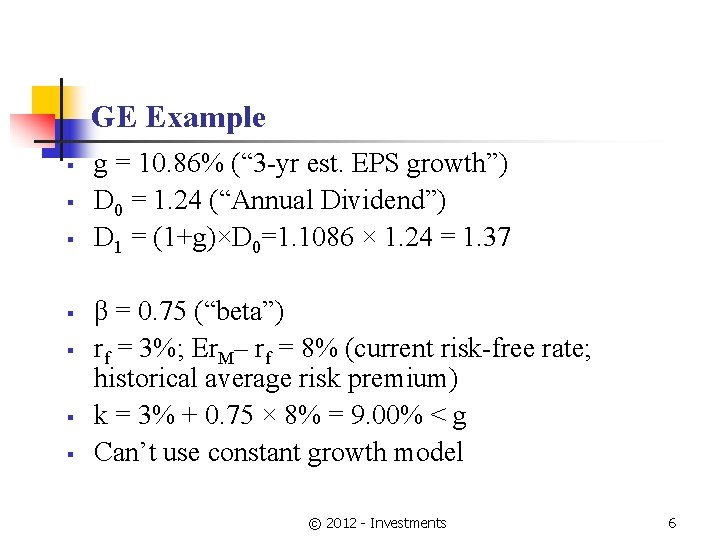
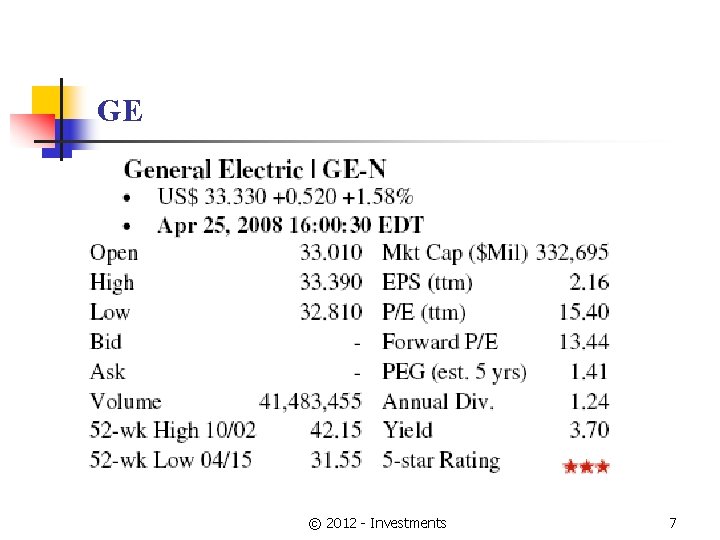
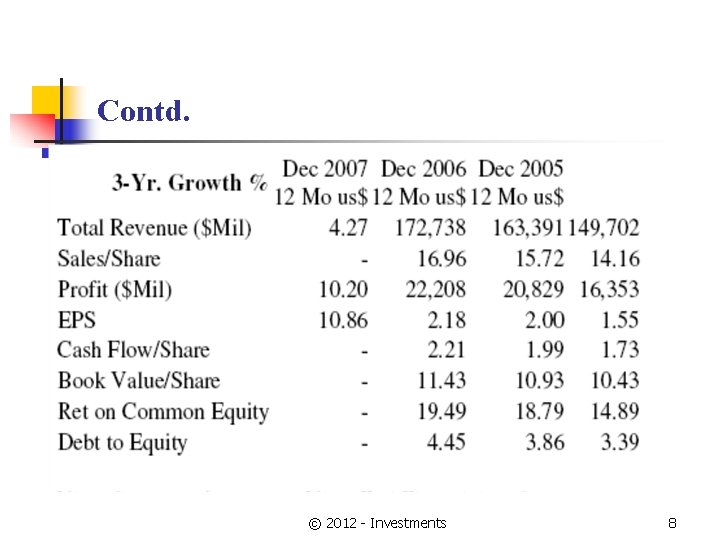
GE Example § § § § g = 10. 86% (“ 3 -yr est. EPS growth”) D 0 = 1. 24 (“Annual Dividend”) D 1 = (1+g)×D 0=1. 1086 × 1. 24 = 1. 37 β = 0. 75 (“beta”) rf = 3%; Er. M– rf = 8% (current risk-free rate; historical average risk premium) k = 3% + 0. 75 × 8% = 9. 00% < g Can’t use constant growth model © 2012 - Investments 6
GE © 2012 - Investments 7
Contd. © 2012 - Investments 8
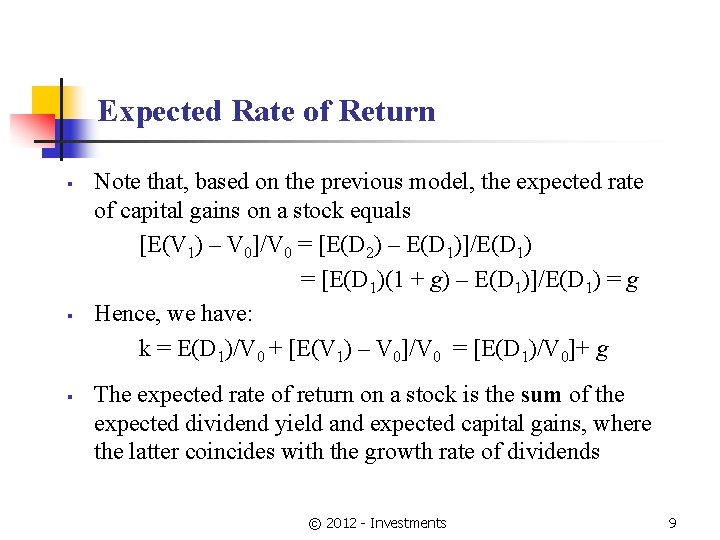
Expected Rate of Return § § § Note that, based on the previous model, the expected rate of capital gains on a stock equals [E(V 1) – V 0]/V 0 = [E(D 2) – E(D 1)]/E(D 1) = [E(D 1)(1 + g) – E(D 1)]/E(D 1) = g Hence, we have: k = E(D 1)/V 0 + [E(V 1) – V 0]/V 0 = [E(D 1)/V 0]+ g The expected rate of return on a stock is the sum of the expected dividend yield and expected capital gains, where the latter coincides with the growth rate of dividends © 2012 - Investments 9
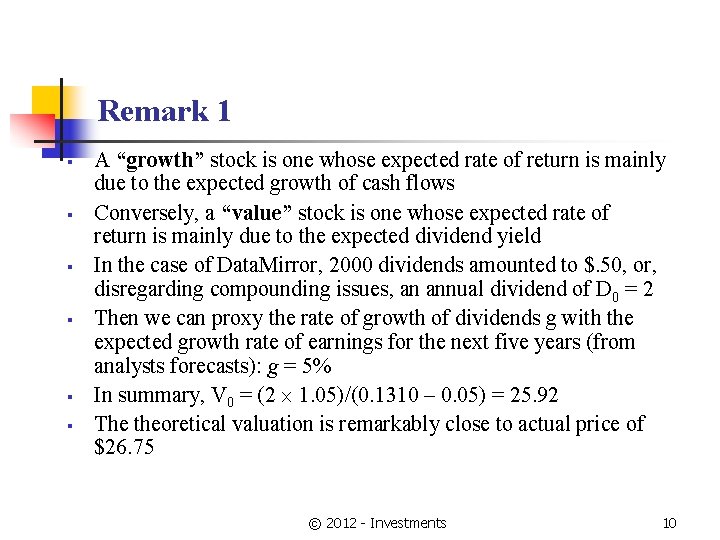
Remark 1 § § § A “growth” stock is one whose expected rate of return is mainly due to the expected growth of cash flows Conversely, a “value” stock is one whose expected rate of return is mainly due to the expected dividend yield In the case of Data. Mirror, 2000 dividends amounted to $. 50, or, disregarding compounding issues, an annual dividend of D 0 = 2 Then we can proxy the rate of growth of dividends g with the expected growth rate of earnings for the next five years (from analysts forecasts): g = 5% In summary, V 0 = (2 1. 05)/(0. 1310 – 0. 05) = 25. 92 The theoretical valuation is remarkably close to actual price of $26. 75 © 2012 - Investments 10
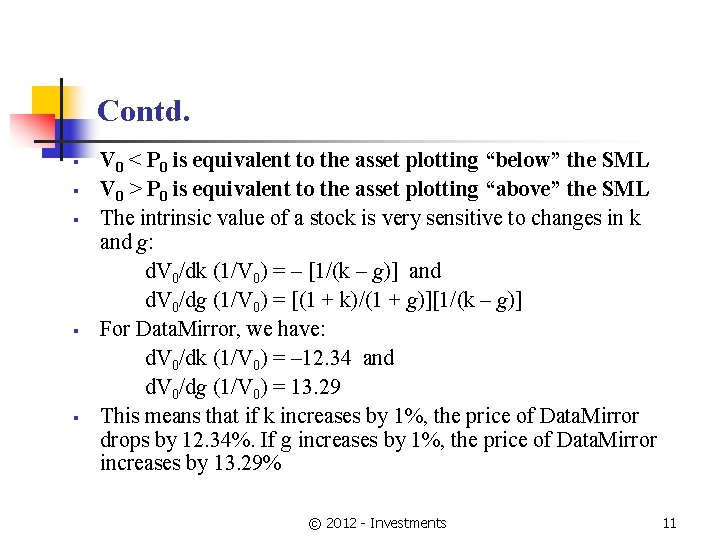
Contd. § § § V 0 < P 0 is equivalent to the asset plotting “below” the SML V 0 > P 0 is equivalent to the asset plotting “above” the SML The intrinsic value of a stock is very sensitive to changes in k and g: d. V 0/dk (1/V 0) = – [1/(k – g)] and d. V 0/dg (1/V 0) = [(1 + k)/(1 + g)][1/(k – g)] For Data. Mirror, we have: d. V 0/dk (1/V 0) = – 12. 34 and d. V 0/dg (1/V 0) = 13. 29 This means that if k increases by 1%, the price of Data. Mirror drops by 12. 34%. If g increases by 1%, the price of Data. Mirror increases by 13. 29% © 2012 - Investments 11
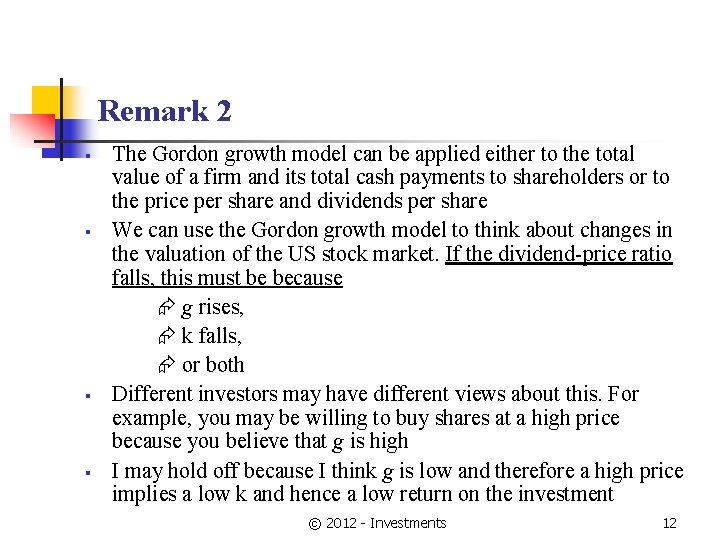
Remark 2 § § The Gordon growth model can be applied either to the total value of a firm and its total cash payments to shareholders or to the price per share and dividends per share We can use the Gordon growth model to think about changes in the valuation of the US stock market. If the dividend-price ratio falls, this must be because g rises, k falls, or both Different investors may have different views about this. For example, you may be willing to buy shares at a high price because you believe that g is high I may hold off because I think g is low and therefore a high price implies a low k and hence a low return on the investment © 2012 - Investments 12
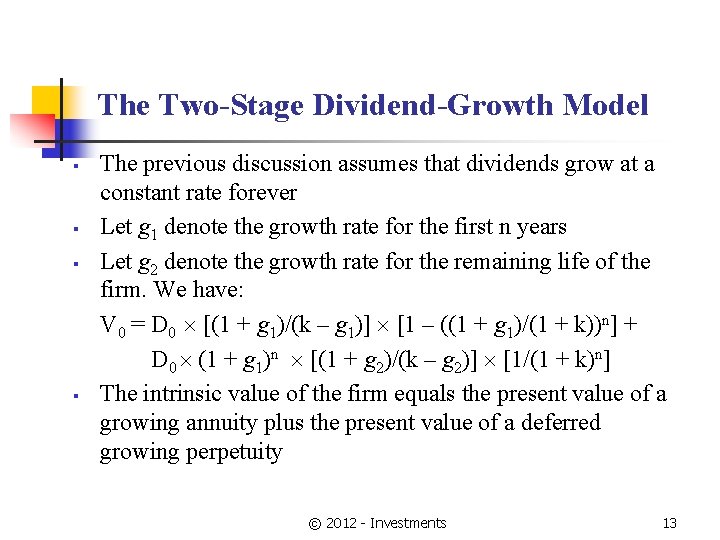
The Two-Stage Dividend-Growth Model § § The previous discussion assumes that dividends grow at a constant rate forever Let g 1 denote the growth rate for the first n years Let g 2 denote the growth rate for the remaining life of the firm. We have: V 0 = D 0 [(1 + g 1)/(k – g 1)] [1 – ((1 + g 1)/(1 + k))n] + D 0 (1 + g 1)n [(1 + g 2)/(k – g 2)] [1/(1 + k)n] The intrinsic value of the firm equals the present value of a growing annuity plus the present value of a deferred growing perpetuity © 2012 - Investments 13
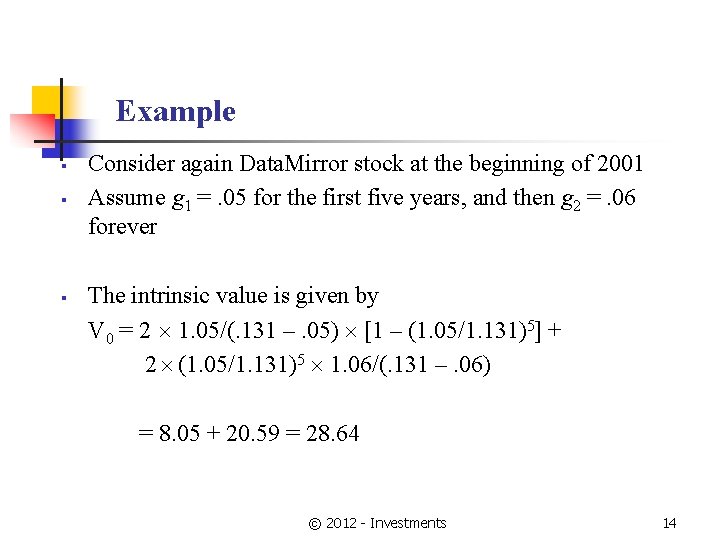
Example § § § Consider again Data. Mirror stock at the beginning of 2001 Assume g 1 =. 05 for the first five years, and then g 2 =. 06 forever The intrinsic value is given by V 0 = 2 1. 05/(. 131 –. 05) [1 – (1. 05/1. 131)5] + 2 (1. 05/1. 131)5 1. 06/(. 131 –. 06) = 8. 05 + 20. 59 = 28. 64 © 2012 - Investments 14
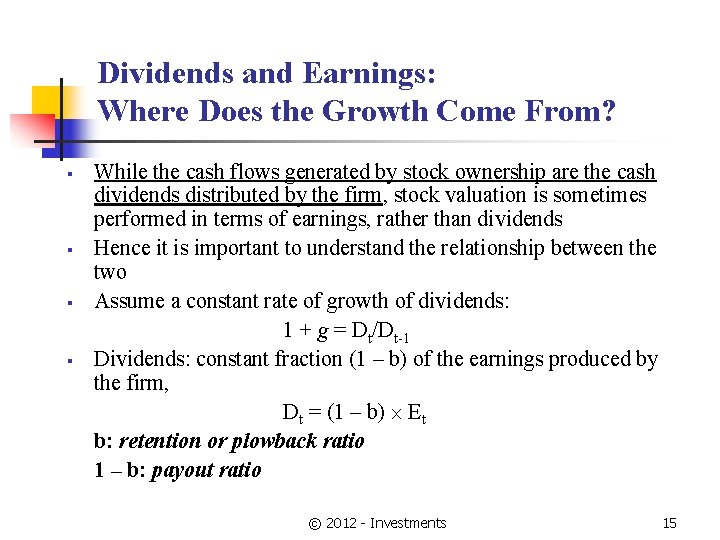
Dividends and Earnings: Where Does the Growth Come From? § § While the cash flows generated by stock ownership are the cash dividends distributed by the firm, stock valuation is sometimes performed in terms of earnings, rather than dividends Hence it is important to understand the relationship between the two Assume a constant rate of growth of dividends: 1 + g = Dt/Dt-1 Dividends: constant fraction (1 – b) of the earnings produced by the firm, Dt = (1 – b) Et b: retention or plowback ratio 1 – b: payout ratio © 2012 - Investments 15
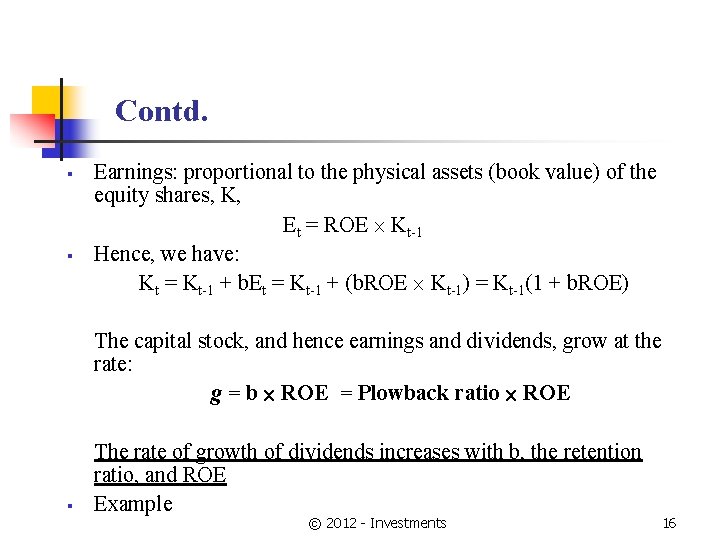
Contd. § § Earnings: proportional to the physical assets (book value) of the equity shares, K, Et = ROE Kt-1 Hence, we have: Kt = Kt-1 + b. Et = Kt-1 + (b. ROE Kt-1) = Kt-1(1 + b. ROE) The capital stock, and hence earnings and dividends, grow at the rate: g = b ROE = Plowback ratio ROE § The rate of growth of dividends increases with b, the retention ratio, and ROE Example © 2012 - Investments 16
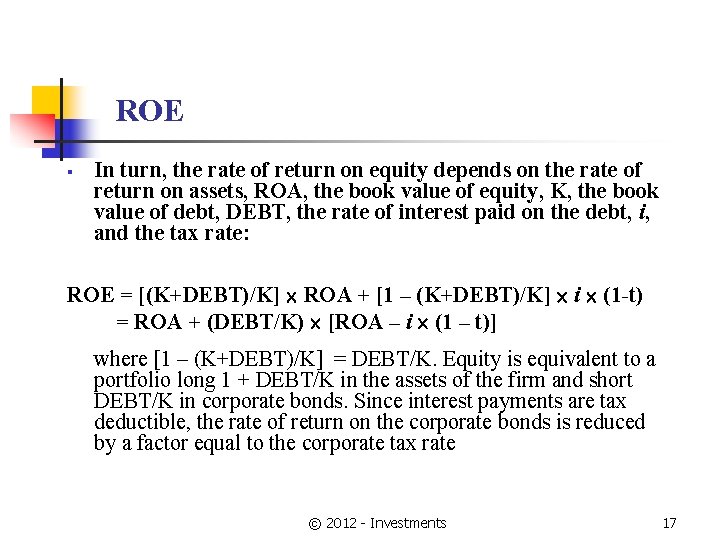
ROE § In turn, the rate of return on equity depends on the rate of return on assets, ROA, the book value of equity, K, the book value of debt, DEBT, the rate of interest paid on the debt, i, and the tax rate: ROE = [(K+DEBT)/K] ROA + [1 – (K+DEBT)/K] i (1 -t) = ROA + (DEBT/K) [ROA – i (1 – t)] where [1 – (K+DEBT)/K] = DEBT/K. Equity is equivalent to a portfolio long 1 + DEBT/K in the assets of the firm and short DEBT/K in corporate bonds. Since interest payments are tax deductible, the rate of return on the corporate bonds is reduced by a factor equal to the corporate tax rate © 2012 - Investments 17
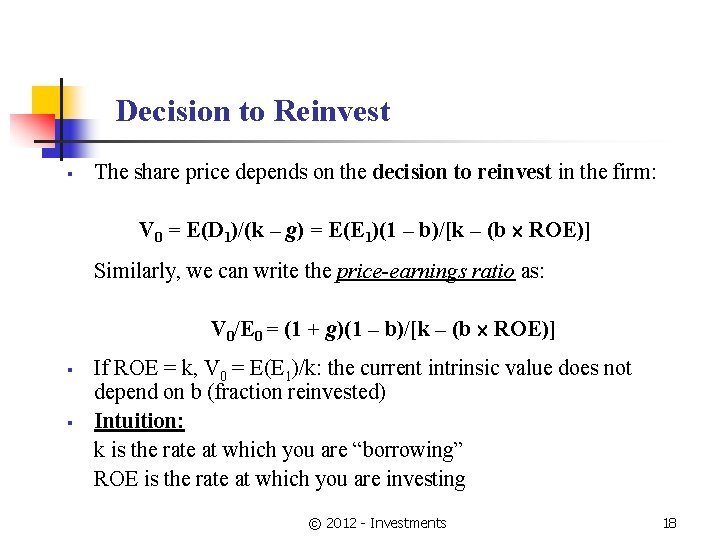
Decision to Reinvest § The share price depends on the decision to reinvest in the firm: V 0 = E(D 1)/(k – g) = E(E 1)(1 – b)/[k – (b ROE)] Similarly, we can write the price-earnings ratio as: V 0/E 0 = (1 + g)(1 – b)/[k – (b ROE)] § § If ROE = k, V 0 = E(E 1)/k: the current intrinsic value does not depend on b (fraction reinvested) Intuition: k is the rate at which you are “borrowing” ROE is the rate at which you are investing © 2012 - Investments 18
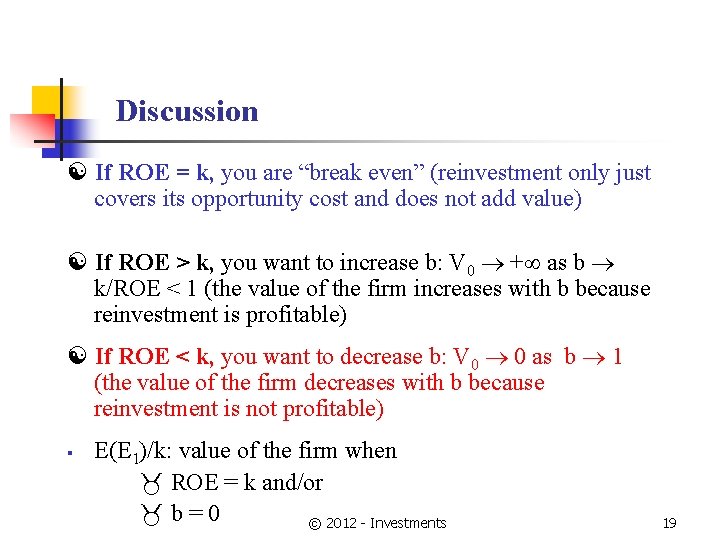
Discussion If ROE = k, you are “break even” (reinvestment only just covers its opportunity cost and does not add value) If ROE > k, you want to increase b: V 0 + as b k/ROE < 1 (the value of the firm increases with b because reinvestment is profitable) If ROE < k, you want to decrease b: V 0 0 as b 1 (the value of the firm decreases with b because reinvestment is not profitable) § E(E 1)/k: value of the firm when ROE = k and/or b=0 © 2012 - Investments 19
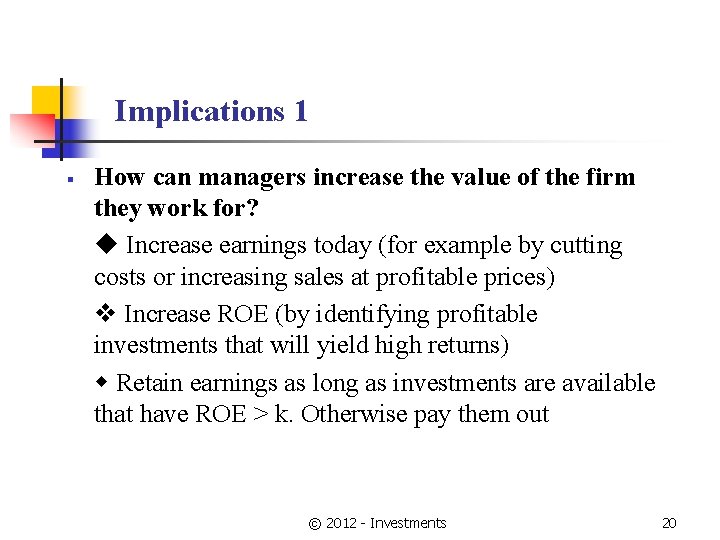
Implications 1 § How can managers increase the value of the firm they work for? Increase earnings today (for example by cutting costs or increasing sales at profitable prices) Increase ROE (by identifying profitable investments that will yield high returns) Retain earnings as long as investments are available that have ROE > k. Otherwise pay them out © 2012 - Investments 20
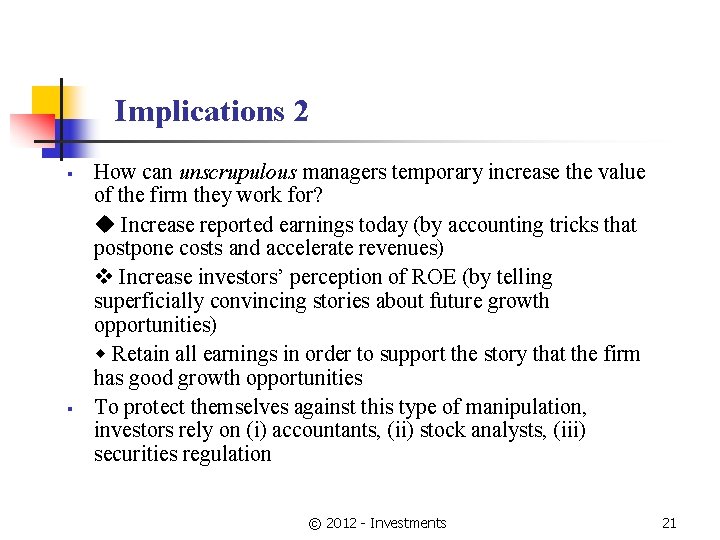
Implications 2 § § How can unscrupulous managers temporary increase the value of the firm they work for? Increase reported earnings today (by accounting tricks that postpone costs and accelerate revenues) Increase investors’ perception of ROE (by telling superficially convincing stories about future growth opportunities) Retain all earnings in order to support the story that the firm has good growth opportunities To protect themselves against this type of manipulation, investors rely on (i) accountants, (ii) stock analysts, (iii) securities regulation © 2012 - Investments 21
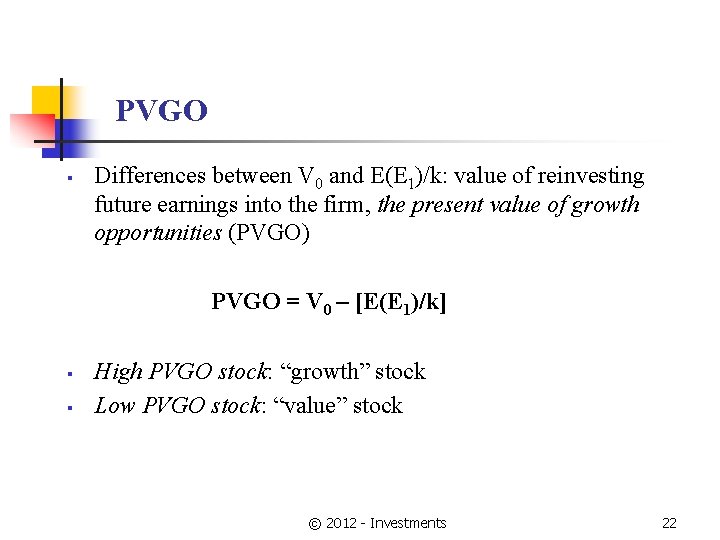
PVGO § Differences between V 0 and E(E 1)/k: value of reinvesting future earnings into the firm, the present value of growth opportunities (PVGO) PVGO = V 0 – [E(E 1)/k] § § High PVGO stock: “growth” stock Low PVGO stock: “value” stock © 2012 - Investments 22
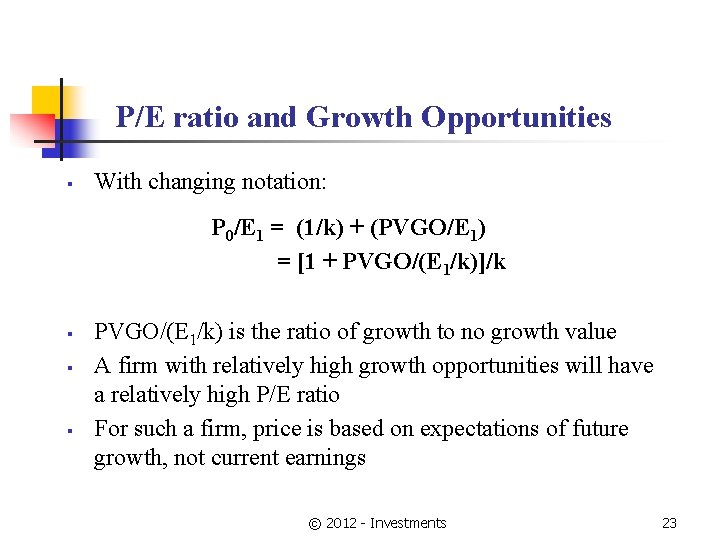
P/E ratio and Growth Opportunities § With changing notation: P 0/E 1 = (1/k) + (PVGO/E 1) = [1 + PVGO/(E 1/k)]/k § § § PVGO/(E 1/k) is the ratio of growth to no growth value A firm with relatively high growth opportunities will have a relatively high P/E ratio For such a firm, price is based on expectations of future growth, not current earnings © 2012 - Investments 23
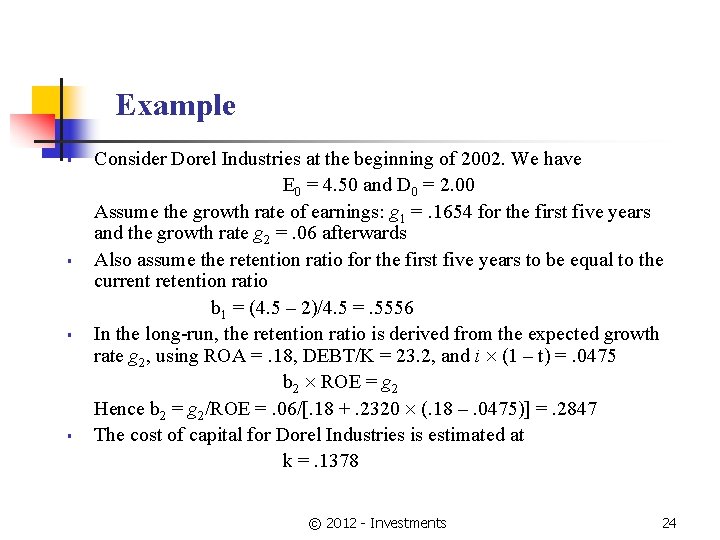
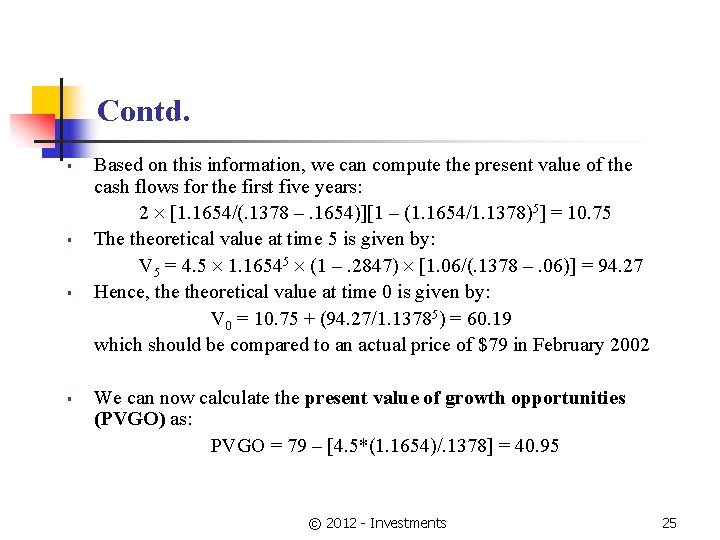
Example § § Consider Dorel Industries at the beginning of 2002. We have E 0 = 4. 50 and D 0 = 2. 00 Assume the growth rate of earnings: g 1 =. 1654 for the first five years and the growth rate g 2 =. 06 afterwards Also assume the retention ratio for the first five years to be equal to the current retention ratio b 1 = (4. 5 – 2)/4. 5 =. 5556 In the long-run, the retention ratio is derived from the expected growth rate g 2, using ROA =. 18, DEBT/K = 23. 2, and i (1 – t) =. 0475 b 2 ROE = g 2 Hence b 2 = g 2/ROE =. 06/[. 18 +. 2320 (. 18 –. 0475)] =. 2847 The cost of capital for Dorel Industries is estimated at k =. 1378 © 2012 - Investments 24
Contd. § § Based on this information, we can compute the present value of the cash flows for the first five years: 2 [1. 1654/(. 1378 –. 1654)][1 – (1. 1654/1. 1378)5] = 10. 75 The theoretical value at time 5 is given by: V 5 = 4. 5 1. 16545 (1 –. 2847) [1. 06/(. 1378 –. 06)] = 94. 27 Hence, theoretical value at time 0 is given by: V 0 = 10. 75 + (94. 27/1. 13785) = 60. 19 which should be compared to an actual price of $79 in February 2002 We can now calculate the present value of growth opportunities (PVGO) as: PVGO = 79 – [4. 5*(1. 1654)/. 1378] = 40. 95 © 2012 - Investments 25
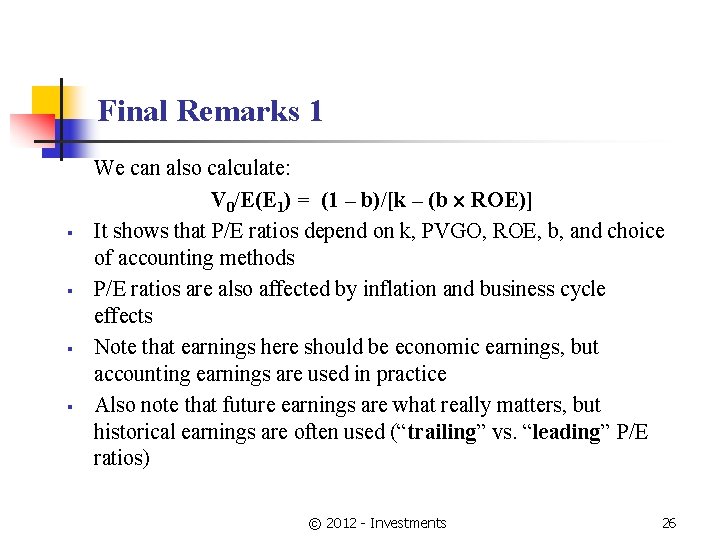
Final Remarks 1 § § We can also calculate: V 0/E(E 1) = (1 – b)/[k – (b ROE)] It shows that P/E ratios depend on k, PVGO, ROE, b, and choice of accounting methods P/E ratios are also affected by inflation and business cycle effects Note that earnings here should be economic earnings, but accounting earnings are used in practice Also note that future earnings are what really matters, but historical earnings are often used (“trailing” vs. “leading” P/E ratios) © 2012 - Investments 26
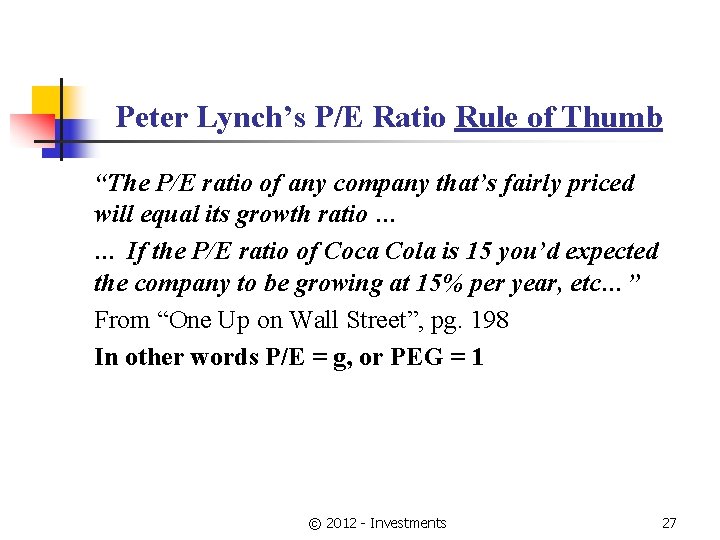
Peter Lynch’s P/E Ratio Rule of Thumb “The P/E ratio of any company that’s fairly priced will equal its growth ratio … … If the P/E ratio of Coca Cola is 15 you’d expected the company to be growing at 15% per year, etc…” From “One Up on Wall Street”, pg. 198 In other words P/E = g, or PEG = 1 © 2012 - Investments 27
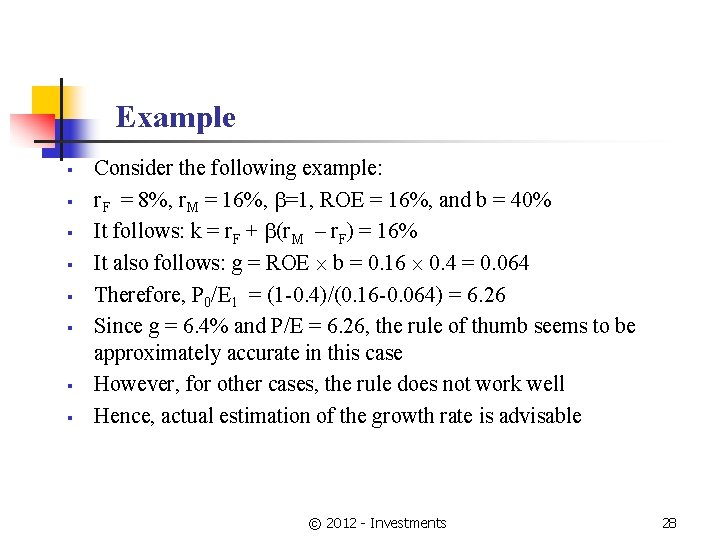
Example § § § § Consider the following example: r. F = 8%, r. M = 16%, =1, ROE = 16%, and b = 40% It follows: k = r. F + (r. M – r. F) = 16% It also follows: g = ROE b = 0. 16 0. 4 = 0. 064 Therefore, P 0/E 1 = (1 -0. 4)/(0. 16 -0. 064) = 6. 26 Since g = 6. 4% and P/E = 6. 26, the rule of thumb seems to be approximately accurate in this case However, for other cases, the rule does not work well Hence, actual estimation of the growth rate is advisable © 2012 - Investments 28
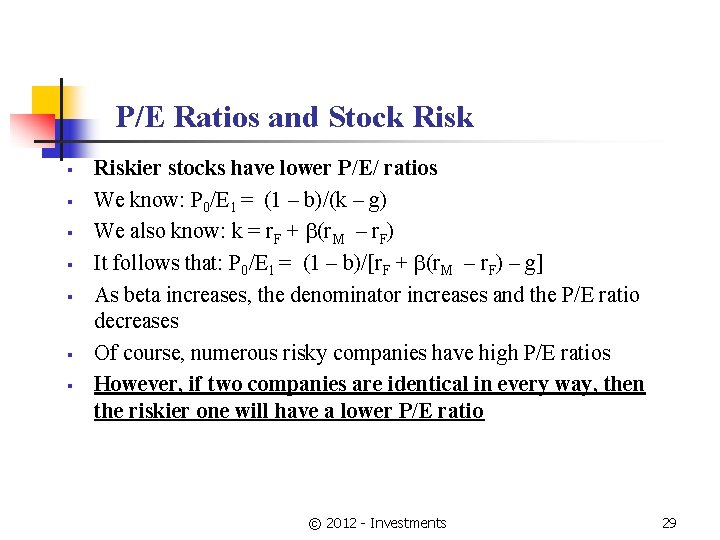
P/E Ratios and Stock Risk § § § § Riskier stocks have lower P/E/ ratios We know: P 0/E 1 = (1 – b)/(k – g) We also know: k = r. F + (r. M – r. F) It follows that: P 0/E 1 = (1 – b)/[r. F + (r. M – r. F) – g] As beta increases, the denominator increases and the P/E ratio decreases Of course, numerous risky companies have high P/E ratios However, if two companies are identical in every way, then the riskier one will have a lower P/E ratio © 2012 - Investments 29
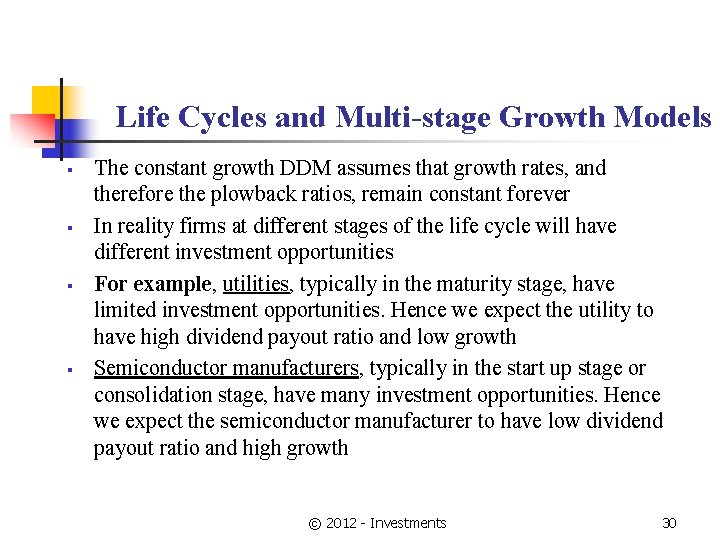
Life Cycles and Multi-stage Growth Models § § The constant growth DDM assumes that growth rates, and therefore the plowback ratios, remain constant forever In reality firms at different stages of the life cycle will have different investment opportunities For example, utilities, typically in the maturity stage, have limited investment opportunities. Hence we expect the utility to have high dividend payout ratio and low growth Semiconductor manufacturers, typically in the start up stage or consolidation stage, have many investment opportunities. Hence we expect the semiconductor manufacturer to have low dividend payout ratio and high growth © 2012 - Investments 30
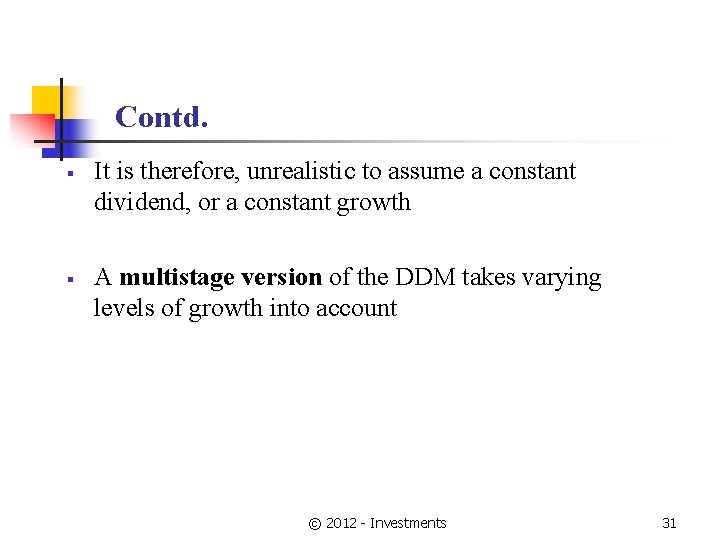
Contd. § § It is therefore, unrealistic to assume a constant dividend, or a constant growth A multistage version of the DDM takes varying levels of growth into account © 2012 - Investments 31
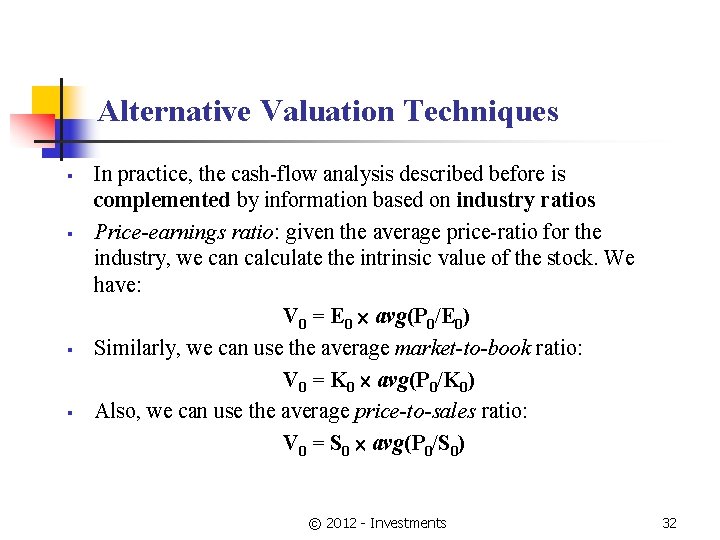
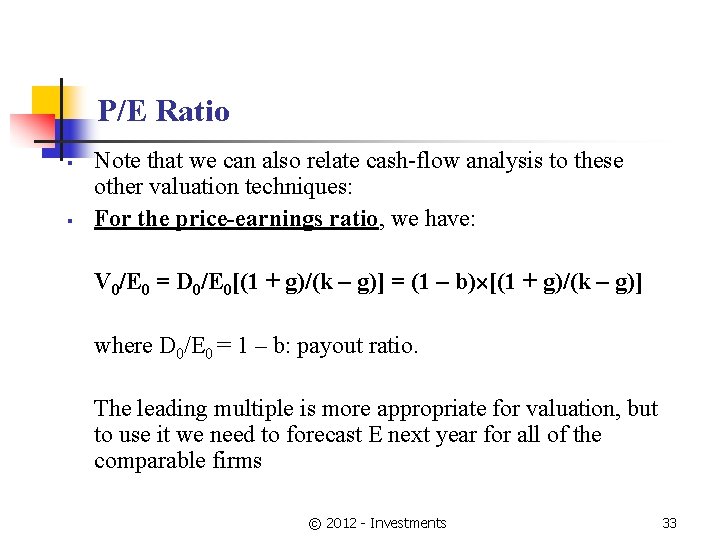
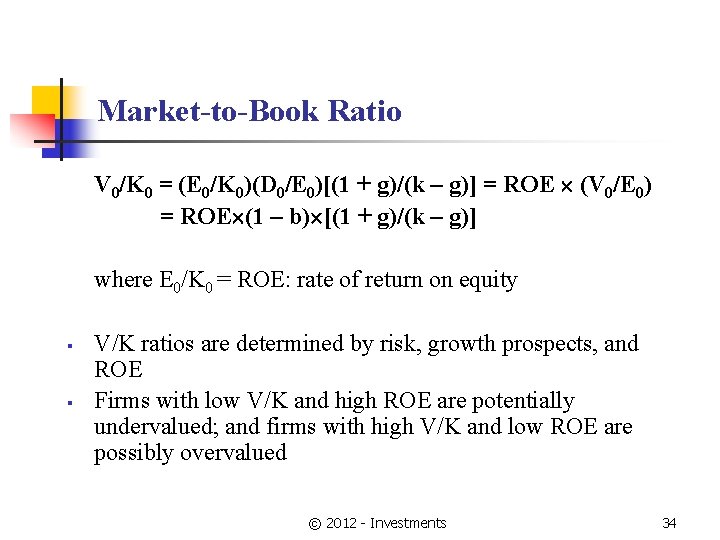
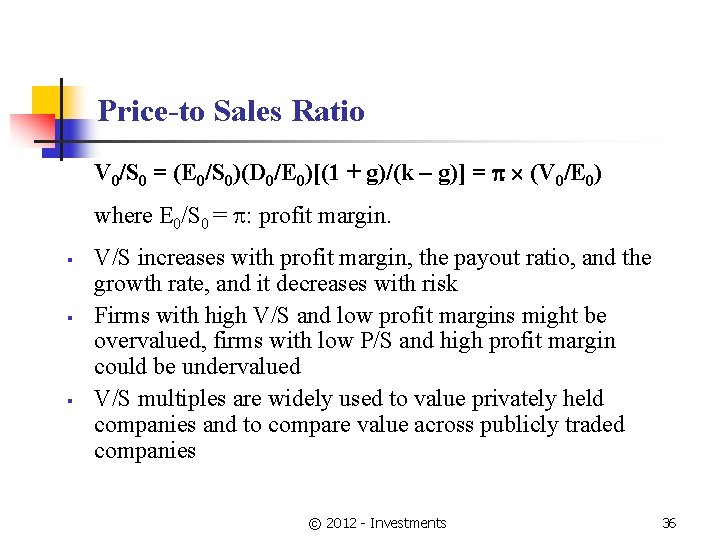
Alternative Valuation Techniques § § In practice, the cash-flow analysis described before is complemented by information based on industry ratios Price-earnings ratio: given the average price-ratio for the industry, we can calculate the intrinsic value of the stock. We have: V 0 = E 0 avg(P 0/E 0) Similarly, we can use the average market-to-book ratio: V 0 = K 0 avg(P 0/K 0) Also, we can use the average price-to-sales ratio: V 0 = S 0 avg(P 0/S 0) © 2012 - Investments 32
P/E Ratio § § Note that we can also relate cash-flow analysis to these other valuation techniques: For the price-earnings ratio, we have: V 0/E 0 = D 0/E 0[(1 + g)/(k – g)] = (1 – b) [(1 + g)/(k – g)] where D 0/E 0 = 1 – b: payout ratio. The leading multiple is more appropriate for valuation, but to use it we need to forecast E next year for all of the comparable firms © 2012 - Investments 33
Market-to-Book Ratio V 0/K 0 = (E 0/K 0)(D 0/E 0)[(1 + g)/(k – g)] = ROE (V 0/E 0) = ROE (1 – b) [(1 + g)/(k – g)] where E 0/K 0 = ROE: rate of return on equity § § V/K ratios are determined by risk, growth prospects, and ROE Firms with low V/K and high ROE are potentially undervalued; and firms with high V/K and low ROE are possibly overvalued © 2012 - Investments 34
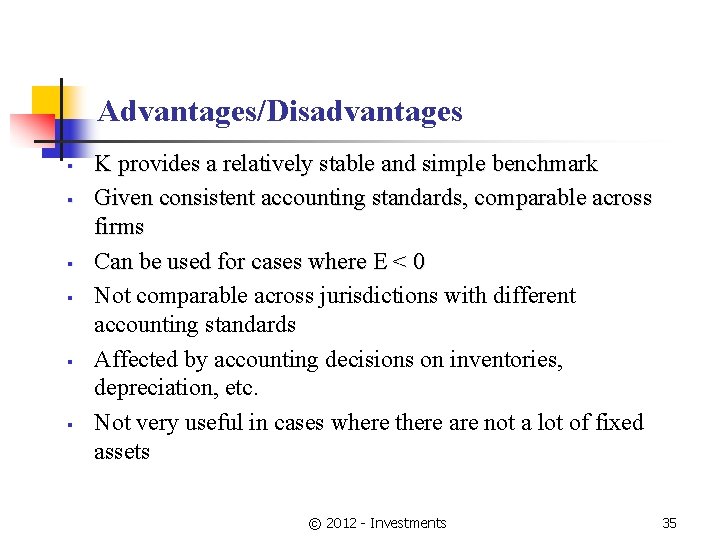
Advantages/Disadvantages § § § K provides a relatively stable and simple benchmark Given consistent accounting standards, comparable across firms Can be used for cases where E < 0 Not comparable across jurisdictions with different accounting standards Affected by accounting decisions on inventories, depreciation, etc. Not very useful in cases where there are not a lot of fixed assets © 2012 - Investments 35
Price-to Sales Ratio V 0/S 0 = (E 0/S 0)(D 0/E 0)[(1 + g)/(k – g)] = (V 0/E 0) where E 0/S 0 = : profit margin. § § § V/S increases with profit margin, the payout ratio, and the growth rate, and it decreases with risk Firms with high V/S and low profit margins might be overvalued, firms with low P/S and high profit margin could be undervalued V/S multiples are widely used to value privately held companies and to compare value across publicly traded companies © 2012 - Investments 36
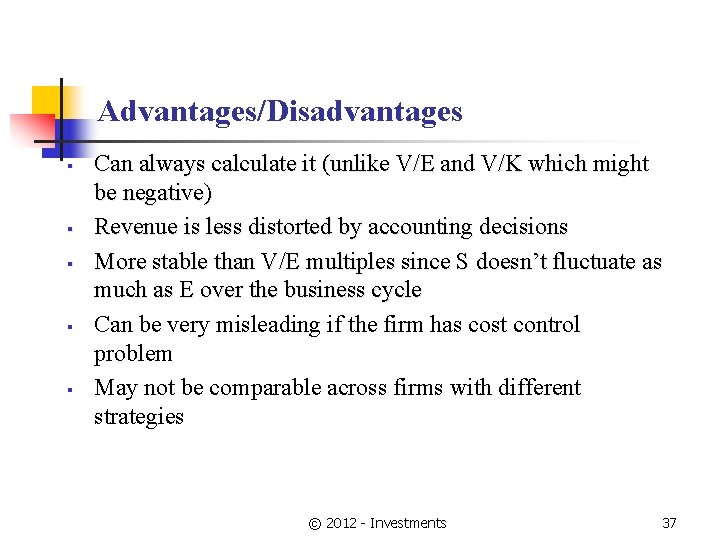
Advantages/Disadvantages § § § Can always calculate it (unlike V/E and V/K which might be negative) Revenue is less distorted by accounting decisions More stable than V/E multiples since S doesn’t fluctuate as much as E over the business cycle Can be very misleading if the firm has cost control problem May not be comparable across firms with different strategies © 2012 - Investments 37
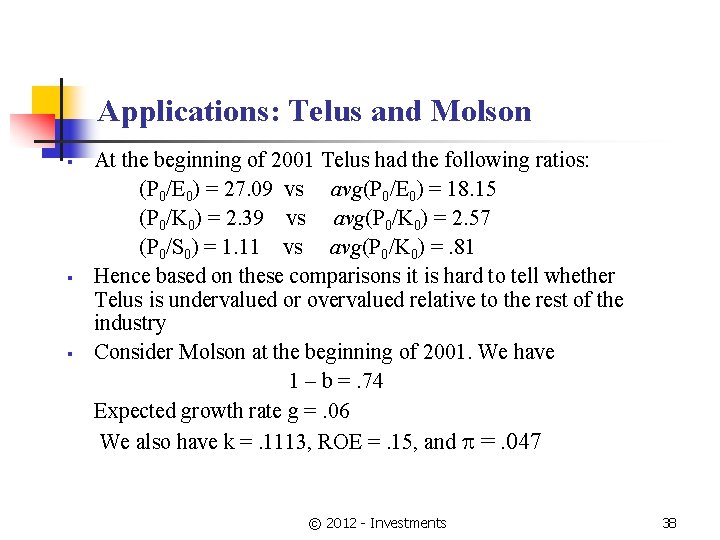
Applications: Telus and Molson § § § At the beginning of 2001 Telus had the following ratios: (P 0/E 0) = 27. 09 vs avg(P 0/E 0) = 18. 15 (P 0/K 0) = 2. 39 vs avg(P 0/K 0) = 2. 57 (P 0/S 0) = 1. 11 vs avg(P 0/K 0) =. 81 Hence based on these comparisons it is hard to tell whether Telus is undervalued or overvalued relative to the rest of the industry Consider Molson at the beginning of 2001. We have 1 – b =. 74 Expected growth rate g =. 06 We also have k =. 1113, ROE =. 15, and =. 047 © 2012 - Investments 38
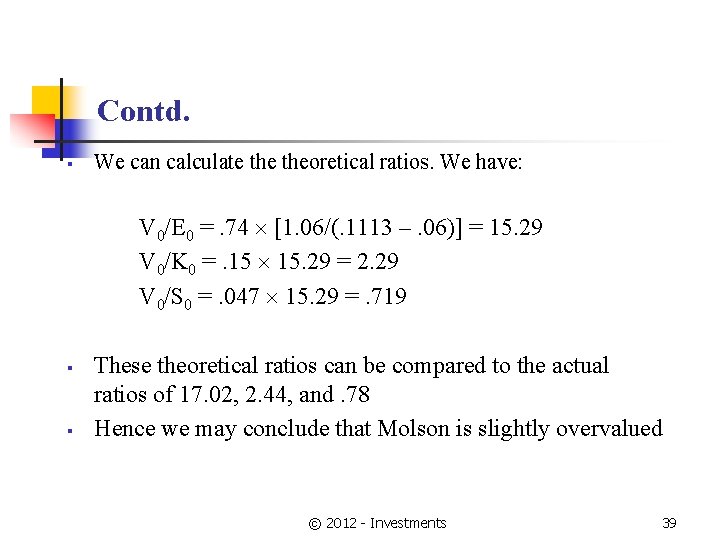
Contd. § We can calculate theoretical ratios. We have: V 0/E 0 =. 74 [1. 06/(. 1113 –. 06)] = 15. 29 V 0/K 0 =. 15 15. 29 = 2. 29 V 0/S 0 =. 047 15. 29 =. 719 § § These theoretical ratios can be compared to the actual ratios of 17. 02, 2. 44, and. 78 Hence we may conclude that Molson is slightly overvalued © 2012 - Investments 39
Readings/Problems § Readings (Bodie et al. ): Chapter 13 © 2012 - Investments 40