
FUNDAMENTAL PRINCIPLES OF CHILD FRIENDLY JUSTICE Chance and
- Slides: 9
FUNDAMENTAL PRINCIPLES OF CHILD FRIENDLY JUSTICE Chance and Challenge - Improve the assistance services for children and youth victims by developing innovative support programs Erasmus Plus, Strategic Partnerships Joint Staff Training Event Romania, September 2015
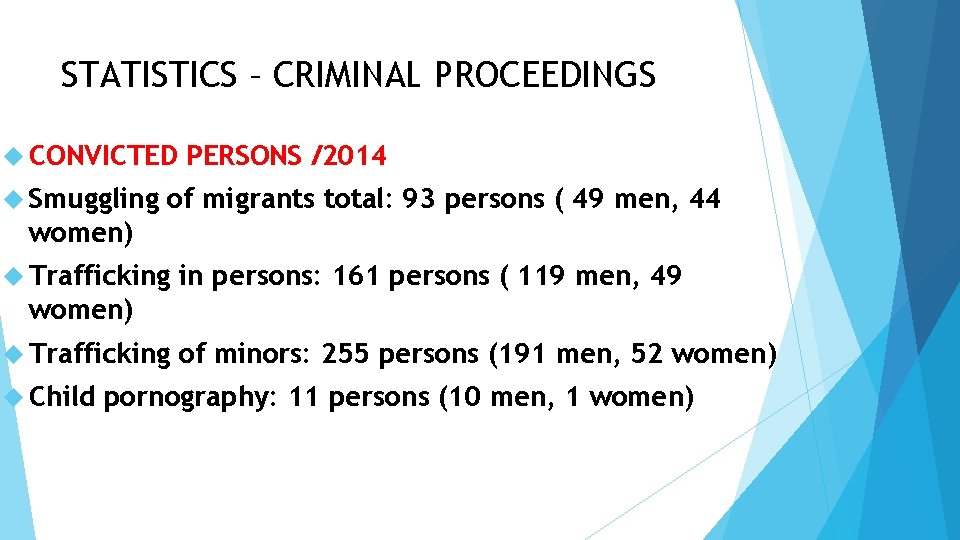
STATISTICS – CRIMINAL PROCEEDINGS CONVICTED Smuggling PERSONS /2014 of migrants total: 93 persons ( 49 men, 44 women) Trafficking in persons: 161 persons ( 119 men, 49 women) Trafficking Child of minors: 255 persons (191 men, 52 women) pornography: 11 persons (10 men, 1 women)
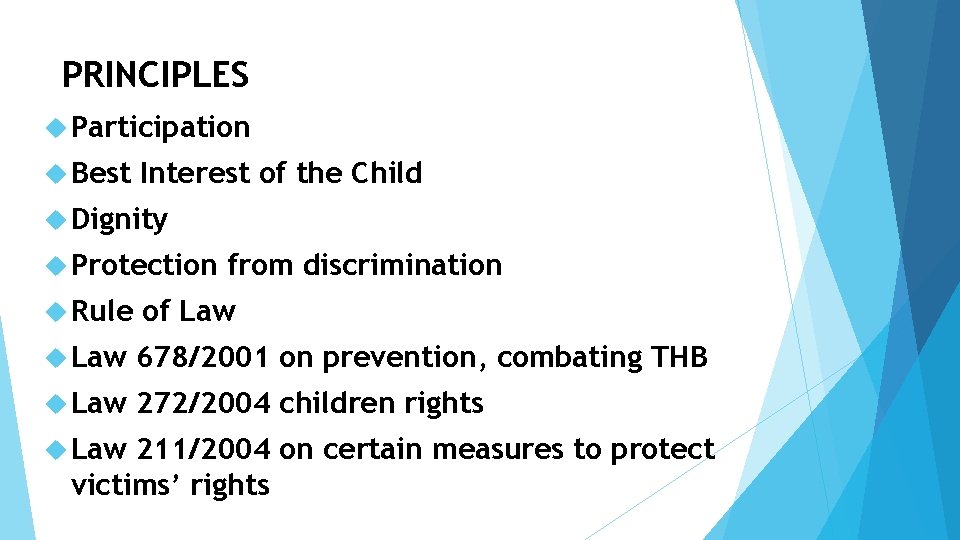
PRINCIPLES Participation Best Interest of the Child Dignity Protection from discrimination Rule of Law 678/2001 on prevention, combating THB Law 272/2004 children rights Law 211/2004 on certain measures to protect victims’ rights
Child friendly justice before, during and after the legal procedures Child Friendly Justice before legal proceedings Children should be thoroughly informed and consulted on the opportunity to have recourse to either a court proceeding or alternatives outside court settings. Alternatives to court proceedings should guarantee an equivalent level of legal safeguards. Police should respect the personal rights and dignity of all children and have regard to their vulnerability, that is, take account of their age and maturity and any special needs of those who may be under a physical or mental disability or have communication difficulties. During police proceedings, the child should be informed in a manner and in language that is appropriate to his or her age and level of understanding.
Child friendly justice before, during and after the legal procedures Child friendly justice during legal proceedings Any obstacles to access to court, such as the cost of the proceedings or the lack of legal counsel, should be removed. Children should have the right to their own legal counsel and representation, in their own name, in proceedings where there is, or could be, a conflict of interest between the child and the parents or other involved parties. Children should have access to free legal aid, under the same or more lenient conditions as adults. Children should be considered as fully fledged clients with their own rights and lawyers representing children should bring forward the opinion of the child. Adequate representation and the right to be represented independently from the parents should be guaranteed, especially in proceedings where the parents, members of the family or caregivers are the alleged offenders.
Child friendly justice before, during and after the legal procedures Judges should respect the right of children to be heard in all matters that affect them or at least to be heard when they are deemed to have a sufficient understanding of the matters in question. The right to be heard is a right of the child, not a duty of the child. In all proceedings involving children, the urgency principle should be applied to provide a speedy response and protect the best interests of the child, while respecting the rule of law. In all proceedings, children should be treated with respect for their age, their special needs, their maturity and level of understanding, and bearing in mind any communication difficulties they may have. Cases involving children should be dealt with in non-intimidating and child-sensitive settings.
Child friendly justice before, during and after the legal procedures When children are heard or interviewed in judicial and non-judicial proceedings and during other interventions, judges and other professionals should interact with them with respect and sensitivity. Direct contact, confrontation or interaction between a child victim or witness with alleged perpetrators should, as far as possible, be avoided unless at the request of the child victim. Children should have the opportunity to give evidence in criminal cases without the presence of the alleged perpetrator. Interviews of and the gathering of statements from children should, as far as possible, be carried out by trained professionals.
Child friendly justice before, during and after the legal procedures Work to Develop a Relationship of Trust Prioritize Effective Communication Be Alert to Symptoms of Psychological Distress Strive to Mitigate the Effects of Recounting Traumatic Events Avoid Exacerbating Feelings of Embarrassment, Shame, or Self-blame Be Sensitive to Issues of Gender Develop and Implement a Safety Plan Be Attentive to Your Client’s Material Needs
Child friendly justice before, during and after the legal procedures Child friendly justice after the legal proceedings The child’s lawyer, guardian ad litem or legal representative should communicate and explain the given decision or judgment to the child in a language adapted to the child’s level of understanding and should give the necessary information on possible measures that could be taken, such as appeal or independent complaint mechanisms. When a decision has not been enforced, children should be informed, possibly through their lawyer, guardian ad litem or legal representative, of available remedies either through non-judicial mechanisms or access to justice.