
Fundamental Physics through Astrophysics Christopher Stubbs Department of
Fundamental Physics through Astrophysics Christopher Stubbs Department of Physics Department of Astronomy Harvard University cstubbs@fas. harvard. edu
Astrophysical Evidence for New Physics ØMatter-antimatter asymmetry • Baryon number & CP violation in early universe? Ø Non-baryonic Dark Matter • New particle physics sector? ØNeutrino oscillations, mass constraints • Non-zero masses, mixing/oscillations ØAccelerating expansion of the Universe 2 • Evidence for weirdness in the vacuum • Puzzle #1: why is this effect so small? • Puzzle #2: why is this effect so large?
Focus is shifting… 10 years ago - What’s the Dark Matter? - What are the values of the cosmological parameters ( , q 0, H 0)? - What’s the connection between primordial fluctuations and observed large scale structure? Now – – – What’s the Dark Matter? What physics is responsible for accelerated expansion? What’s the connection between primordial fluctuations, dark matter, and observed galactic structure? – How can we probe the foundations of gravity? 3
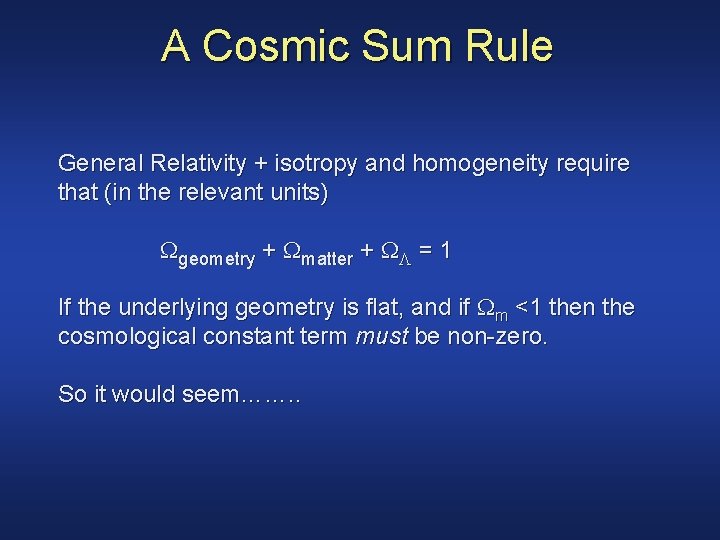
A Cosmic Sum Rule General Relativity + isotropy and homogeneity require that (in the relevant units) geometry + matter + = 1 If the underlying geometry is flat, and if m <1 then the cosmological constant term must be non-zero. So it would seem……. .
Emergence of a Standard Cosmology Our geometrically flat Universe started in a hot big bang 13. 7 Gyrs ago. The evolution of the Universe is increasingly dominated by the phenomenology of the vacuum. Matter, mostly non-baryonic, is a minor component. Luminous matter comprises a preposterously low fraction of the mass of the Universe. 5
This picture is supported by multiple independent lines of evidence • Lower bound on age, from stars • Inventories of cosmic matter content • Measurements of expansion history using supernovae • Primordial element abundances • CMB provides strong confirmation…. WMAP 6
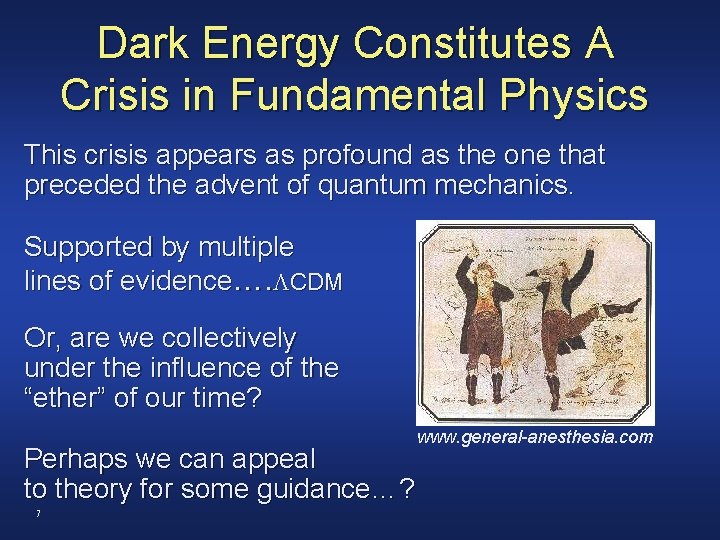
Dark Energy Constitutes A Crisis in Fundamental Physics This crisis appears as profound as the one that preceded the advent of quantum mechanics. Supported by multiple lines of evidence…. CDM Or, are we collectively under the influence of the “ether” of our time? www. general-anesthesia. com Perhaps we can appeal to theory for some guidance…? 7
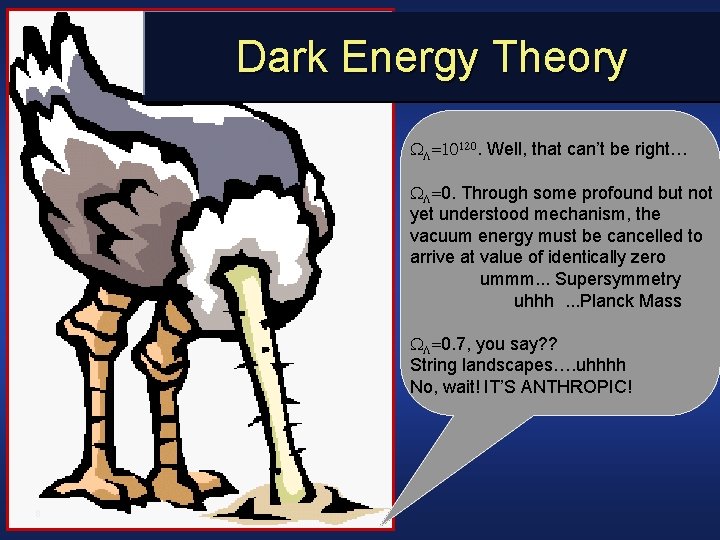
Dark Energy Theory . Well, that can’t be right… 0. Through some profound but not yet understood mechanism, the vacuum energy must be cancelled to arrive at value of identically zero ummm. . . Supersymmetry uhhh . . . Planck Mass 0. 7, you say? ? String landscapes…. uhhhh No, wait! IT’S ANTHROPIC! 8
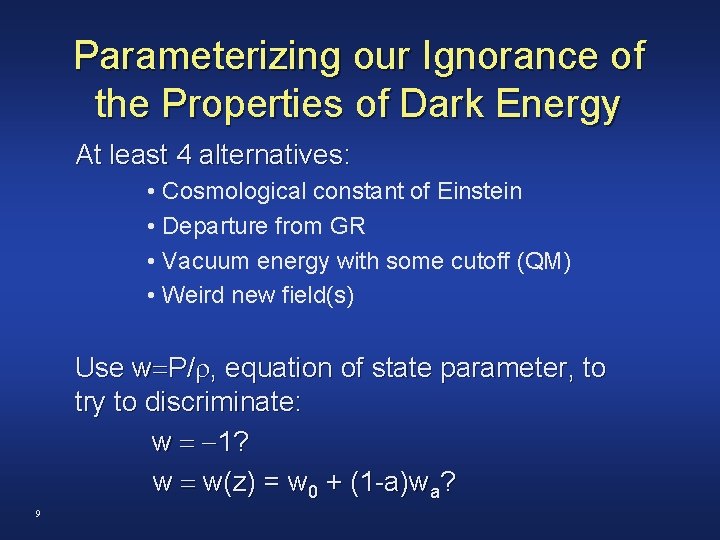
Parameterizing our Ignorance of the Properties of Dark Energy At least 4 alternatives: • Cosmological constant of Einstein • Departure from GR • Vacuum energy with some cutoff (QM) • Weird new field(s) Use w P/ , equation of state parameter, to try to discriminate: w 1? w w(z) = w 0 + (1 -a)wa? 9
Probing the nature of Dark Energy with Observations • SN Hubble diagram • Baryon oscillations • Weak gravitational lensing • Galaxy cluster abundances vs. redshift See Dark Energy Task Force Report, Albrecht et al astro-ph/0609591, also Albrecht and Bernstein, astro-ph/0608269 v 2 10 Surveys!
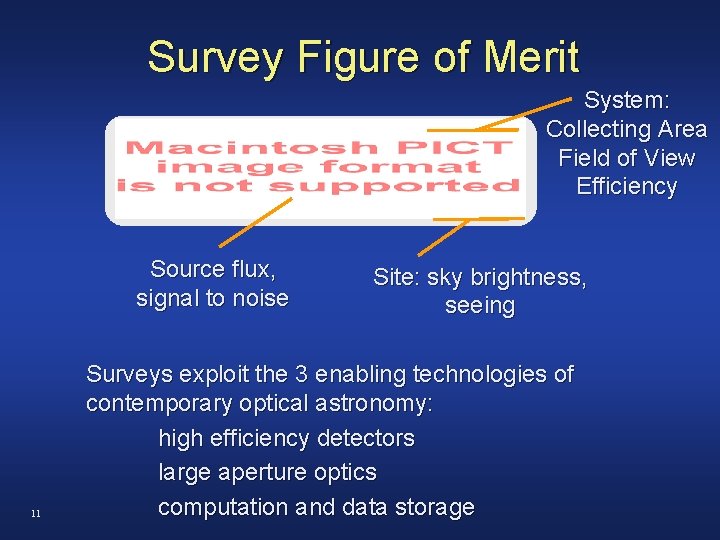
Survey Figure of Merit System: Collecting Area Field of View Efficiency Source flux, signal to noise 11 Site: sky brightness, seeing Surveys exploit the 3 enabling technologies of contemporary optical astronomy: high efficiency detectors large aperture optics computation and data storage
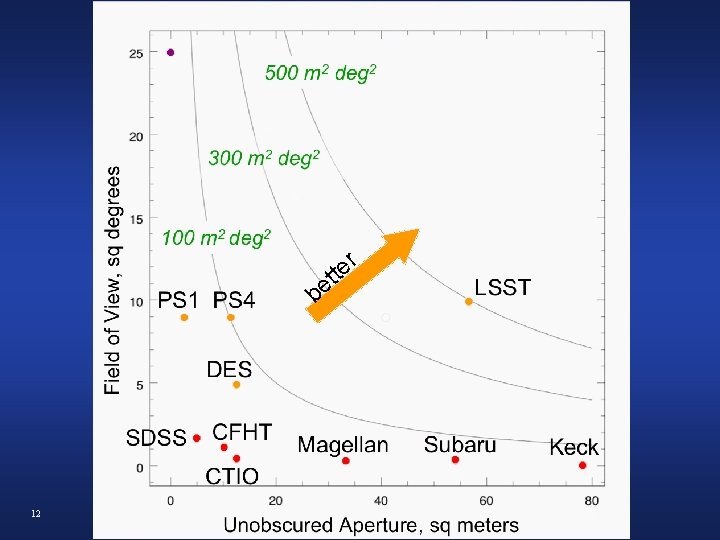
Survey Figure of Merit Number of objects detected per unit time, to given SNR r e tt be 12
The Current Generation: Measuring w • Wide field multiband, 2. 5 m survey system • SDSS, SDSS 2 • Mosaic CCD imagers, 4 m, shared time • • • ESSENCE SN survey - CTIO 4 m CFHT Legacy Survey - CFHT 4 m Deep Lens Survey - 28 sq deg, CTIO 4 m Blanco Cosmology Survey - 100 sq deg … • Hubble Space Telescope, shared time • Cosmos - 2 degrees, HST • GOODS survey 13
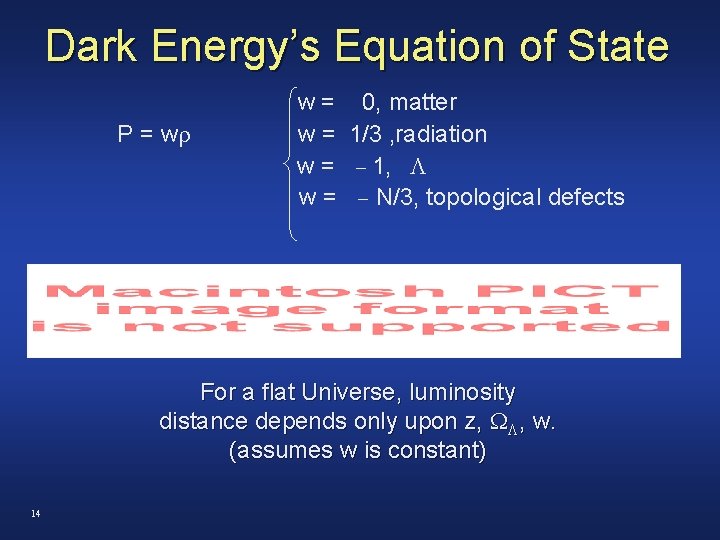
Dark Energy’s Equation of State w = 0, matter P = w w = 1/3 , radiation w = 1, w = N/3, topological defects For a flat Universe, luminosity distance depends only upon z, , w. (assumes w is constant) 14
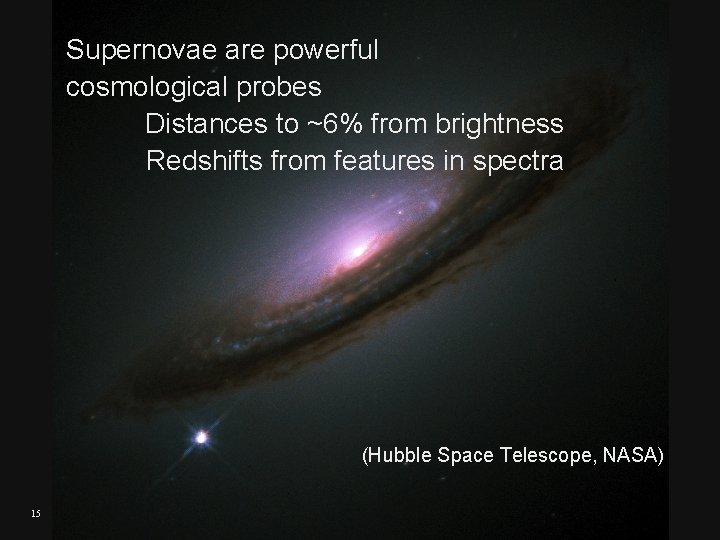
Supernovae are powerful cosmological probes Distances to ~6% from brightness Redshifts from features in spectra (Hubble Space Telescope, NASA) 15
Schmidt et al, High-z SN Team 16
The ESSENCE Survey • Our goal is to determine the equation of state parameter to 10% • This should help determine whether belongs on the left or right side of the Einstein equations… • w = 1 or dw/dz = 0 favors QM • Supernovae are well suited to this task – they probe directly the epoch of accelerating expansion. 17
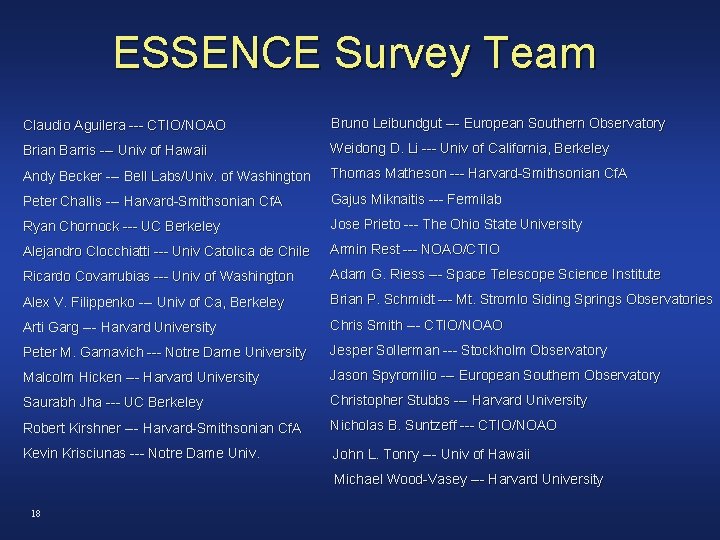
ESSENCE Survey Team Claudio Aguilera --- CTIO/NOAO Bruno Leibundgut --- European Southern Observatory Brian Barris --- Univ of Hawaii Weidong D. Li --- Univ of California, Berkeley Andy Becker --- Bell Labs/Univ. of Washington Thomas Matheson --- Harvard-Smithsonian Cf. A Peter Challis --- Harvard-Smithsonian Cf. A Gajus Miknaitis --- Fermilab Ryan Chornock --- UC Berkeley Jose Prieto --- The Ohio State University Alejandro Clocchiatti --- Univ Catolica de Chile Armin Rest --- NOAO/CTIO Ricardo Covarrubias --- Univ of Washington Adam G. Riess --- Space Telescope Science Institute Alex V. Filippenko --- Univ of Ca, Berkeley Brian P. Schmidt --- Mt. Stromlo Siding Springs Observatories Arti Garg --- Harvard University Chris Smith --- CTIO/NOAO Peter M. Garnavich --- Notre Dame University Jesper Sollerman --- Stockholm Observatory Malcolm Hicken --- Harvard University Jason Spyromilio --- European Southern Observatory Saurabh Jha --- UC Berkeley Christopher Stubbs --- Harvard University Robert Kirshner --- Harvard-Smithsonian Cf. A Nicholas B. Suntzeff --- CTIO/NOAO Kevin Krisciunas --- Notre Dame Univ. John L. Tonry --- Univ of Hawaii Michael Wood-Vasey --- Harvard University 18
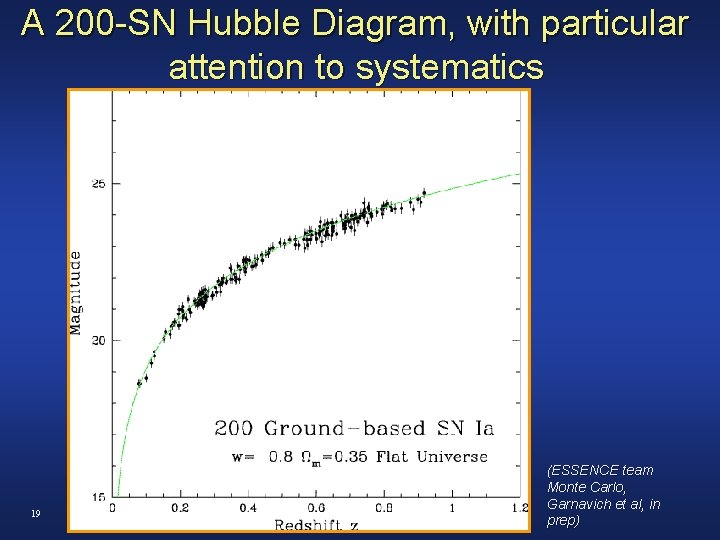
A 200 -SN Hubble Diagram, with particular attention to systematics 19 (ESSENCE team Monte Carlo, Garnavich et al, in prep)
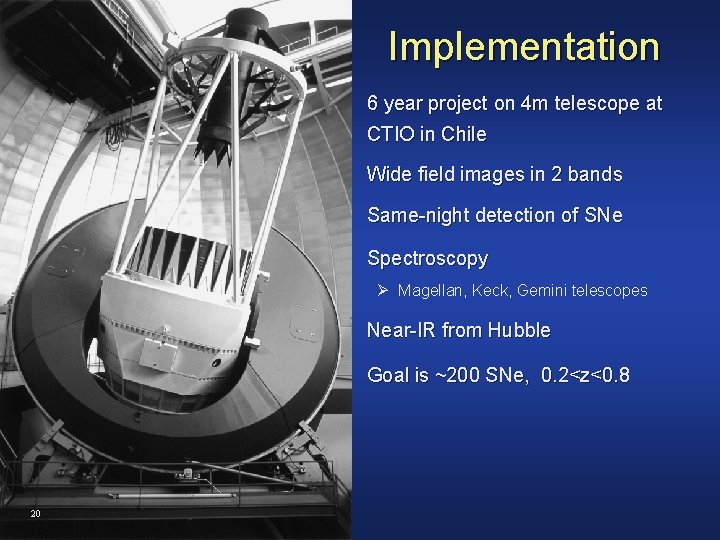
Implementation • 6 year project on 4 m telescope at CTIO in Chile • Wide field images in 2 bands • Same-night detection of SNe • Spectroscopy Ø Magellan, Keck, Gemini telescopes • Near-IR from Hubble • Goal is ~200 SNe, 0. 2<z<0. 8 20
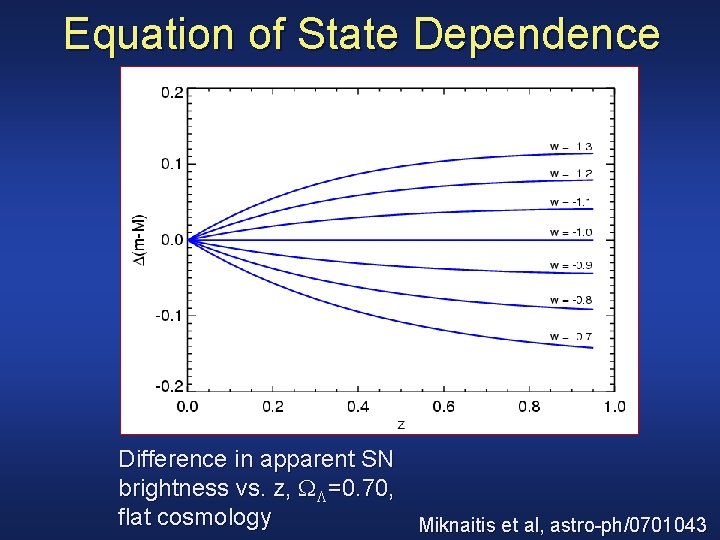
Equation of State Dependence Difference in apparent SN brightness vs. z, =0. 70, flat cosmology Miknaitis et al, astro-ph/0701043
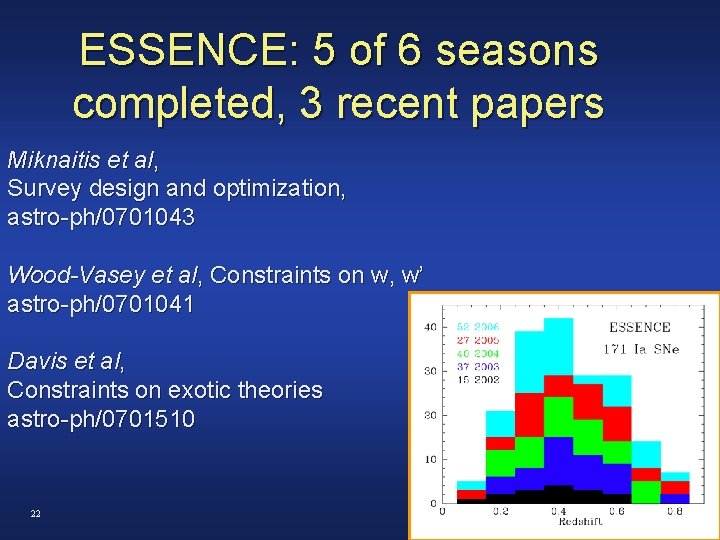
ESSENCE: 5 of 6 seasons completed, 3 recent papers Miknaitis et al, Survey design and optimization, astro-ph/0701043 Wood-Vasey et al, Constraints on w, w’ astro-ph/0701041 Davis et al, Constraints on exotic theories astro-ph/0701510 22
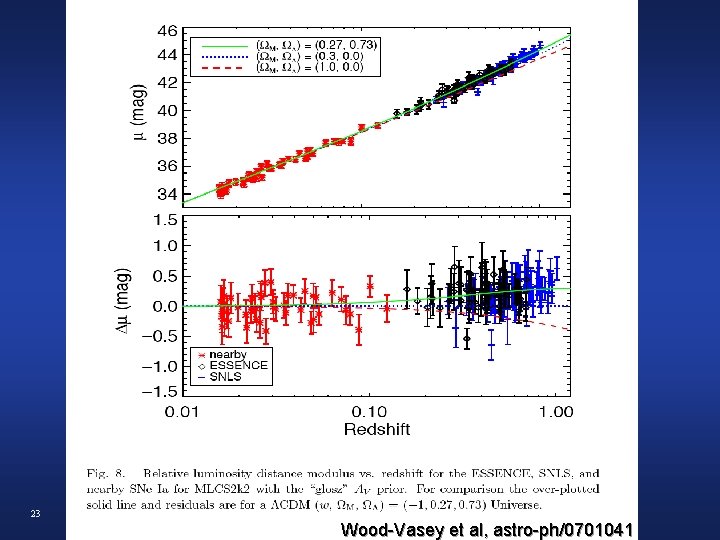
23 Wood-Vasey et al, astro-ph/0701041
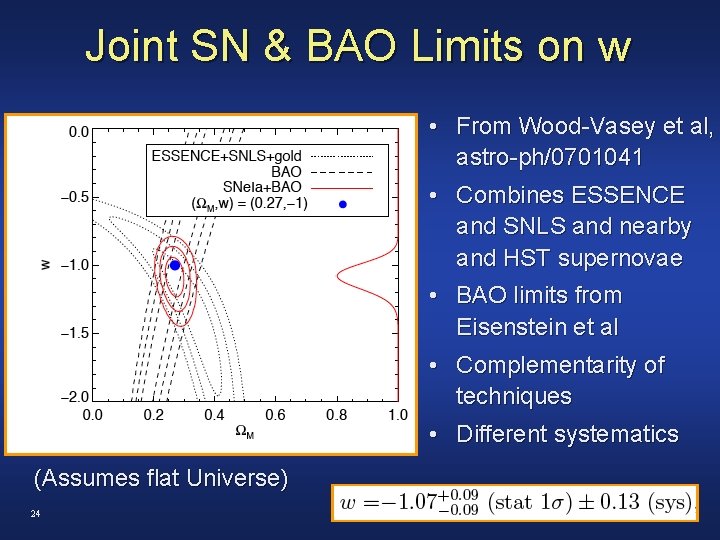
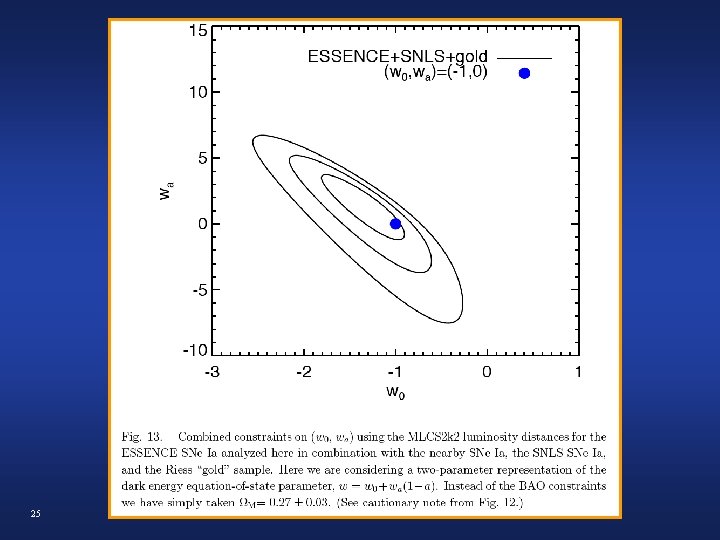
Joint SN & BAO Limits on w • From Wood-Vasey et al, astro-ph/0701041 • Combines ESSENCE and SNLS and nearby and HST supernovae • BAO limits from Eisenstein et al • Complementarity of techniques • Different systematics (Assumes flat Universe) 24
25
Potential sources of systematic error • Flux calibrations • Bias in distance determination codes • Extinction • Host galaxy • Our Galaxy • Atmosphere • Passband errors • K corrections • Photometry normlization • Nonlinearity in flux measurements 26
Potential Systematics, Cont. • Hubble bubble trouble • Gravitational lensing • Evolutionary effects in Sne • Biases or errors in low z sample • Contamination by non Ia’s • Malmquist bias 27
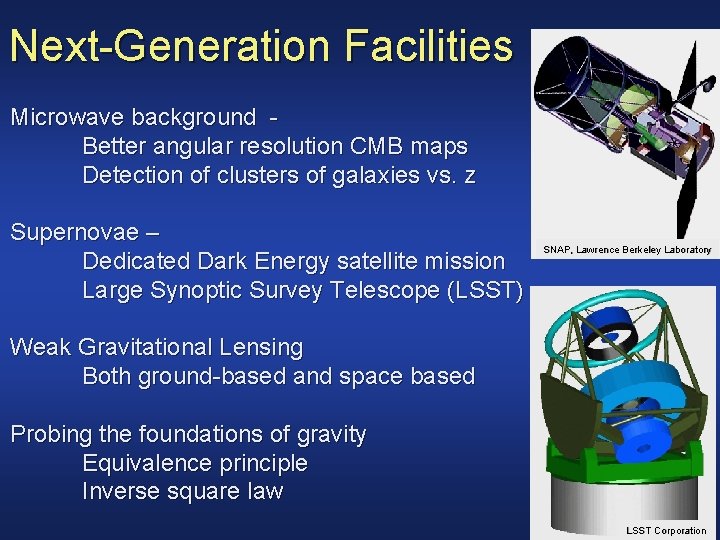
Next-Generation Facilities Microwave background - Better angular resolution CMB maps Detection of clusters of galaxies vs. z Supernovae – Dedicated Dark Energy satellite mission Large Synoptic Survey Telescope (LSST) SNAP, Lawrence Berkeley Laboratory Weak Gravitational Lensing Both ground-based and space based Probing the foundations of gravity Equivalence principle Inverse square law LSST Corporation
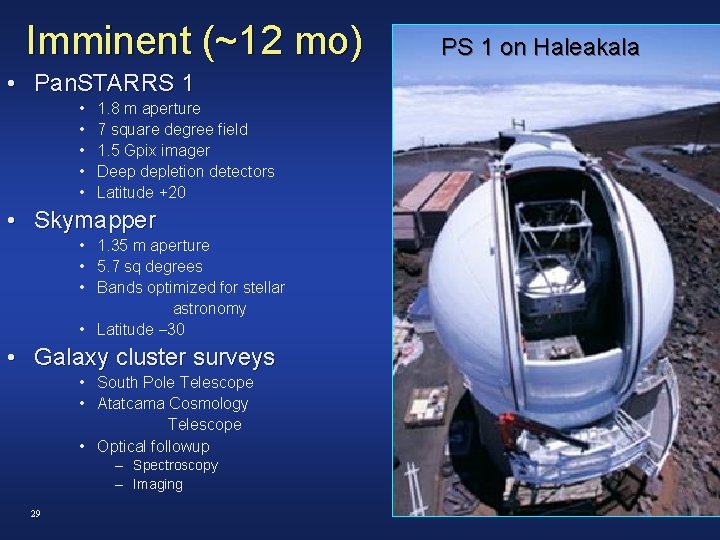
Imminent (~12 mo) • Pan. STARRS 1 • • • 1. 8 m aperture 7 square degree field 1. 5 Gpix imager Deep depletion detectors Latitude +20 • Skymapper • 1. 35 m aperture • 5. 7 sq degrees • Bands optimized for stellar astronomy • Latitude 30 • Galaxy cluster surveys • South Pole Telescope • Atatcama Cosmology Telescope • Optical followup – Spectroscopy – Imaging 29 PS 1 on Haleakala
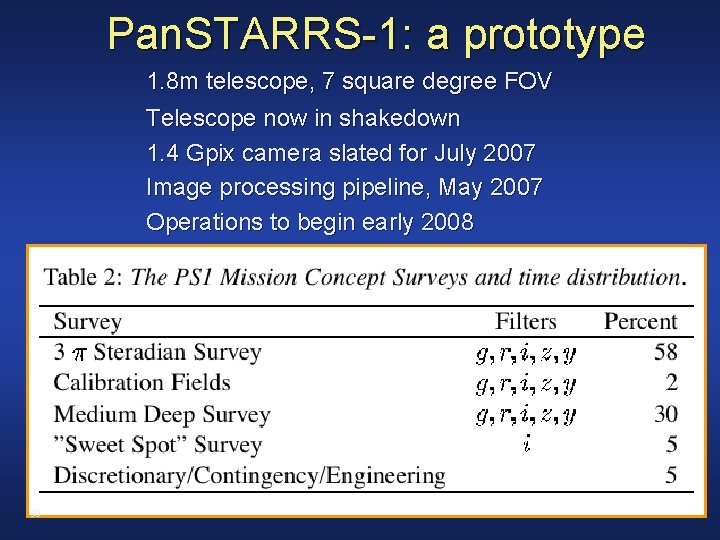
Pan. STARRS-1: a prototype 1. 8 m telescope, 7 square degree FOV Telescope now in shakedown 1. 4 Gpix camera slated for July 2007 Image processing pipeline, May 2007 Operations to begin early 2008 30
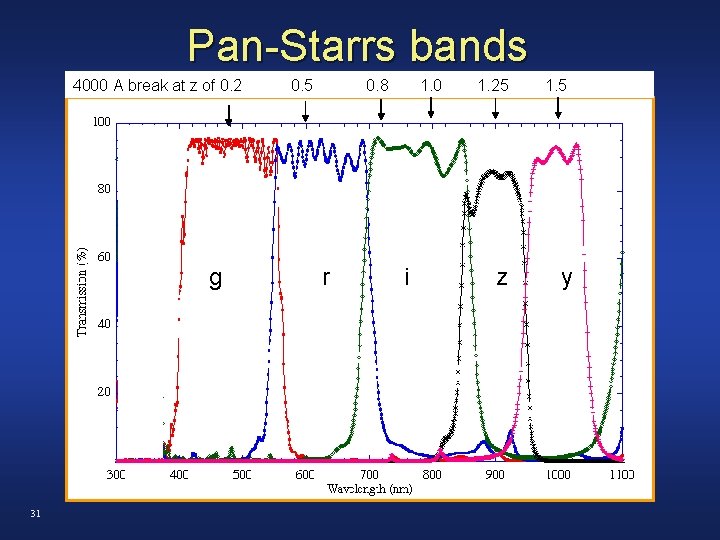
Pan-Starrs bands 4000 A break at z of 0. 2 0. 5 0. 8 1. 0 1. 25 1. 5 g r i z y 31
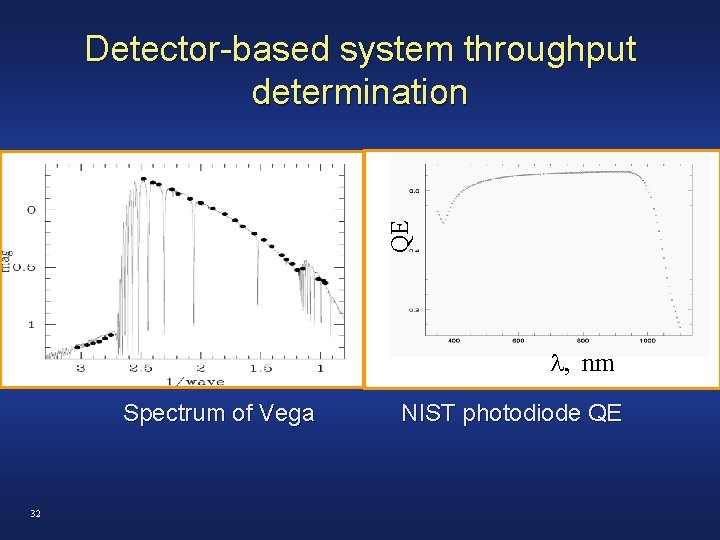
QE Detector-based system throughput determination nm Spectrum of Vega NIST photodiode QE 32
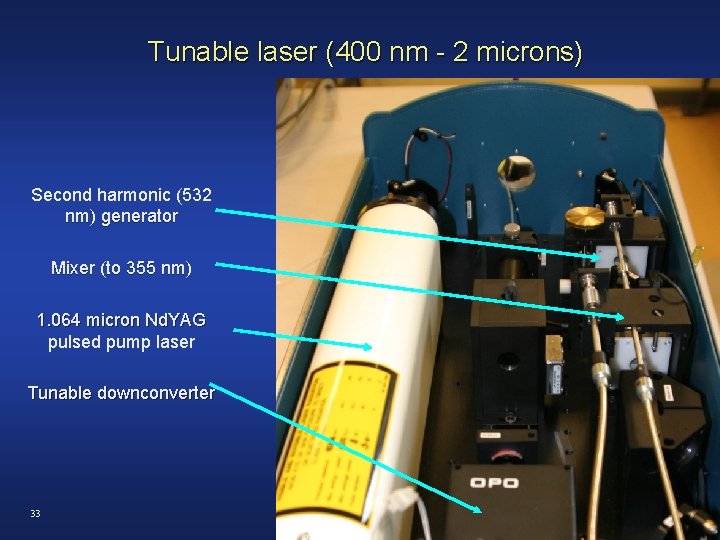
Tunable laser (400 nm - 2 microns) Second harmonic (532 nm) generator Mixer (to 355 nm) 1. 064 micron Nd. YAG pulsed pump laser Tunable downconverter 33

34
Atmospheric Transmission Visible to NIR (from SNAP team website)
Atmospheric Transmission Differential spectroscopy (CTIO 1. 5 m) Simultaneous multiband imager 36
In the Planning/Design phase • Dark Energy Survey • Equip CTIO 4 m with 3 sq deg camera • 1/3 of the time, 5 year survey • Cluster photo-z’s, SNe, Weak Lensing, LSS • Spectroscopic BAO surveys • WFMOS, SDSS follow-on… • Photo-z’s not accurate enough for BAO? • Pan. STARRS 4 • Four 1. 8 m telescopes, PS-1 is prototype • Large Synoptic Survey Telescope • 8. 4 m aperture • 9. 6 sq degree field 37
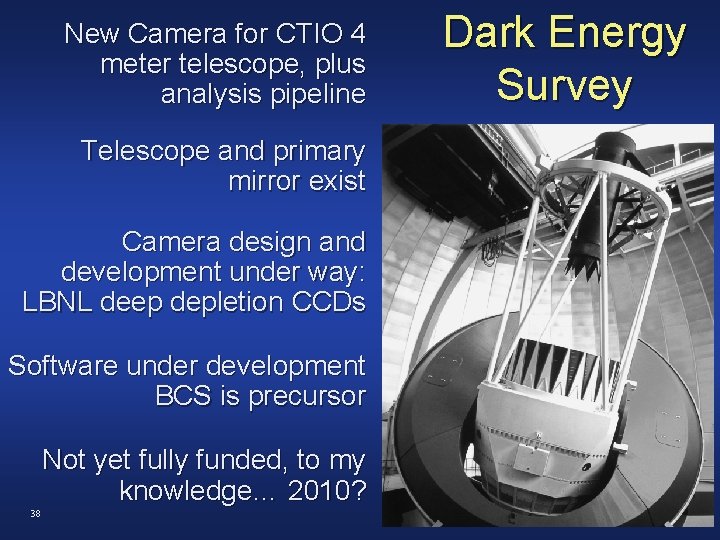
New Camera for CTIO 4 meter telescope, plus analysis pipeline Telescope and primary mirror exist Camera design and development under way: LBNL deep depletion CCDs Software under development BCS is precursor Not yet fully funded, to my knowledge… 2010? 38 Dark Energy Survey
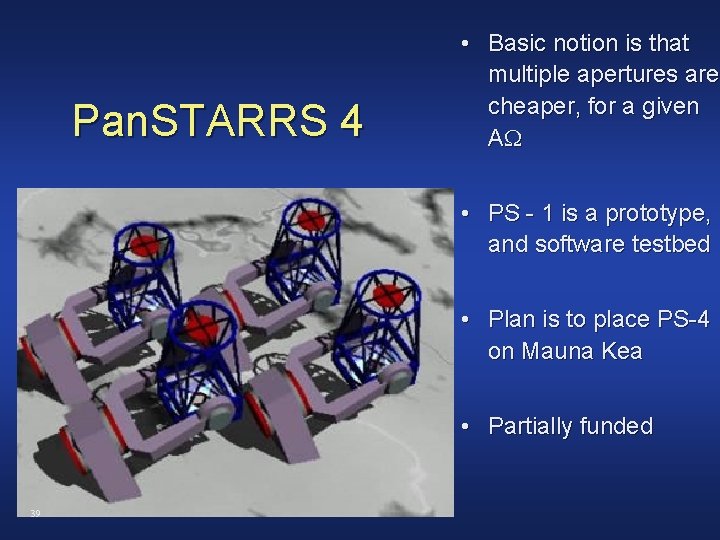
Pan. STARRS 4 • Basic notion is that multiple apertures are cheaper, for a given A • PS - 1 is a prototype, and software testbed • Plan is to place PS-4 on Mauna Kea • Partially funded 39
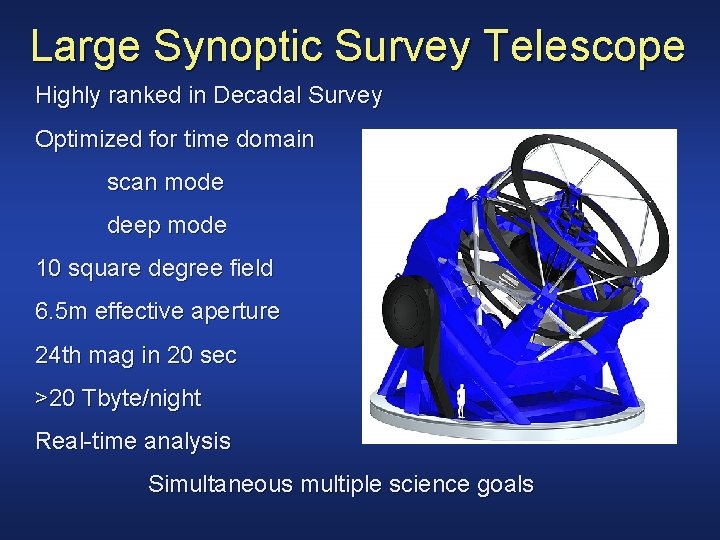
Large Synoptic Survey Telescope Highly ranked in Decadal Survey Optimized for time domain scan mode deep mode 10 square degree field 6. 5 m effective aperture 24 th mag in 20 sec >20 Tbyte/night Real-time analysis Simultaneous multiple science goals
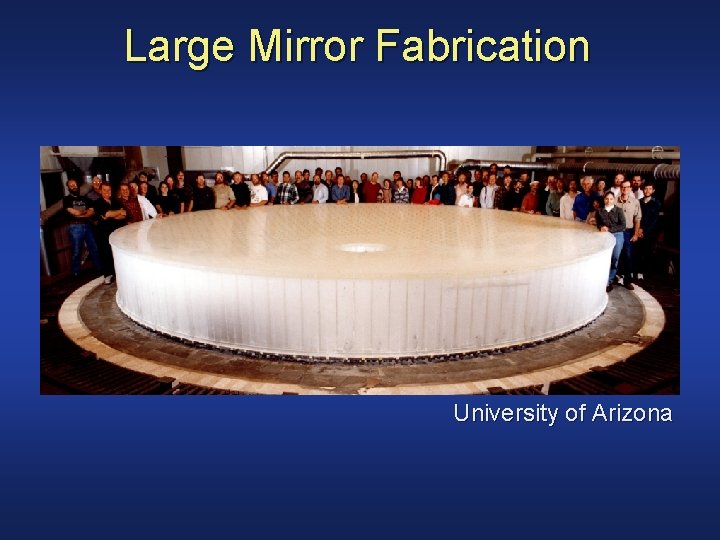
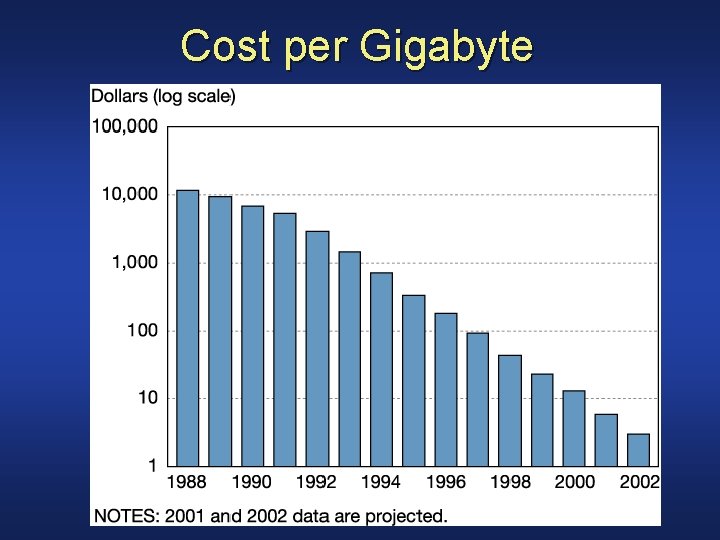
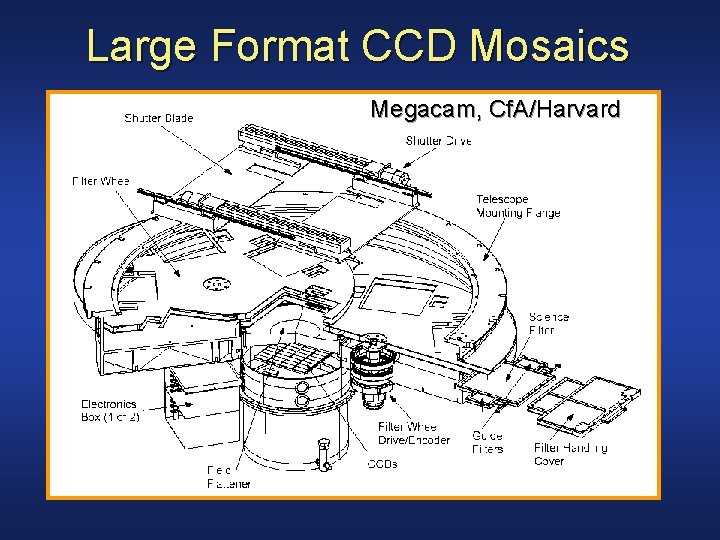
LSST Merges 3 Enabling Technologies • Large Aperture Optics • Computing and Data Storage • High Efficiency Detectors 41
Large Mirror Fabrication University of Arizona
Cost per Gigabyte
Large Format CCD Mosaics Megacam, Cf. A/Harvard
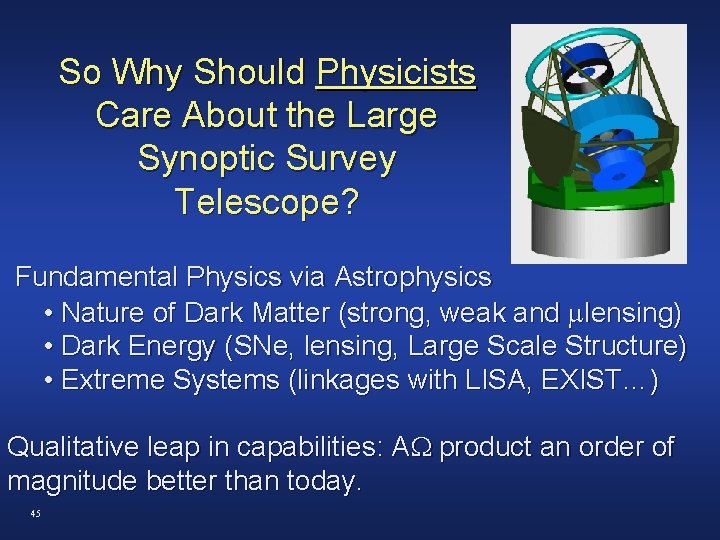
So Why Should Physicists Care About the Large Synoptic Survey Telescope? Fundamental Physics via Astrophysics • Nature of Dark Matter (strong, weak and mlensing) • Dark Energy (SNe, lensing, Large Scale Structure) • Extreme Systems (linkages with LISA, EXIST…) Qualitative leap in capabilities: A product an order of magnitude better than today. 45
Some Examples • Thousands of type Ia supernovae Ø Detailed study of physics Ø Isotropy of Hubble diagram Ø Subdivide data set • Host galaxy type • Redshift shells • SN color/decline parameter • Time delays from strongly lensed Sne Ø Constrains nature of dark matter • Weak Lensing of galaxies as a probe of nature of dark energy • Optical counterparts to gravity wave sources Ø Break degeneracy in (1+z)Mchirp 46
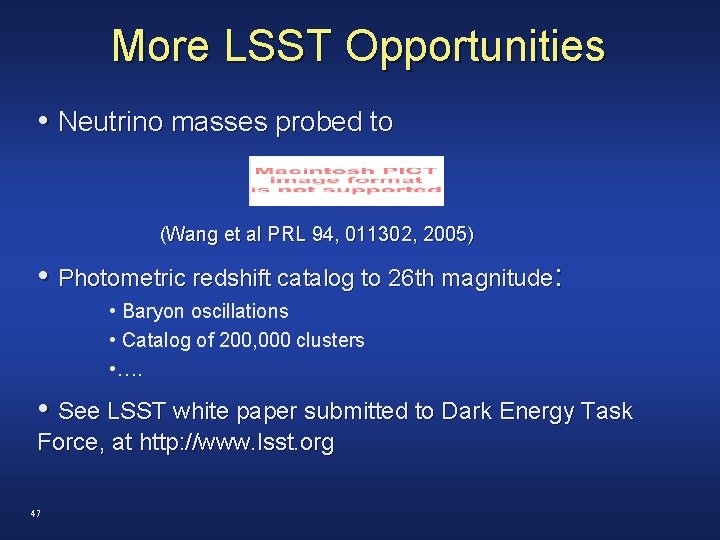
More LSST Opportunities • Neutrino masses probed to (Wang et al PRL 94, 011302, 2005) • Photometric redshift catalog to 26 th magnitude: • Baryon oscillations • Catalog of 200, 000 clusters • …. • See LSST white paper submitted to Dark Energy Task Force, at http: //www. lsst. org 47
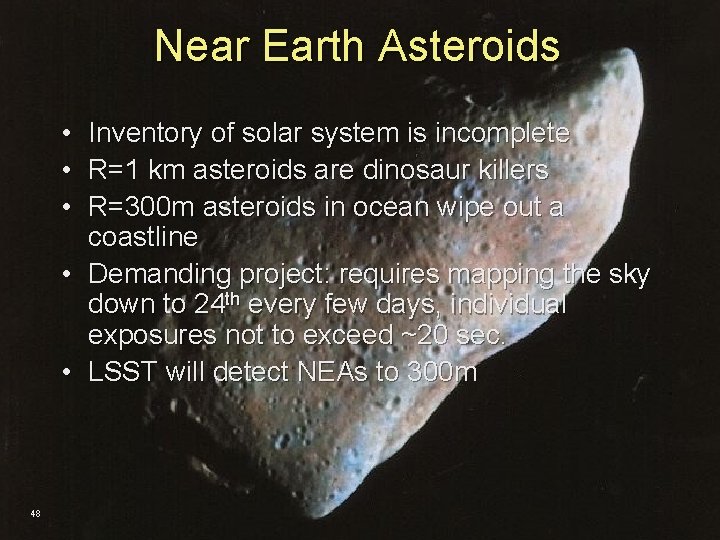
Near Earth Asteroids • • • Inventory of solar system is incomplete R=1 km asteroids are dinosaur killers R=300 m asteroids in ocean wipe out a coastline • Demanding project: requires mapping the sky down to 24 th every few days, individual exposures not to exceed ~20 sec. • LSST will detect NEAs to 300 m 48

49
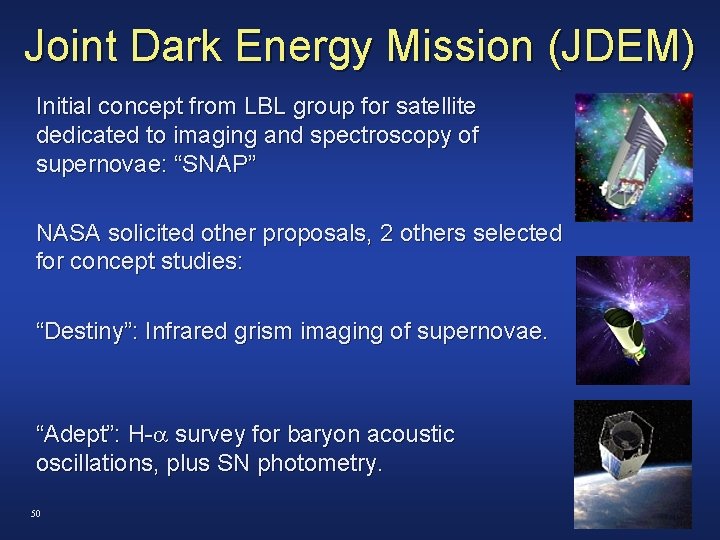
Joint Dark Energy Mission (JDEM) Initial concept from LBL group for satellite dedicated to imaging and spectroscopy of supernovae: “SNAP” NASA solicited other proposals, 2 others selected for concept studies: “Destiny”: Infrared grism imaging of supernovae. “Adept”: H- survey for baryon acoustic oscillations, plus SN photometry. 50
Common Challenges • Systematics! • These are observations, not experiments. • Diversity of techniques is essential • Software • Real-time processing and transient classification • High-throughput image processing and data access • Database technology • • • 51 Precision Calibration of Photometry Point Spread Functions Photometric redshifts International astro-politics Multiagency/interdisciplinary support?
A Sobering Note… and 3 questions Evidence of Dark Energy seems compelling Current data favor w 1, wa= 0 1. What if this is the real answer? When do we quit? 2. How do we assign value to this parameter space, absent guidance from theory? 3. What combination of ground and space-based facilities is the most cost-effective approach? 52
Summary Astrophysics is a fruitful avenue for exploring new fundamental physics Ø Makes sense to go where the signal is! Imperatives include Ø Understanding the physics of an apparent non-zero Ø Determining nature and distribution of dark matter Ø Probing foundations of gravity Next-generation facilities offer tremendous leap in capability: Pan-Starrs, DES, LSST, SPT, JDEM…. 53
54
- Slides: 54