
Fundamental of Wireless LAN Radio Waves n IEEE
- Slides: 23
Fundamental of Wireless LAN Radio Waves n IEEE 802 Families n Appenidx (Infrared and Carrier Currents LANs) n Ch 2: 1 Wireless. Net Tseng
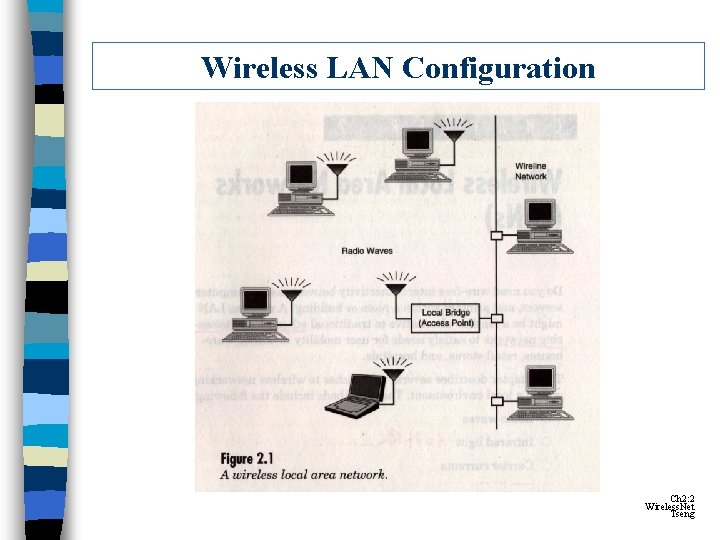
Wireless LAN Configuration Ch 2: 2 Wireless. Net Tseng
Radio-Based Wireless LANs n Most widely used method u. Adv: penetrating walls and other obstacles with little attenuation. u. Disadv: security, interference, etc. n 2 approaches: u. Narrow band u. ISM band Spread spectrum Ch 2: 3 Wireless. Net Tseng
Narrow Band Modulation n n n Concentrate all transmission power in a narrow range of frequency. Efficient use of radio spectrum; save bandwidth. ex: television, AM, FM Adv: for long distance transmission (e. g. metropolitan area) Disadv: noise can easily corrupt the signals Need to obtain FCC licenses to coordinate the use. Ch 2: 4 Wireless. Net Tseng
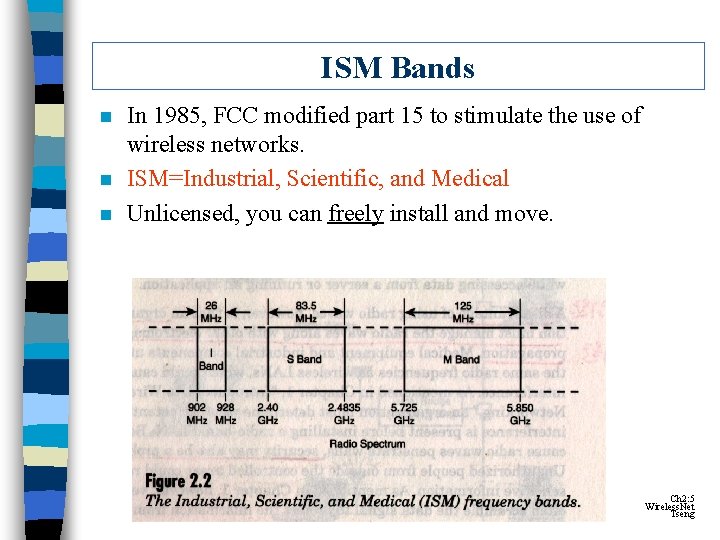
ISM Bands n n n In 1985, FCC modified part 15 to stimulate the use of wireless networks. ISM=Industrial, Scientific, and Medical Unlicensed, you can freely install and move. Ch 2: 5 Wireless. Net Tseng
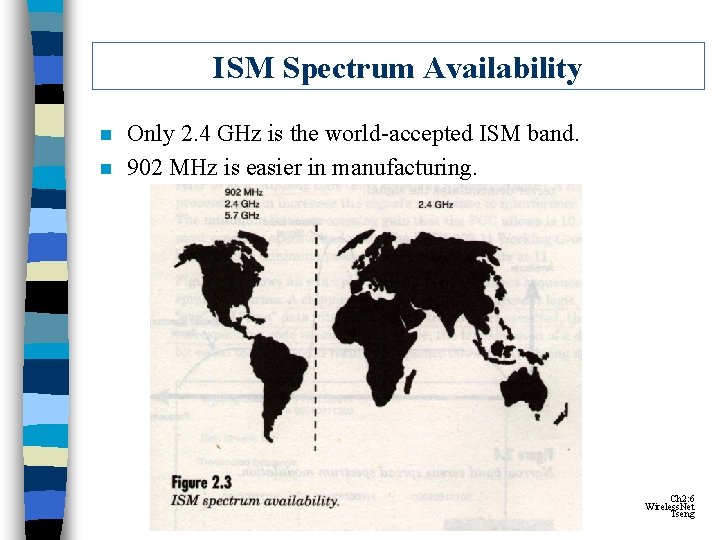
ISM Spectrum Availability n n Only 2. 4 GHz is the world-accepted ISM band. 902 MHz is easier in manufacturing. Ch 2: 6 Wireless. Net Tseng
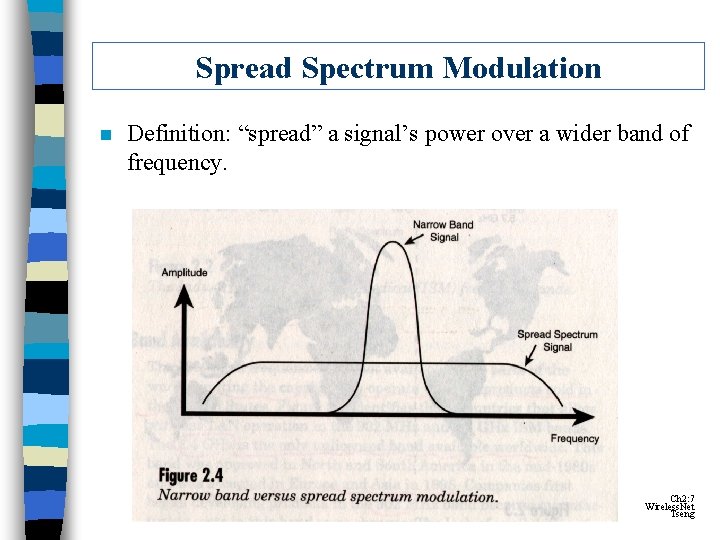
Spread Spectrum Modulation n Definition: “spread” a signal’s power over a wider band of frequency. Ch 2: 7 Wireless. Net Tseng
Spread Spectrum n n Disadv: This contradicts with the goal of conserving bandwidth. Adv: less susceptible to electrical noise (especially from narrow band sources) u. In World War II, US Army uses spread spectrum to avoid hostile jamming. (invented by Hedy Lamarr, an actress) n To spread a signal, there are two ways: udirect sequence (DSSS) ufrequency hopping (FHSS) Ch 2: 8 Wireless. Net Tseng
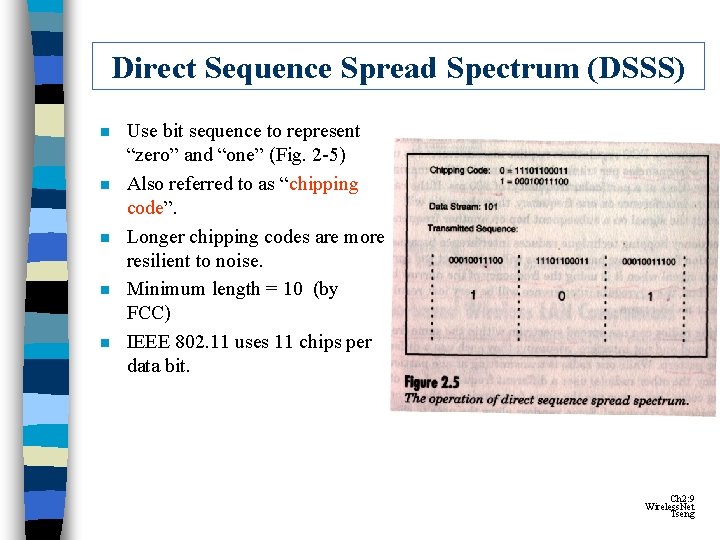
Direct Sequence Spread Spectrum (DSSS) n n n Use bit sequence to represent “zero” and “one” (Fig. 2 -5) Also referred to as “chipping code”. Longer chipping codes are more resilient to noise. Minimum length = 10 (by FCC) IEEE 802. 11 uses 11 chips per data bit. Ch 2: 9 Wireless. Net Tseng
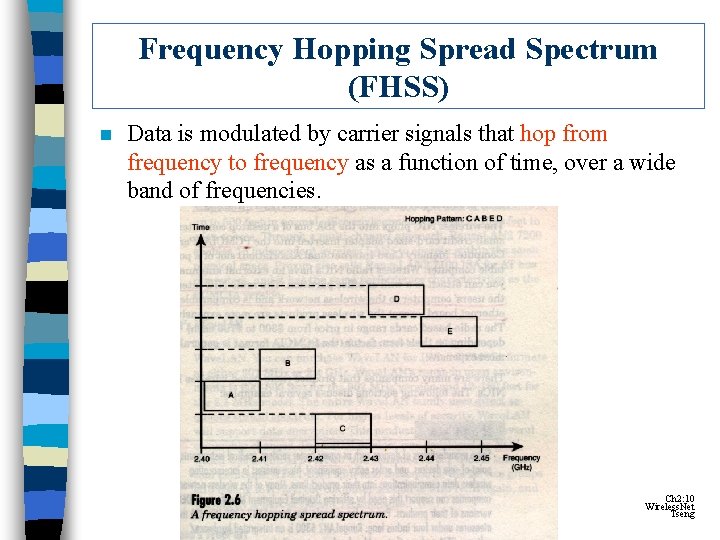
Frequency Hopping Spread Spectrum (FHSS) n Data is modulated by carrier signals that hop from frequency to frequency as a function of time, over a wide band of frequencies. Ch 2: 10 Wireless. Net Tseng
FHSS (cont. ) n n n Hopping Code: to determine the order of hopping frequencies The receiver must “listen” to incoming signals at the right time at the right frequency. FCC regulation: at least 75 frequencies, with max. dwell time 400 ms. Adv. : very resilient to noise. Orthogonal hopping codes: a set of hopping codes that never use the same frequencies at the same time (can be on -line adjusted by software). Allow multiple wireless LANs to co-exist. Ch 2: 11 Wireless. Net Tseng
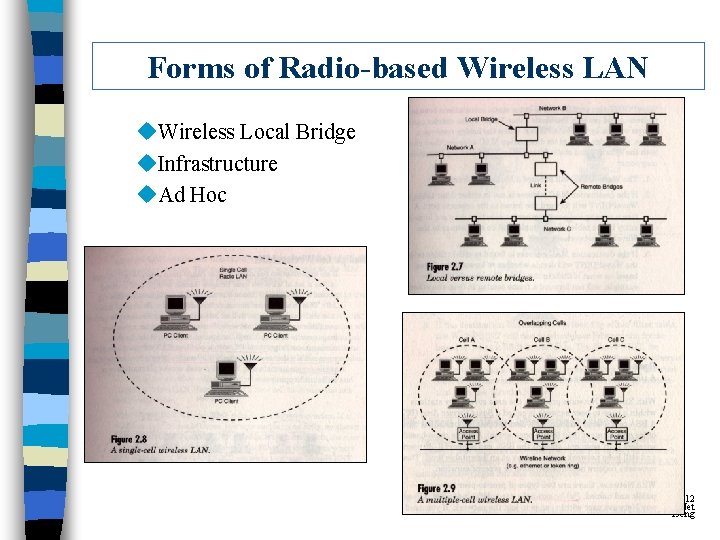
Forms of Radio-based Wireless LAN u. Wireless Local Bridge u. Infrastructure u. Ad Hoc Ch 2: 12 Wireless. Net Tseng
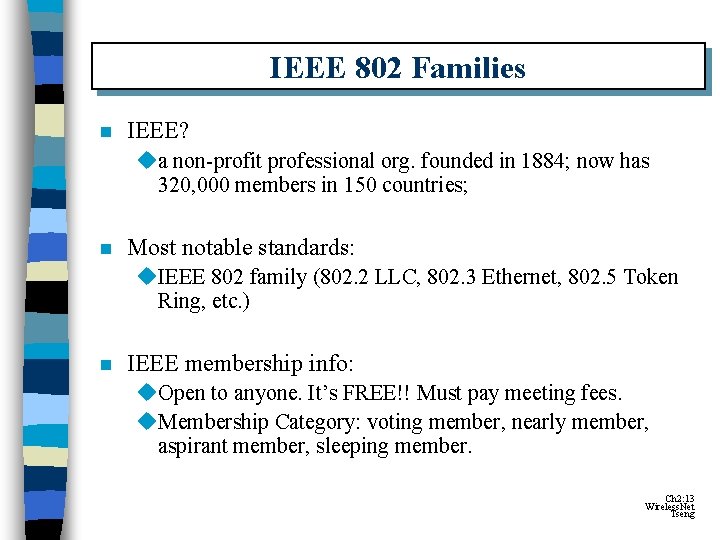
IEEE 802 Families n IEEE? ua non-profit professional org. founded in 1884; now has 320, 000 members in 150 countries; n Most notable standards: u. IEEE 802 family (802. 2 LLC, 802. 3 Ethernet, 802. 5 Token Ring, etc. ) n IEEE membership info: u. Open to anyone. It’s FREE!! Must pay meeting fees. u. Membership Category: voting member, nearly member, aspirant member, sleeping member. Ch 2: 13 Wireless. Net Tseng
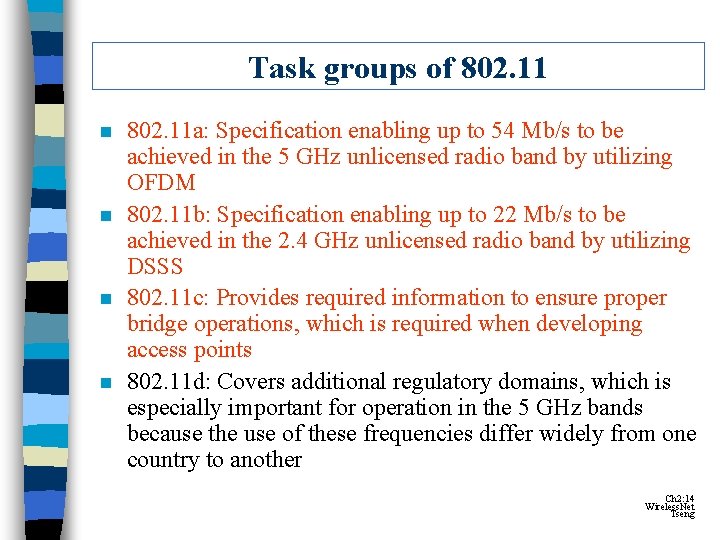
Task groups of 802. 11 n n 802. 11 a: Specification enabling up to 54 Mb/s to be achieved in the 5 GHz unlicensed radio band by utilizing OFDM 802. 11 b: Specification enabling up to 22 Mb/s to be achieved in the 2. 4 GHz unlicensed radio band by utilizing DSSS 802. 11 c: Provides required information to ensure proper bridge operations, which is required when developing access points 802. 11 d: Covers additional regulatory domains, which is especially important for operation in the 5 GHz bands because the use of these frequencies differ widely from one country to another Ch 2: 14 Wireless. Net Tseng
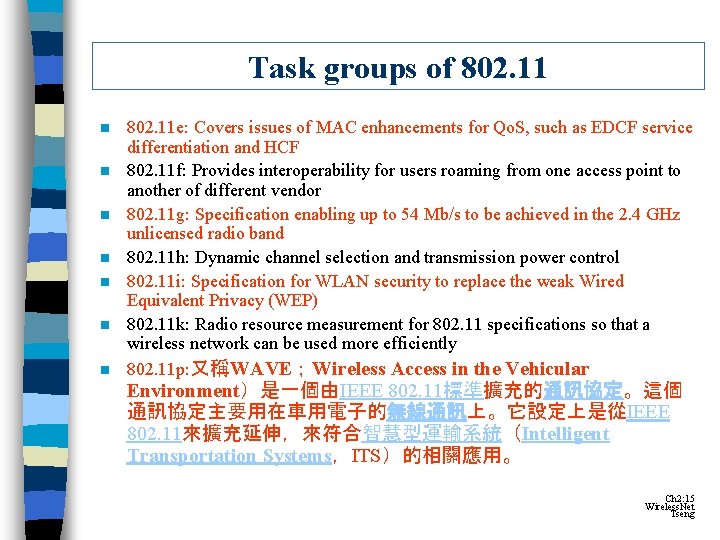
Task groups of 802. 11 n n n n 802. 11 e: Covers issues of MAC enhancements for Qo. S, such as EDCF service differentiation and HCF 802. 11 f: Provides interoperability for users roaming from one access point to another of different vendor 802. 11 g: Specification enabling up to 54 Mb/s to be achieved in the 2. 4 GHz unlicensed radio band 802. 11 h: Dynamic channel selection and transmission power control 802. 11 i: Specification for WLAN security to replace the weak Wired Equivalent Privacy (WEP) 802. 11 k: Radio resource measurement for 802. 11 specifications so that a wireless network can be used more efficiently 802. 11 p: 又稱WAVE;Wireless Access in the Vehicular Environment)是一個由IEEE 802. 11標準擴充的通訊協定。這個 通訊協定主要用在車用電子的無線通訊上。它設定上是從IEEE 802. 11來擴充延伸,來符合智慧型運輸系統(Intelligent Transportation Systems,ITS)的相關應用。 Ch 2: 15 Wireless. Net Tseng
Appendix: (for your reference) Ch 2: 16 Wireless. Net Tseng
Infrared Light-based Wireless LAN n Wavelength range: 0. 75 ~ 1000 u uultraviolet < visible lights < infrared < radio utypically operating at 0. 82 u n Adv: uhigher security: does not propagate through opaque objects, keeping signals within rooms and building uno interference from microwave ovens and radio transmitters n Disadv: udirectional, not suitable for mobile applications n Two types of infrared light LANs: u. Diffused u. Point-to-point Ch 2: 17 Wireless. Net Tseng
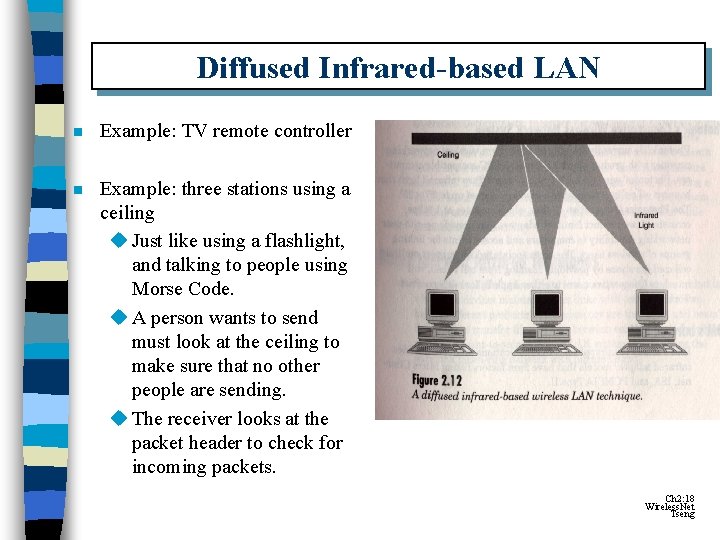
Diffused Infrared-based LAN n Example: TV remote controller n Example: three stations using a ceiling u Just like using a flashlight, and talking to people using Morse Code. u A person wants to send must look at the ceiling to make sure that no other people are sending. u The receiver looks at the packet header to check for incoming packets. Ch 2: 18 Wireless. Net Tseng
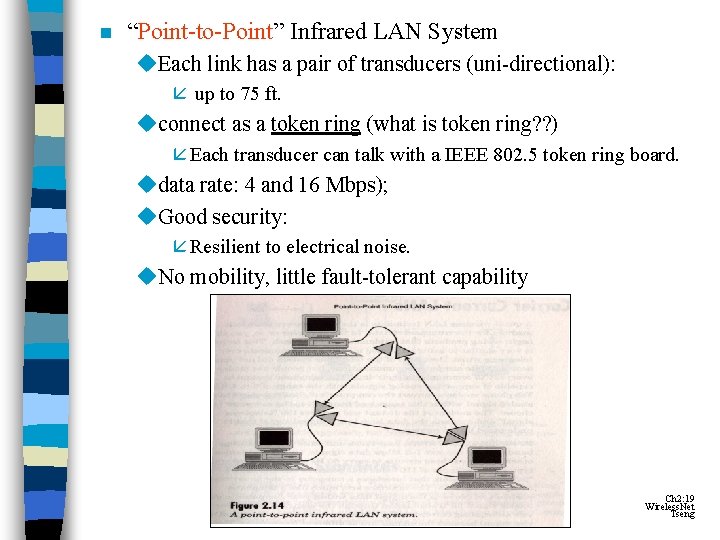
n “Point-to-Point” Infrared LAN System u. Each link has a pair of transducers (uni-directional): å up to 75 ft. uconnect as a token ring (what is token ring? ? ) å Each transducer can talk with a IEEE 802. 5 token ring board. udata rate: 4 and 16 Mbps); u. Good security: å Resilient to electrical noise. u. No mobility, little fault-tolerant capability Ch 2: 19 Wireless. Net Tseng
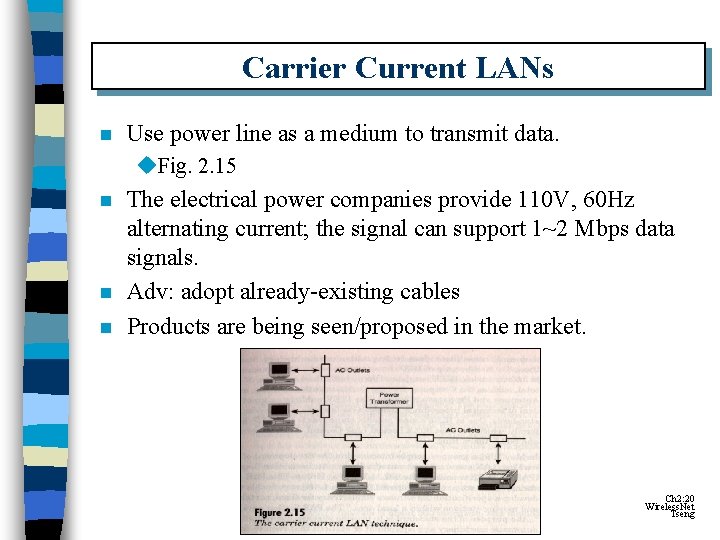
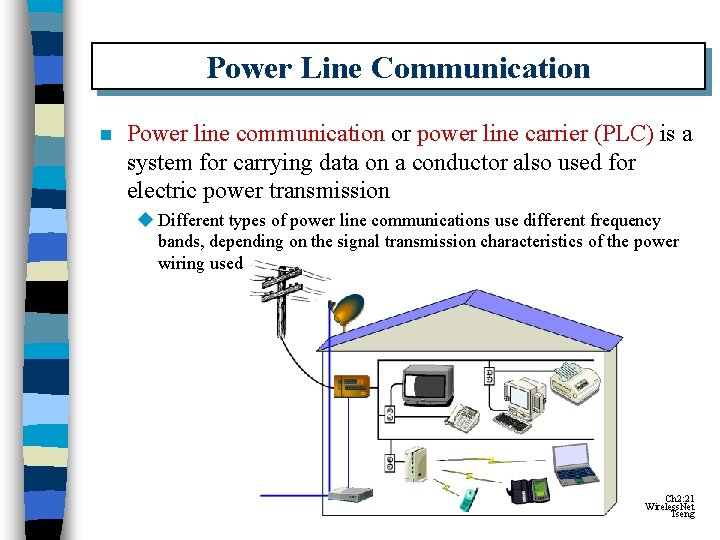
Carrier Current LANs n Use power line as a medium to transmit data. u. Fig. 2. 15 n n n The electrical power companies provide 110 V, 60 Hz alternating current; the signal can support 1~2 Mbps data signals. Adv: adopt already-existing cables Products are being seen/proposed in the market. Ch 2: 20 Wireless. Net Tseng
Power Line Communication n Power line communication or power line carrier (PLC) is a system for carrying data on a conductor also used for electric power transmission u Different types of power line communications use different frequency bands, depending on the signal transmission characteristics of the power wiring used Ch 2: 21 Wireless. Net Tseng
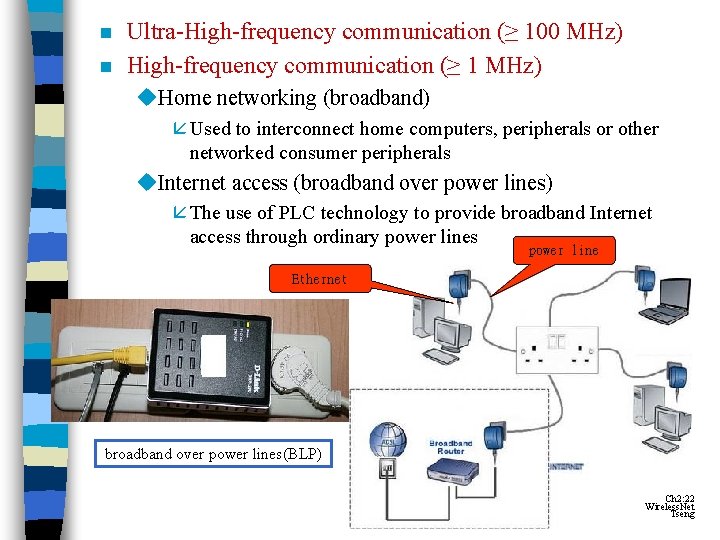
n n Ultra-High-frequency communication (≥ 100 MHz) High-frequency communication (≥ 1 MHz) u. Home networking (broadband) å Used to interconnect home computers, peripherals or other networked consumer peripherals u. Internet access (broadband over power lines) å The use of PLC technology to provide broadband Internet access through ordinary power lines power line Ethernet broadband over power lines(BLP) Ch 2: 22 Wireless. Net Tseng
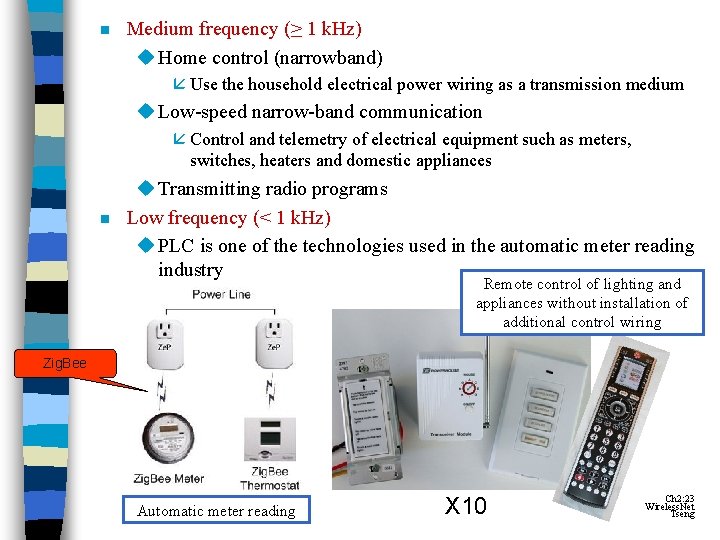
n Medium frequency (≥ 1 k. Hz) u Home control (narrowband) å Use the household electrical power wiring as a transmission medium u Low-speed narrow-band communication å Control and telemetry of electrical equipment such as meters, switches, heaters and domestic appliances n u Transmitting radio programs Low frequency (< 1 k. Hz) u PLC is one of the technologies used in the automatic meter reading industry Remote control of lighting and appliances without installation of additional control wiring Zig. Bee Automatic meter reading X 10 Ch 2: 23 Wireless. Net Tseng