
Fundamental frequency behavior in sad and happy speech
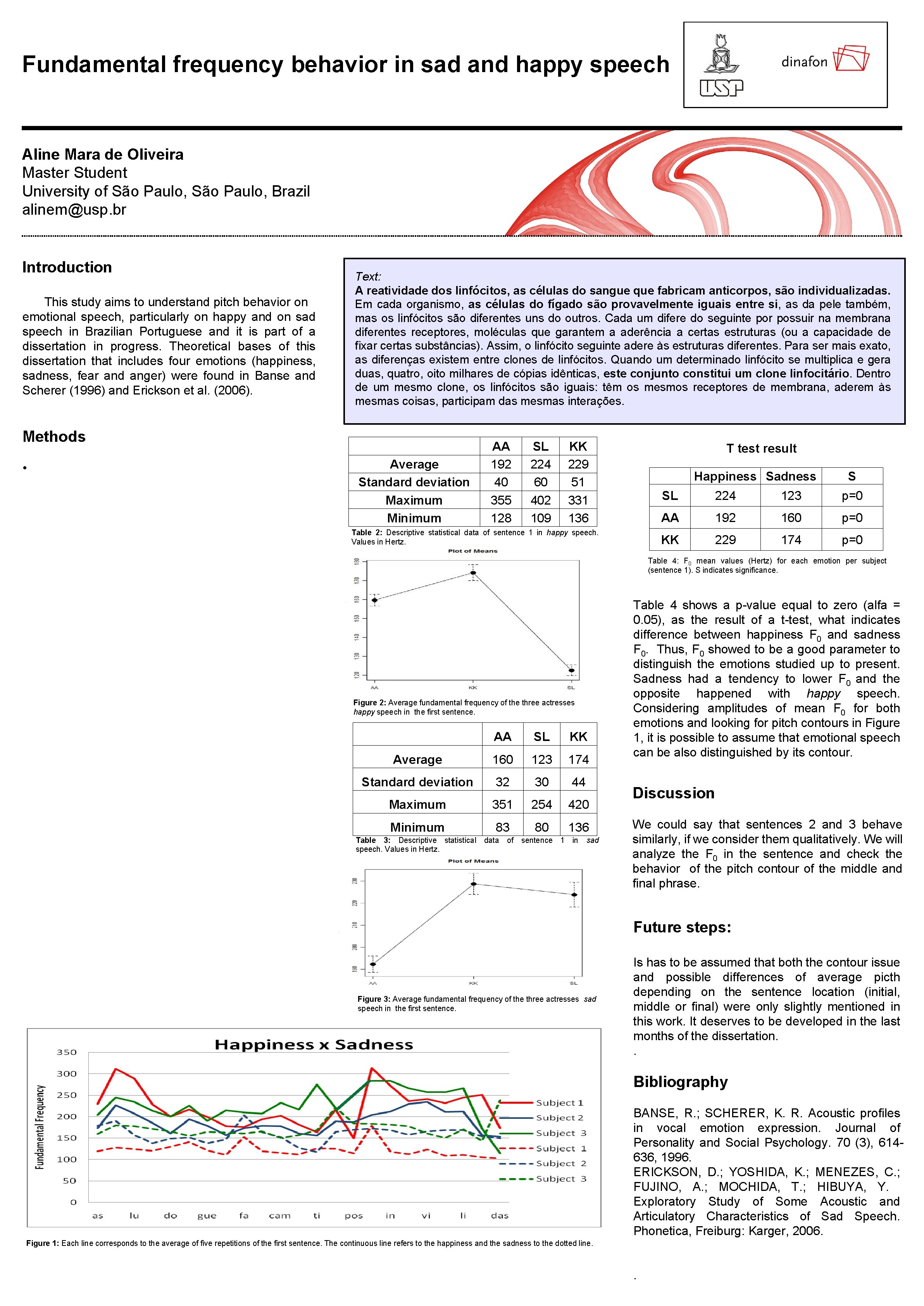
Fundamental frequency behavior in sad and happy speech Aline Mara de Oliveira Master Student University of São Paulo, Brazil alinem@usp. br Introduction This study aims to understand pitch behavior on emotional speech, particularly on happy and on sad speech in Brazilian Portuguese and it is part of a dissertation in progress. Theoretical bases of this dissertation that includes four emotions (happiness, sadness, fear and anger) were found in Banse and Scherer (1996) and Erickson et al. (2006). Text: A reatividade dos linfócitos, as células do sangue que fabricam anticorpos, são individualizadas. Em cada organismo, as células do fígado são provavelmente iguais entre si, as da pele também, mas os linfócitos são diferentes uns do outros. Cada um difere do seguinte por possuir na membrana diferentes receptores, moléculas que garantem a aderência a certas estruturas (ou a capacidade de fixar certas substâncias). Assim, o linfócito seguinte adere às estruturas diferentes. Para ser mais exato, as diferenças existem entre clones de linfócitos. Quando um determinado linfócito se multiplica e gera duas, quatro, oito milhares de cópias idênticas, este conjunto constitui um clone linfocitário. Dentro de um mesmo clone, os linfócitos são iguais: têm os mesmos receptores de membrana, aderem às mesmas coisas, participam das mesmas interações. Methods • Average Standard deviation Maximum Minimum AA 192 40 355 128 SL 224 60 402 109 KK 229 51 331 136 T test result Happiness Sadness Table 2: Descriptive statistical data of sentence 1 in happy speech. Values in Hertz. S SL 224 123 p=0 AA 192 160 p=0 KK 229 174 p=0 Table 4: F 0 mean values (Hertz) for each emotion per subject (sentence 1). S indicates significance. Figure 2: Average fundamental frequency of the three actresses happy speech in the first sentence. AA SL KK Average 160 123 174 Standard deviation 32 30 44 Maximum 351 254 420 Minimum 83 80 136 Table 3: Descriptive statistical speech. Values in Hertz. data of sentence 1 in sad Table 4 shows a p-value equal to zero (alfa = 0. 05), as the result of a t-test, what indicates difference between happiness F 0 and sadness F 0. Thus, F 0 showed to be a good parameter to distinguish the emotions studied up to present. Sadness had a tendency to lower F 0 and the opposite happened with happy speech. Considering amplitudes of mean F 0 for both emotions and looking for pitch contours in Figure 1, it is possible to assume that emotional speech can be also distinguished by its contour. Discussion We could say that sentences 2 and 3 behave similarly, if we consider them qualitatively. We will analyze the F 0 in the sentence and check the behavior of the pitch contour of the middle and final phrase. Future steps: Figure 3: Average fundamental frequency of the three actresses sad speech in the first sentence. Is has to be assumed that both the contour issue and possible differences of average picth depending on the sentence location (initial, middle or final) were only slightly mentioned in this work. It deserves to be developed in the last months of the dissertation. . Bibliography BANSE, R. ; SCHERER, K. R. Acoustic profiles in vocal emotion expression. Journal of Personality and Social Psychology. 70 (3), 614636, 1996. ERICKSON, D. ; YOSHIDA, K. ; MENEZES, C. ; FUJINO, A. ; MOCHIDA, T. ; HIBUYA, Y. Exploratory Study of Some Acoustic and Articulatory Characteristics of Sad Speech. Phonetica, Freiburg: Karger, 2006. Figure 1: Each line corresponds to the average of five repetitions of the first sentence. The continuous line refers to the happiness and the sadness to the dotted line. .
- Slides: 1