
Fundamental Freedoms Ms Walker US Government Civil Liberties
Fundamental Freedoms Ms. Walker US Government
Civil Liberties l The basic individual rights and freedoms that are protected from government violation l http: //www. annenbergclassroom. org/page/te aching-the-constitution
Limited Government l Rights are Relative, not absolute l The constitution guarantees many different rights to everyone in the US, but, no one has the right to do anything he or she wishes l http: //www. learner. org/courses/democracyi namerica/dia_4_video. html part 1: 1 st amendment rights are not absolute
Limited Government l When rights collide-(freedom of the press v jury trial) Sheppard v Maxwell: Sheppard claimed he could not receive a fair trial due to extensive media coverage l To whom are Rights guaranteed? Aliens and citizens l http: //www. learner. org/courses/democracyi namerica/dia_4_video. html l Part 3: When Rights collide
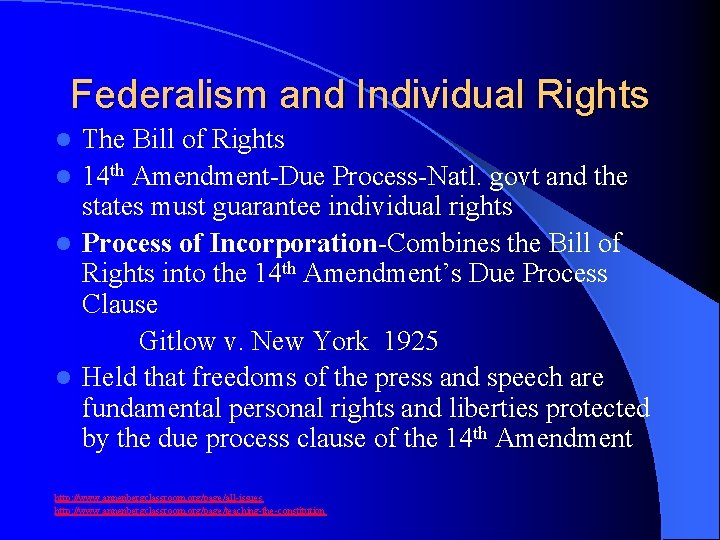
Federalism and Individual Rights The Bill of Rights l 14 th Amendment-Due Process-Natl. govt and the states must guarantee individual rights l Process of Incorporation-Combines the Bill of Rights into the 14 th Amendment’s Due Process Clause Gitlow v. New York 1925 l Held that freedoms of the press and speech are fundamental personal rights and liberties protected by the due process clause of the 14 th Amendment l http: //www. annenbergclassroom. org/page/all-issues http: //www. annenbergclassroom. org/page/teaching-the-constitution
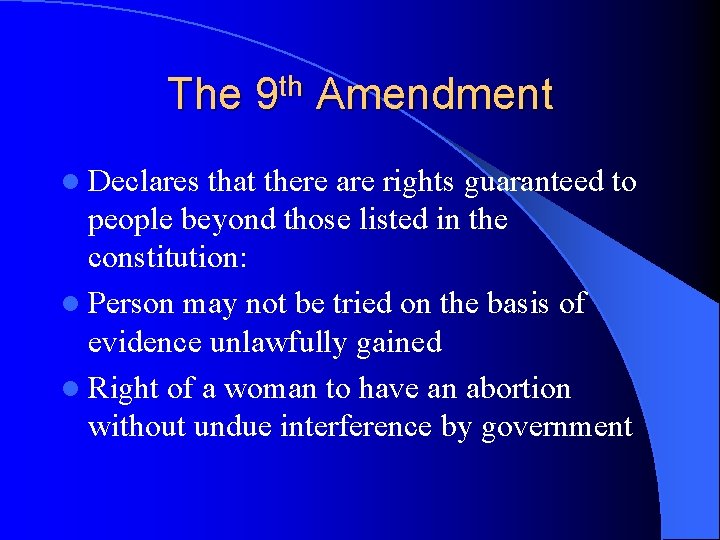
The 9 th Amendment l Declares that there are rights guaranteed to people beyond those listed in the constitution: l Person may not be tried on the basis of evidence unlawfully gained l Right of a woman to have an abortion without undue interference by government
The Bill of Rights l http: //sunnylandsclassroom. org/Asset. aspx? Id=1506
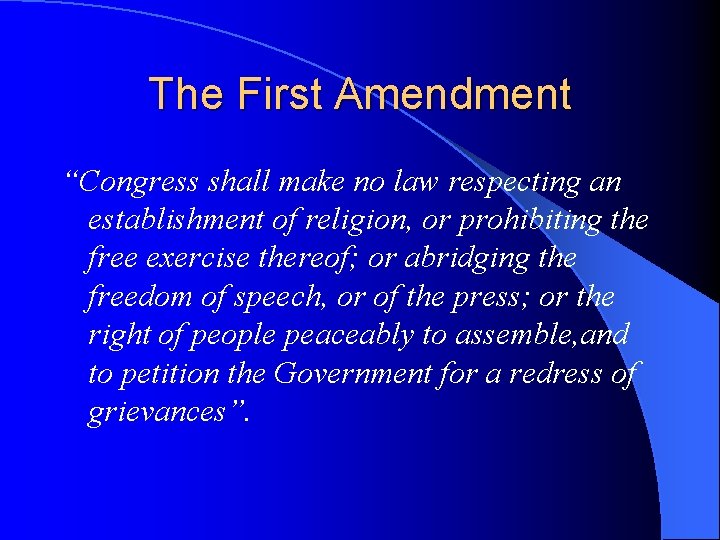
The First Amendment “Congress shall make no law respecting an establishment of religion, or prohibiting the free exercise thereof; or abridging the freedom of speech, or of the press; or the right of people peaceably to assemble, and to petition the Government for a redress of grievances”.

Freedom of Religion
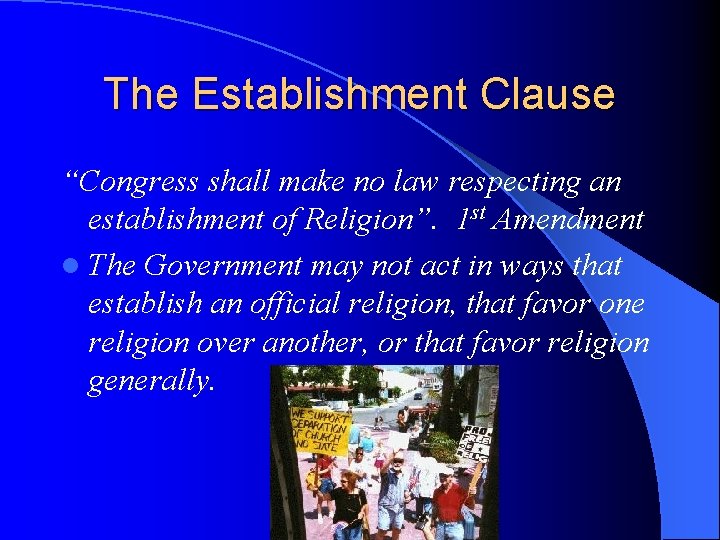
The Establishment Clause “Congress shall make no law respecting an establishment of Religion”. 1 st Amendment l The Government may not act in ways that establish an official religion, that favor one religion over another, or that favor religion generally.
Separation of Church and State l l l Government encourages churches and religion-no taxes Chaplains serve in the military Oaths of office in the name of God Legislative sessions begin with prayer National anthem and currency make reference to God
Religion and Education Landmark Supreme Court Cases l l Mc. Collum v Board of Education 1948 -An Illinois religious instruction program unconstitutionally established religion because it received official support Engel v Vitale 1962 -Prayer in public schools violates the establishment clause 1984 Equal Access Act: Students may use public school buildings for religious meetings Epperson v Arkansas 1968 -stuck down a state law which forbade the teaching of evolution.
Aid to Parochial Schools The Lemon Test l 1. 2. 3. l Lemon v Kurtzman 1971 -established a three part test for deciding if a government law aiding a religious body violates the establishment clause Have a secular and nonreligious purpose Neither advance nor limit religion Not result in excessive government involvement with religion Public schools cannot sponsor religious exercises
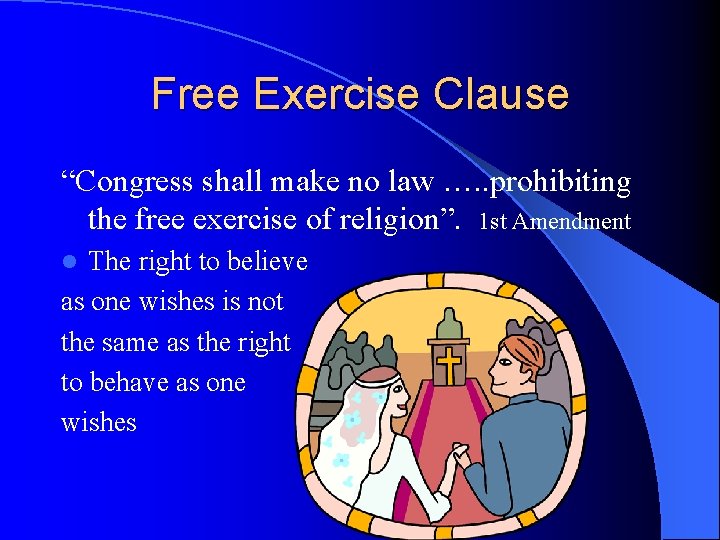
Free Exercise Clause “Congress shall make no law …. . prohibiting the free exercise of religion”. 1 st Amendment The right to believe as one wishes is not the same as the right to behave as one wishes l
Supreme Court Cases Reynolds v United States 1879 -Mormons could not engage in Bigamy l West Va. State Board of education v Barnette 1943 -Jehovah’s witnesses could not be forced to salute the flag-did not have to pay homage to an object of worship. Saying the pledge is also not required and if forced to, violates 1 st amendment free speech clause. l
Freedom of Speech and Press Free Expression-the 1 st amendment guarantees that each person has the right to have their say and the right to hear what others have to say Some forms of free expression are not protected by the constitution: 1. Clear and Present Danger-May not yell “Fire” in a crowded theatre 2. Libel-false and malicious use of printed words 3. Slander-false and malicious use of spoken words 4. Obscene words/materials, false advertising 5. Seditious Speech-advocating and urging an attempt to overthrow the government by violent acts (sedition) l
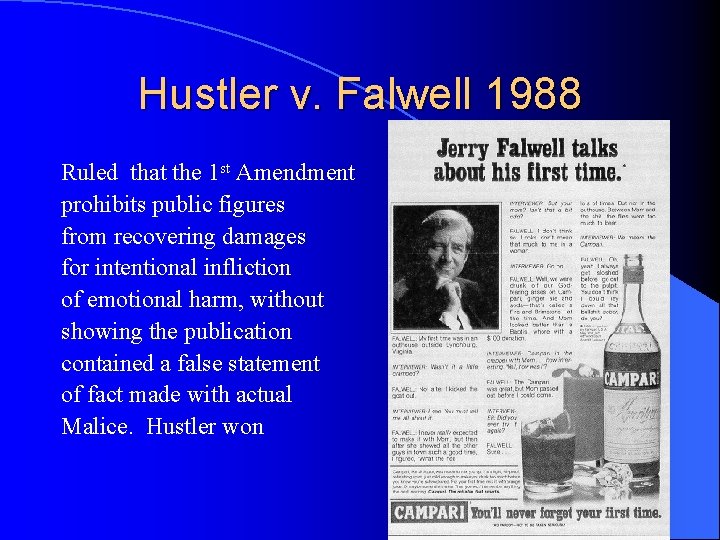
Hustler v. Falwell 1988 Ruled that the 1 st Amendment prohibits public figures from recovering damages for intentional infliction of emotional harm, without showing the publication contained a false statement of fact made with actual Malice. Hustler won
The Alien and Sedition Acts l 1798 -The president could deport undesirable aliens and made “any false, scandalous, and malicious” criticism of the government a crime-expired by 1801 l 1917 -WWI-Couldn’t utter, print…. abusive language about the form of government of the US-Schneck v US
Schneck v. US l Charles Schneck-An officer of the Socialist Party had been found guilty of obstructing the war effort. He has sent “fiery” leaflets to some 15, 000 men who had been drafted, urging them to resist service. Supreme Court upheld the decision. Schneck presented a clear and present danger
The Smith Act of 1940 l It is a crime for anyone to advocate the violent overthrow of the US government, distribute such material or belong to a group that has those goals l Overturned in 1957: Held that merely to urge someone to believe something, in contrast to urging that person to do something, cannot be made illegal.
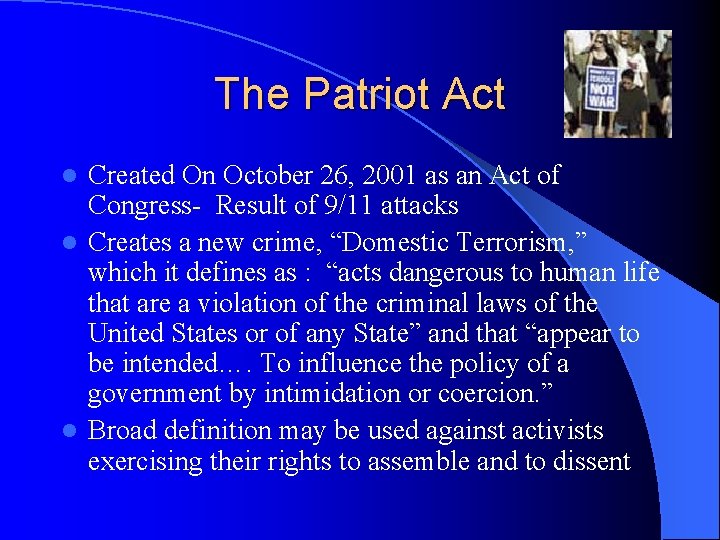
The Patriot Act Created On October 26, 2001 as an Act of Congress- Result of 9/11 attacks l Creates a new crime, “Domestic Terrorism, ” which it defines as : “acts dangerous to human life that are a violation of the criminal laws of the United States or of any State” and that “appear to be intended…. To influence the policy of a government by intimidation or coercion. ” l Broad definition may be used against activists exercising their rights to assemble and to dissent l
Obscenity l l l 1. 2. 3. Obscenity is not protected by the Bill of Rights. Roth v the US 1957 -1 st attempt to define Obscenity-not allowed to send it through the mail Miller v California 1973 -3 part test to determine what material is obscene: The average person finds the work offensiveexcites lust The work describes a form of sexual conduct not dealt with in an anti-obscenity law The work lacks serious artistic, political…
Prior Restraint The government cannot place any prior restraint on spoken or written words (The government cannot curb ideas before they are expressed) l Near v Minnesota 1931 -A local court forbade the printing of the Saturday Press. That publication had printed articles on corruption. The court couldn’t stop the publication l New York Times v. The US, 1971 -The US tried to stop the printing of the Pentagon Papers. l
Prior Restraint l Hazelwood School District v. Kuhlmeir, 1988 -Held that educators can exercise “editorial control over the style and content of student speech in school-sponsored expressive activities so long as their actions are reasonably related to legitimate pedagogical concerns. ”
The Media To what extent can the media-both print and electronic-be regulated by government? l Confidentiality-Should journalists be forced to name their sources or confidential information in a court of law? Journalists believe that if they tell, they will not be able to assure confidentiality, and therefore, many sources will not reveal their information. l Branzburg v. Hayes 1972 -Reporters must respond to relevant questions in the course of a valid trialnot enforced l Shield laws-30 states give reporters some protection against having to disclose their sources
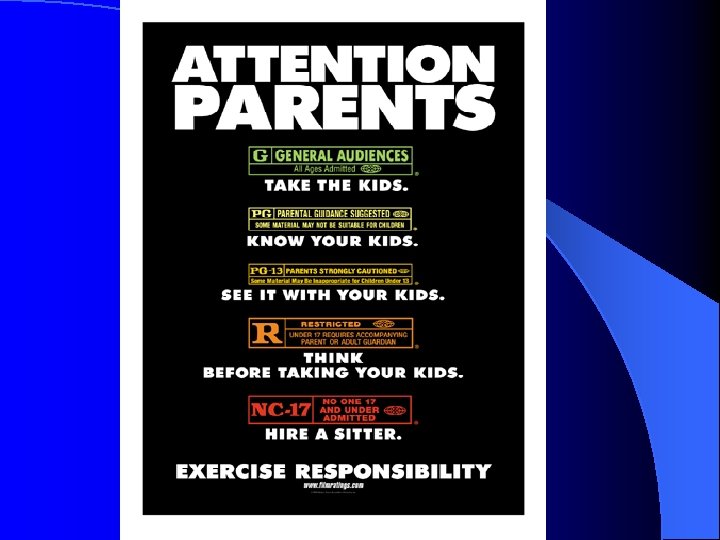
Motion Pictures, Radio and Television The rating system-Controls who sees movies, TV l Radio and TV use public airwaves and are under heavy federal regulation l Federal Communications Commission (FCC)regulates radio and TV-Can’t censor the content of programs before they air. Can prohibit indecent language l US v. Playboy Entertainment Group 2000 -Cable may show sexually explicit programming late at night l
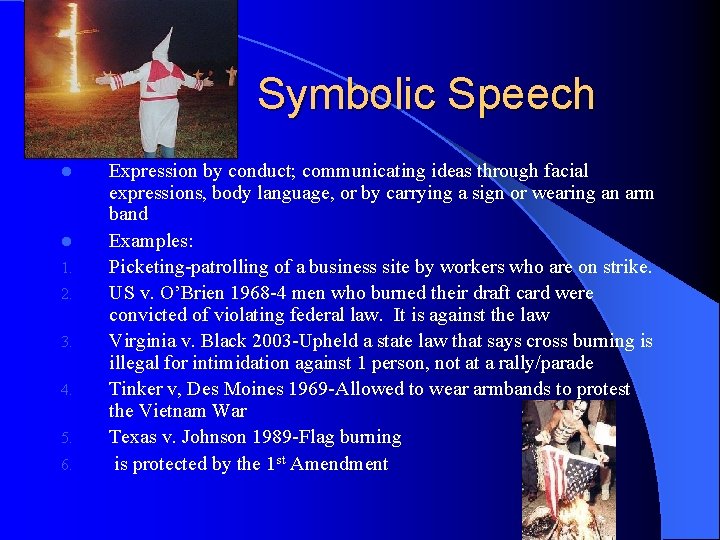
Symbolic Speech l l 1. 2. 3. 4. 5. 6. Expression by conduct; communicating ideas through facial expressions, body language, or by carrying a sign or wearing an arm band Examples: Picketing-patrolling of a business site by workers who are on strike. US v. O’Brien 1968 -4 men who burned their draft card were convicted of violating federal law. It is against the law Virginia v. Black 2003 -Upheld a state law that says cross burning is illegal for intimidation against 1 person, not at a rally/parade Tinker v, Des Moines 1969 -Allowed to wear armbands to protest the Vietnam War Texas v. Johnson 1989 -Flag burning is protected by the 1 st Amendment
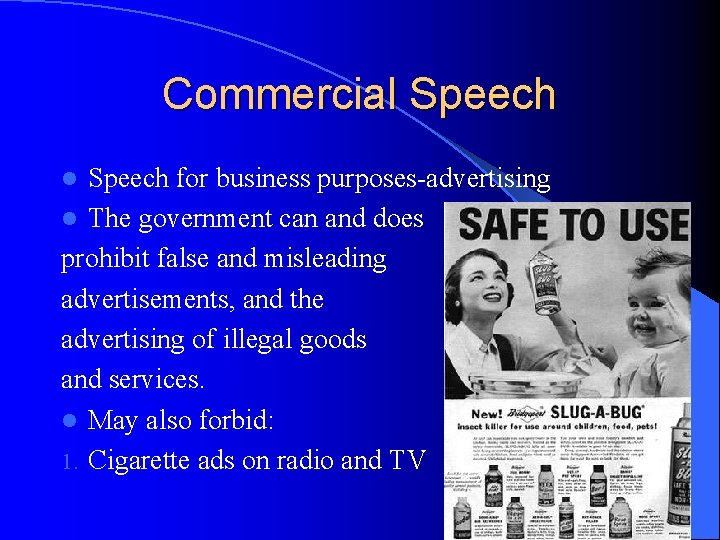
Commercial Speech for business purposes-advertising l The government can and does prohibit false and misleading advertisements, and the advertising of illegal goods and services. l May also forbid: 1. Cigarette ads on radio and TV l
Freedom of Assembly and Petition The Constitution protects the right of the people to peacefully assemble-to gather together with one another-to express their views on public matters l Time-Place-Manner Regulations-Government can make and enforce reasonable rules covering the time, place, and manner of assemblies. Must be content neutral l
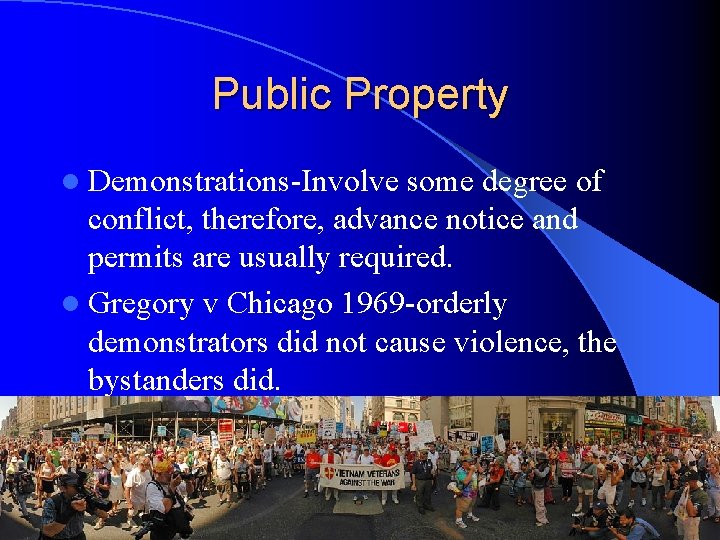
Public Property l Demonstrations-Involve some degree of conflict, therefore, advance notice and permits are usually required. l Gregory v Chicago 1969 -orderly demonstrators did not cause violence, the bystanders did.
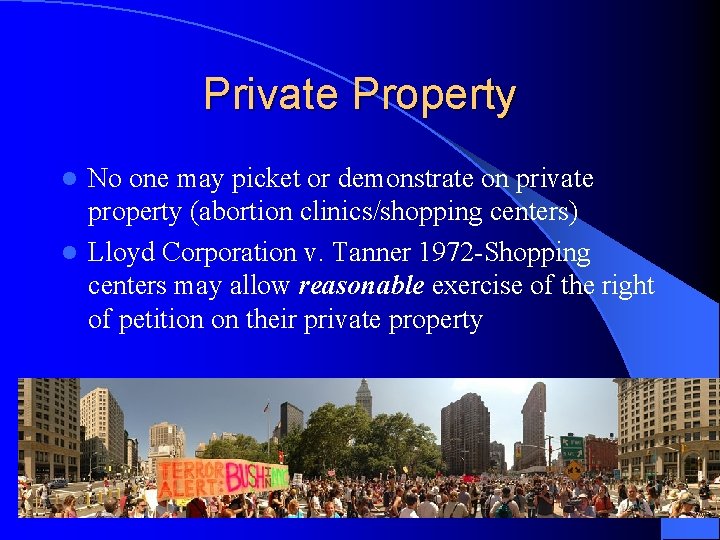
Private Property No one may picket or demonstrate on private property (abortion clinics/shopping centers) l Lloyd Corporation v. Tanner 1972 -Shopping centers may allow reasonable exercise of the right of petition on their private property l
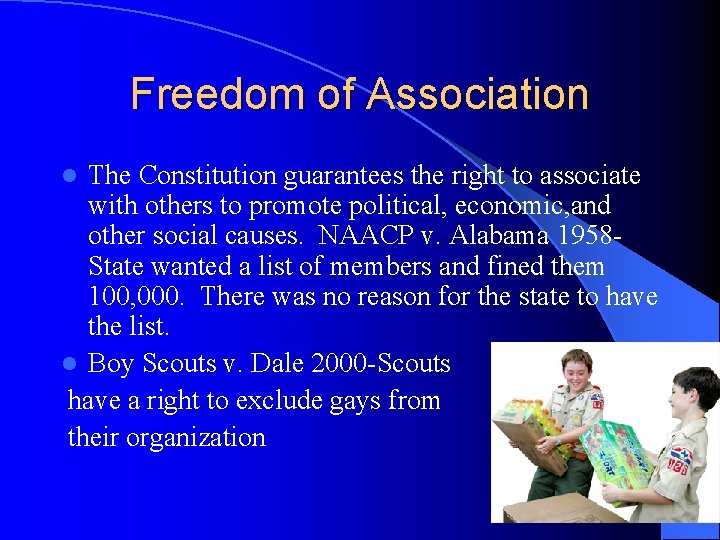
Freedom of Association The Constitution guarantees the right to associate with others to promote political, economic, and other social causes. NAACP v. Alabama 1958 State wanted a list of members and fined them 100, 000. There was no reason for the state to have the list. l Boy Scouts v. Dale 2000 -Scouts have a right to exclude gays from their organization l
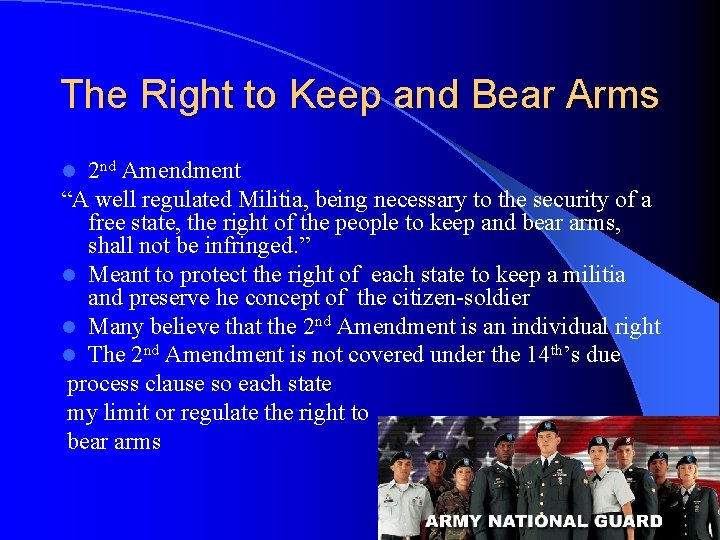
The Right to Keep and Bear Arms 2 nd Amendment “A well regulated Militia, being necessary to the security of a free state, the right of the people to keep and bear arms, shall not be infringed. ” l Meant to protect the right of each state to keep a militia and preserve he concept of the citizen-soldier l Many believe that the 2 nd Amendment is an individual right l The 2 nd Amendment is not covered under the 14 th’s due process clause so each state my limit or regulate the right to bear arms l
Civil Liberties: Protecting Individual Rights Due Process: forbid the national and state governments to “deny any person life, liberty, or property without due process of law”. . 1. 5 th Amendment 2. 14 th Amendment Very difficult to define, so the Supreme Court finds the meaning of due process on a case-by case basis 1. Procedural Due Process: Gives an individual a fair hearing or formal trial 2. Substantive Due Process: The policies or laws are fair: Fundamental fairness l
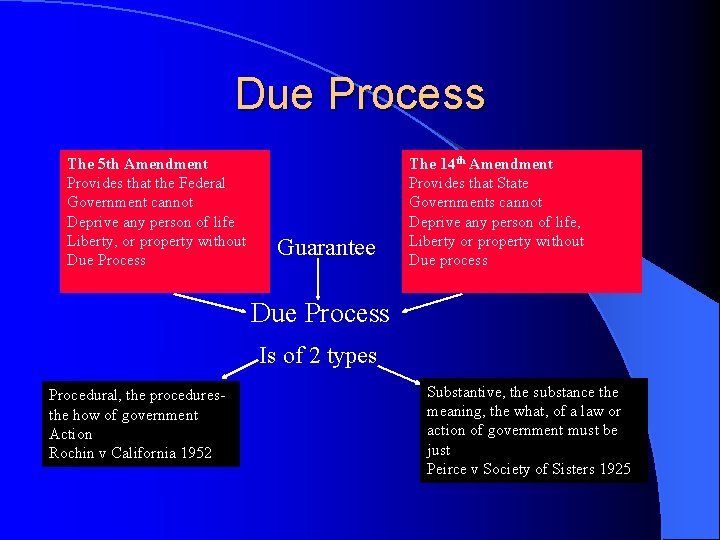
Due Process The 5 th Amendment Provides that the Federal Government cannot Deprive any person of life Liberty, or property without Due Process Guarantee The 14 th Amendment Provides that State Governments cannot Deprive any person of life, Liberty or property without Due process Due Process Is of 2 types Procedural, the procedures- the how of government Action Rochin v California 1952 Substantive, the substance the meaning, the what, of a law or action of government must be just Peirce v Society of Sisters 1925
Due Process l Procedural: Rochin v. Californina 1952 1. Suspected narcotics dealer l 2. cops went to his house and entered without a warrant- found drugs and arrested and convicted him (he swallowed them and they pumped his stomach) l l Substantive: Pierce v. Society of Sisters 1925 1. Oregon law forced all children from 8 -16 to attend public school l The law itself was unconstitutional l
The 14 th Amendment and the Bill of Rights l The 14 th Amendment’s Due Process Clause includes within its meaning most of the protections set out in the Bill of Rights. l In a series of decisions dating from 1925, the Supreme Court extended protections of the Bill of Rights against the States through the 14 th Amendments Due Process Clause.
The Police Power The authority of each state to act to protect and promote the public health, safety, morals, and general welfare. l Produces conflicts with civil rights protections: Health: limit the sale of alcohol/tobacco, make laws to combat pollution, require vaccinations Safety: forbid concealed weapons, require seat belts, punish drunk drivers Morals: regulate gambling, outlaw obscene material, prostitution General Welfare: compulsory education laws, limit profits from utilities l
The Right to Privacy l “The right to be left alone” l The constitution makes no specific mention of the right to privacy, but the Supreme Court declared its existence in: Griswald v. Connecticut
Roe v. Wade 1973 l l 1. 2. 3. To what extent can a state limit a woman’s right to an abortion? Case stated that: In the 1 sr trimester a state must recognize a woman’s right to an abortion In the 2 nd trimester, a state may make reasonable regulations on how, when and where abortions may be held, but cannot prohibit the procedure 3 rd trimester, a state can chose to prohibit all abortions except those necessary to preserve the life or health of the mother
Later Reproductive Rights Webster v. Reproductive Health Services 1989 No abortions in a public hospital or clinic No abortion after 20 weeks Hodgsen v. Minnesota 1990 A minor must have written consent of 1 parent or a judge Planned Parenthood v. Casey 1992 (PA) 1. A woman must have counseling before an abortion 2. A woman must delay an abortion 24 hours after counseling 3. An unmarried female under 18 must have consent of a parent or judge 4. Doctors and clinics must keep records of all abortions l 1. 2. l 1.
Freedom and Security of the Person 13 th Amendment: Ends slavery l Still occasional cases: involuntary servitude or forced labor l Does not include selective service l Discrimination (bias, unfairness) against African Americans by private individuals did not place the “badge of slavery” on them nor kept them in servitude l Jones v. Mayer 1968, discrimination by private individuals is illegal. l
Security of Home and Person l 3 rd and 4 th Amendment provides that the government cannot arbitrarily violate the home or person of any American l 3 rd Amendment: The government cannot house soldiers in private homes during peacetime without consent of the owner. l Has no real importance
4 th Amendment l Designed to prevent writs of assistance- blanket search warrants l Probable Cause: Police officers have no general right to search for evidence or to seize either evidence or persons. l A warrant must be obtained with probable cause or reasonable suspicion of a crime
Arrests l An arrest is the seizure of a person l Don’t need a warrant- only probable cause l Automobiles: An officer needs no warrant to search a car, boat, airplane or other vehicle because the scene of a crime could be moved.
The Exclusionary Rule l Evidence gained as the result of an illegal act by police cannot be used at the trial of the person from whom it was seized. l Mapp v. Ohio 1961 14 th Amendment forbids unreasonable search and seizures by State and local officers
Drug Testing l Federal drug testing programs are covered by the 4 th Amendment l Tests may be conducted without a warrant Wiretapping l Need a warrant to wiretap l http: //www. learner. org/courses/democracyi namerica/dia_4_video. html Part 2
Rights of the Accused “It is better that ten guilty persons go free than that one innocent person be punished” l You are innocent until you are proven guilty l Habeas Corpus- Write of Liberty – prevents unjust arrests or imprisonments. You must be brought to court and an officer must show cause, or explain with good reason why the prisoner should not be released. The President or Congress may suspend the writ in times of war
Bills of Attainder A legislative act that inflicts punishment without a court trial Ex Post Facto Laws- (a law passed after the fact) and has three features: 1. Is a criminal law 2. Applies to an act committed before its passage 3. Works to the disadvantage of the accused l A law making it a crime to sell marijuana cannot be applied to someone who sold it before the law was passed l
Self Incrimination 5 th Amendment No person can be compelled in any criminal case to be a witness against himself. l A personal right l Does not protect the person from being fingerprinted or photographed or from not submitted to a blood test in a drunk driving situation l l
Double Jeopardy Once a person has been tried for a crime, he or she cannot be tried again for the same crime- 5 th amendment Speedy and Public Trial- 6 th Amendment l The government must try a person without undue delay: 1. The length of the delay ( not more than 100 days) 2. The reasons for it 3. Whether the delay has in fact harmed the defendant 4. Whether the defendant asked for a prompt trial l Trails are public, unless the Judge orders them closed l
Trial by Jury l 6 th Amendment l An accused person must be tried by an impartial jury l A defendant may request a Bench trial- where only the Judge hears the case
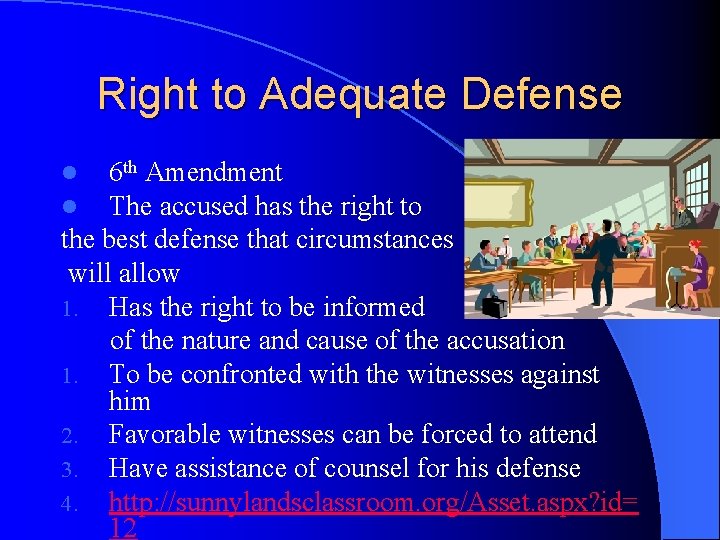
Right to Adequate Defense 6 th Amendment The accused has the right to the best defense that circumstances will allow 1. Has the right to be informed of the nature and cause of the accusation 1. To be confronted with the witnesses against him 2. Favorable witnesses can be forced to attend 3. Have assistance of counsel for his defense 4. http: //sunnylandsclassroom. org/Asset. aspx? id= 12 l l
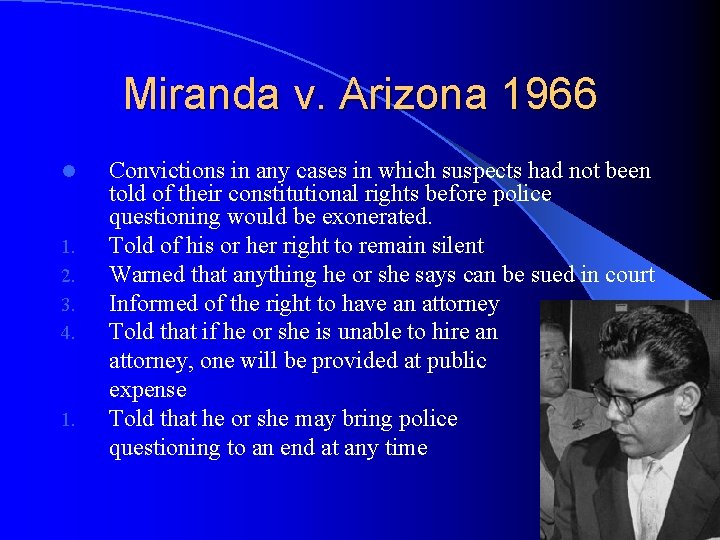
Miranda v. Arizona 1966 Convictions in any cases in which suspects had not been told of their constitutional rights before police questioning would be exonerated. 1. Told of his or her right to remain silent 2. Warned that anything he or she says can be sued in court 3. Informed of the right to have an attorney 4. Told that if he or she is unable to hire an attorney, one will be provided at public expense 1. Told that he or she may bring police questioning to an end at any time l
Punishment l l 1. 2. l l l 8 th Amendment Bail- a sum of money that the accused may be required to post (deposit with the court) as a guarantee that he or she will appear in court at the proper time. A person should not be jailed until his or her guilt is established A defendant is better able to prepare for trial outside of a jail Not all persons accused of a crime are entitled to bail. Where bail is set, it may not be excessive A person may be released on their own recognizance
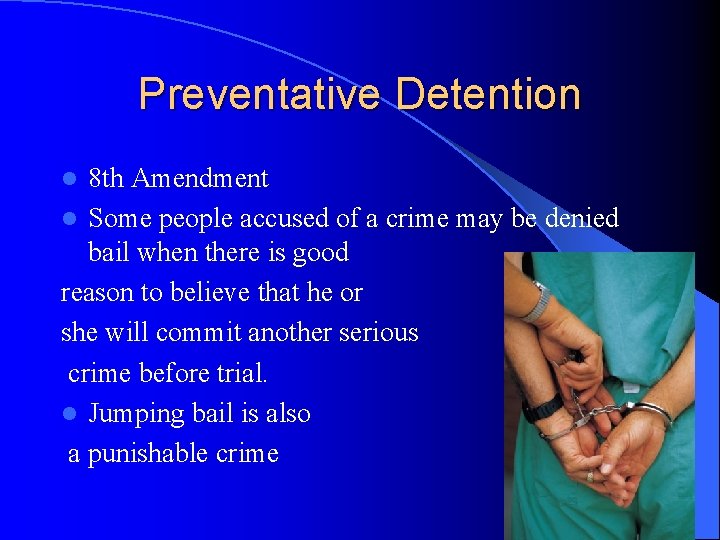
Preventative Detention 8 th Amendment l Some people accused of a crime may be denied bail when there is good reason to believe that he or she will commit another serious crime before trial. l Jumping bail is also a punishable crime l
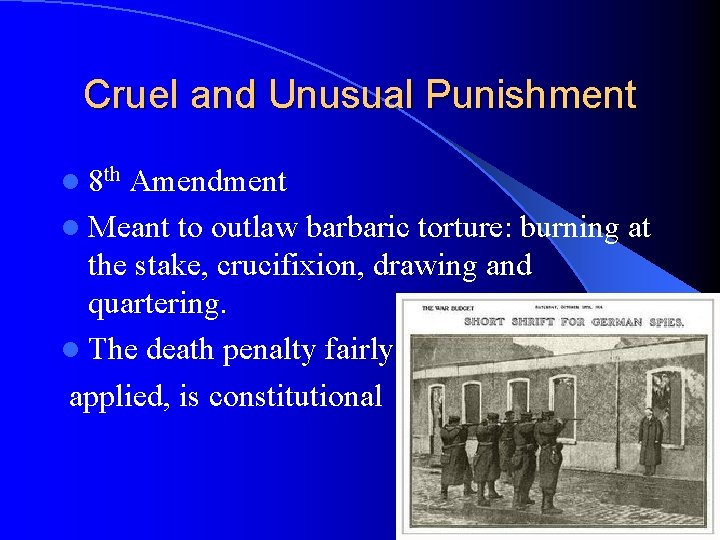
Cruel and Unusual Punishment l 8 th Amendment l Meant to outlaw barbaric torture: burning at the stake, crucifixion, drawing and quartering. l The death penalty fairly applied, is constitutional
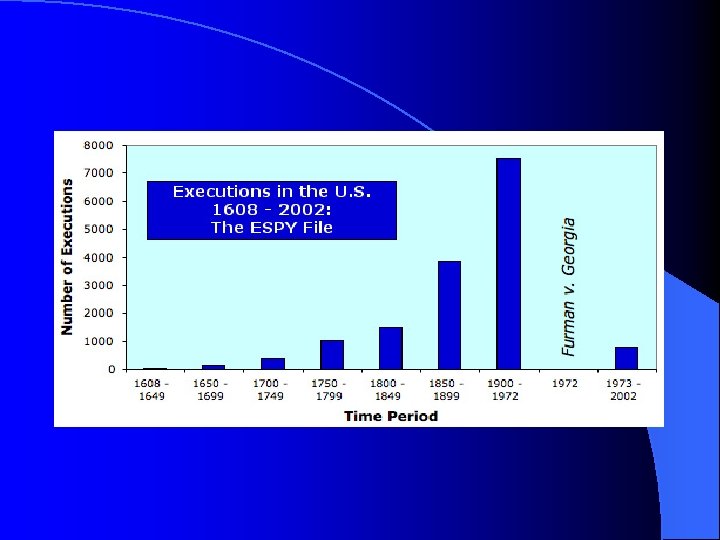
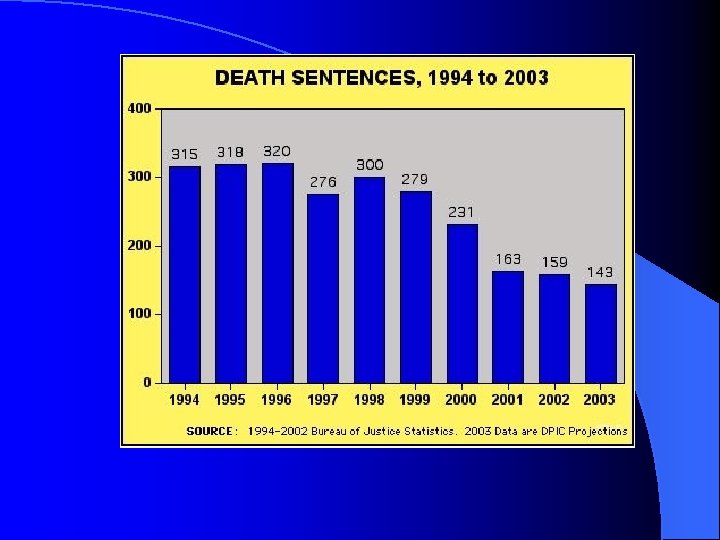
Capital Punishment Furman v. Georgia 1972 - Supreme Court struck down all laws allowing the death penalty-too much discretion given to judges or juries in deciding whether to impose the death penalty l Since then (1976) the Supreme court has allowed the death penalty as long as a two stage process occurs: 1. One trial for the crime 2. One trial to decide on the penalty of death l
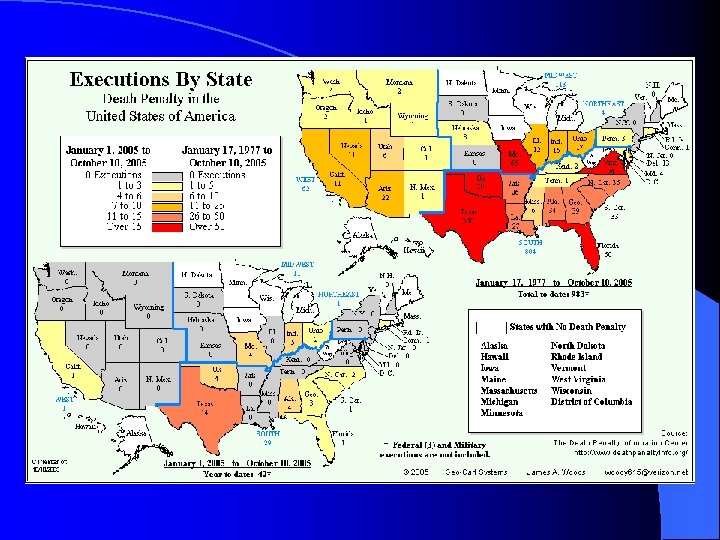
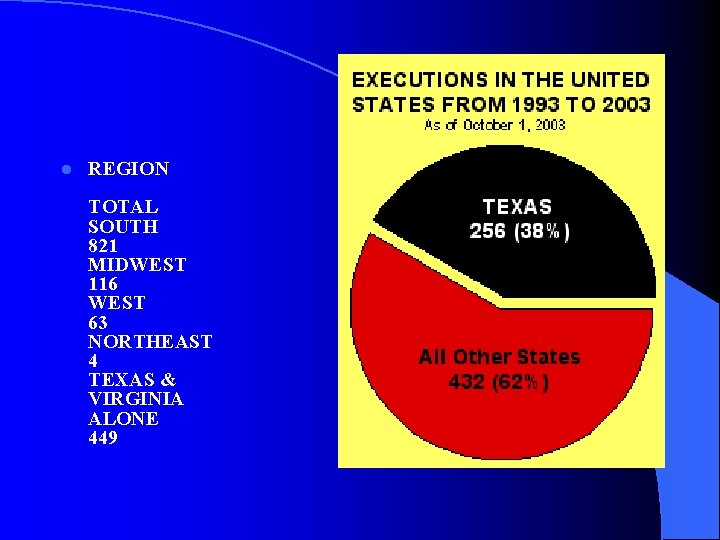
l REGION TOTAL SOUTH 821 MIDWEST 116 WEST 63 NORTHEAST 4 TEXAS & VIRGINIA ALONE 449
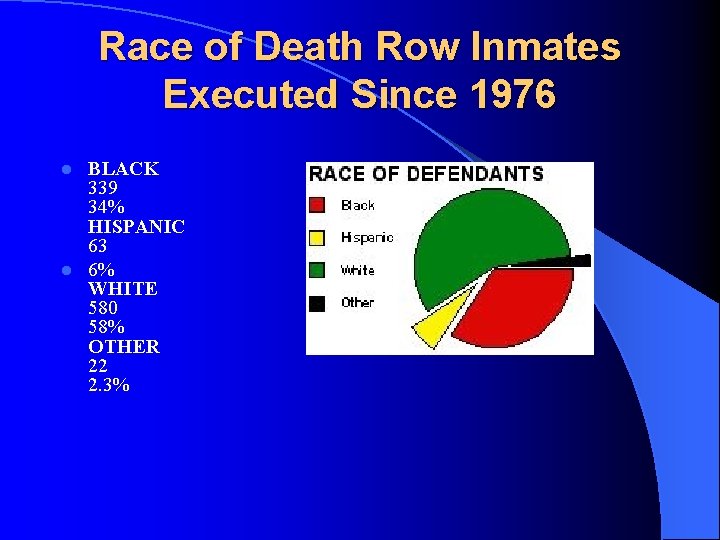
Race of Death Row Inmates Executed Since 1976 BLACK 339 34% HISPANIC 63 l 6% WHITE 580 58% OTHER 22 2. 3% l
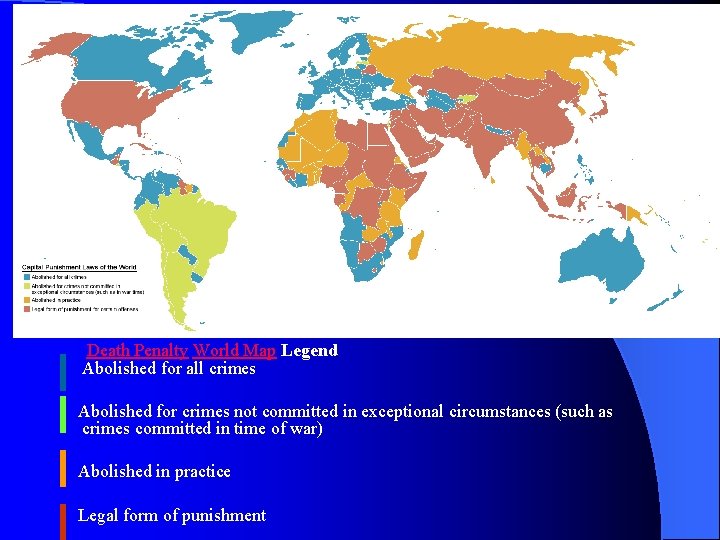
Death Penalty World Map Legend Abolished for all crimes Abolished for crimes not committed in exceptional circumstances (such as crimes committed in time of war) Abolished in practice Legal form of punishment
Death Penalty Information Center l http: //www. deathpenaltyinfo. org/article. php ? did=144&scid=10
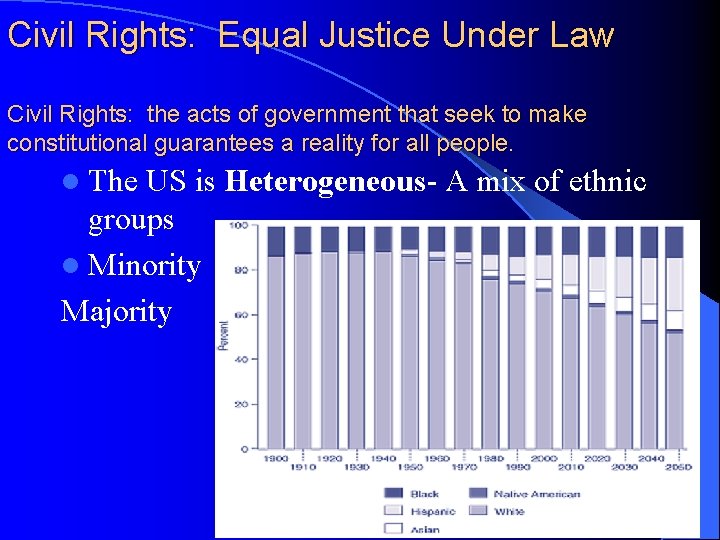
Civil Rights: Equal Justice Under Law Civil Rights: the acts of government that seek to make constitutional guarantees a reality for all people. l The US is Heterogeneous- A mix of ethnic groups l Minority Majority
Race-Based Discrimination l 1. 2. 3. African Americans- Discrimination against AA for centuries. 3 reasons for Anti –discrimination laws: 2 nd largest group, 37 million 12% of US pop. Victims of unjust treatment-Slavery 13 th Amendment ends slavery Laws based on equality have stemmed from the civil rights movement
Native Americans l 17 th century- 1 million, 1900 -250, 000 l Diseases and military campaigns killed many l Today 2. 7 million live on or near Indian reservations l Discrimination has led to poverty, joblessness, and alcoholism among many
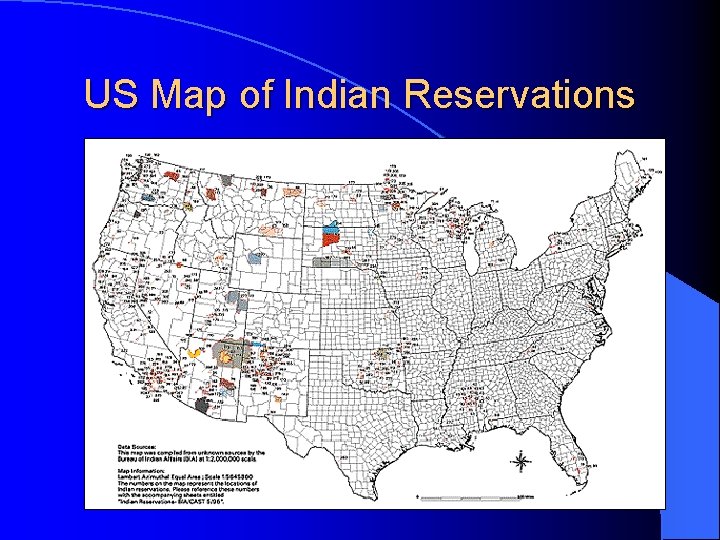
US Map of Indian Reservations
Hispanic Americans l l 1. 2. 3. 4. Spanish speaking backgrounds Latinos 40 million-(white, mestizos, black, or mulatto) 4 main groups Mexican Americans-18 million Puerto Ricans- 3 million Cuban Americans-Miami Central and South American: Refugees-one who seeks protection from war, persecution, or some other danger
Asian Americans l l l Assimilation- when a culture merges into or becomes a part of another- Difficult for Asian’s to do. Came as laborers, Chinese Exclusion Act 1882 - WWII- US government evacuated all persons of Japanese decent from the US. 120, 000 were interned (Korematsu v. United States) http: //sunnylandsclassroom. org/Asset. aspx? id=1474 1965 - Congress changes immigration laws-4 million Asian immigrants have come to the US 11 million-fastest growing group in the US (4. 3%)
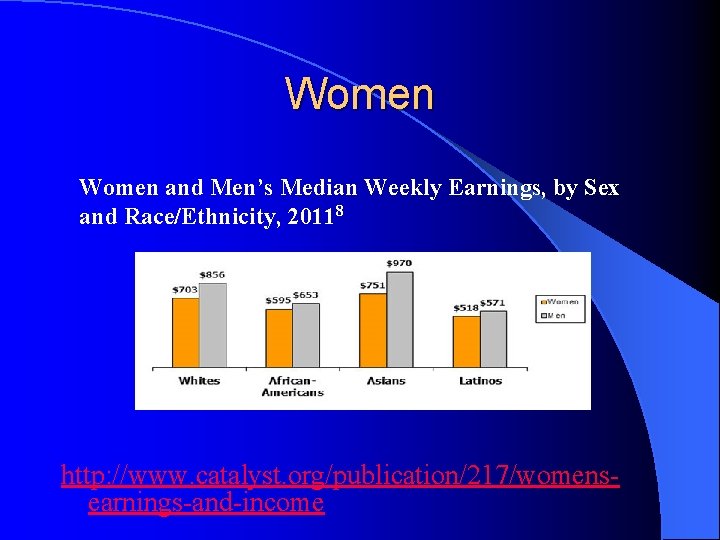
Women and Men’s Median Weekly Earnings, by Sex and Race/Ethnicity, 20118 http: //www. catalyst. org/publication/217/womensearnings-and-income
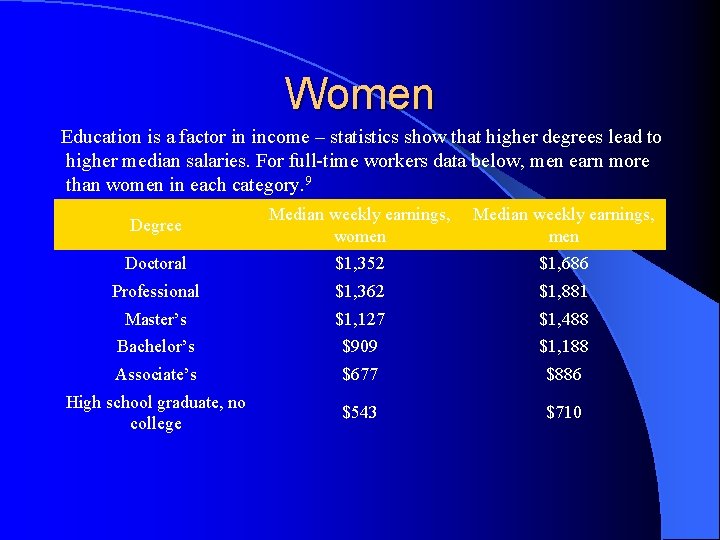
Women Education is a factor in income – statistics show that higher degrees lead to higher median salaries. For full-time workers data below, men earn more than women in each category. 9 Degree Median weekly earnings, women Median weekly earnings, men Doctoral $1, 352 $1, 686 Professional $1, 362 $1, 881 Master’s $1, 127 $1, 488 Bachelor’s $909 $1, 188 Associate’s $677 $886 High school graduate, no college $543 $710
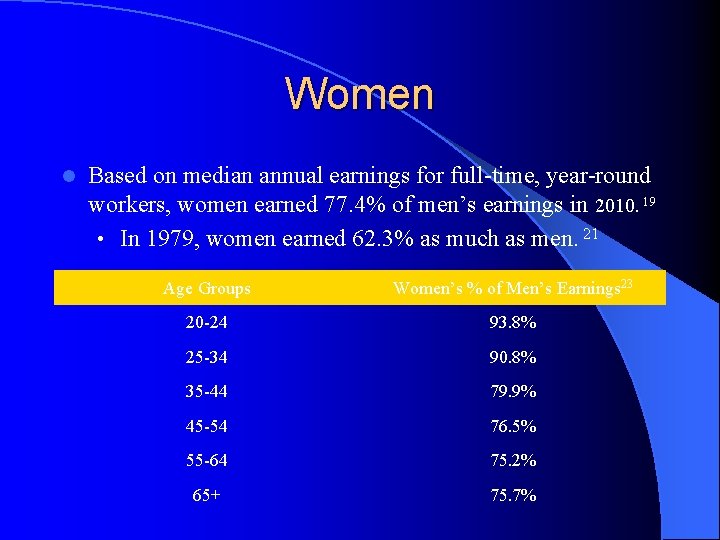
Women l Based on median annual earnings for full-time, year-round workers, women earned 77. 4% of men’s earnings in 2010. 19 • In 1979, women earned 62. 3% as much as men. 21 Age Groups Women’s % of Men’s Earnings 23 20 -24 93. 8% 25 -34 90. 8% 35 -44 79. 9% 45 -54 76. 5% 55 -64 75. 2% 65+ 75. 7%
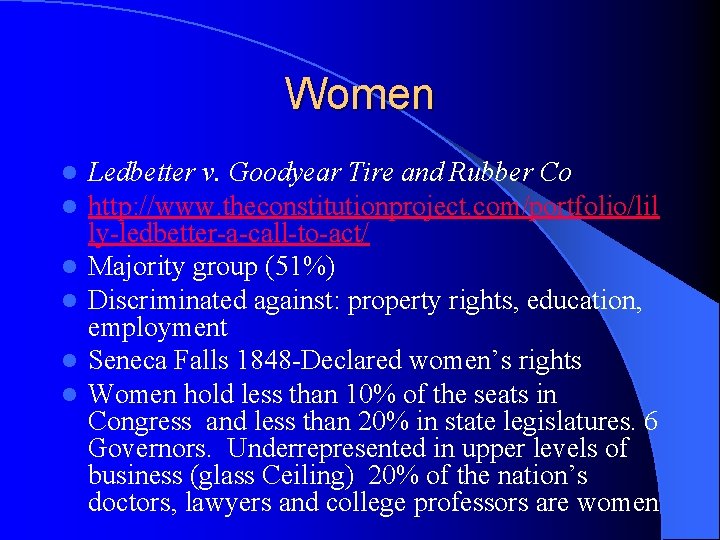
Women l l l Ledbetter v. Goodyear Tire and Rubber Co http: //www. theconstitutionproject. com/portfolio/lil ly-ledbetter-a-call-to-act/ Majority group (51%) Discriminated against: property rights, education, employment Seneca Falls 1848 -Declared women’s rights Women hold less than 10% of the seats in Congress and less than 20% in state legislatures. 6 Governors. Underrepresented in upper levels of business (glass Ceiling) 20% of the nation’s doctors, lawyers and college professors are women
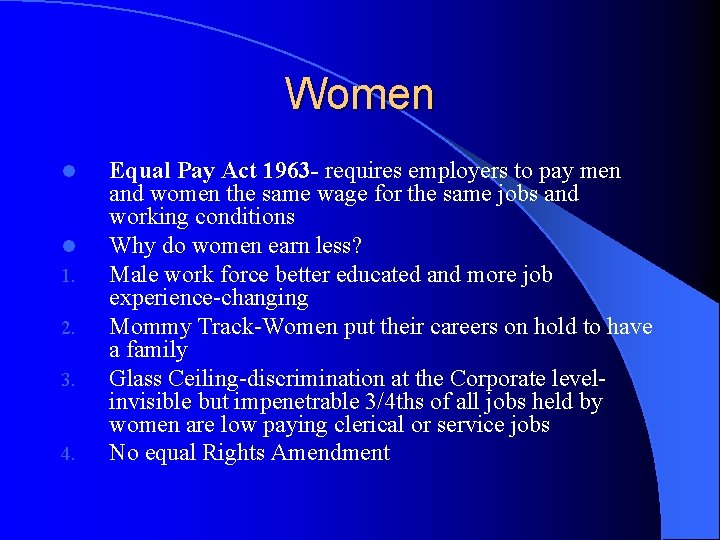
Women l l 1. 2. 3. 4. Equal Pay Act 1963 - requires employers to pay men and women the same wage for the same jobs and working conditions Why do women earn less? Male work force better educated and more job experience-changing Mommy Track-Women put their careers on hold to have a family Glass Ceiling-discrimination at the Corporate levelinvisible but impenetrable 3/4 ths of all jobs held by women are low paying clerical or service jobs No equal Rights Amendment
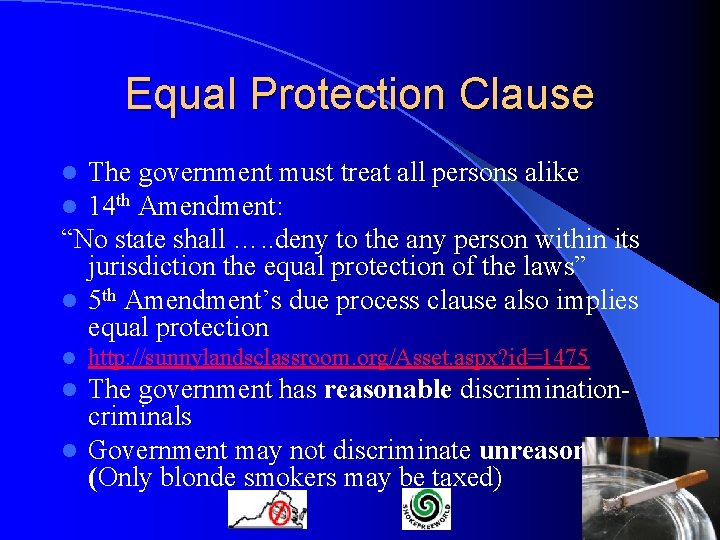
Equal Protection Clause The government must treat all persons alike 14 th Amendment: “No state shall …. . deny to the any person within its jurisdiction the equal protection of the laws” l 5 th Amendment’s due process clause also implies equal protection l l l http: //sunnylandsclassroom. org/Asset. aspx? id=1475 The government has reasonable discriminationcriminals l Government may not discriminate unreasonably(Only blonde smokers may be taxed) l
Segregation in America Jim Crow Laws- Laws that separate people on the basis of race l Separate-but-Equal Doctrine: 1896 - Plessy v. Ferguson-upheld a Louisiana law requiring segregation in rail cars- Separate facilities were equal l 1954 Brown v. Board of Education of Topeka- segregation by race in public education is unconstitutional l South resists integration- the process of bringing a group into the mainstream of society l
De Jure, De Facto Segregation l De Jure- segregation by law l De Facto- segregation in fact, or custom- housing patterns. How to integrate all black schools in inner cities? Busing. l Other fields that have outlawed segregation: Swimming pools, transportation, marriages, child custody
Classification by Sex l 19 th Amendment- only one that mentions sex/gender l Proper role of women- Protect the weaker sex? l 1873 Bradwell v. Illinois- upheld a state law that prohibited women from practicing law
Federal Civil Rights Laws “Laws may not change the heart, but they can restrain the heartless” MLK l Civil Rights Acts of 1957, 1960, 1964, and 1968 l Voting Rights Acts of 1965, 1970, 1975, and 1982 l Civil Rights Act of 1964 - outlaws discrimination l Civil Rights Act of 1968 - Open Housing Act, forbids anyone to refuse or sell or rent a dwelling to any person on the basis race, color, religion, national origin, sex or disability l http: //sunnylandsclassroom. org/Asset. aspx? id=14 30
Other Groups Active Under the Civil Rights Umbrella • • • 37 Million are 65 or older (12%) 4. 5 Million are 85 or older –fastest- growing age group 1967 Age Discrimination in Employment Act Civil Rights and People with Disabilities: The Americans with Disabilities Act of 1990 Gay and Lesbian Rights: Defense of Marriage Act 1996: Don’t Ask, Don’t Tell
Affirmative Action As a result of Civil Rights Legislation Tried to right the wrongs done in the past Requires that most employers take positive steps to remedy the effects of past discriminations. 1965 l All government agencies and to all business that deal with the government l The work force must reflect the general makeup of the population in its local (quotas) and include steps to correct or prevent inequalities in pay, promotions, and fringe benefits l l l
Reverse Discrimination l Discrimination against the majority group l Regents of the University of Calif. V. Bakke 1978 - White male denied to medical schoolwon l Quotas may be used in only extreme situations l Race may be one factor in deciding employment, etc. .
American Citizenship l Citizen, one who owes allegiance to the US l 90% of the pop. are citizens l 14 th Amendment defines citizenship as “All persons born or naturalized in the US and subject to the jurisdiction thereof, are citizens of the US and of the state wherein they reside
Naturalization Individually: Naturalization of both parents (one parent if divorced or the other is dead) automatically naturalizes children under 16 who reside in the US. Adopted children born abroad are automatically naturalized if under 18 when adoption becomes final Collectively 1. Treaties: Louisiana, Florida, Alaska 2. Acts of Congress: Hawaii, Puerto Rico, Native Americans, Virgin Islands, Guam, N. Mariania Islands 3. Joint Resolution of Congress: Texas 4. Constitutional Amendment: African Americans and others 14 th l 1.
Rules of Naturalization l l l l Be 18 Have entered the country legally, lived in the US for 5 years (husbands or wives of citizens, 3 years) File a petition for naturalization Be literate in the English language Be of good moral character Have knowledge and understandings of the fundamental history and form of government Take an oath or affirmation to renounce any allegiance to any foreign power an promises to support and defend the Constitution and laws of the US
Birth Jus Sanguinis A child born to an American citizen on foreign soil becomes a citizen if: 1. Both parents are American citizens, and at least one has lived in the US or an American territory for some time 2. One parent is an America citizen who has lived in the US for at least 10 years, 5 of them after age 14 and the child ahs lived in the US continuously for at least 5 years between the ages of 14 and 28 Jus Soli A child becomes an American citizen if born in the US, PR, Guam, VI, NMI, any US embassy, or aboard a US public vessel anywhere in the world
Loss of Citizenship Expatriation- the legal process by which a loss of citizenship occurs l Congress cannot take away a person’s citizenship for something they have done l Denaturalization- a person may lose citizenship only after a court order and it was shown that the person became a citizen by fraud or deception l A person can neither gain or lose citizenship by marriage l
A Nation of Immigrants l 1. 2. 3. 4. 5. 6. Regulation: Congress has the power to regulate immigration (inherent power) Until 1890, immigration encouraged Chinese Exclusion Act of 1882 - 1 st law to regulate immigration- also outlawed convicts, lunatics and paupers Immigration Acts of 1921 & 1924 further limited immigration by setting quotas Immigration and Nationality Act of 1952 - set limits from every country outside the Western Hemisphere Immigration Act of 1965 eliminated the quota system
Present Immigration Policies l 1. 2. 3. 4. Immigration Act of 1990 - Sets the ceiling at 675, 000 per year Family-preference 1/3 of all immigrants are relatives of US citizens/aliens Those will demanded skills can come in Excluded include: Criminals, those with communicable diseases, drug abusers, illiterates, mentally disturbed
Immigration Relatives of immigrants are allowed in: l The immediate relatives category includes unmarried minor children, spouses, and parents of U. S. citizens. The immediate relatives category is unlimited; any qualified individual who is the immediate relative of a U. S. citizen has a right to a visa under current immigration law, regardless of how many apply. Other relatives fall into four subcategories called preferences (see chart for details). Relatives accounted for 64 percent of immigration in 2001.
Immigration Employment-Based Immigrants l Employment-based immigrants are admitted because employers request them.
Immigration Other Legal Immigrants Refugees and asylees are applicants for admission who claim to be fleeing their homeland due to persecution or the fear of persecution. Refugees apply from abroad and are subject to a numerical limit. Asylees apply from the within the U. S. and there is no limit to how many may apply or be granted asylum. Many more people apply for asylum than receive it. . l There a few other special immigration programs, such as the diversity visa lottery (55, 000 visas). These special programs operate outside the core immigration programs mentioned above. l l
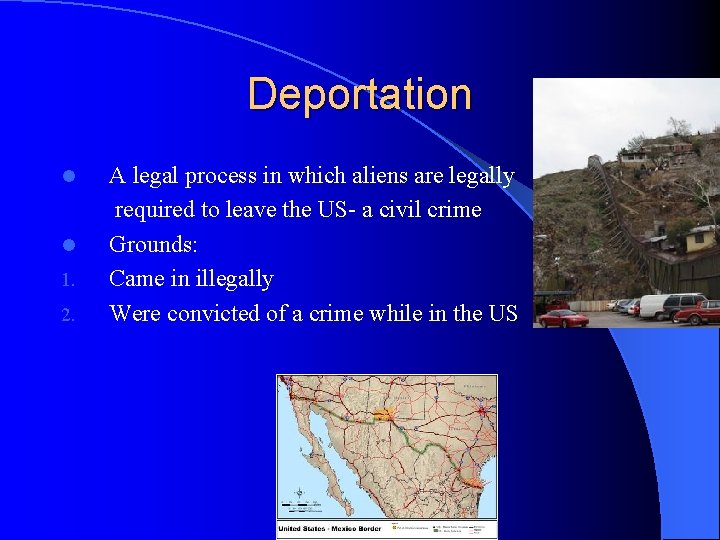
Deportation A legal process in which aliens are legally required to leave the US- a civil crime l Grounds: 1. Came in illegally 2. Were convicted of a crime while in the US l
Undocumented Aliens l l l 1. 11 million? Increasing by ½ a million per year Enter through Canada and Mexico Many enter legally, but overstay their welcome Over 1 million have been sent home each year Problems: Texas, California, and Florida have overburdened schools, welfare systems
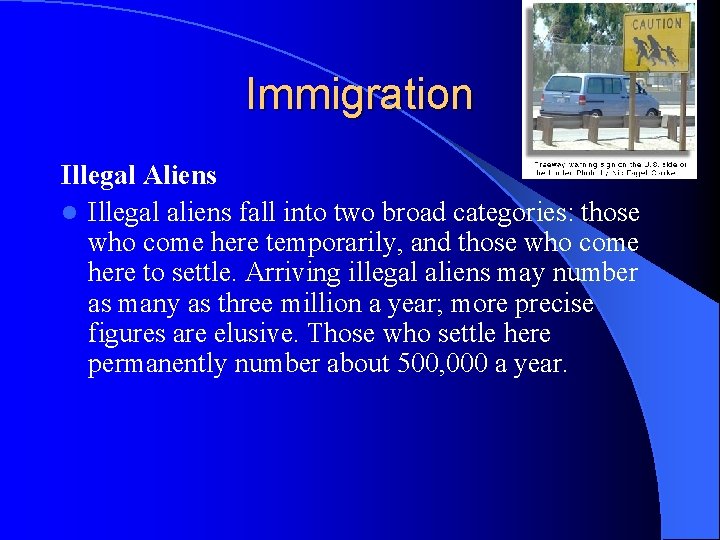
Immigration Illegal Aliens l Illegal aliens fall into two broad categories: those who come here temporarily, and those who come here to settle. Arriving illegal aliens may number as many as three million a year; more precise figures are elusive. Those who settle here permanently number about 500, 000 a year.
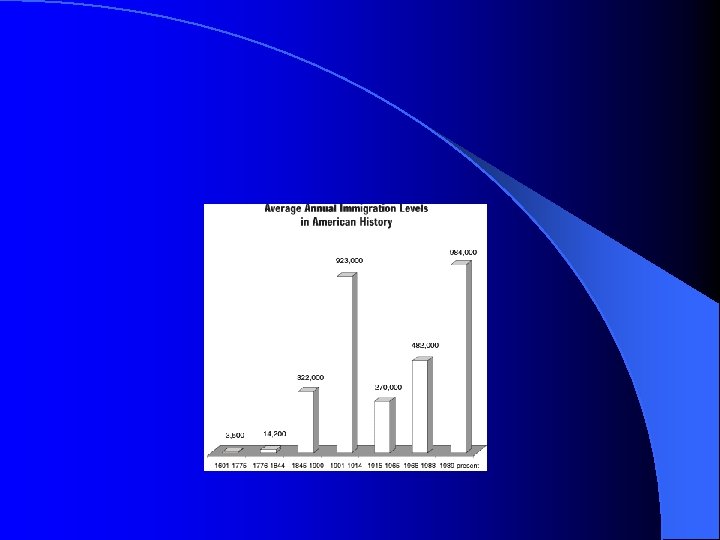
Immigration Facts l l l During the first 50 years after Independence, the United States received about 710, 000 immigrants. In 2001 alone, we admitted one million. During the first century or so of our country (1776 to 1884), we received about two immigrants a day; since the 1990 s, we have been admitting two immigrants a minute. In the last 20 years, the United States has admitted more immigrants than it did in the previous 65 years. The level of legal immigration has doubled in the last 30 years The 1990 Immigration Act increased legal immigration by 40 percent. There are 31 million immigrants already living in the United States; this is more than 10 percent of the nation's population.
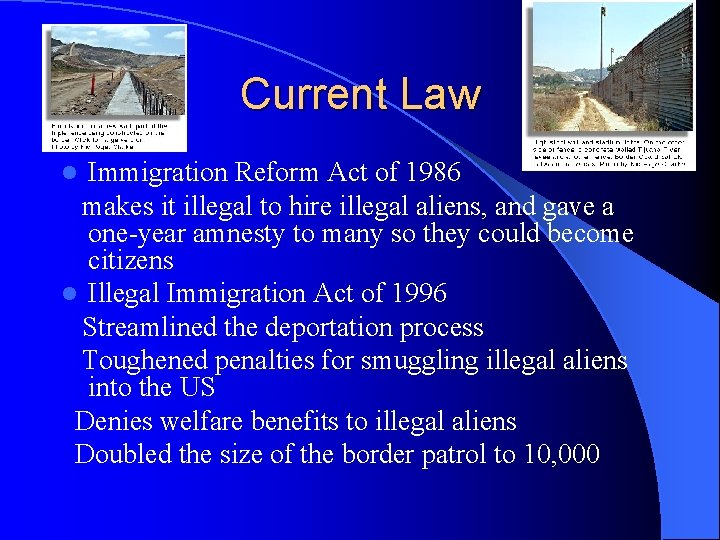
Current Law Immigration Reform Act of 1986 makes it illegal to hire illegal aliens, and gave a one-year amnesty to many so they could become citizens l Illegal Immigration Act of 1996 Streamlined the deportation process Toughened penalties for smuggling illegal aliens into the US Denies welfare benefits to illegal aliens Doubled the size of the border patrol to 10, 000 l
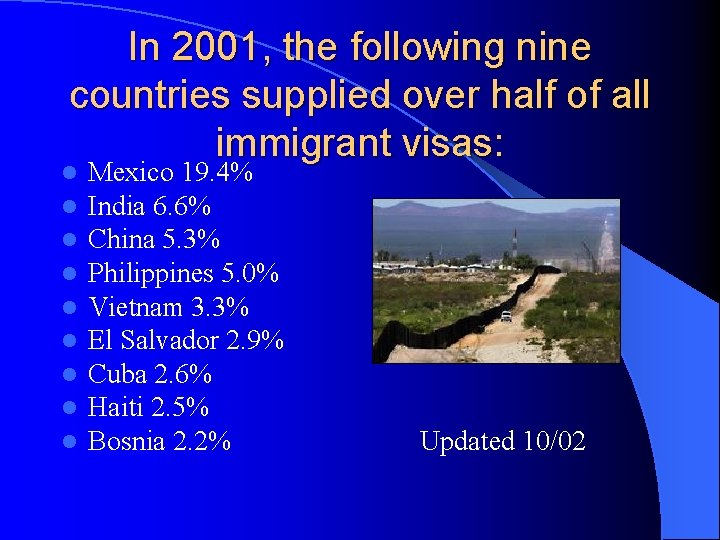
In 2001, the following nine countries supplied over half of all immigrant visas: l l l l l Mexico 19. 4% India 6. 6% China 5. 3% Philippines 5. 0% Vietnam 3. 3% El Salvador 2. 9% Cuba 2. 6% Haiti 2. 5% Bosnia 2. 2% Updated 10/02
Immigration in Virginia l http: //www. dhs. gov/sites/default/files/public ations/immigrationstatistics/yearbook/2011/ois_yb_2011. pdf l http: //www. immigrationpolicy. org/justfacts/new-americans-virginia
Any Last Questions?
- Slides: 104