
Fundamental ForcesInteractions Virtual Particles Messenger Particles and Vacuum

- Slides: 12
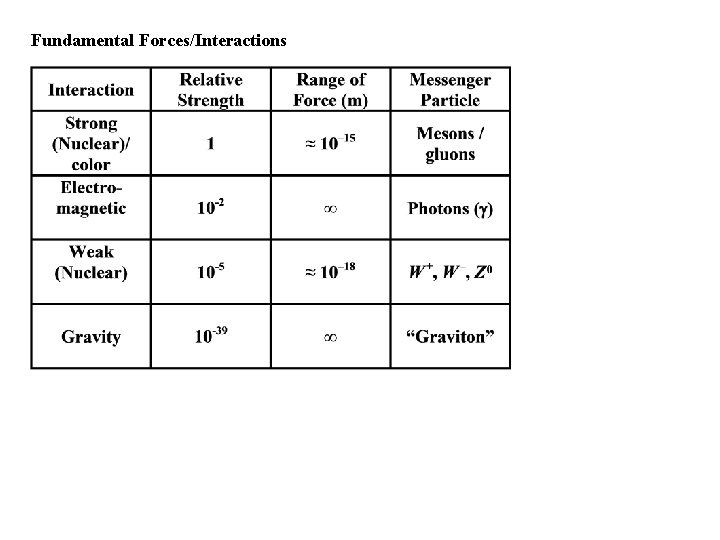
Fundamental Forces/Interactions
Virtual Particles, Messenger Particles, and Vacuum Fluctuations Energy-time uncertainty relation: Assume a force has a range of 1. 5 x 10 -15 m. Estimate the mass of the messenger particle for this force.
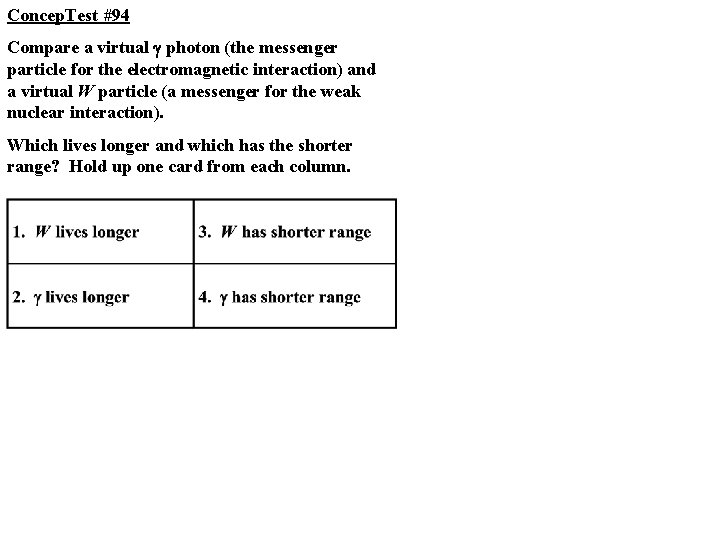
Concep. Test #94 Compare a virtual g photon (the messenger particle for the electromagnetic interaction) and a virtual W particle (a messenger for the weak nuclear interaction). Which lives longer and which has the shorter range? Hold up one card from each column.
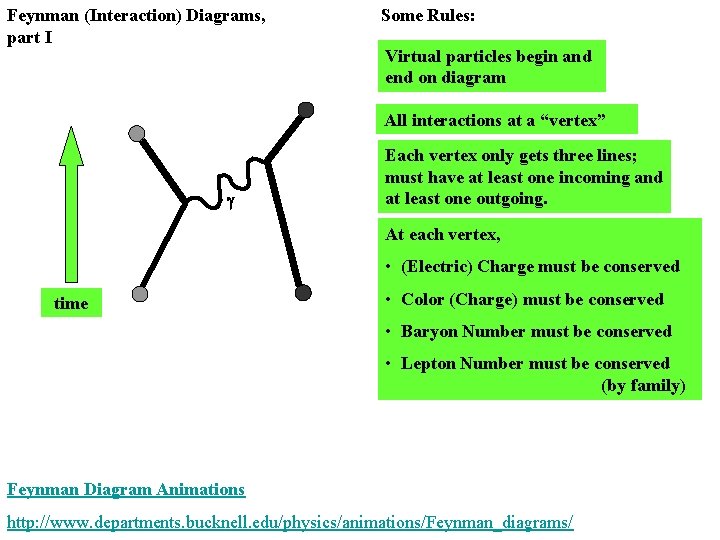
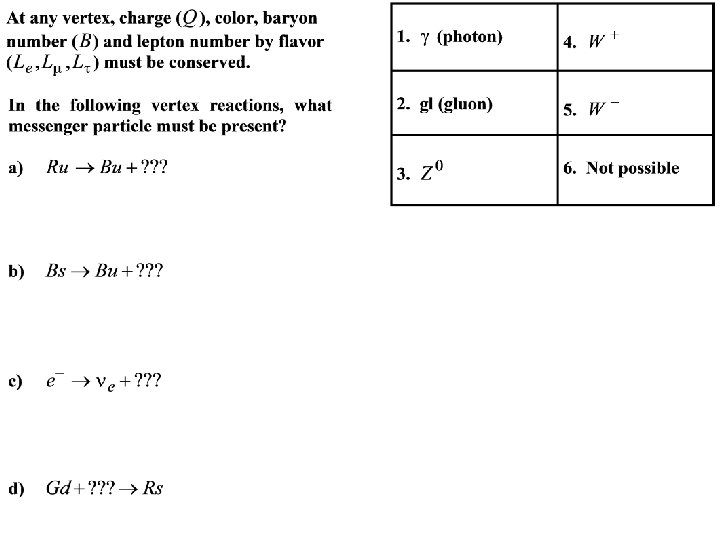
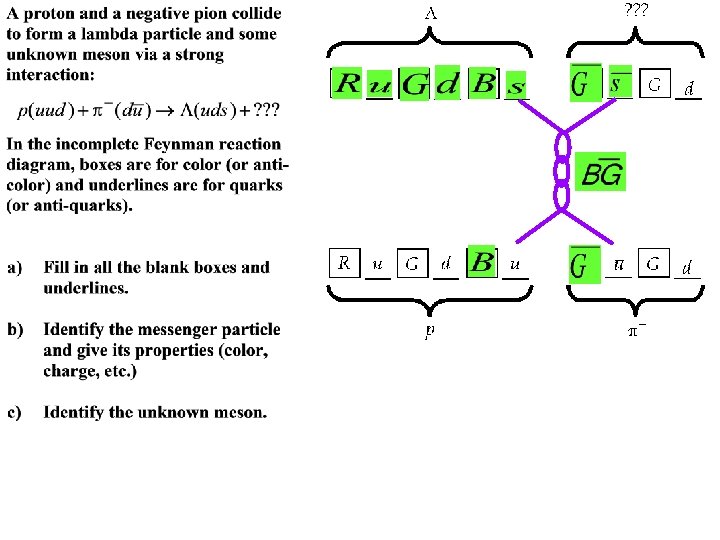
Feynman (Interaction) Diagrams, part I Some Rules: Virtual particles begin and end on diagram All interactions at a “vertex” time g Each vertex only gets three lines; must have at least one incoming and at least one outgoing. At each vertex, • (Electric) Charge must be conserved time • Color (Charge) must be conserved • Baryon Number must be conserved • Lepton Number must be conserved (by family) Feynman Diagram Animations http: //www. departments. bucknell. edu/physics/animations/Feynman_diagrams/
Quarks and Color and Camouflage, oh my! What is the quark content of the D++?
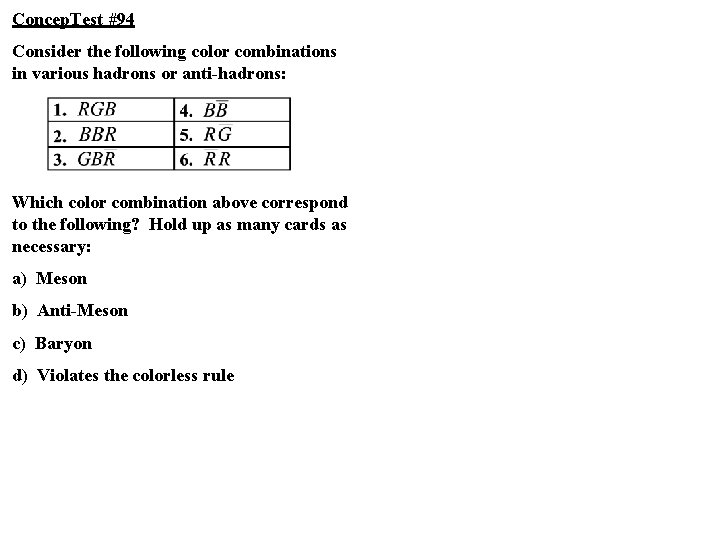
Concep. Test #94 Consider the following color combinations in various hadrons or anti-hadrons: Which color combination above correspond to the following? Hold up as many cards as necessary: a) Meson b) Anti-Meson c) Baryon d) Violates the colorless rule
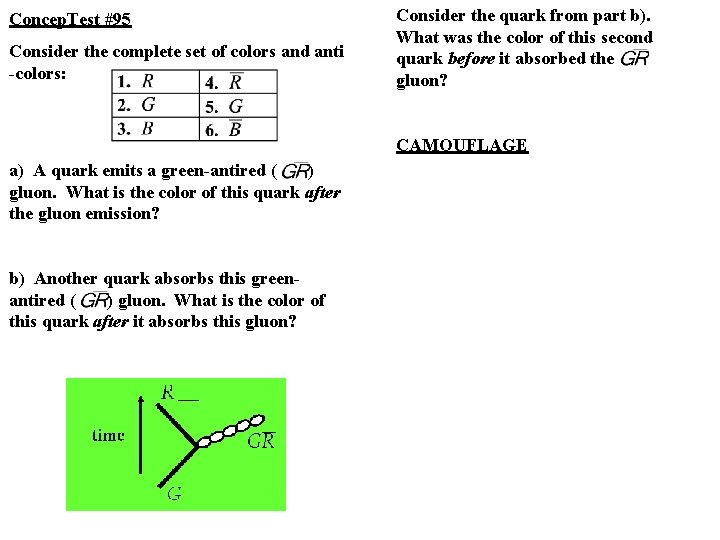
Concep. Test #95 Consider the complete set of colors and anti -colors: Consider the quark from part b). What was the color of this second quark before it absorbed the gluon? CAMOUFLAGE a) A quark emits a green-antired ( ) gluon. What is the color of this quark after the gluon emission? b) Another quark absorbs this greenantired ( ) gluon. What is the color of this quark after it absorbs this gluon?
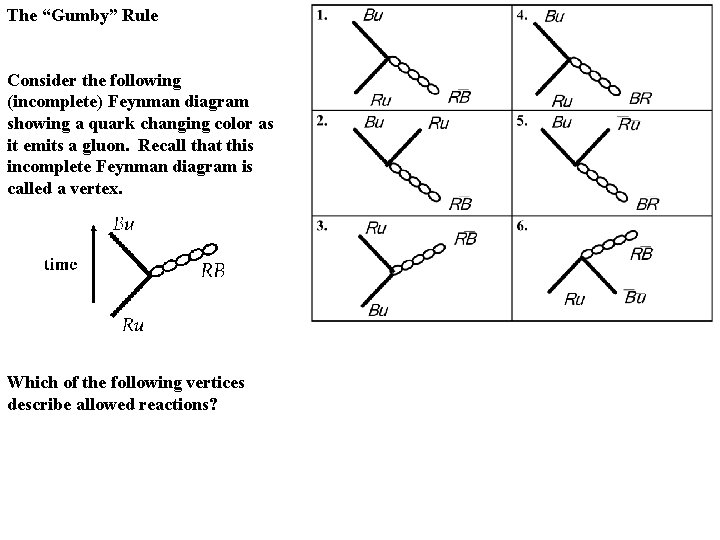
The “Gumby” Rule Consider the following (incomplete) Feynman diagram showing a quark changing color as it emits a gluon. Recall that this incomplete Feynman diagram is called a vertex. Which of the following vertices describe allowed reactions?
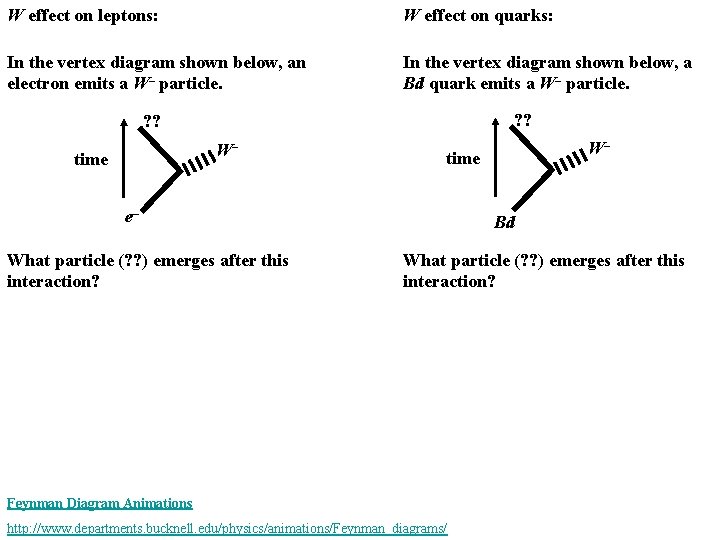
W effect on leptons: W effect on quarks: In the vertex diagram shown below, an electron emits a W– particle. In the vertex diagram shown below, a Bd quark emits a W– particle. ? ? W– time e– What particle (? ? ) emerges after this interaction? W– Bd What particle (? ? ) emerges after this interaction? Feynman Diagram Animations http: //www. departments. bucknell. edu/physics/animations/Feynman_diagrams/
Decay Reactions and Particle Lifetimes Consider the following four particle decays. Determine the interaction through which each particle decays. Then rank the particles in terms of lifetime.