
Fundamental Electrical Concepts Charge Current Voltage Power and

- Slides: 16
Fundamental Electrical Concepts Charge, Current, Voltage, Power and Energy
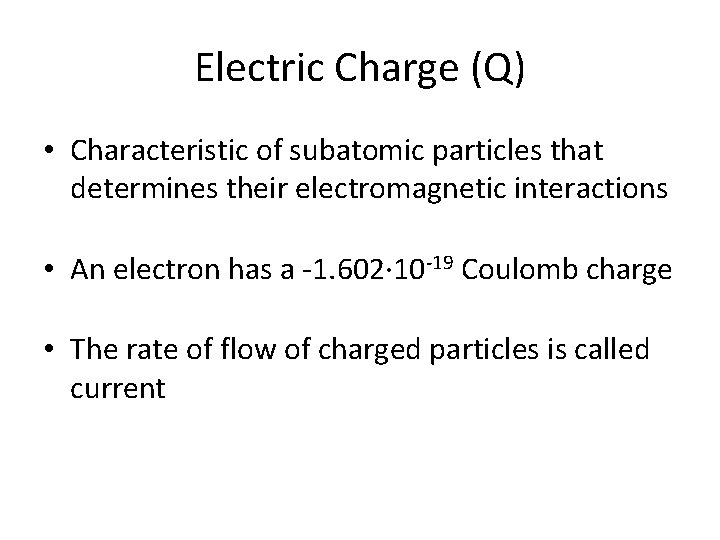
Electric Charge (Q) • Characteristic of subatomic particles that determines their electromagnetic interactions • An electron has a -1. 602∙ 10 -19 Coulomb charge • The rate of flow of charged particles is called current
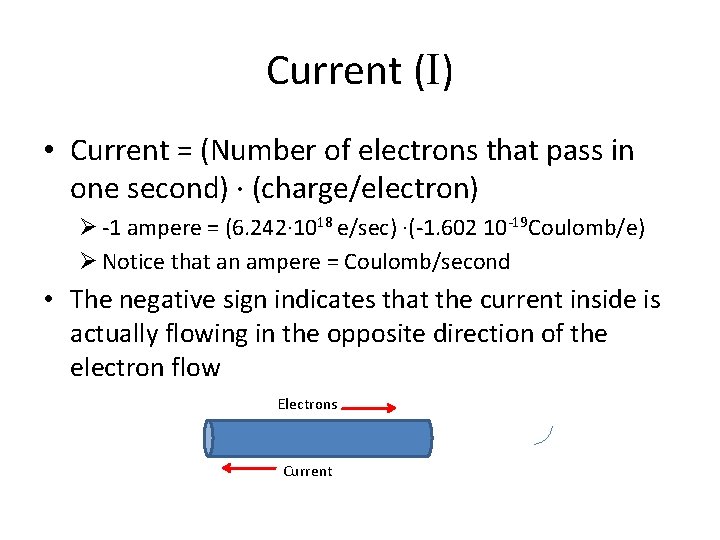
Current (I) • Current = (Number of electrons that pass in one second) ∙ (charge/electron) Ø -1 ampere = (6. 242∙ 1018 e/sec) ∙(-1. 602 10 -19 Coulomb/e) Ø Notice that an ampere = Coulomb/second • The negative sign indicates that the current inside is actually flowing in the opposite direction of the electron flow Electrons Current
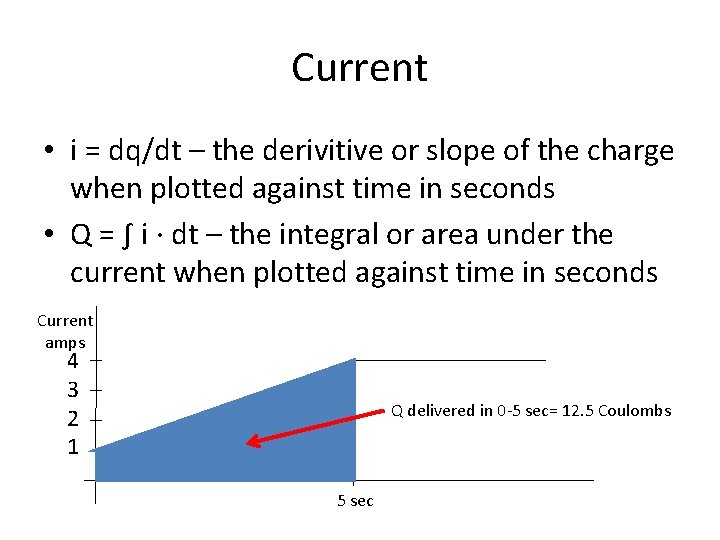
Current • i = dq/dt – the derivitive or slope of the charge when plotted against time in seconds • Q = ∫ i ∙ dt – the integral or area under the current when plotted against time in seconds Current amps 4 3 2 1 Q delivered in 0 -5 sec= 12. 5 Coulombs 5 sec
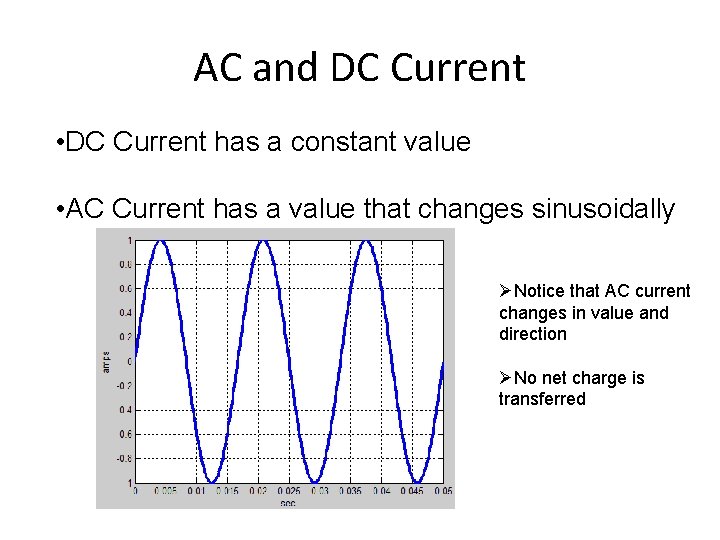
AC and DC Current • DC Current has a constant value • AC Current has a value that changes sinusoidally ØNotice that AC current changes in value and direction ØNo net charge is transferred
Why Does Current Flow? • A voltage source provides the energy (or work) required to produce a current ØVolts = joules/Coulomb = d. W/d. Q • A source takes charged particles (usually electrons) and raises their potential so they flow out of one terminal into and through a transducer (light bulb or motor) on their way back to the source’s other terminal
Voltage • Voltage is a measure of the potential energy that causes a current to flow through a transducer in a circuit • Voltage is always measured as a difference with respect to an arbitrary common point called ground • Voltage is also known as electromotive force or EMF outside engineering
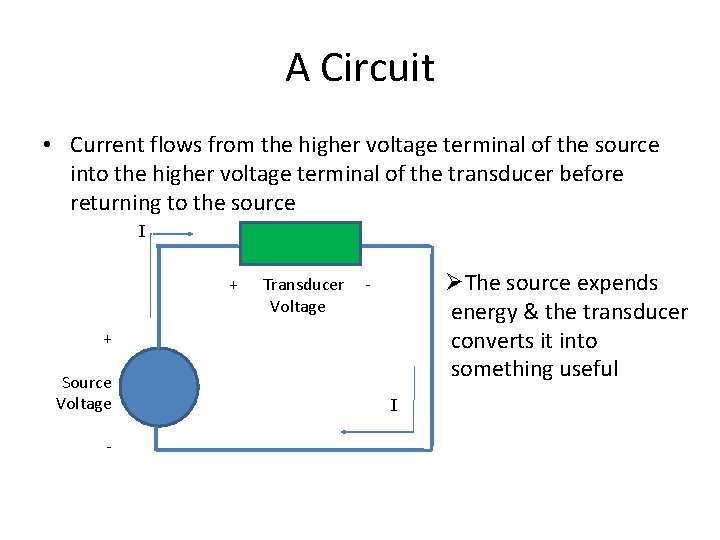
A Circuit • Current flows from the higher voltage terminal of the source into the higher voltage terminal of the transducer before returning to the source I + Transducer Voltage ØThe source expends energy & the transducer converts it into something useful - + Source Voltage - I
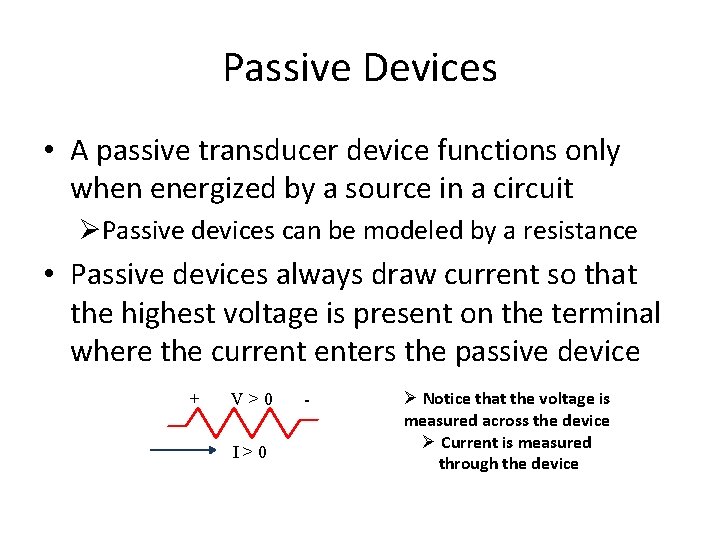
Passive Devices • A passive transducer device functions only when energized by a source in a circuit ØPassive devices can be modeled by a resistance • Passive devices always draw current so that the highest voltage is present on the terminal where the current enters the passive device + V>0 I>0 - Ø Notice that the voltage is measured across the device Ø Current is measured through the device
Active Devices • Sources expend energy and are considered active devices • Their current normally flows out of their highest voltage terminal • Sometimes, when there are multiple sources in a circuit, one overpowers another, forcing the other to behave in a passive manner
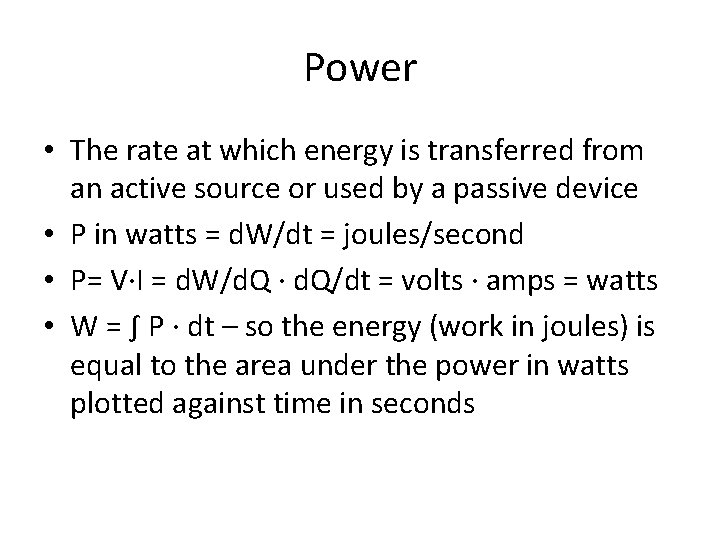
Power • The rate at which energy is transferred from an active source or used by a passive device • P in watts = d. W/dt = joules/second • P= V∙I = d. W/d. Q ∙ d. Q/dt = volts ∙ amps = watts • W = ∫ P ∙ dt – so the energy (work in joules) is equal to the area under the power in watts plotted against time in seconds
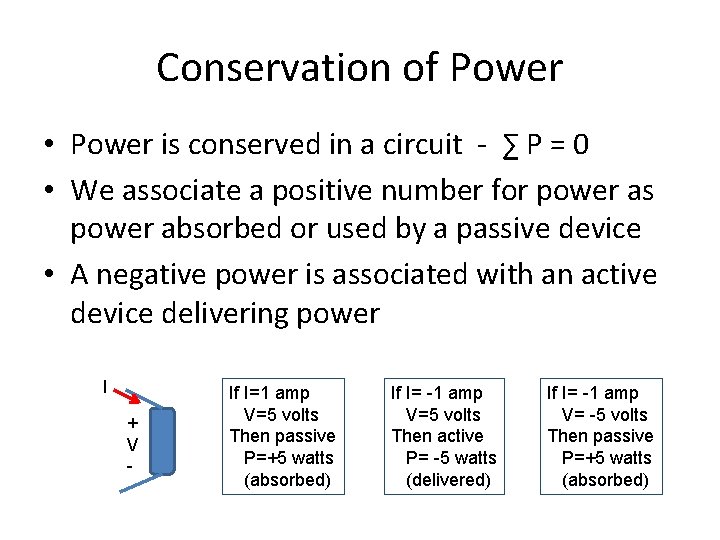
Conservation of Power • Power is conserved in a circuit - ∑ P = 0 • We associate a positive number for power as power absorbed or used by a passive device • A negative power is associated with an active device delivering power I + V - If I=1 amp V=5 volts Then passive P=+5 watts (absorbed) If I= -1 amp V=5 volts Then active P= -5 watts (delivered) If I= -1 amp V= -5 volts Then passive P=+5 watts (absorbed)
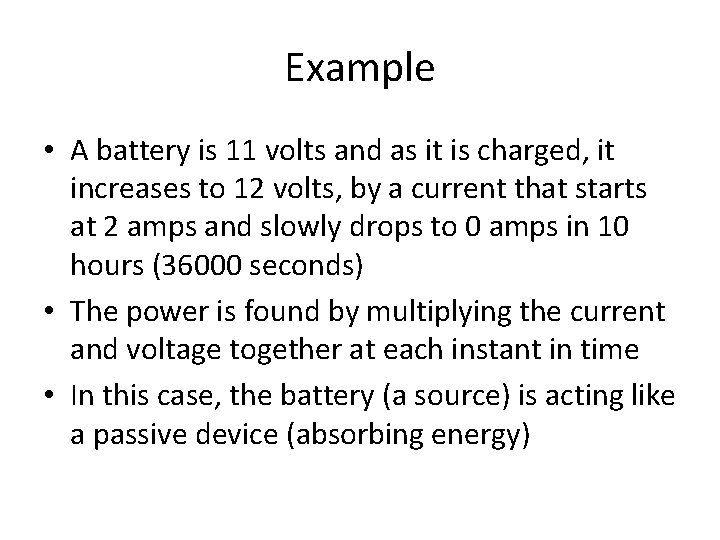
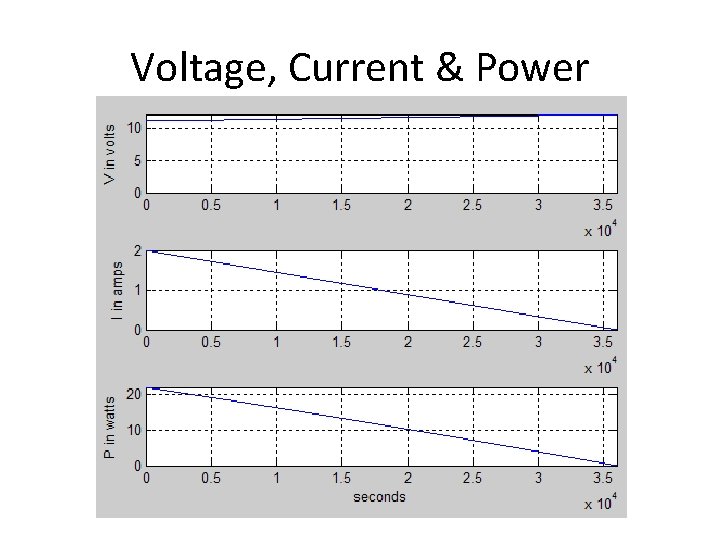
Example • A battery is 11 volts and as it is charged, it increases to 12 volts, by a current that starts at 2 amps and slowly drops to 0 amps in 10 hours (36000 seconds) • The power is found by multiplying the current and voltage together at each instant in time • In this case, the battery (a source) is acting like a passive device (absorbing energy)
Voltage, Current & Power
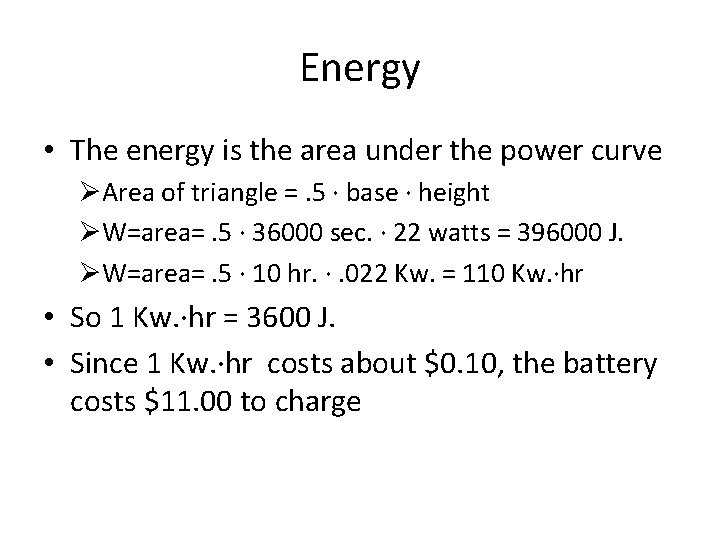
Energy • The energy is the area under the power curve ØArea of triangle =. 5 ∙ base ∙ height ØW=area=. 5 ∙ 36000 sec. ∙ 22 watts = 396000 J. ØW=area=. 5 ∙ 10 hr. ∙. 022 Kw. = 110 Kw. ∙hr • So 1 Kw. ∙hr = 3600 J. • Since 1 Kw. ∙hr costs about $0. 10, the battery costs $11. 00 to charge
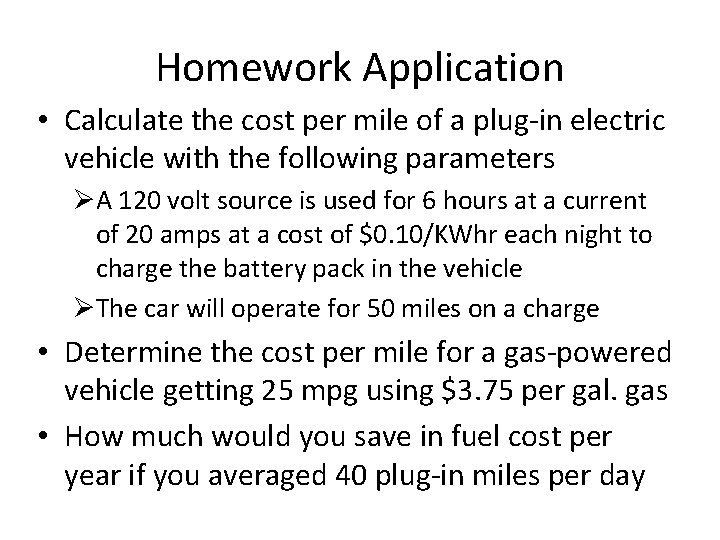
Homework Application • Calculate the cost per mile of a plug-in electric vehicle with the following parameters ØA 120 volt source is used for 6 hours at a current of 20 amps at a cost of $0. 10/KWhr each night to charge the battery pack in the vehicle ØThe car will operate for 50 miles on a charge • Determine the cost per mile for a gas-powered vehicle getting 25 mpg using $3. 75 per gal. gas • How much would you save in fuel cost per year if you averaged 40 plug-in miles per day