
Fundamental Counting Principle If one event can occur
- Slides: 26
Fundamental Counting Principle • If one event can occur in m ways and a second event can occur in n ways, the number of ways the two events can occur in sequence is m*n. • Can be extended for any number of events occurring in sequence. Larson/Farber 4 th ed 1
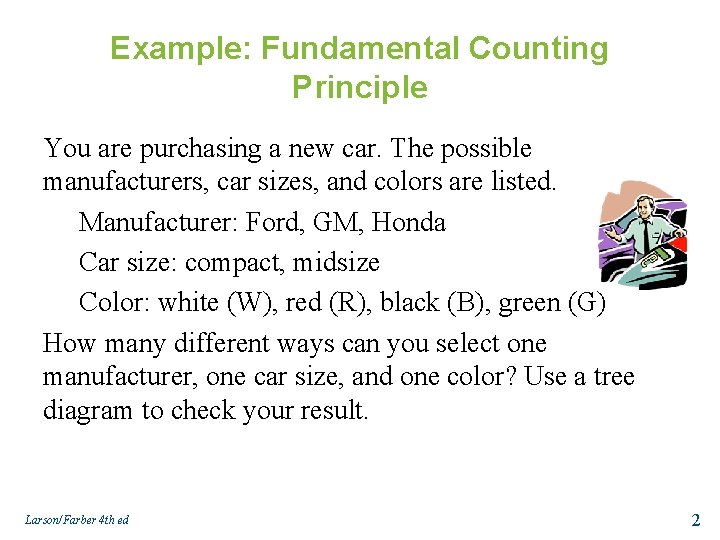
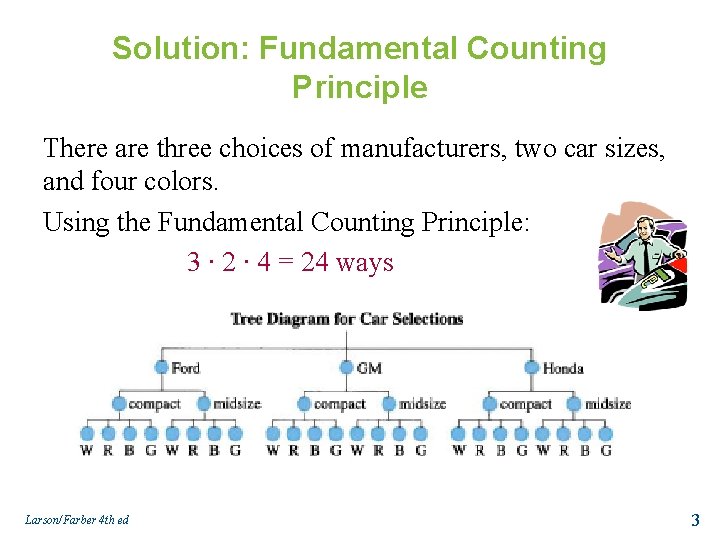
Example: Fundamental Counting Principle You are purchasing a new car. The possible manufacturers, car sizes, and colors are listed. Manufacturer: Ford, GM, Honda Car size: compact, midsize Color: white (W), red (R), black (B), green (G) How many different ways can you select one manufacturer, one car size, and one color? Use a tree diagram to check your result. Larson/Farber 4 th ed 2
Solution: Fundamental Counting Principle There are three choices of manufacturers, two car sizes, and four colors. Using the Fundamental Counting Principle: 3 ∙ 2 ∙ 4 = 24 ways Larson/Farber 4 th ed 3
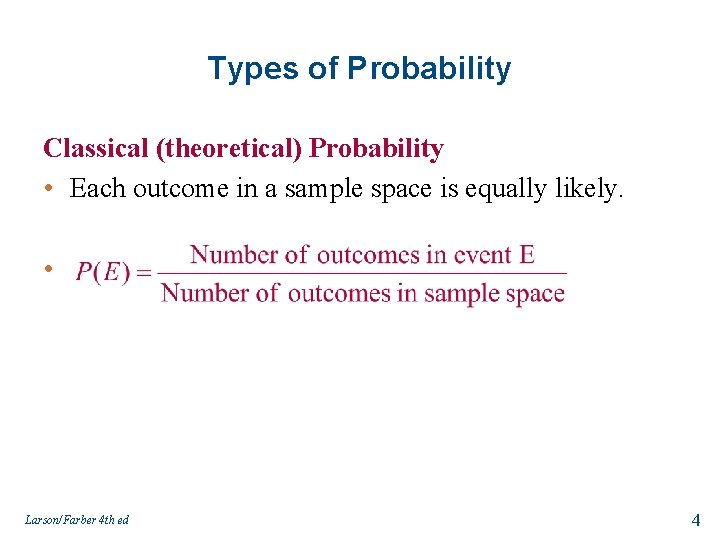
Types of Probability Classical (theoretical) Probability • Each outcome in a sample space is equally likely. • Larson/Farber 4 th ed 4
Example: Probability Using the Fundamental Counting Principle Your college identification number consists of 8 digits. Each digit can be 0 through 9 and each digit can be repeated. What is the probability of getting your college identification number when randomly generating eight digits? Larson/Farber 4 th ed 5
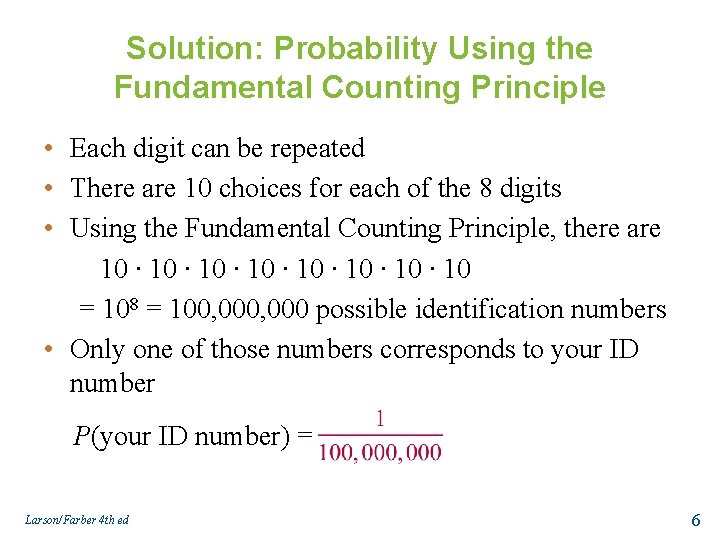
Solution: Probability Using the Fundamental Counting Principle • Each digit can be repeated • There are 10 choices for each of the 8 digits • Using the Fundamental Counting Principle, there are 10 ∙ 10 ∙ 10 = 108 = 100, 000 possible identification numbers • Only one of those numbers corresponds to your ID number P(your ID number) = Larson/Farber 4 th ed 6
Section 3. 4 Additional Topics in Probability and Counting Larson/Farber 4 th ed 7
Section 3. 4 Objectives • Determine the number of ways a group of objects can be arranged in order • Determine the number of ways to choose several objects from a group without regard to order • Use the counting principles to find probabilities Larson/Farber 4 th ed 8
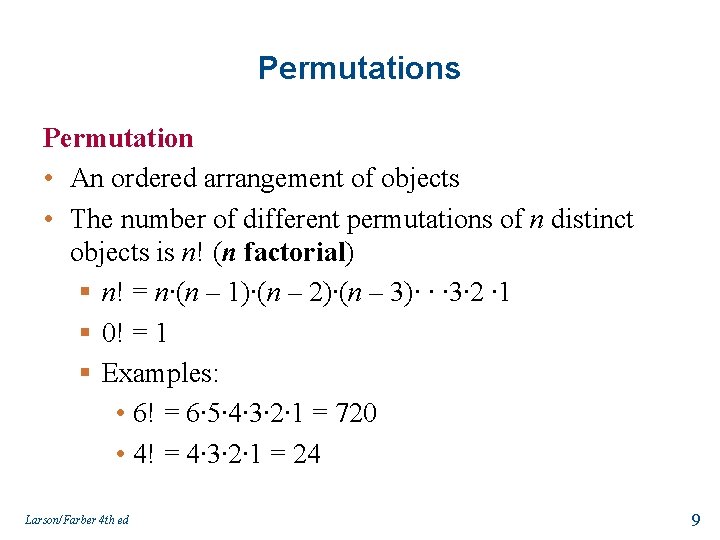
Permutations Permutation • An ordered arrangement of objects • The number of different permutations of n distinct objects is n! (n factorial) § n! = n∙(n – 1)∙(n – 2)∙(n – 3)∙ ∙ ∙ 3∙ 2 ∙ 1 § 0! = 1 § Examples: • 6! = 6∙ 5∙ 4∙ 3∙ 2∙ 1 = 720 • 4! = 4∙ 3∙ 2∙ 1 = 24 Larson/Farber 4 th ed 9
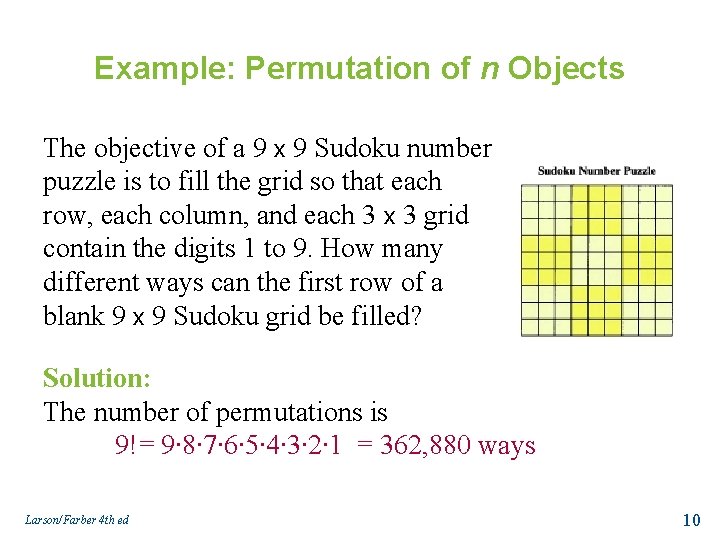
Example: Permutation of n Objects The objective of a 9 x 9 Sudoku number puzzle is to fill the grid so that each row, each column, and each 3 x 3 grid contain the digits 1 to 9. How many different ways can the first row of a blank 9 x 9 Sudoku grid be filled? Solution: The number of permutations is 9!= 9∙ 8∙ 7∙ 6∙ 5∙ 4∙ 3∙ 2∙ 1 = 362, 880 ways Larson/Farber 4 th ed 10
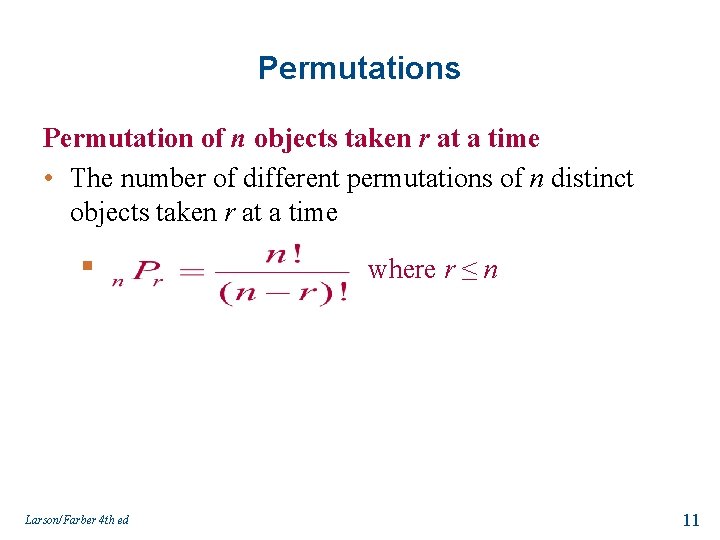
Permutations Permutation of n objects taken r at a time • The number of different permutations of n distinct objects taken r at a time ■ Larson/Farber 4 th ed where r ≤ n 11
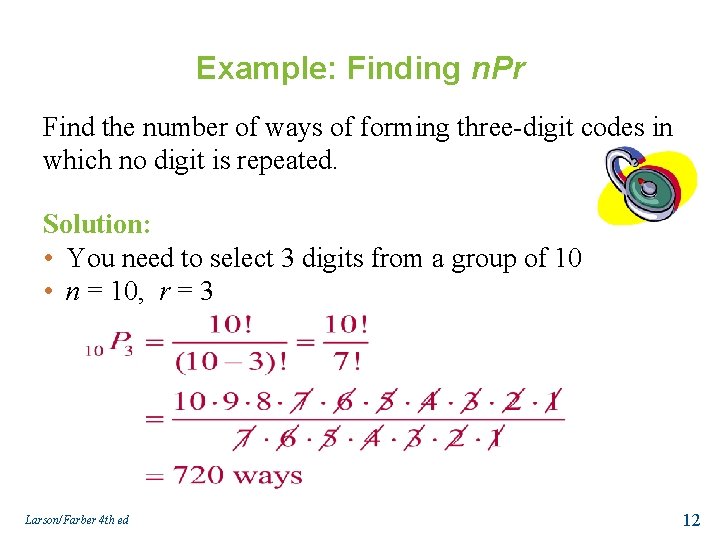
Example: Finding n. Pr Find the number of ways of forming three-digit codes in which no digit is repeated. Solution: • You need to select 3 digits from a group of 10 • n = 10, r = 3 Larson/Farber 4 th ed 12
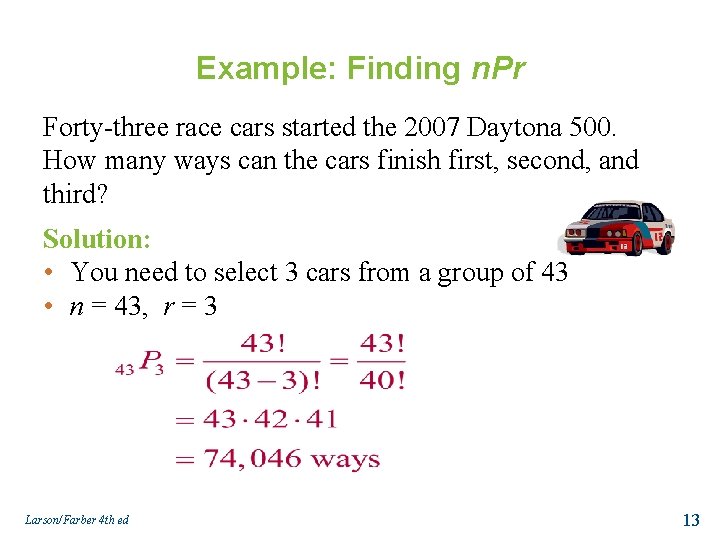
Example: Finding n. Pr Forty-three race cars started the 2007 Daytona 500. How many ways can the cars finish first, second, and third? Solution: • You need to select 3 cars from a group of 43 • n = 43, r = 3 Larson/Farber 4 th ed 13
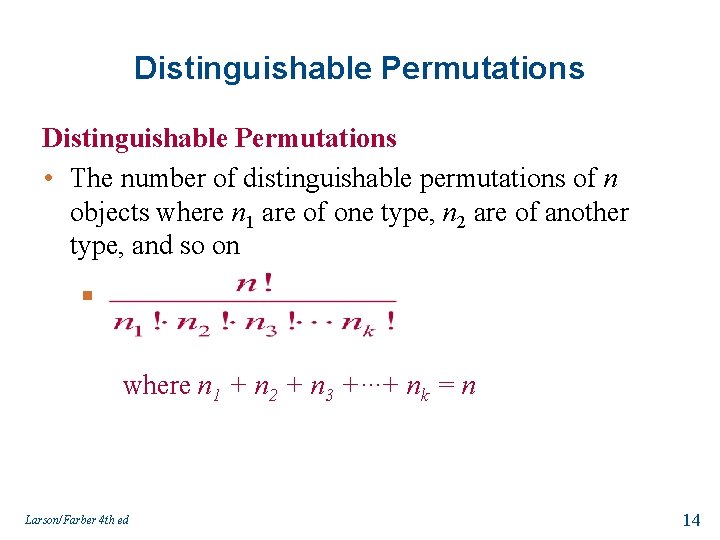
Distinguishable Permutations • The number of distinguishable permutations of n objects where n 1 are of one type, n 2 are of another type, and so on ■ where n 1 + n 2 + n 3 +∙∙∙+ nk = n Larson/Farber 4 th ed 14
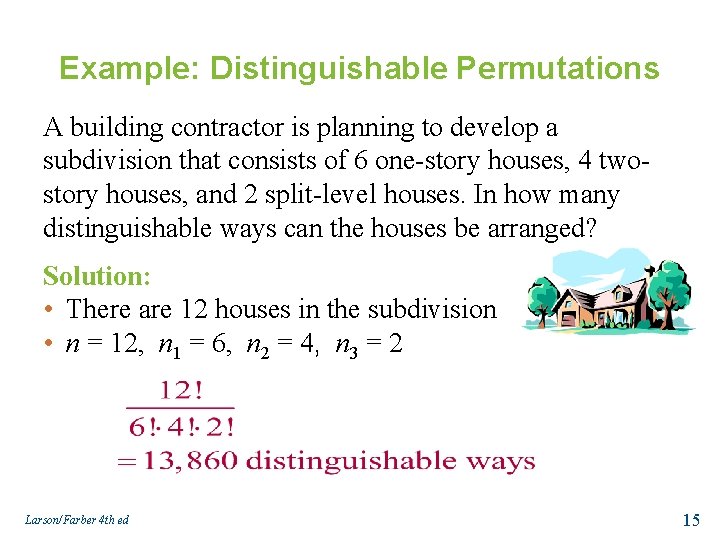
Example: Distinguishable Permutations A building contractor is planning to develop a subdivision that consists of 6 one-story houses, 4 twostory houses, and 2 split-level houses. In how many distinguishable ways can the houses be arranged? Solution: • There are 12 houses in the subdivision • n = 12, n 1 = 6, n 2 = 4, n 3 = 2 Larson/Farber 4 th ed 15
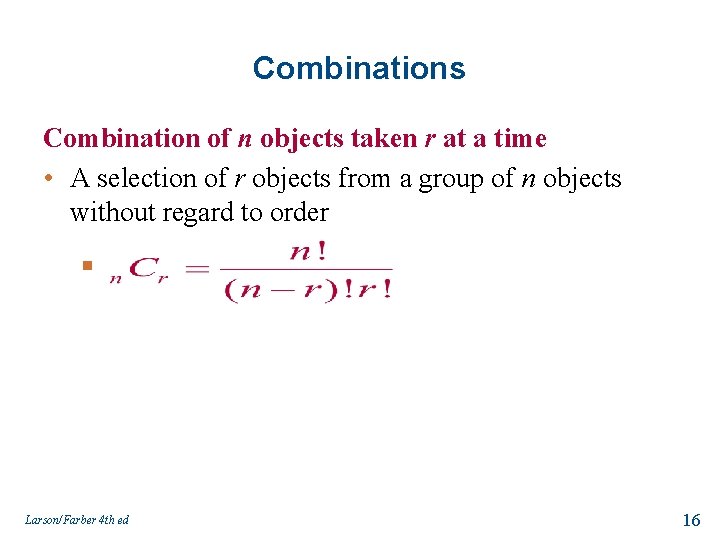
Combinations Combination of n objects taken r at a time • A selection of r objects from a group of n objects without regard to order ■ Larson/Farber 4 th ed 16
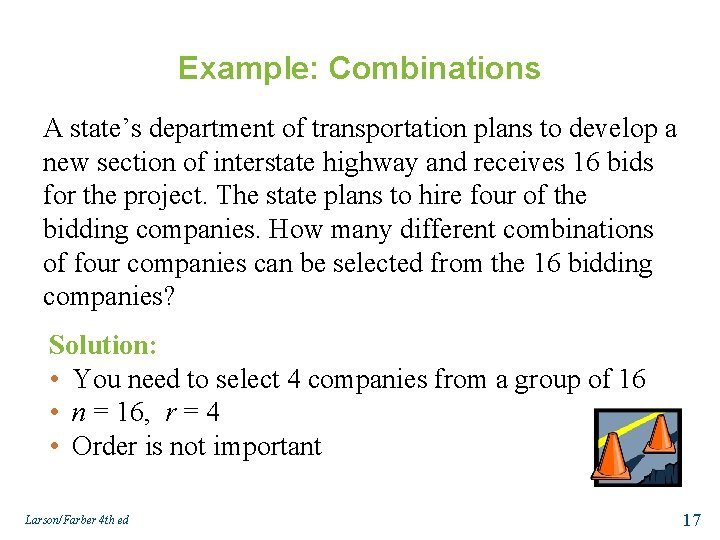
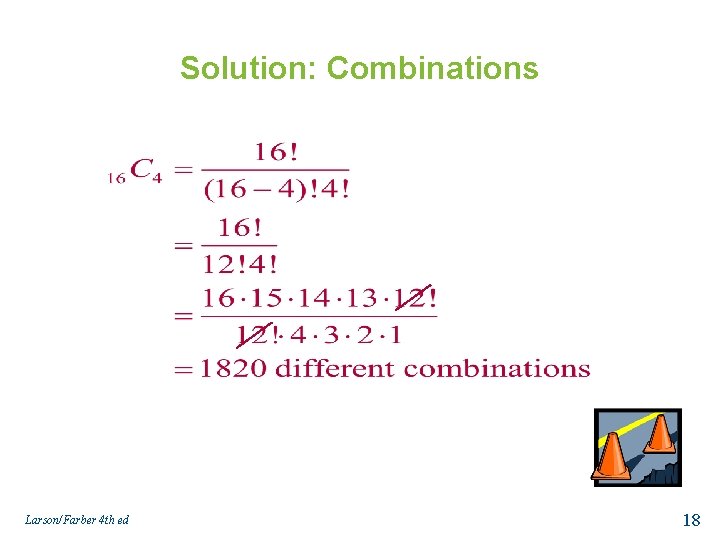
Example: Combinations A state’s department of transportation plans to develop a new section of interstate highway and receives 16 bids for the project. The state plans to hire four of the bidding companies. How many different combinations of four companies can be selected from the 16 bidding companies? Solution: • You need to select 4 companies from a group of 16 • n = 16, r = 4 • Order is not important Larson/Farber 4 th ed 17
Solution: Combinations Larson/Farber 4 th ed 18
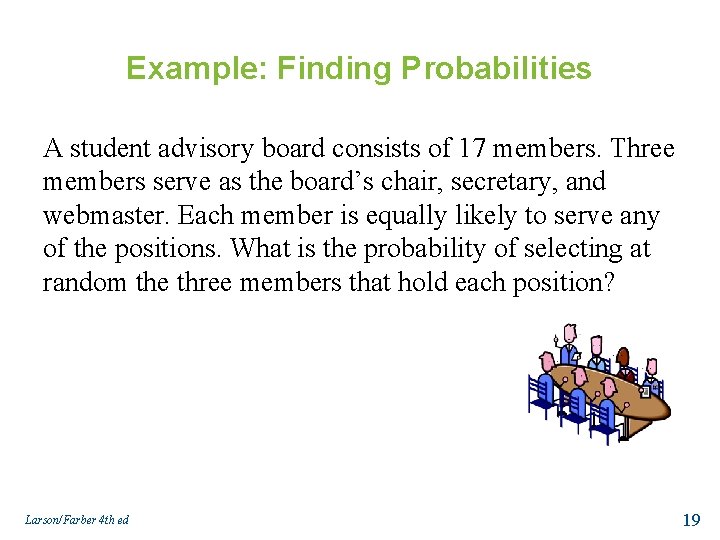
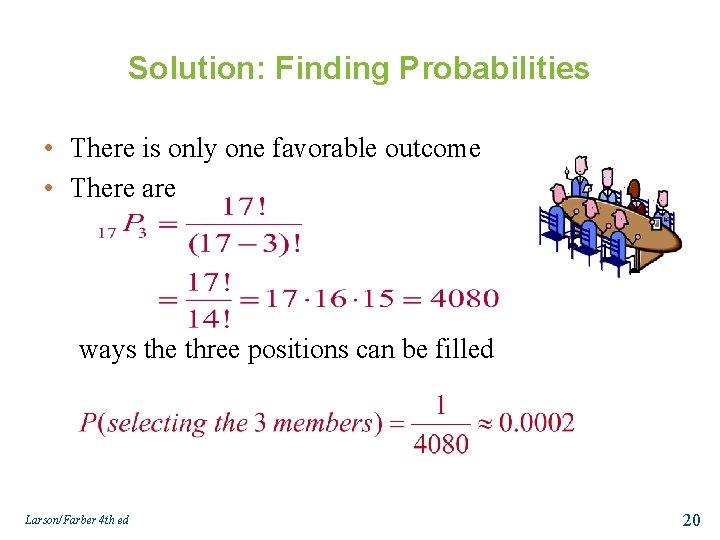
Example: Finding Probabilities A student advisory board consists of 17 members. Three members serve as the board’s chair, secretary, and webmaster. Each member is equally likely to serve any of the positions. What is the probability of selecting at random the three members that hold each position? Larson/Farber 4 th ed 19
Solution: Finding Probabilities • There is only one favorable outcome • There are ways the three positions can be filled Larson/Farber 4 th ed 20
Example: Finding Probabilities You have 11 letters consisting of one M, four Is, four Ss, and two Ps. If the letters are randomly arranged in order, what is the probability that the arrangement spells the word Mississippi? Larson/Farber 4 th ed 21
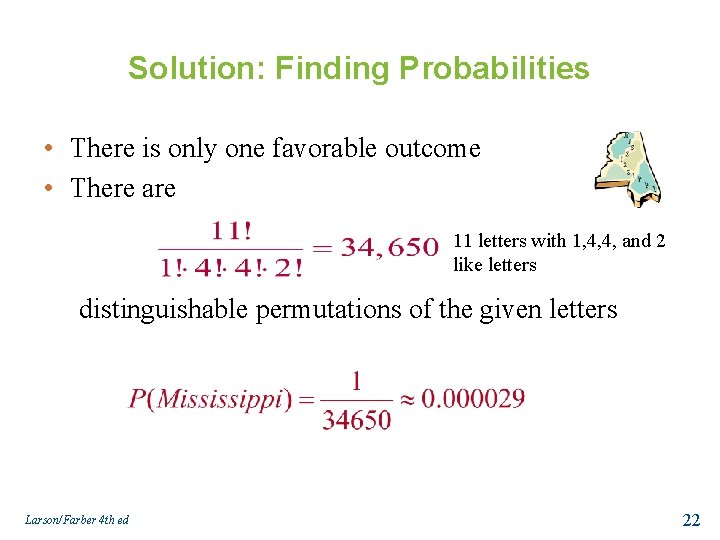
Solution: Finding Probabilities • There is only one favorable outcome • There are 11 letters with 1, 4, 4, and 2 like letters distinguishable permutations of the given letters Larson/Farber 4 th ed 22
Example: Finding Probabilities A food manufacturer is analyzing a sample of 400 corn kernels for the presence of a toxin. In this sample, three kernels have dangerously high levels of the toxin. If four kernels are randomly selected from the sample, what is the probability that exactly one kernel contains a dangerously high level of the toxin? Larson/Farber 4 th ed 23
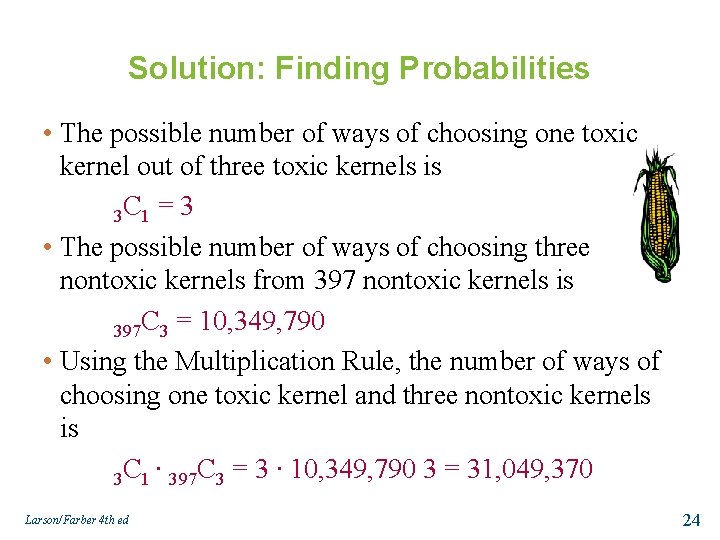
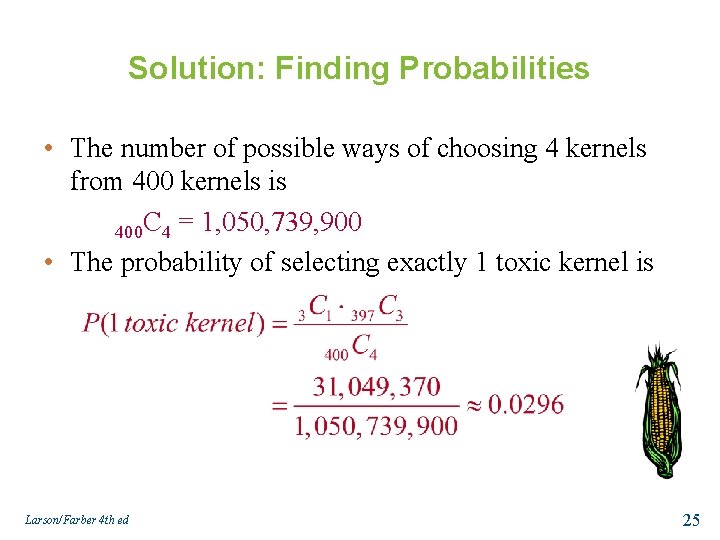
Solution: Finding Probabilities • The possible number of ways of choosing one toxic kernel out of three toxic kernels is 3 C 1 = 3 • The possible number of ways of choosing three nontoxic kernels from 397 nontoxic kernels is 397 C 3 = 10, 349, 790 • Using the Multiplication Rule, the number of ways of choosing one toxic kernel and three nontoxic kernels is 3 C 1 ∙ 397 C 3 = 3 ∙ 10, 349, 790 3 = 31, 049, 370 Larson/Farber 4 th ed 24
Solution: Finding Probabilities • The number of possible ways of choosing 4 kernels from 400 kernels is 400 C 4 = 1, 050, 739, 900 • The probability of selecting exactly 1 toxic kernel is Larson/Farber 4 th ed 25
Section 3. 4 Summary • Determined the number of ways a group of objects can be arranged in order • Determined the number of ways to choose several objects from a group without regard to order • Used the counting principles to find probabilities Larson/Farber 4 th ed 26