
Fundamental Conclusion of the Army Training and Leader
- Slides: 15
Fundamental Conclusion of the Army Training and Leader Development Panel: The Army Must Become a Learning Organization Warrior Knowledge Network and the Semantic Web: Building the Self-Aware, Adaptive Leaders of the Future; Transforming the Army into a Learning and Knowledge Sharing Organization Rick Morris Deputy Director, Center for Army Lessons Learned 6 June 2001
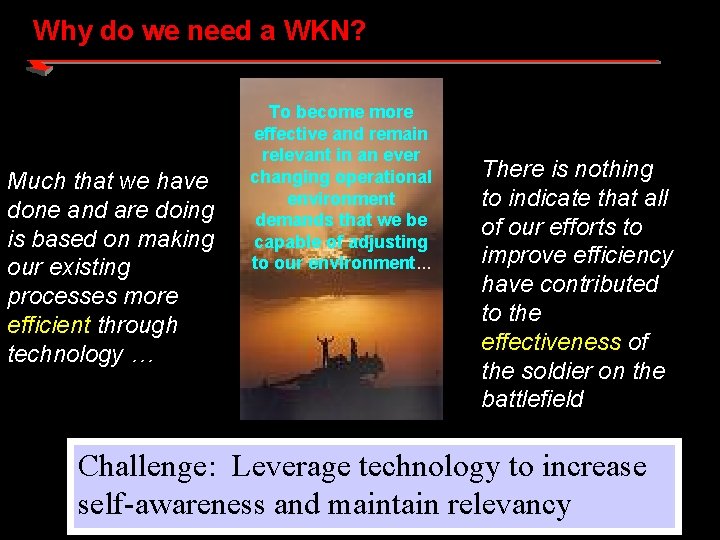
Why do we need a WKN? Much that we have done and are doing is based on making our existing processes more efficient through technology … To become more effective and remain relevant in an ever changing operational environment demands that we be capable of adjusting to our environment. . . There is nothing to indicate that all of our efforts to improve efficiency have contributed to the effectiveness of the soldier on the battlefield Challenge: Leverage technology to increase self-awareness and maintain relevancy
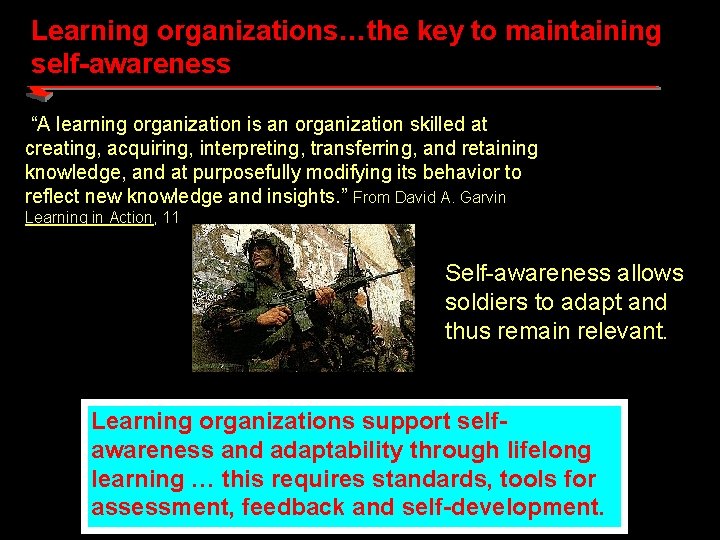
Learning organizations…the key to maintaining self-awareness “A learning organization is an organization skilled at creating, acquiring, interpreting, transferring, and retaining knowledge, and at purposefully modifying its behavior to reflect new knowledge and insights. ” From David A. Garvin Learning in Action, 11 Self-awareness allows soldiers to adapt and thus remain relevant. Learning organizations support selfawareness and adaptability through lifelong learning … this requires standards, tools for assessment, feedback and self-development.
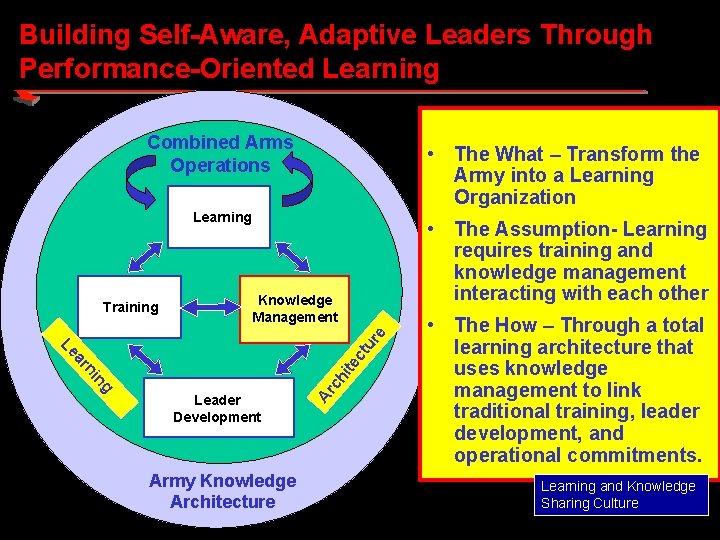
Building Self-Aware, Adaptive Leaders Through Performance-Oriented Learning Combined Arms Operations • The What – Transform the Army into a Learning Organization Learning Knowledge Management Le te ct ur e Training • The Assumption- Learning requires training and knowledge management interacting with each other hi Army Knowledge Architecture Ar c ng ni ar Leader Development • The How – Through a total learning architecture that uses knowledge management to link traditional training, leader development, and operational commitments. Learning and Knowledge Sharing Culture
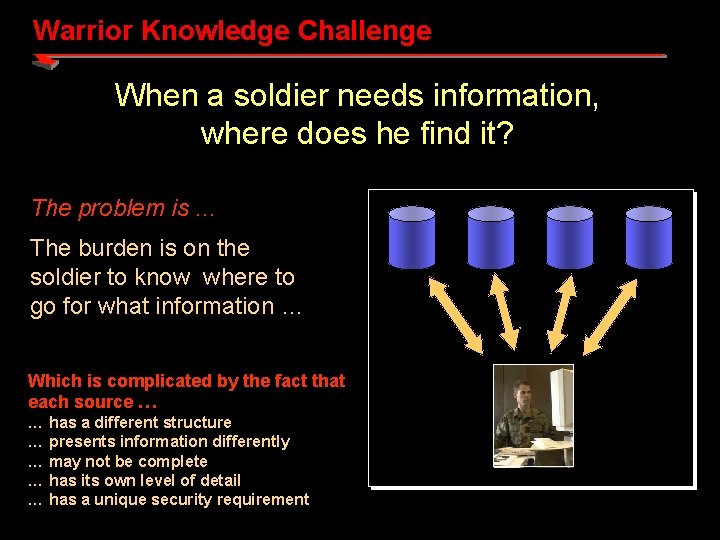
Warrior Knowledge Challenge When a soldier needs information, where does he find it? The problem is. . . The burden is on the soldier to know where to go for what information … Which is complicated by the fact that each source … … has a different structure … presents information differently … may not be complete … has its own level of detail … has a unique security requirement
Purpose of the WKN • Implement recommendations of the Army Training and Leader Development Panel to… – Transform the Army into a learning organization – Build self-aware, adaptive leaders • Develop a capability to facilitate the sharing of tacit and explicit knowledge at the tactical level. • Support the goals of the Army Knowledge Management Strategic Plan to… – Assimilate knowledge management into Army processes to improve performance – Broaden Army workforce perspective to enable effective and agile decision making
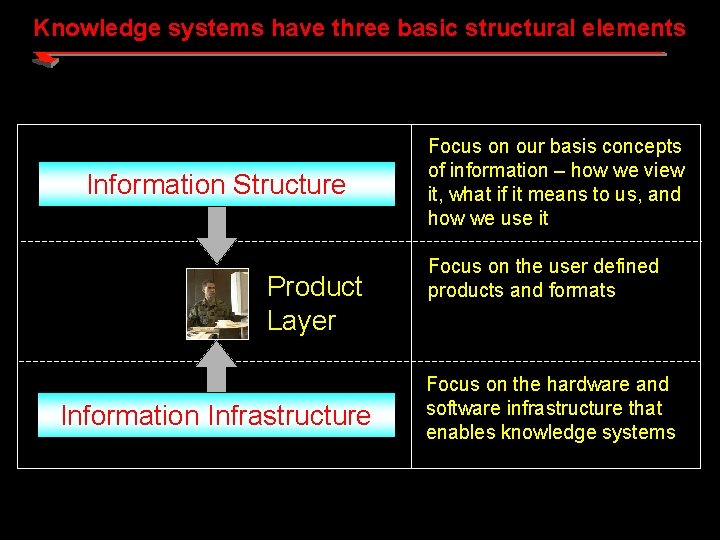
Knowledge systems have three basic structural elements Information Structure Product Layer Information Infrastructure Focus on our basis concepts of information – how we view it, what if it means to us, and how we use it Focus on the user defined products and formats Focus on the hardware and software infrastructure that enables knowledge systems
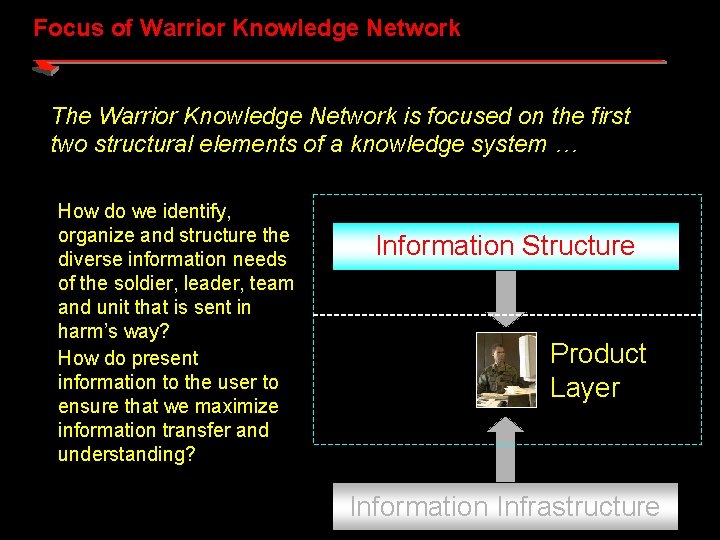
Focus of Warrior Knowledge Network The Warrior Knowledge Network is focused on the first two structural elements of a knowledge system … How do we identify, organize and structure the diverse information needs of the soldier, leader, team and unit that is sent in harm’s way? How do present information to the user to ensure that we maximize information transfer and understanding? Information Structure Product Layer Information Infrastructure
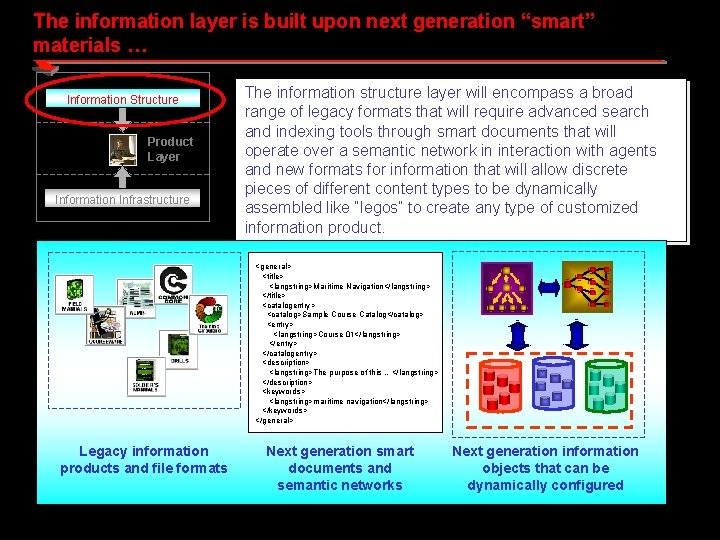
The information layer is built upon next generation “smart” materials … Information Structure Product Layer Information Infrastructure The information structure layer will encompass a broad range of legacy formats that will require advanced search and indexing tools through smart documents that will operate over a semantic network in interaction with agents and new formats for information that will allow discrete pieces of different content types to be dynamically assembled like “legos” to create any type of customized information product. <general> <title> <langstring>Maritime Navigation</langstring> </title> <catalogentry> <catalog>Sample Course Catalog</catalog> <entry> <langstring>Course 01</langstring> </entry> </catalogentry> <description> <langstring>The purpose of this …</langstring> </description> <keywords> <langstring>maritime navigation</langstring> </keywords> </general> Legacy information products and file formats Next generation smart documents and semantic networks Next generation information objects that can be dynamically configured
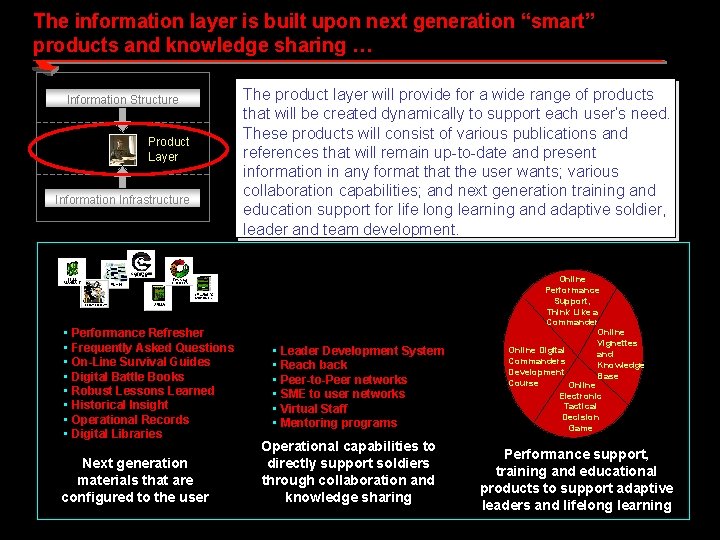
The information layer is built upon next generation “smart” products and knowledge sharing … Information Structure Product Layer Information Infrastructure • Performance Refresher • Frequently Asked Questions • On-Line Survival Guides • Digital Battle Books • Robust Lessons Learned • Historical Insight • Operational Records • Digital Libraries Next generation materials that are configured to the user The product layer will provide for a wide range of products that will be created dynamically to support each user’s need. These products will consist of various publications and references that will remain up-to-date and present information in any format the user wants; various collaboration capabilities; and next generation training and education support for life long learning and adaptive soldier, leader and team development. • Leader Development System • Reach back • Peer-to-Peer networks • SME to user networks • Virtual Staff • Mentoring programs Operational capabilities to directly support soldiers through collaboration and knowledge sharing Online Performance Support, Think Like a Commander Online Vignettes Online Digital and Commanders Knowledge Development Base Course Online Electronic Tactical Decision Game Performance support, training and educational products to support adaptive leaders and lifelong learning
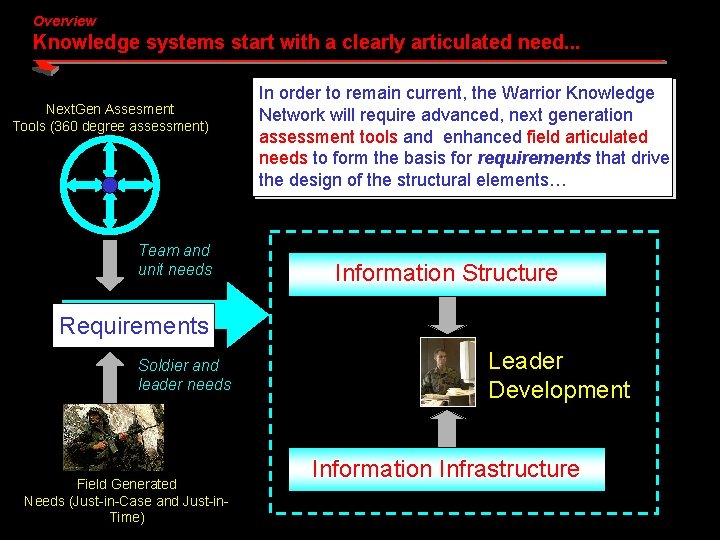
Overview Knowledge systems start with a clearly articulated need. . . Next. Gen Assesment Tools (360 degree assessment) Team and unit needs In order to remain current, the Warrior Knowledge Network will require advanced, next generation assessment tools and enhanced field articulated needs to form the basis for requirements that drive the design of the structural elements… Information Structure Requirements Soldier and leader needs Field Generated Needs (Just-in-Case and Just-in. Time) Leader Development Information Infrastructure
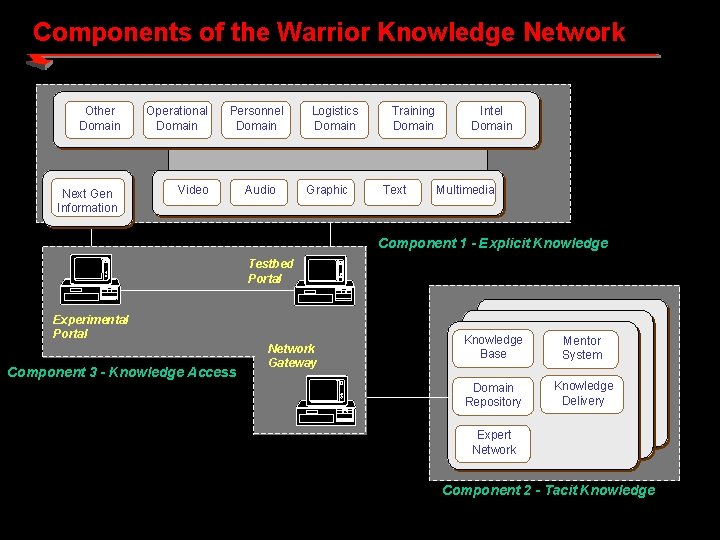
Components of the Warrior Knowledge Network Other Domain Operational Domain Next Gen Information Video Personnel Domain Audio Logistics Domain Graphic Training Domain Text Intel Domain Multimedia Component 1 - Explicit Knowledge Testbed Portal Experimental Portal Component 3 - Knowledge Access Network Gateway Knowledge Base Mentor System Domain Repository Knowledge Delivery Expert Network Component 2 - Tacit Knowledge
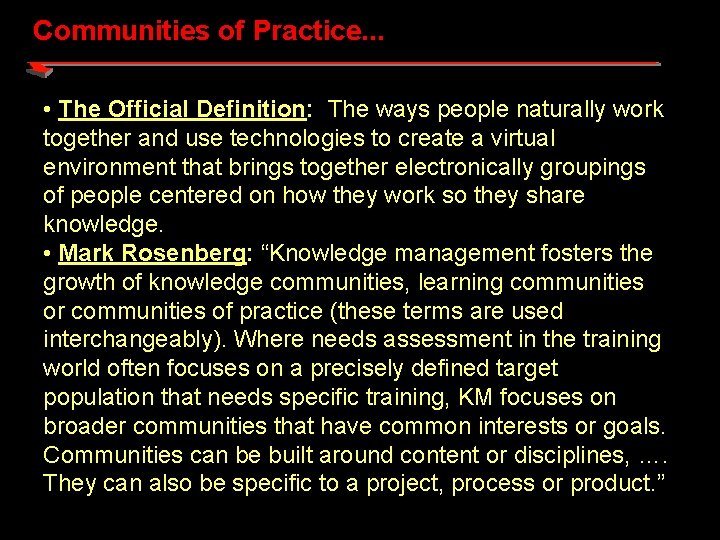
Communities of Practice. . . • The Official Definition: The ways people naturally work together and use technologies to create a virtual environment that brings together electronically groupings of people centered on how they work so they share knowledge. • Mark Rosenberg: “Knowledge management fosters the growth of knowledge communities, learning communities or communities of practice (these terms are used interchangeably). Where needs assessment in the training world often focuses on a precisely defined target population that needs specific training, KM focuses on broader communities that have common interests or goals. Communities can be built around content or disciplines, …. They can also be specific to a project, process or product. ”
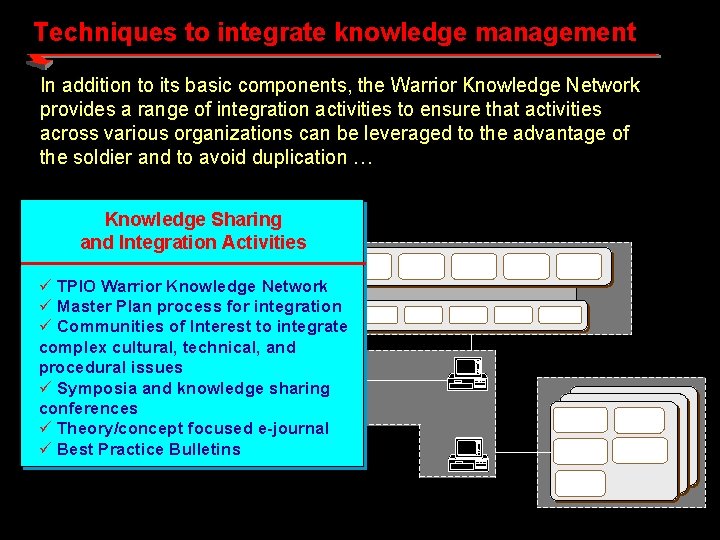
Techniques to integrate knowledge management In addition to its basic components, the Warrior Knowledge Network provides a range of integration activities to ensure that activities across various organizations can be leveraged to the advantage of the soldier and to avoid duplication … Knowledge Sharing and Integration Activities ü TPIO Warrior Knowledge Network ü Master Plan process for integration ü Communities of Interest to integrate complex cultural, technical, and procedural issues ü Symposia and knowledge sharing conferences ü Theory/concept focused e-journal ü Best Practice Bulletins
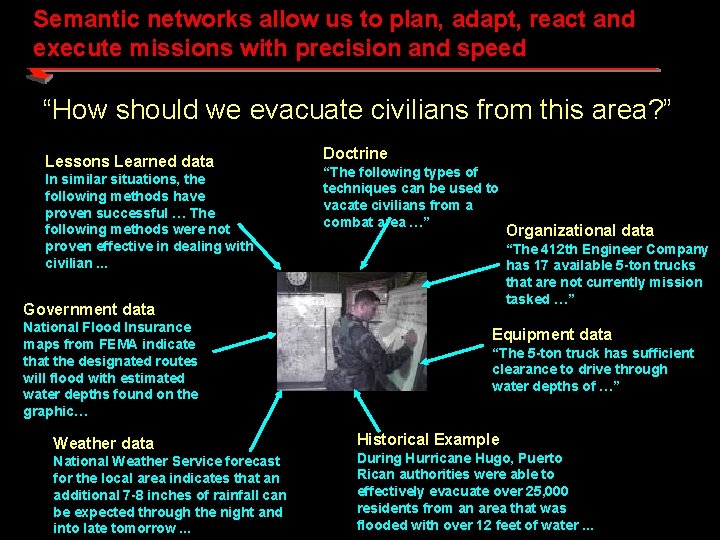
Semantic networks allow us to plan, adapt, react and execute missions with precision and speed “How should we evacuate civilians from this area? ” Lessons Learned data In similar situations, the following methods have proven successful … The following methods were not proven effective in dealing with civilian. . . Doctrine “The following types of techniques can be used to vacate civilians from a combat area …” “The 412 th Engineer Company has 17 available 5 -ton trucks that are not currently mission tasked …” Government data National Flood Insurance maps from FEMA indicate that the designated routes will flood with estimated water depths found on the graphic… Weather data National Weather Service forecast for the local area indicates that an additional 7 -8 inches of rainfall can be expected through the night and into late tomorrow. . . Organizational data Equipment data “The 5 -ton truck has sufficient clearance to drive through water depths of …” Historical Example During Hurricane Hugo, Puerto Rican authorities were able to effectively evacuate over 25, 000 residents from an area that was flooded with over 12 feet of water. . .