
Fundamental Concepts of Programming Languages PL families Lecture
![The Philosophers program proc philosophers module array tforks[0. . 4] (int) var forks: tforks;](https://slidetodoc.com/presentation_image_h2/1cf3c3f1405b10e0e6bd5f6cf9fba8cb/image-36.jpg "The Philosophers program proc philosophers module array tforks[0. . 4] (int) var forks: tforks;")
![The Philosophers program *proc get(philo: int) begin when forks[philo] = 2 do forks[philoright(philo)]: =](https://slidetodoc.com/presentation_image_h2/1cf3c3f1405b10e0e6bd5f6cf9fba8cb/image-37.jpg "The Philosophers program *proc get(philo: int) begin when forks[philo] = 2 do forks[philoright(philo)]: =")
![The Philosophers program *proc put(philo: int) begin when true do forks[philoright(philo)]: = forks[philoright(philo)]+1; forks[philoright(philo)]:](https://slidetodoc.com/presentation_image_h2/1cf3c3f1405b10e0e6bd5f6cf9fba8cb/image-38.jpg "The Philosophers program *proc put(philo: int) begin when true do forks[philoright(philo)]: = forks[philoright(philo)]+1; forks[philoright(philo)]:")
![The Philosophers program begin i: =0 while i<5 forks[i]: =2 i: =i+1; end](https://slidetodoc.com/presentation_image_h2/1cf3c3f1405b10e0e6bd5f6cf9fba8cb/image-39.jpg "The Philosophers program begin i: =0 while i<5 forks[i]: =2 i: =i+1; end")
- Slides: 65
Fundamental Concepts of Programming Languages PL families Lecture 02 conf. dr. ing. Ciprian-Bogdan Chirila
Lecture outline Imperative PLs Functional PLs Declarative PLs
The three PL families There are several criteria of PL classification… Imperative Functional Declarative Inside each family there is a diversity of languages They have the same basic principles
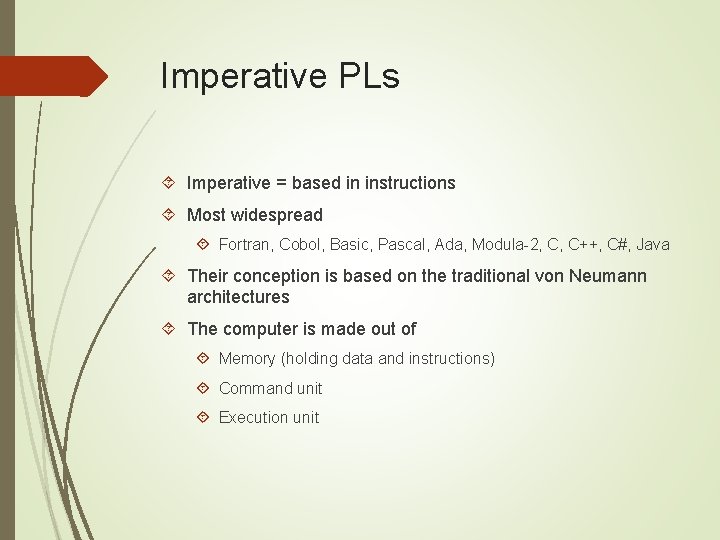
Imperative PLs Imperative = based in instructions Most widespread Fortran, Cobol, Basic, Pascal, Ada, Modula-2, C, C++, C#, Java Their conception is based on the traditional von Neumann architectures The computer is made out of Memory (holding data and instructions) Command unit Execution unit
Imperative PLs Based on 2 concepts Sequential (step by step) execution of instructions Keeping a modifiable set of values during program execution Those values define the state of system
Imperative PLs The 3 essential components: Variables Major component in imperative PLs Memory cells with names assigned and values stored Assignment instruction Memorizing the computed value Iteration Typical way to do complex computation To execute repeatedly a set of instructions
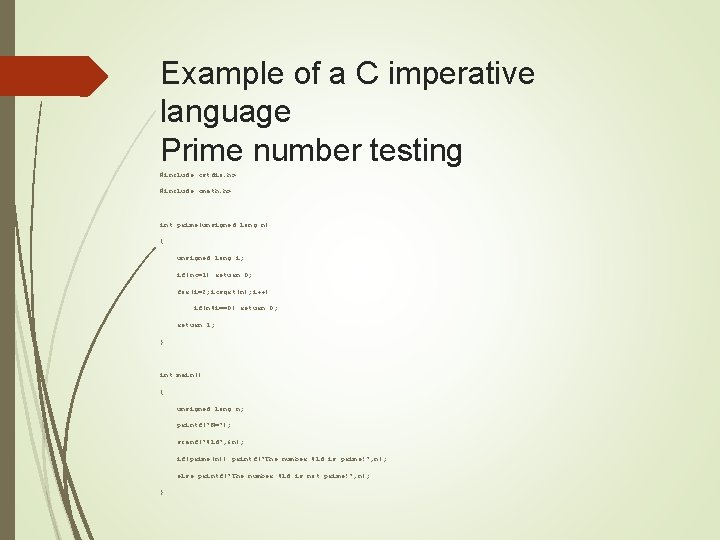
Example of a C imperative language Prime number testing #include <stdio. h> #include <math. h> int prime(unsigned long n) { unsigned long i; if(n<=1) return 0; for(i=2; i<sqrt(n); i++) if(n%i==0) return 0; return 1; } int main() { unsigned long n; printf("N="); scanf("%ld", &n); if(prime(n)) printf("The number %ld is prime!", n); else printf("The number %ld is not prime!", n); }
Functional PLs Are based on mathematical concepts of function apply Applicative languages Free from the von Neumann concept LISP, SML, Miranda
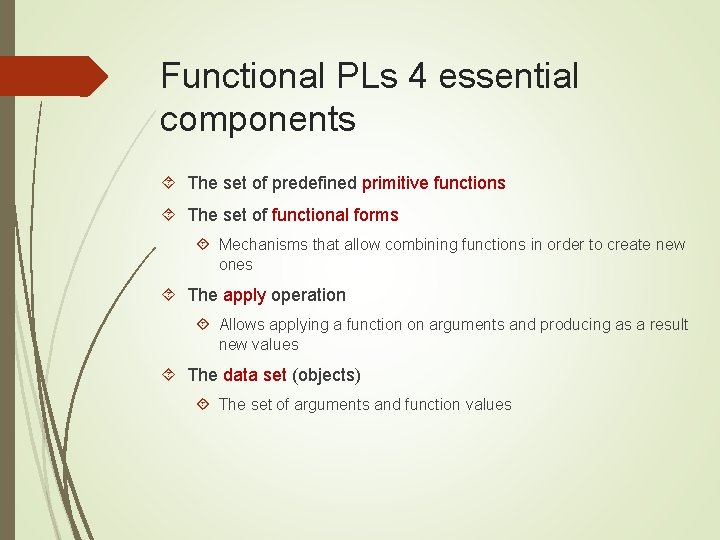
Functional PLs 4 essential components The set of predefined primitive functions The set of functional forms Mechanisms that allow combining functions in order to create new ones The apply operation Allows applying a function on arguments and producing as a result new values The data set (objects) The set of arguments and function values
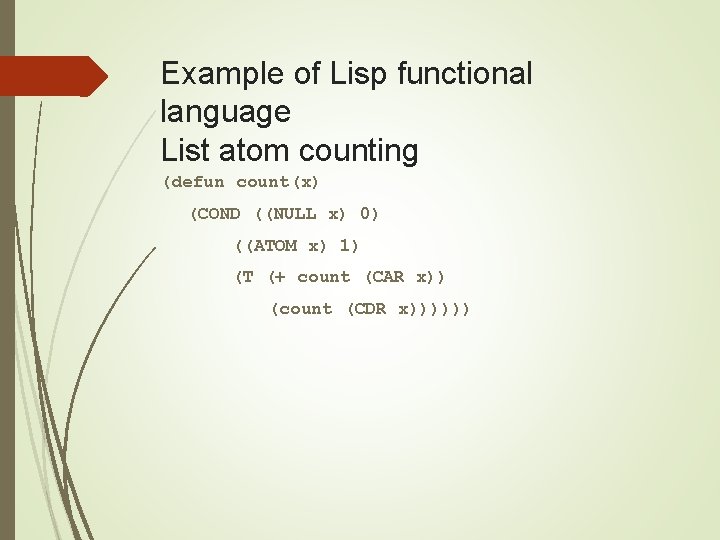
Example of Lisp functional language List atom counting (defun count(x) (COND ((NULL x) 0) ((ATOM x) 1) (T (+ count (CAR x)) (count (CDR x))))))
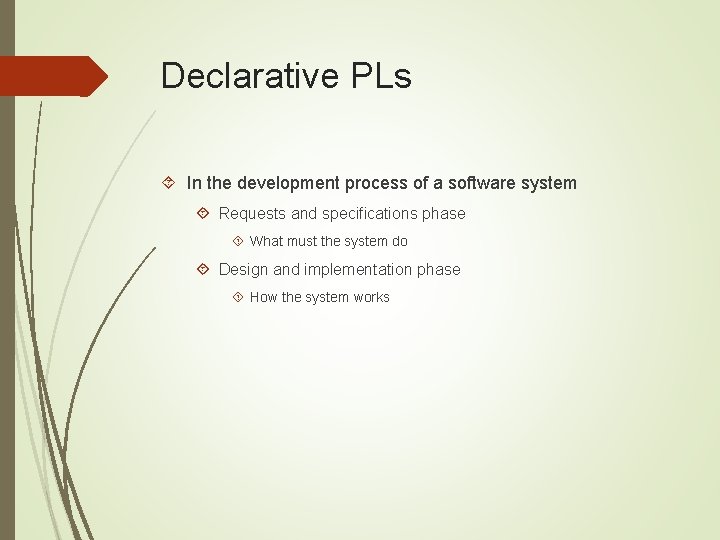
Declarative PLs In the development process of a software system Requests and specifications phase What must the system do Design and implementation phase How the system works
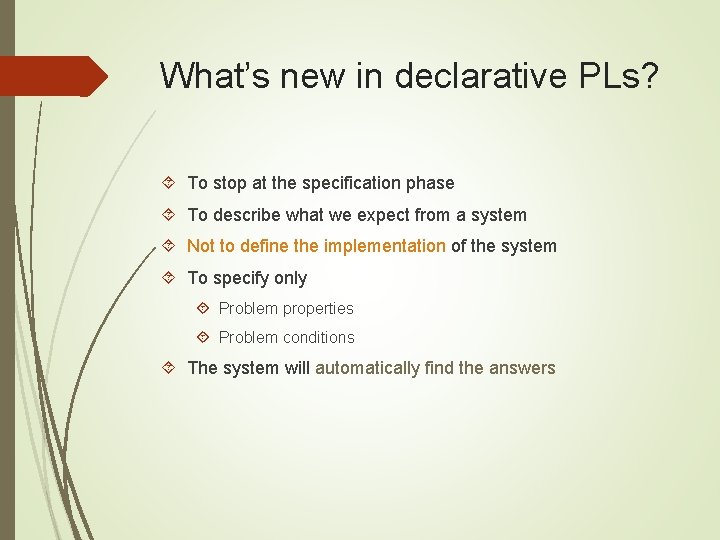
What’s new in declarative PLs? To stop at the specification phase To describe what we expect from a system Not to define the implementation of the system To specify only Problem properties Problem conditions The system will automatically find the answers
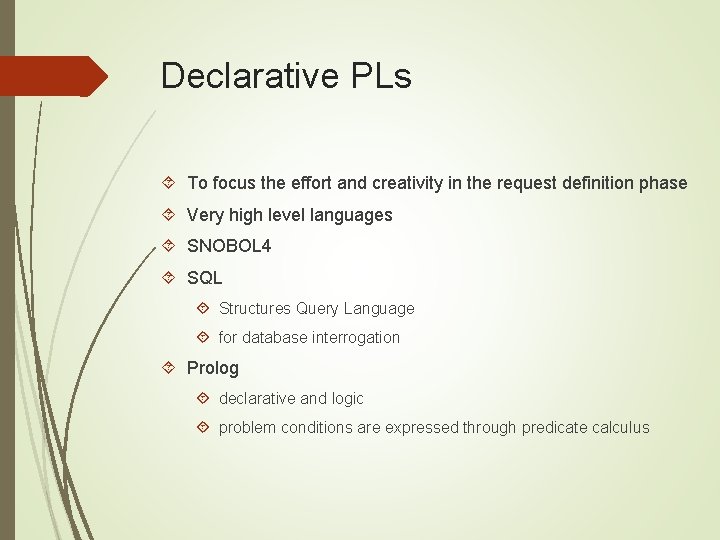
Declarative PLs To focus the effort and creativity in the request definition phase Very high level languages SNOBOL 4 SQL Structures Query Language for database interrogation Prolog declarative and logic problem conditions are expressed through predicate calculus
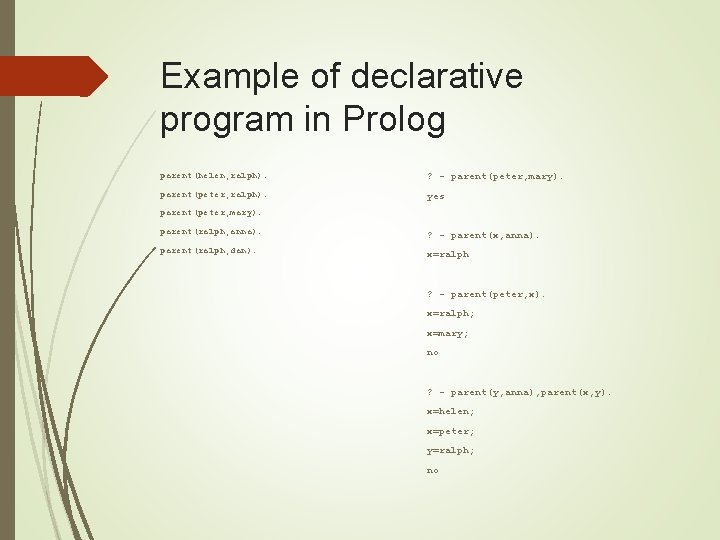
Example of declarative program in Prolog parent(helen, ralph). ? - parent(peter, mary). parent(peter, ralph). yes parent(peter, mary). parent(ralph, anna). ? - parent(x, anna). parent(ralph, dan). x=ralph ? - parent(peter, x). x=ralph; x=mary; no ? - parent(y, anna), parent(x, y). x=helen; x=peter; y=ralph; no
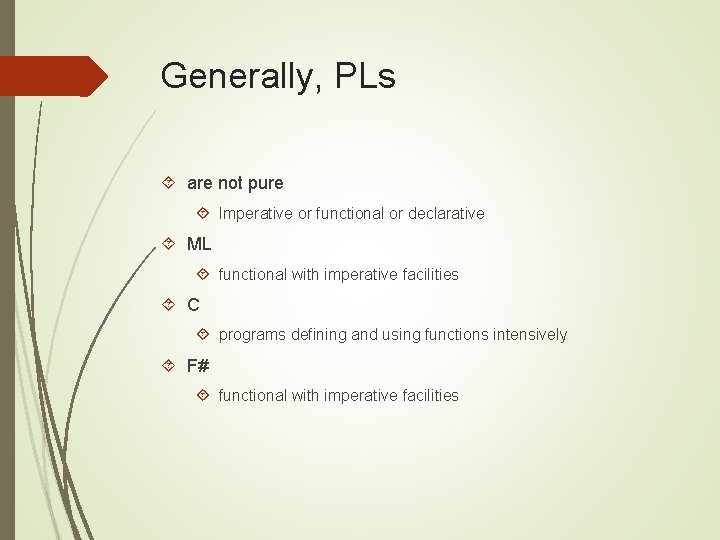
Generally, PLs are not pure Imperative or functional or declarative ML functional with imperative facilities C programs defining and using functions intensively F# functional with imperative facilities
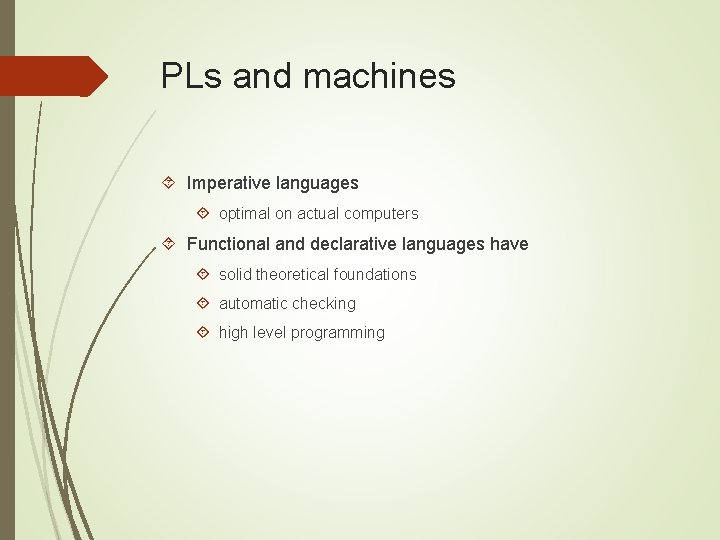
PLs and machines Imperative languages optimal on actual computers Functional and declarative languages have solid theoretical foundations automatic checking high level programming
Functional and declarative PL domains Artificial intelligence List processing Databases Symbolic calculus Natural language processing Knowledge bases Program checking Theorem provers
Sequential programming vs. concurrent programming Imperative program actions data Next action initiated when the current action has finished The program becomes a process The programming activity is sequential programming
Parallel vs. concurrent processes a process uses computer resources one at a time if only 1 process in a system using all resources weak usage performance multiple processors are useless multiple processes in memory to use the CPU in time division is useful logic parallelism virtually the processes are executed in parallel
Multiprogramming operating systems Multiple programs in the memory Parallel execution The physical parallelism depends on The number of CPUs The type of CPUs Windows, Unix, OS/2 Allow multi programmed process management Great improvement in resource usage rate
Programs on multiprogramming OS Parallel processes Executed independently As if they ran on a mono programmed system Resource conflicts are handled by the OS Transparent to the application programmer
Processes with communication Isolated processes are not always a solution The solution may be multiple processes asynchronous with Message exchange with Data transfer sharing in common the system resources Concurrent processes Sometimes they need synchronization
Synchronization cases Mutual exclusion Cooperation
Mutual exclusion Multiple processes use the same resource The access is permitted to one process at a time The access requests must be sequenced Synchronization based on a condition Delaying a process until a condition becomes true Critical resource A resource that may be used in a single process at one time Critical section The code section manipulating the critical resource
Mutual exclusion Definition: Mutual exclusion is a synchronization form for concurrent processes allowing that only one process to be in the critical section at one time a language construction to solve this issue is the critical region Added by CAR Hoare and P. Brinch Hansen in 1972 To emphasis program text and variables which denote the critical resource To add new keywords like region, when for the access of such resources Adding a synchronization condition -> conditional critical region
Cooperation Messages or data are exchanged between processes Keep a producer/consumer relationship The information produced by a process are used/consumed by the other Describing concurrent processes and their relationship -> concurrent programming Resources Shared between authorized processed Protected from unauthorized processes When the time factor involved -> real-time processes Concurrent processes programming languages
Distributed systems Concurrent systems The most widespread because of the Internet and networking Communication based on message transmission
Concurrent programming languages Are developed in the last 30 years Have special facilities to describe parallel and concurrent processes synchronization and communication Edison defined by P. Brinch Hansen 1980 To describe concurrent programs of small and medium sizes for micro and mini computing systems
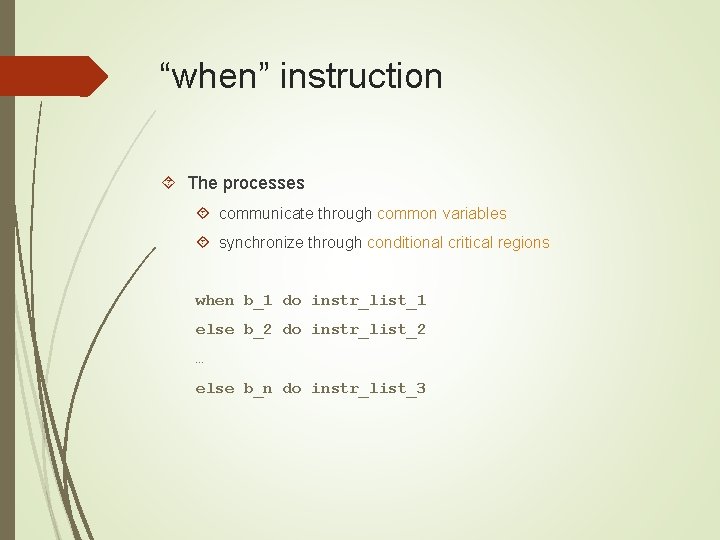
“when” instruction The processes communicate through common variables synchronize through conditional critical regions when b_1 do instr_list_1 else b_2 do instr_list_2 … else b_n do instr_list_3
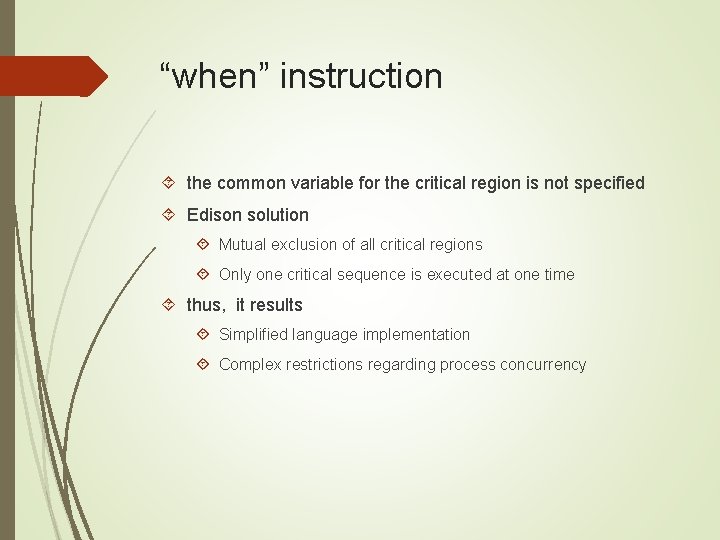
“when” instruction the common variable for the critical region is not specified Edison solution Mutual exclusion of all critical regions Only one critical sequence is executed at one time thus, it results Simplified language implementation Complex restrictions regarding process concurrency
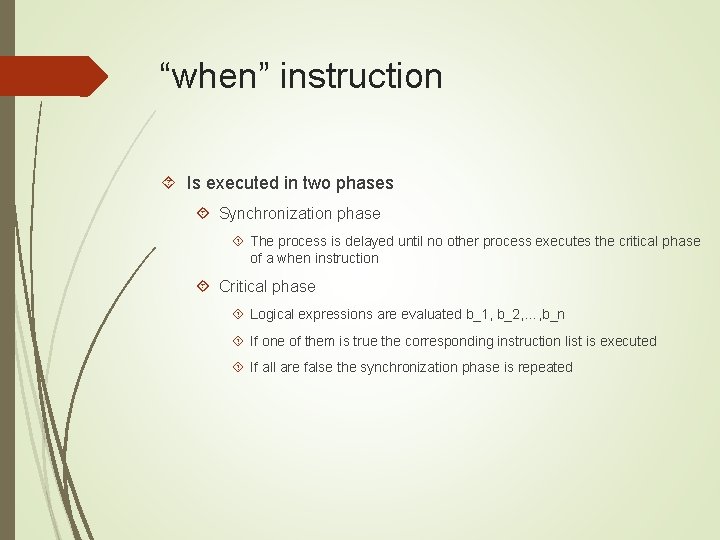
“when” instruction Is executed in two phases Synchronization phase The process is delayed until no other process executes the critical phase of a when instruction Critical phase Logical expressions are evaluated b_1, b_2, …, b_n If one of them is true the corresponding instruction list is executed If all are false the synchronization phase is repeated
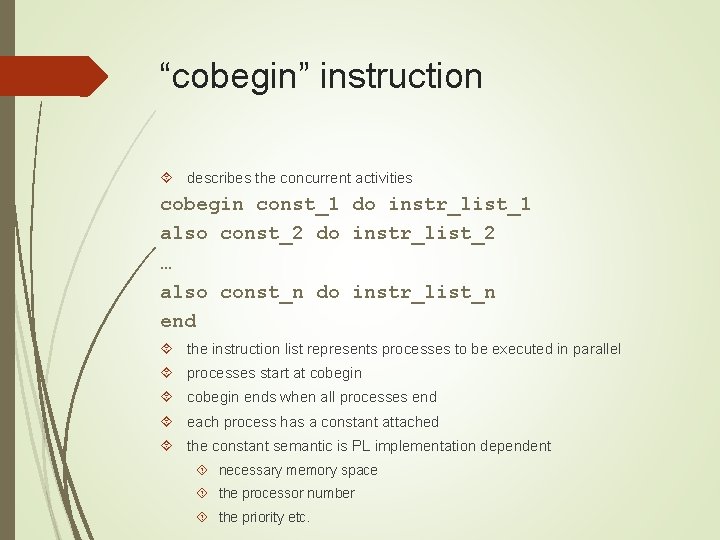
“cobegin” instruction describes the concurrent activities cobegin const_1 do instr_list_1 also const_2 do instr_list_2 … also const_n do instr_list_n end the instruction list represents processes to be executed in parallel processes start at cobegin ends when all processes end each process has a constant attached the constant semantic is PL implementation dependent necessary memory space the processor number the priority etc.
Edison program Has the form of a procedure Is launched by activating the procedure instructions Is formed out of several modules The exported identifiers are preceded by the star * symbol
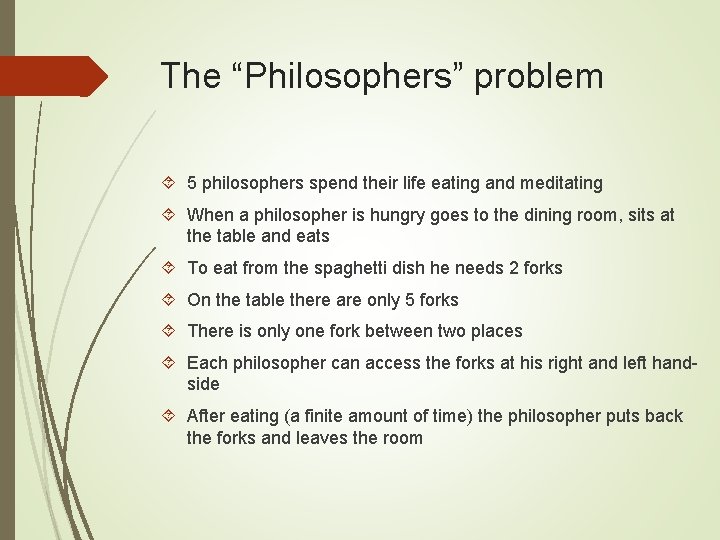
The “Philosophers” problem 5 philosophers spend their life eating and meditating When a philosopher is hungry goes to the dining room, sits at the table and eats To eat from the spaghetti dish he needs 2 forks On the table there are only 5 forks There is only one fork between two places Each philosopher can access the forks at his right and left handside After eating (a finite amount of time) the philosopher puts back the forks and leaves the room
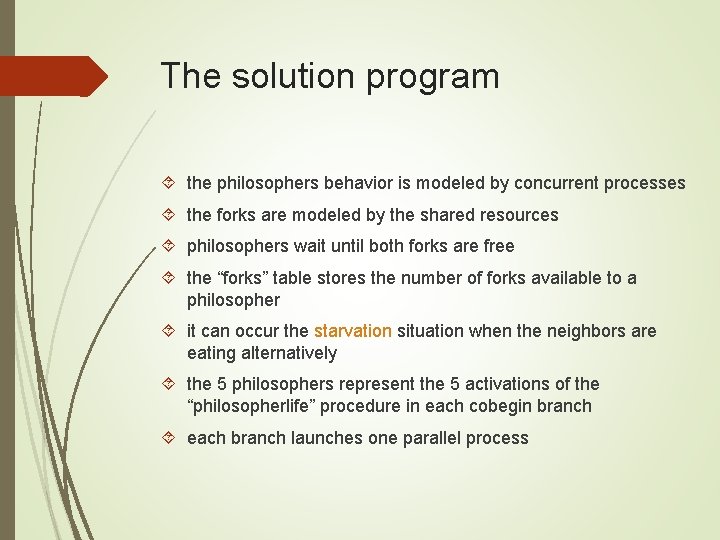
The solution program the philosophers behavior is modeled by concurrent processes the forks are modeled by the shared resources philosophers wait until both forks are free the “forks” table stores the number of forks available to a philosopher it can occur the starvation situation when the neighbors are eating alternatively the 5 philosophers represent the 5 activations of the “philosopherlife” procedure in each cobegin branch each branch launches one parallel process
The Philosophers program proc philosophers module array tforks[0. . 4] (int) var forks: tforks; i: int; proc philoright(i: int): int begin val philoright: =(i+1) mod 5 end proc philoleft(i: int): int begin if i=0 do val philoleft: =4 else true val philoleft: =i-1 end
The Philosophers program *proc get(philo: int) begin when forks[philo] = 2 do forks[philoright(philo)]: = forks[philoright(philo)]-1; forks[philoleft(philo)]: = forks[philoleft(philo)]-1; end
The Philosophers program *proc put(philo: int) begin when true do forks[philoright(philo)]: = forks[philoright(philo)]+1; forks[philoright(philo)]: = forks[philoleft(philo)]+1; end
The Philosophers program begin i: =0 while i<5 forks[i]: =2 i: =i+1; end
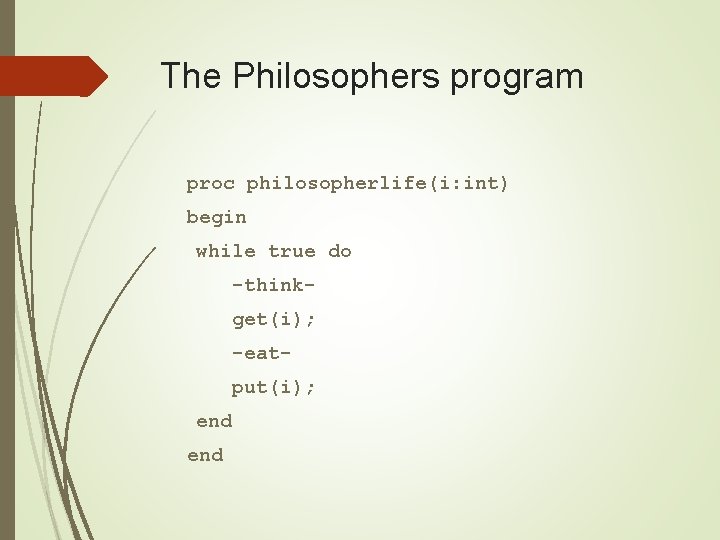
The Philosophers program proc philosopherlife(i: int) begin while true do -thinkget(i); -eatput(i); end
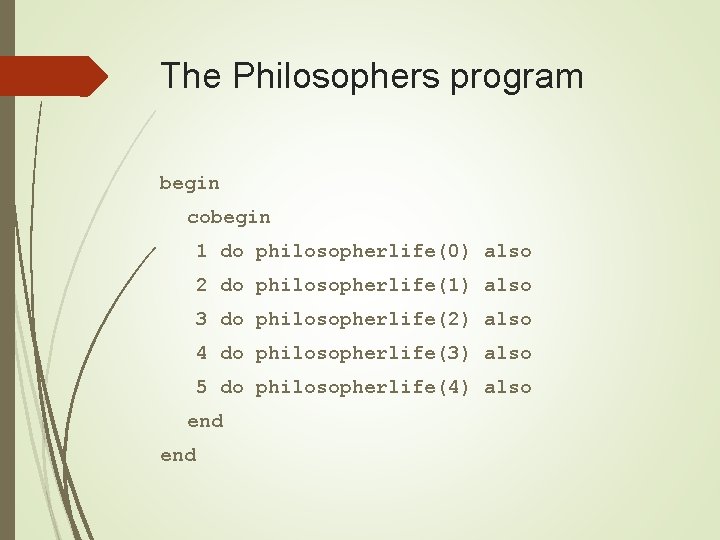
The Philosophers program begin cobegin 1 do philosopherlife(0) also 2 do philosopherlife(1) also 3 do philosopherlife(2) also 4 do philosopherlife(3) also 5 do philosopherlife(4) also end
Distributed systems programming Distributed system a set of computers capable of information exchange computers are called nodes can be programmed to solve problems involving concurrency parallelism
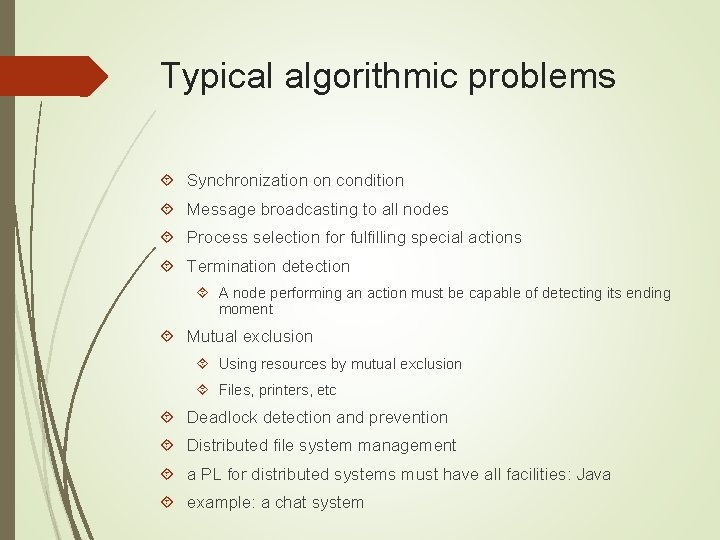
Typical algorithmic problems Synchronization on condition Message broadcasting to all nodes Process selection for fulfilling special actions Termination detection A node performing an action must be capable of detecting its ending moment Mutual exclusion Using resources by mutual exclusion Files, printers, etc Deadlock detection and prevention Distributed file system management a PL for distributed systems must have all facilities: Java example: a chat system
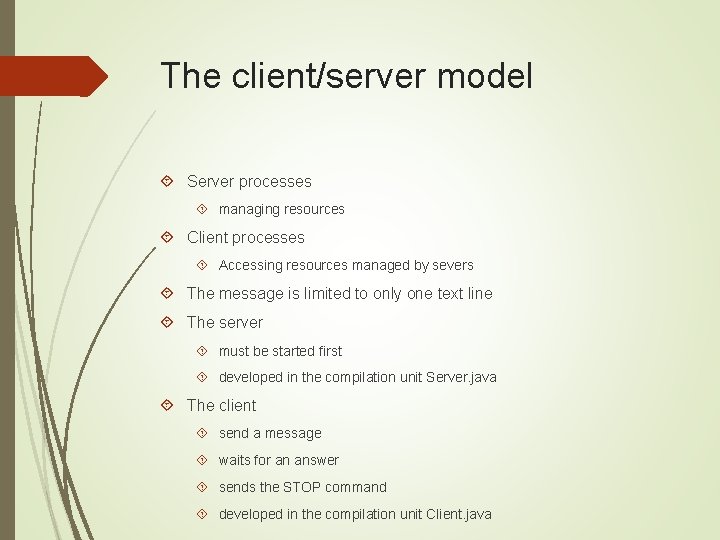
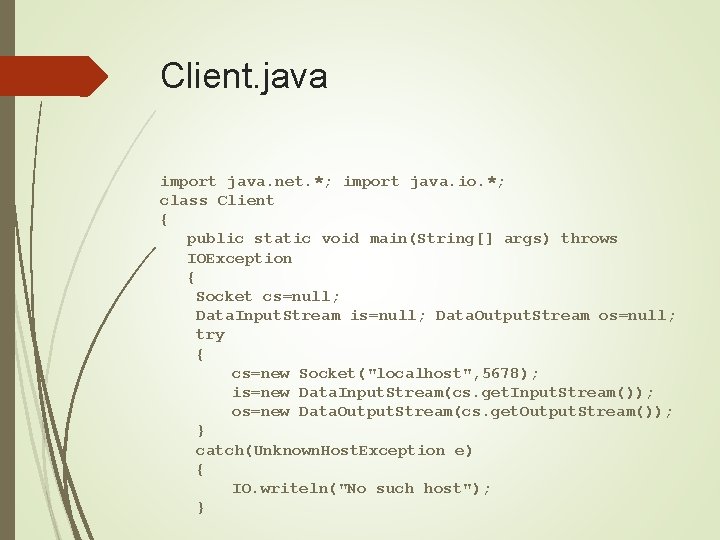
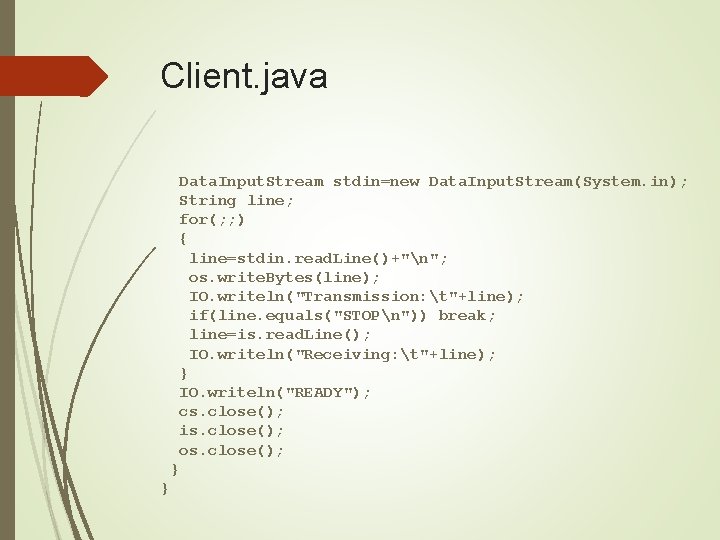
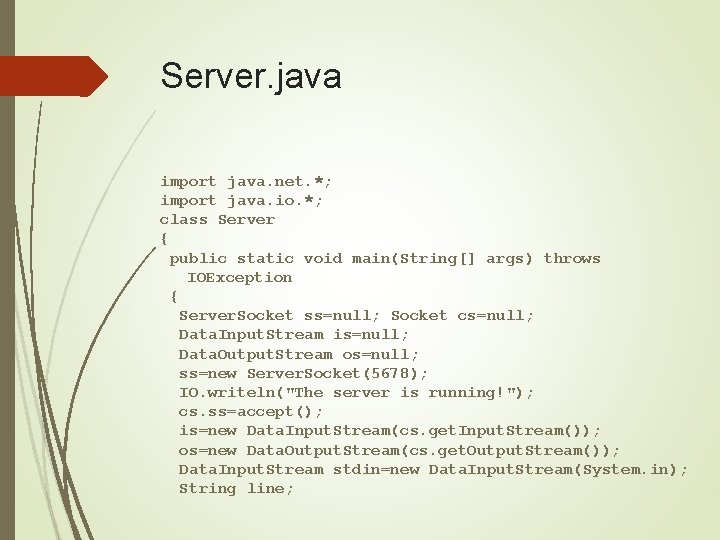
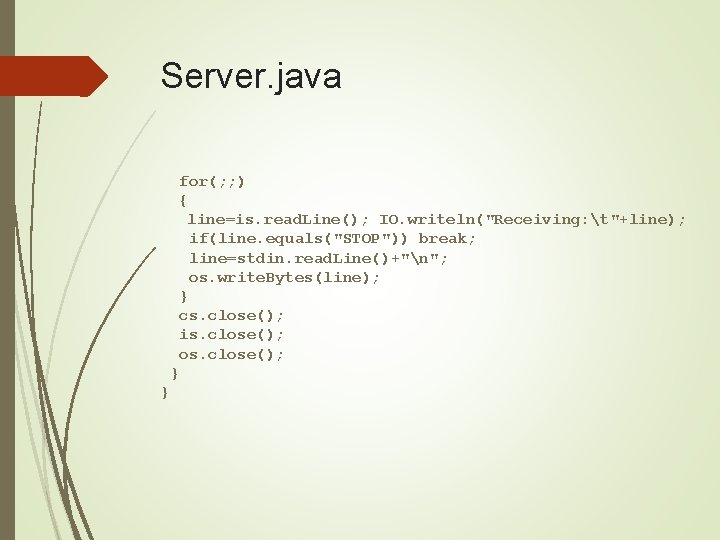
The client/server model Server processes managing resources Client processes Accessing resources managed by severs The message is limited to only one text line The server must be started first developed in the compilation unit Server. java The client send a message waits for an answer sends the STOP command developed in the compilation unit Client. java
Client. java import java. net. *; import java. io. *; class Client { public static void main(String[] args) throws IOException { Socket cs=null; Data. Input. Stream is=null; Data. Output. Stream os=null; try { cs=new Socket("localhost", 5678); is=new Data. Input. Stream(cs. get. Input. Stream()); os=new Data. Output. Stream(cs. get. Output. Stream()); } catch(Unknown. Host. Exception e) { IO. writeln("No such host"); }
Client. java Data. Input. Stream stdin=new Data. Input. Stream(System. in); String line; for(; ; ) { line=stdin. read. Line()+"n"; os. write. Bytes(line); IO. writeln("Transmission: t"+line); if(line. equals("STOPn")) break; line=is. read. Line(); IO. writeln("Receiving: t"+line); } IO. writeln("READY"); cs. close(); is. close(); os. close(); } }
Server. java import java. net. *; import java. io. *; class Server { public static void main(String[] args) throws IOException { Server. Socket ss=null; Socket cs=null; Data. Input. Stream is=null; Data. Output. Stream os=null; ss=new Server. Socket(5678); IO. writeln("The server is running!"); cs. ss=accept(); is=new Data. Input. Stream(cs. get. Input. Stream()); os=new Data. Output. Stream(cs. get. Output. Stream()); Data. Input. Stream stdin=new Data. Input. Stream(System. in); String line;
Server. java for(; ; ) { line=is. read. Line(); IO. writeln("Receiving: t"+line); if(line. equals("STOP")) break; line=stdin. read. Line()+"n"; os. write. Bytes(line); } cs. close(); is. close(); os. close(); } }
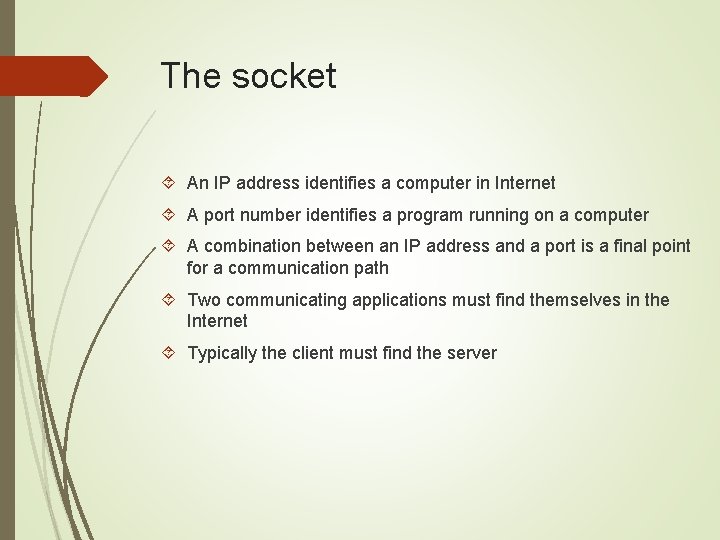
The socket An IP address identifies a computer in Internet A port number identifies a program running on a computer A combination between an IP address and a port is a final point for a communication path Two communicating applications must find themselves in the Internet Typically the client must find the server
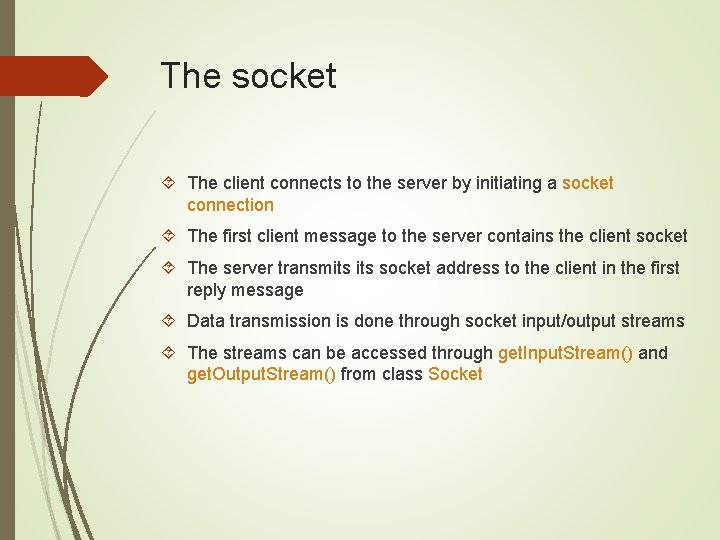
The socket The client connects to the server by initiating a socket connection The first client message to the server contains the client socket The server transmits socket address to the client in the first reply message Data transmission is done through socket input/output streams The streams can be accessed through get. Input. Stream() and get. Output. Stream() from class Socket
Short history of PL development First high level PL were created in 1950 In this period the efficiency was the main goal Fortran Designed by a group from IBM lead by John Bachus 1954 Algol 60 1958 -1960 Block structures Recursive procedures
Short history of PL development Cobol Financed by Department of Defense in 1959 Economical applications Files Data description facilities record struct Used in current days in an evolved version
Short history of PL development Late 50 s and early 60 s Functional PLs Lisp John Mc. Carthy MIT 1955 The main PL in artificial intelligence APL Iverson IBM 1962 Declarative PL Snobol Bell Laboratories 1964
Short history of PL development Mid 60 s Large diversity of programming languages IBM project To gather all concepts in a single PL To replace all other PLs PL/I 1964 Limited success Complex Heavy
Short history of PL development In the 60 s Algol 68 1968 Perfect orthogonality Defined using formal methods Simula 67 1967 Simulation facilities Uses the class concept for Modularization Abstract data description
Short history of PL development Pascal 1971 N. Wirth Expressivity Simplicity ML 1973 University of Edinburgh Functional PL Strongly typed
Short history of PL development C 1974 One of the most widespread PL Dennis Ritchie at Bell Labs Portable implementation for the Unix operating system C programs have good portability
Short history of PL development In the 70 s Abstract data types Program checking Exception handling Concurrent programming
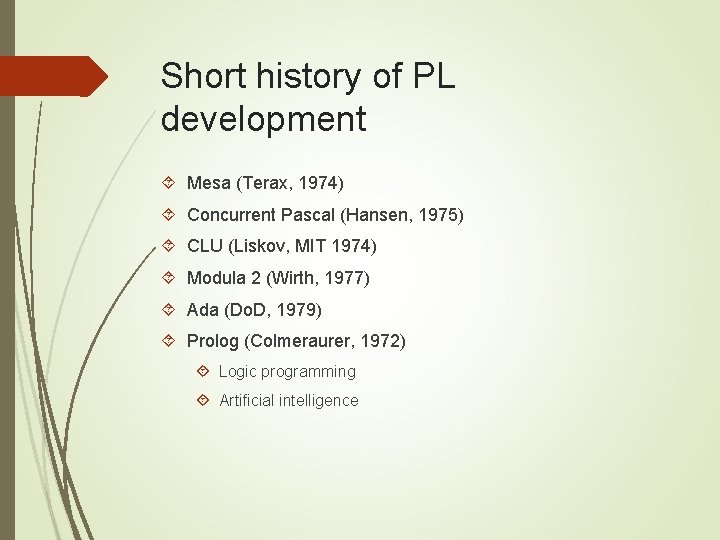
Short history of PL development Mesa (Terax, 1974) Concurrent Pascal (Hansen, 1975) CLU (Liskov, MIT 1974) Modula 2 (Wirth, 1977) Ada (Do. D, 1979) Prolog (Colmeraurer, 1972) Logic programming Artificial intelligence
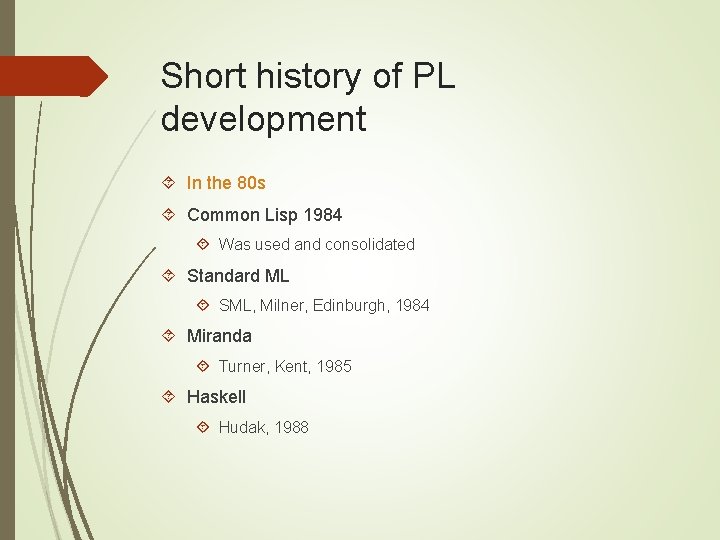
Short history of PL development In the 80 s Common Lisp 1984 Was used and consolidated Standard ML SML, Milner, Edinburgh, 1984 Miranda Turner, Kent, 1985 Haskell Hudak, 1988
Short history of PL development Imperative languages Object-oriented programming languages Small. Talk PL and IDE Xerox late 70 s C++ Bjarne Stroustrup, Bell Labs, 1988 C with object-oriented concepts Widely used in present
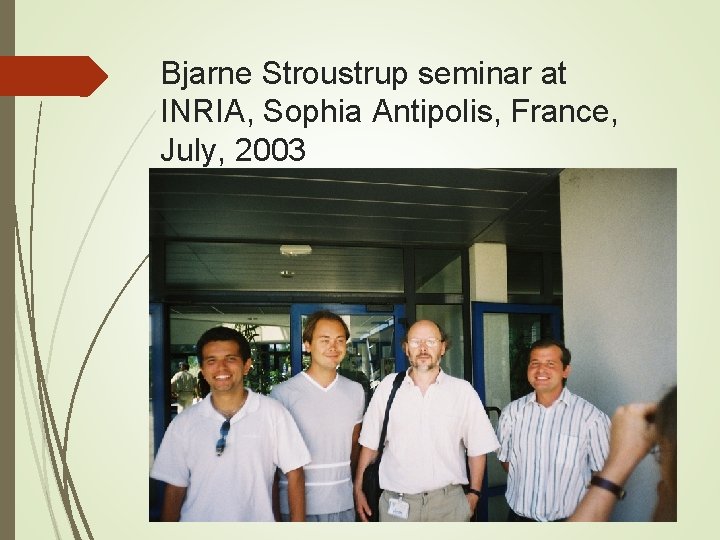
Bjarne Stroustrup seminar at INRIA, Sophia Antipolis, France, July, 2003
Short history of PL development Object Oberon Zurich, 1989 Eiffel Bertrand Meyer, 1988 Java Sun Microsystems Inc. , 1995 OOP interactivity Animation Internet applications Distributed applications
Short history of PL development Java Anti C++ no pointer arithmetic no manually releasing memory no multiple inheritance between classes other object-oriented PL Object Pascal (Delphi, Borland 1995 -2000) CLOS (Common Lisp Object System) OCAML (object oriented ML)
Short history of PL development Microsoft C# Alpha release 2000 Microsoft team lead by Andres Hejlsberg Derived from C, C++ and Java Portability taken from Java Can be mixed with other PL Full integration with MS Windows OS Java vs. C# time will tell…