
Fundamental Analysis Classical vs Keynesian Similarities n Both

Fundamental Analysis Classical vs. Keynesian

Similarities n Both the classical approach and the Keynesian approach are macro models and, hence, examine the interaction between asset, money, and labor markets. n Both models depend on the “fundamentals” (GDP, price levels, etc)

Differences Classical Analysis Keynesian Analysis

Differences Classical Analysis • • • Prices are flexible, markets clear Money is “Neutral” Emphasis on Relative Prices Asset markets play a minor role Emphasis on Technology rather that policy (Supply side) Keynesian Analysis

Differences Classical Analysis • • • Prices are flexible, markets clear Money is “Neutral” Emphasis on Relative Prices Asset markets play a minor role Emphasis on Technology rather that policy (Supply side) Keynesian Analysis • • Prices are fixed in the short run Money can influence output in the short run (Phillips curve) Asset markets play a pivotal role Emphasis on policy rather than technology (demand side)

Example: The Productivity Slowdown n During the Mid 1970’s, productivity growth dropped from its long run average of 1. 5% to -. 27%.

Classical Analysis n How would this drop in productivity influence capital markets?

Classical Analysis n How would this drop in productivity influence capital markets? n Investment demand would most likely drop as firm’s face lower profit expectations.

Classical Analysis n How would this drop in productivity influence capital markets? n Investment demand would most likely drop as firm’s face lower profit expectations. n Lower productivity , means shrinking personal income. What happens to personal savings?

Classical Analysis n How would this drop in productivity influence capital markets? n Investment demand would most likely drop as firm’s face lower profit expectations. n Lower productivity , means shrinking personal income. What happens to personal savings? n Temporary drop in income tends to lower savings n Permanent declines in income tend to lower consumption

Classical Analysis n Recall that at a (fixed) global interest rate, the current account balance is the difference between domestic savings and domestic borrowing (public and private)

Classical Analysis n Suppose that, initially trade was balances at the global interest rate of 10%.

Classical Analysis Suppose that, initially trade was balances at the global interest rate of 10%. n A drop in investment demand in a closed economy would lower the domestic interest rate n In an open economy, the economy runs a trade surplus n

Classical Analysis n How would this drop in productivity influence money markets?

Classical Analysis n How would this drop in productivity influence money markets? n Recall, the demand for money is equal to M = k. PY n A drop in income (Y) without a corresponding drop in money supply creates rising prices

Classical Analysis n What happens to real/nominal exchange rates?
Classical Analysis n What happens to real/nominal exchange rates? Recall, P=e. P* (PPP) n Assuming no change in the foreign price level, a rise in the domestic price level causes an equal rise (depreciation) in the nominal exchange rate n PPP implies a constant real exchange rate n

Summary n Current account improves n No change in domestic (real) interest rates n A rise in the domestic price level n A depreciation in the nominal exchange rate n A constant real exchange rate
Keynesian Analysis n As before, begin in capital markets. Investment drops while savings remains constant n With excess demand for credit, interest rates fall and income falls (lower income lowers savings) – IS shifts left n

Keynesian Analysis n The shift in IS reflects two opposing forces in the balance of payments:
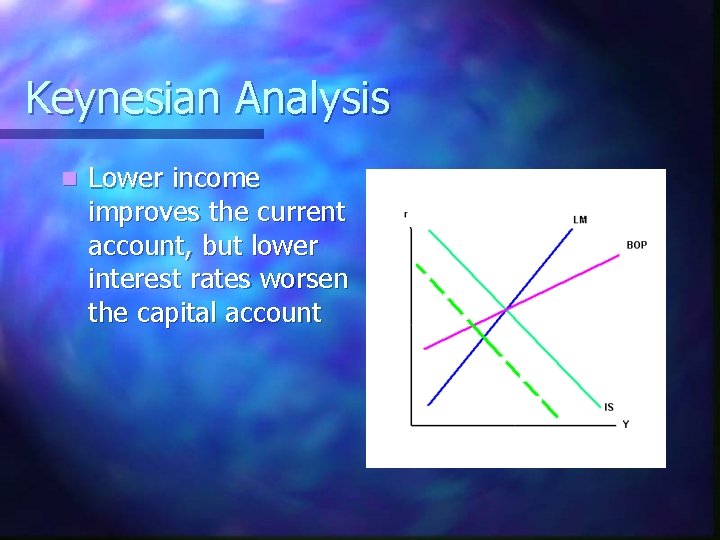
Keynesian Analysis n Lower income improves the current account, but lower interest rates worsen the capital account

Keynesian Analysis With a high rate of capital mobility, the interest rate effect dominates and a BOP deficit results n A BOP deficit forces a currency depreciation n

Keynesian Analysis n We know that the long run impact is a currency depreciation n However, lower domestic interest rates imply a future currency appreciation (Interest Parity)
Keynesian Analysis n We know that the long run impact is a currency depreciation n However, lower domestic interest rates imply a future currency appreciation (Interest Parity) n Therefore, the initial currency depreciation must be larger than the long run result (overshooting)

Summary n Current account improves (by more in the short run due to the sharp depreciation) n Domestic real interest rates fall n No change in domestic prices n A sharp depreciation (both real and nominal) followed by an appreciation

Savings: 1970 -1980

Consumption: 1970 -1980

Investment: 1970 -1980

Interest Rates: 1970 -1980

Current Account: 1970 -1980
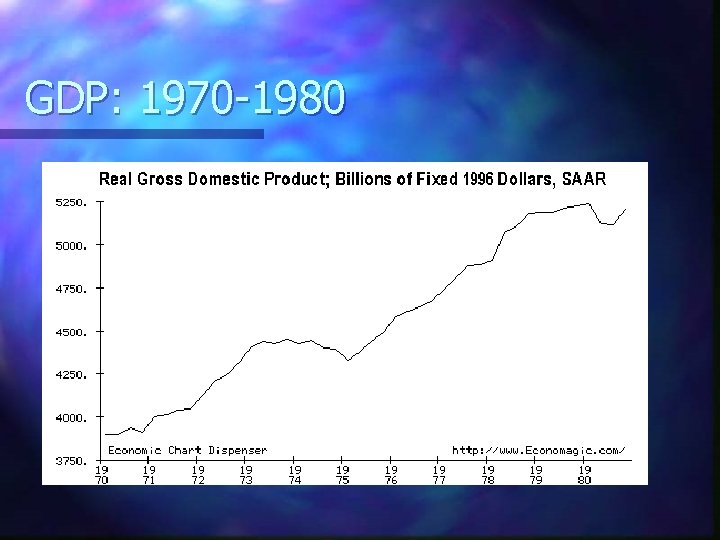
GDP: 1970 -1980

Prices: 1970 -1980
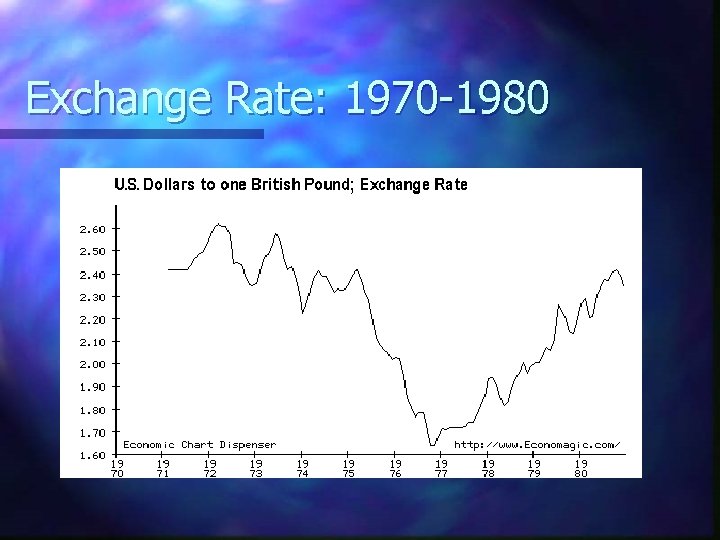
Exchange Rate: 1970 -1980

Example: Government Deficits n Currently, the US deficit is around $500 B dollars (projected to be $550 B in 2004)
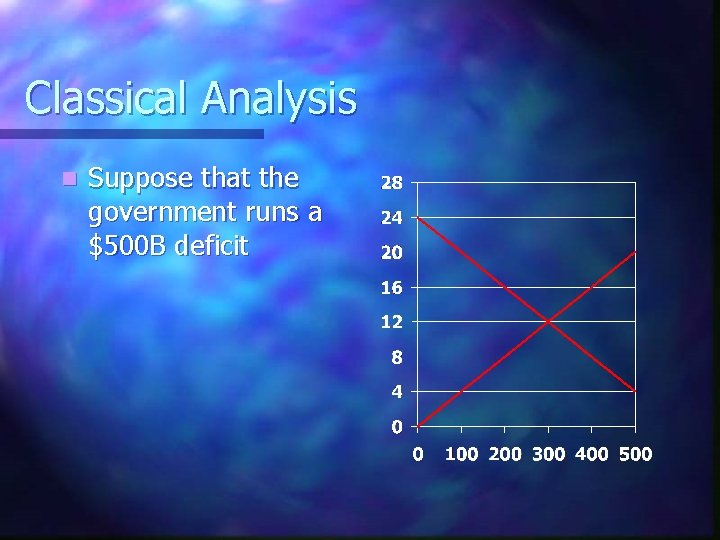
Classical Analysis n Suppose that the government runs a $500 B deficit
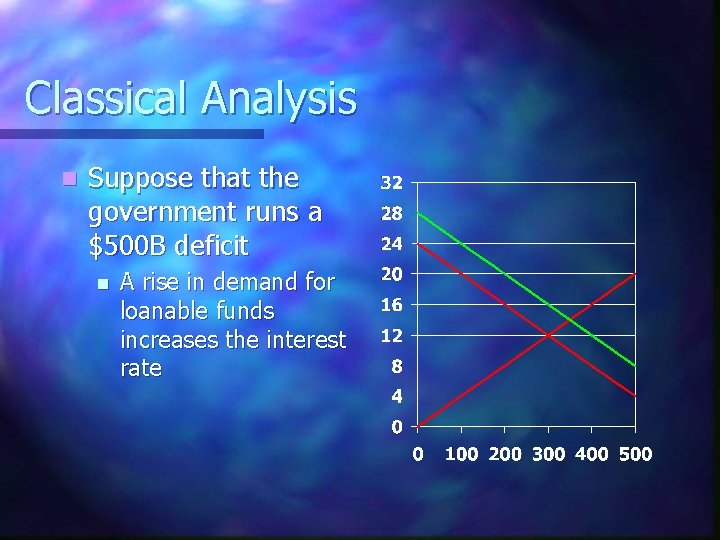
Classical Analysis n Suppose that the government runs a $500 B deficit n A rise in demand for loanable funds increases the interest rate
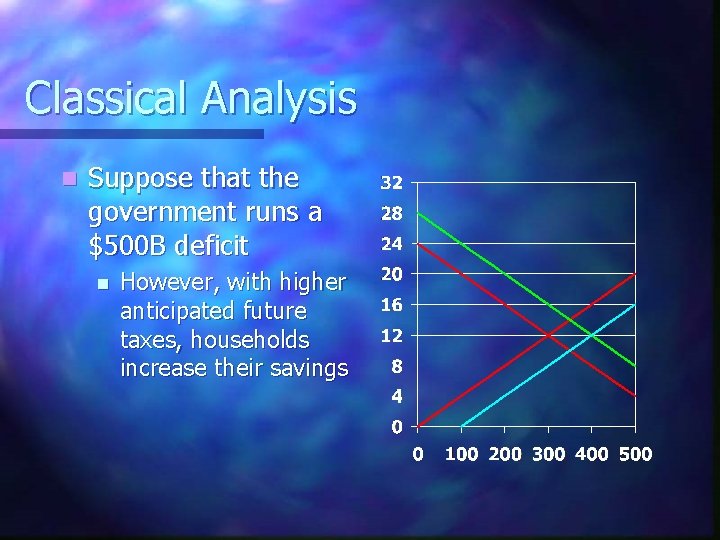
Classical Analysis n Suppose that the government runs a $500 B deficit n However, with higher anticipated future taxes, households increase their savings
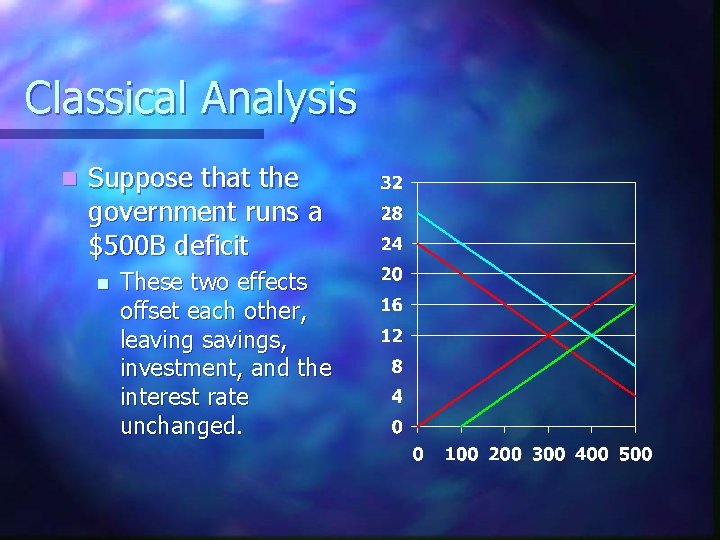
Classical Analysis n Suppose that the government runs a $500 B deficit n These two effects offset each other, leaving savings, investment, and the interest rate unchanged.
Summary n The current account is unaffected as are domestic interest rates n Assuming that the deficit has no effect on GDP, money markets are unaffected leaving prices and exchange rates (real and nominal) unchanged.

Keynesian Analysis Suppose that the government deficit increases. n The long run impact should be zero. n

Keynesian Analysis However, in the short run, the IS curve shifts right – output increases and interest rates rise. n In this example, the worsening of the trade deficit is more than offset by higher interest rates attracting foreign capital. A balance of payments surplus is created. n

Summary n In the short run, a BOP surplus is created causing a currency appreciation n However, interest parity suggests that higher domestic interest rates imply a currency depreciation
- Slides: 42