
FUNcube1 Using satellites in schools and colleges INTRODUCTION
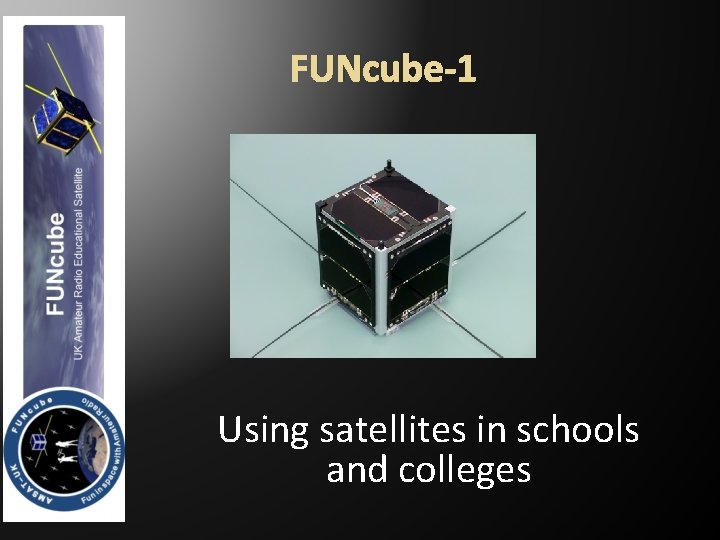
FUNcube-1 Using satellites in schools and colleges
INTRODUCTION TO FUNCUBE-1
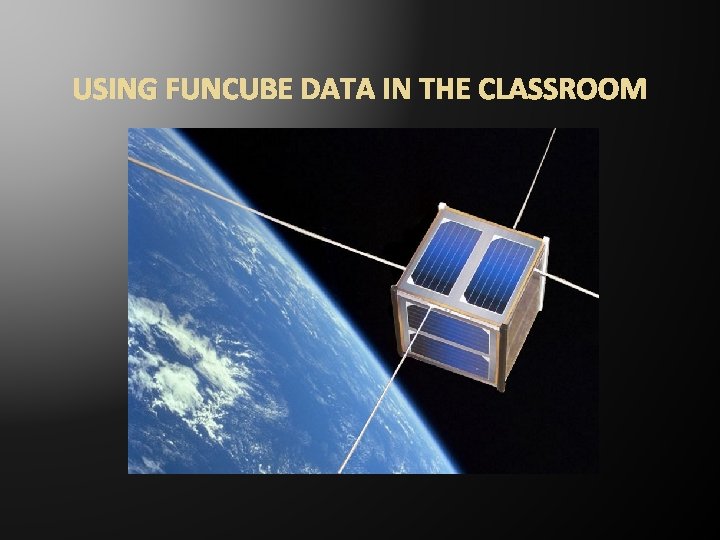
What is FUNcube-1 � � FUNcube-1 is a 1 U Cube. Sat that was designed, built and financed ENTIRELY by volunteers and supporters of AMSAT-UK and AMSAT-NL “ 1 U” means that it is one unit in size/weight – that is, its dimensions are 10 x 10 cm in size and a launch mass of just 988 grams AMSAT-UK and AMSAT-NL are two of many AMSAT organisations worldwide comprising radio amateurs who have a special passion for space based communications. After four years of work was finally launched 21 st Nov 2013 from Russia
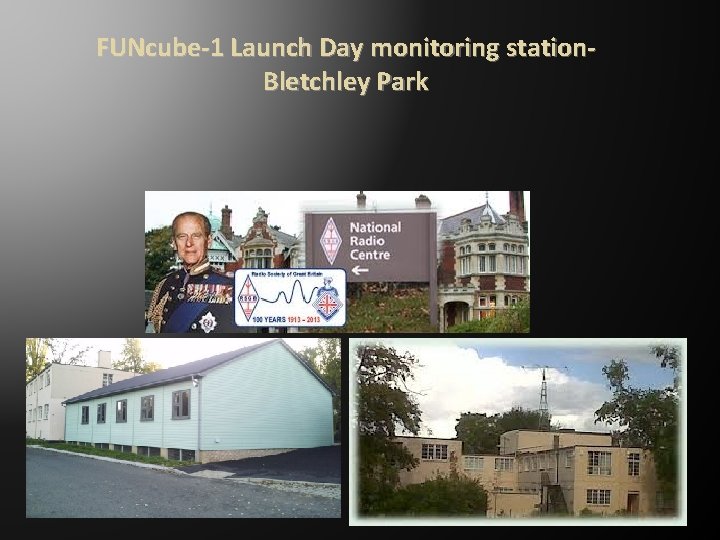
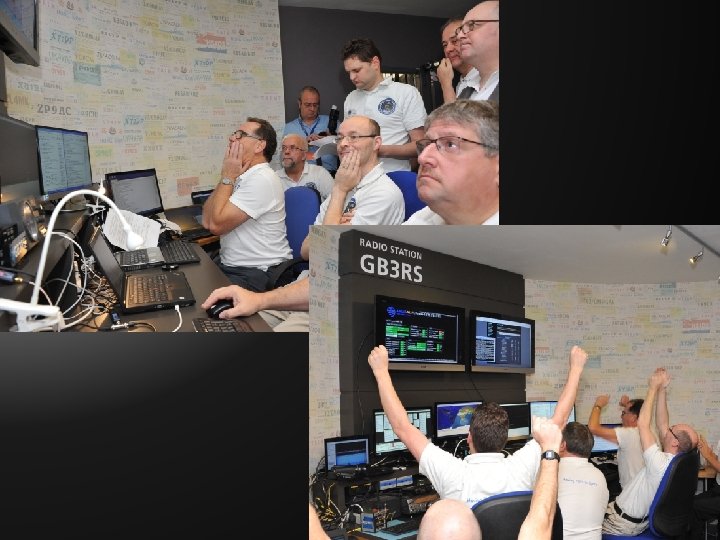
FUNcube-1 Launch Day monitoring station. Bletchley Park
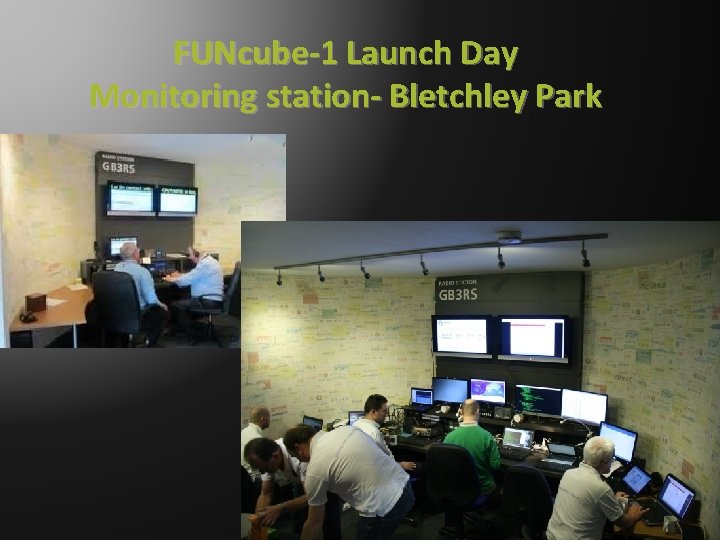
FUNcube-1 Launch Day Monitoring station- Bletchley Park
The FUNcube Project 22/06/10 7
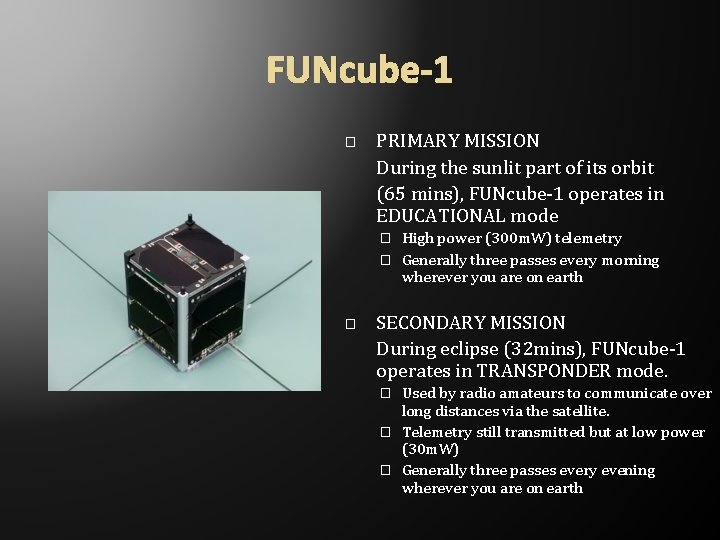
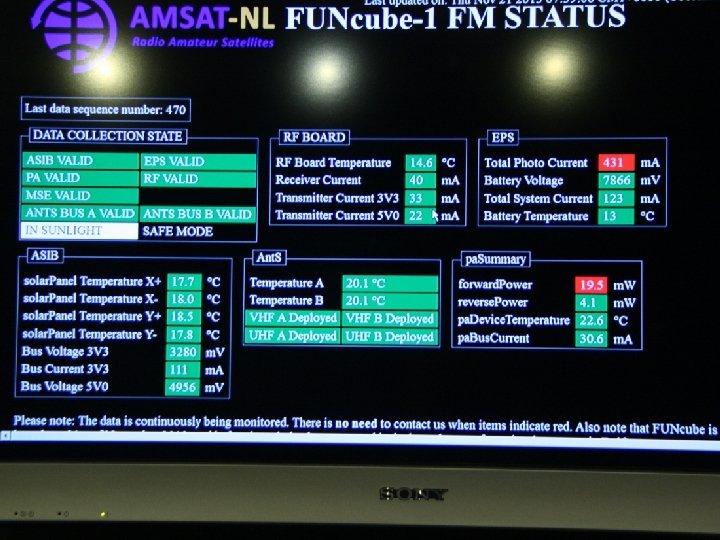
FUNcube-1 � PRIMARY MISSION During the sunlit part of its orbit (65 mins), FUNcube-1 operates in EDUCATIONAL mode High power (300 m. W) telemetry � Generally three passes every morning wherever you are on earth � � SECONDARY MISSION During eclipse (32 mins), FUNcube-1 operates in TRANSPONDER mode. Used by radio amateurs to communicate over long distances via the satellite. � Telemetry still transmitted but at low power (30 m. W) � Generally three passes every evening wherever you are on earth �
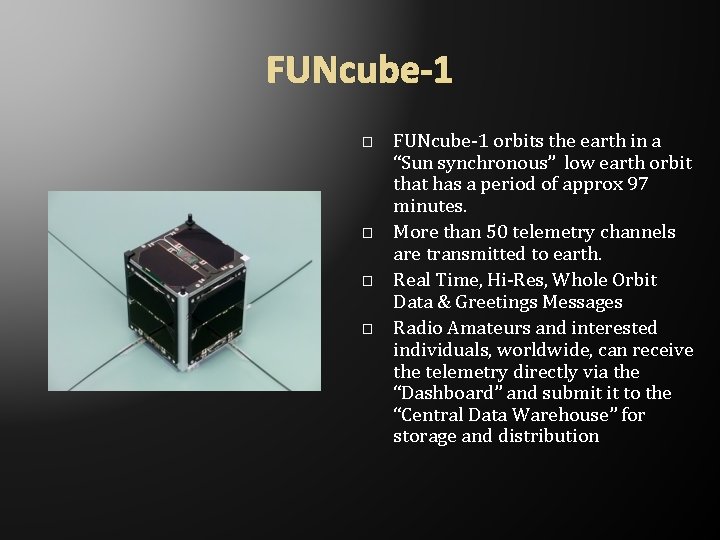
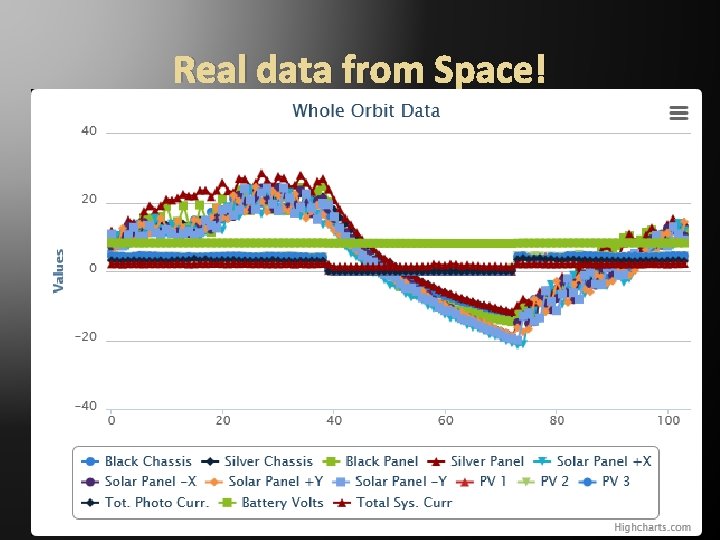
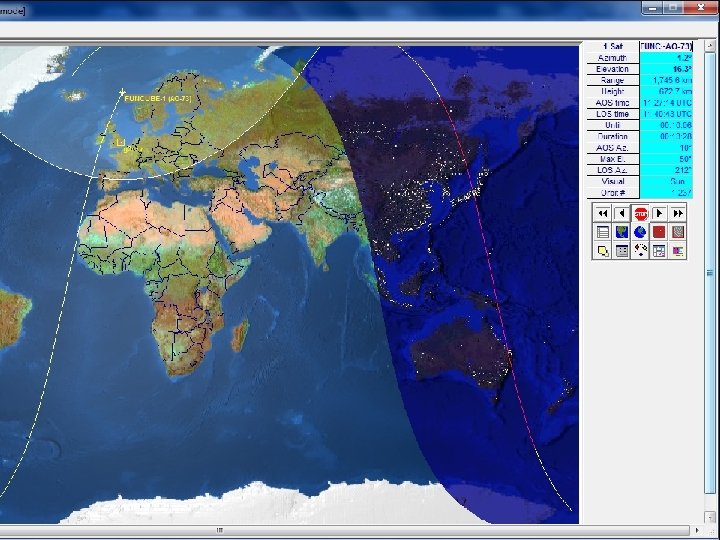
FUNcube-1 � � FUNcube-1 orbits the earth in a “Sun synchronous” low earth orbit that has a period of approx 97 minutes. More than 50 telemetry channels are transmitted to earth. Real Time, Hi-Res, Whole Orbit Data & Greetings Messages Radio Amateurs and interested individuals, worldwide, can receive the telemetry directly via the “Dashboard” and submit it to the “Central Data Warehouse” for storage and distribution
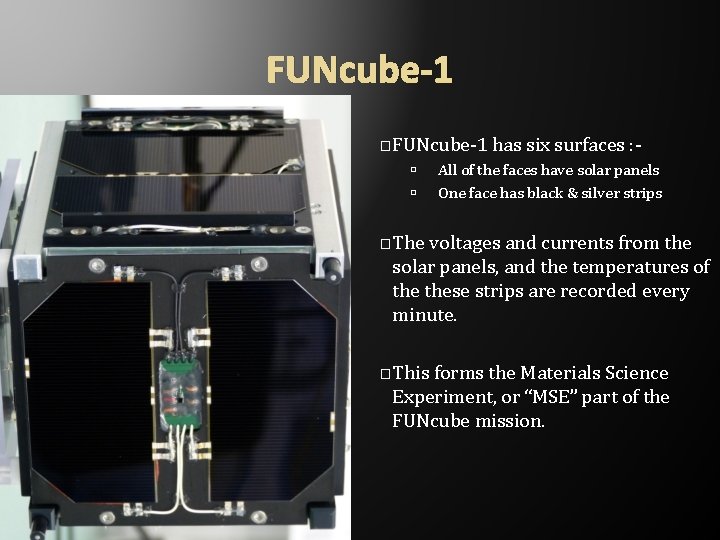
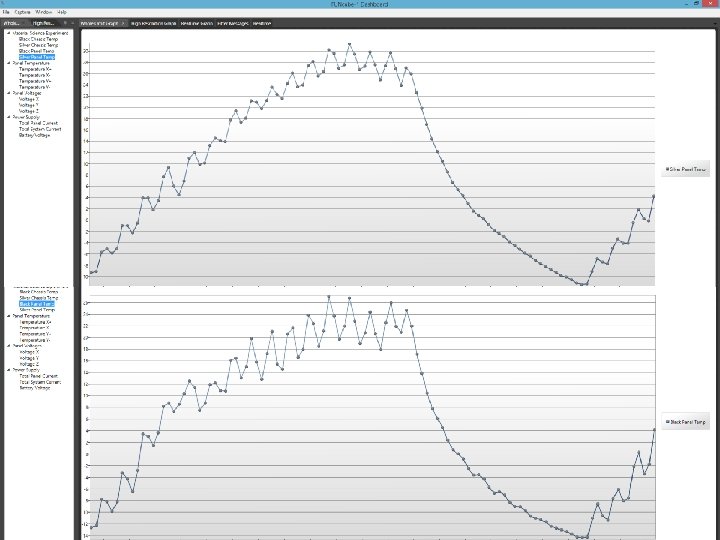
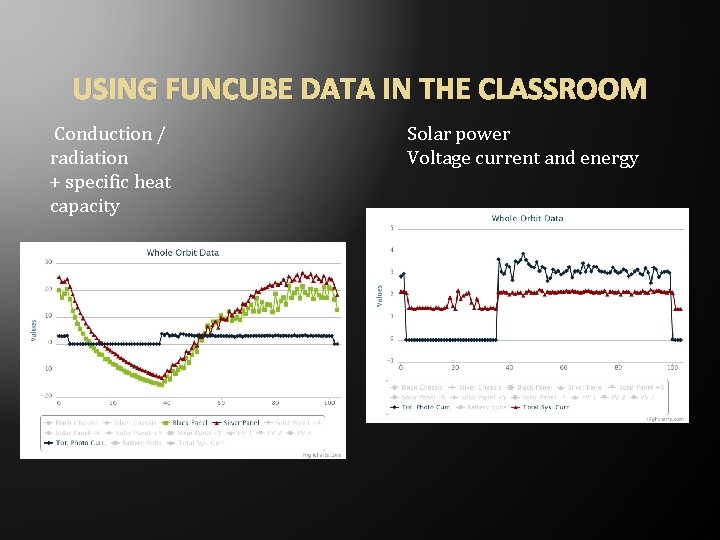
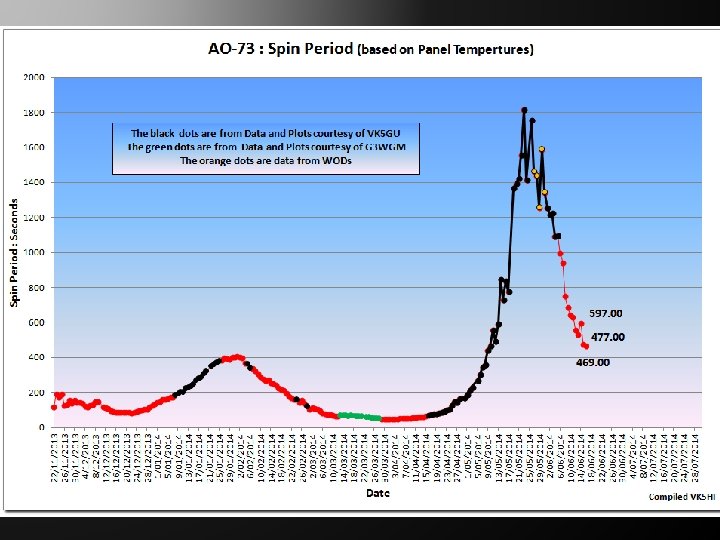
FUNcube-1 �FUNcube-1 has six surfaces : - All of the faces have solar panels One face has black & silver strips �The voltages and currents from the solar panels, and the temperatures of these strips are recorded every minute. �This forms the Materials Science Experiment, or “MSE” part of the FUNcube mission.
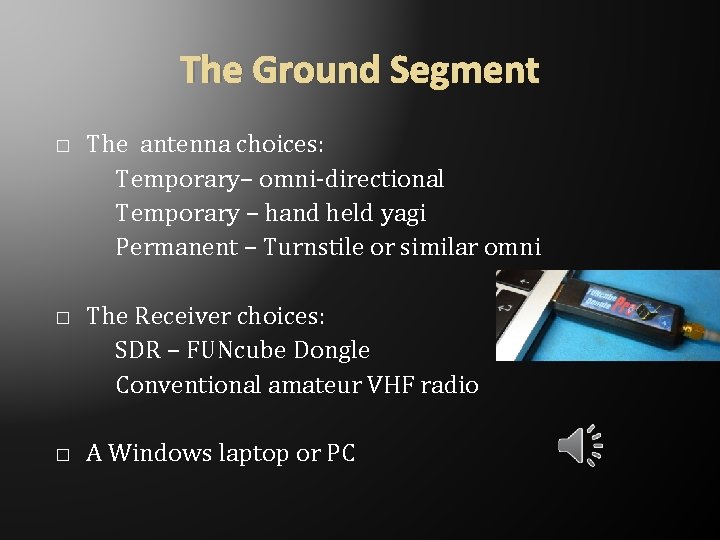
The Ground Segment � � � The antenna choices: Temporary– omni-directional Temporary – hand held yagi Permanent – Turnstile or similar omni The Receiver choices: SDR – FUNcube Dongle Conventional amateur VHF radio A Windows laptop or PC
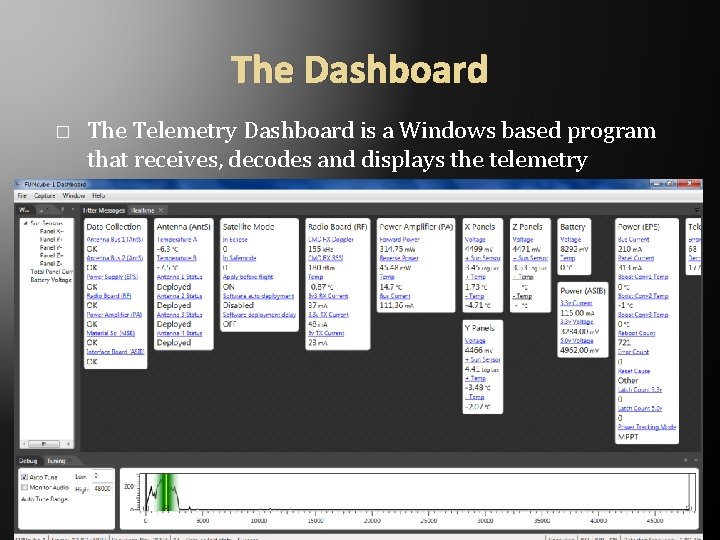
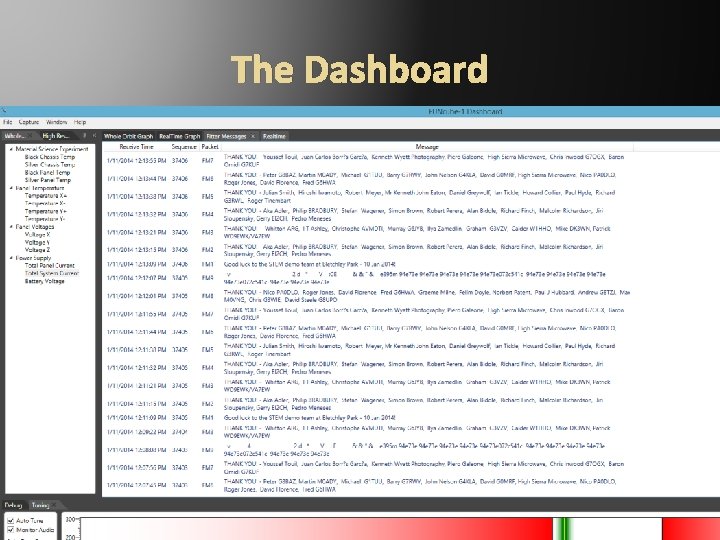
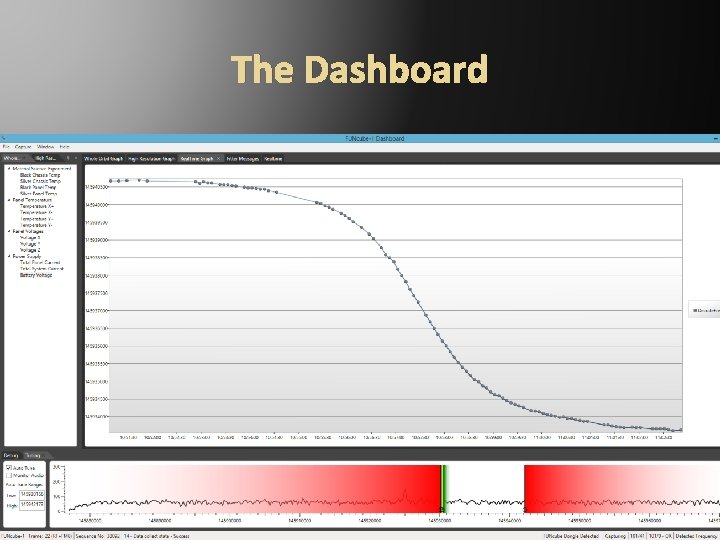
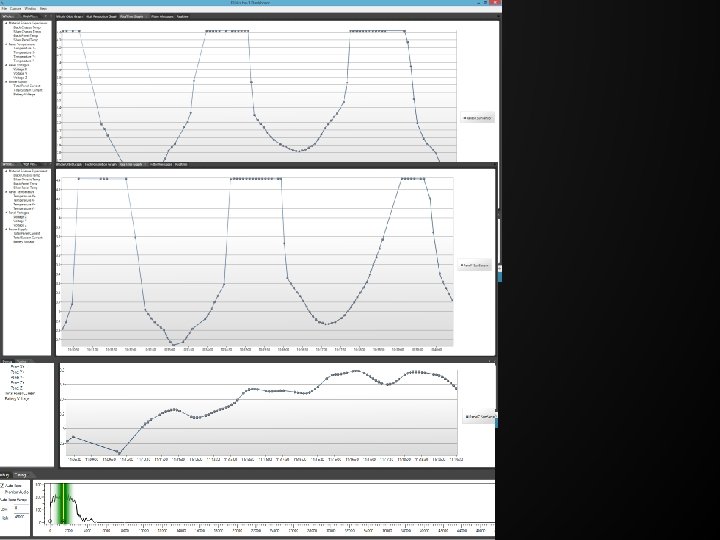
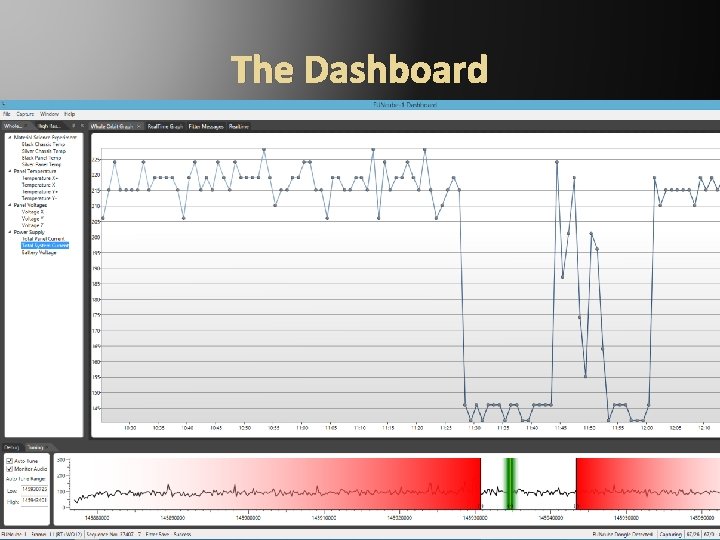
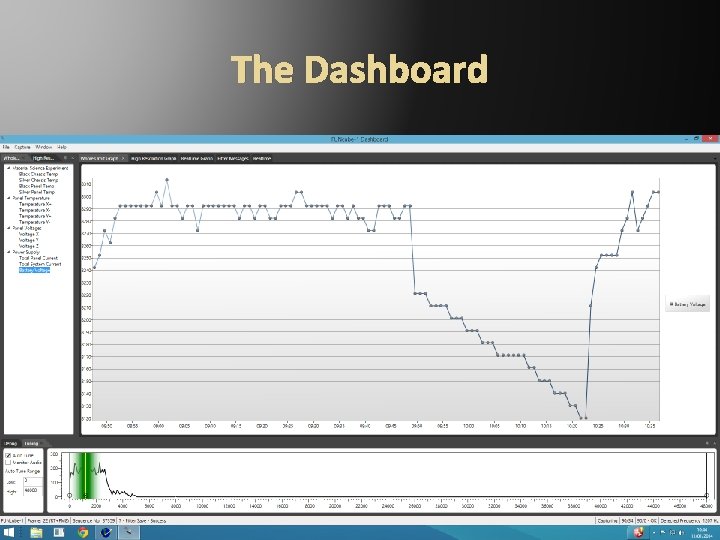
The Dashboard � The Telemetry Dashboard is a Windows based program that receives, decodes and displays the telemetry
The Dashboard
The Dashboard
The Dashboard
The Dashboard
The Dashboard
The Dashboard
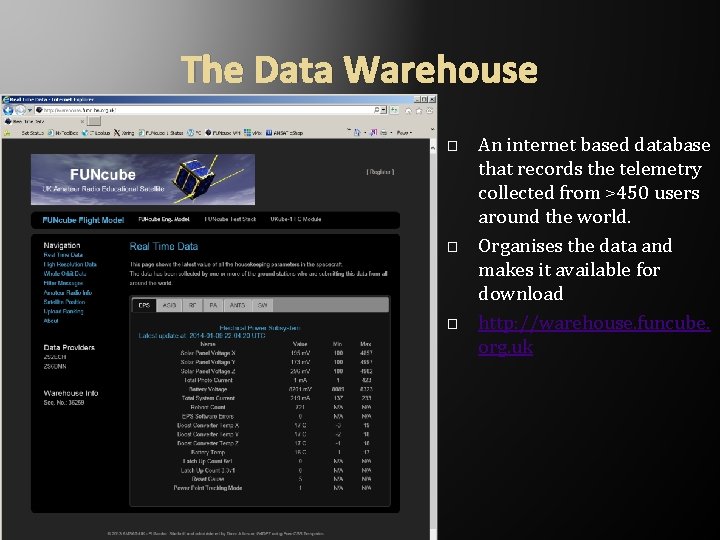
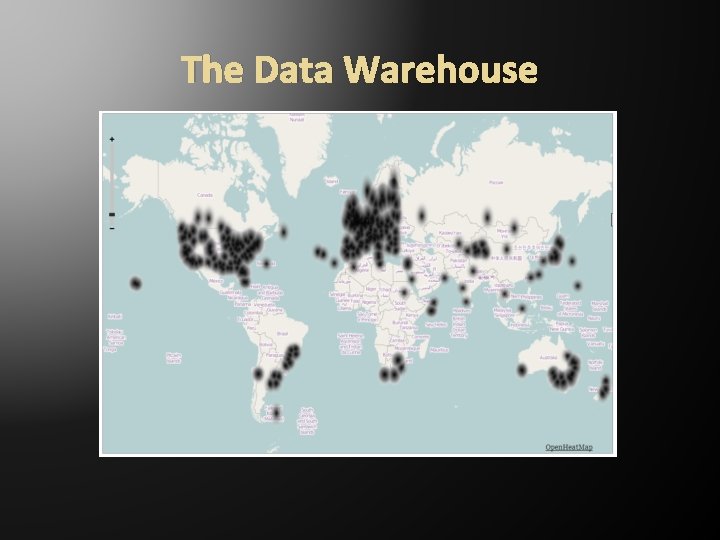
The Data Warehouse � � � An internet based database that records the telemetry collected from >450 users around the world. Organises the data and makes it available for download http: //warehouse. funcube. org. uk
The Data Warehouse
USING FUNCUBE DATA IN THE CLASSROOM
USING FUNCUBE DATA IN THE CLASSROOM Conduction / radiation + specific heat capacity Solar power Voltage current and energy
Real data from Space!
USING FUNCUBE DATA IN THE CLASSROOM Velocity: Eclipse time Time in sun Orbital period External temperature
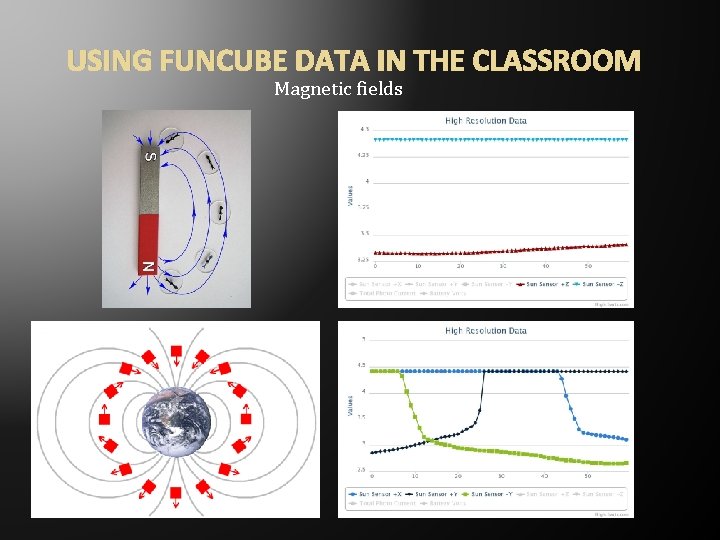
USING FUNCUBE DATA IN THE CLASSROOM Magnetic fields
Using FUNcube-1 in the classroom � � Using OCR Physics Curriculum for Key Stage 4 as an example. Not limited to just Physics but can be developed into Mathematics, English, and other subjects, even History.
GCSE Key Stage 4 Physics – Key Areas � Orbits What is an orbit? � How do you get into orbit? � http: //galileo. phys. virginia. edu/classes/109 N/more_stuff/Applets/newtmtn. html or http: //galileoandeinstein. physics. virginia. edu /more_stuff/flashlets/Newt. Mtn. ht ml Use of low earth orbits � Use of Geosynchronous orbits � Which orbit is appropriate for communications, earth observation etc � � http: //galileoandeinstein. physics. virginia. edu/more_stuff/flashlets/ � Satellites “Object that orbits a much larger object” � Earth has one natural satellite, the moon � Earth has thousands of artificial satellites, including FUNcube-1 �
GCSE Key Stage 4 Physics – Key Areas � Electro. Magnetic Spectrum What is it? � What does it include? � How is light related to the EMS � Where is radio included within the EMS � What are the different uses of the EMS (e. g. medical/physical investigations, mobile phones, wifi, TV, commercial radio etc) � � Communications Can take many forms � Historically, Analogue communications methods predominated � Today, digital communications methods � What are the differences? � Howdoes the ionosphere affect communications? �
GCSE Key Stage 4 Physics – Key Areas � Alternative Energy Sources What are they? � Where does a satellite get its energy from? � How do you recharge the batteries whilst in space? � Solar cells – is it a workable/long term renewable energy source? � How can you monitor the energy produced by a solar cell in space? � Energy Transfer � � � � Conduction/radiation modes of energy transfer and what are the differences? How can you identify which mode is dominant in a particular circumstance? How do different coloured surfaces react when exposed to a heat source? How do different coloured surfaces radiate heat? How does heat radiation differ on earth and in space (Leslie’s Cube experiment) What are the sources of heat in space?
What about other subjects? � Mathematics � � Estimating speed from History � The launch vehicle was the telemetry? � Calculating Doppler corrections � Recognising patterns in data � Deriving data for further analysis originally an ICBM with nuclear warheads � SALT/SALT 2 Talks � Establishment of new business areas out of the end of the Cold War. q Geography � Footprint/coverage/lo cation
USING FUNCUBE DATA IN THE CLASSROOM From OCR Key stage 4 Physics Define Satellite Orbits – Velocity and Altitude. – Newton’s cannon Orbit types and uses - Polar (Earth observation) and geostationary (telecom) Renewable energy. – Solar power Energy transfers. Conduction and radiation Specific heat capacity / The space environment and temperature Doppler. – Typically AS, but red shift in KS 4. Expanding universe. Voltage / current / power / energy Electro-magnetic spectrum (VHF communications) Analogue and digital. – FUNcube communicates using just 300 m. W of digital data • Magnetic fields. Uses magnetic attitude control • • •
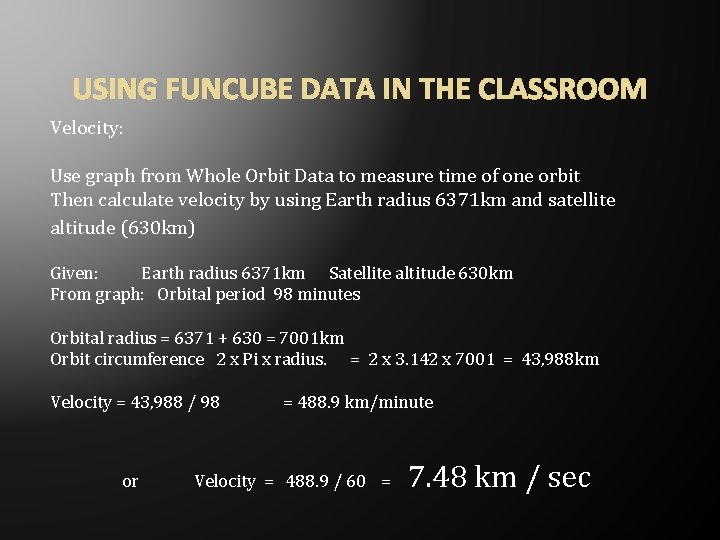
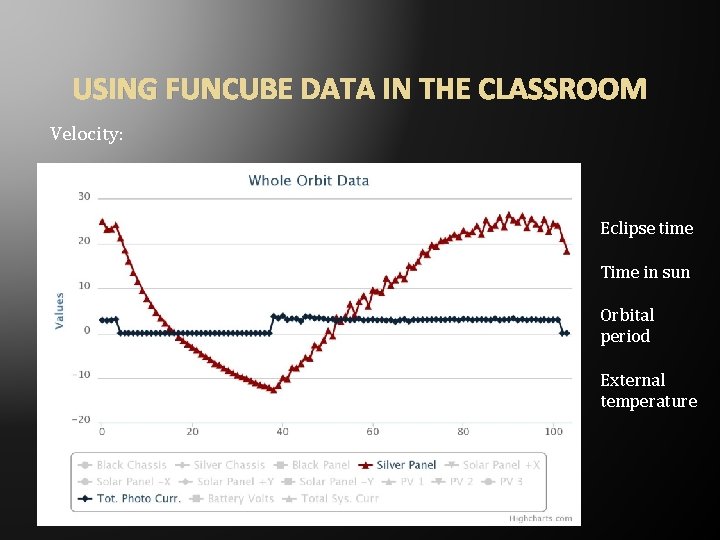
USING FUNCUBE DATA IN THE CLASSROOM Velocity: Use graph from Whole Orbit Data to measure time of one orbit Then calculate velocity by using Earth radius 6371 km and satellite altitude (630 km) Given: Earth radius 6371 km Satellite altitude 630 km From graph: Orbital period 98 minutes Orbital radius = 6371 + 630 = 7001 km Orbit circumference 2 x Pi x radius. = 2 x 3. 142 x 7001 = 43, 988 km Velocity = 43, 988 / 98 or = 488. 9 km/minute Velocity = 488. 9 / 60 = 7. 48 km / sec
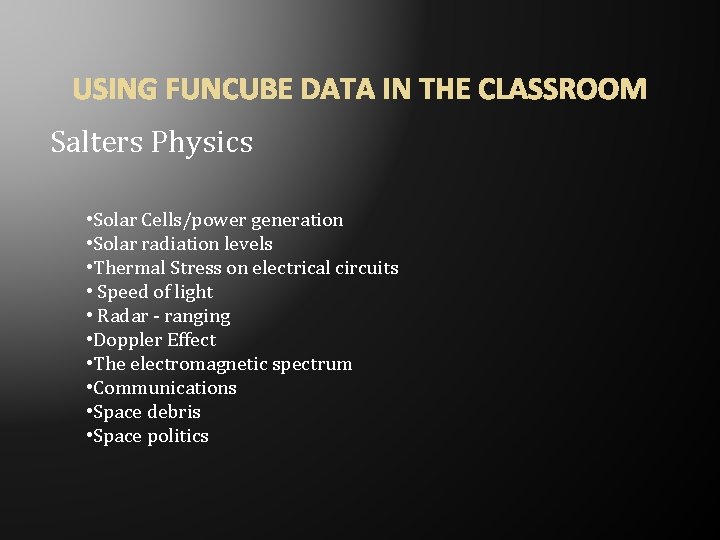
USING FUNCUBE DATA IN THE CLASSROOM Salters Physics • Solar Cells/power generation • Solar radiation levels • Thermal Stress on electrical circuits • Speed of light • Radar - ranging • Doppler Effect • The electromagnetic spectrum • Communications • Space debris • Space politics
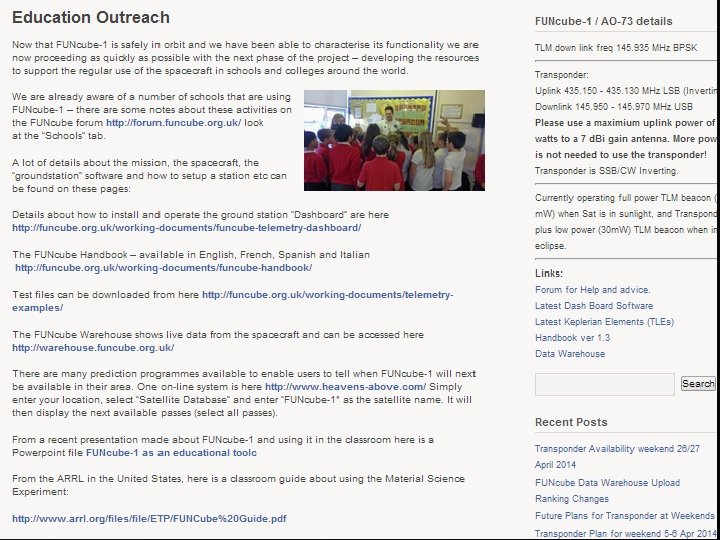
RESOURCES FOR THE CLASSROOM
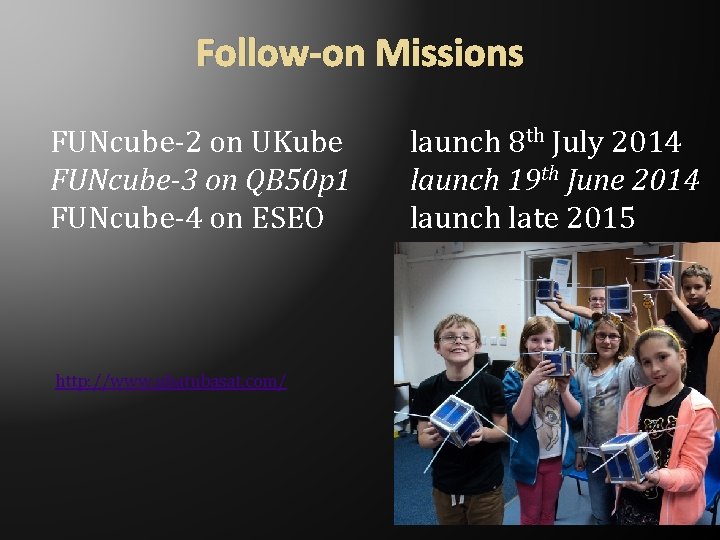
Follow-on Missions FUNcube-2 on UKube FUNcube-3 on QB 50 p 1 FUNcube-4 on ESEO http: //www. ubatubasat. com/ launch 8 th July 2014 launch 19 th June 2014 launch late 2015
- Slides: 37