
Functions Vocabulary review The Function Machine What is
Functions! Vocabulary review
The Function Machine � What is a Function? � A function relates an input to an output. � It is like a machine that has an input and an output. � And the output is related somehow to the input. � f(x) "f(x) =. . . " is the classic way of writing a function. And there are other ways, as you will see!
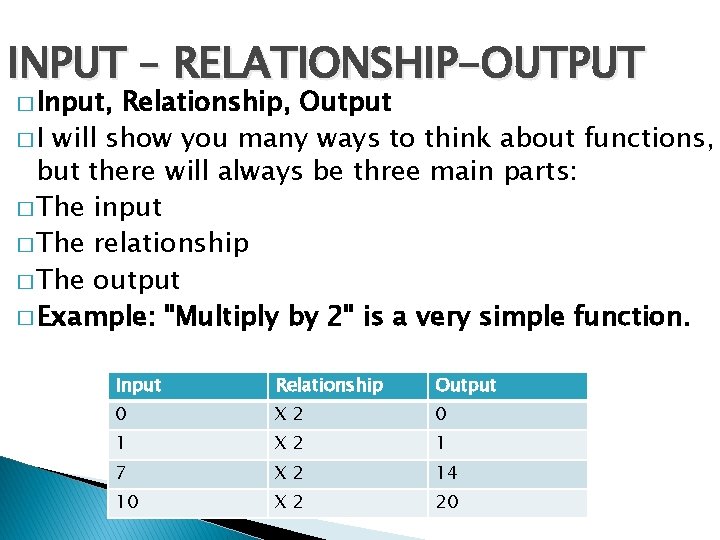
INPUT – RELATIONSHIP-OUTPUT � Input, Relationship, Output � I will show you many ways to think about functions, but there will always be three main parts: � The input � The relationship � The output � Example: "Multiply by 2" is a very simple function. Input Relationship Output 0 X 2 0 1 X 2 1 7 X 2 14 10 X 2 20
Function Examples � Some Examples of Functions � x 2 (squaring) is a function � x 3+1 is also a function � Sine, Cosine and Tangent are functions used in trigonometry and there are lots more!
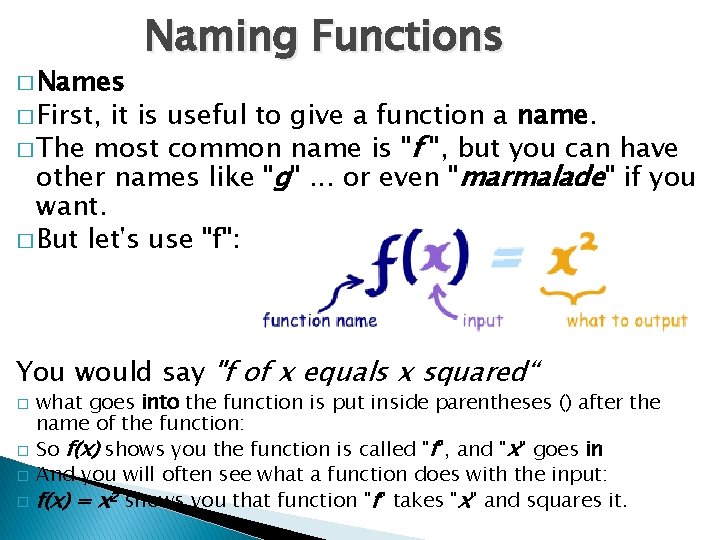
� Names Naming Functions � First, it is useful to give a function a name. � The most common name is "f ", but you can have other names like "g". . . or even "marmalade" if you want. � But let's use "f": You would say "f of x equals x squared“ � � what goes into the function is put inside parentheses () after the name of the function: So f(x) shows you the function is called "f", and "x" goes in And you will often see what a function does with the input: f(x) = x 2 shows you that function "f" takes "x" and squares it.
Function Example: with f(x) = x 2: � an input of 4 � becomes an output of 16. � In fact we can write f(4) = 16 or the ordered pair (4 , 16)
The "x" is Just a Place-Holder! � Don't get too concerned about "x", it is just there to show you where the input goes and what happens to it. � It could be anything! So this function: � f(x) = 1 - x + x 2 Would be the same function if I wrote: � f(q) = 1 - q + q 2 � h(A) = 1 - A + A 2 � w(θ) = 1 - θ + θ 2 It is just there so you know where to put the values: � f(2) = 1 - 2 + 22 = 3
Sometimes There is No Function Name Sometimes a function has no name, and you might just see something like: � y = x 2 But there is still: � an input (x) � a relationship (squaring) � and an output (y)
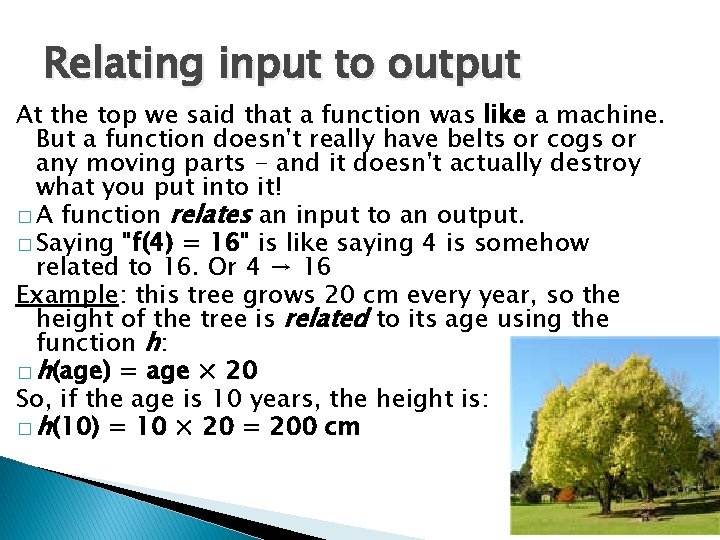
Relating input to output At the top we said that a function was like a machine. But a function doesn't really have belts or cogs or any moving parts - and it doesn't actually destroy what you put into it! � A function relates an input to an output. � Saying "f(4) = 16" is like saying 4 is somehow related to 16. Or 4 → 16 Example: this tree grows 20 cm every year, so the height of the tree is related to its age using the function h: � h(age) = age × 20 So, if the age is 10 years, the height is: � h(10) = 10 × 20 = 200 cm
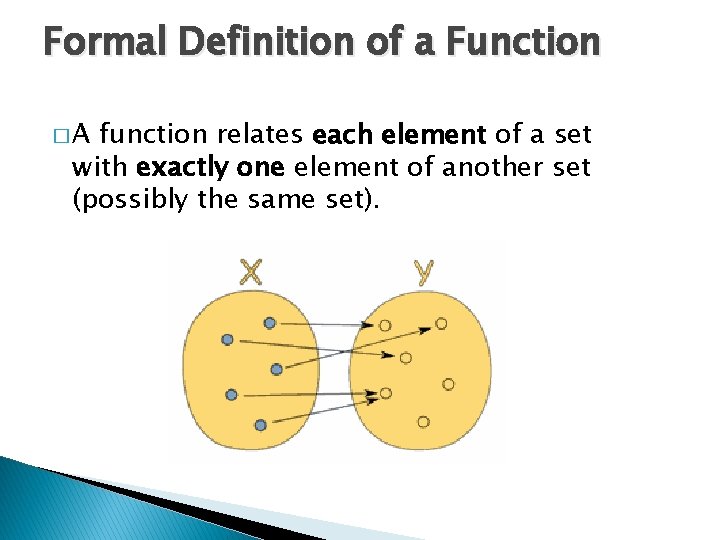
Formal Definition of a Function �A function relates each element of a set with exactly one element of another set (possibly the same set).
The Two Important Things! 1. ". . . each element. . . " means that every element in X is related to some element in Y. � We say that the function covers X (relates every element of it). � (But some elements of Y might not be related to at all, which is fine. ) 2. ". . . exactly one. . . " means that a function is single valued. It will not give back 2 or more results for the same input.
- Slides: 11