
Functions Tables Graphs Formulas All slides in this

Functions Tables, Graphs, Formulas All slides in this presentations are based on the book Functions, Data and Models, S. P. Gordon and F. S Gordon ISBN 978 -0 -88385 -767 -0
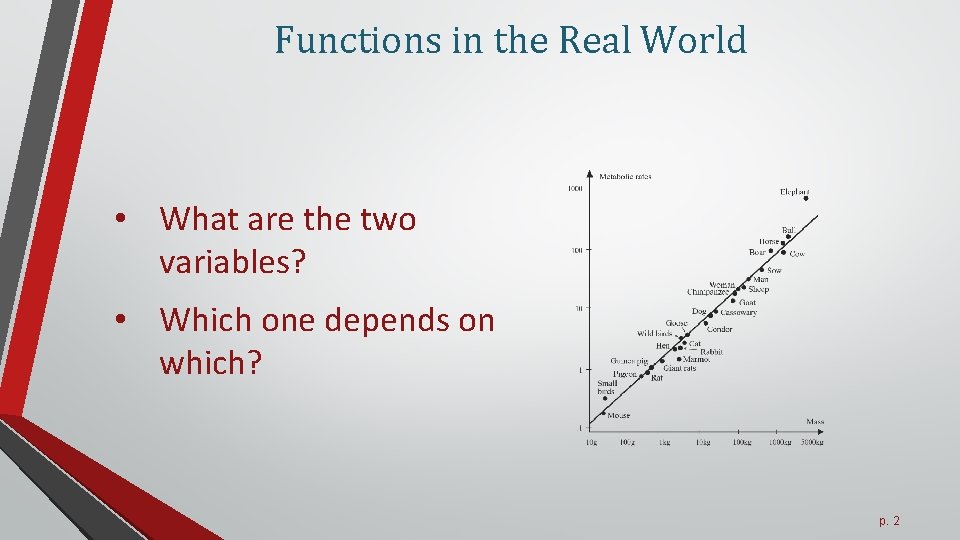
Functions in the Real World • What are the two variables? • Which one depends on which? p. 2

Functions in the Real World What are the two variables? Which one depends on which? Metabolic rate R depends on the body mass M of an organism R is a function of M; a rule assigning values to R given a value of M p. 3
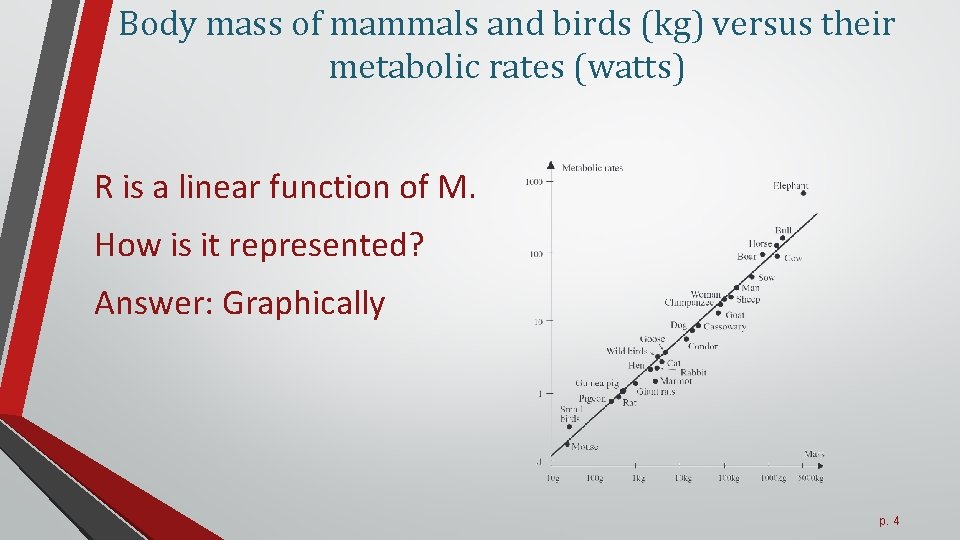
Body mass of mammals and birds (kg) versus their metabolic rates (watts) R is a linear function of M. How is it represented? Answer: Graphically p. 4
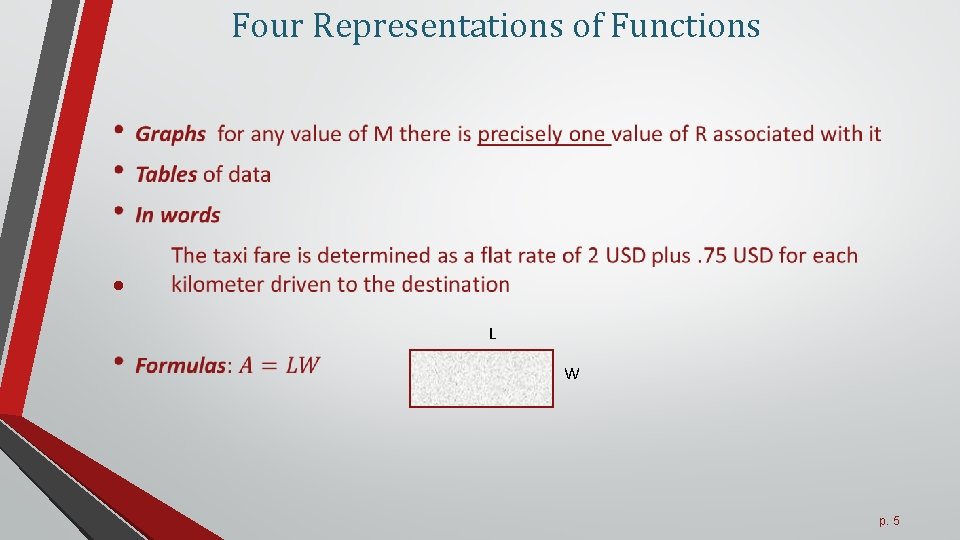
Four Representations of Functions • L W p. 5
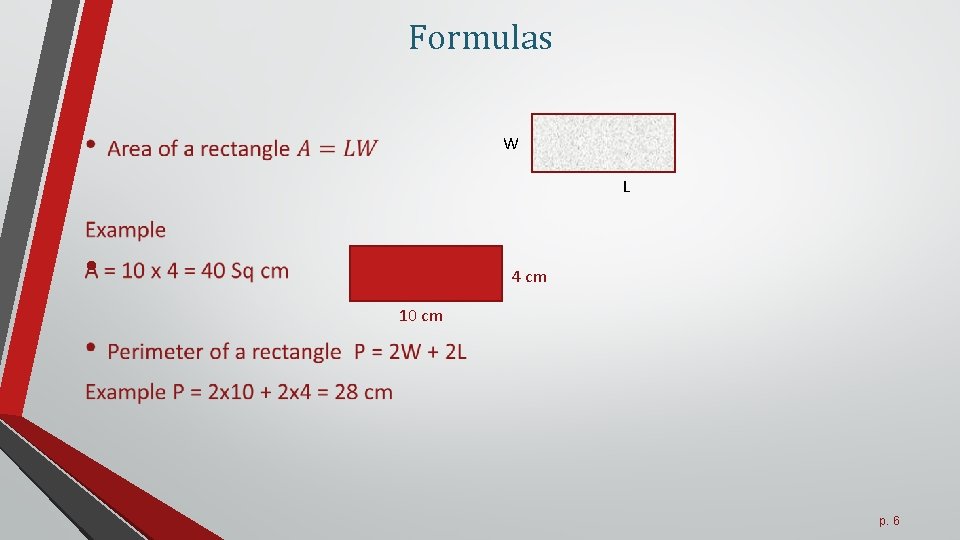
Formulas W L • 4 cm 10 cm p. 6
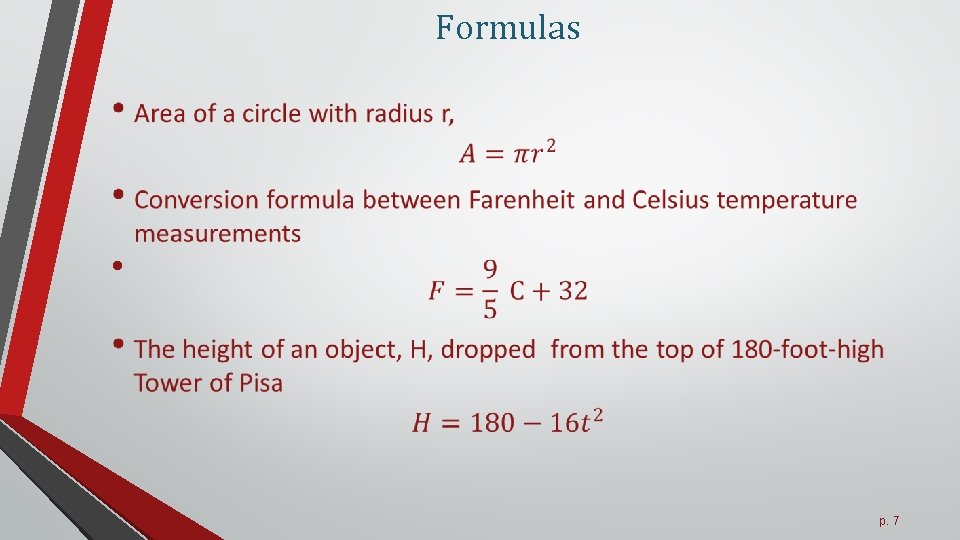
Formulas • p. 7
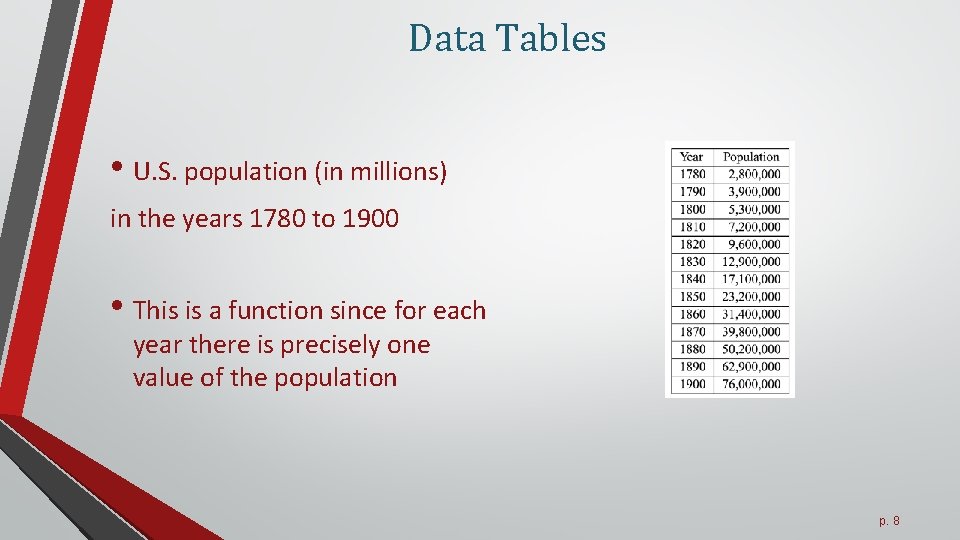
Data Tables • U. S. population (in millions) in the years 1780 to 1900 • This is a function since for each year there is precisely one value of the population p. 8
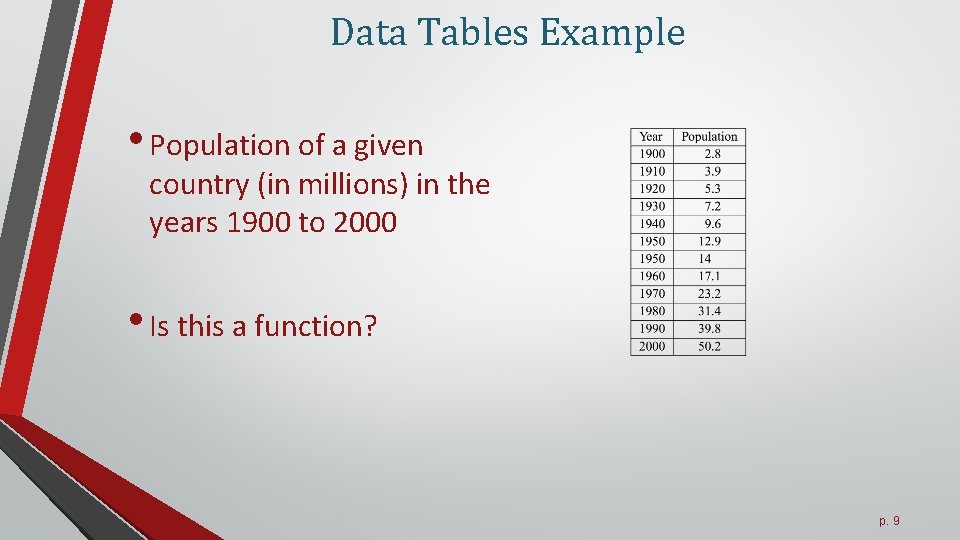
Data Tables Example • Population of a given country (in millions) in the years 1900 to 2000 • Is this a function? p. 9
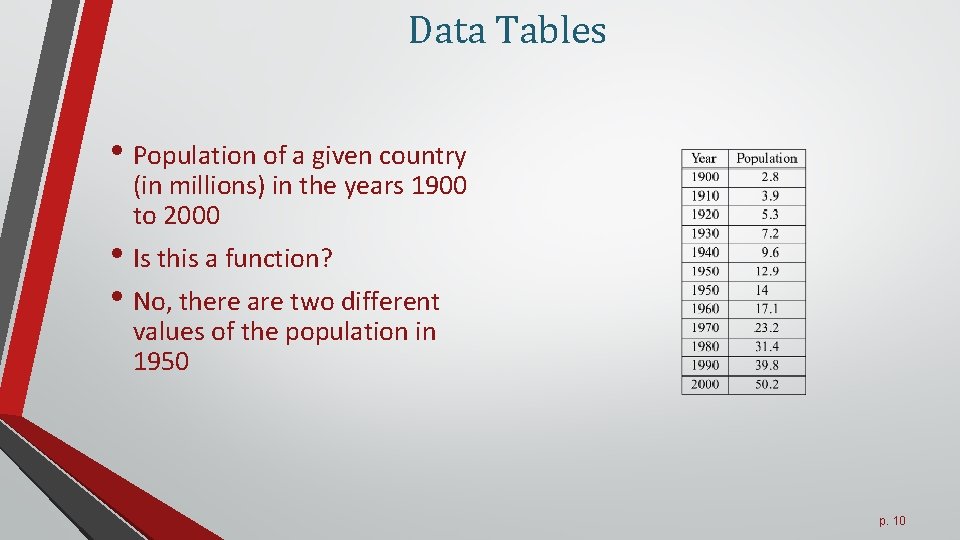
Data Tables • Population of a given country (in millions) in the years 1900 to 2000 • Is this a function? • No, there are two different values of the population in 1950 p. 10
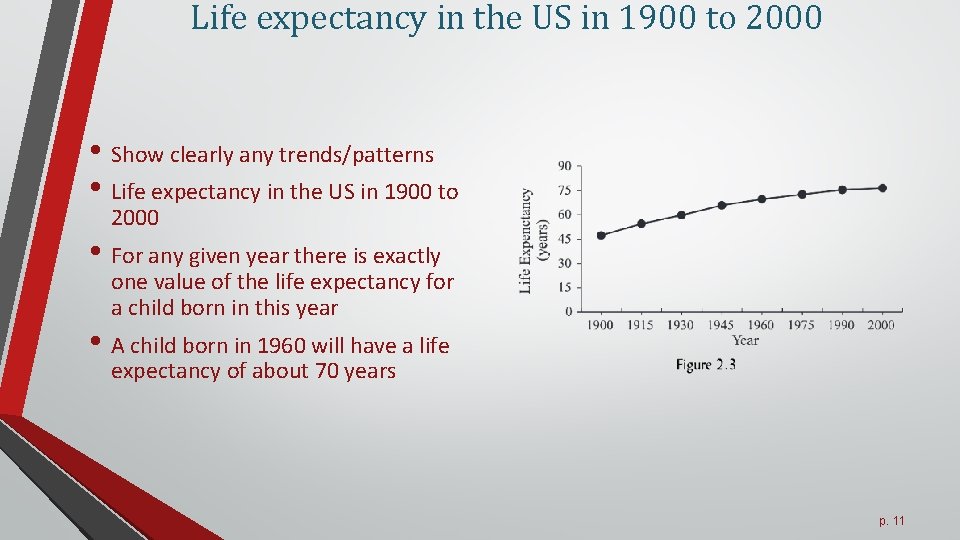
Life expectancy in the US in 1900 to 2000 • Show clearly any trends/patterns • Life expectancy in the US in 1900 to 2000 • For any given year there is exactly one value of the life expectancy for a child born in this year • A child born in 1960 will have a life expectancy of about 70 years p. 11
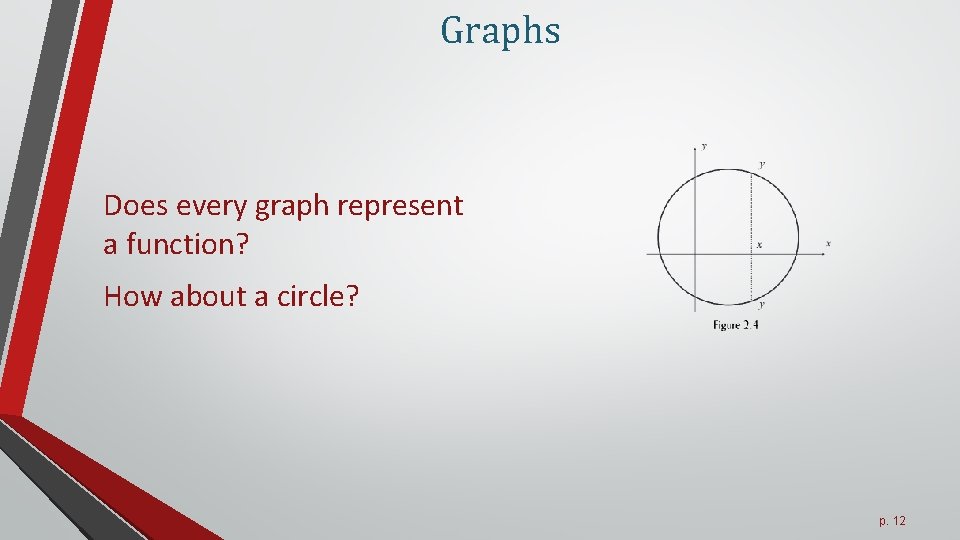
Graphs Does every graph represent a function? How about a circle? p. 12
Why we study Functions • Is a given quantity a function of another one? • If there is a functional relationship, can we find a formula for it? • If not, can construct a table or graph relating the two quantities? • If we can find a formula, a table or a graph, how do we use it? p. 13
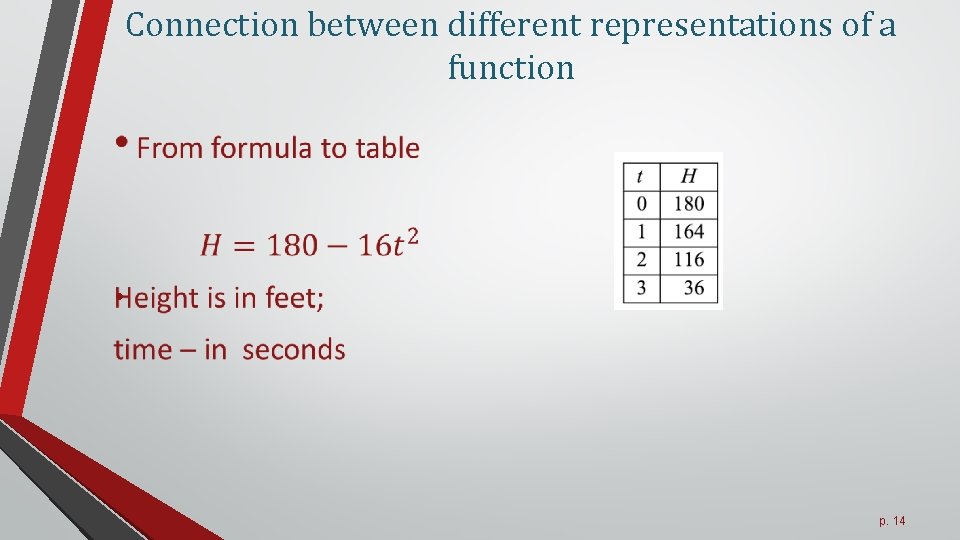
Connection between different representations of a function • p. 14
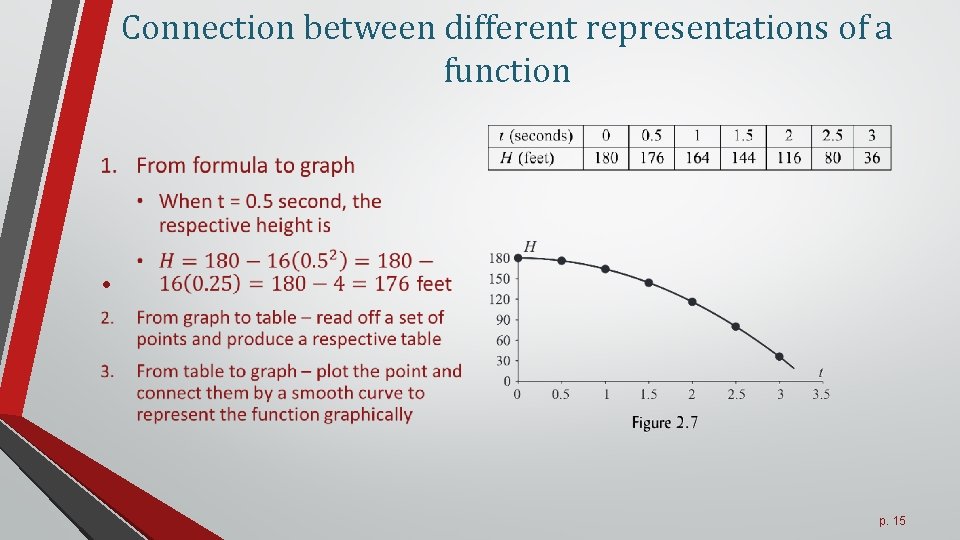
Connection between different representations of a function • p. 15
From table to formula; from graph to formula Often in real life we have a data table and need to produce a formula to fit the given data points This is difficult but is made possible using modern technology We’ll revisit this approach several times in our course in future classes p. 16
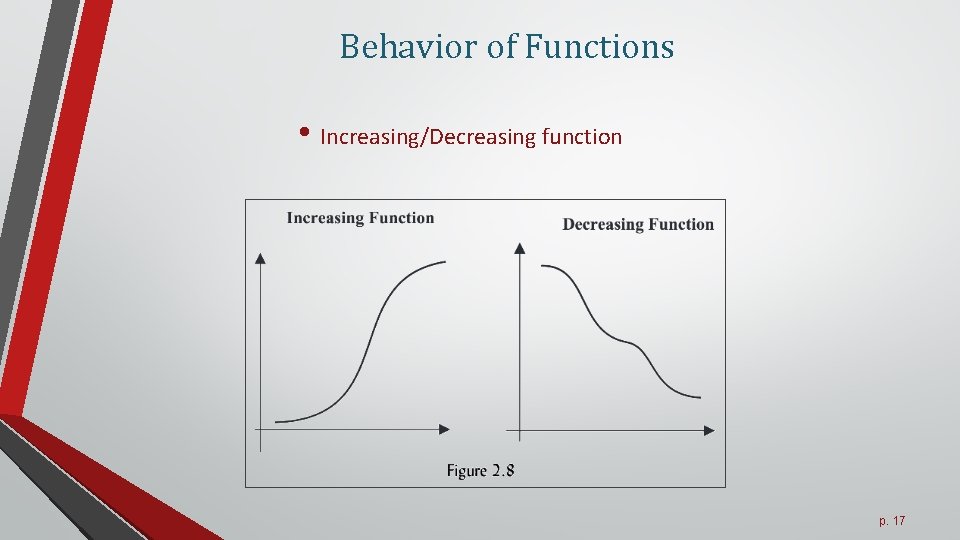
Behavior of Functions • Increasing/Decreasing function p. 17
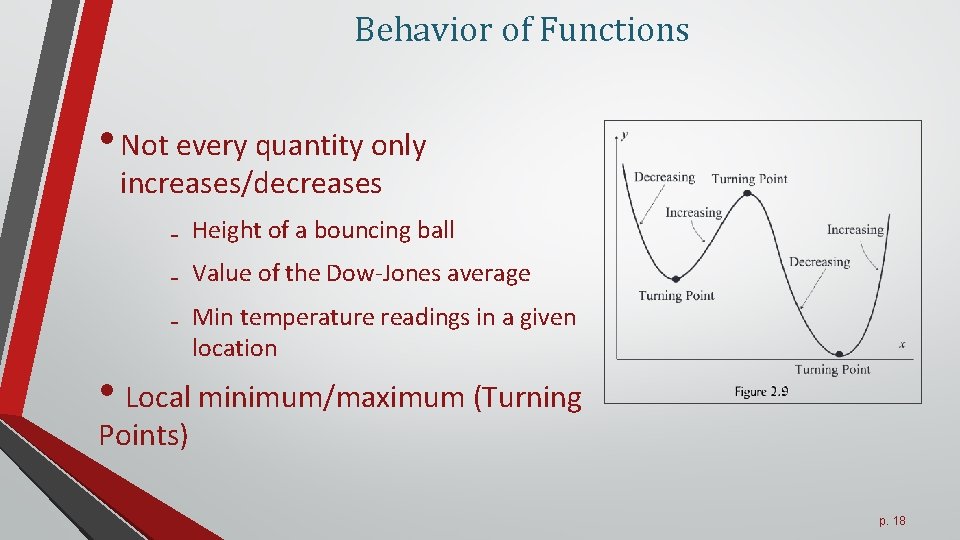
Behavior of Functions • Not every quantity only increases/decreases ₋ Height of a bouncing ball ₋ Value of the Dow-Jones average ₋ Min temperature readings in a given location • Local minimum/maximum (Turning Points) p. 18

Examples For each of the following functions, determine which are strictly increasing, strictly decreasing, or neither. ₋ The closing price of one share of Apple stock for each trading day on the stock exchange. ₋ The height H of a bungee jumper t seconds after leaping off a bridge. p. 19
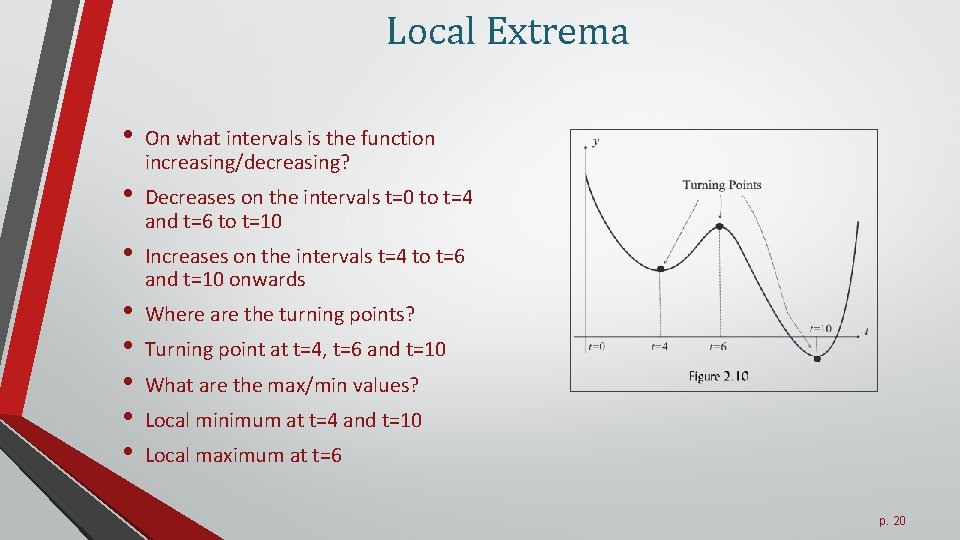
Local Extrema • • On what intervals is the function increasing/decreasing? Decreases on the intervals t=0 to t=4 and t=6 to t=10 Increases on the intervals t=4 to t=6 and t=10 onwards Where are the turning points? Turning point at t=4, t=6 and t=10 What are the max/min values? Local minimum at t=4 and t=10 Local maximum at t=6 p. 20
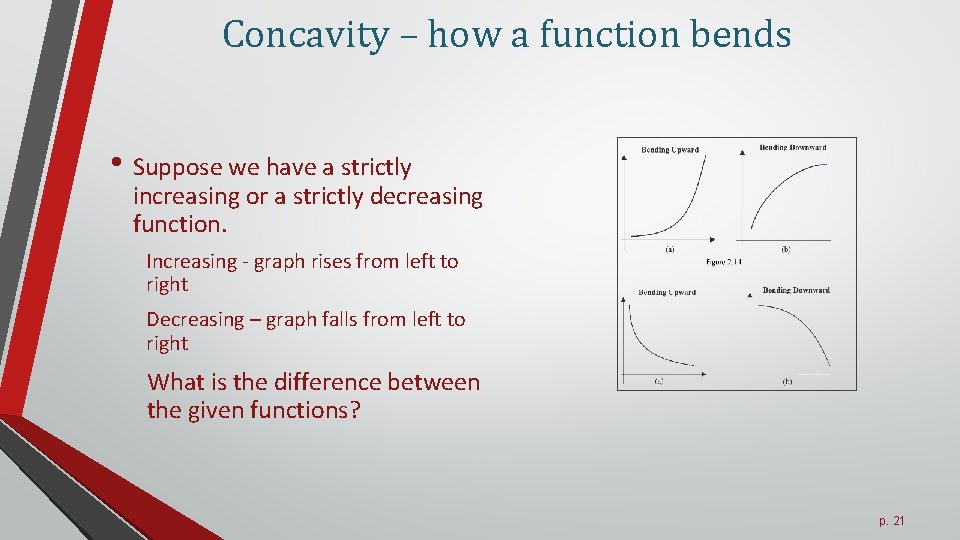
Concavity – how a function bends • Suppose we have a strictly increasing or a strictly decreasing function. Increasing - graph rises from left to right Decreasing – graph falls from left to right What is the difference between the given functions? p. 21
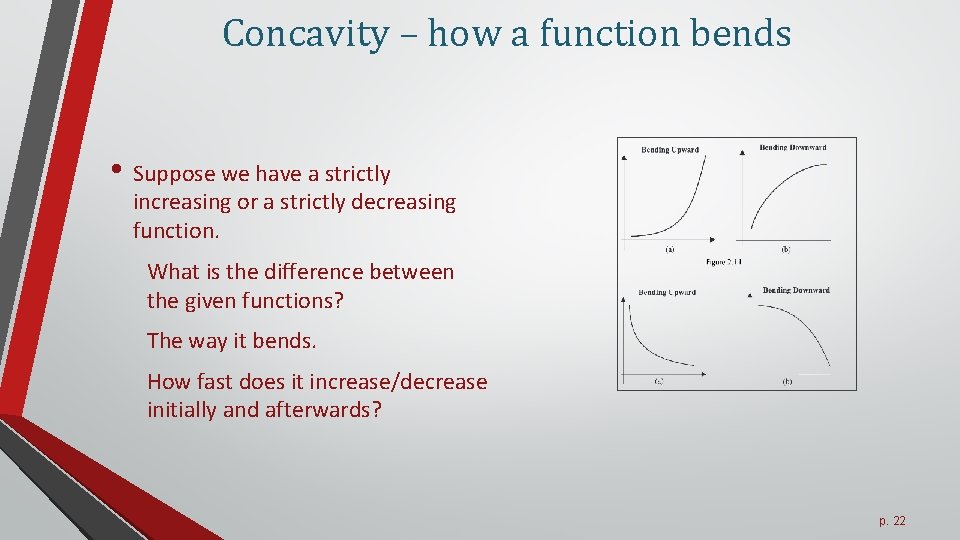
Concavity – how a function bends • Suppose we have a strictly increasing or a strictly decreasing function. What is the difference between the given functions? The way it bends. How fast does it increase/decrease initially and afterwards? p. 22
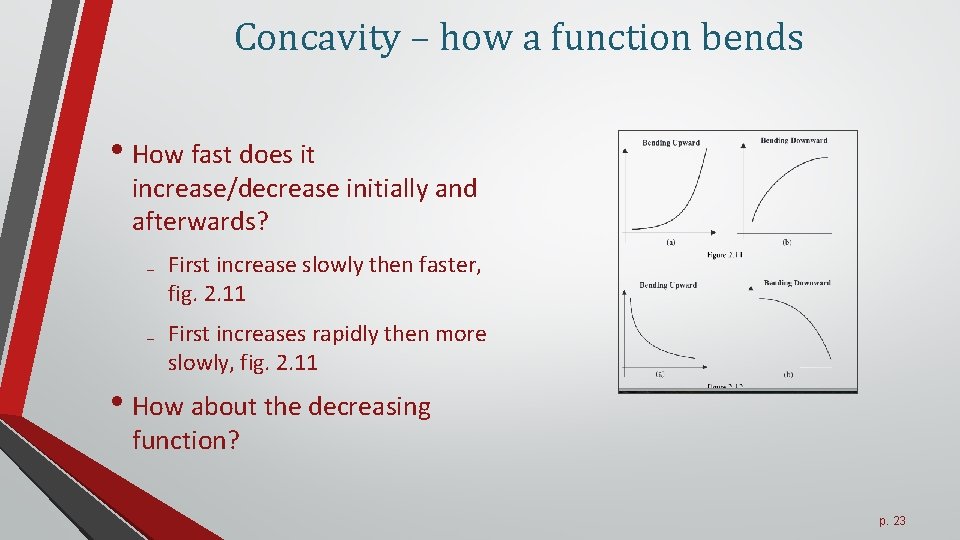
Concavity – how a function bends • How fast does it increase/decrease initially and afterwards? ₋ First increase slowly then faster, fig. 2. 11 ₋ First increases rapidly then more slowly, fig. 2. 11 • How about the decreasing function? p. 23
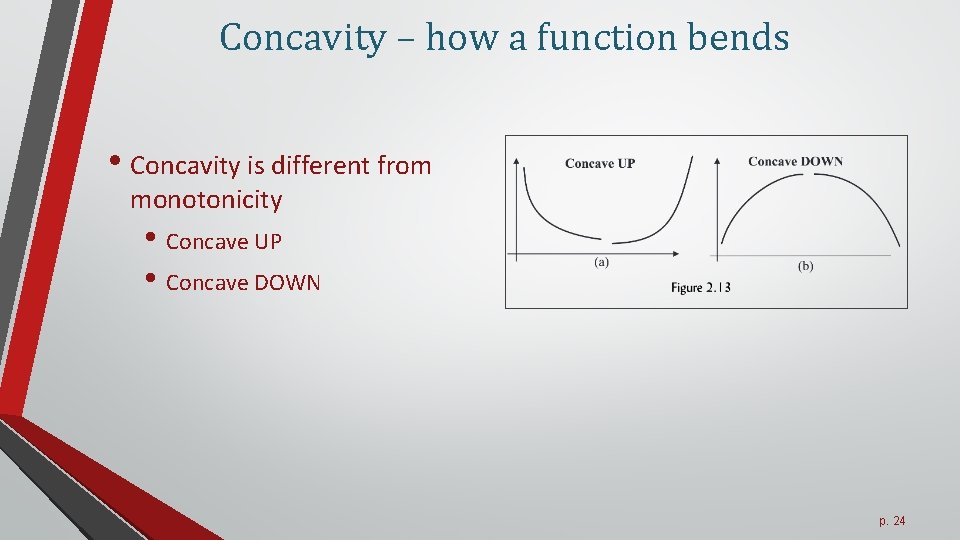
Concavity – how a function bends • Concavity is different from monotonicity • Concave UP • Concave DOWN p. 24
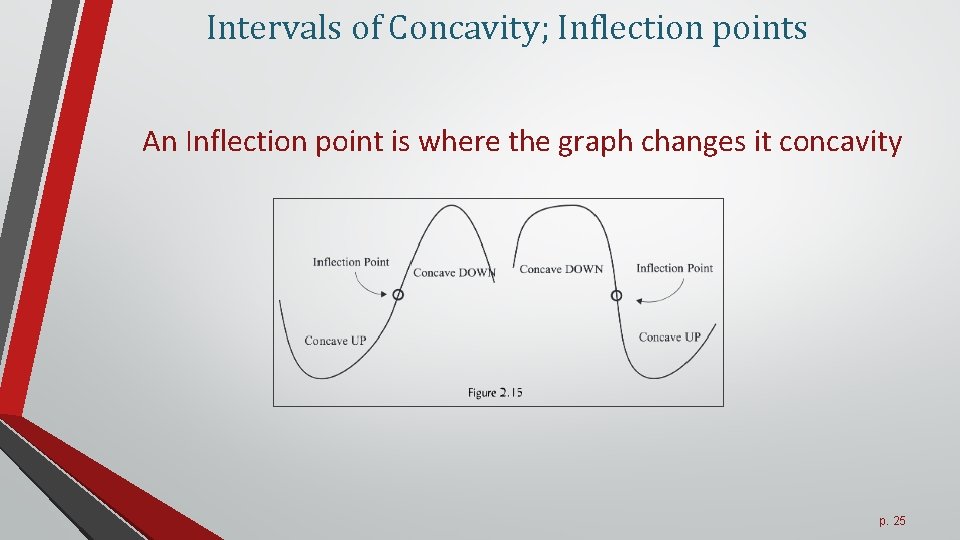
Intervals of Concavity; Inflection points An Inflection point is where the graph changes it concavity p. 25
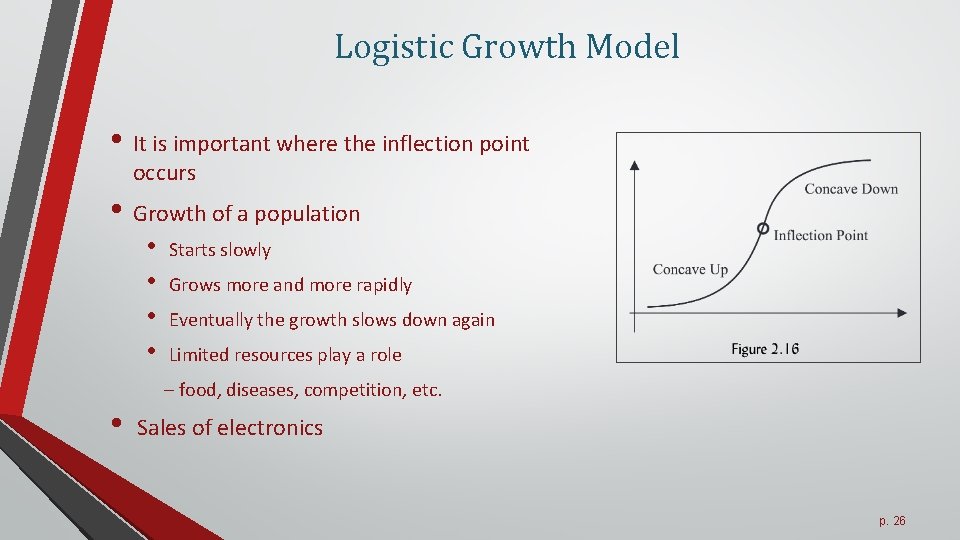
Logistic Growth Model • It is important where the inflection point occurs • Growth of a population • • Starts slowly Grows more and more rapidly Eventually the growth slows down again Limited resources play a role – food, diseases, competition, etc. • Sales of electronics p. 26
Summary • A function is • Increasing if its values increase as the argument increases • Decreasing if its values decrease as the argument increases • Turning point – where the monotonicity changes • • • Concave UP if the graph bends upwards Concave DOWN if the graphs bends downwards Inflection point - where bending of graph changes p. 27
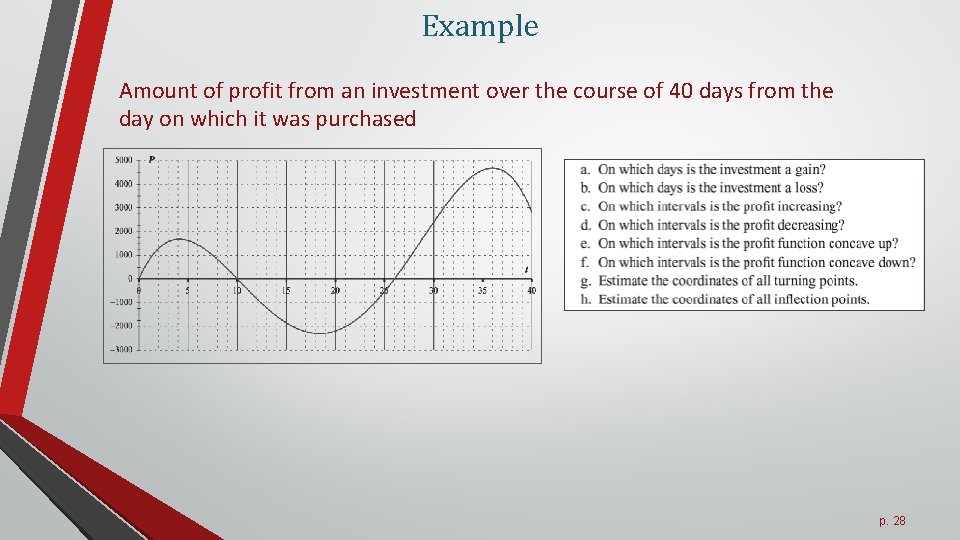
Example Amount of profit from an investment over the course of 40 days from the day on which it was purchased p. 28
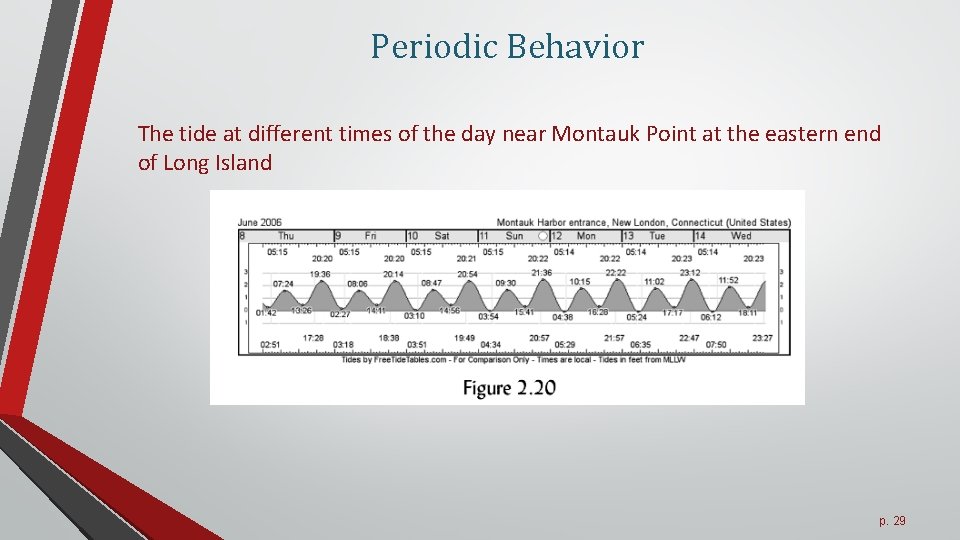
Periodic Behavior The tide at different times of the day near Montauk Point at the eastern end of Long Island p. 29
- Slides: 29