
FUNCTIONS OF THE SKELETON SUPPORT The skeleton supports
- Slides: 1
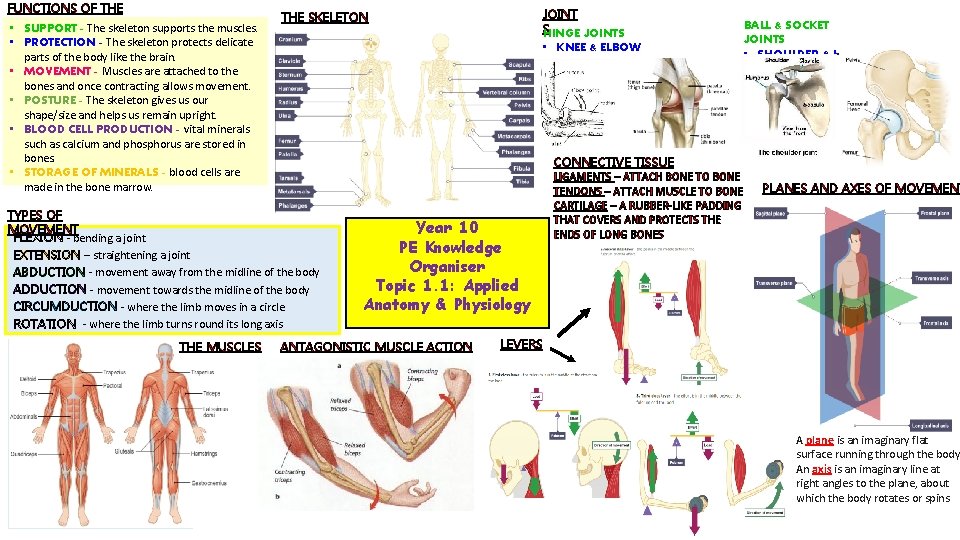
FUNCTIONS OF THE SKELETON • SUPPORT - The skeleton supports the muscles. JOINT S HINGE JOINTS THE SKELETON • PROTECTION - The skeleton protects delicate parts of the body like the brain. • MOVEMENT - Muscles are attached to the bones and once contracting allows movement. • POSTURE - The skeleton gives us our shape/size and helps us remain upright. • BLOOD CELL PRODUCTION - vital minerals such as calcium and phosphorus are stored in bones. • STORAGE OF MINERALS - blood cells are made in the bone marrow. • KNEE & ELBOW TYPES OF MOVEMENT FLEXION - bending a joint EXTENSION – straightening a joint ABDUCTION - movement away from the midline of the body ADDUCTION - movement towards the midline of the body CIRCUMDUCTION - where the limb moves in a circle ROTATION - where the limb turns round its long axis THE MUSCLES Year 10 PE Knowledge Organiser Topic 1. 1: Applied Anatomy & Physiology ANTAGONISTIC MUSCLE ACTION CONNECTIVE TISSUE LIGAMENTS – ATTACH BONE TO BONE TENDONS – ATTACH MUSCLE TO BONE CARTILAGE – A RUBBER-LIKE PADDING THAT COVERS AND PROTECTS THE ENDS OF LONG BONES BALL & SOCKET JOINTS • SHOULDER & HIP PLANES AND AXES OF MOVEMENT LEVERS A plane is an imaginary flat surface running through the body An axis is an imaginary line at right angles to the plane, about which the body rotates or spins