
Functions of the Nervous System Sensory inputgathering information













- Slides: 60
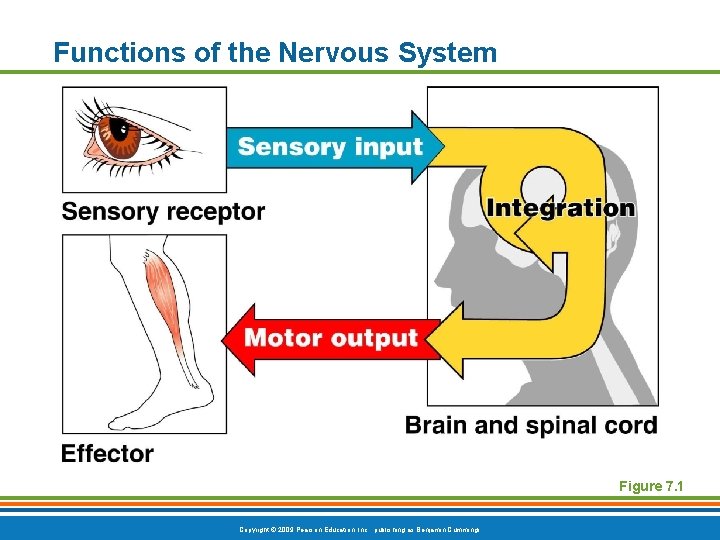
Functions of the Nervous System § Sensory input—gathering information § To monitor changes occurring inside and outside the body § Changes = stimuli § Integration § To process and interpret sensory input and decide if action is needed Copyright © 2009 Pearson Education, Inc. , publishing as Benjamin Cummings
Functions of the Nervous System § Motor output § A response to integrated stimuli § The response activates muscles or glands Copyright © 2009 Pearson Education, Inc. , publishing as Benjamin Cummings
Functions of the Nervous System Figure 7. 1 Copyright © 2009 Pearson Education, Inc. , publishing as Benjamin Cummings
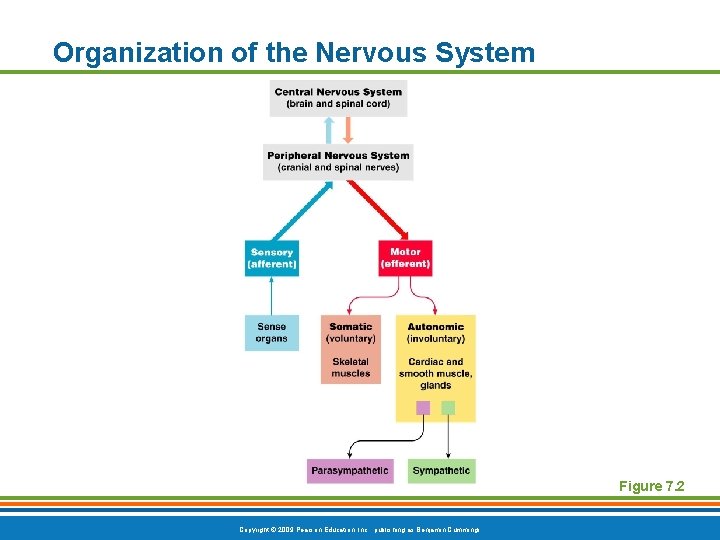
Structural Classification of the Nervous System § Central nervous system (CNS) § Brain § Spinal cord § Peripheral nervous system (PNS) § Nerves outside the brain and spinal cord § Spinal nerves § Cranial nerves Copyright © 2009 Pearson Education, Inc. , publishing as Benjamin Cummings
Functional Classification of the Peripheral Nervous System § Sensory (afferent) division § Nerve fibers that carry information to the central nervous system § Motor (efferent) division § Nerve fibers that carry impulses away from the central nervous system Copyright © 2009 Pearson Education, Inc. , publishing as Benjamin Cummings
Organization of the Nervous System Figure 7. 2 Copyright © 2009 Pearson Education, Inc. , publishing as Benjamin Cummings
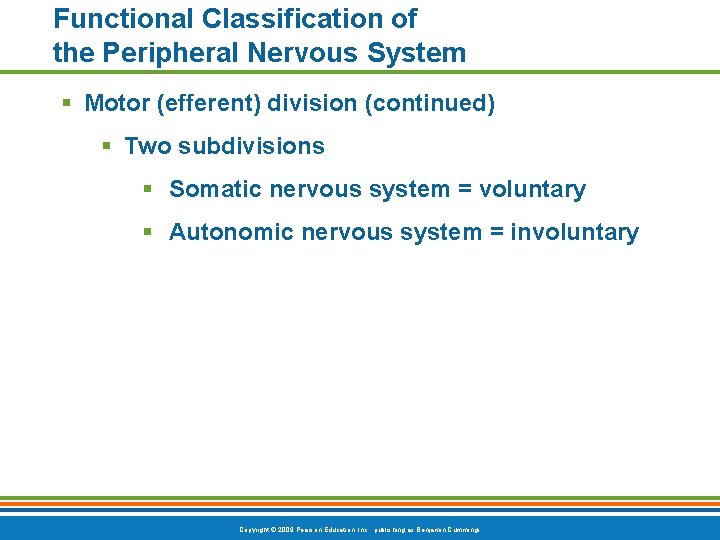
Functional Classification of the Peripheral Nervous System § Motor (efferent) division (continued) § Two subdivisions § Somatic nervous system = voluntary § Autonomic nervous system = involuntary Copyright © 2009 Pearson Education, Inc. , publishing as Benjamin Cummings
Nervous Tissue: Support Cells § Support cells in the CNS are grouped together as “neuroglia” § Function: to support, insulate, and protect neurons Copyright © 2009 Pearson Education, Inc. , publishing as Benjamin Cummings
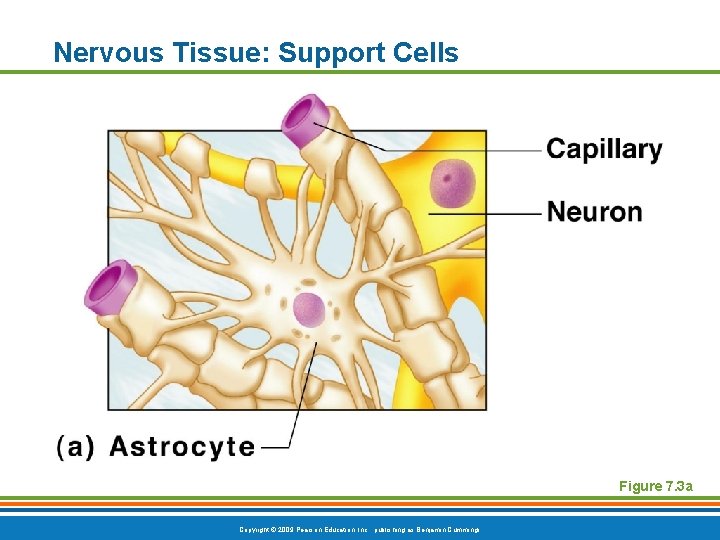
Nervous Tissue: Support Cells § Astrocytes § Abundant, star-shaped cells § Brace neurons § Form barrier between capillaries and neurons § Control the chemical environment of the brain Copyright © 2009 Pearson Education, Inc. , publishing as Benjamin Cummings
Nervous Tissue: Support Cells Figure 7. 3 a Copyright © 2009 Pearson Education, Inc. , publishing as Benjamin Cummings
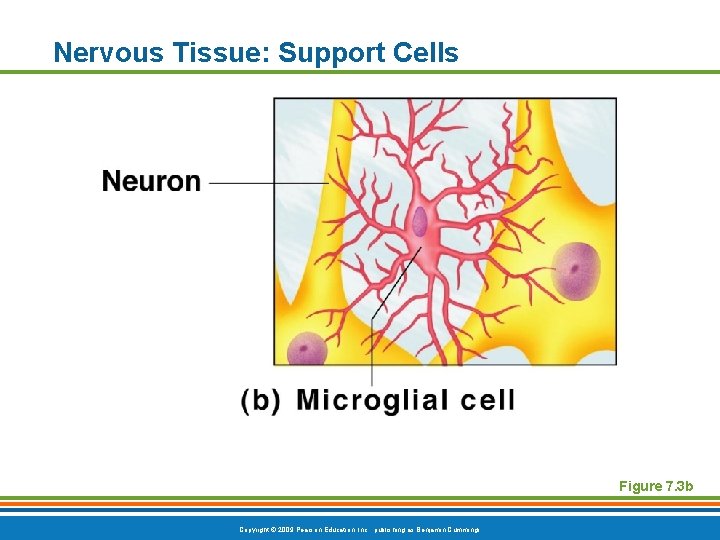
Nervous Tissue: Support Cells § Microglia § Spiderlike phagocytes § Dispose of debris Copyright © 2009 Pearson Education, Inc. , publishing as Benjamin Cummings
Nervous Tissue: Support Cells Figure 7. 3 b Copyright © 2009 Pearson Education, Inc. , publishing as Benjamin Cummings
Nervous Tissue: Support Cells § Ependymal cells § Line cavities of the brain and spinal cord § Circulate cerebrospinal fluid Copyright © 2009 Pearson Education, Inc. , publishing as Benjamin Cummings
Nervous Tissue: Support Cells Figure 7. 3 c Copyright © 2009 Pearson Education, Inc. , publishing as Benjamin Cummings
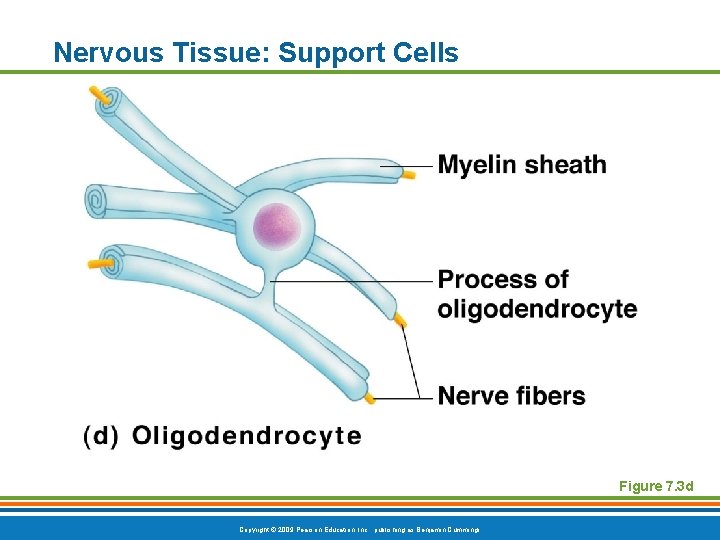
Nervous Tissue: Support Cells § Oligodendrocytes § Wrap around nerve fibers in the central nervous system § Produce myelin sheaths Copyright © 2009 Pearson Education, Inc. , publishing as Benjamin Cummings
Nervous Tissue: Support Cells Figure 7. 3 d Copyright © 2009 Pearson Education, Inc. , publishing as Benjamin Cummings
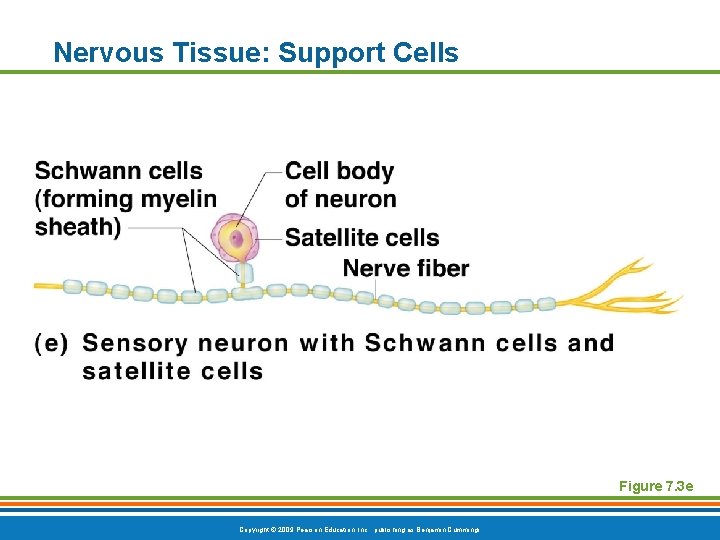
Nervous Tissue: Support Cells § Satellite cells § Protect neuron cell bodies § Schwann cells § Form myelin sheath in the peripheral nervous system Copyright © 2009 Pearson Education, Inc. , publishing as Benjamin Cummings
Nervous Tissue: Support Cells Figure 7. 3 e Copyright © 2009 Pearson Education, Inc. , publishing as Benjamin Cummings
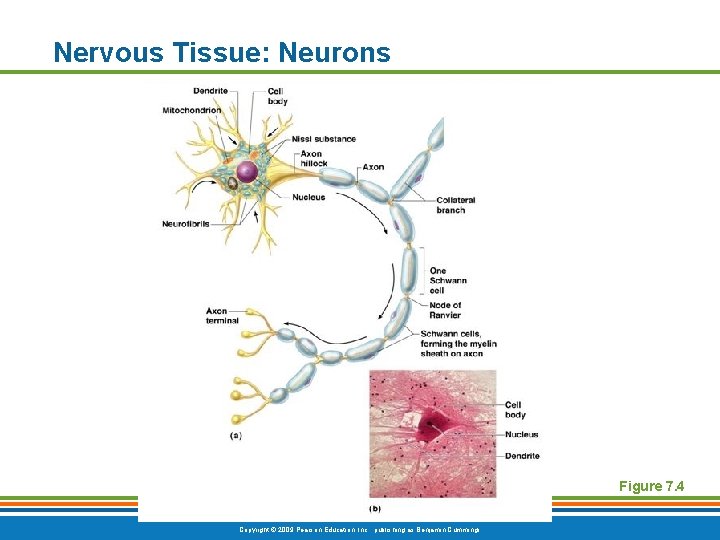
Nervous Tissue: Neurons § Neurons = nerve cells § Cells specialized to transmit messages § Major regions of neurons § Cell body—nucleus and metabolic center of the cell § Processes—fibers that extend from the cell body Copyright © 2009 Pearson Education, Inc. , publishing as Benjamin Cummings
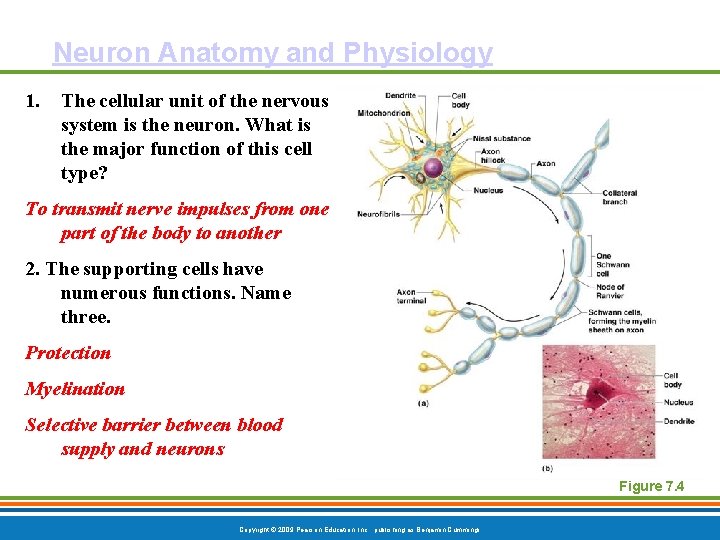
Nervous Tissue: Neurons Figure 7. 4 Copyright © 2009 Pearson Education, Inc. , publishing as Benjamin Cummings
Neuron Anatomy and Physiology 1. The cellular unit of the nervous system is the neuron. What is the major function of this cell type? To transmit nerve impulses from one part of the body to another 2. The supporting cells have numerous functions. Name three. Protection Myelination Selective barrier between blood supply and neurons Figure 7. 4 Copyright © 2009 Pearson Education, Inc. , publishing as Benjamin Cummings
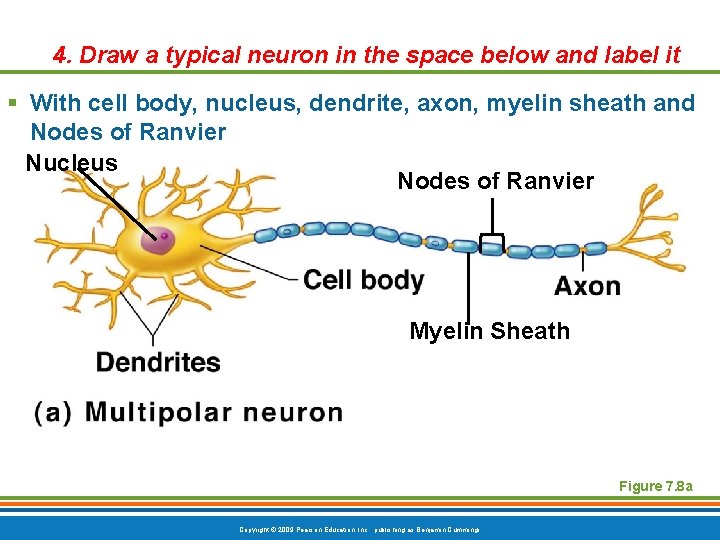
Nervous Tissue: Neurons § Cell body § Nucleus § Large nucleolus § Processes outside the cell body § Dendrites—conduct impulses toward the cell body § Axons—conduct impulses away from the cell body Copyright © 2009 Pearson Education, Inc. , publishing as Benjamin Cummings
Nervous Tissue: Neurons Figure 7. 4 Copyright © 2009 Pearson Education, Inc. , publishing as Benjamin Cummings
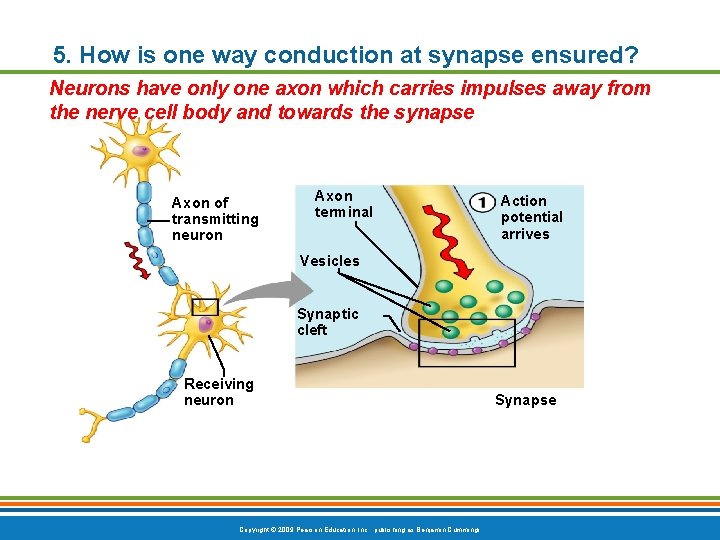
Nervous Tissue: Neurons § Axons end in axonal terminals § Axonal terminals contain vesicles with neurotransmitters § Axonal terminals are separated from the next neuron by a gap § Synaptic cleft—gap between adjacent neurons § Synapse—junction between nerves Copyright © 2009 Pearson Education, Inc. , publishing as Benjamin Cummings
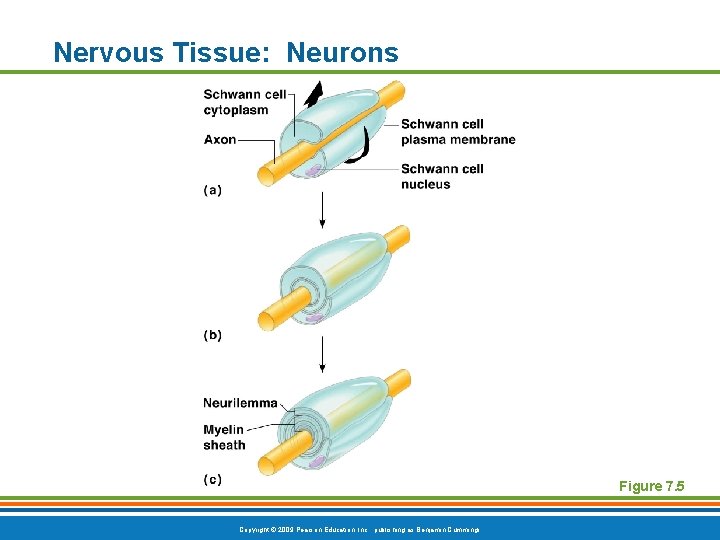
Nervous Tissue: Neurons § Myelin sheath—whitish, fatty material covering axons § Schwann cells—produce myelin sheaths in jelly roll–like fashion § Nodes of Ranvier—gaps in myelin sheath along the axon Copyright © 2009 Pearson Education, Inc. , publishing as Benjamin Cummings
Nervous Tissue: Neurons Figure 7. 5 Copyright © 2009 Pearson Education, Inc. , publishing as Benjamin Cummings
7. Describe how the Schwann cells from the myelin sheath Axons in the peripheral nervous system are myelinated by the Schwann cells, which wrap themselves tightly around the axon in a jelly roll fashion. When the wrap is complete it is referred to as the nurilemma Figure 7. 5 Copyright © 2009 Pearson Education, Inc. , publishing as Benjamin Cummings
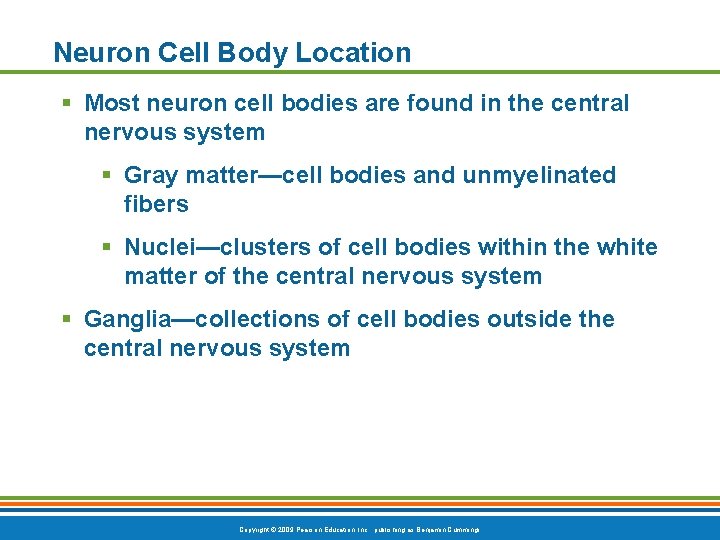
Neuron Cell Body Location § Most neuron cell bodies are found in the central nervous system § Gray matter—cell bodies and unmyelinated fibers § Nuclei—clusters of cell bodies within the white matter of the central nervous system § Ganglia—collections of cell bodies outside the central nervous system Copyright © 2009 Pearson Education, Inc. , publishing as Benjamin Cummings
4. Draw a typical neuron in the space below and label it § With cell body, nucleus, dendrite, axon, myelin sheath and Nodes of Ranvier Nucleus Nodes of Ranvier Myelin Sheath Figure 7. 8 a Copyright © 2009 Pearson Education, Inc. , publishing as Benjamin Cummings
Quiz! § Next class period you will have a quiz on § Organization of Nervous system § Support cell Form and function § Neuron anatomy Copyright © 2009 Pearson Education, Inc. , publishing as Benjamin Cummings
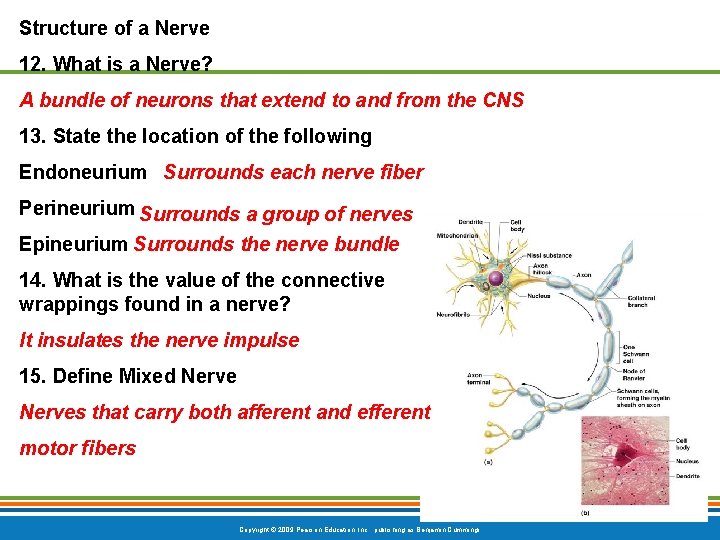
Structure of a Nerve 12. What is a Nerve? A bundle of neurons that extend to and from the CNS 13. State the location of the following Endoneurium Surrounds each nerve fiber Perineurium Surrounds a group of nerves Epineurium Surrounds the nerve bundle 14. What is the value of the connective wrappings found in a nerve? It insulates the nerve impulse 15. Define Mixed Nerves that carry both afferent and efferent motor fibers Copyright © 2009 Pearson Education, Inc. , publishing as Benjamin Cummings
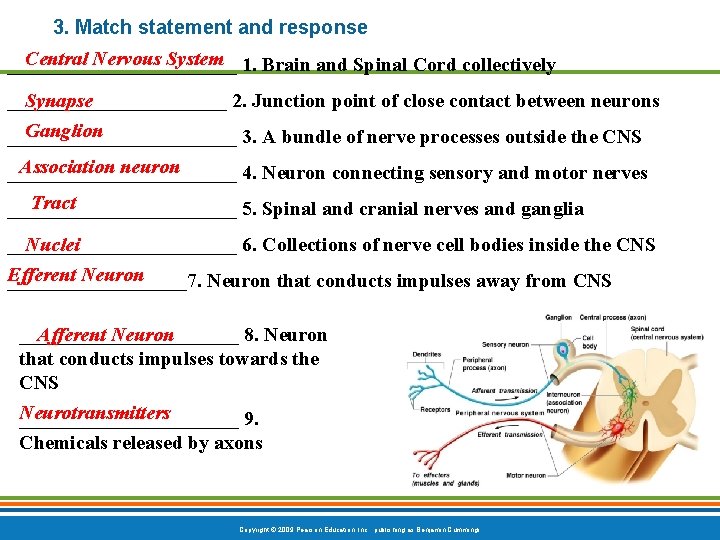
3. Match statement and response Central Nervous System 1. Brain and Spinal Cord collectively ____________ Synapse ___________ 2. Junction point of close contact between neurons Ganglion ____________ 3. A bundle of nerve processes outside the CNS Association neuron ____________ 4. Neuron connecting sensory and motor nerves Tract ____________ 5. Spinal and cranial nerves and ganglia ____________ 6. Collections of nerve cell bodies inside the CNS Nuclei Efferent Neuron _________7. Neuron that conducts impulses away from CNS ___________ Afferent Neuron 8. Neuron that conducts impulses towards the CNS Neurotransmitters ___________ 9. Chemicals released by axons Copyright © 2009 Pearson Education, Inc. , publishing as Benjamin Cummings
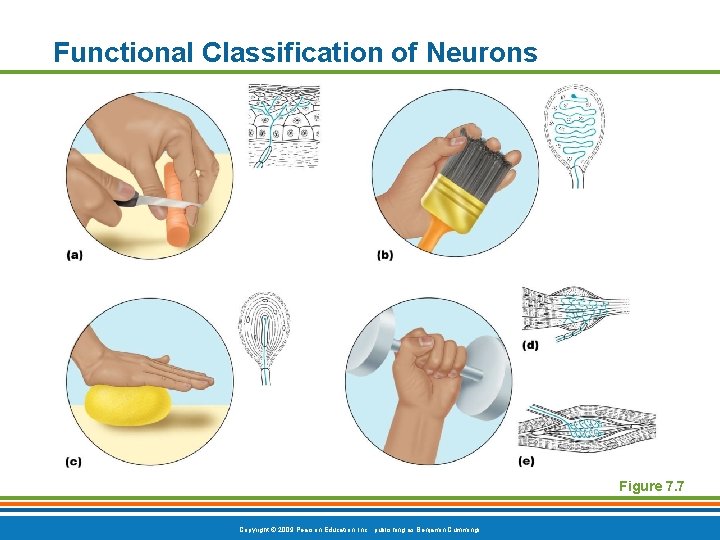
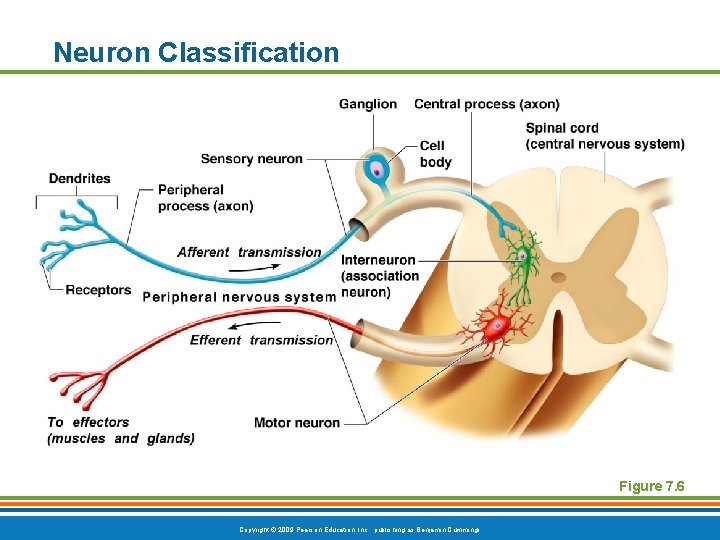
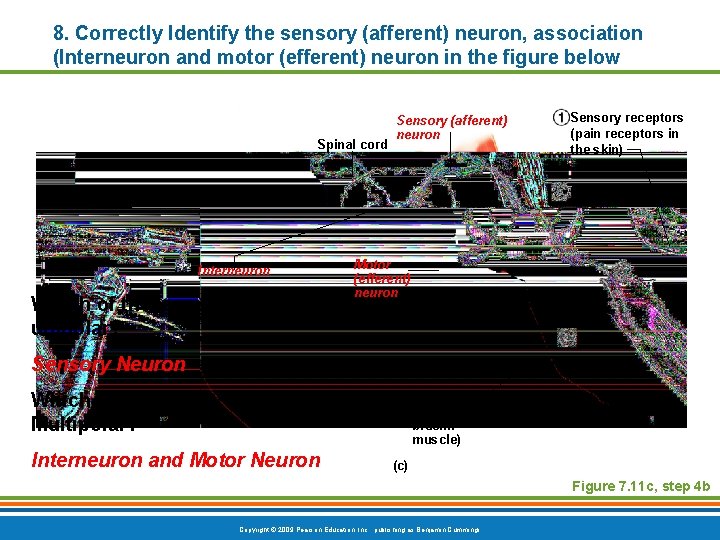
Functional Classification of Neurons § Sensory (afferent) neurons § Carry impulses from the sensory receptors to the CNS § Cutaneous sense organs § Proprioceptors—detect stretch or tension § Motor (efferent) neurons § Carry impulses from the central nervous system to viscera, muscles, or glands Copyright © 2009 Pearson Education, Inc. , publishing as Benjamin Cummings
5. How is one way conduction at synapse ensured? Neurons have only one axon which carries impulses away from the nerve cell body and towards the synapse Axon of transmitting neuron Axon terminal Action potential arrives Vesicles Synaptic cleft Receiving neuron Copyright © 2009 Pearson Education, Inc. , publishing as Benjamin Cummings Synapse
Functional Classification of Neurons Figure 7. 7 Copyright © 2009 Pearson Education, Inc. , publishing as Benjamin Cummings
Functional Classification of Neurons § Interneurons (association neurons) § Found in neural pathways in the central nervous system § Connect sensory and motor neurons Copyright © 2009 Pearson Education, Inc. , publishing as Benjamin Cummings
Neuron Classification Figure 7. 6 Copyright © 2009 Pearson Education, Inc. , publishing as Benjamin Cummings
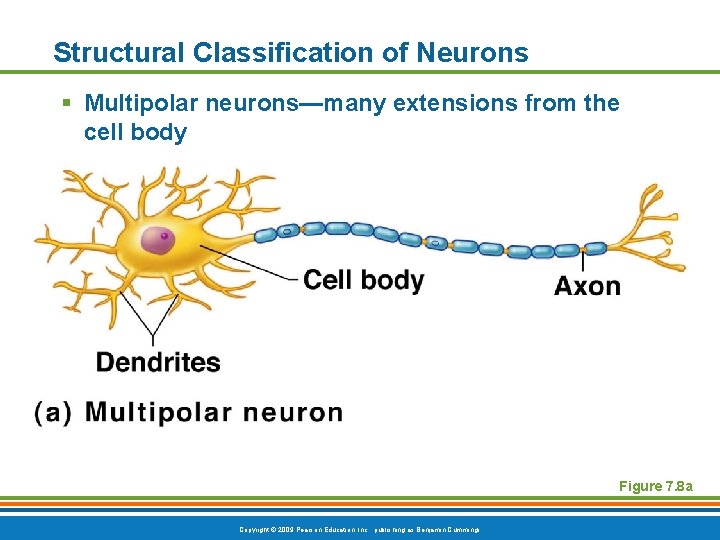
Structural Classification of Neurons § Multipolar neurons—many extensions from the cell body Figure 7. 8 a Copyright © 2009 Pearson Education, Inc. , publishing as Benjamin Cummings
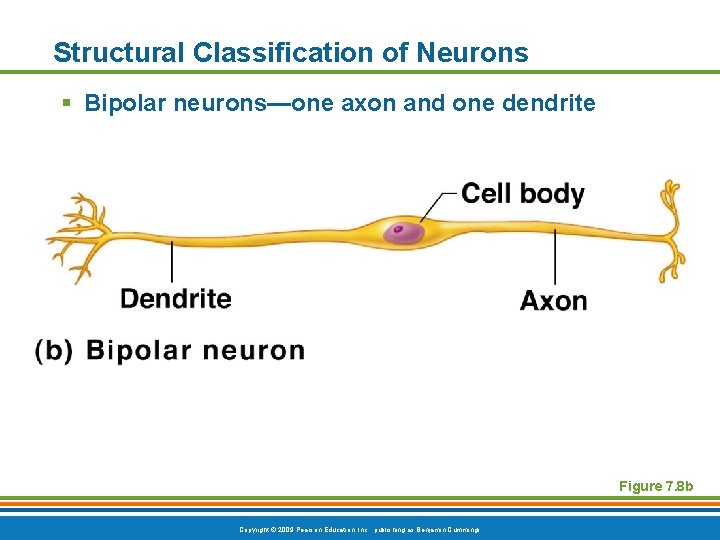
Structural Classification of Neurons § Bipolar neurons—one axon and one dendrite Figure 7. 8 b Copyright © 2009 Pearson Education, Inc. , publishing as Benjamin Cummings
Structural Classification of Neurons § Unipolar neurons—have a short single process leaving the cell body Figure 7. 8 c Copyright © 2009 Pearson Education, Inc. , publishing as Benjamin Cummings
6. What anatomical characteristic determines whether a particular neuron is classified as unipolar, bipolar or multipolar? § The number of processes attached to the cell body § Make a simple line drawing of each neuron type Copyright © 2009 Pearson Education, Inc. , publishing as Benjamin Cummings
8. Correctly Identify the sensory (afferent) neuron, association (Interneuron and motor (efferent) neuron in the figure below Spinal cord Interneuron Which of these neuron types are unipolar? Sensory (afferent) neuron Sensory receptors (pain receptors in the skin) Motor (efferent) neuron Sensory Neuron Which is most likely to be Multipolar? Interneuron and Motor Neuron Effector (biceps brachii muscle) (c) Figure 7. 11 c, step 4 b Copyright © 2009 Pearson Education, Inc. , publishing as Benjamin Cummings
Functional Properties of Neurons § Irritability § Ability to respond to stimuli § Conductivity § Ability to transmit an impulse Copyright © 2009 Pearson Education, Inc. , publishing as Benjamin Cummings
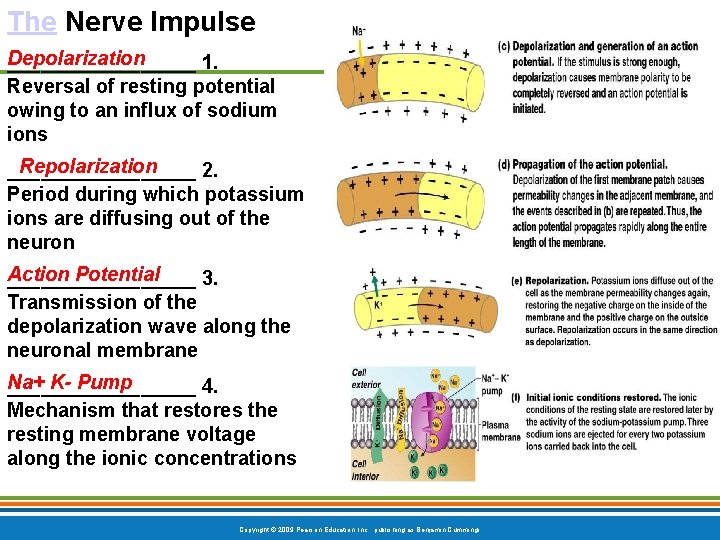
Nerve Impulses § Resting neuron § The plasma membrane at rest is polarized § Fewer positive ions are inside the cell than outside the cell § Depolarization § A stimulus depolarizes the neuron’s membrane § A depolarized membrane allows sodium (Na+) to flow inside the membrane § The exchange of ions initiates an action potential in the neuron Copyright © 2009 Pearson Education, Inc. , publishing as Benjamin Cummings
Nerve Impulses Figure 7. 9 a–b Copyright © 2009 Pearson Education, Inc. , publishing as Benjamin Cummings
Nerve Impulses § Action potential § If the action potential (nerve impulse) starts, it is propagated over the entire axon § Impulses travel faster when fibers have a myelin sheath Copyright © 2009 Pearson Education, Inc. , publishing as Benjamin Cummings
Nerve Impulses Figure 7. 9 c–d Copyright © 2009 Pearson Education, Inc. , publishing as Benjamin Cummings
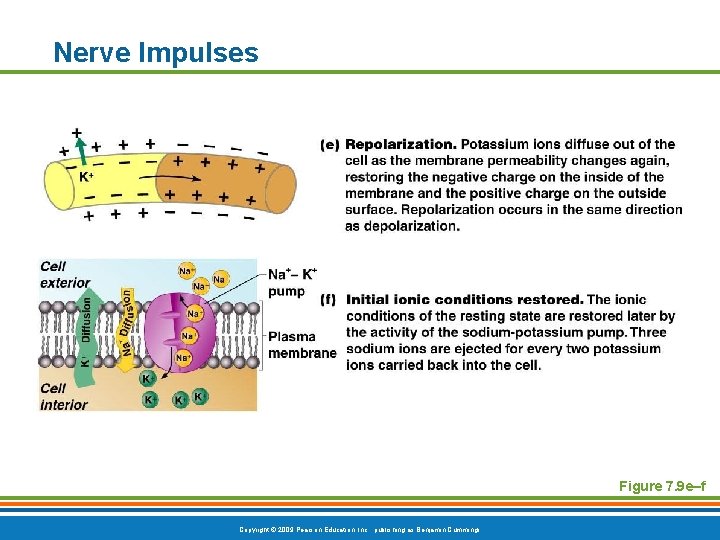
Nerve Impulses § Repolarization § Potassium ions rush out of the neuron after sodium ions rush in, which repolarizes the membrane § The sodium-potassium pump, using ATP, restores the original configuration Copyright © 2009 Pearson Education, Inc. , publishing as Benjamin Cummings
Nerve Impulses Figure 7. 9 e–f Copyright © 2009 Pearson Education, Inc. , publishing as Benjamin Cummings
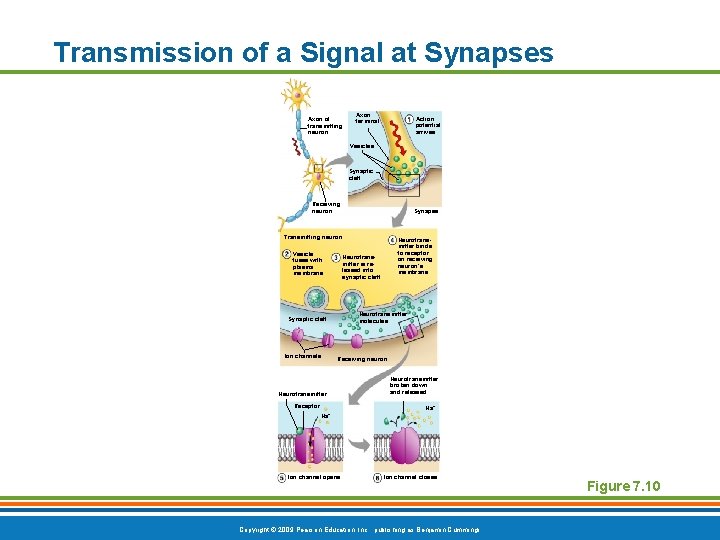
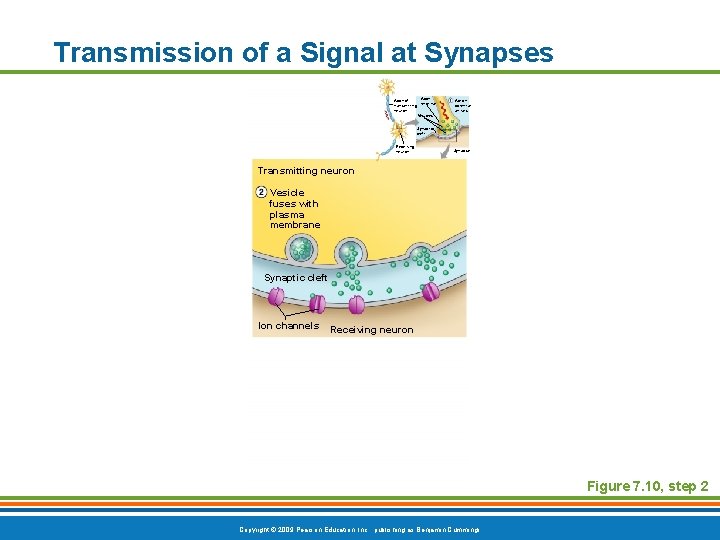
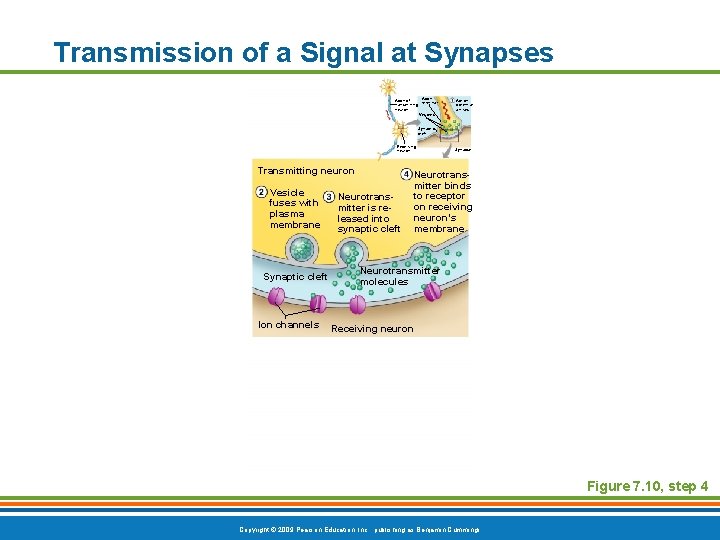
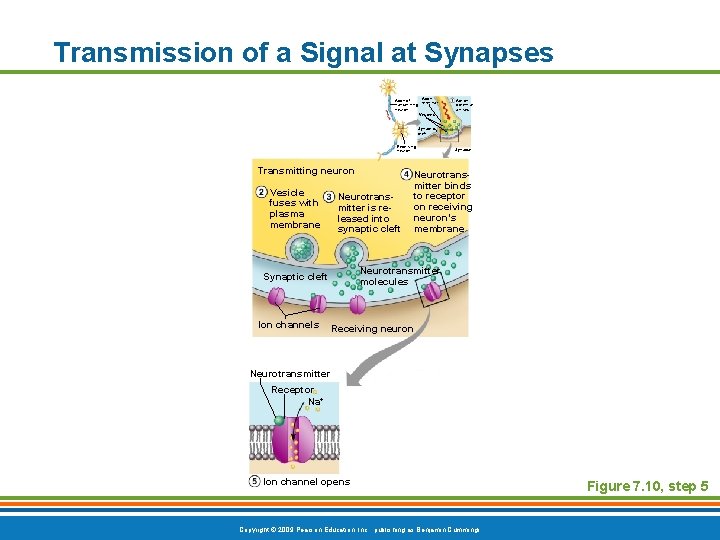
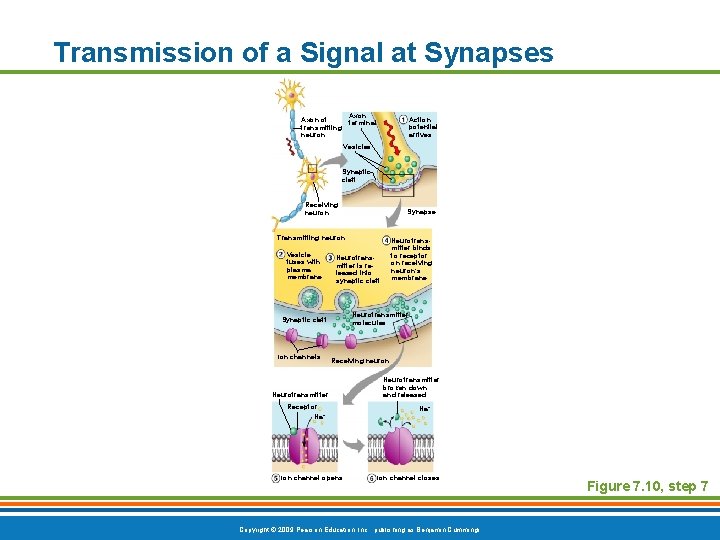
Transmission of a Signal at Synapses § Impulses are able to cross the synapse to another nerve § Neurotransmitter is released from a nerve’s axon terminal § The dendrite of the next neuron has receptors that are stimulated by the neurotransmitter § An action potential is started in the dendrite Copyright © 2009 Pearson Education, Inc. , publishing as Benjamin Cummings
Transmission of a Signal at Synapses Axon of transmitting neuron Axon terminal Action potential arrives Vesicles Synaptic cleft Receiving neuron Synapse Transmitting neuron Vesicle fuses with plasma membrane Neurotransmitter is released into synaptic cleft Neurotransmitter molecules Synaptic cleft Ion channels Neurotransmitter binds to receptor on receiving neuron’s membrane Receiving neuron Neurotransmitter Receptor Neurotransmitter broken down and released Na+ Ion channel opens Ion channel closes Copyright © 2009 Pearson Education, Inc. , publishing as Benjamin Cummings Figure 7. 10
Transmission of a Signal at Synapses Axon of transmitting neuron Axon terminal Action potential arrives Vesicles Synaptic cleft Receiving neuron Synapse Figure 7. 10, step 1 Copyright © 2009 Pearson Education, Inc. , publishing as Benjamin Cummings
Transmission of a Signal at Synapses Axon of transmitting terminal neuron Vesicles Action potential arrives Synaptic cleft Receiving neuron Synapse Transmitting neuron Vesicle fuses with plasma membrane Synaptic cleft Ion channels Receiving neuron Figure 7. 10, step 2 Copyright © 2009 Pearson Education, Inc. , publishing as Benjamin Cummings
Transmission of a Signal at Synapses Axon of terminal transmitting neuron Vesicles Action potential arrives Synaptic cleft Receiving neuron Synapse Transmitting neuron Vesicle fuses with plasma membrane Synaptic cleft Ion channels Neurotransmitter is released into synaptic cleft Neurotransmitter molecules Receiving neuron Figure 7. 10, step 3 Copyright © 2009 Pearson Education, Inc. , publishing as Benjamin Cummings
Transmission of a Signal at Synapses Axon of terminal transmitting neuron Vesicles Action potential arrives Synaptic cleft Receiving neuron Transmitting neuron Vesicle fuses with plasma membrane Synaptic cleft Ion channels Neurotransmitter is released into synaptic cleft Synapse Neurotransmitter binds to receptor on receiving neuron’s membrane Neurotransmitter molecules Receiving neuron Figure 7. 10, step 4 Copyright © 2009 Pearson Education, Inc. , publishing as Benjamin Cummings
Transmission of a Signal at Synapses Axon of terminal transmitting neuron Vesicles Action potential arrives Synaptic cleft Receiving neuron Transmitting neuron Vesicle fuses with plasma membrane Neurotransmitter is released into synaptic cleft Neurotransmitter binds to receptor on receiving neuron’s membrane Neurotransmitter molecules Synaptic cleft Ion channels Synapse Receiving neuron Neurotransmitter Receptor Na+ Ion channel opens Copyright © 2009 Pearson Education, Inc. , publishing as Benjamin Cummings Figure 7. 10, step 5
Transmission of a Signal at Synapses Axon of terminal transmitting neuron Vesicles Action potential arrives Synaptic cleft Receiving neuron Transmitting neuron Vesicle fuses with plasma membrane Neurotransmitter is released into synaptic cleft Neurotransmitter binds to receptor on receiving neuron’s membrane Neurotransmitter molecules Synaptic cleft Ion channels Synapse Receiving neuron Neurotransmitter Receptor Na+ Ion channel opens Neurotransmitter broken down and released Na+ Ion channel closes Copyright © 2009 Pearson Education, Inc. , publishing as Benjamin Cummings Figure 7. 10, step 6
Transmission of a Signal at Synapses Axon terminal Axon of transmitting neuron Action potential arrives Vesicles Synaptic cleft Receiving neuron Synapse Transmitting neuron Vesicle fuses with plasma membrane Neurotransmitter is released into synaptic cleft Neurotransmitter molecules Synaptic cleft Ion channels Neurotransmitter binds to receptor on receiving neuron’s membrane Receiving neuron Neurotransmitter Receptor Na+ Ion channel opens Neurotransmitter broken down and released Na+ Ion channel closes Copyright © 2009 Pearson Education, Inc. , publishing as Benjamin Cummings Figure 7. 10, step 7
The Nerve Impulse Depolarization _________ 1. Reversal of resting potential owing to an influx of sodium ions Repolarization _________ 2. Period during which potassium ions are diffusing out of the neuron Action Potential _________ 3. Transmission of the depolarization wave along the neuronal membrane Na+ K- Pump _________ 4. Mechanism that restores the resting membrane voltage along the ionic concentrations Copyright © 2009 Pearson Education, Inc. , publishing as Benjamin Cummings
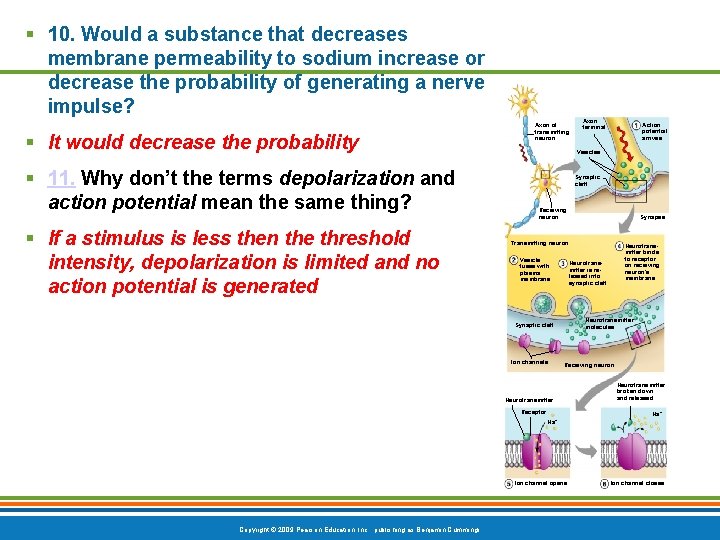
§ 10. Would a substance that decreases membrane permeability to sodium increase or decrease the probability of generating a nerve impulse? § It would decrease the probability § 11. Why don’t the terms depolarization and action potential mean the same thing? § If a stimulus is less then the threshold intensity, depolarization is limited and no action potential is generated Axon of transmitting neuron Axon terminal Action potential arrives Vesicles Synaptic cleft Receiving neuron Synapse Transmitting neuron Vesicle fuses with plasma membrane Neurotransmitter is released into synaptic cleft Neurotransmitter molecules Synaptic cleft Ion channels Neurotransmitter binds to receptor on receiving neuron’s membrane Receiving neuron Neurotransmitter Receptor Neurotransmitter broken down and released Na+ Ion channel opens Copyright © 2009 Pearson Education, Inc. , publishing as Benjamin Cummings Ion channel closes