
Functions of Commercial Banks in India Dr Manish
Functions of Commercial Banks in India Dr. Manish Dadhich
Banking Structure in India • A well-regulated banking system is a key comfort for local and foreign stake-holders in any country. Prudent banking regulation is recognized as one of the reasons why India was less affected by the global financial crisis. • Banks can be broadly categorized as Commercial Banks or Co-operative Banks. • Banks which meet specific criteria are included in the second schedule of the RBI Act, 1934. These are called scheduled banks. They may be commercial banks or cooperative banks. Scheduled banks are considered to be safer, and are entitled to special facilities like re-finance from RBI. Inclusion in the schedule also comes with its responsibilities of reporting to RBI and maintaining a percentage of its demand time liabilities as Cash Reserve Ratio (CRR) with RBI.

Broad Classification of Banks in India 1) The RBI: The RBI is the supreme monetary and banking authority in the country and has the responsibility to control the banking system in the country. It keeps the reserves of all scheduled banks and hence is known as the “Reserve Bank”. 2) Public Sector Banks: State Bank of India Nationalized Banks (19) Regional Rural Banks Sponsored by Public Sector Banks (196) 3) Private Sector Banks: Old Generation Private Banks (22) Foreign New Generation Private Banks (8) Banks in India (40)
4) Co-operative Sector Banks: State Co-operative Banks Central Co-operative Banks Primary Agricultural Credit Societies Land Development Banks State Land Development Banks 5) Development Banks: Development Banks mostly provide long term finance for setting up industries. They also provide short-term finance (for export and import activities) Industrial Finance Co-operation of India (IFCI) Industrial Development of India (IDBI) Industrial Investment Bank of India (IIBI) Small Industries Development Bank of India (SIDBI) National Bank for Agriculture and Rural Development (NABARD) Export-Import Bank of India (EXIM)
Commercial Banks • Commercial banks comprising public sector banks, foreign banks, and private sector banks represent the most important financial intermediary in the Indian financial system. The changes in banking structure and control have resulted due to wider geographical spread and deeper penetration of rural areas, higher mobilization of deposits, reallocation of bank credit to priority activities, and lower operational autonomy for a bank management. Public sector commercial banks, dominate the commercial banking scene in the country. The largest commercial Banks in India is SBI 5
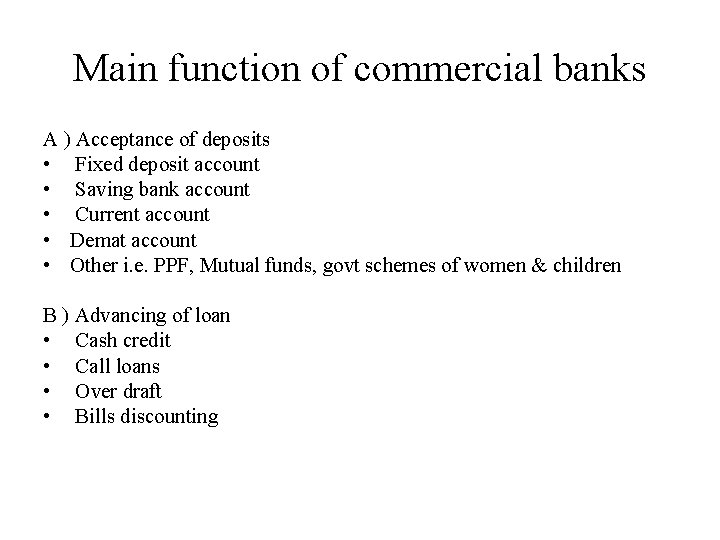
Main function of commercial banks A ) Acceptance of deposits • Fixed deposit account • Saving bank account • Current account • Demat account • Other i. e. PPF, Mutual funds, govt schemes of women & children B ) Advancing of loan • Cash credit • Call loans • Over draft • Bills discounting
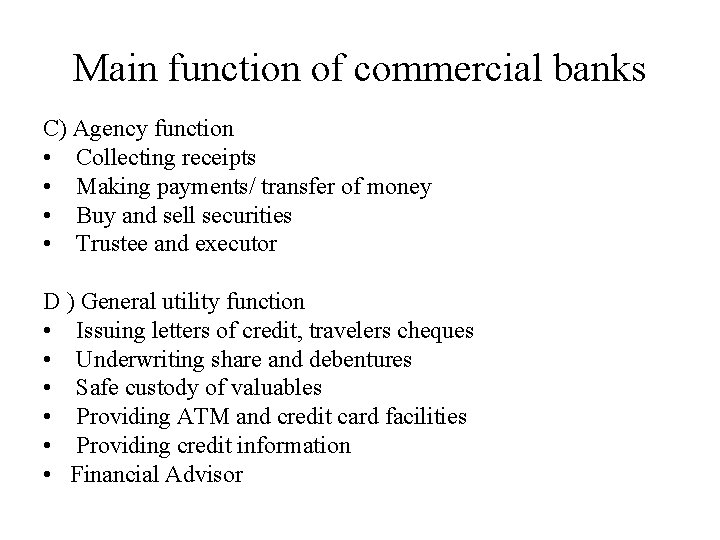
Main function of commercial banks C) Agency function • Collecting receipts • Making payments/ transfer of money • Buy and sell securities • Trustee and executor D ) General utility function • Issuing letters of credit, travelers cheques • Underwriting share and debentures • Safe custody of valuables • Providing ATM and credit card facilities • Providing credit information • Financial Advisor

Cooperative Bank • These banks play a vital role in mobilizing savings and stimulating agricultural investment. Co-operative credit institutions account for the second largest proportion of 44. 6% of total institutional credit. The co-operative sector is very much useful for rural people. The co-operative banking sector is divided into the following categories. • State co-operative Banks • Central co-operative banks • Primary Agriculture Credit Societies 8

Development Banks • A development bank may be defined as a financial institution concerned with providing all types of financial assistance to business units in the form of loans, underwriting, investment and guarantee operations and promotional activities-economic development in general and industrial development in particular • A development bank is basically a term lending institution. It is a multipurpose financial institution with a broad development outlook. • The industrial finance corporation of India, the first development bank was established in 1948. Subsequently many other institutions were set-up. Ex. IDBI, IFCI, SIDBI etc. 9

Functions of Development Banks • • Fostering industrial growth Providing Long term assistant Balanced development Providing Promotional services Infrastructure building Entrepreneur Development Fulfilling Socio economic objectives 10
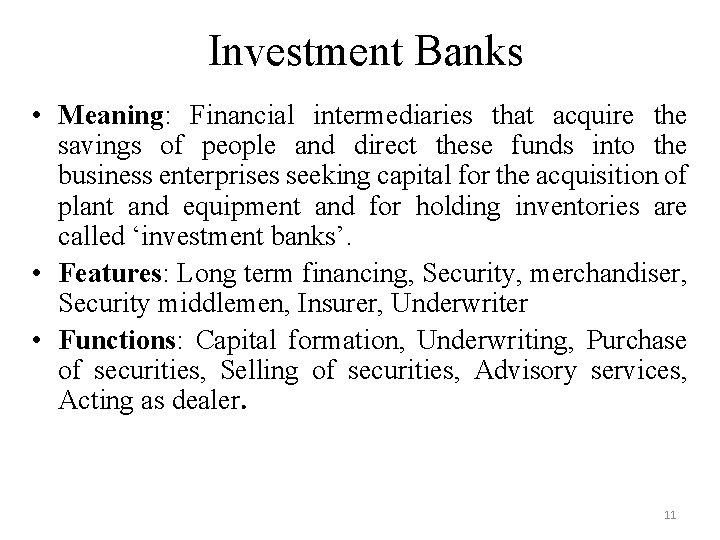
Investment Banks • Meaning: Financial intermediaries that acquire the savings of people and direct these funds into the business enterprises seeking capital for the acquisition of plant and equipment and for holding inventories are called ‘investment banks’. • Features: Long term financing, Security, merchandiser, Security middlemen, Insurer, Underwriter • Functions: Capital formation, Underwriting, Purchase of securities, Selling of securities, Advisory services, Acting as dealer. 11
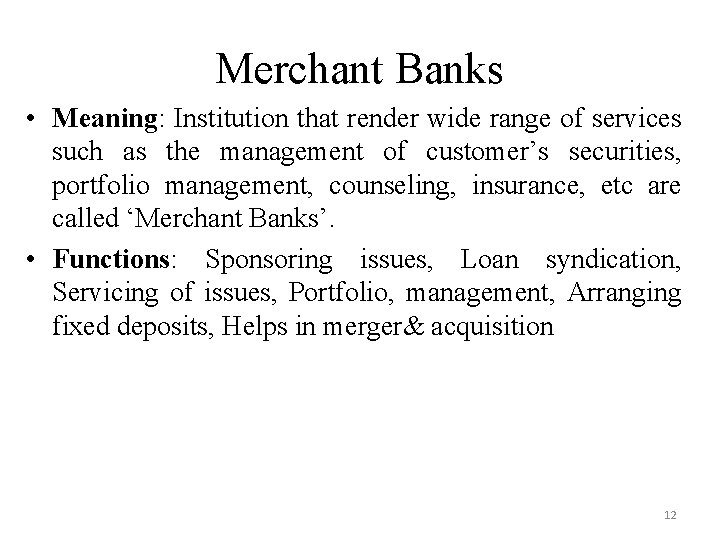
Merchant Banks • Meaning: Institution that render wide range of services such as the management of customer’s securities, portfolio management, counseling, insurance, etc are called ‘Merchant Banks’. • Functions: Sponsoring issues, Loan syndication, Servicing of issues, Portfolio, management, Arranging fixed deposits, Helps in merger& acquisition 12
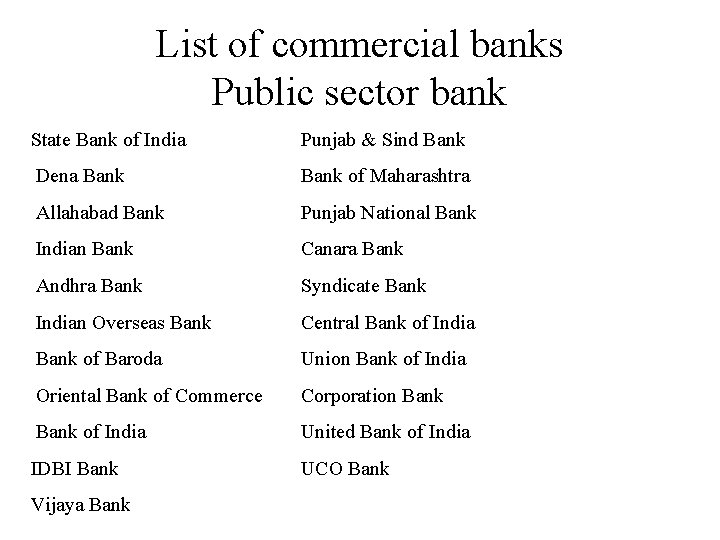
List of commercial banks Public sector bank State Bank of India Punjab & Sind Bank Dena Bank of Maharashtra Allahabad Bank Punjab National Bank Indian Bank Canara Bank Andhra Bank Syndicate Bank Indian Overseas Bank Central Bank of India Bank of Baroda Union Bank of India Oriental Bank of Commerce Corporation Bank of India United Bank of India IDBI Bank UCO Bank Vijaya Bank
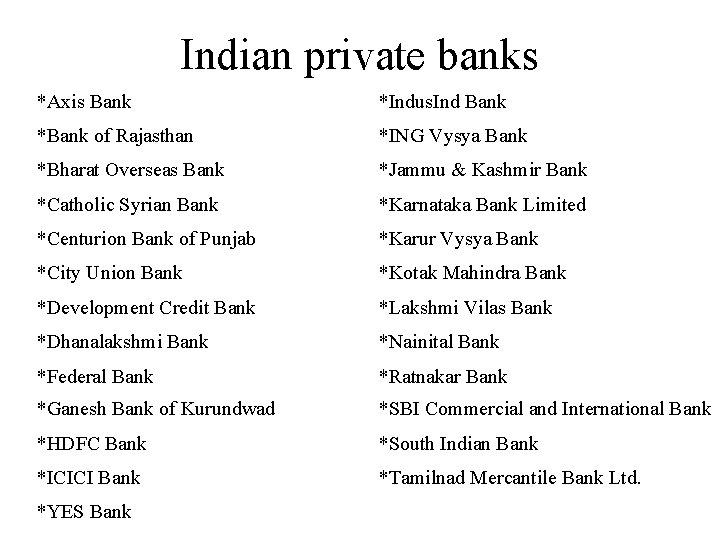
Indian private banks *Axis Bank *Indus. Ind Bank *Bank of Rajasthan *ING Vysya Bank *Bharat Overseas Bank *Jammu & Kashmir Bank *Catholic Syrian Bank *Karnataka Bank Limited *Centurion Bank of Punjab *Karur Vysya Bank *City Union Bank *Kotak Mahindra Bank *Development Credit Bank *Lakshmi Vilas Bank *Dhanalakshmi Bank *Nainital Bank *Federal Bank *Ratnakar Bank *Ganesh Bank of Kurundwad *SBI Commercial and International Bank *HDFC Bank *South Indian Bank *ICICI Bank *Tamilnad Mercantile Bank Ltd. *YES Bank
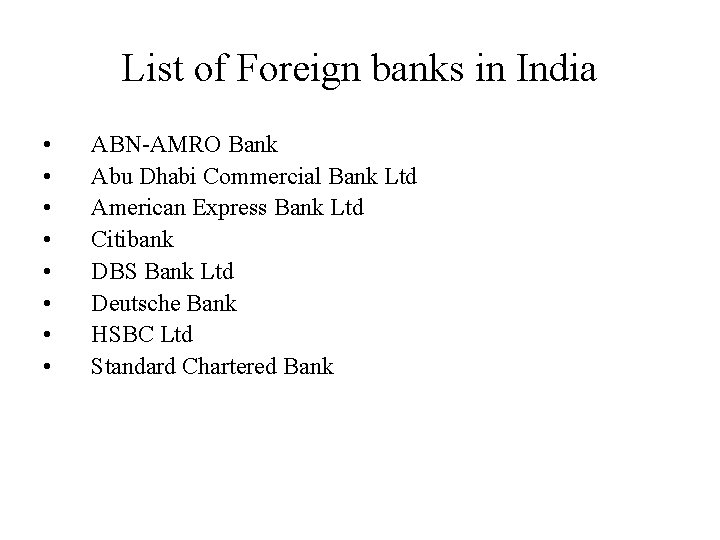
List of Foreign banks in India • • ABN-AMRO Bank Abu Dhabi Commercial Bank Ltd American Express Bank Ltd Citibank DBS Bank Ltd Deutsche Bank HSBC Ltd Standard Chartered Bank
- Slides: 15