
Functions Introduction to Functions Definition A function f

- Slides: 43
Functions
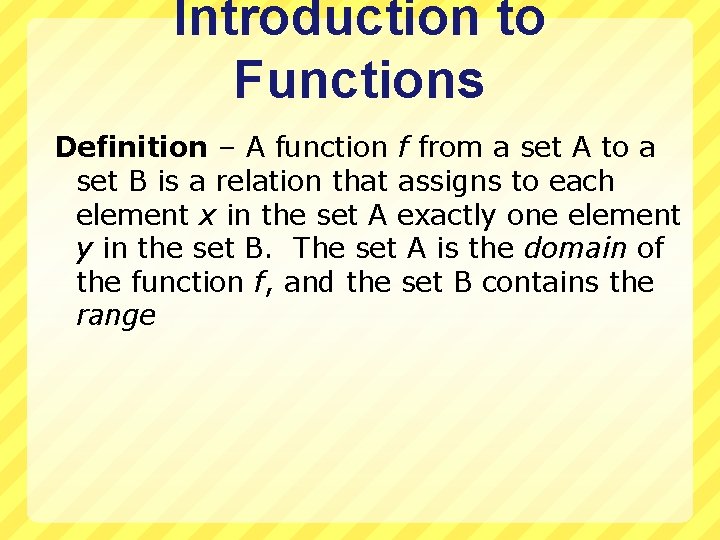
Introduction to Functions Definition – A function f from a set A to a set B is a relation that assigns to each element x in the set A exactly one element y in the set B. The set A is the domain of the function f, and the set B contains the range
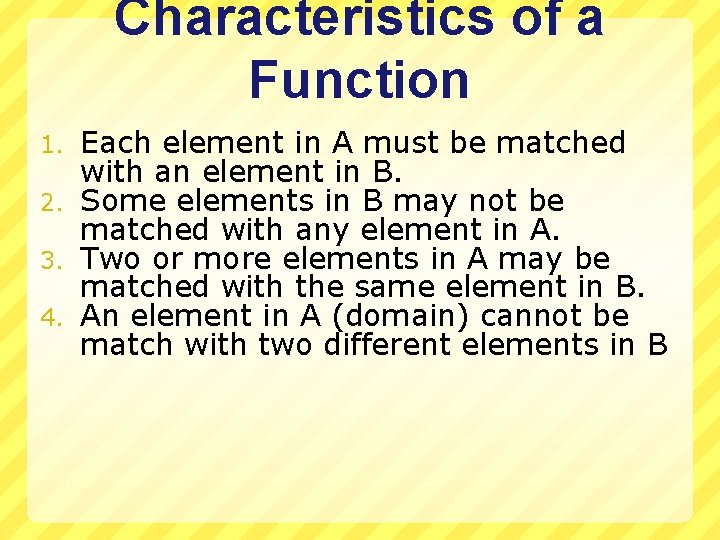
Characteristics of a Function Each element in A must be matched with an element in B. 2. Some elements in B may not be matched with any element in A. 3. Two or more elements in A may be matched with the same element in B. 4. An element in A (domain) cannot be match with two different elements in B 1.
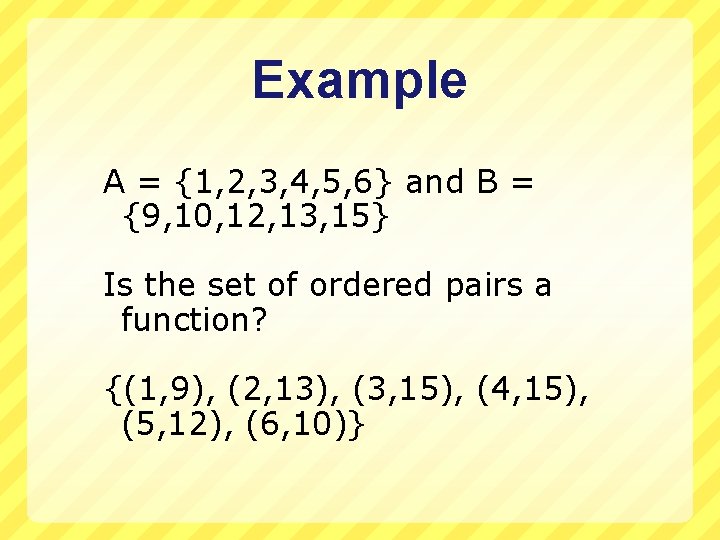
Example A = {1, 2, 3, 4, 5, 6} and B = {9, 10, 12, 13, 15} Is the set of ordered pairs a function? {(1, 9), (2, 13), (3, 15), (4, 15), (5, 12), (6, 10)}
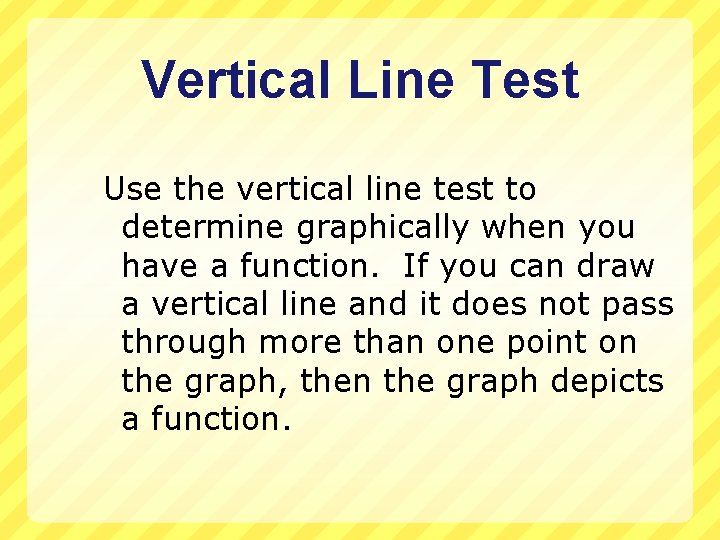
Vertical Line Test Use the vertical line test to determine graphically when you have a function. If you can draw a vertical line and it does not pass through more than one point on the graph, then the graph depicts a function.
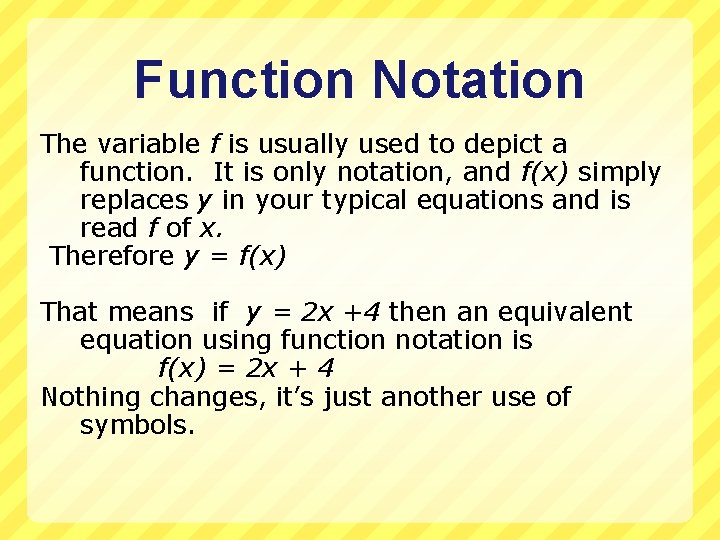
Function Notation The variable f is usually used to depict a function. It is only notation, and f(x) simply replaces y in your typical equations and is read f of x. Therefore y = f(x) That means if y = 2 x +4 then an equivalent equation using function notation is f(x) = 2 x + 4 Nothing changes, it’s just another use of symbols.
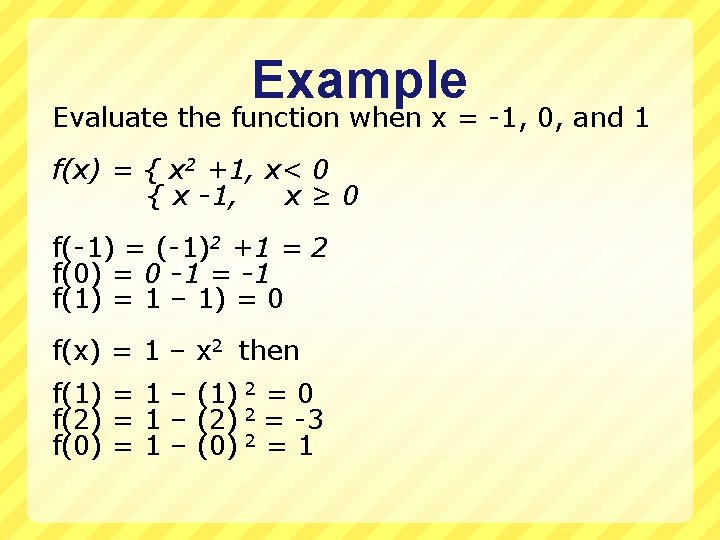
Example Evaluate the function when x = -1, 0, and 1 f(x) = { x 2 +1, x< 0 { x -1, x≥ 0 f(-1) = (-1)2 +1 = 2 f(0) = 0 -1 = -1 f(1) = 1 – 1) = 0 f(x) = 1 – x 2 then f(1) = 1 – (1) 2 = 0 f(2) = 1 – (2) 2 = -3 f(0) = 1 – (0) 2 = 1
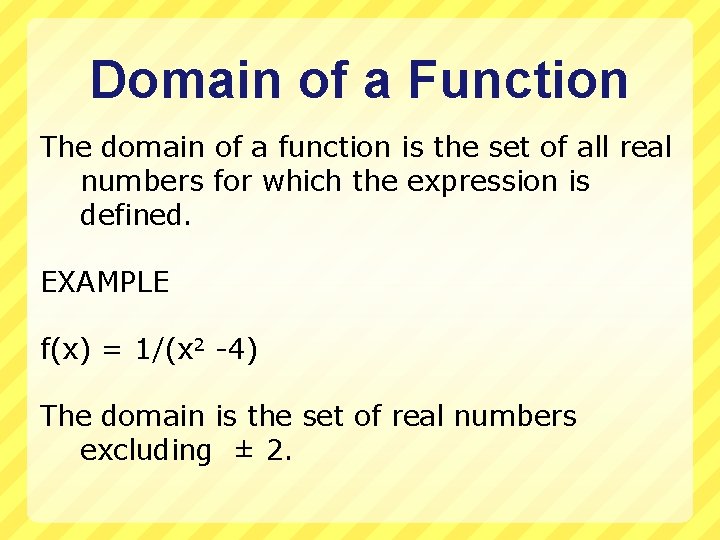
Domain of a Function The domain of a function is the set of all real numbers for which the expression is defined. EXAMPLE f(x) = 1/(x 2 -4) The domain is the set of real numbers excluding ± 2.
Analyzing Graphs of Functions
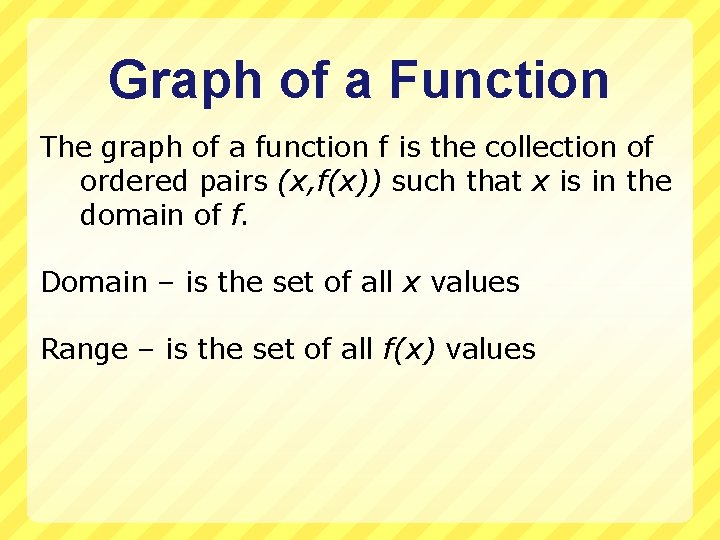
Graph of a Function The graph of a function f is the collection of ordered pairs (x, f(x)) such that x is in the domain of f. Domain – is the set of all x values Range – is the set of all f(x) values
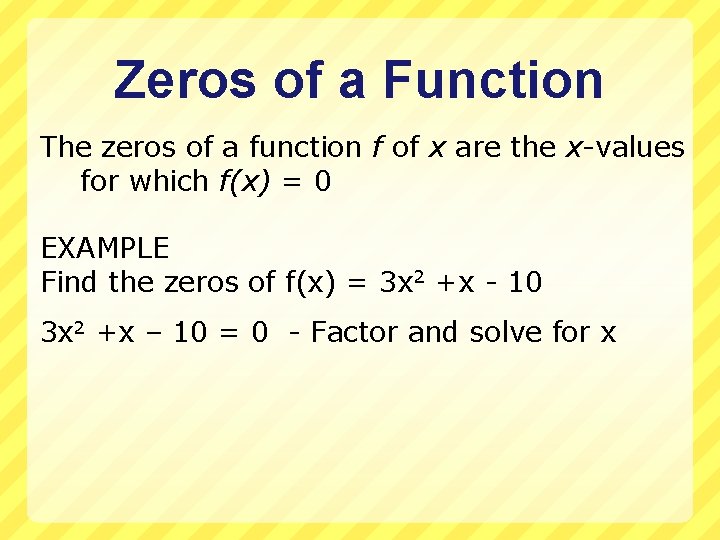
Zeros of a Function The zeros of a function f of x are the x-values for which f(x) = 0 EXAMPLE Find the zeros of f(x) = 3 x 2 +x - 10 3 x 2 +x – 10 = 0 - Factor and solve for x
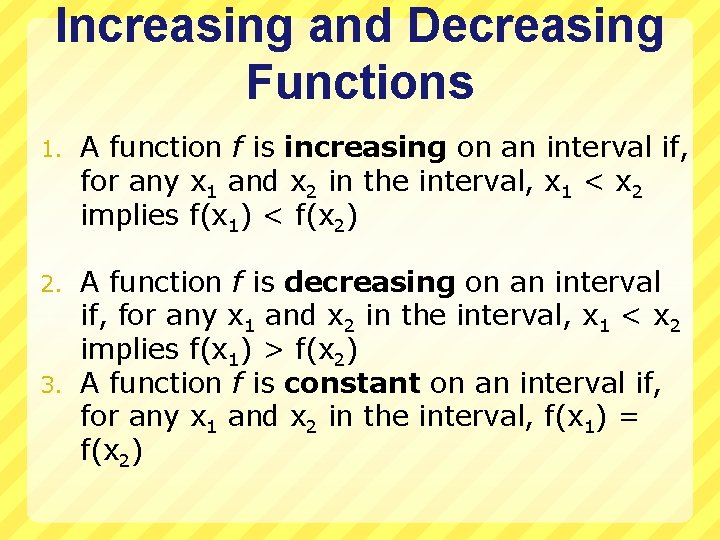
Increasing and Decreasing Functions 1. A function f is increasing on an interval if, for any x 1 and x 2 in the interval, x 1 < x 2 implies f(x 1) < f(x 2) A function f is decreasing on an interval if, for any x 1 and x 2 in the interval, x 1 < x 2 implies f(x 1) > f(x 2) 3. A function f is constant on an interval if, for any x 1 and x 2 in the interval, f(x 1) = f(x 2) 2.
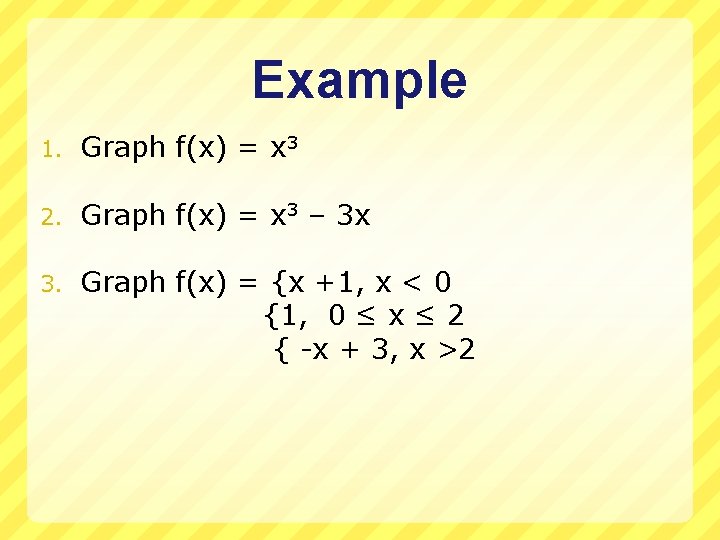
Example 1. Graph f(x) = x 3 2. Graph f(x) = x 3 – 3 x 3. Graph f(x) = {x +1, x < 0 {1, 0 ≤ x ≤ 2 { -x + 3, x >2
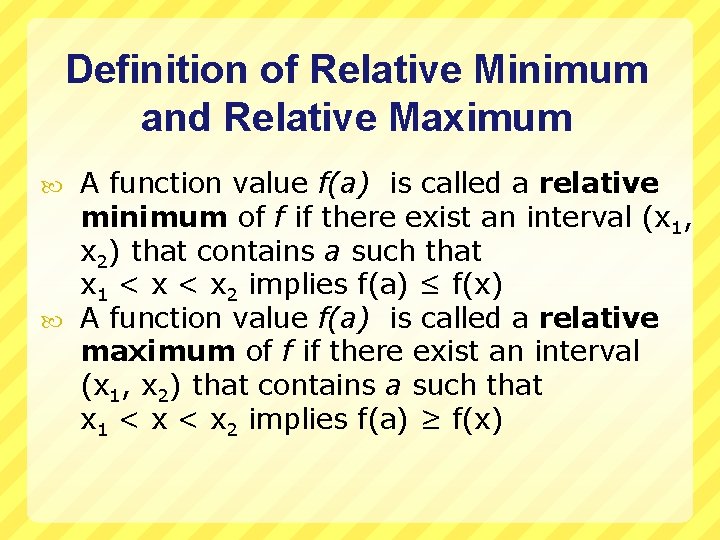
Definition of Relative Minimum and Relative Maximum A function value f(a) is called a relative minimum of f if there exist an interval (x 1, x 2) that contains a such that x 1 < x 2 implies f(a) ≤ f(x) A function value f(a) is called a relative maximum of f if there exist an interval (x 1, x 2) that contains a such that x 1 < x 2 implies f(a) ≥ f(x)
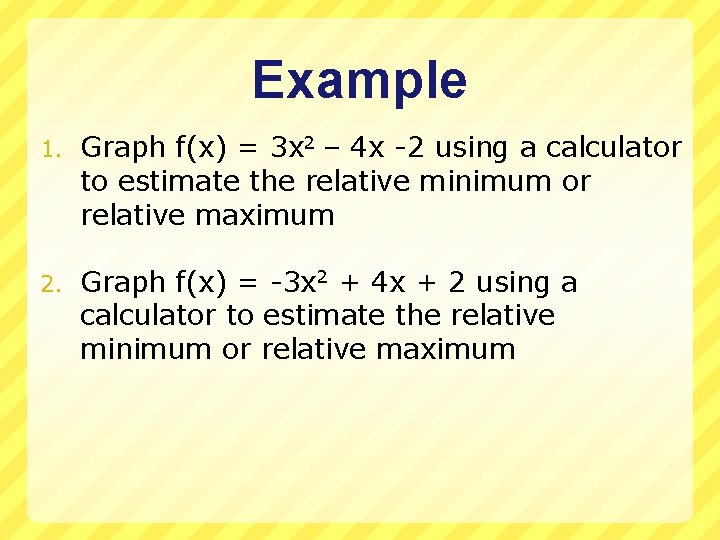
Example 1. Graph f(x) = 3 x 2 – 4 x -2 using a calculator to estimate the relative minimum or relative maximum 2. Graph f(x) = -3 x 2 + 4 x + 2 using a calculator to estimate the relative minimum or relative maximum
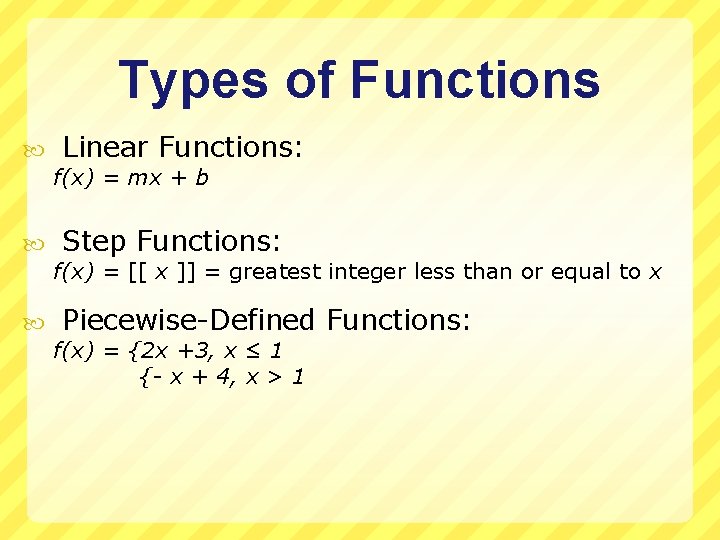
Types of Functions Linear Functions: f(x) = mx + b Step Functions: f(x) = [[ x ]] = greatest integer less than or equal to x Piecewise-Defined Functions: f(x) = {2 x +3, x ≤ 1 {- x + 4, x > 1
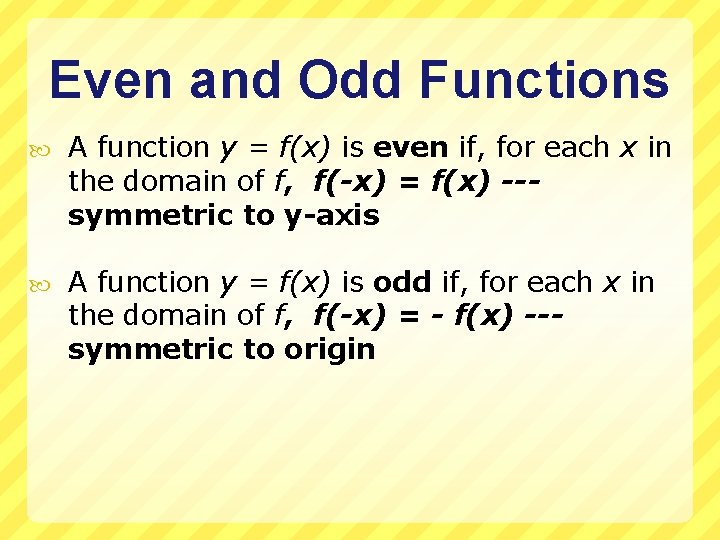
Even and Odd Functions A function y = f(x) is even if, for each x in the domain of f, f(-x) = f(x) --symmetric to y-axis A function y = f(x) is odd if, for each x in the domain of f, f(-x) = - f(x) --symmetric to origin
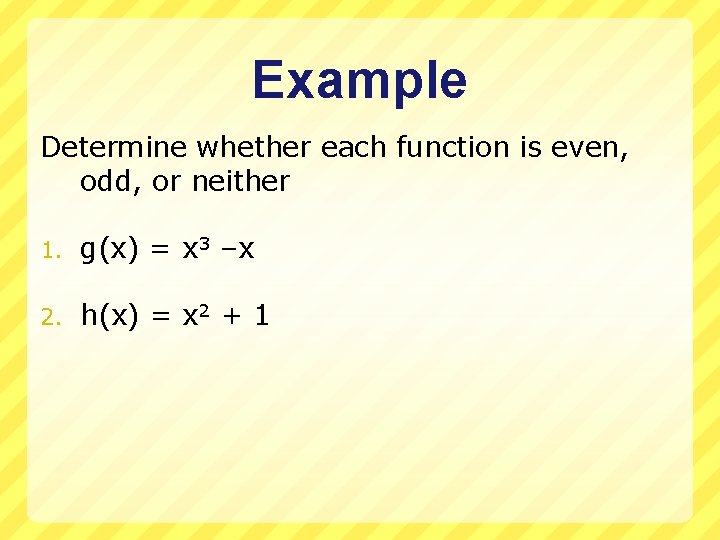
Example Determine whether each function is even, odd, or neither 1. g(x) = x 3 –x 2. h(x) = x 2 + 1
Shifting, Reflecting, and Stretching Graphs
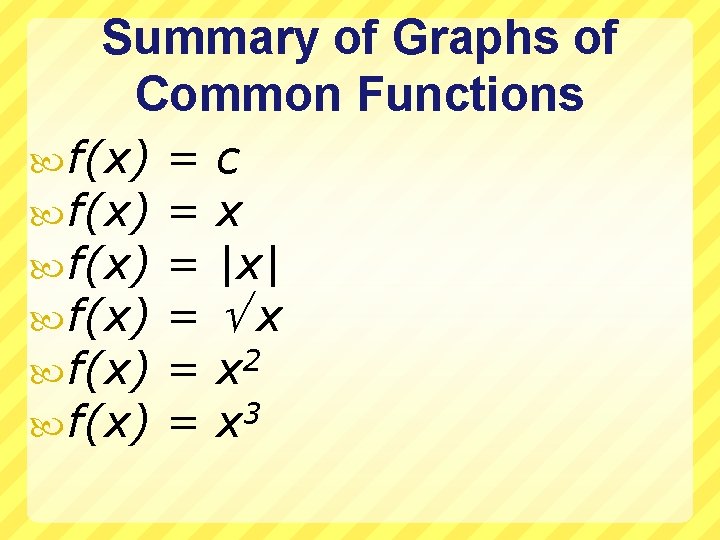
Summary of Graphs of Common Functions f(x) f(x) = = = c x |x| x 2 x x 3
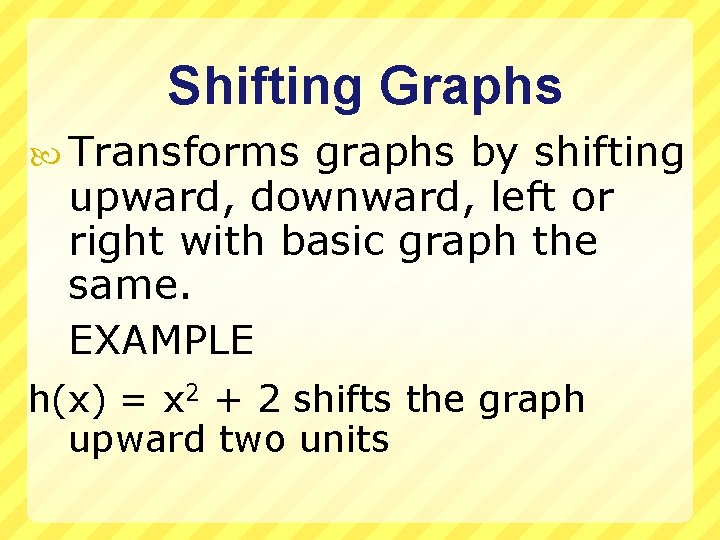
Shifting Graphs Transforms graphs by shifting upward, downward, left or right with basic graph the same. EXAMPLE h(x) = x 2 + 2 shifts the graph upward two units
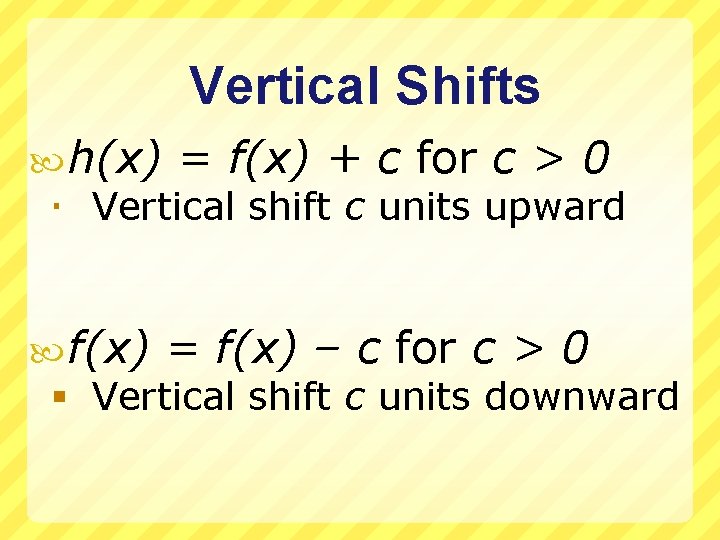
Vertical Shifts h(x) = f(x) + c for c > 0 Vertical shift c units upward f(x) = f(x) – c for c > 0 § Vertical shift c units downward
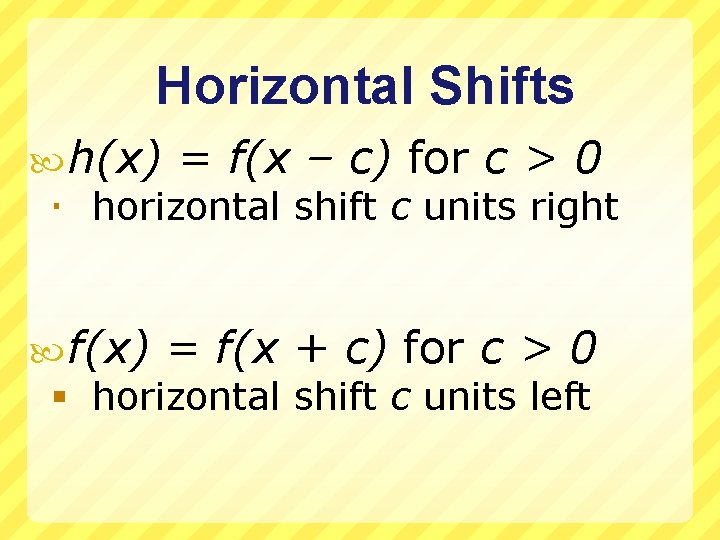
Horizontal Shifts h(x) = f(x – c) for c > 0 f(x) = f(x + c) for c > 0 horizontal shift c units right § horizontal shift c units left
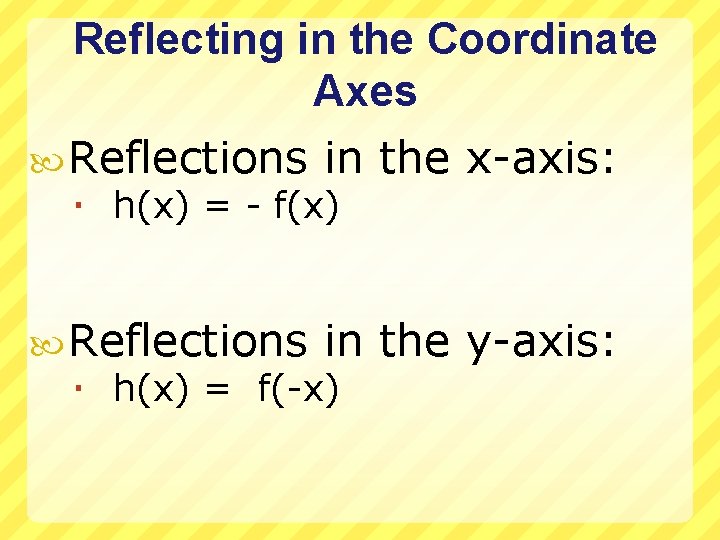
Reflecting in the Coordinate Axes Reflections in h(x) = - f(x) the x-axis: Reflections in h(x) = f(-x) the y-axis:
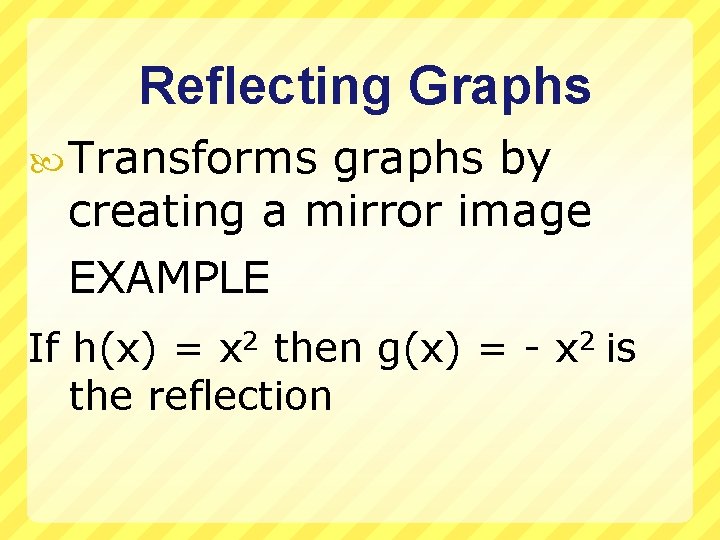
Reflecting Graphs Transforms graphs by creating a mirror image EXAMPLE If h(x) = x 2 then g(x) = - x 2 is the reflection
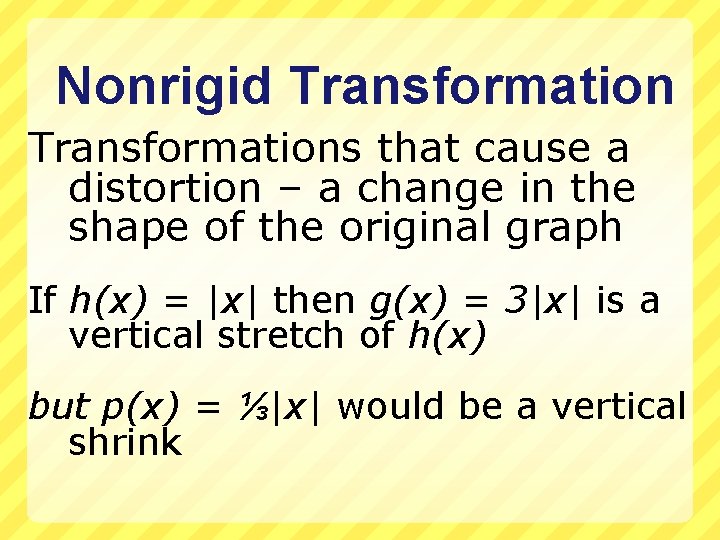
Nonrigid Transformations that cause a distortion – a change in the shape of the original graph If h(x) = |x| then g(x) = 3|x| is a vertical stretch of h(x) but p(x) = ⅓|x| would be a vertical shrink
Combinations of Functions
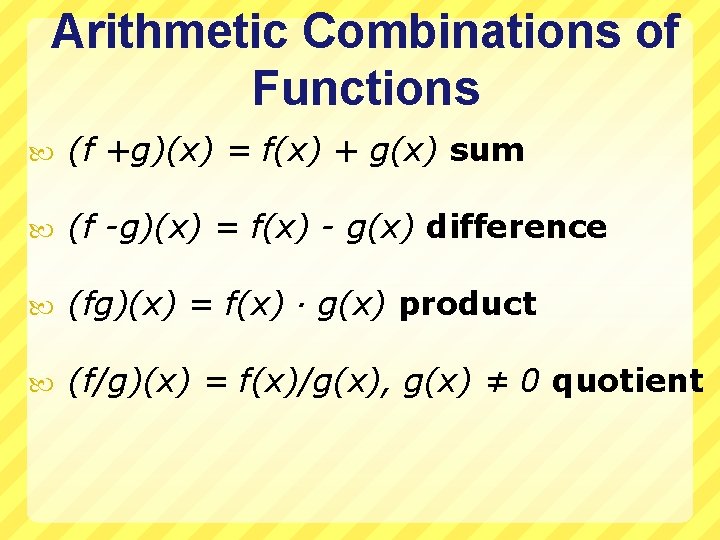
Arithmetic Combinations of Functions (f +g)(x) = f(x) + g(x) sum (f -g)(x) = f(x) - g(x) difference (fg)(x) = f(x) · g(x) product (f/g)(x) = f(x)/g(x), g(x) ≠ 0 quotient
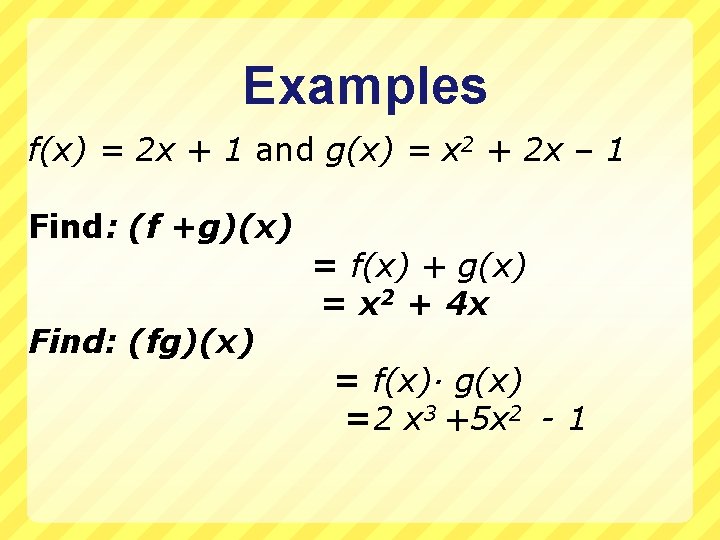
Examples f(x) = 2 x + 1 and g(x) = x 2 + 2 x – 1 Find: (f +g)(x) Find: (fg)(x) = f(x) + g(x) = x 2 + 4 x = f(x)· g(x) =2 x 3 +5 x 2 - 1
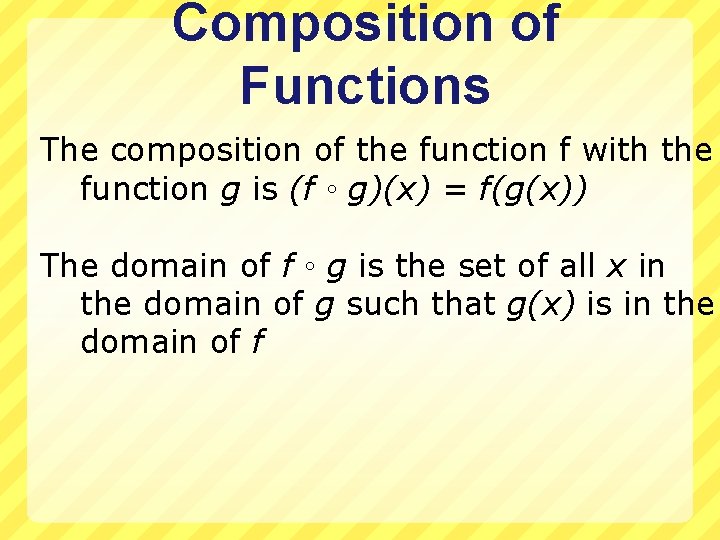
Composition of Functions The composition of the function f with the function g is (f ◦ g)(x) = f(g(x)) The domain of f ◦ g is the set of all x in the domain of g such that g(x) is in the domain of f
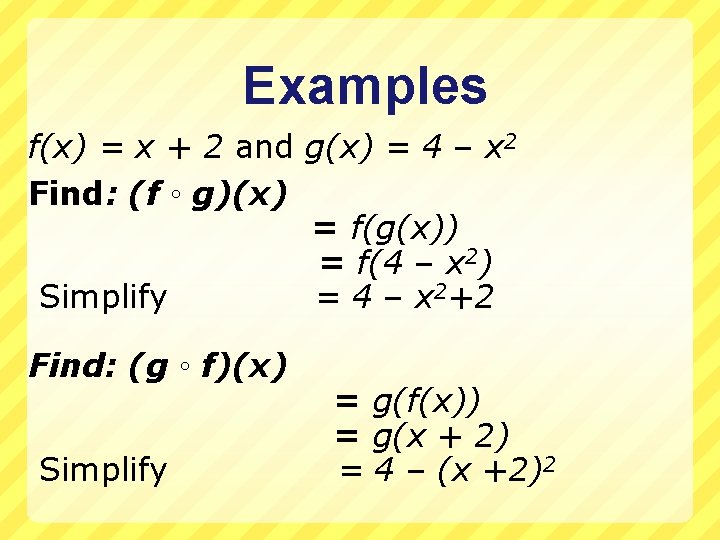
Examples f(x) = x + 2 and g(x) = 4 – x 2 Find: (f ◦ g)(x) = f(g(x)) = f(4 – x 2) Simplify = 4 – x 2+2 Find: (g ◦ f)(x) Simplify = g(f(x)) = g(x + 2) = 4 – (x +2)2
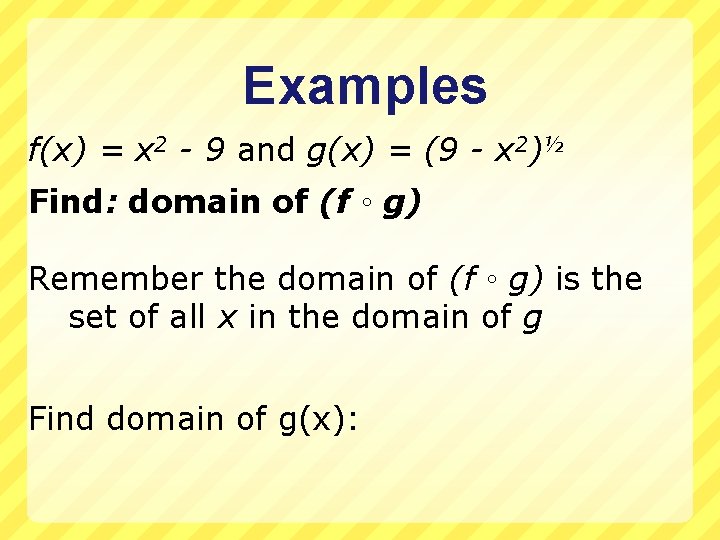
Examples f(x) = x 2 - 9 and g(x) = (9 - x 2)½ Find: domain of (f ◦ g) Remember the domain of (f ◦ g) is the set of all x in the domain of g Find domain of g(x):
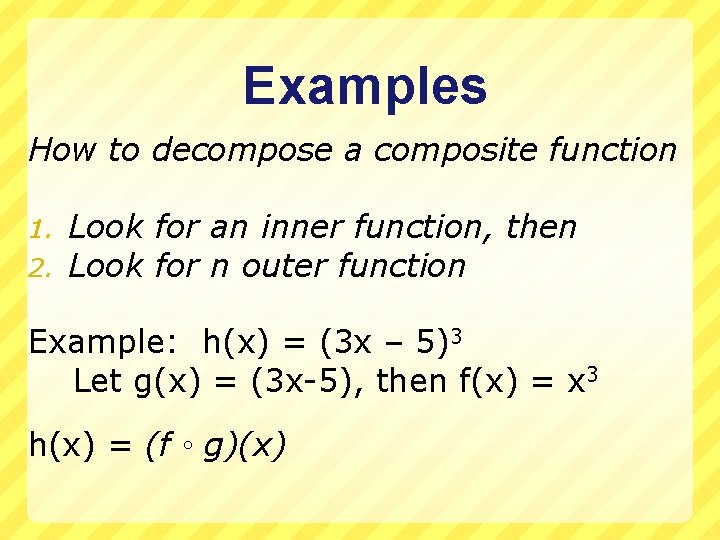
Examples How to decompose a composite function 1. 2. Look for an inner function, then Look for n outer function Example: h(x) = (3 x – 5)3 Let g(x) = (3 x-5), then f(x) = x 3 h(x) = (f ◦ g)(x)
Inverse of Functions
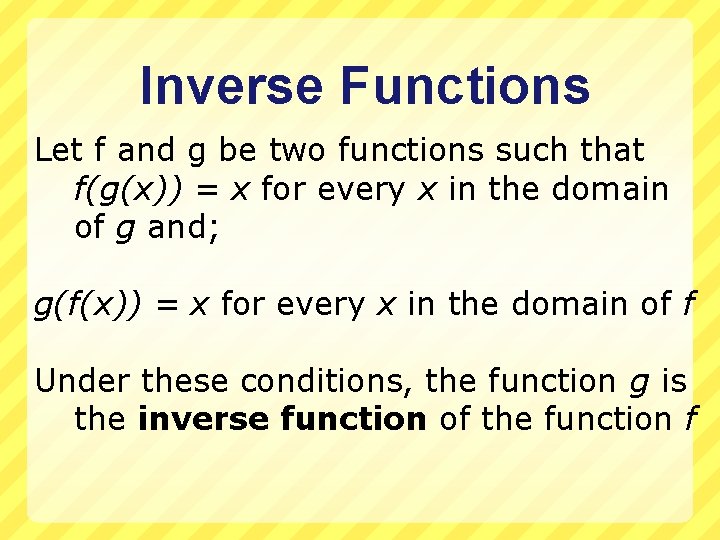
Inverse Functions Let f and g be two functions such that f(g(x)) = x for every x in the domain of g and; g(f(x)) = x for every x in the domain of f Under these conditions, the function g is the inverse function of the function f
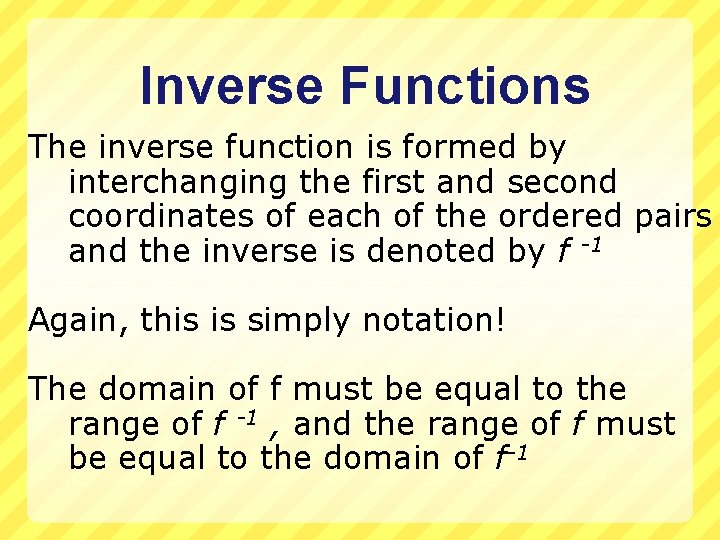
Inverse Functions The inverse function is formed by interchanging the first and second coordinates of each of the ordered pairs and the inverse is denoted by f -1 Again, this is simply notation! The domain of f must be equal to the range of f -1 , and the range of f must be equal to the domain of f-1
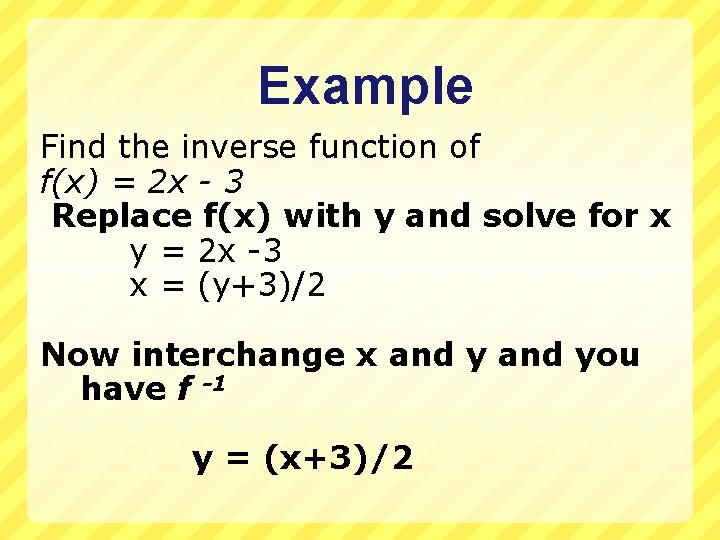
Example Find the inverse function of f(x) = 2 x - 3 Replace f(x) with y and solve for x y = 2 x -3 x = (y+3)/2 Now interchange x and you have f -1 y = (x+3)/2
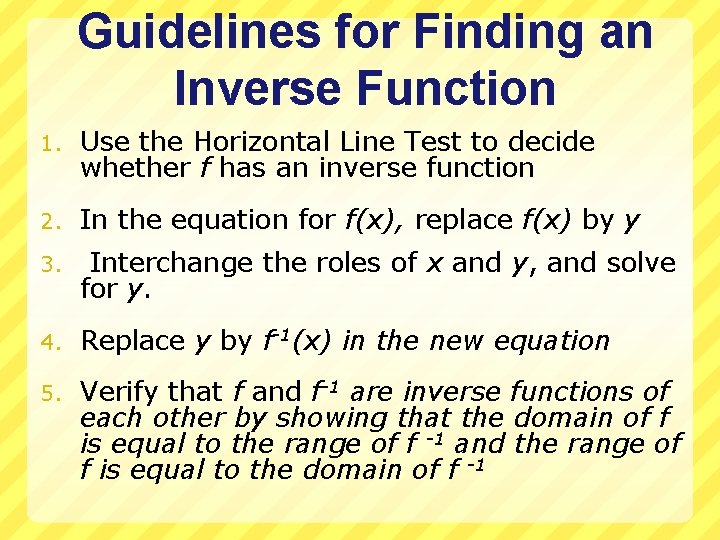
Guidelines for Finding an Inverse Function 1. Use the Horizontal Line Test to decide whether f has an inverse function 2. In the equation for f(x), replace f(x) by y 3. Interchange the roles of x and y, and solve for y. 4. Replace y by f-1(x) in the new equation 5. Verify that f and f-1 are inverse functions of each other by showing that the domain of f is equal to the range of f -1 and the range of f is equal to the domain of f -1
Mathematical Modeling
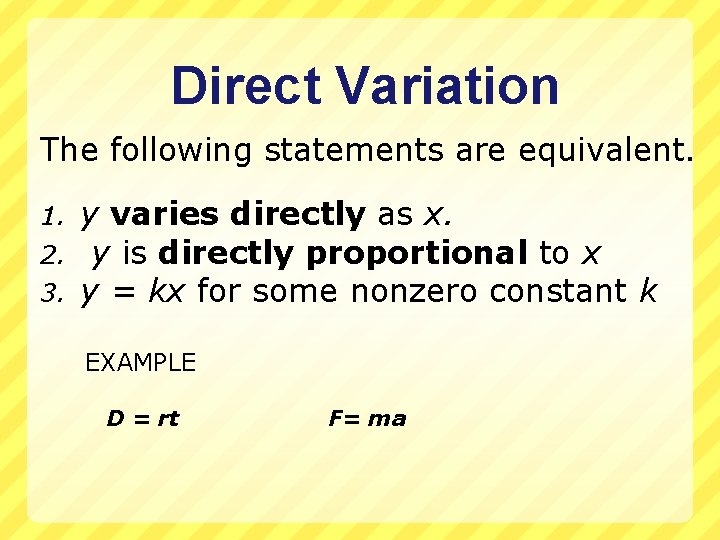
Direct Variation The following statements are equivalent. 1. 2. 3. y varies directly as x. y is directly proportional to x y = kx for some nonzero constant k EXAMPLE D = rt F= ma
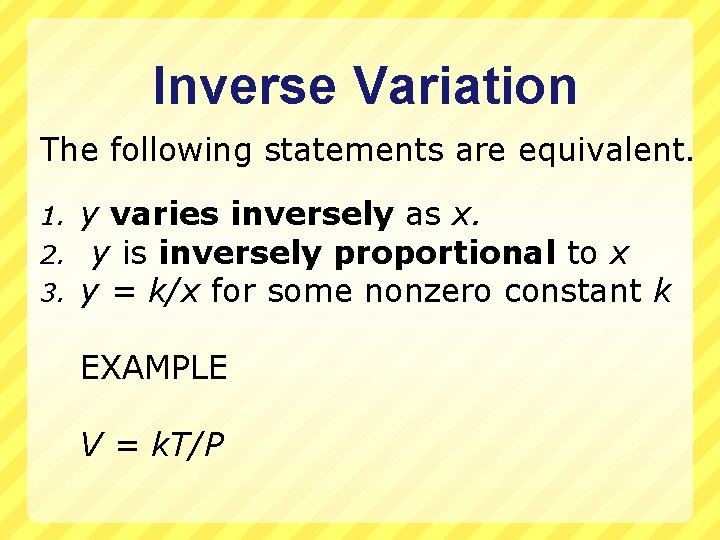
Inverse Variation The following statements are equivalent. 1. 2. 3. y varies inversely as x. y is inversely proportional to x y = k/x for some nonzero constant k EXAMPLE V = k. T/P
END