
Functions Chapter 6 8 11192008 CS 150 Introduction
![Arrays as Function Arguments void print. Int. Array(int arr[], int size) { for(int i](https://slidetodoc.com/presentation_image_h2/64b303835992ea1cb99aee0d5ec512f1/image-4.jpg "Arrays as Function Arguments void print. Int. Array(int arr[], int size) { for(int i")
- Slides: 21
Functions Chapter 6, 8 11/19/2008 CS 150 Introduction to Computer Science 1 1
Review Functions o Prototype o Call o Definition Passing arguments o By value o By reference 11/19/2008 CS 150 Introduction to Computer Science 1 2
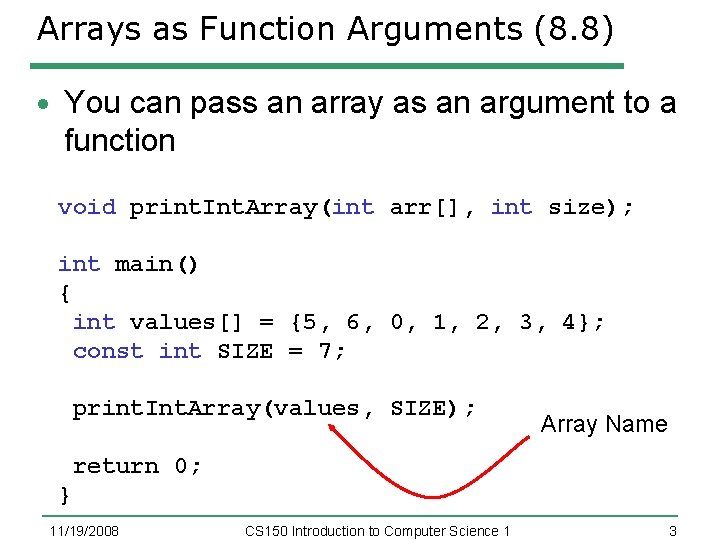
Arrays as Function Arguments (8. 8) You can pass an array as an argument to a function void print. Int. Array(int arr[], int size); int main() { int values[] = {5, 6, 0, 1, 2, 3, 4}; const int SIZE = 7; print. Int. Array(values, SIZE); Array Name return 0; } 11/19/2008 CS 150 Introduction to Computer Science 1 3
Arrays as Function Arguments void print. Int. Array(int arr[], int size) { for(int i = 0; i < size; i++) { cout << arr[i] << endl; } } 11/19/2008 CS 150 Introduction to Computer Science 1 4
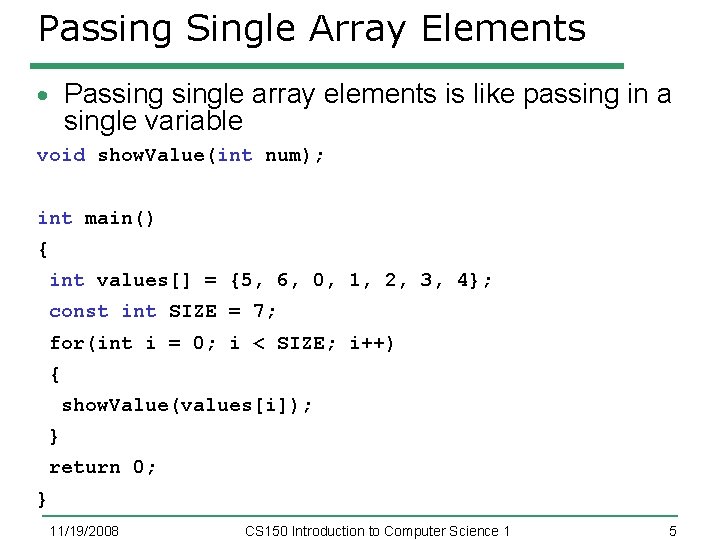
Passing Single Array Elements Passingle array elements is like passing in a single variable void show. Value(int num); int main() { int values[] = {5, 6, 0, 1, 2, 3, 4}; const int SIZE = 7; for(int i = 0; i < SIZE; i++) { show. Value(values[i]); } return 0; } 11/19/2008 CS 150 Introduction to Computer Science 1 5
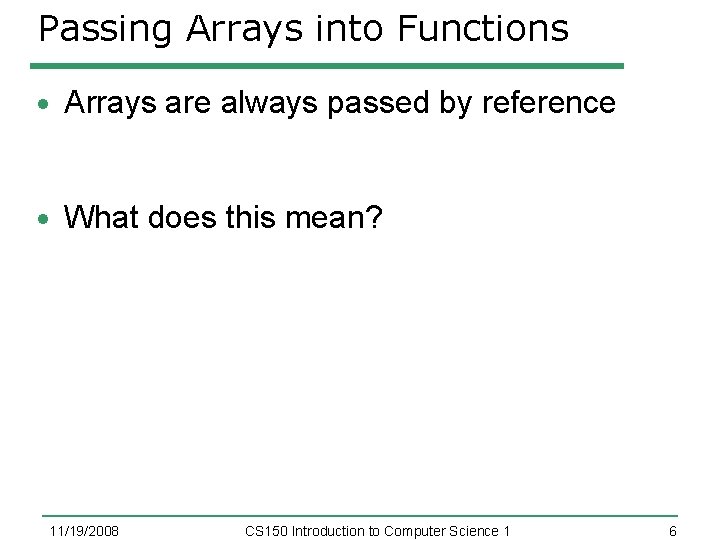
Passing Arrays into Functions Arrays are always passed by reference What does this mean? 11/19/2008 CS 150 Introduction to Computer Science 1 6
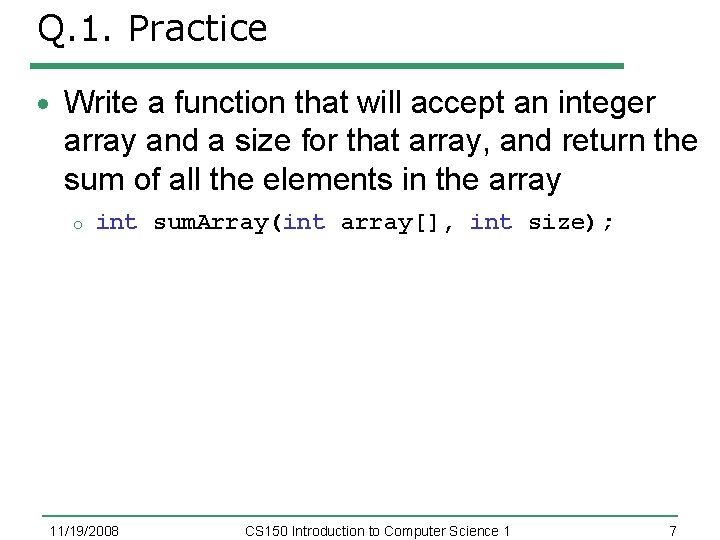
Q. 1. Practice Write a function that will accept an integer array and a size for that array, and return the sum of all the elements in the array o int sum. Array(int array[], int size); 11/19/2008 CS 150 Introduction to Computer Science 1 7
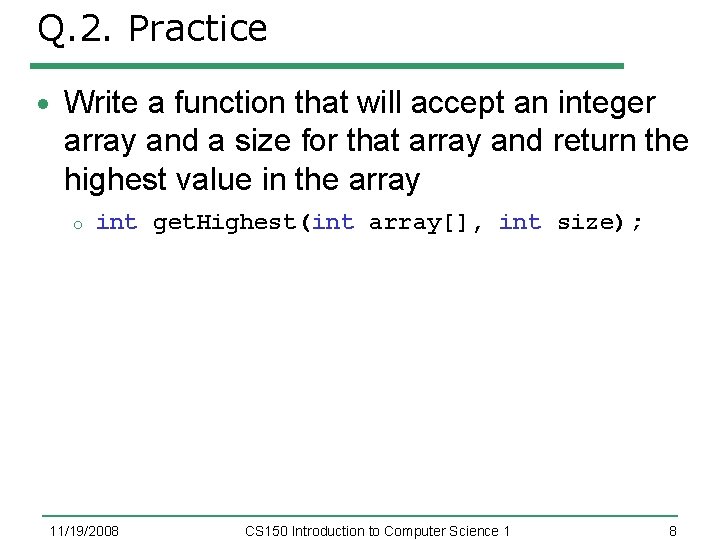
Q. 2. Practice Write a function that will accept an integer array and a size for that array and return the highest value in the array o int get. Highest(int array[], int size); 11/19/2008 CS 150 Introduction to Computer Science 1 8
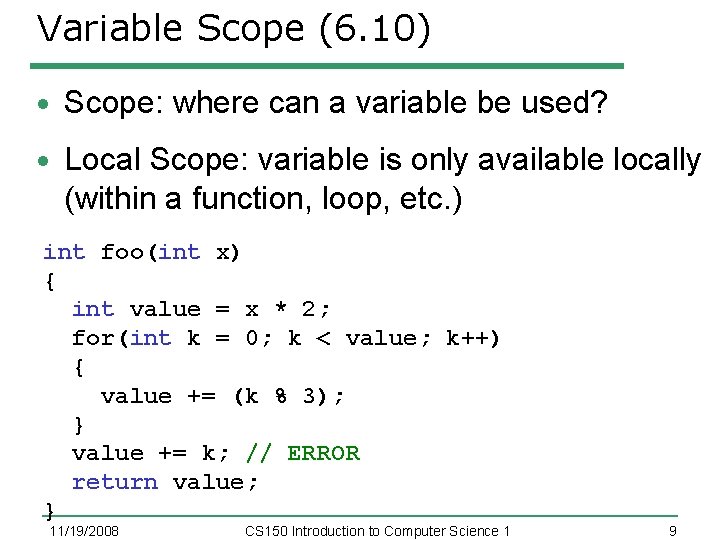
Variable Scope (6. 10) Scope: where can a variable be used? Local Scope: variable is only available locally (within a function, loop, etc. ) int foo(int x) { int value = x * 2; for(int k = 0; k < value; k++) { value += (k % 3); } value += k; // ERROR return value; } 11/19/2008 CS 150 Introduction to Computer Science 1 9
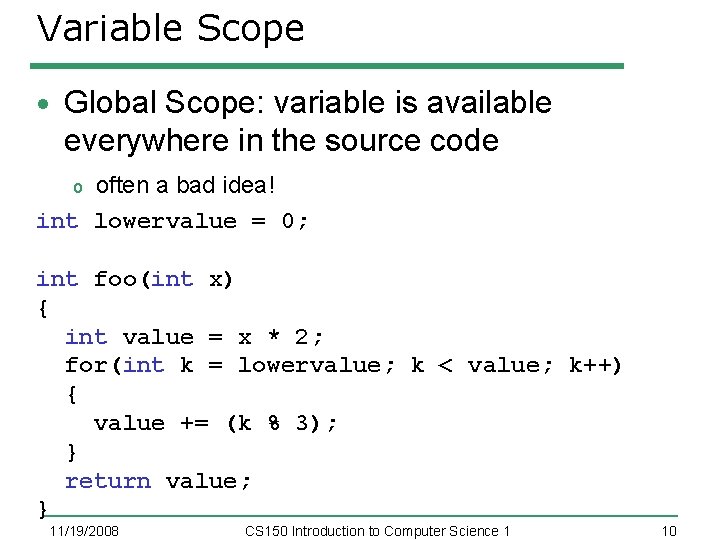
Variable Scope Global Scope: variable is available everywhere in the source code often a bad idea! int lowervalue = 0; o int foo(int x) { int value = x * 2; for(int k = lowervalue; k < value; k++) { value += (k % 3); } return value; } 11/19/2008 CS 150 Introduction to Computer Science 1 10
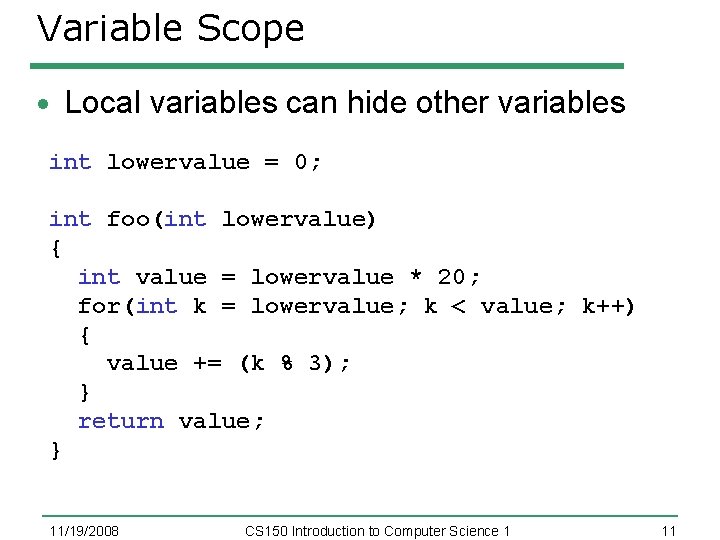
Variable Scope Local variables can hide other variables int lowervalue = 0; int foo(int lowervalue) { int value = lowervalue * 20; for(int k = lowervalue; k < value; k++) { value += (k % 3); } return value; } 11/19/2008 CS 150 Introduction to Computer Science 1 11
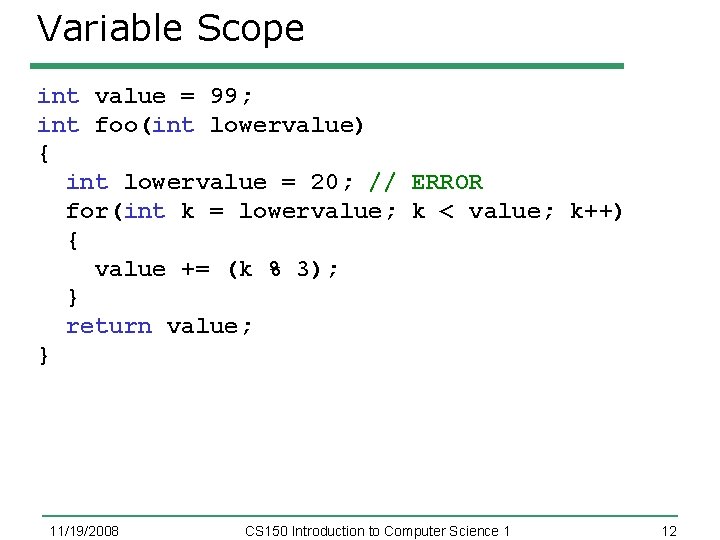
Variable Scope int value = 99; int foo(int lowervalue) { int lowervalue = 20; // ERROR for(int k = lowervalue; k < value; k++) { value += (k % 3); } return value; } 11/19/2008 CS 150 Introduction to Computer Science 1 12
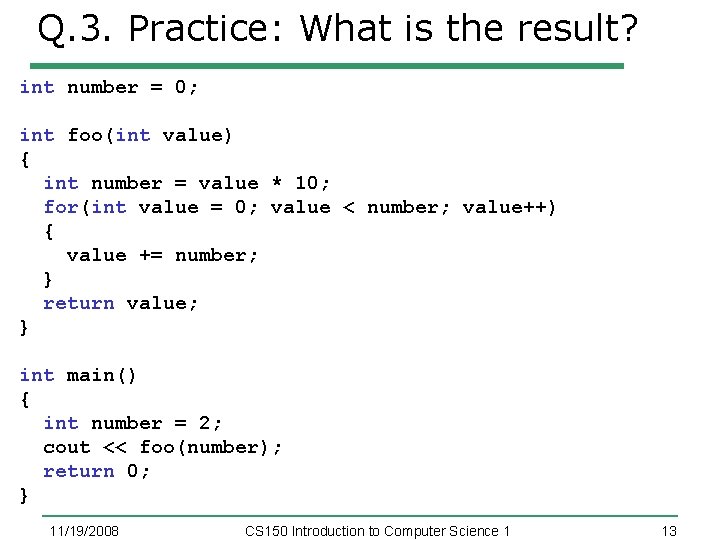
Q. 3. Practice: What is the result? int number = 0; int foo(int value) { int number = value * 10; for(int value = 0; value < number; value++) { value += number; } return value; } int main() { int number = 2; cout << foo(number); return 0; } 11/19/2008 CS 150 Introduction to Computer Science 1 13
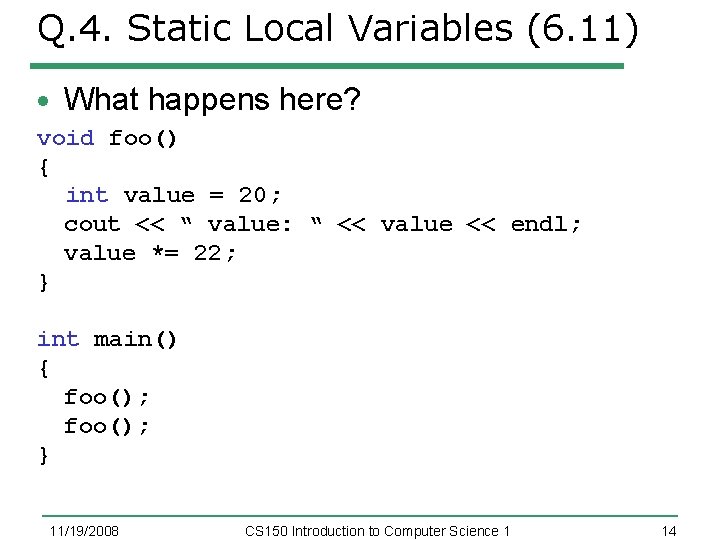
Q. 4. Static Local Variables (6. 11) What happens here? void foo() { int value = 20; cout << “ value: “ << value << endl; value *= 22; } int main() { foo(); } 11/19/2008 CS 150 Introduction to Computer Science 1 14
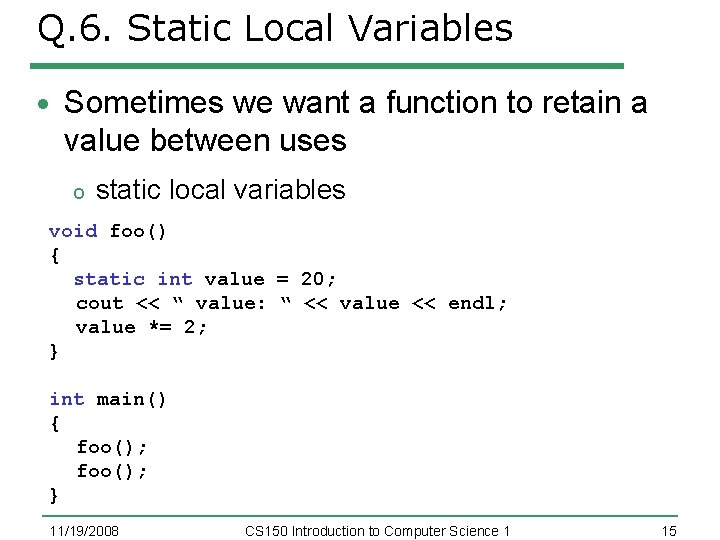
Q. 6. Static Local Variables Sometimes we want a function to retain a value between uses o static local variables void foo() { static int value = 20; cout << “ value: “ << value << endl; value *= 2; } int main() { foo(); } 11/19/2008 CS 150 Introduction to Computer Science 1 15
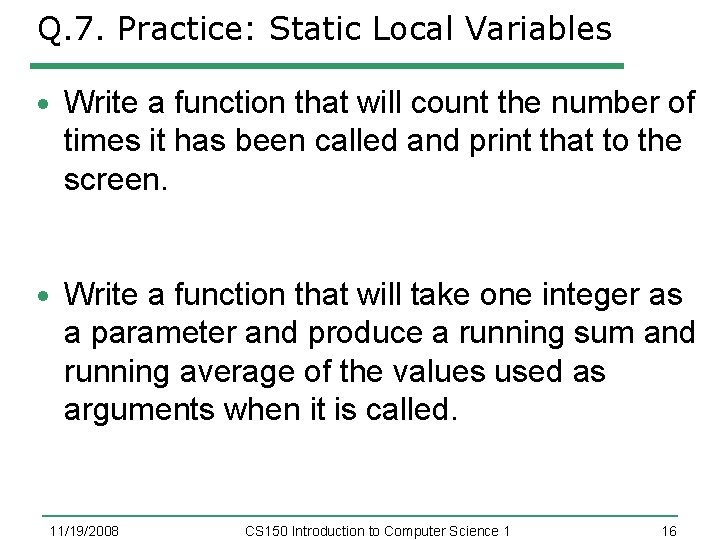
Q. 7. Practice: Static Local Variables Write a function that will count the number of times it has been called and print that to the screen. Write a function that will take one integer as a parameter and produce a running sum and running average of the values used as arguments when it is called. 11/19/2008 CS 150 Introduction to Computer Science 1 16
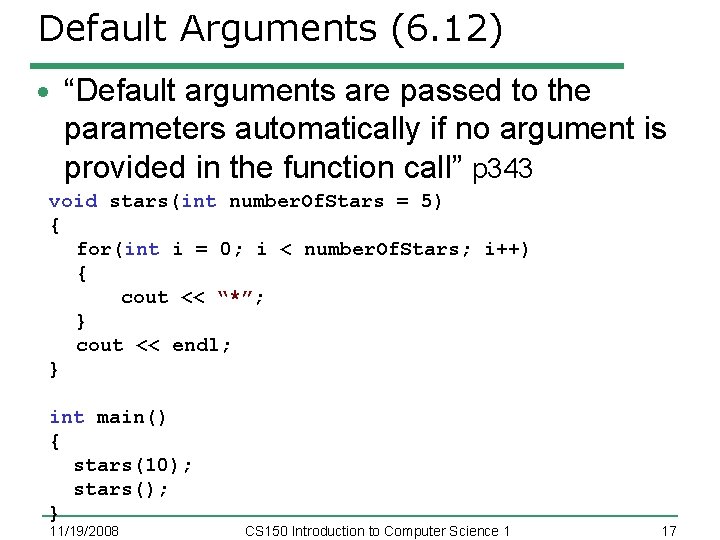
Default Arguments (6. 12) “Default arguments are passed to the parameters automatically if no argument is provided in the function call” p 343 void stars(int number. Of. Stars = 5) { for(int i = 0; i < number. Of. Stars; i++) { cout << “*”; } cout << endl; } int main() { stars(10); stars(); } 11/19/2008 CS 150 Introduction to Computer Science 1 17
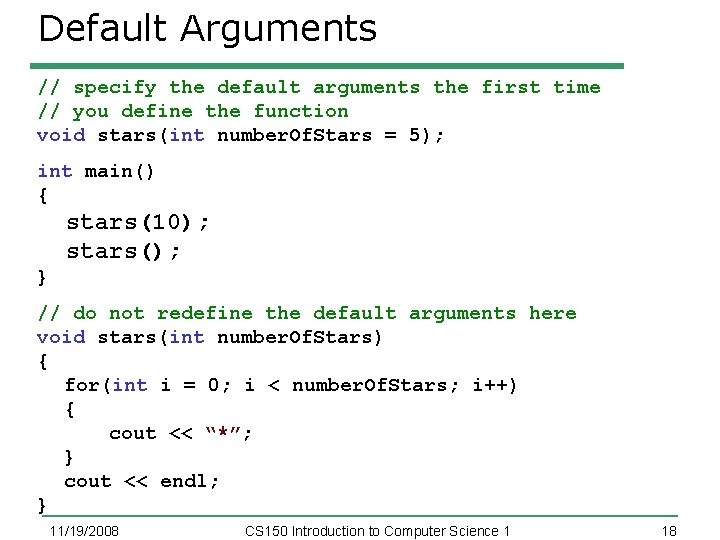
Default Arguments // specify the default arguments the first time // you define the function void stars(int number. Of. Stars = 5); int main() { stars(10); stars(); } // do not redefine the default arguments here void stars(int number. Of. Stars) { for(int i = 0; i < number. Of. Stars; i++) { cout << “*”; } cout << endl; } 11/19/2008 CS 150 Introduction to Computer Science 1 18
Q. 8. Practice: Default Arguments Write a function that will accept either one or two integers as parameters and return the area of a square (if one parameter is specified) or a rectangle (if two parameters are specified) 11/19/2008 CS 150 Introduction to Computer Science 1 19
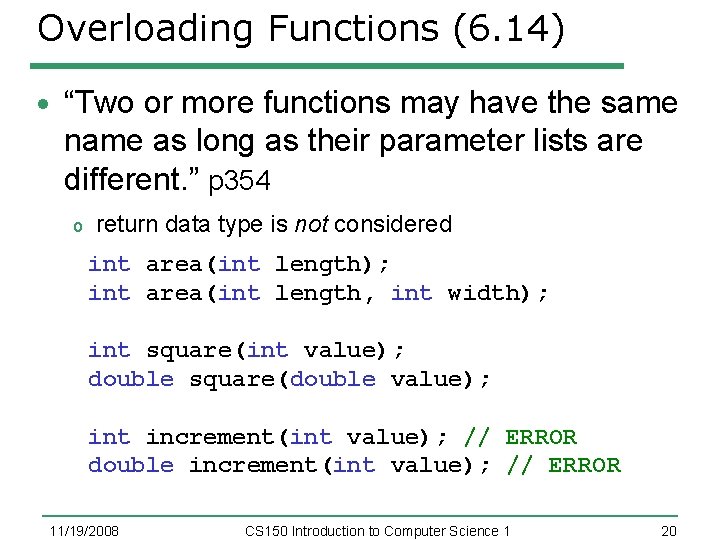
Overloading Functions (6. 14) “Two or more functions may have the same name as long as their parameter lists are different. ” p 354 o return data type is not considered int area(int length); int area(int length, int width); int square(int value); double square(double value); int increment(int value); // ERROR double increment(int value); // ERROR 11/19/2008 CS 150 Introduction to Computer Science 1 20
Q. 9. Practice: Overloaded Functions Write two overloaded functions that will produce the sum and average of three integers or three doubles. 11/19/2008 CS 150 Introduction to Computer Science 1 21