
FUNCTIONING OF THE EAR IN HEARING AND BALANCE
FUNCTIONING OF THE EAR IN HEARING AND BALANCE SUBJECT: LIFE SCIENCES SUBJECT ADVISOR NAME: Ms Dlamini. P. N DISTRICT: ORTID 1
EXAMINATION GUIDELINES 2017 Functioning of the human ear in: • Hearing (include the role of the organ of Corti, without details of its structure) Balance (include the role of maculae and cristae, without details of their structure) 2

PARTS OF THE EAR INVOLVED IN HEARING 3

HEARING PROCESS Organ of Corti Perilymph Endolymph in cochlear canal Basilar membrane Perilymph Auditory nerve 4
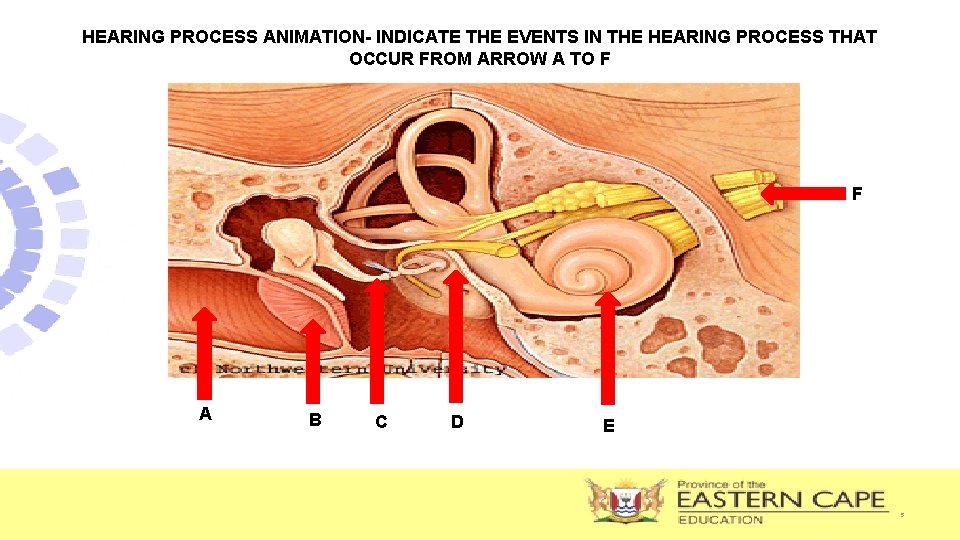
HEARING PROCESS ANIMATION- INDICATE THE EVENTS IN THE HEARING PROCESS THAT OCCUR FROM ARROW A TO F F A B C D E 5

PROCESS OF HEARING • The pinna traps and directs sound waves into auditory canal towards the tympanic membrane. • The tympanic membrane vibrates as the sound waves strike against it • Vibrations are passed to the ossicles which vibrate and amplify vibrations which are then transmitted to the oval window • Vibrations of the oval window set up pressure waves of the perilymph which are then transferred to endolymph in the cochlea. • Organ of Corti in the cochlea is stimulated by pressure waves and converts the stimulus to an impulse • Impulse is transmitted by the auditory nerve to cerebrum where the impulse is interpreted as a specific sound. • Pressure waves in the cochlea are absorbed by round window into the middle ear.
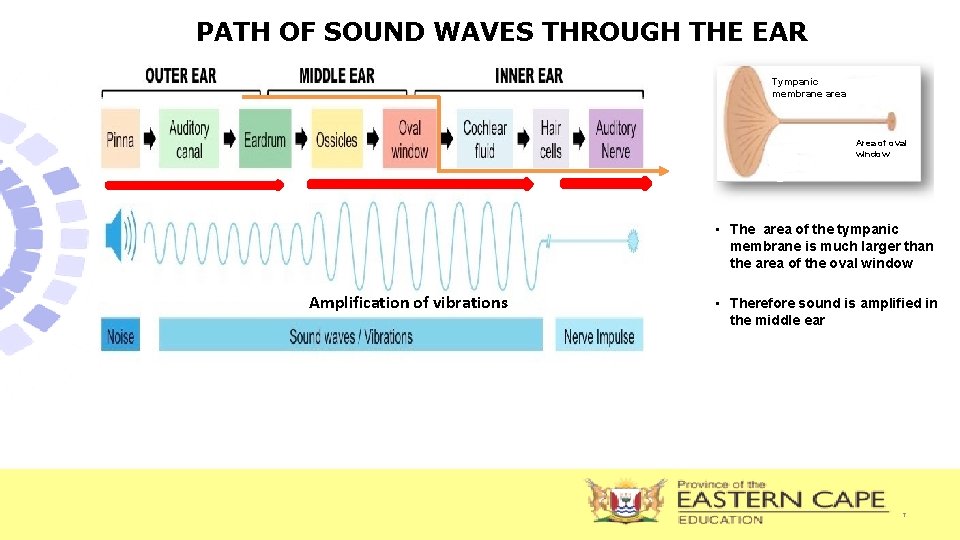
PATH OF SOUND WAVES THROUGH THE EAR Tympanic membrane area Area of oval window • The area of the tympanic membrane is much larger than the area of the oval window Amplification of vibrations • Therefore sound is amplified in the middle ear 7

STRUCTURES INVOLVED IN BALANCE AND EQUILIBRIUM Utriculus and succulus Semi circular canals vestibular branch of auditory nerve Auditory nerve Cochlear nerve ampulla cristae maculae Sensory hair cells endolymph Sensory hair cells 8

BALANCE AND EQUILIBRIUM IN AMPULLA • When the body is stationery, the endolymph does not move, there is no stimulus on the cristae • sudden change in speed and direction of body(rotation) ampulla • causes movement of endolymph which Cone shaped jelly substance cristae impulse stimulates the cristae • Cristae changes stimulus to an impulse • Impulse transported by auditory nerve to cerebellum, • Cerebellum restores balance by coordination of skeletal muscles 9
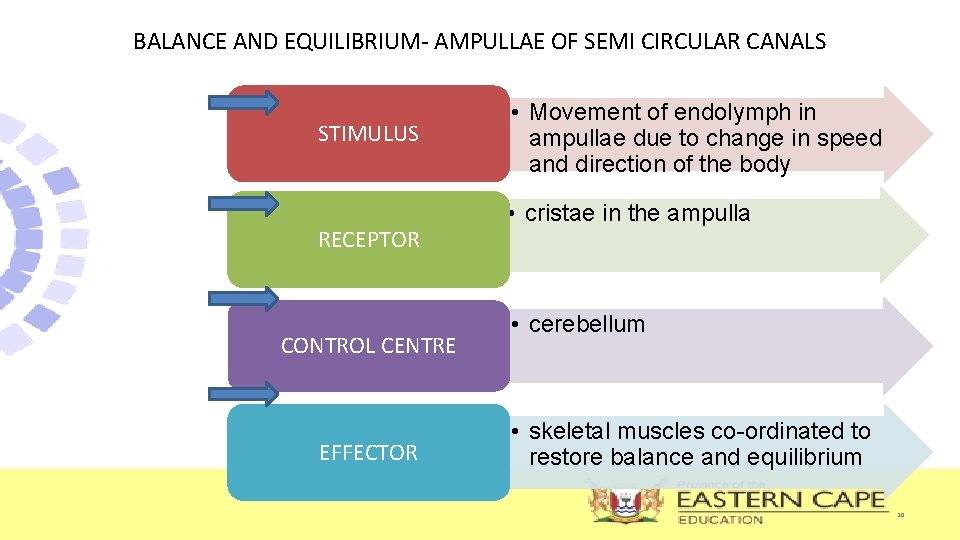
BALANCE AND EQUILIBRIUM- AMPULLAE OF SEMI CIRCULAR CANALS STIMULUS RECEPTOR CONTROL CENTRE EFFECTOR • Movement of endolymph in ampullae due to change in speed and direction of the body • cristae in the ampulla • cerebellum • skeletal muscles co-ordinated to restore balance and equilibrium 10
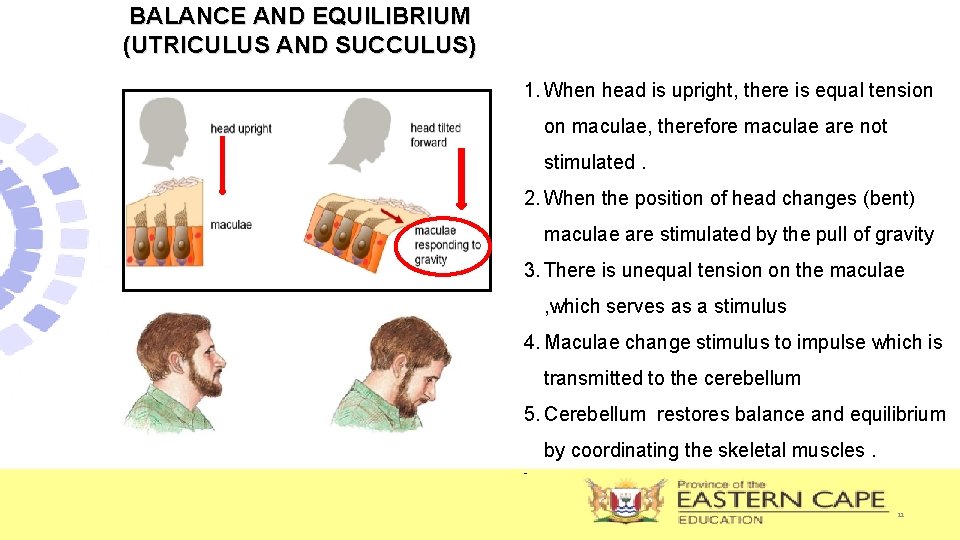
BALANCE AND EQUILIBRIUM (UTRICULUS AND SUCCULUS) 1. When head is upright, there is equal tension on maculae, therefore maculae are not stimulated. 2. When the position of head changes (bent) maculae are stimulated by the pull of gravity 3. There is unequal tension on the maculae , which serves as a stimulus 4. Maculae change stimulus to impulse which is transmitted to the cerebellum 5. Cerebellum restores balance and equilibrium by coordinating the skeletal muscles. 11
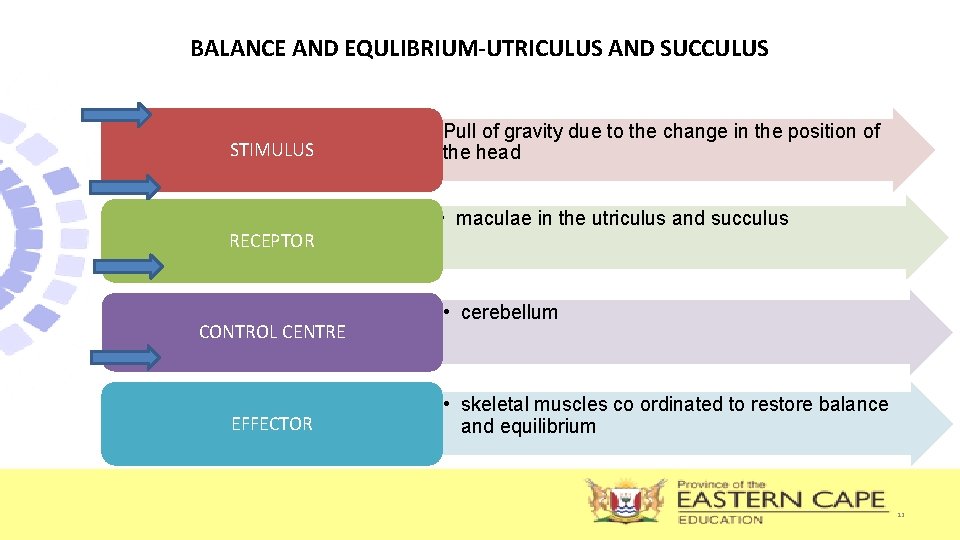
BALANCE AND EQULIBRIUM-UTRICULUS AND SUCCULUS STIMULUS RECEPTOR CONTROL CENTRE EFFECTOR • Pull of gravity due to the change in the position of the head • maculae in the utriculus and succulus • cerebellum • skeletal muscles co ordinated to restore balance and equilibrium 12
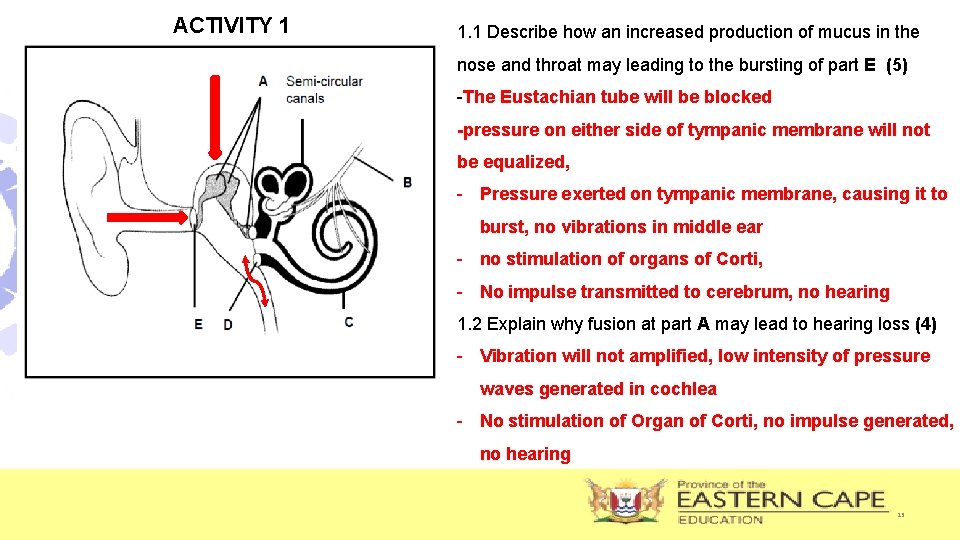
ACTIVITY 1 1. 1 Describe how an increased production of mucus in the nose and throat may leading to the bursting of part E (5) -The Eustachian tube will be blocked -pressure on either side of tympanic membrane will not be equalized, - Pressure exerted on tympanic membrane, causing it to burst, no vibrations in middle ear - no stimulation of organs of Corti, - No impulse transmitted to cerebrum, no hearing 1. 2 Explain why fusion at part A may lead to hearing loss (4) - Vibration will not amplified, low intensity of pressure waves generated in cochlea - No stimulation of Organ of Corti, no impulse generated, no hearing 13
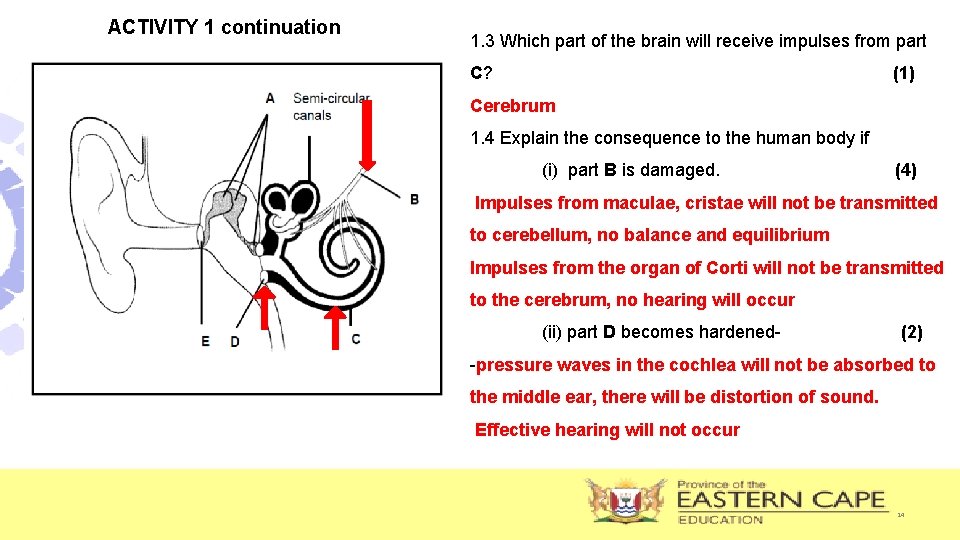
ACTIVITY 1 continuation 1. 3 Which part of the brain will receive impulses from part C? (1) Cerebrum 1. 4 Explain the consequence to the human body if (i) part B is damaged. (4) Impulses from maculae, cristae will not be transmitted to cerebellum, no balance and equilibrium Impulses from the organ of Corti will not be transmitted to the cerebrum, no hearing will occur (ii) part D becomes hardened- (2) -pressure waves in the cochlea will not be absorbed to the middle ear, there will be distortion of sound. Effective hearing will not occur 14
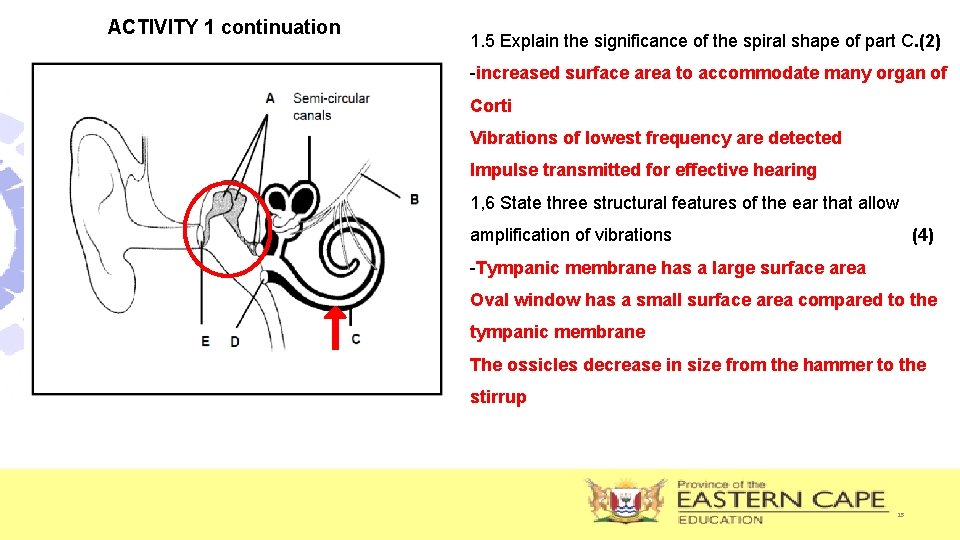
ACTIVITY 1 continuation 1. 5 Explain the significance of the spiral shape of part C. (2) -increased surface area to accommodate many organ of Corti Vibrations of lowest frequency are detected Impulse transmitted for effective hearing 1, 6 State three structural features of the ear that allow amplification of vibrations (4) -Tympanic membrane has a large surface area Oval window has a small surface area compared to the tympanic membrane The ossicles decrease in size from the hammer to the stirrup 15
- Slides: 15