
FUNCTIONAL UNITS AP BIOLOGY UNIT 8 ORGANISM FORM
FUNCTIONAL UNITS AP BIOLOGY UNIT 8 ORGANISM FORM & FUNCTION
Absorption of Nutrients • The small intestine has a huge surface area – Due to the presence of villi and microvilli that are exposed to the intestinal lumen Copyright © 2005 Pearson Education, Inc. publishing as Benjamin Cummings
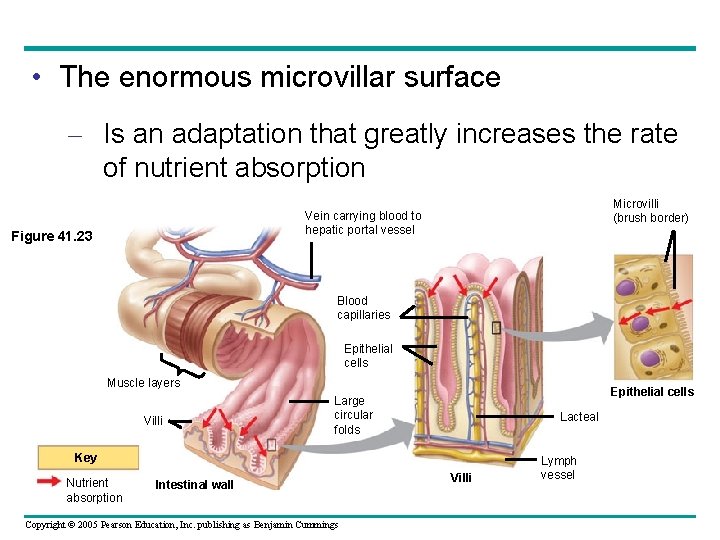
• The enormous microvillar surface – Is an adaptation that greatly increases the rate of nutrient absorption Microvilli (brush border) Vein carrying blood to hepatic portal vessel Figure 41. 23 Blood capillaries Epithelial cells Muscle layers Villi Epithelial cells Large circular folds Lacteal Key Nutrient absorption Intestinal wall Copyright © 2005 Pearson Education, Inc. publishing as Benjamin Cummings Villi Lymph vessel
• The core of each villus – Contains a network of blood vessels and a small vessel of the lymphatic system called a lacteal Copyright © 2005 Pearson Education, Inc. publishing as Benjamin Cummings
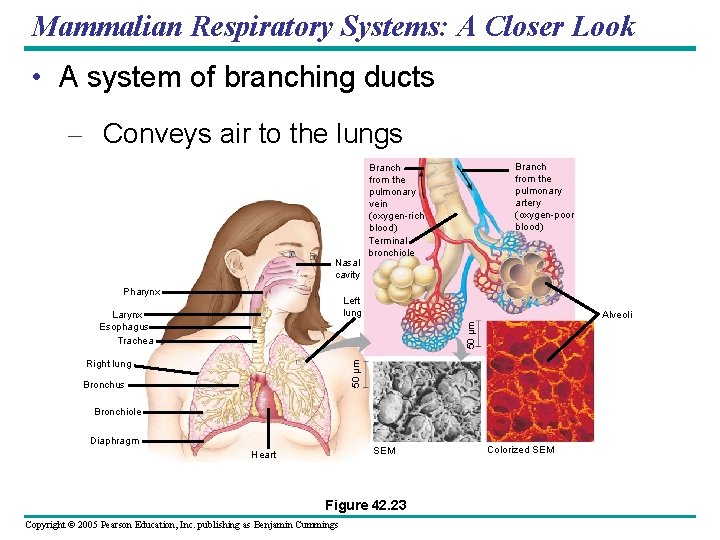
Mammalian Respiratory Systems: A Closer Look • A system of branching ducts – Conveys air to the lungs Nasal cavity Pharynx Branch from the pulmonary artery (oxygen-poor blood) Branch from the pulmonary vein (oxygen-rich blood) Terminal bronchiole Left lung Alveoli 50 µm Larynx Esophagus Trachea 50 µm Right lung Bronchus Bronchiole Diaphragm SEM Heart Figure 42. 23 Copyright © 2005 Pearson Education, Inc. publishing as Benjamin Cummings Colorized SEM
• Concept 44. 4: Nephrons and associated blood vessels are the functional unit of the mammalian kidney • The mammalian excretory system centers on paired kidneys – Which are also the principal site of water balance and salt regulation Copyright © 2005 Pearson Education, Inc. publishing as Benjamin Cummings
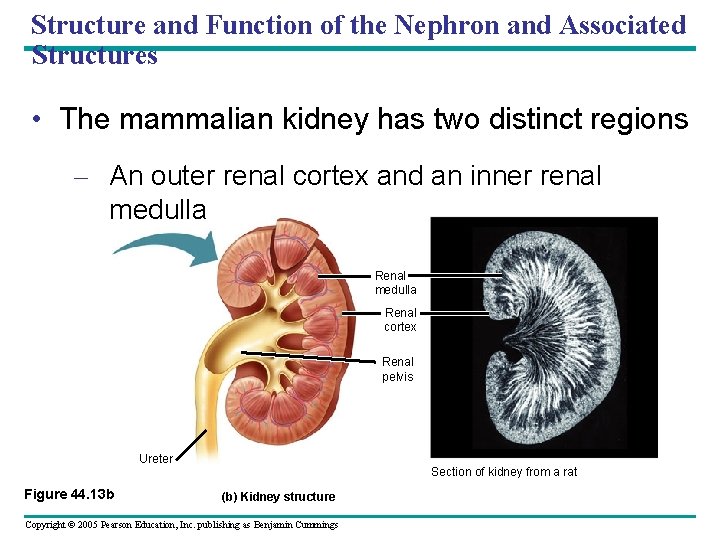
Structure and Function of the Nephron and Associated Structures • The mammalian kidney has two distinct regions – An outer renal cortex and an inner renal medulla Renal cortex Renal pelvis Ureter Figure 44. 13 b Section of kidney from a rat (b) Kidney structure Copyright © 2005 Pearson Education, Inc. publishing as Benjamin Cummings
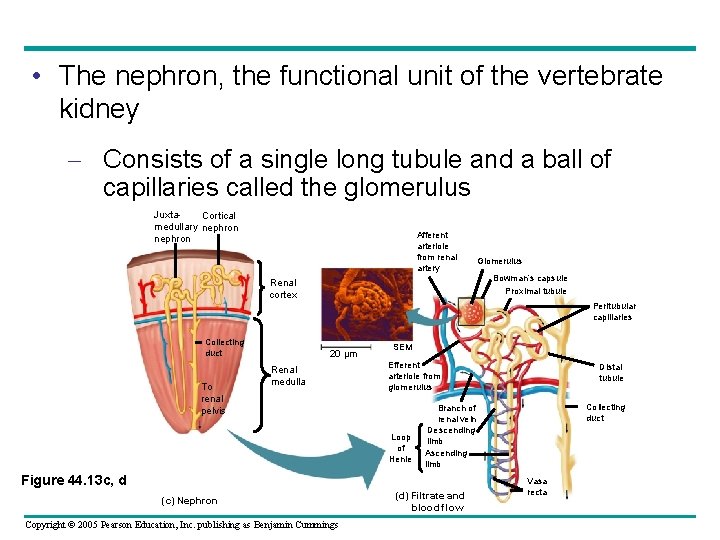
• The nephron, the functional unit of the vertebrate kidney – Consists of a single long tubule and a ball of capillaries called the glomerulus Juxta. Cortical medullary nephron Afferent arteriole from renal artery Glomerulus Bowman’s capsule Proximal tubule Renal cortex Peritubular capillaries Collecting duct To renal pelvis 20 µm Renal medulla SEM Efferent arteriole from glomerulus Loop of Henle Copyright © 2005 Pearson Education, Inc. publishing as Benjamin Cummings Collecting duct Branch of renal vein Descending limb Ascending limb Figure 44. 13 c, d (c) Nephron Distal tubule (d) Filtrate and blood flow Vasa recta
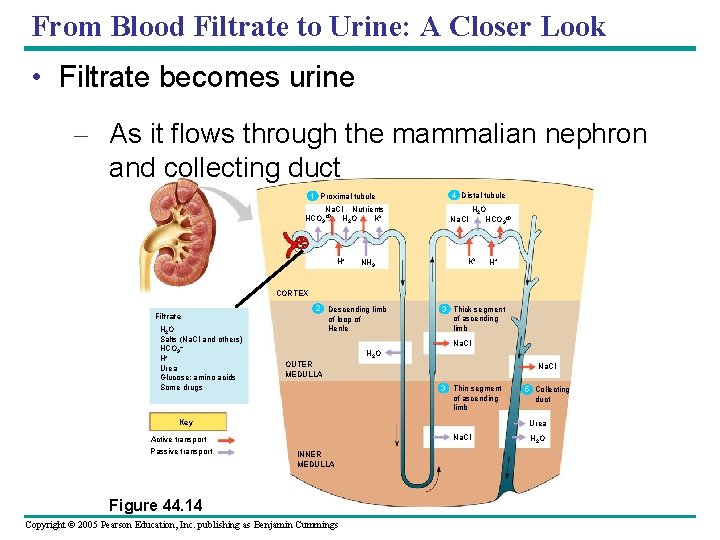
From Blood Filtrate to Urine: A Closer Look • Filtrate becomes urine – As it flows through the mammalian nephron and collecting duct 1 Proximal tubule Na. Cl Nutrients HCO 3 H 2 O K+ H+ NH 3 4 Distal tubule Na. Cl H 2 O HCO 3 K+ H+ CORTEX Filtrate H 2 O Salts (Na. Cl and others) HCO 3– H+ Urea Glucose; amino acids Some drugs 2 Descending limb of loop of Henle 3 Thick segment of ascending limb Na. Cl H 2 O OUTER MEDULLA Na. Cl 3 Thin segment of ascending limb Key Active transport Passive transport 5 Collecting duct Urea Na. Cl INNER MEDULLA Figure 44. 14 Copyright © 2005 Pearson Education, Inc. publishing as Benjamin Cummings H 2 O
- Slides: 9