
Functional Polymers Building Blocks for Macromolecular and Supramolecular
Functional Polymers – Building Blocks for Macromolecular and Supramolecular Architectures Bogdan C. Simionescu 1, 2 1 “Gh. Asachi” Technical University, Iasi, Romania 2 “Petru Poni”Institute of Macromolecular Chemistry, Iasi, Romania Workshop “Nanostiinta si Nanotehnologie” Bucuresti, 17 -18. 09. 2008
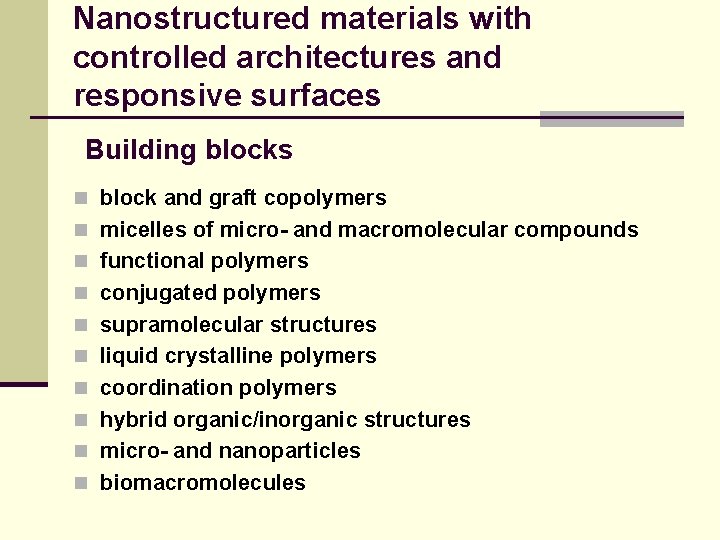
Nanostructured materials with controlled architectures and responsive surfaces Building blocks n block and graft copolymers n micelles of micro- and macromolecular compounds n functional polymers n conjugated polymers n supramolecular structures n liquid crystalline polymers n coordination polymers n hybrid organic/inorganic structures n micro- and nanoparticles n biomacromolecules

Micro- and nanoparticles ● perfect spherical shape ● extremely uniform size distribution ● accurately controlled diameter ● well-characterized surface (functionality, morphology) ● controlled porosity ● various physical properties Ø large variety Ø high surface area Ø controlled inner reactivity
![Topics n Poly[(N-acylimino)ethylene] (PNAI) building blocks Ø Ø Functional micro- and nanoparticles based on](http://slidetodoc.com/presentation_image_h/ea762354ae4ea9e1ddc97c9ba4ec8911/image-4.jpg "Topics n Poly[(N-acylimino)ethylene] (PNAI) building blocks Ø Ø Functional micro- and nanoparticles based on")
Topics n Poly[(N-acylimino)ethylene] (PNAI) building blocks Ø Ø Functional micro- and nanoparticles based on PNAI building blocks PNAI – based gels n Functional siloxane building blocks Ø Poly(ε-caprolactone) – polydimethylsiloxane di- and triblock copolymers (PεCL–PDMS) Ø PDMS with end or pendant pyrrolyl groups n Polyrotaxanes n Conclusions
![Poly[(N-acylimino)ethylenes] (PNAI) ücontrol of structural properties (living cationic polymerization) übiocompatibility or no acute toxicity](http://slidetodoc.com/presentation_image_h/ea762354ae4ea9e1ddc97c9ba4ec8911/image-5.jpg "Poly[(N-acylimino)ethylenes] (PNAI) ücontrol of structural properties (living cationic polymerization) übiocompatibility or no acute toxicity")
Poly[(N-acylimino)ethylenes] (PNAI) ücontrol of structural properties (living cationic polymerization) übiocompatibility or no acute toxicity ühydrophilic or hydrophobic properties (R) üchelating ability ügood adhesion to polar surfaces üfacile modification to PEI ücompatibility with most common organic polymers üchain flexibility ücrystallization ability tailored polymers multifunctional polymers complex architectures
![Poly[(N-acylimino)ethylene] azo initiators PNAI azo initiator](http://slidetodoc.com/presentation_image_h/ea762354ae4ea9e1ddc97c9ba4ec8911/image-6.jpg "Poly[(N-acylimino)ethylene] azo initiators PNAI azo initiator")
Poly[(N-acylimino)ethylene] azo initiators PNAI azo initiator
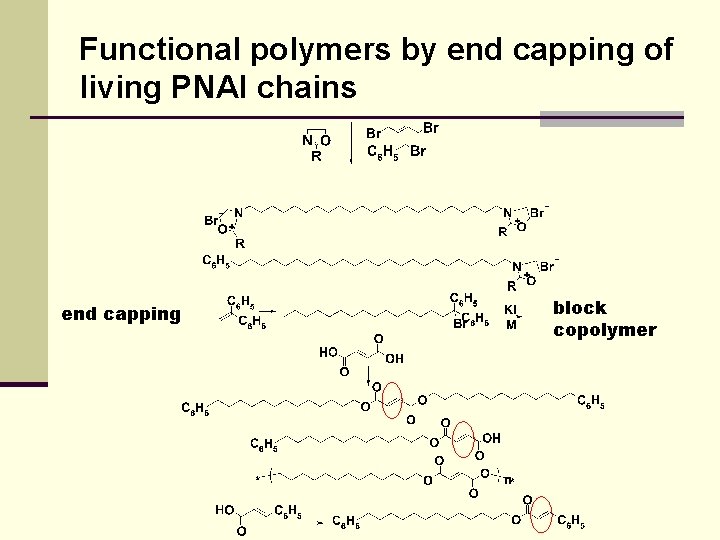
Functional polymers by end capping of living PNAI chains end capping block copolymer
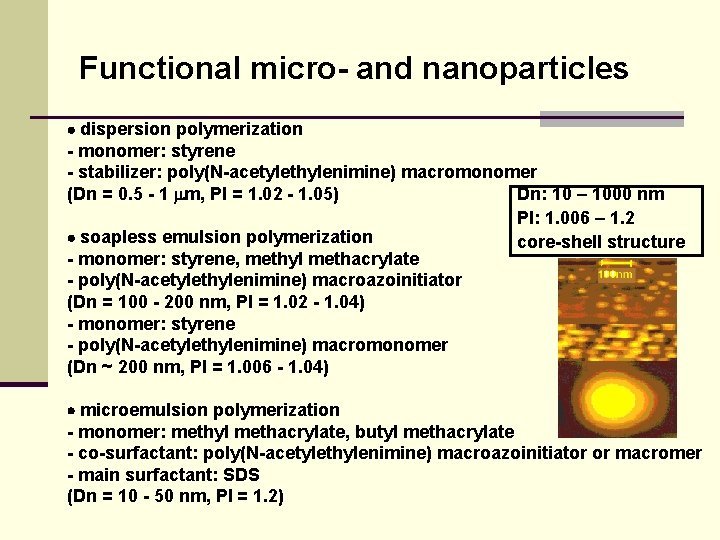
Functional micro- and nanoparticles dispersion polymerization - monomer: styrene - stabilizer: poly(N-acetylethylenimine) macromonomer (Dn = 0. 5 - 1 m, PI = 1. 02 - 1. 05) Dn: 10 – 1000 nm PI: 1. 006 – 1. 2 soapless emulsion polymerization core-shell structure - monomer: styrene, methyl methacrylate - poly(N-acetylethylenimine) macroazoinitiator (Dn = 100 - 200 nm, PI = 1. 02 - 1. 04) - monomer: styrene - poly(N-acetylethylenimine) macromonomer (Dn ~ 200 nm, PI = 1. 006 - 1. 04) microemulsion polymerization - monomer: methyl methacrylate, butyl methacrylate - co-surfactant: poly(N-acetylethylenimine) macroazoinitiator or macromer - main surfactant: SDS (Dn = 10 - 50 nm, PI = 1. 2)

Core-shell nano/micro particles by soapless emulsion polymerization ü size control ü high surface functionality ü high purity (“clean” particles) ü low toxicity ü bio-compound immobilization ability ü film forming ability ü narrow size distribution or “monodispersity” drug release systems uniform thin polymer films (electrode coating, biosensors) high selectivity membranes ___ 1μ

Stable hybrid Pt nanocatalyst/polymer systems Pt catalysts PSt - hydrolysed PNAI latex colloidal Pt nanocatalyst particles protected by PSt-g-PNAI copolymer retention > 90% at 136. 8 μg Pt / m. L (60 min reflux) agglomeration prevented polymer protected improved stability - recoverable Pt (IV) - sorbent maximum Pt (IV) recovery yield - in buffer solutions of p. H = 10 sorption half time: t 1/2 ≈ 90 min sorption capacity: 1111 μg / g latex stable until 228 μg Pt / m. L
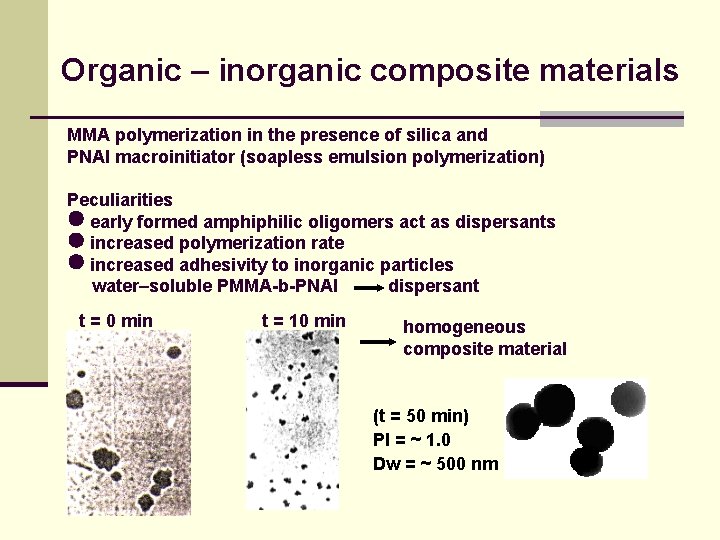
Organic – inorganic composite materials MMA polymerization in the presence of silica and PNAI macroinitiator (soapless emulsion polymerization) Peculiarities early formed amphiphilic oligomers act as dispersants increased polymerization rate increased adhesivity to inorganic particles water–soluble PMMA-b-PNAI dispersant t = 0 min t = 10 min homogeneous composite material (t = 50 min) PI = ~ 1. 0 Dw = ~ 500 nm
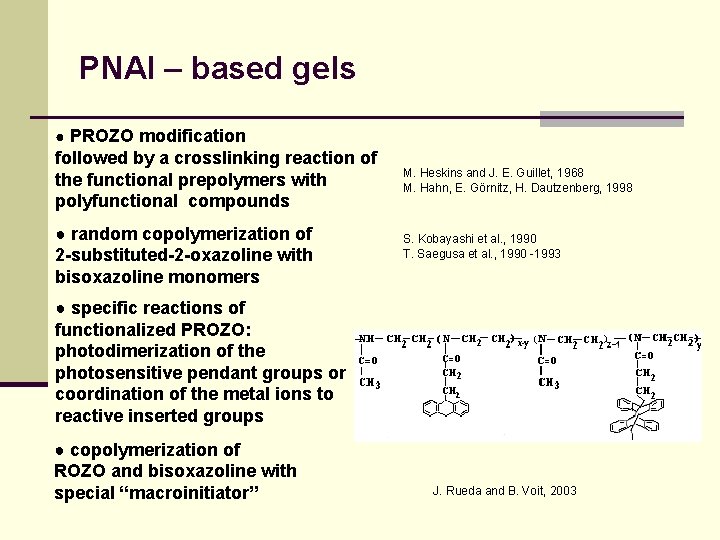
PNAI – based gels ● PROZO modification followed by a crosslinking reaction of the functional prepolymers with polyfunctional compounds ● random copolymerization of 2 -substituted-2 -oxazoline with bisoxazoline monomers M. Heskins and J. E. Guillet, 1968 M. Hahn, E. Görnitz, H. Dautzenberg, 1998 S. Kobayashi et al. , 1990 T. Saegusa et al. , 1990 -1993 ● specific reactions of functionalized PROZO: photodimerization of the photosensitive pendant groups or coordination of the metal ions to reactive inserted groups ● copolymerization of ROZO and bisoxazoline with special “macroinitiator” J. Rueda and B. Voit, 2003
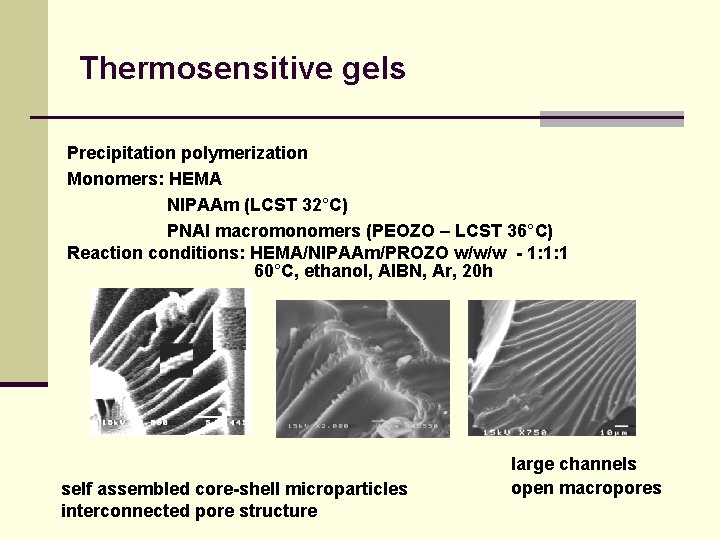
Thermosensitive gels Precipitation polymerization Monomers: HEMA NIPAAm (LCST 32°C) PNAI macromonomers (PEOZO – LCST 36°C) Reaction conditions: HEMA/NIPAAm/PROZO w/w/w - 1: 1: 1 60°C, ethanol, AIBN, Ar, 20 h self assembled core-shell microparticles interconnected pore structure large channels open macropores
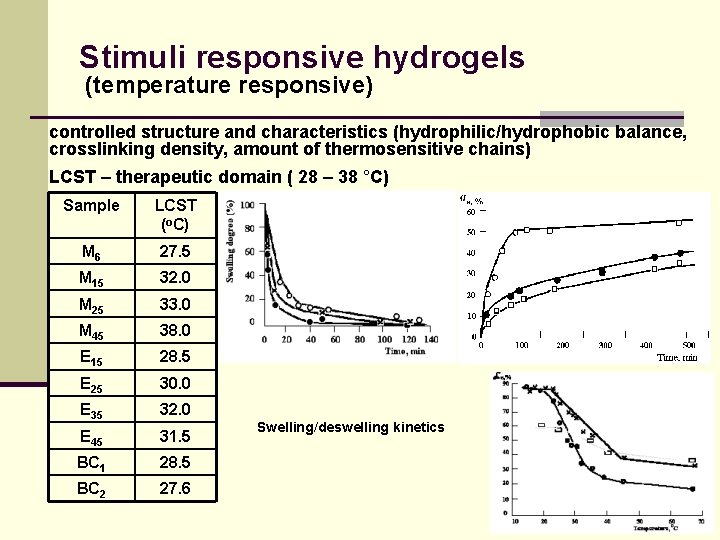
Stimuli responsive hydrogels (temperature responsive) controlled structure and characteristics (hydrophilic/hydrophobic balance, crosslinking density, amount of thermosensitive chains) LCST – therapeutic domain ( 28 – 38 °C) Sample LCST (o. C) M 6 27. 5 M 15 32. 0 M 25 33. 0 M 45 38. 0 E 15 28. 5 E 25 30. 0 E 35 32. 0 E 45 31. 5 BC 1 28. 5 BC 2 27. 6 Swelling/deswelling kinetics
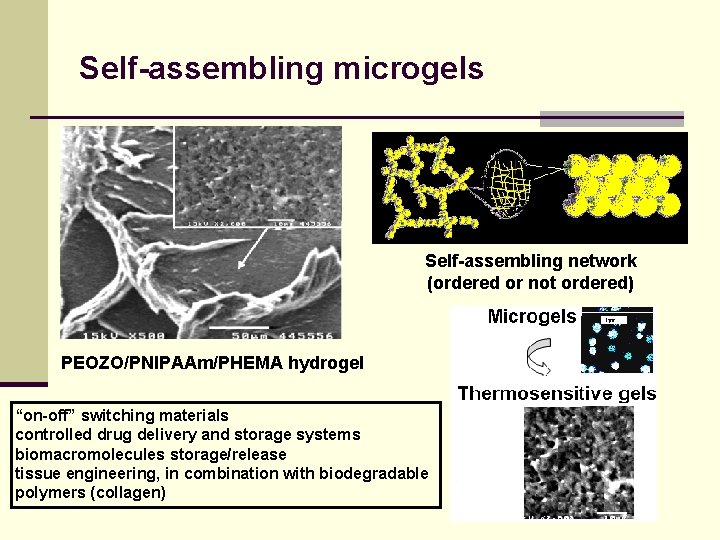
Self-assembling microgels Self-assembling network (ordered or not ordered) PEOZO/PNIPAAm/PHEMA hydrogel “on-off” switching materials controlled drug delivery and storage systems biomacromolecules storage/release tissue engineering, in combination with biodegradable polymers (collagen)

Siloxane building blocks Si O ü hybrid organic - inorganic polymers ü biocompatibility (physiological inertness) ü high gas permeability ü good oxidative, thermal and UV stability ü high chain flexibility ü very low solubility parameter and low surface tension (immiscibility with most organic polymers) Functional siloxanes and siloxane copolymers Ø blend compatibilizers Ø surface modifiers Ø biomaterials (contact lenses, implants, transdermal penetration enhancers)
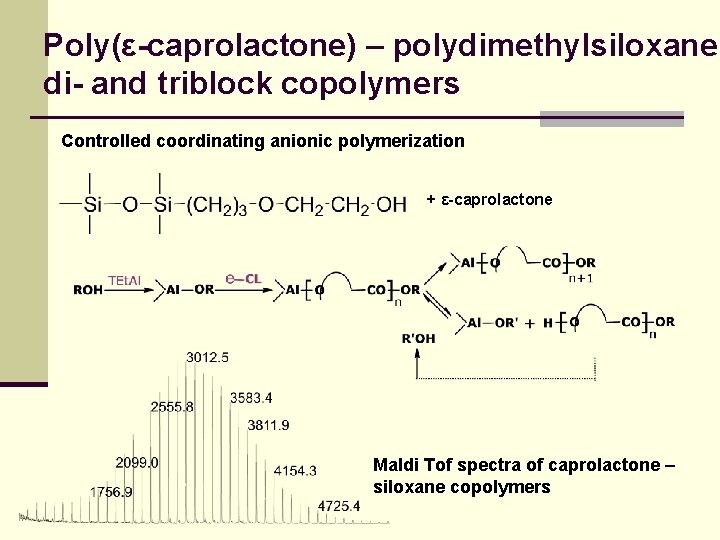
Poly(ε-caprolactone) – polydimethylsiloxane di- and triblock copolymers Controlled coordinating anionic polymerization + ε-caprolactone Maldi Tof spectra of caprolactone – siloxane copolymers
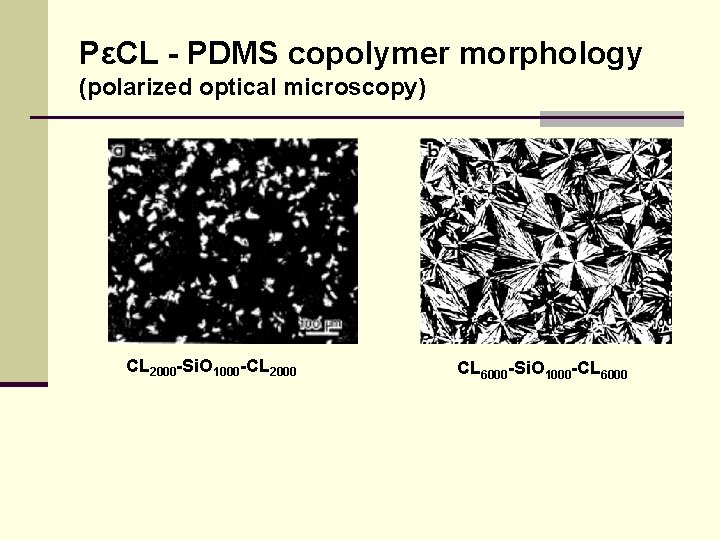
PεCL - PDMS copolymer morphology (polarized optical microscopy) CL 2000 -Si. O 1000 -CL 2000 CL 6000 -Si. O 1000 -CL 6000
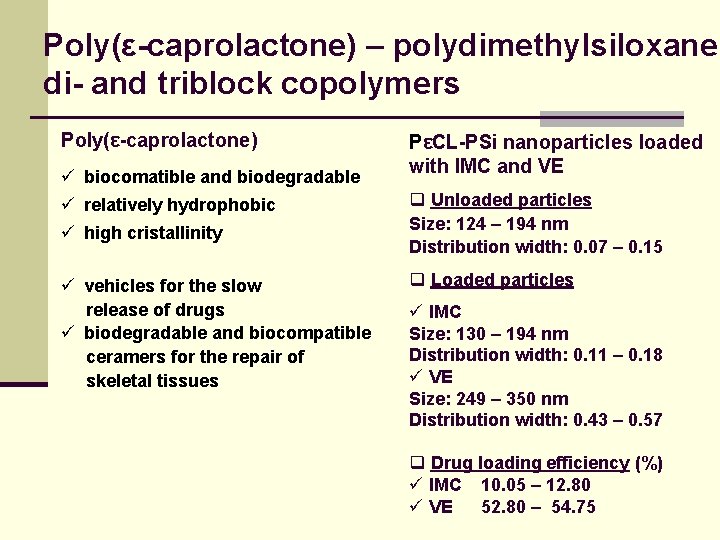
Poly(ε-caprolactone) – polydimethylsiloxane di- and triblock copolymers Poly(ε-caprolactone) ü biocomatible and biodegradable ü relatively hydrophobic ü high cristallinity ü vehicles for the slow release of drugs ü biodegradable and biocompatible ceramers for the repair of skeletal tissues PεCL-PSi nanoparticles loaded with IMC and VE q Unloaded particles Size: 124 – 194 nm Distribution width: 0. 07 – 0. 15 q Loaded particles ü IMC Size: 130 – 194 nm Distribution width: 0. 11 – 0. 18 ü VE Size: 249 – 350 nm Distribution width: 0. 43 – 0. 57 q Drug loading efficiency (%) ü IMC 10. 05 – 12. 80 ü VE 52. 80 – 54. 75
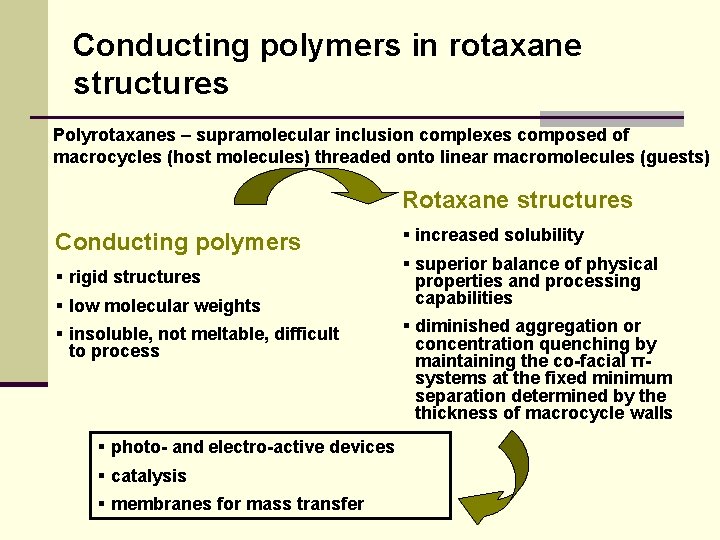
Conducting polymers in rotaxane structures Polyrotaxanes – supramolecular inclusion complexes composed of macrocycles (host molecules) threaded onto linear macromolecules (guests) Rotaxane structures Conducting polymers § rigid structures § low molecular weights § insoluble, not meltable, difficult to process § photo- and electro-active devices § catalysis § membranes for mass transfer § increased solubility § superior balance of physical properties and processing capabilities § diminished aggregation or concentration quenching by maintaining the co-facial πsystems at the fixed minimum separation determined by the thickness of macrocycle walls
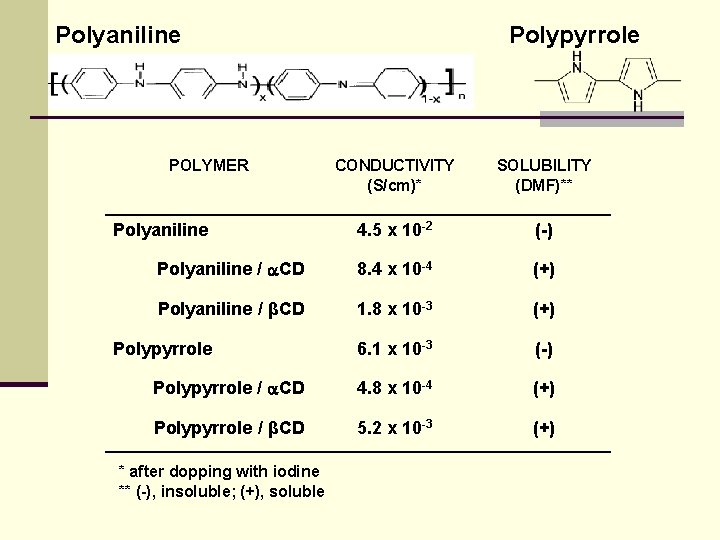
Polyaniline POLYMER Polypyrrole CONDUCTIVITY (S/cm)* SOLUBILITY (DMF)** 4. 5 x 10 -2 (-) Polyaniline / CD 8. 4 x 10 -4 (+) Polyaniline / βCD 1. 8 x 10 -3 (+) 6. 1 x 10 -3 (-) Polypyrrole / CD 4. 8 x 10 -4 (+) Polypyrrole / βCD 5. 2 x 10 -3 (+) Polyaniline Polypyrrole * after dopping with iodine ** (-), insoluble; (+), soluble
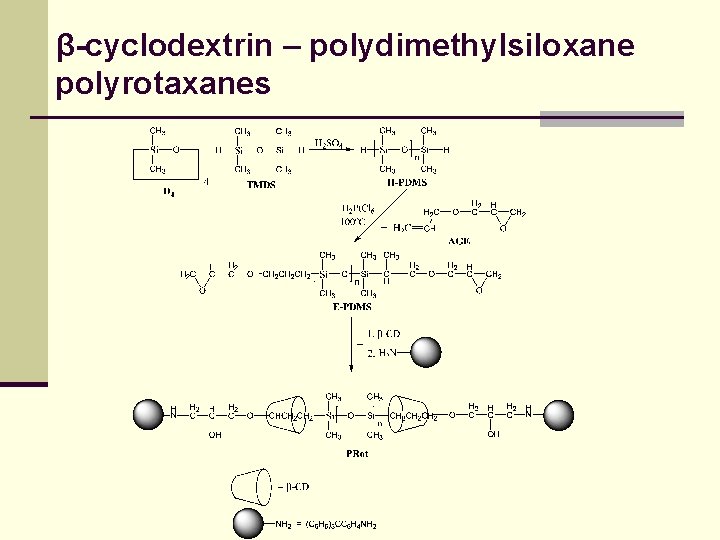
β-cyclodextrin – polydimethylsiloxane polyrotaxanes
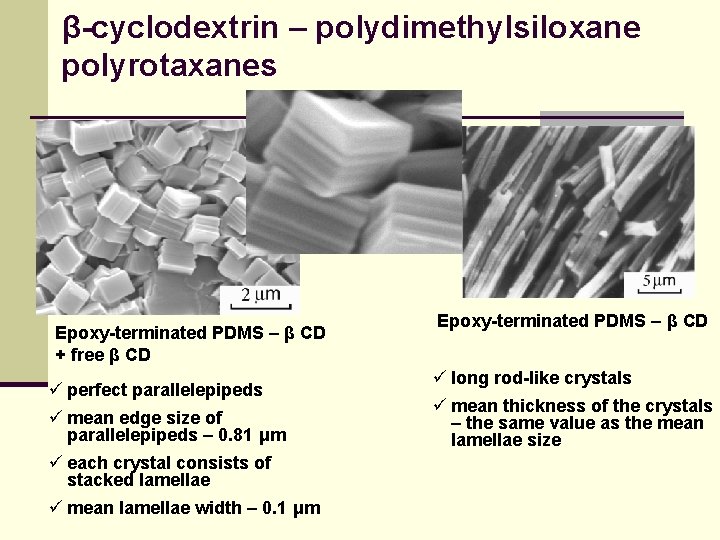
β-cyclodextrin – polydimethylsiloxane polyrotaxanes Epoxy-terminated PDMS – β CD + free β CD ü perfect parallelepipeds ü mean edge size of parallelepipeds – 0. 81 μm ü each crystal consists of stacked lamellae ü mean lamellae width – 0. 1 μm Epoxy-terminated PDMS – β CD ü long rod-like crystals ü mean thickness of the crystals – the same value as the mean lamellae size
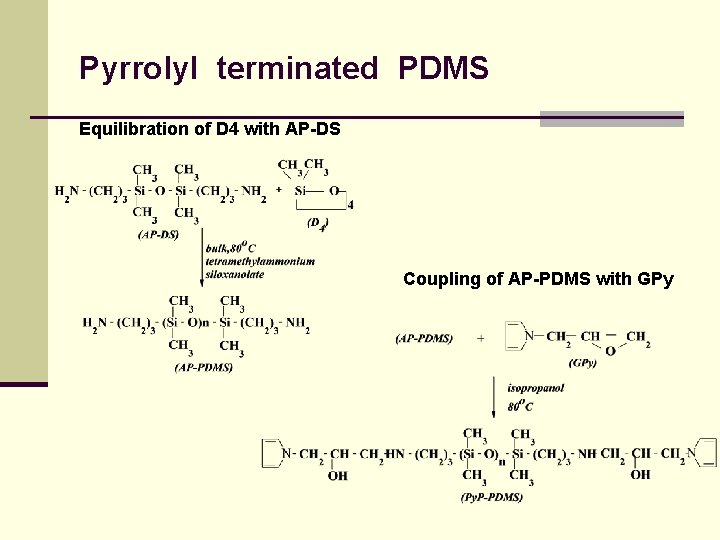
Pyrrolyl terminated PDMS Equilibration of D 4 with AP-DS Coupling of AP-PDMS with GPy
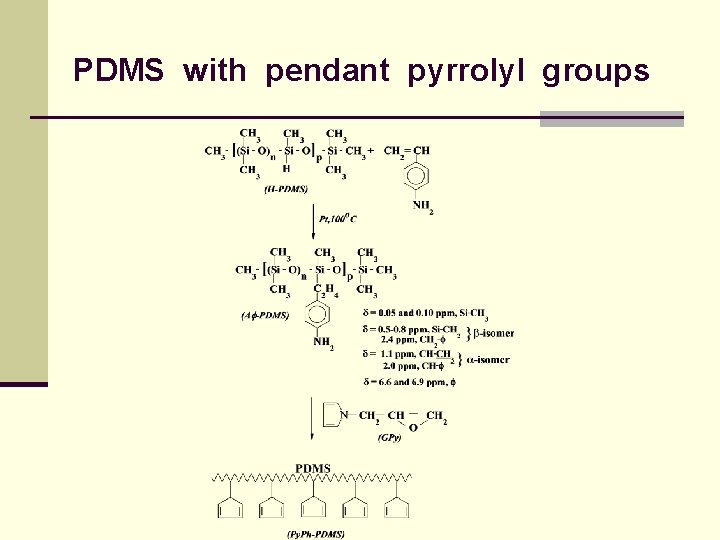
PDMS with pendant pyrrolyl groups
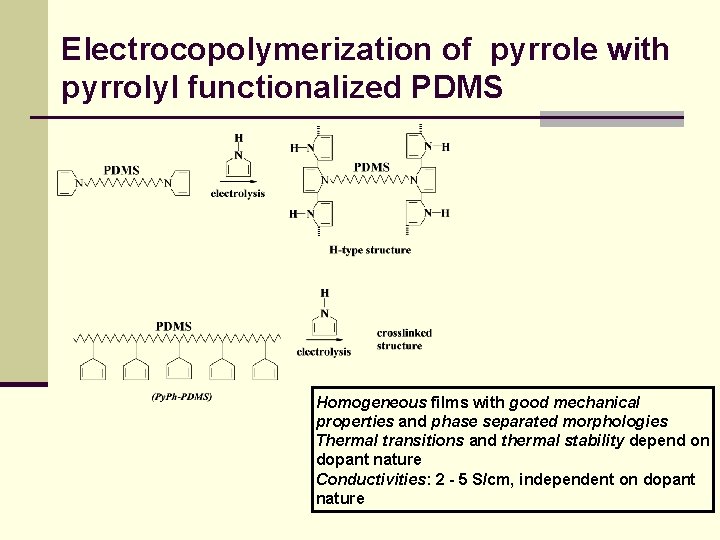
Electrocopolymerization of pyrrole with pyrrolyl functionalized PDMS Homogeneous films with good mechanical properties and phase separated morphologies Thermal transitions and thermal stability depend on dopant nature Conductivities: 2 - 5 S/cm, independent on dopant nature
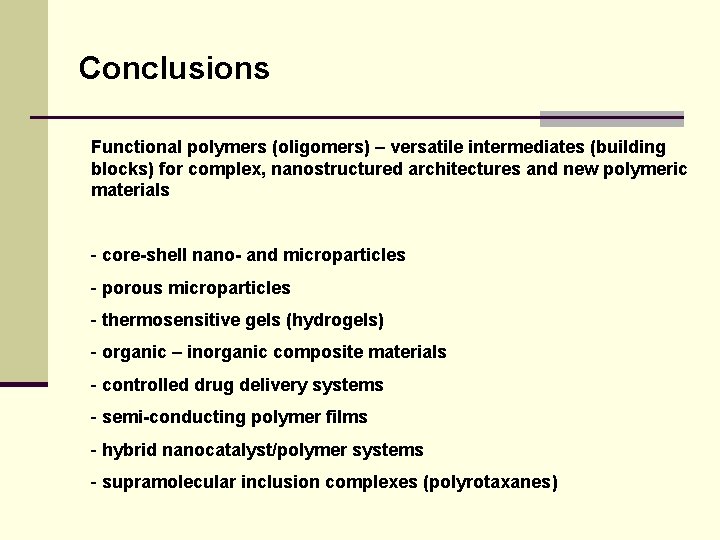
Conclusions Functional polymers (oligomers) – versatile intermediates (building blocks) for complex, nanostructured architectures and new polymeric materials - core-shell nano- and microparticles - porous microparticles - thermosensitive gels (hydrogels) - organic – inorganic composite materials - controlled drug delivery systems - semi-conducting polymer films - hybrid nanocatalyst/polymer systems - supramolecular inclusion complexes (polyrotaxanes)

Thank you for your attention!
- Slides: 28