
Functional mother tongue education as the basis for
Functional mother tongue education as the basis for teaching foreign languages Nyitra, April 28, 2014
“The mother tongue is unavoidable in gaining knowledge about the world, it is indispensible in its definition of itself and also in developing its relationship with the world – people become what they become partly through their mother tongue. ” (Tolcsvai 2005) In a bilingual context this is true of the other language as well.
• Mother tongue (L 1) – foreign language (FL or L 2) • Diglossia – bilingualism • Mother tongue education – foreign language teaching • Teaching of grammar – teaching of grammatical system • Language is not a static set of elements and rules but a way of working and functioning (Tolcsvai 2005). • The lexicon develops before grammar in both L 1 and L 2 acquisition. (Tolcsvai 2005) • The grammatical system is the most abstract and symbolic encoding system of language.
• I. Mother tongue education in school • 1. an already used encoding system with unconsciously used structure • 2. varieties, diglossia – unclarified notions • II. Foreign language teaching in school (? ) • 1. the encoding system • A. in use – unconsciously used structure • B. partly in use – unconsciously used structure • C. not used – making elements + structure conscious • 2. varieties, diglossia • The task of teaching the grammatical system: making the structure of the encoding (functionally) conscious
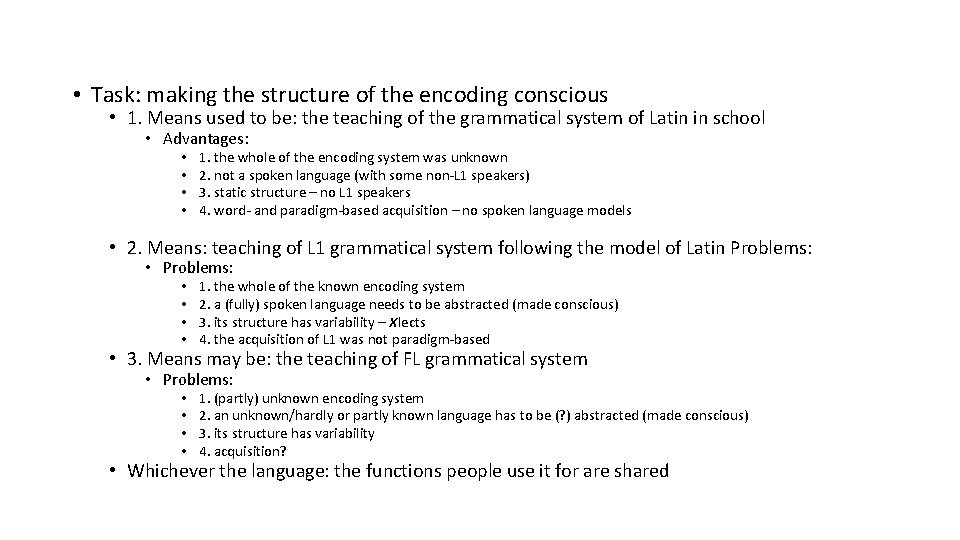
• Task: making the structure of the encoding conscious • 1. Means used to be: the teaching of the grammatical system of Latin in school • Advantages: • • 1. the whole of the encoding system was unknown 2. not a spoken language (with some non-L 1 speakers) 3. static structure – no L 1 speakers 4. word- and paradigm-based acquisition – no spoken language models • 2. Means: teaching of L 1 grammatical system following the model of Latin Problems: • • 1. the whole of the known encoding system 2. a (fully) spoken language needs to be abstracted (made conscious) 3. its structure has variability – Xlects 4. the acquisition of L 1 was not paradigm-based • 3. Means may be: the teaching of FL grammatical system • Problems: • • 1. (partly) unknown encoding system 2. an unknown/hardly or partly known language has to be (? ) abstracted (made conscious) 3. its structure has variability 4. acquisition? • Whichever the language: the functions people use it for are shared
![• The basic principles of functional cognitive grammar include that […] • the](http://slidetodoc.com/presentation_image/9ba4df0167fcbbabd00ad95333a8f26e/image-6.jpg "• The basic principles of functional cognitive grammar include that […] • the")
• The basic principles of functional cognitive grammar include that […] • the semantic code and semantic structure are not universal but, to a great extent, language specific (Langacker 1987: 2, cited by Tolcsvai 1996, 2001: 44 ff. ), • the features of cognitive skills (perception, processing, recall) connected to language are universal, not grammar itself Kugler FGGy • http: //www. anyanyelv-pedagogia. hu/cikkek. php? id=153 • Grammar, grammatical system = expression through words • Grammatical rule: • When function F is attributed to X in a (partial) system SZ, if X has activity A which contributes to F and the implementation of F (Dressler 1995) (following Kugler). • Consequence: the feeling of uncountability of functions > school presentation? ?
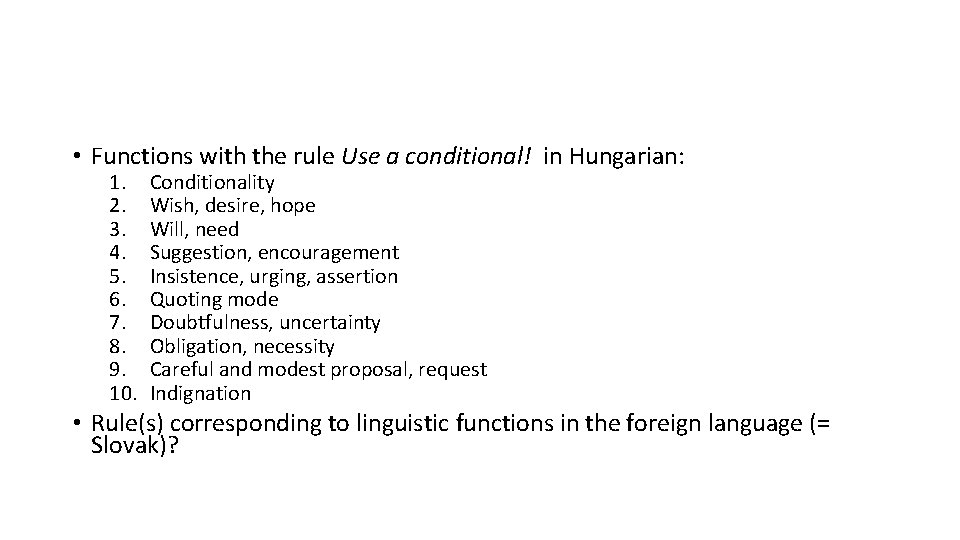
• Functions with the rule Use a conditional! in Hungarian: 1. 2. 3. 4. 5. 6. 7. 8. 9. 10. Conditionality Wish, desire, hope Will, need Suggestion, encouragement Insistence, urging, assertion Quoting mode Doubtfulness, uncertainty Obligation, necessity Careful and modest proposal, request Indignation • Rule(s) corresponding to linguistic functions in the foreign language (= Slovak)?
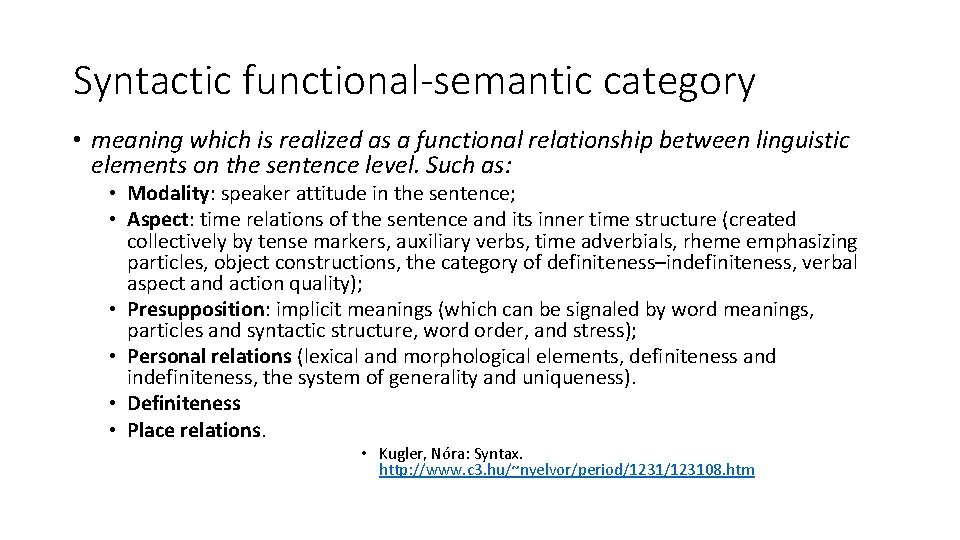
Syntactic functional-semantic category • meaning which is realized as a functional relationship between linguistic elements on the sentence level. Such as: • Modality: speaker attitude in the sentence; • Aspect: time relations of the sentence and its inner time structure (created collectively by tense markers, auxiliary verbs, time adverbials, rheme emphasizing particles, object constructions, the category of definiteness–indefiniteness, verbal aspect and action quality); • Presupposition: implicit meanings (which can be signaled by word meanings, particles and syntactic structure, word order, and stress); • Personal relations (lexical and morphological elements, definiteness and indefiniteness, the system of generality and uniqueness). • Definiteness • Place relations. • Kugler, Nóra: Syntax. http: //www. c 3. hu/~nyelvor/period/123108. htm
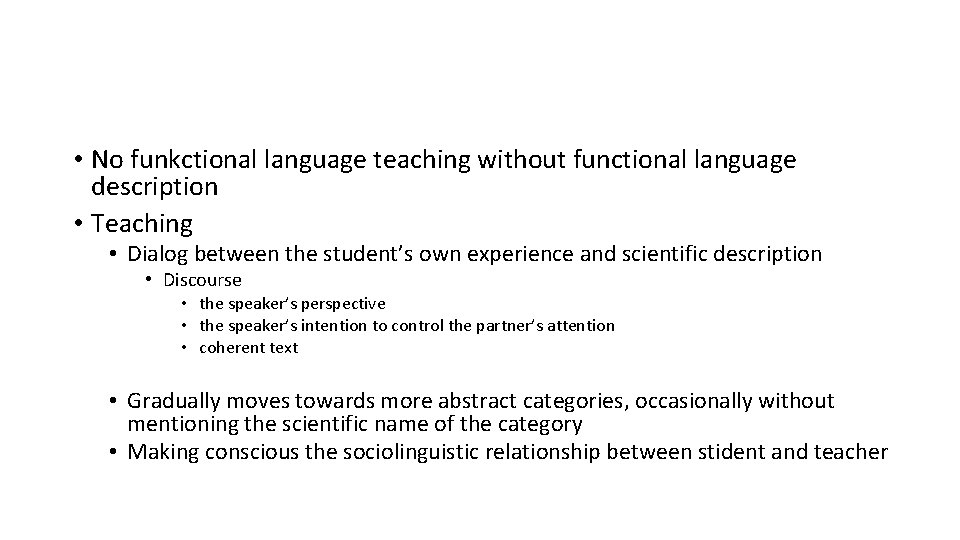
• No funkctional language teaching without functional language description • Teaching • Dialog between the student’s own experience and scientific description • Discourse • the speaker’s perspective • the speaker’s intention to control the partner’s attention • coherent text • Gradually moves towards more abstract categories, occasionally without mentioning the scientific name of the category • Making conscious the sociolinguistic relationship between stident and teacher
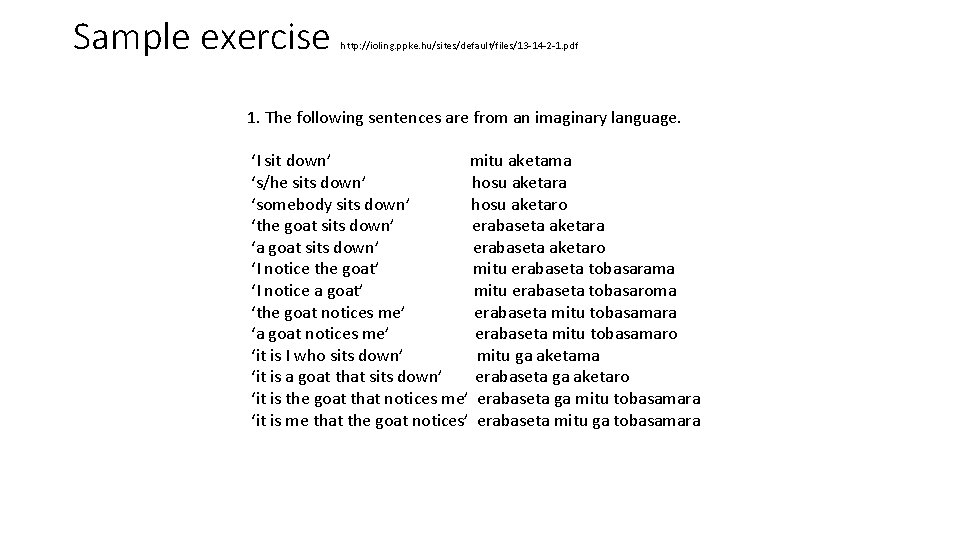
Sample exercise http: //ioling. ppke. hu/sites/default/files/13 -14 -2 -1. pdf 1. The following sentences are from an imaginary language. ‘I sit down’ mitu aketama ‘s/he sits down’ hosu aketara ‘somebody sits down’ hosu aketaro ‘the goat sits down’ erabaseta aketara ‘a goat sits down’ erabaseta aketaro ‘I notice the goat’ mitu erabaseta tobasarama ‘I notice a goat’ mitu erabaseta tobasaroma ‘the goat notices me’ erabaseta mitu tobasamara ‘a goat notices me’ erabaseta mitu tobasamaro ‘it is I who sits down’ mitu ga aketama ‘it is a goat that sits down’ erabaseta ga aketaro ‘it is the goat that notices me’ erabaseta ga mitu tobasamara ‘it is me that the goat notices’ erabaseta mitu ga tobasamara
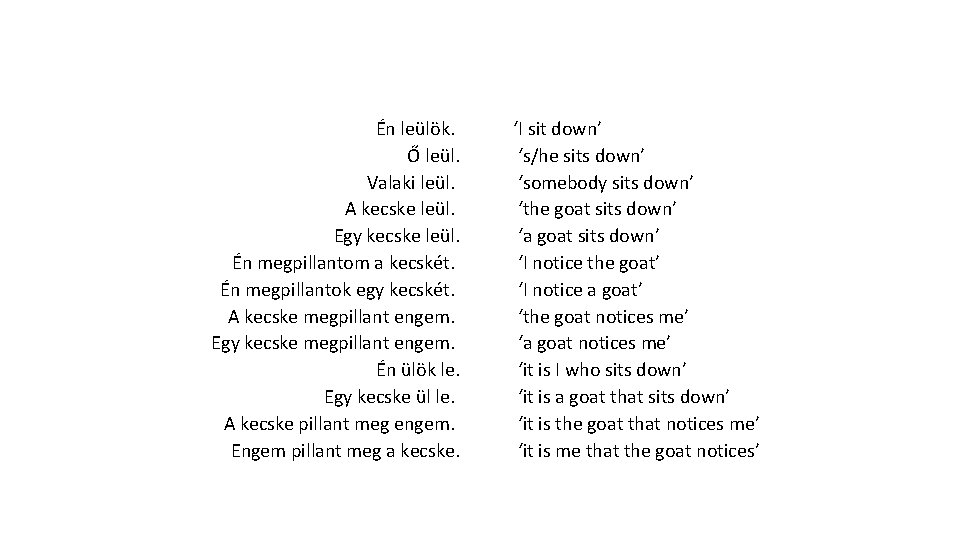
Én leülök. Ő leül. Valaki leül. A kecske leül. Egy kecske leül. Én megpillantom a kecskét. Én megpillantok egy kecskét. A kecske megpillant engem. Egy kecske megpillant engem. Én ülök le. Egy kecske ül le. A kecske pillant meg engem. Engem pillant meg a kecske. ‘I sit down’ ‘s/he sits down’ ‘somebody sits down’ ‘the goat sits down’ ‘a goat sits down’ ‘I notice the goat’ ‘I notice a goat’ ‘the goat notices me’ ‘a goat notices me’ ‘it is I who sits down’ ‘it is a goat that sits down’ ‘it is the goat that notices me’ ‘it is me that the goat notices’
- Slides: 11