
Functional Fit Analysis Objectives Define the value propositions
Functional Fit Analysis Objectives - Define the value propositions in organizations - Identify the role of ERP in adding value to organizations. - Define the functional fit analysis methods - Explain the approach of functional fit analysis
Significance of Functional Fit Analysis (FFA): How the data integration and best practice provided by the ERP will improve the processes and management of organizations ? • FFA is related to the organizations mission and strategy • What is the added value of the new ERP? • Variety of added values !!! • Concentration will be on financial added value
Significance of Functional Fit Analysis Value propositions: • Operational Excellence • Customer intimacy • Product leadership
q Added value / ERP implementation pitfalls • Application of ERP best practice may destroy the add value • Hanging on the existing ways working FFA objective is to determine the combination of ERP best practice and tailor-made adaptation, given the organization value proposition
Functional Fit Analysis Method Talbert Theory: ERP suppliers have numerous assumptions about business processes. These assumptions are used during the designing, programming and implementation of ERP • Misfit: The difference between the programmed and actual best practice. This misfit is one of the most important reasons behind the failure of ERP implementation.
Functional Fit Analysis Method • Good fit Options: § Process replication § Process modification § Software modification § Exploration
Functional Fit Analysis Method • Risks of software modifications (Talbert theory): § High cost § Long-time-to market § Decreased flexibility • Newly developed ERPs reduce this risk by § Increased number of best practices are programmed § ERP is becoming more modular and built-in connection points for adaptation. § Software modifications are offered by thirdpartners.
Functional Fit Analysis Approach • Based on Talbert theory: o Create a list of business processes that will be supported by the preselected ERPs o Start the exploration process: § Compare each business process with corresponding ERP best practice: § Check : Best fit? § Check Competitive advantage § Decisions are: Ø Process replications Ø Process modifications Ø Software modifications
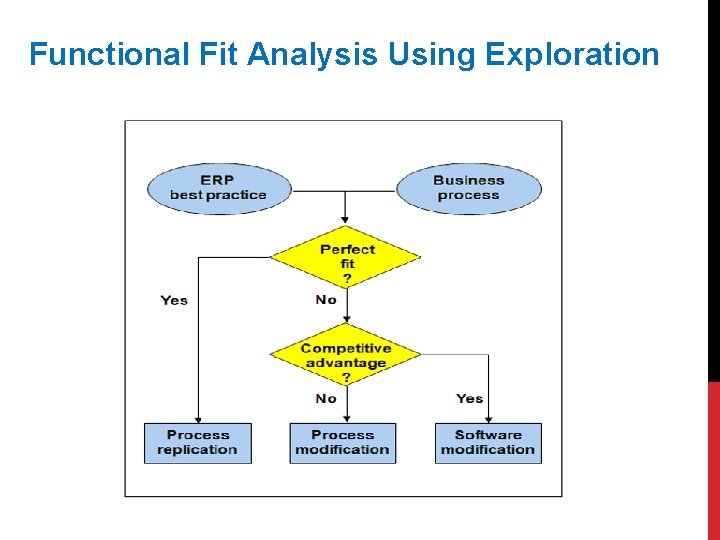
Functional Fit Analysis Using Exploration
Functional Fit Analysis Using Exploration ØProcess Replication: • Cost: No • Risk: No ØProcess Modification: • Cost: Process design and employee training • Risk: Resistance to change and design errors ØSoftware Modification: • Cost: Software design • Risk: Budget overrun and late delivery
Functional Fit Analysis Team knowledge and composition: • Business processes ( current and improvements): o Experienced users o Process analyst o Operational auditor ( quality specialist) • Specialist knowledge of the preselected ERPs o From the same organization o Implementation partners • IT system development ( for software modification) o Time, cost and other efforts are estimated
- Slides: 11