
Functional Decomposition Design Project Management Rochester Institute of
- Slides: 36
Functional Decomposition Design Project Management Rochester Institute of Technology Mechanical Engineering Department Rochester, NY USA R. I. T Mechanical Engineering
Purpose of the functional decomposition: • Identify a small number of functions (the WHAT) that your product must deliver to the customer to satisfy their need (the WHY) • Prepare to map those functions back to customer needs. • As long as you provide the correct “WHAT” to your customer, they will often not care “HOW” you deliver the functions. • Modularize the product • Provide a structure around which to specify the problem • Provide a structure around which to brainstorm • We will try two different approaches today – both may have value for your team! R. I. T Mechanical Engineering
What is the core function? • What is the one core function that the device/product/process needs to accomplish? • What subfunctions need to be performed in order to achieve that function? • This allows you to begin distinguishing your problem/solution from others. R. I. T Mechanical Engineering
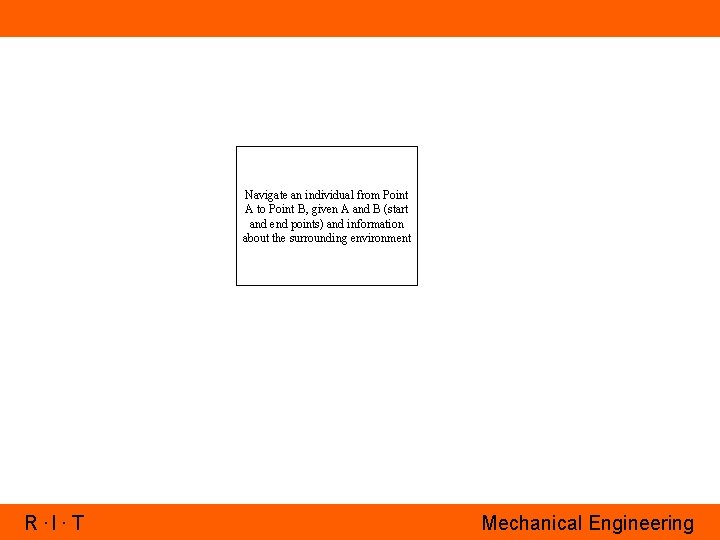
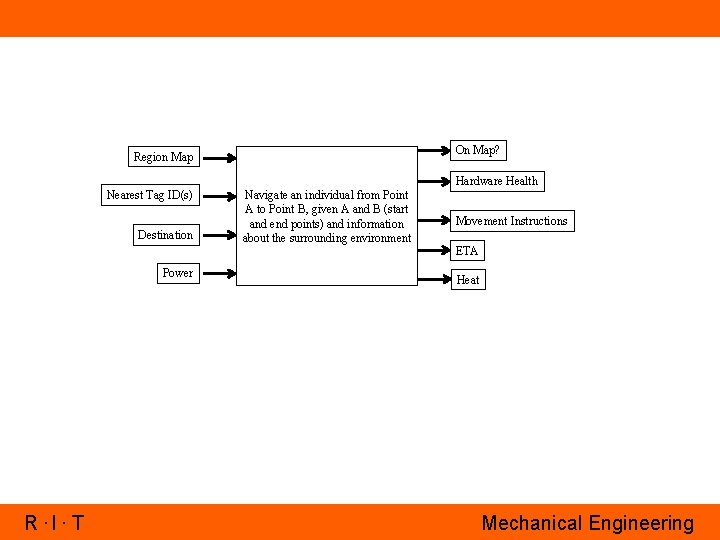
Navigate an individual from Point A to Point B, given A and B (start and end points) and information about the surrounding environment R. I. T Mechanical Engineering
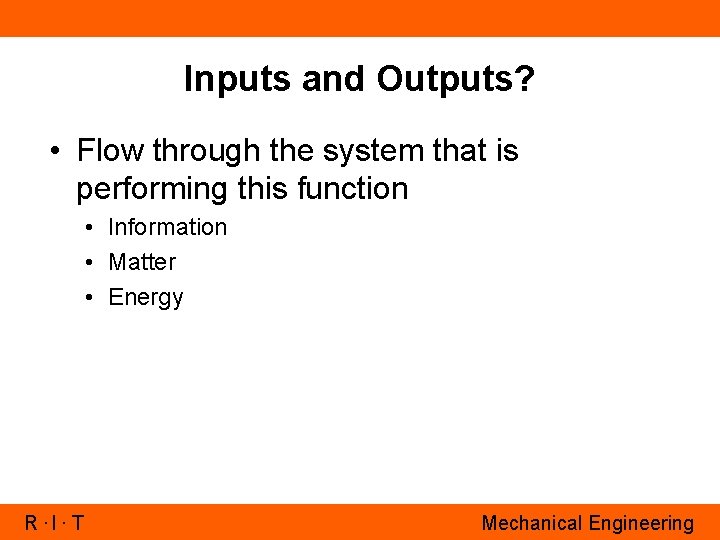
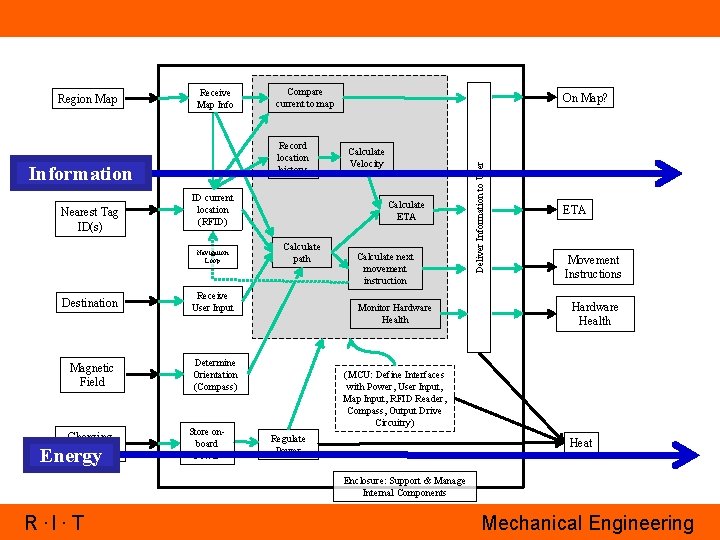
Inputs and Outputs? • Flow through the system that is performing this function • Information • Matter • Energy R. I. T Mechanical Engineering
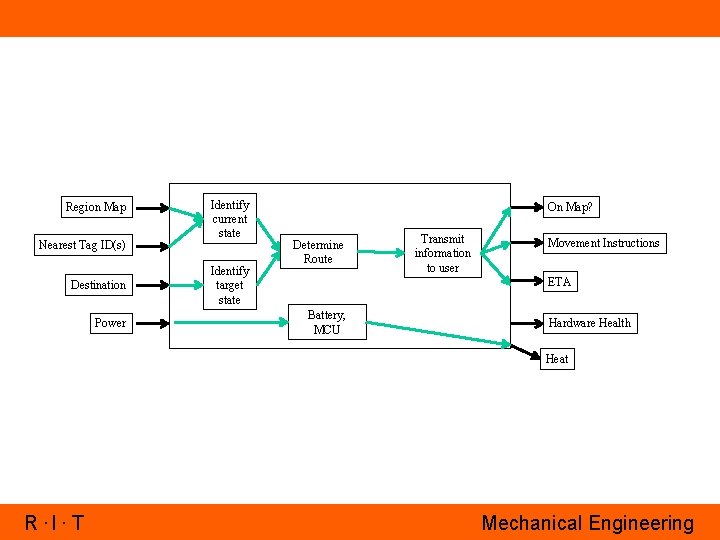
On Map? Region Map Hardware Health Nearest Tag ID(s) Destination Power R. I. T Navigate an individual from Point A to Point B, given A and B (start and end points) and information about the surrounding environment Movement Instructions ETA Heat Mechanical Engineering
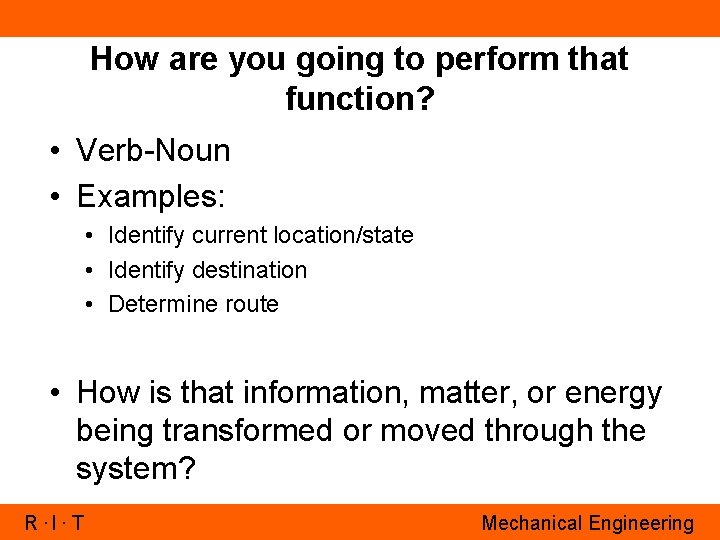
How are you going to perform that function? • Verb-Noun • Examples: • Identify current location/state • Identify destination • Determine route • How is that information, matter, or energy being transformed or moved through the system? R. I. T Mechanical Engineering
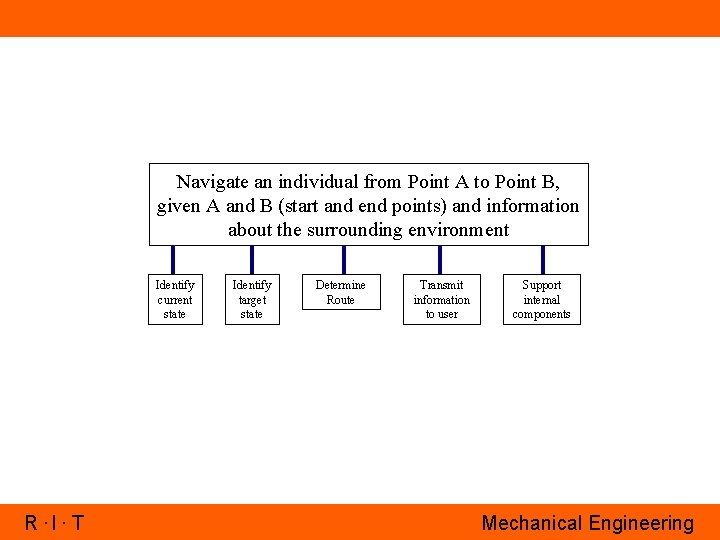
Navigate an individual from Point A to Point B, given A and B (start and end points) and information about the surrounding environment Identify current state R. I. T Identify target state Determine Route Transmit information to user Support internal components Mechanical Engineering
Region Map Nearest Tag ID(s) Destination Power Identify current state Identify target state On Map? Determine Route Transmit information to user Movement Instructions ETA Battery, MCU Hardware Health Heat R. I. T Mechanical Engineering
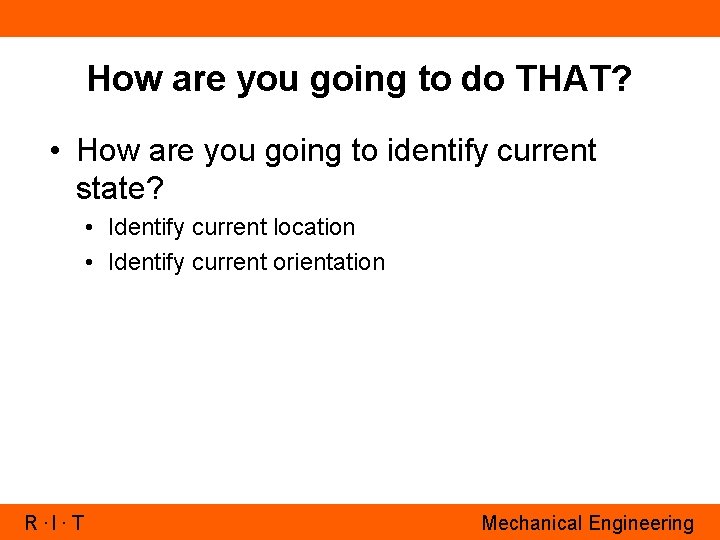
How are you going to do THAT? • How are you going to identify current state? • Identify current location • Identify current orientation R. I. T Mechanical Engineering
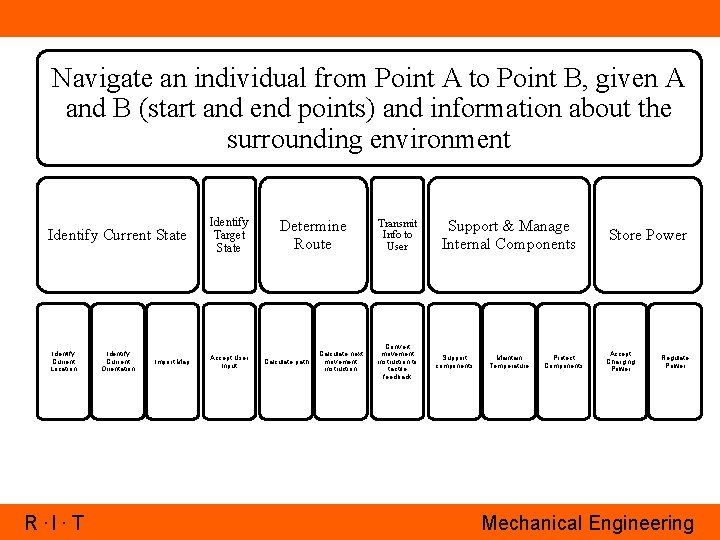
Navigate an individual from Point A to Point B, given A and B (start and end points) and information about the surrounding environment Identify Current State Identify Target State Identify Current Location Accept User Input R. I. T Identify Current Orientation Import Map Determine Route Calculate path Calculate next movement instruction Transmit Info to User Convert movement instruction to tactile feedback Support & Manage Internal Components Support components Maintain Temperature Protect Components Store Power Accept Charging Power Regulate Power Mechanical Engineering
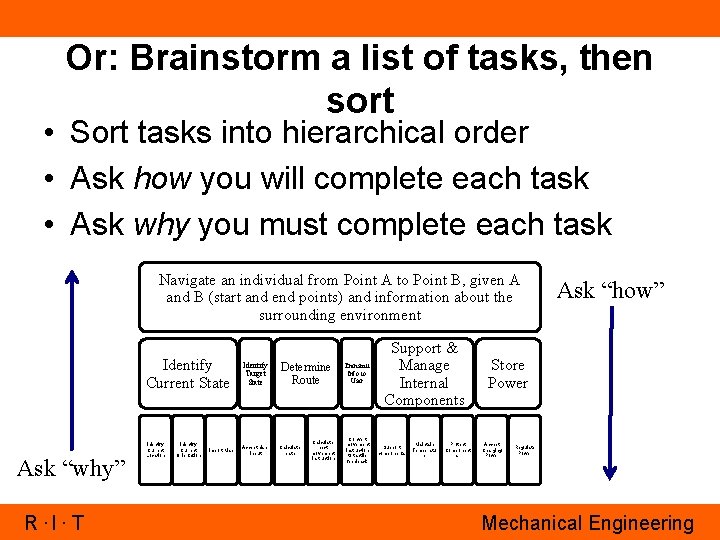
Or: Brainstorm a list of tasks, then sort • Sort tasks into hierarchical order • Ask how you will complete each task • Ask why you must complete each task Navigate an individual from Point A to Point B, given A and B (start and end points) and information about the surrounding environment Ask “why” R. I. T Identify Current State Identify Target State Determine Route Identify Current Location Accept User Input Calculate path Identify Current Orientation Import Map Calculate next movement instruction Transmit Info to User Convert movement instruction to tactile feedback Support & Manage Internal Components Support components Maintain Temperatur e Protect Component s Ask “how” Store Power Accept Charging Power Regulate Power Mechanical Engineering
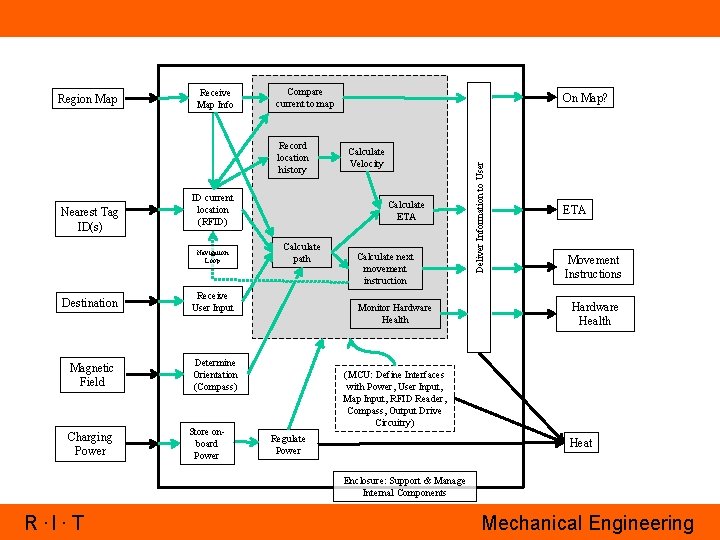
Receive Map Info Compare current to map Record location history Nearest Tag ID(s) ID current location (RFID) Navigation Loop Destination Receive User Input Magnetic Field Determine Orientation (Compass) Charging Power Store onboard Power On Map? Calculate Velocity Calculate ETA Calculate path Calculate next movement instruction Monitor Hardware Health Deliver Information to User Region Map ETA Movement Instructions Hardware Health (MCU: Define Interfaces with Power, User Input, Map Input, RFID Reader, Compass, Output Drive Circuitry) Regulate Power Heat Enclosure: Support & Manage Internal Components R. I. T Mechanical Engineering
Receive Map Info Record location history Information Nearest Tag ID(s) ID current location (RFID) Navigation Loop Destination Receive User Input Magnetic Field Determine Orientation (Compass) Charging Power Energy Compare current to map Store onboard Power On Map? Calculate Velocity Calculate ETA Calculate path Calculate next movement instruction Monitor Hardware Health Deliver Information to User Region Map ETA Movement Instructions Hardware Health (MCU: Define Interfaces with Power, User Input, Map Input, RFID Reader, Compass, Output Drive Circuitry) Regulate Power Heat Enclosure: Support & Manage Internal Components R. I. T Mechanical Engineering
Consider last week’s example… • I said, “We need a better ladder”. • What if I had said, “We need a device that provides access to objects above human reach”? • Core fuction: Provide access to objects above human reach. • Define problem further in the subfunctions R. I. T Mechanical Engineering
Point of Confusion #1 • Functions ≠ Constraints • Constraints are system-wide parameters, like cost, weight, overall footprint • Functions are actions, what your device/system will do (verb-noun) R. I. T Mechanical Engineering
Point of Confusion #2 • Engineering Metrics and Target Specifications define how well you need to perform these functions/subfunctions, or what constraints you must meet • Metrics = what to measure, units • Specifications = magnitude • Consider specifications for minimally acceptable, target, and ideal conditions R. I. T Mechanical Engineering
Examples of Functions • Some functions that your product may perform (from Otto & Wood Product Design): • Import, export, transfer, transmit, guide, translate, rotate, allow degrees of freedom • Stop, stabilize, secure, position • Couple, mix, separate, remove, refine, distribute, dissipate • Store, supply, extract • Actuate, regulate, change, form, condition • Sense, indicate, display, measure R. I. T Mechanical Engineering
In-Class Example • Develop a functional decomposition for a device that will enable a person with one hand to secure their hair in a ponytail. • R 13002, R 13201, and R 13301 use function tree/FAST diagram • R 13401, R 13701, and R 13904 use flow diagram R. I. T Mechanical Engineering
Regroup • Two teams share function trees • Discussion: • • • R. I. T How are these different from yours? Is one right or wrong? Better or worse? Are you (or they) missing functions? Are you (or they) prescribing solutions? Other questions? Mechanical Engineering
Questions? R. I. T Mechanical Engineering
Rest of Today… • Refine VOC, problem background • Feedback from guide • Follow-up with stakeholders • Prepare for next week’s presentation • What information do you want to convey? • What information are you still missing? • Begin considering core function(s) for your project(s) R. I. T Mechanical Engineering
Next Steps • Assign metrics and specifications • Metrics = what to measure, units • Specifications = magnitude • Consider specifications for minimally acceptable, target, and ideal conditions • Performance Specifications: what the customer sees • Design Specifications: define interfaces R. I. T Mechanical Engineering
R. I. T Mechanical Engineering
Specifications: Metrics and Target Values Design Project Management R. I. T Mechanical Engineering
When we left off… • Functional decomposition • Function Tree • Flow Diagram • Each product development team should have a draft functional decomposition (or two, or three…) by now R. I. T Mechanical Engineering
Context • Objective Tree: What the customer needs • Function Tree: How the overall project goal will be achieved • Specifications: How well do the functions need to be performed? R. I. T Mechanical Engineering
Metrics and Specifications • Indicate units of measure (metrics) • Indicate preferred direction • • • Up, maximize Down, minimize Target value Range or list of values Binary Survey results • Min. acceptable, target, and ideal values R. I. T Mechanical Engineering
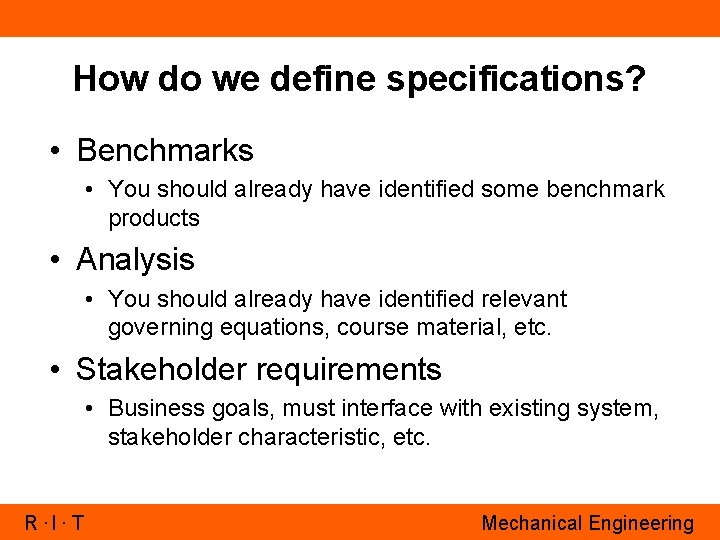
How do we define specifications? • Benchmarks • You should already have identified some benchmark products • Analysis • You should already have identified relevant governing equations, course material, etc. • Stakeholder requirements • Business goals, must interface with existing system, stakeholder characteristic, etc. R. I. T Mechanical Engineering
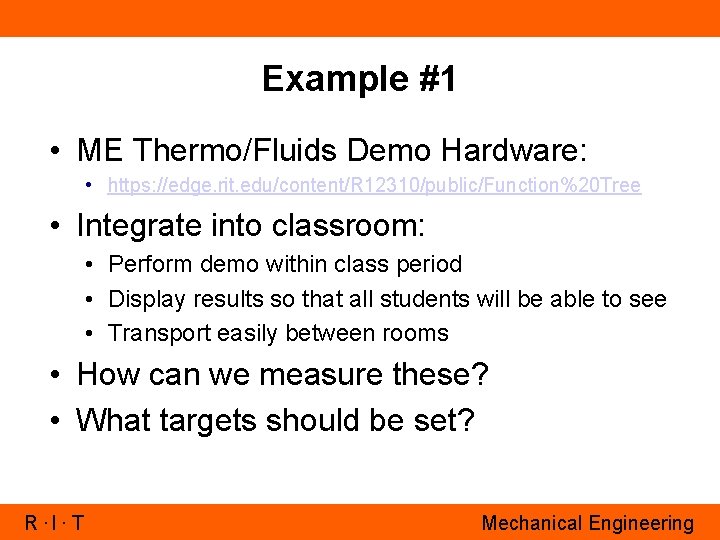
Example #1 • ME Thermo/Fluids Demo Hardware: • https: //edge. rit. edu/content/R 12310/public/Function%20 Tree • Integrate into classroom: • Perform demo within class period • Display results so that all students will be able to see • Transport easily between rooms • How can we measure these? • What targets should be set? R. I. T Mechanical Engineering
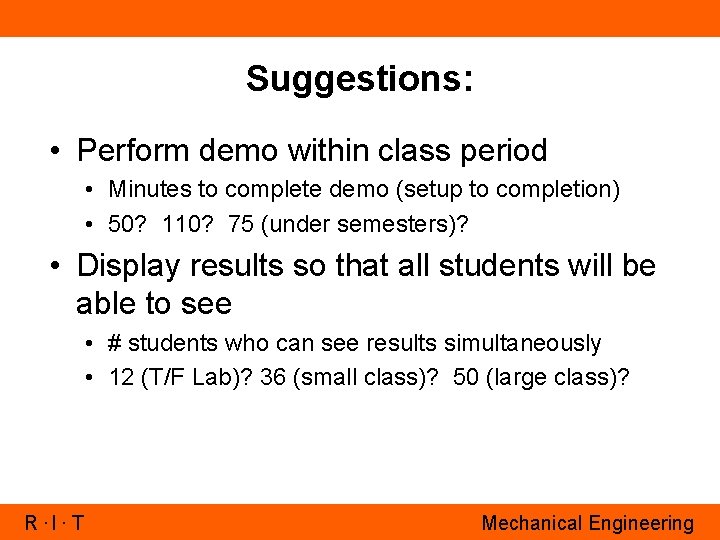
Suggestions: • Perform demo within class period • Minutes to complete demo (setup to completion) • 50? 110? 75 (under semesters)? • Display results so that all students will be able to see • # students who can see results simultaneously • 12 (T/F Lab)? 36 (small class)? 50 (large class)? R. I. T Mechanical Engineering
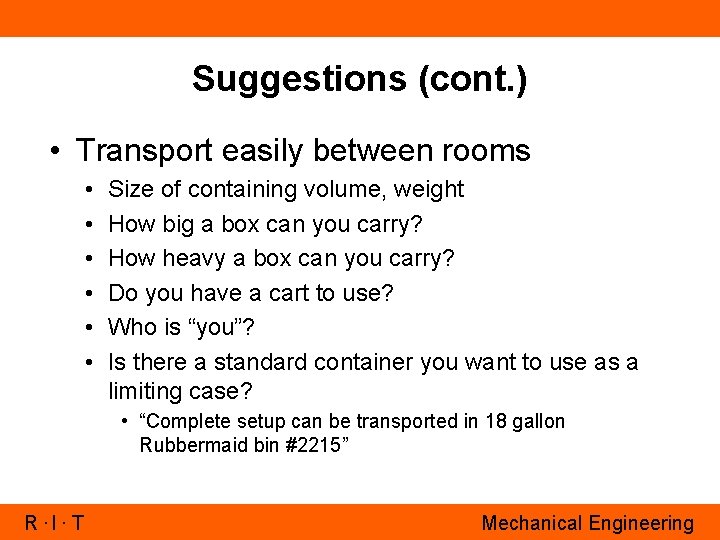
Suggestions (cont. ) • Transport easily between rooms • • • Size of containing volume, weight How big a box can you carry? How heavy a box can you carry? Do you have a cart to use? Who is “you”? Is there a standard container you want to use as a limiting case? • “Complete setup can be transported in 18 gallon Rubbermaid bin #2215” R. I. T Mechanical Engineering
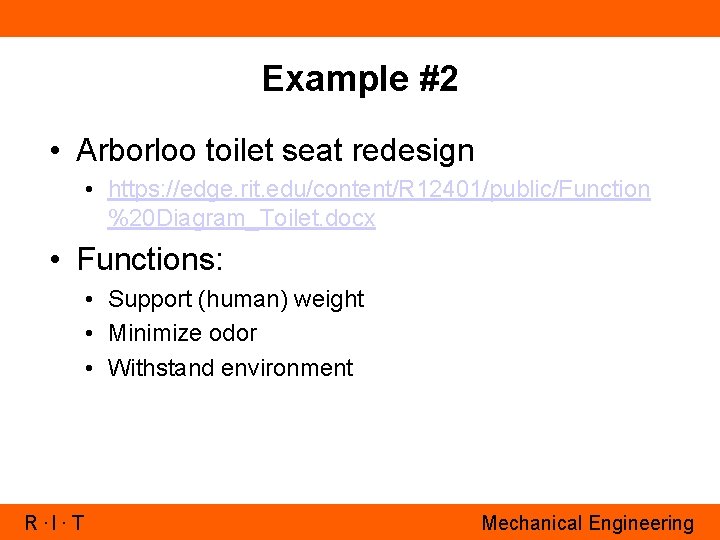
Example #2 • Arborloo toilet seat redesign • https: //edge. rit. edu/content/R 12401/public/Function %20 Diagram_Toilet. docx • Functions: • Support (human) weight • Minimize odor • Withstand environment R. I. T Mechanical Engineering
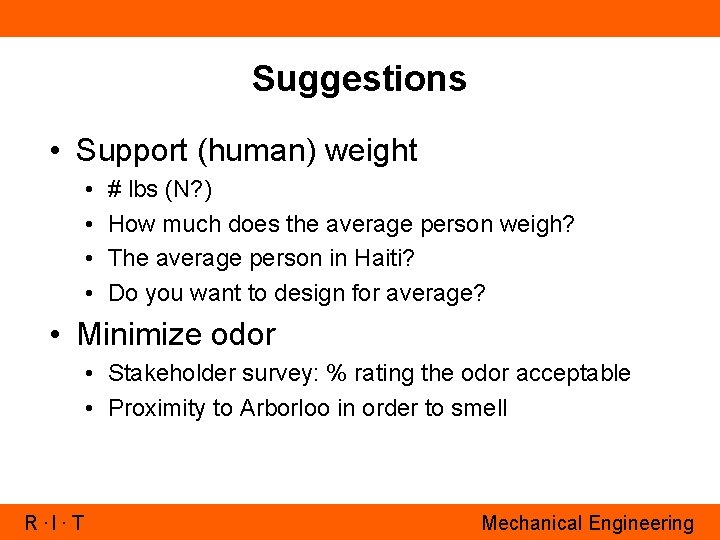
Suggestions • Support (human) weight • • # lbs (N? ) How much does the average person weigh? The average person in Haiti? Do you want to design for average? • Minimize odor • Stakeholder survey: % rating the odor acceptable • Proximity to Arborloo in order to smell R. I. T Mechanical Engineering
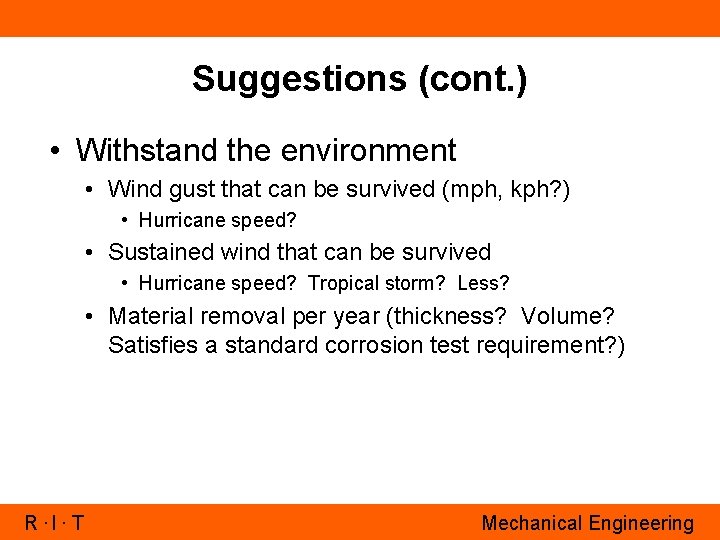
Suggestions (cont. ) • Withstand the environment • Wind gust that can be survived (mph, kph? ) • Hurricane speed? • Sustained wind that can be survived • Hurricane speed? Tropical storm? Less? • Material removal per year (thickness? Volume? Satisfies a standard corrosion test requirement? ) R. I. T Mechanical Engineering
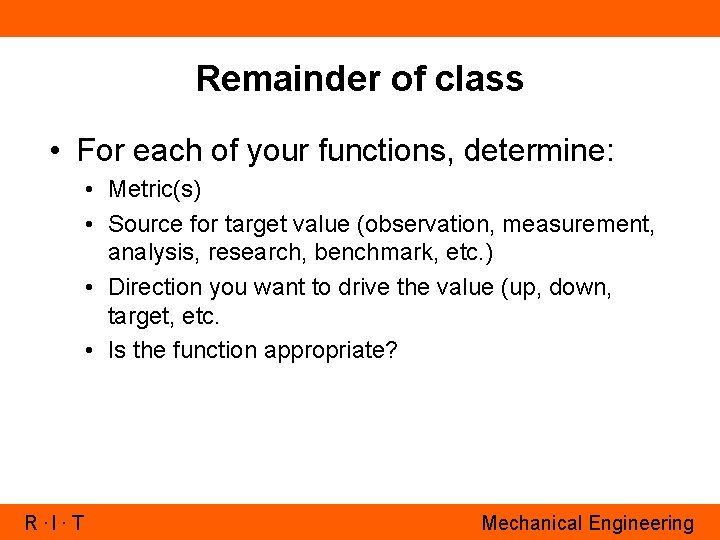
Remainder of class • For each of your functions, determine: • Metric(s) • Source for target value (observation, measurement, analysis, research, benchmark, etc. ) • Direction you want to drive the value (up, down, target, etc. • Is the function appropriate? R. I. T Mechanical Engineering