
FUNCTIONAL COMPONENTS AND ORGANIZATION OF SPINAL CORD AND
- Slides: 18
FUNCTIONAL COMPONENTS AND ORGANIZATION OF SPINAL CORD AND BRAINSTEM
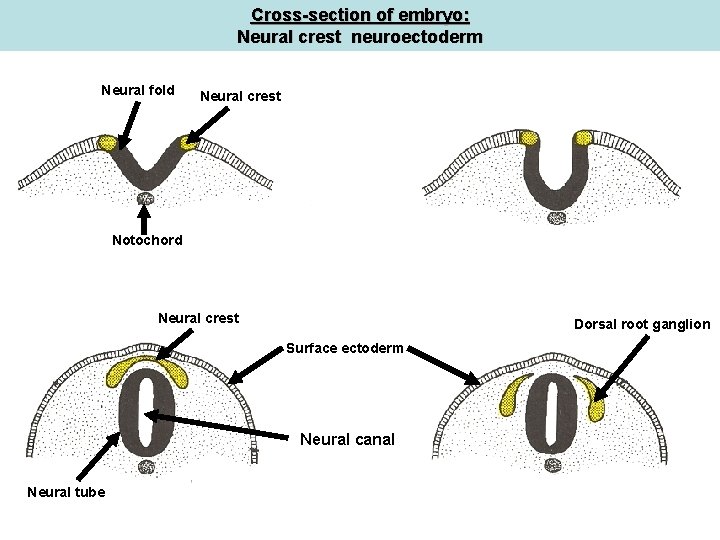
Cross-section of embryo: Neural crest neuroectoderm Neural fold Neural crest Notochord Neural crest Dorsal root ganglion Surface ectoderm Neural canal Neural tube
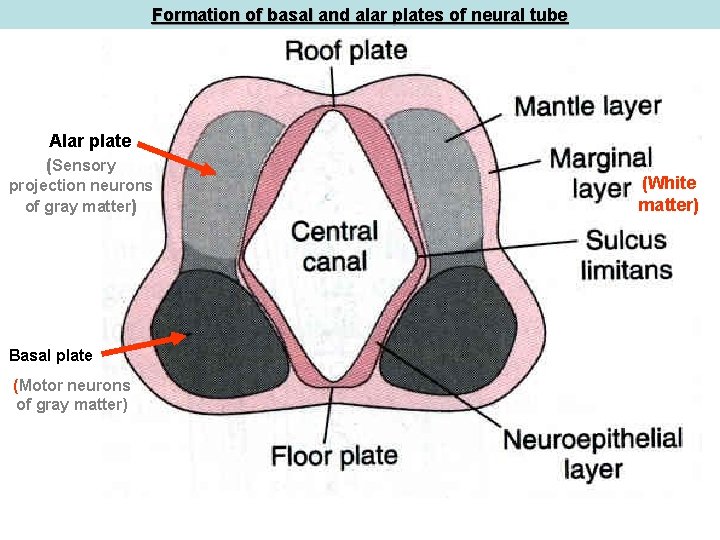
Formation of basal and alar plates of neural tube Alar plate (Sensory projection neurons of gray matter) Basal plate (Motor neurons of gray matter) (White matter)
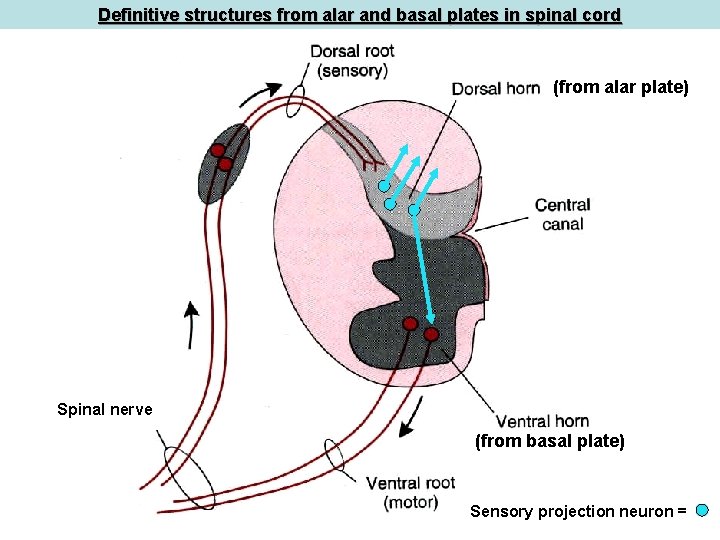
Definitive structures from alar and basal plates in spinal cord (from alar plate) Spinal nerve (from basal plate) Sensory projection neuron =
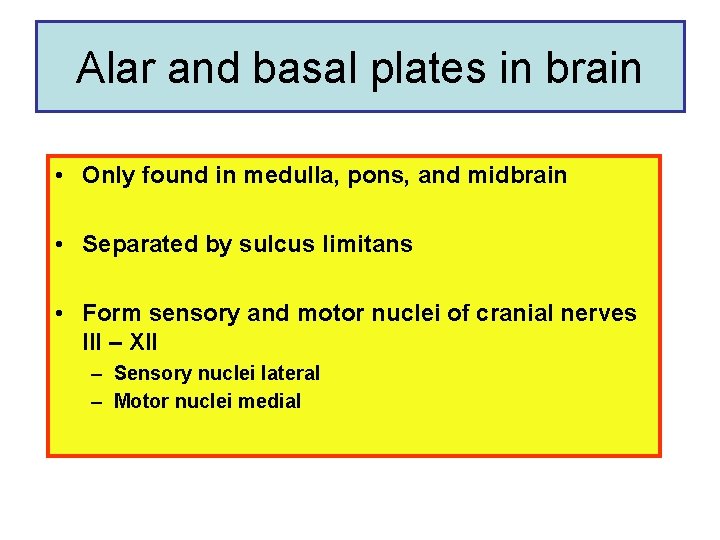
Alar and basal plates in brain • Only found in medulla, pons, and midbrain • Separated by sulcus limitans • Form sensory and motor nuclei of cranial nerves III – XII – Sensory nuclei lateral – Motor nuclei medial
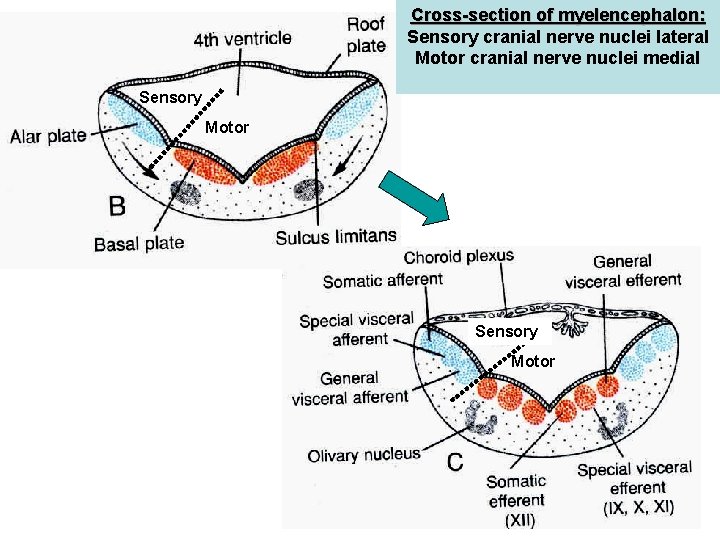
Cross-section of myelencephalon: Sensory cranial nerve nuclei lateral Motor cranial nerve nuclei medial Sensory Motor
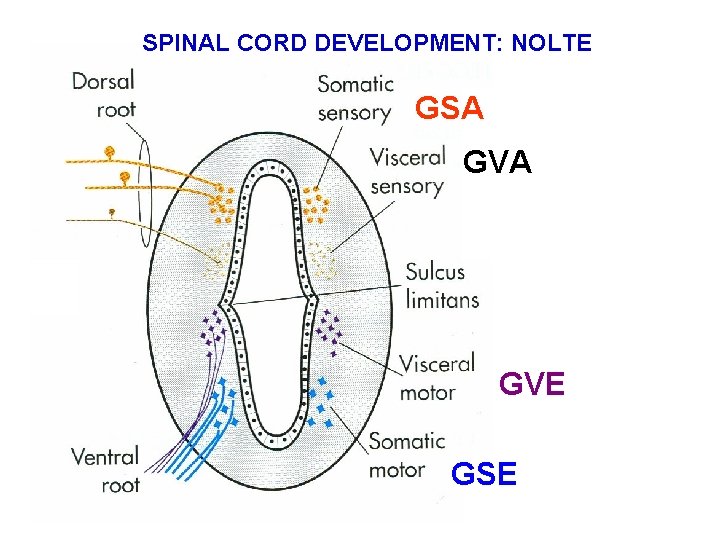
SPINAL CORD DEVELOPMENT: NOLTE GSA GVE GSE
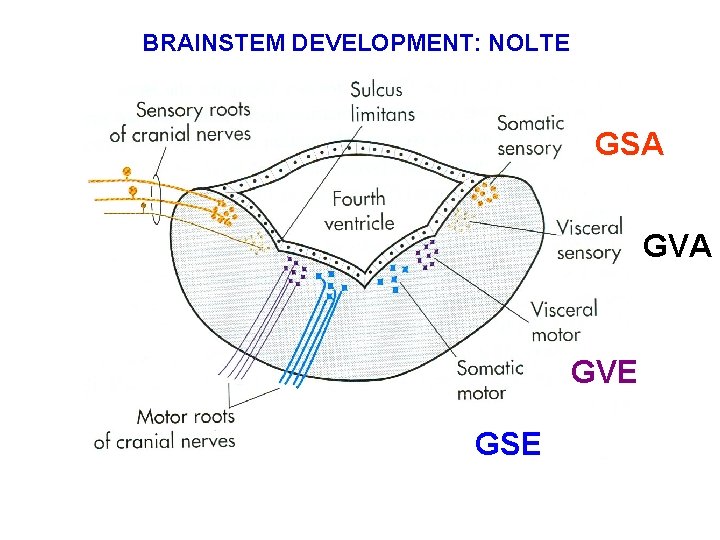
BRAINSTEM DEVELOPMENT: NOLTE GSA GVE GSE
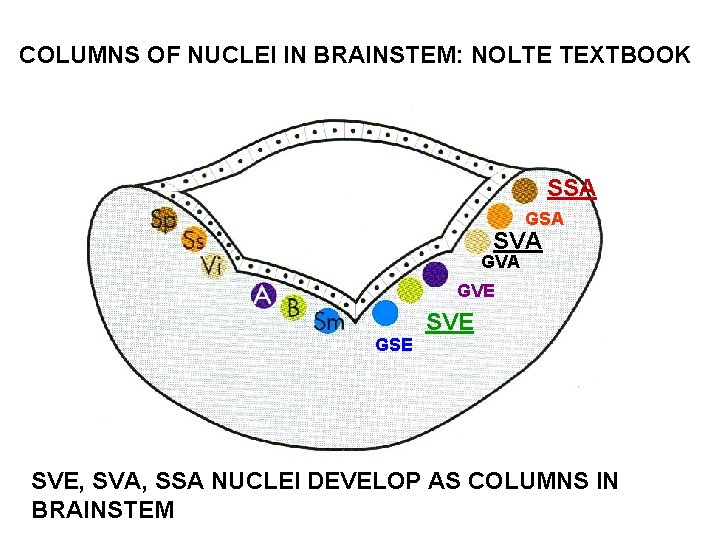
COLUMNS OF NUCLEI IN BRAINSTEM: NOLTE TEXTBOOK SSA GSA SVA GVE GSE SVE, SVA, SSA NUCLEI DEVELOP AS COLUMNS IN BRAINSTEM
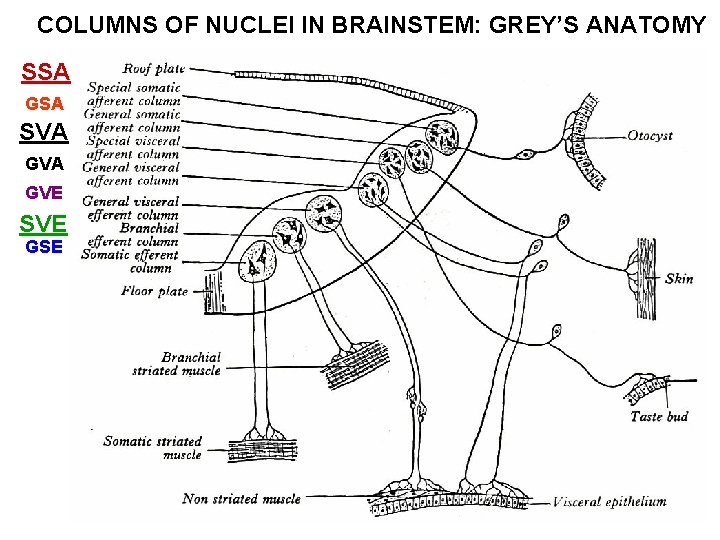
COLUMNS OF NUCLEI IN BRAINSTEM: GREY’S ANATOMY SSA GSA SVA GVE SVE GSE
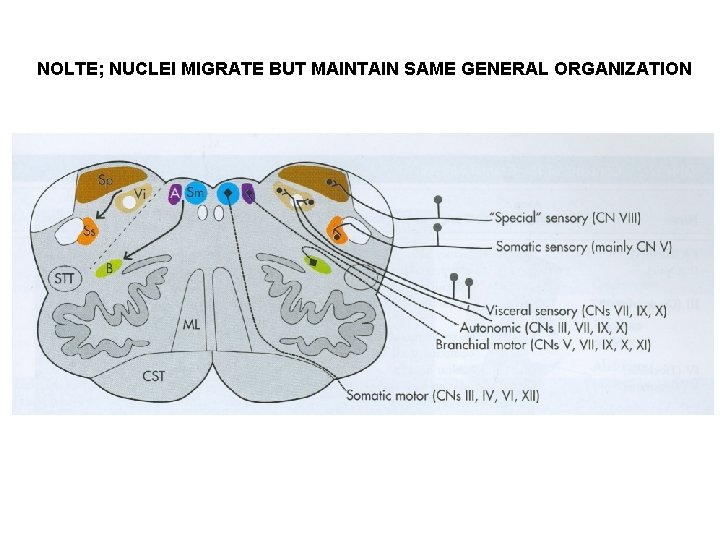
NOLTE; NUCLEI MIGRATE BUT MAINTAIN SAME GENERAL ORGANIZATION
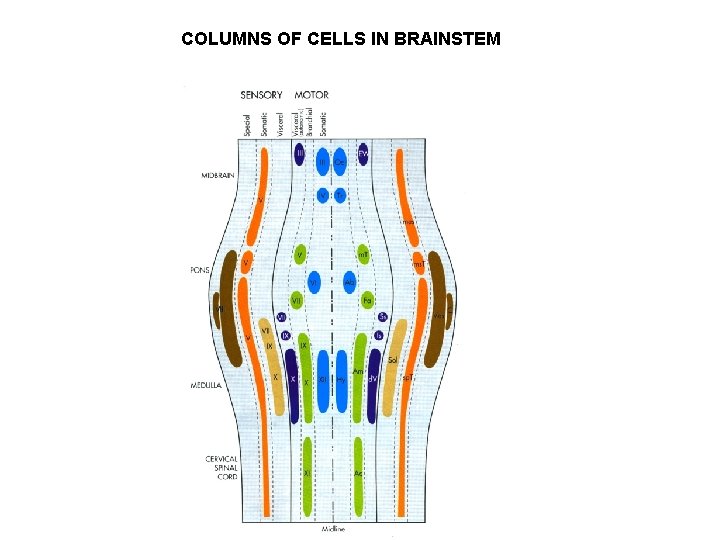
COLUMNS OF CELLS IN BRAINSTEM
Appendix: Embryonic development of cranial sensory and motor cell columns in the Brainstem
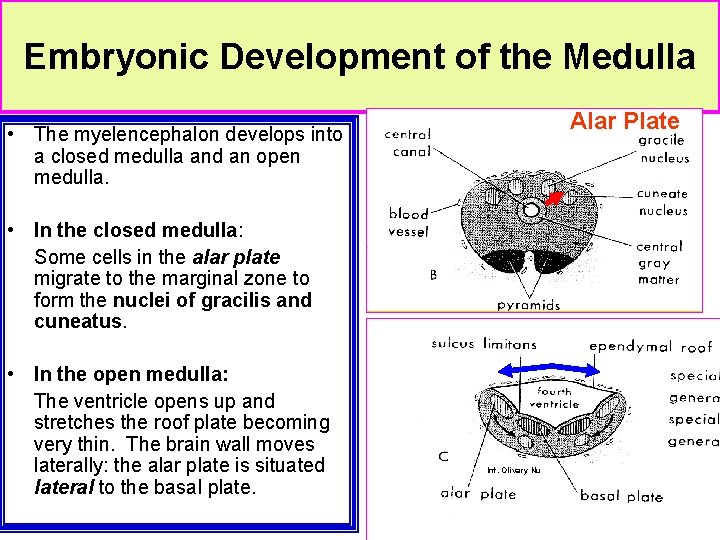
Embryonic Development of the Medulla Alar Plate • The myelencephalon develops into a closed medulla and an open medulla. • In the closed medulla: Some cells in the alar plate migrate to the marginal zone to form the nuclei of gracilis and cuneatus. • In the open medulla: The ventricle opens up and stretches the roof plate becoming very thin. The brain wall moves laterally: the alar plate is situated lateral to the basal plate. Inf. Olivary Nu
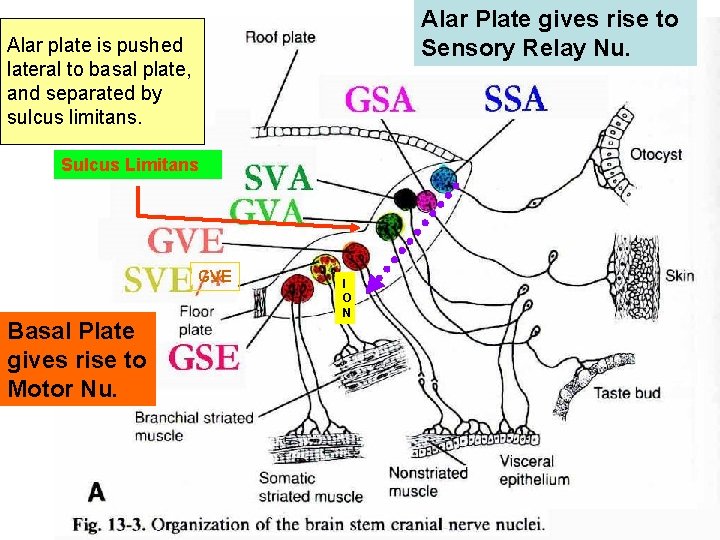
Alar Plate gives rise to Sensory Relay Nu. Alar plate is pushed lateral to basal plate, and separated by sulcus limitans. Sulcus Limitans GVE Basal Plate gives rise to Motor Nu. I O N
ALAR PLATE gives rise to Nu. Gracilis, Nu. Cuneatus, Inferior Olivary Nu. and 4 Sensory Cell Columns • GVA (General visceral afferent) –Caudal Solitary nucleus receives sensory inputs from mucous membrane of pharynx and larynx, aortic arch/body and carotid sinus/body (VII, IX, X). • SVA (Special visceral afferent) –Rostral Solitary nucleus receives taste sensation from tongues, pharynx and larynx, and epiglottis (VII, IX, X). • GSA (General somatic afferents)-Spinal Trigeminal Nucleus receives pain, temperature, and touch sensation from ipsilateral face, ear and neck areas (V, VII, IX, X) • SSA (Special somatic afferent )-Vestibulo-cochlear nuclei
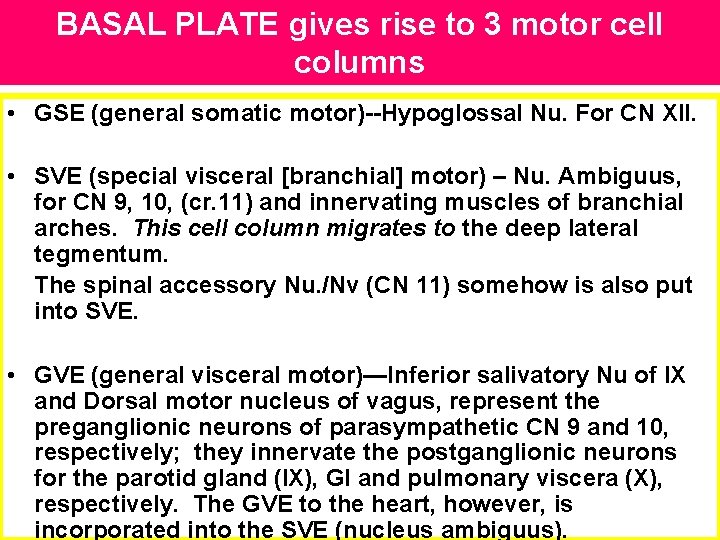
BASAL PLATE gives rise to 3 motor cell columns • GSE (general somatic motor)--Hypoglossal Nu. For CN XII. • SVE (special visceral [branchial] motor) – Nu. Ambiguus, for CN 9, 10, (cr. 11) and innervating muscles of branchial arches. This cell column migrates to the deep lateral tegmentum. The spinal accessory Nu. /Nv (CN 11) somehow is also put into SVE. • GVE (general visceral motor)—Inferior salivatory Nu of IX and Dorsal motor nucleus of vagus, represent the preganglionic neurons of parasympathetic CN 9 and 10, respectively; they innervate the postganglionic neurons for the parotid gland (IX), GI and pulmonary viscera (X), respectively. The GVE to the heart, however, is incorporated into the SVE (nucleus ambiguus).
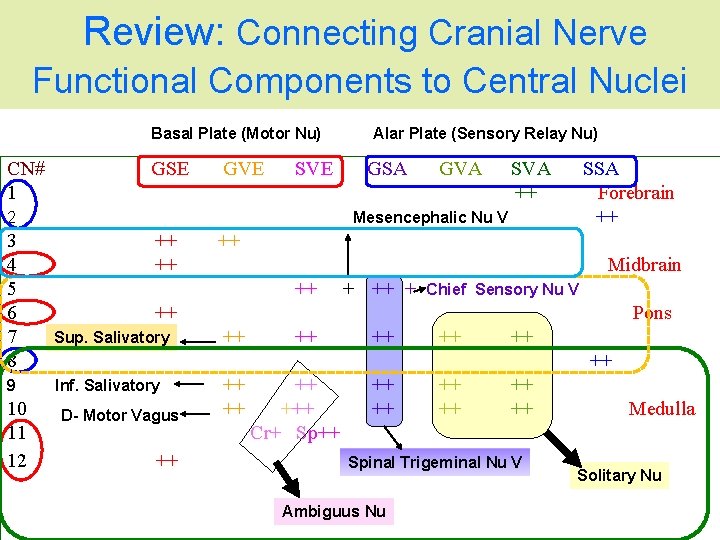
Review: Connecting Cranial Nerve Functional Components to Central Nuclei Basal Plate (Motor Nu) CN# 1 GSE GVE SVE 2 3 4 5 6 7 8 9 10 11 12 Alar Plate (Sensory Relay Nu) GSA GVA SVA ++ SSA Forebrain ++ Mesencephalic Nu V ++ ++ ++ Midbrain ++ + Chief Sensory Nu V ++ Sup. Salivatory Pons ++ ++ ++ Inf. Salivatory D- Motor Vagus ++ ++ +++ Cr+ Sp++ ++ Spinal Trigeminal Nu V Ambiguus Nu Medulla Solitary Nu