
Functional Classification of Neurotransmitters Two classifications excitatory and







- Slides: 32
Functional Classification of Neurotransmitters • Two classifications: excitatory and inhibitory – Excitatory neurotransmitters cause _ • – Inhibitory neurotransmitters cause _ •
Functional Classification of Neurotransmitters • Some neurotransmitters have _ – Determined by the __________ type of the postsynaptic neuron – Example: _ • _______________ at neuromuscular junctions with skeletal muscle •
Neurotransmitter Receptor Mechanisms • Direct: neurotransmitters that open _ – Promote _ – Examples: _______ and amino acids • Indirect: neurotransmitters that _ – Promote _ • Examples: biogenic amines, peptides, and dissolved gases
Neural Integration: Neuronal Pools • Functional groups of neurons that: – _____________ incoming information – Forward the processed information to its appropriate destination
Neural Integration: Neuronal Pools • Simple neuronal pool – Input fiber • – Discharge zone • neurons _________________ with the incoming fiber – Facilitated zone • neurons farther away from _
Types of Circuits in Neuronal Pools • Divergent –
Types of Circuits in Neuronal Pools • Convergent –
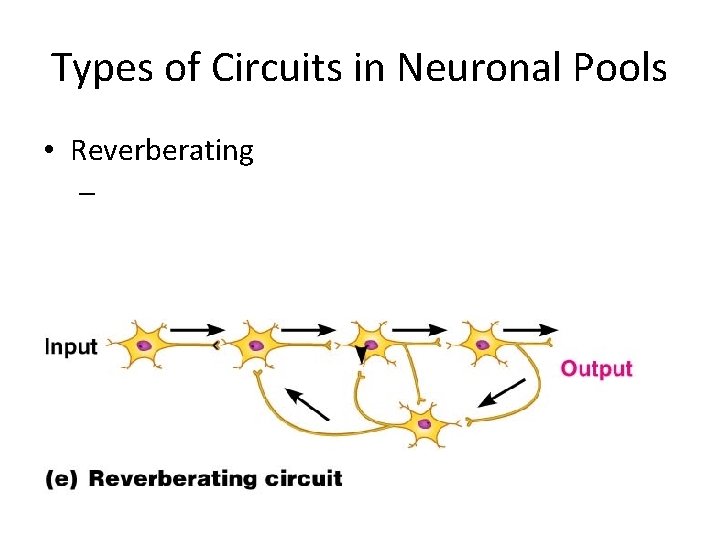
Types of Circuits in Neuronal Pools • Reverberating –
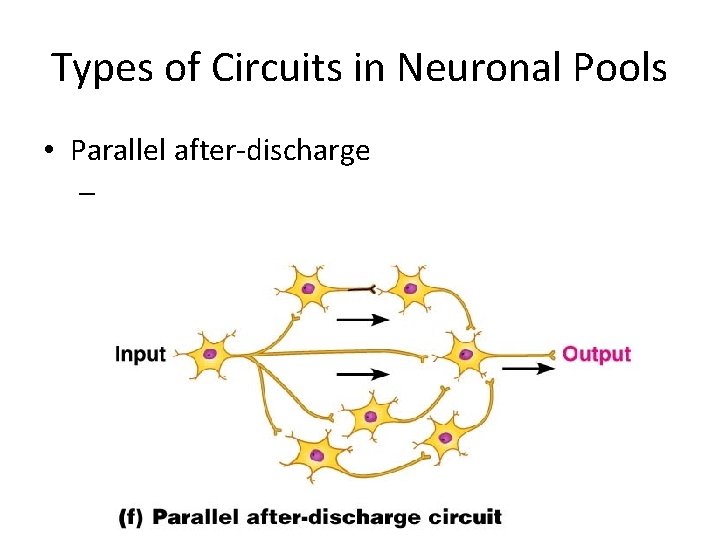
Types of Circuits in Neuronal Pools • Parallel after-discharge –
Patterns of Neural Processing • Serial Processing – Input travels along one pathway to a specific destination – Works in an _ – Example:
Patterns of Neural Processing • Parallel Processing – Input travels along _ – Pathways are integrated in different CNS systems – • Example:
Chapter 12
Central Nervous System (CNS) • CNS – composed of the _ • – Elaboration of the anterior portion of the CNS – Increase in ______________ in the head – Highest level is reached in the human brain
The Brain • Composed of wrinkled, pinkish gray tissue • Surface anatomy includes • • •
Adult Brain Structures • – cerebrum: cortex, white matter, and basal nuclei • – thalamus, hypothalamus, and epithalamus • – brain stem: midbrain • Metencephalon – brain stem: pons • Myelencephalon – brain stem: medulla oblongata
Adult Neural Canal Regions • Adult structures derived from the neural canal – Telencephalon – – Diencephalon – – Mesencephalon – – Metencephalon and myelencephalon –
Basic Pattern of the Central Nervous System • Spinal Cord – _______________ surrounded by a _ – Gray matter is surrounded by _ • myelinated fiber _ • Brain – Similar to spinal cord but with _ – Cerebellum has gray matter in nuclei – Cerebrum has nuclei and additional gray matter in the cortex
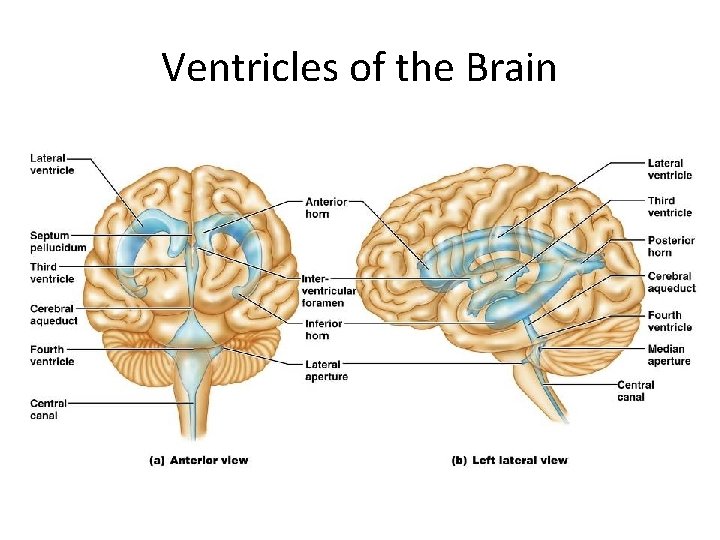
Ventricles of the Brain • Arise from expansion of the lumen of the neural tube • The ventricles are: – The paired _ – The third ventricle found in the diencephalon – The fourth ventricle found in the hindbrain dorsal to the pons
Ventricles of the Brain
Cerebral Hemispheres • Contains ridges – • and shallow grooves – • Contain deep grooves – • Are separated by the _ • Have three basic regions: – cortex, white matter, and basal nuclei
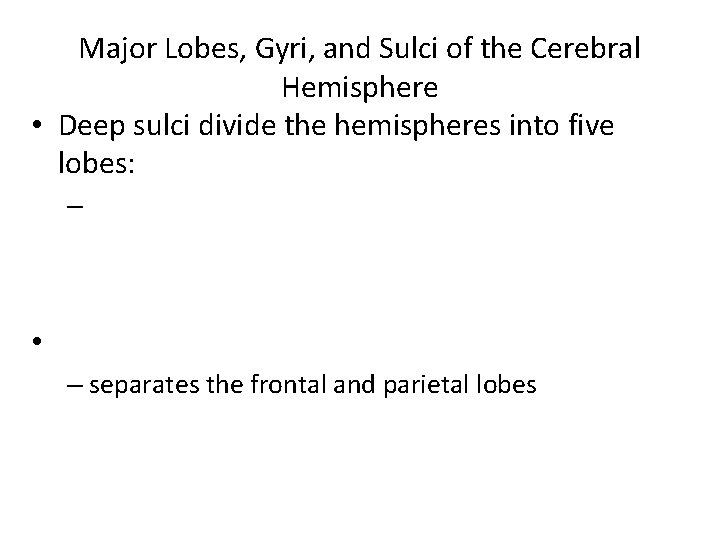
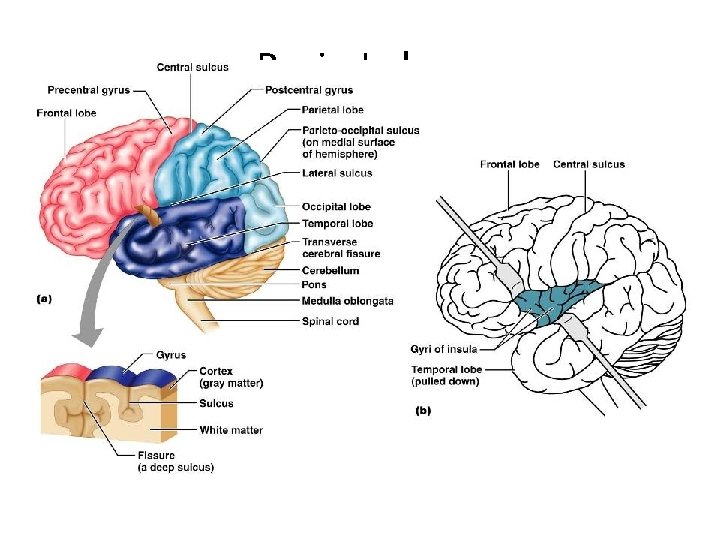
Major Lobes, Gyri, and Sulci of the Cerebral Hemisphere • Deep sulci divide the hemispheres into five lobes: – • – separates the frontal and parietal lobes
Brain Lobes
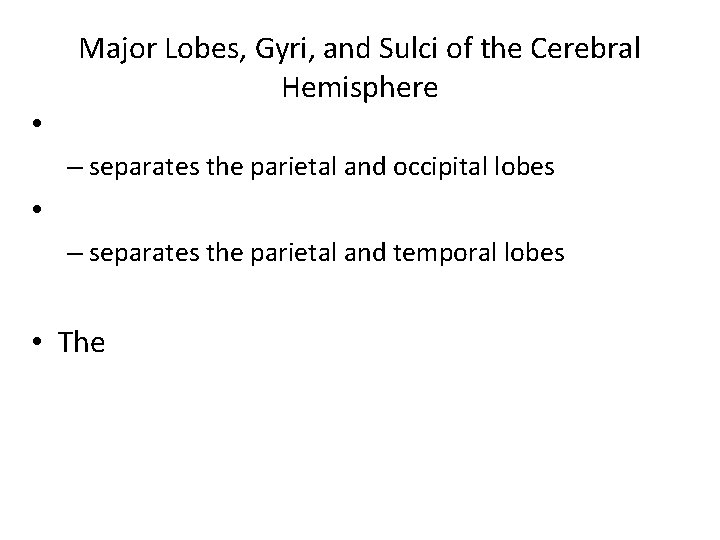
• Major Lobes, Gyri, and Sulci of the Cerebral Hemisphere – separates the parietal and occipital lobes • – separates the parietal and temporal lobes • The
Cerebral Cortex • The cortex – superficial gray matter – accounts for 40% of the mass of the brain • It enables • Each hemisphere acts _______________ (controls the opposite side of the body) • Hemispheres are not equal in function • No functional area acts alone; conscious behavior involves the entire cortex
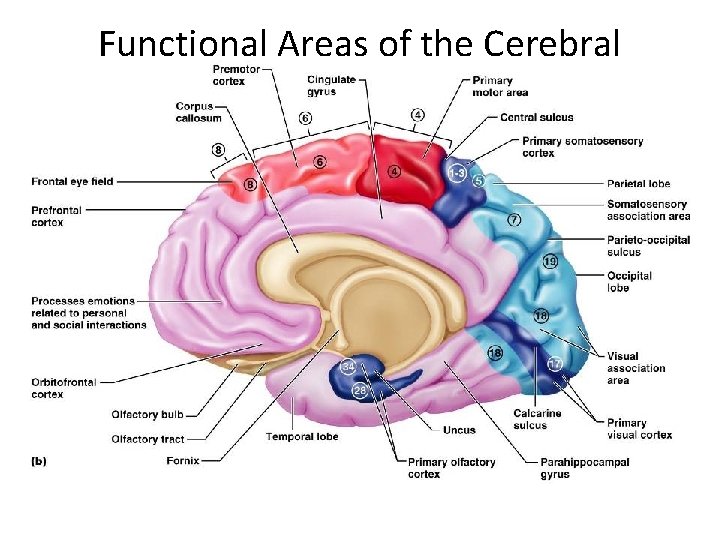
Functional Areas of the Cerebral Cortex • The three types of functional areas are: – • control voluntary movement – • conscious awareness of sensation – • integrate diverse information
Functional Areas of the Cerebral Cortex
Functional Areas of the Cerebral Cortex
Cerebral Cortex: Motor Areas • Primary _ • Premotor cortex • • Frontal eye field
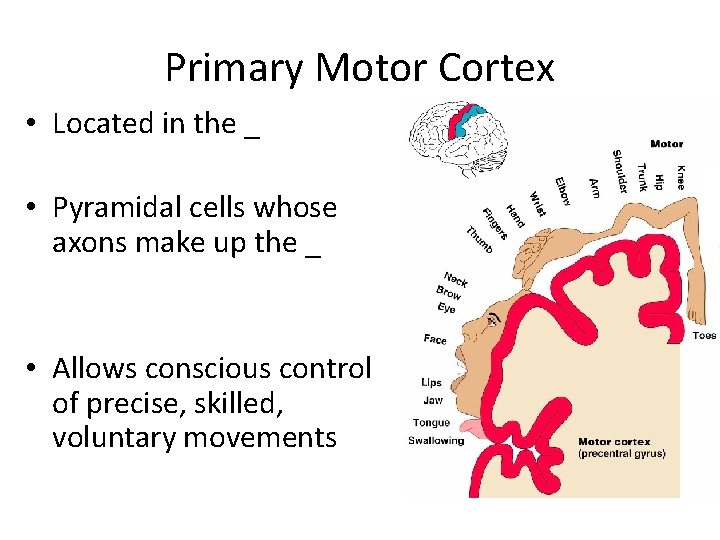
Primary Motor Cortex • Located in the _ • Pyramidal cells whose axons make up the _ • Allows conscious control of precise, skilled, voluntary movements
Premotor Cortex • Located _ • Controls _ • Coordinates simultaneous or sequential actions • Involved in the planning of movements
Broca’s Area • Broca’s area – Located anterior to the inferior region of the premotor area – Present in _ – A motor speech area that _ – Is active as one prepares to speak
Frontal Eye Field • – Located anterior to the premotor cortex and superior to Broca’s area – Controls _