
Functional biology Lecture 3 Andleeb Asmat Fatty Acids

Functional biology Lecture 3 Andleeb Asmat
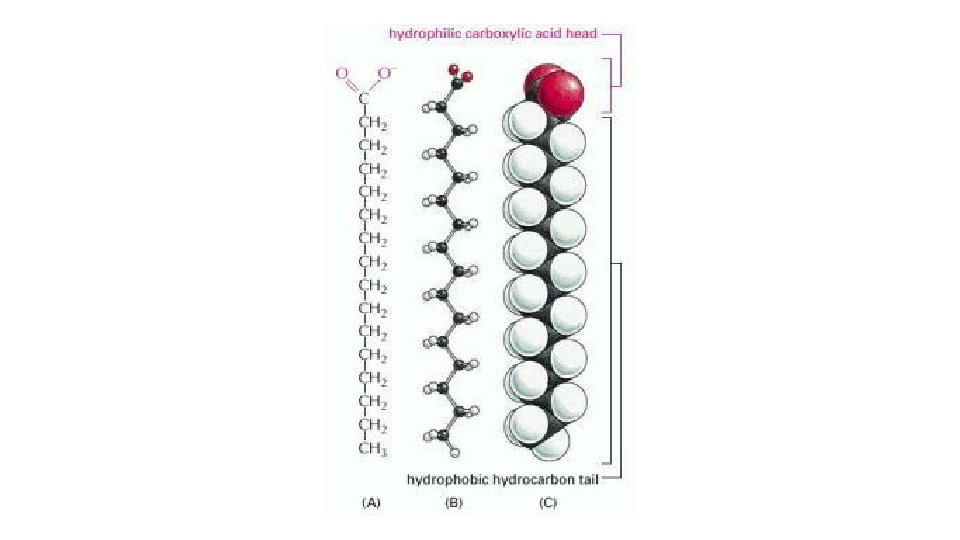
Fatty Acids • A fatty acid molecule, such as palmitic acid, has two chemically distinct regions. • One is a long hydrocarbon chain, which is hydrophobic and not very reactive chemically. • The other is a carboxyl (-COOH) group, which behaves as an acid (carboxylic acid): it is ionized in solution (-COO-), extremely hydrophilic, and chemically reactive. • Almost all the fatty acid molecules in a cell are covalently linked to other molecules by their carboxylic acid group.
• The hydrocarbon tail of palmitic acid is saturated: it has no double bonds between carbon atoms and contains the maximum possible number of hydrogens. • Stearic acid, another one of the common fatty acids in animal fat, is also saturated. Some other fatty acids, such as oleic acid, have unsaturated tails, with one or more double bonds along their length. • The double bonds create kinks in the molecules, interfering with their ability to pack together in a solid mass. • It is that accounts for the difference between hard (saturated) and soft (polyunsaturated) margarine. • The many different fatty acids found in cells differ only in the length of their hydrocarbon chains and the number and position of the carbon double bonds
• The most important function of fatty acids in cells is in the construction of cell membranes. • These thin sheets enclose all cells and surround their internal organelles. • They are composed largely of phospholipids, which are small molecules that, like triacylglycerols, are constructed mainly from fatty acids and glycerol. • In phospholipids the glycerol is joined to two fatty acid chains, however, rather than to three as in triacylglycerols. • The “third” site on the glycerol is linked to a hydrophilic phosphate group, which is in turn attached to a small hydrophilic compound such as choline. • Each phospholipid molecule, therefore, has a hydrophobic tail composed of the two fatty acid chains and a hydrophilic head, where the phosphate is located.
• This gives them different physical and chemical properties from triacylglycerols, which are predominantly hydrophobic. • Molecules like phospholipids, with both hydrophobic and hydrophilic regions, are termed amphipathic. • The membrane-forming property of phospholipids results from their amphipathic nature. • Phospholipids will spread over the surface of water to form a monolayer of phospholipid molecules, with the hydrophobic tails facing the air and the hydrophilic heads in contact with the water. • Two such molecular layers can readily combine tail-to-tail in water to make a phospholipid sandwich, or lipid bilayer. This bilayer is the structural basis of all cell membranes
- Slides: 6