
Functional Behavioral Assessment Case Study Project Craig Grace
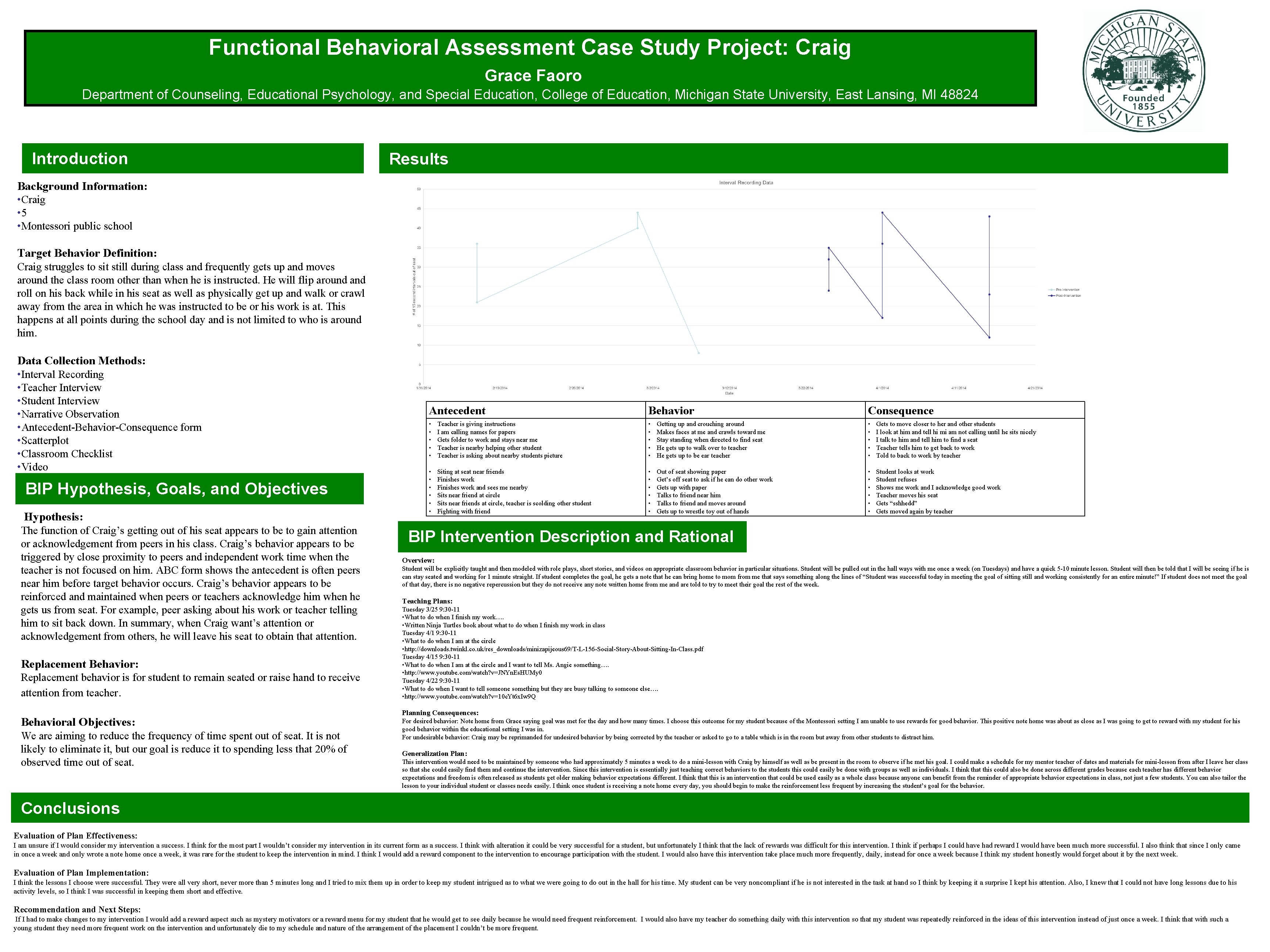
Functional Behavioral Assessment Case Study Project: Craig Grace Faoro Department of Counseling, Educational Psychology, and Special Education, College of Education, Michigan State University, East Lansing, MI 48824 Introduction Results Background Information: • Craig • 5 • Montessori public school Target Behavior Definition: Craig struggles to sit still during class and frequently gets up and moves around the class room other than when he is instructed. He will flip around and roll on his back while in his seat as well as physically get up and walk or crawl away from the area in which he was instructed to be or his work is at. This happens at all points during the school day and is not limited to who is around him. Data Collection Methods: • Interval Recording • Teacher Interview • Student Interview • Narrative Observation • Antecedent-Behavior-Consequence form • Scatterplot • Classroom Checklist • Video BIP Hypothesis, Goals, and Objectives Hypothesis: The function of Craig’s getting out of his seat appears to be to gain attention or acknowledgement from peers in his class. Craig’s behavior appears to be triggered by close proximity to peers and independent work time when the teacher is not focused on him. ABC form shows the antecedent is often peers near him before target behavior occurs. Craig’s behavior appears to be reinforced and maintained when peers or teachers acknowledge him when he gets us from seat. For example, peer asking about his work or teacher telling him to sit back down. In summary, when Craig want’s attention or acknowledgement from others, he will leave his seat to obtain that attention. Replacement Behavior: Replacement behavior is for student to remain seated or raise hand to receive attention from teacher. Behavioral Objectives: We are aiming to reduce the frequency of time spent out of seat. It is not likely to eliminate it, but our goal is reduce it to spending less that 20% of observed time out of seat. Antecedent Behavior Consequence • • • Teacher is giving instructions I am calling names for papers Gets folder to work and stays near me Teacher is nearby helping other student Teacher is asking about nearby students picture • • • Getting up and crouching around Makes faces at me and crawls toward me Stay standing when directed to find seat He gets up to walk over to teacher He gets up to be ear teacher • • • Gets to move closer to her and other students I look at him and tell hi mi am not calling until he sits nicely I talk to him and tell him to find a seat Teacher tells him to get back to work Told to back to work by teacher • • • Siting at seat near friends Finishes work and sees me nearby Sits near friend at circle Sits near friends at circle, teacher is scolding other student Fighting with friend • • • Out of seat showing paper Get’s off seat to ask if he can do other work Gets up with paper Talks to friend near him Talks to friend and moves around Gets up to wrestle toy out of hands • • • Student looks at work Student refuses Shows me work and I acknowledge good work Teacher moves his seat Gets “sshhedd” Gets moved again by teacher BIP Intervention Description and Rational Overview: Student will be explicitly taught and then modeled with role plays, short stories, and videos on appropriate classroom behavior in particular situations. Student will be pulled out in the hall ways with me once a week (on Tuesdays) and have a quick 5 -10 minute lesson. Student will then be told that I will be seeing if he is can stay seated and working for 1 minute straight. If student completes the goal, he gets a note that he can bring home to mom from me that says something along the lines of “Student was successful today in meeting the goal of sitting still and working consistently for an entire minute!” If student does not meet the goal of that day, there is no negative repercussion but they do not receive any note written home from me and are told to try to meet their goal the rest of the week. Teaching Plans: Tuesday 3/25 9: 30 -11 • What to do when I finish my work…. • Written Ninja Turtles book about what to do when I finish my work in class Tuesday 4/1 9: 30 -11 • What to do when I am at the circle • http: //downloads. twinkl. co. uk/res_downloads/minizapijeous 69/T-L-156 -Social-Story-About-Sitting-In-Class. pdf Tuesday 4/15 9: 30 -11 • What to do when I am at the circle and I want to tell Ms. Angie something…. • http: //www. youtube. com/watch? v=JNYn. Es. HUMy 0 Tuesday 4/22 9: 30 -11 • What to do when I want to tell someone something but they are busy talking to someone else…. • http: //www. youtube. com/watch? v=10 c. Yt 6 x. Iw 9 Q Planning Consequences: For desired behavior: Note home from Grace saying goal was met for the day and how many times. I choose this outcome for my student because of the Montessori setting I am unable to use rewards for good behavior. This positive note home was about as close as I was going to get to reward with my student for his good behavior within the educational setting I was in. For undesirable behavior: Craig may be reprimanded for undesired behavior by being corrected by the teacher or asked to go to a table which is in the room but away from other students to distract him. Generalization Plan: This intervention would need to be maintained by someone who had approximately 5 minutes a week to do a mini-lesson with Craig by himself as well as be present in the room to observe if he met his goal. I could make a schedule for my mentor teacher of dates and materials for mini-lesson from after I leave her class so that she could easily find them and continue the intervention. Since this intervention is essentially just teaching correct behaviors to the students this could easily be done with groups as well as individuals. I think that this could also be done across different grades because each teacher has different behavior expectations and freedom is often released as students get older making behavior expectations different. I think that this is an intervention that could be used easily as a whole class because anyone can benefit from the reminder of appropriate behavior expectations in class, not just a few students. You can also tailor the lesson to your individual student or classes needs easily. I think once student is receiving a note home every day, you should begin to make the reinforcement less frequent by increasing the student’s goal for the behavior. Conclusions Evaluation of Plan Effectiveness: I am unsure if I would consider my intervention a success. I think for the most part I wouldn’t consider my intervention in its current form as a success. I think with alteration it could be very successful for a student, but unfortunately I think that the lack of rewards was difficult for this intervention. I think if perhaps I could have had reward I would have been much more successful. I also think that since I only came in once a week and only wrote a note home once a week, it was rare for the student to keep the intervention in mind. I think I would add a reward component to the intervention to encourage participation with the student. I would also have this intervention take place much more frequently, daily, instead for once a week because I think my student honestly would forget about it by the next week. Evaluation of Plan Implementation: I think the lessons I choose were successful. They were all very short, never more than 5 minutes long and I tried to mix them up in order to keep my student intrigued as to what we were going to do out in the hall for his time. My student can be very noncompliant if he is not interested in the task at hand so I think by keeping it a surprise I kept his attention. Also, I knew that I could not have long lessons due to his activity levels, so I think I was successful in keeping them short and effective. Recommendation and Next Steps: If I had to make changes to my intervention I would add a reward aspect such as mystery motivators or a reward menu for my student that he would get to see daily because he would need frequent reinforcement. I would also have my teacher do something daily with this intervention so that my student was repeatedly reinforced in the ideas of this intervention instead of just once a week. I think that with such a young student they need more frequent work on the intervention and unfortunately die to my schedule and nature of the arrangement of the placement I couldn’t be more frequent.
- Slides: 1