
Functional Behavior Assessments Agenda Concepts of FBAs Techniques
Functional Behavior Assessments
Agenda �Concepts of FBAs �Techniques for FBAs �Using them at your schools �Linking FBAs to Behavior Intervention Plans
Overview of FBAs and Intervention Adult Tasks: ▪ Identify function of behavior ▪ Prevent need for behavior ▪ Teach a replacement behavior that meets need ▪ Reinforce new behavior ▪ Stop reinforcement of old behavior ▪ Help problem solve issues as arise
FBA Concept �Behavior happens for a reason �Often to gain or avoid something
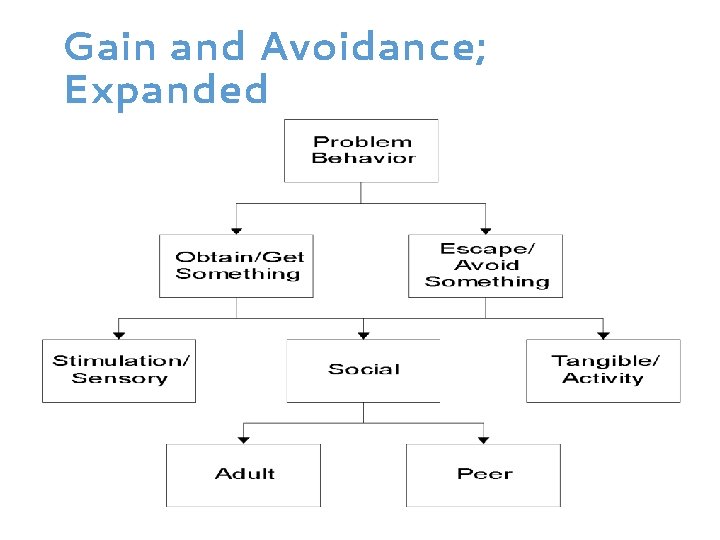
Gain and Avoidance; Expanded
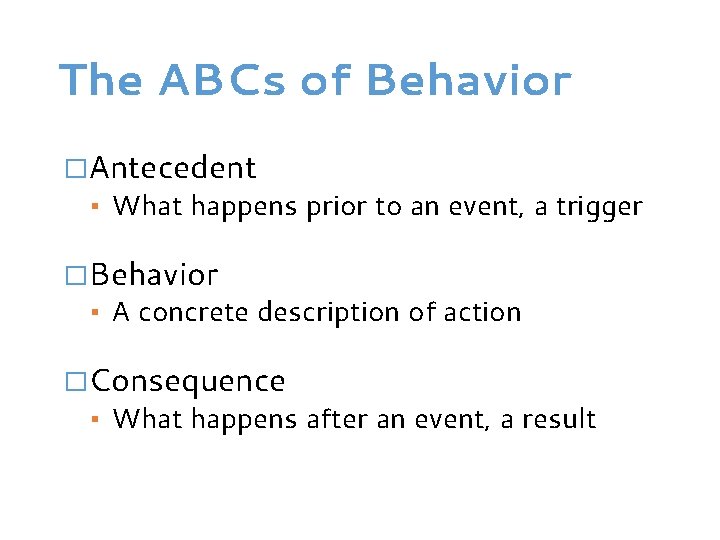
The ABCs of Behavior �Antecedent ▪ What happens prior to an event, a trigger �Behavior ▪ A concrete description of action �Consequence ▪ What happens after an event, a result
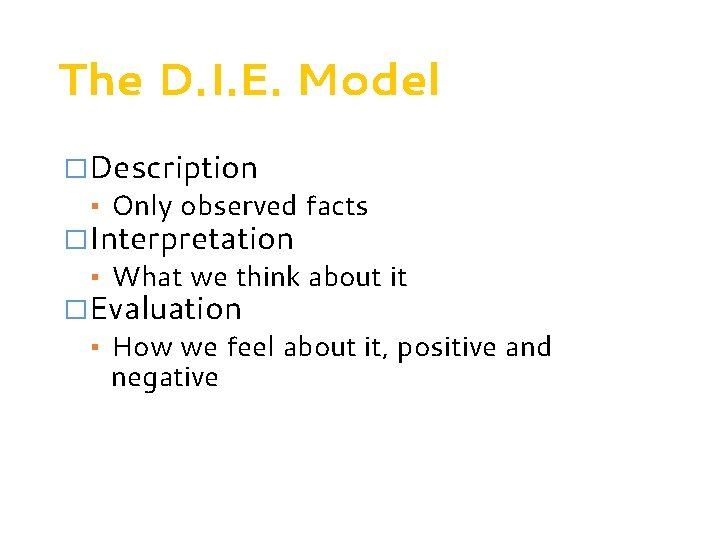
The D. I. E. Model �Description ▪ Only observed facts �Interpretation ▪ What we think about it �Evaluation ▪ How we feel about it, positive and negative
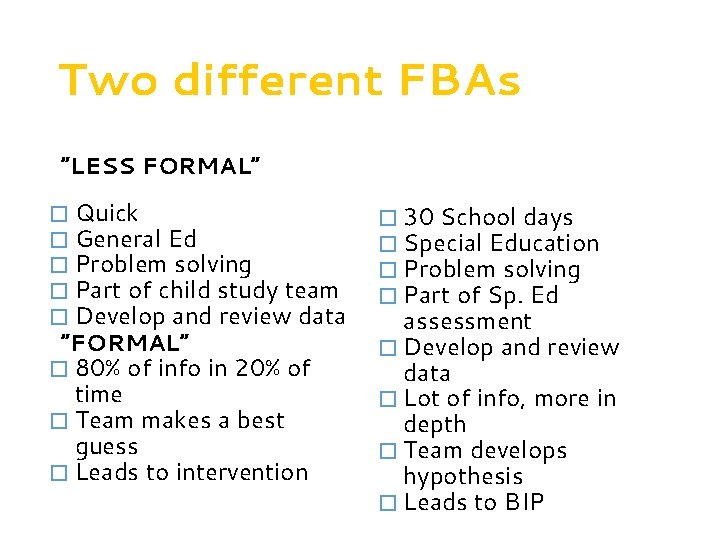
Two different FBAs “LESS FORMAL” � Quick � General Ed � Problem solving � Part of child study team � Develop and review data “FORMAL” � 80% of info in 20% of time � Team makes a best guess � Leads to intervention � 30 School days � Special Education � Problem solving � Part of Sp. Ed assessment � Develop and review data � Lot of info, more in depth � Team develops hypothesis � Leads to BIP
FBAs and Permission � Anytime LESS FORMAL we are doing something outside of what is typically done with all students – best practice to inform parents/care givers and develop partnership � Assessment Planning Mgt � Prior written notice � Parent Permission � 30 school days to complete � Notice of a Team Mtg � Evaluation Results Mtg
When to use “Less Formal” FBAs �High frequency, low severity behaviors �Have received interventions that did not work �Showing up in 1 -2 school routines or settings �Problem solving team prior to evaluation �If dangerous or complex behaviors exhibited, contact a behavior specialist in your school district who is trained to conduct FBAs for students with more challenging behaviors
When to use a “formal” FBA �As part of an evaluation to determine eligibility for special services �Baseline for Behavior Intervention Plan (BIP) �In response to severe behavior situations �As due process to suspension and placement �As required in relation to manifestation determinations
MDE Expectations/requirements A description of problem behaviors and the identification of events, times, and situations that predict the occurrence and nonoccurrence of the behavior The antecedents, consequences, and reinforcers that maintain the behavior, the possible functions of the behavior, and possible positive alternative behaviors A variety of data collection methods and sources that facilitate the development of hypotheses and summary statements regarding behavioral patterns
Applicable Citations: � 34. C. F. R. § 300. 530 FBAs & Disciplinary Removal � 34. C. F. R. § 300. 320 Initial Evaluations � 34. C. F. R. § 300. 321 Re-evaluations �Minn. R. 3525. 0210, subp. 22 Definitions �Minn. Stat. § 125 A. 08 School District Obligations �Minn. R. 3525. 2900 Transition and Behavioral Intervention Planning
Sped Forms FBA �A functional behavior assessment was completed utilizing a variety of strategies including observations, interviews and a review of records.
FBA - Sped Forms � Target behaviors; frequency, severity, duration � Events, times and situations that predict the occurrence and nonoccurrence of the target behaviors � Antecedents, consequences and other reinforcers that maintain the target behavior � Apparent functions of the target behaviors and possible appropriate replacement behaviors � Team has considered other treatable causes for the target behaviors, including mental or physical health condition � Positive behavioral interventions and supports and other strategies used in the past and the effectiveness of each
Sped Forms - continued � Changes in the environment in which the target behaviors occur that may reduce the frequency of the behaviors � Summary statements and hypotheses about the purposes of the target behaviors that will assist in the development of the child's behavioral intervention plan � Any other evaluation data that may assist in the development of an appropriate behavior intervention plan for the child � An evaluation of proposed regulated interventions and contraindication of any regulated interventions
Conversations about behavior �When we are trying to determine a function of behavior, we are going to talk to others ▪ Might need to explain behavior as ▪ ▪ ▪ functional Ask about what happened before and after Ask follow up questions for more info Ask if ok to stop in and watch Ask if they will record Check back again Thank them
A Version of the 5 Ws �Why? ? ? ▪ Who ▪ What ▪ Where ▪ When ▪ How often ▪ Who else involved
Measuring Behavior �Frequency �Duration �Intensity �Latency �Norms
Review student data �Grades �Behavior �Attendance �Achievement �Motivation on referrals �Look for changes and patterns �Who else is around and involved �Look by location, time of day, day of week… �Try to identify a sequence of events, then check it out with team, parents, and student
Record Review �Multiple sources and records ▪ Student file review ▪ Student info on computer ▪ Past assessments and interventions ▪ Health records and what is with Sch Nurse �Start piecing together a timeline ▪ Past years and past months ▪ Look for changes in grades, behavior, attendance �Identify strengths and things for interviews
Interviews �Multiple people �Appreciate and connect �Common ideas of “behavior” �Ask about strengths and success �Use open and close ended questions �Use follow up and clarifying questions �May be defensive; “function” & “success” �Create an interview tool from report template �Gain okay to check back for a quick follow-up �Agree best time, place, and how long to meet
Observations �Share the purpose; function and intervention �Ask and agree ahead of time with teacher ▪ Day, time, where to sit, not intro to class, leave �Decide if going in with blank slate or not �Look for ABCs of behavior �Remember measuring behavior ▪ Student, staff, and peers �Put in context of what others are doing in class �Consider mapping location of key parts or room �Send a thank you, share summary and next steps
Hypothesis �Best guess; function of behavior �Based on all information we gained �We all have our own lens we look through ▪ Difference between functional and intentional �Okay to look at other models & lists of functions ▪ Wisconsin Department of Education ▪ Blueprints for Success; 68 pages ▪ http: //sped. dpi. wi. gov/sped_ebdbluepri ▪ Adult Attention, Escape/Avoidance, Power/Control, Peer Affiliation, & Justice/Revenge
FBA Concept- review �FBAs are for understand behavior �BIPs are for teaching and changing behavior
Behavior Supports and Intervention Adult Tasks: ▪ Identify function of behavior ▪ Prevent need for behavior ▪ Teach a replacement behavior that meets need ▪ Reinforce new behavior ▪ Stop reinforcement of old behavior ▪ Help problem solve issues as arise
Linking FBAs and BIPs �Closer formats line up, easier to use ▪ Use or create forms that mirror each other ▪ Sped Forms has available documents ▪ Positive Behavior Support Plan ▪ Continue to make improvements �Try to make BIPs work for all who use them ▪ One page or many? ▪ Important information ▪ Available to subs and paras ▪ Connected to school wide expectations
Sped Forms Positive Behavior Support Plan �Need for the Positive Behavior Support Plan �Student Strengths �Hypothesis Statement �Antecedent & Setting Event Strategies
Sped Forms PBSP �Alternative/Replacement ▪ ▪ Identified Taught Practiced Reinforced Skills:
Sped Forms Plan-Positive Behavior Support �Consequence Interventions �Lifestyle Interventions �Crisis Intervention Plan �Parent Signature Date
Wisconsin Department of Education Blueprints for Success – Wisconsin DPI 68 packed pages of good info
- Slides: 31