
Functional Anatomy of the Basal Ganglia Sharif Taha

Functional Anatomy of the Basal Ganglia Sharif Taha, Ph. D. s. taha@utah. edu Department of Neurobiology and Anatomy
Outline 1. Anatomy a. BG components b. Anatomical connectivity 2. Function: Modulation through disinhibition 3. Action Selection 4. Neuromodulators: dopamine
What do the basal ganglia do? 1. Modulate the initiation, termination, amplitude, and selection of movement - Initiation and selection 2. Learning -Response-outcome associations - Stimulus-response associations
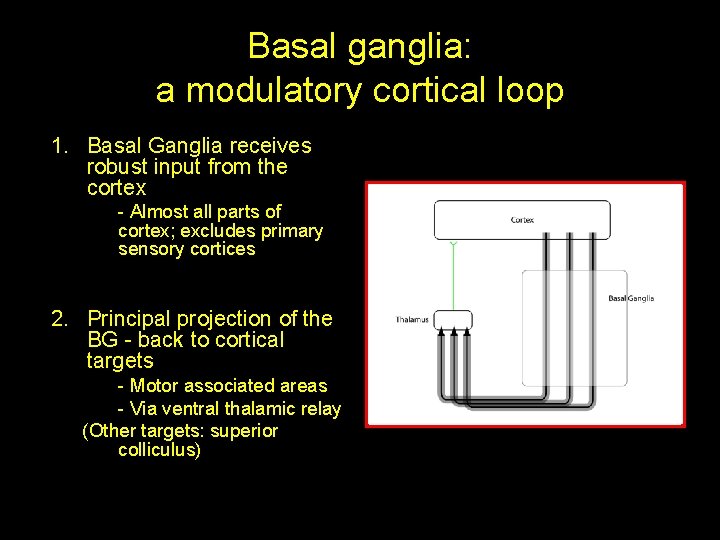
Basal ganglia: a modulatory cortical loop 1. Basal Ganglia receives robust input from the cortex - Almost all parts of cortex; excludes primary sensory cortices 2. Principal projection of the BG - back to cortical targets - Motor associated areas - Via ventral thalamic relay (Other targets: superior colliculus)

Overview of BG organization • Input: – Caudate and putamen (together, the striatum) • Intrinsic: – Subthalamic nucleus (STN) – External segment of globus pallidus (GPe) SNc • Output: • Substantia nigra pars reticulata (SNr) • Internal segment of globus pallidus (GPi) • Neuromodulator: • Substantia nigra pars compacta (SNc)
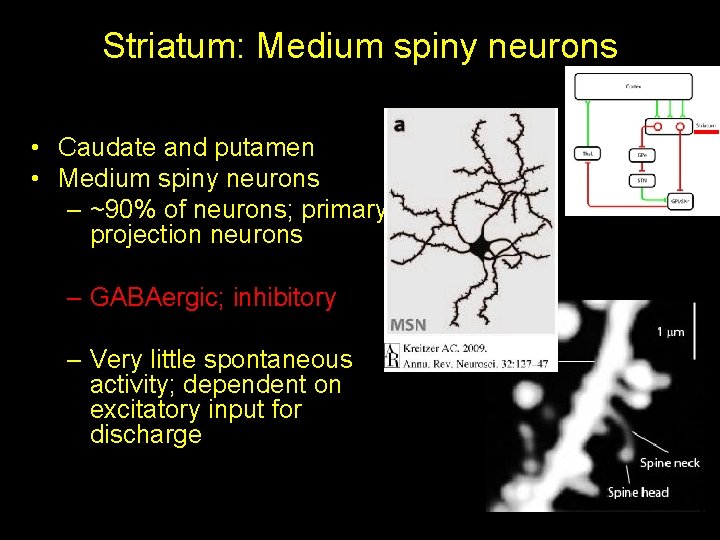
Striatum: Medium spiny neurons • Caudate and putamen • Medium spiny neurons – ~90% of neurons; primary projection neurons – GABAergic; inhibitory – Very little spontaneous activity; dependent on excitatory input for discharge
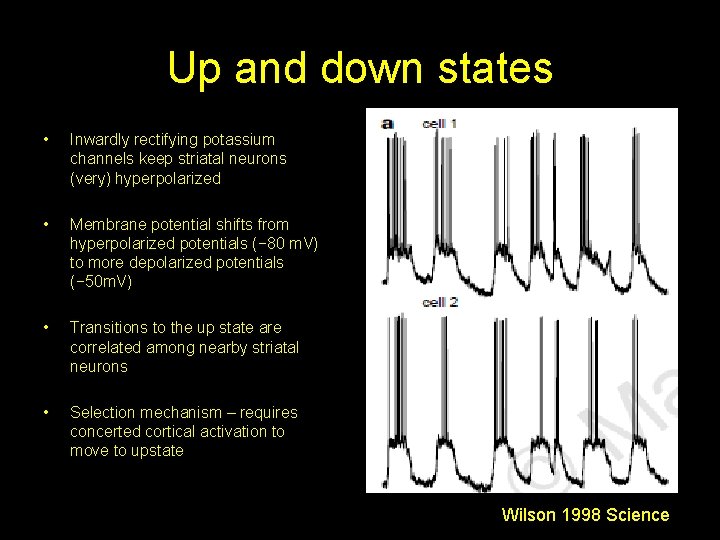
Up and down states • Inwardly rectifying potassium channels keep striatal neurons (very) hyperpolarized • Membrane potential shifts from hyperpolarized potentials (− 80 m. V) to more depolarized potentials (− 50 m. V) • Transitions to the up state are correlated among nearby striatal neurons • Selection mechanism – requires concerted cortical activation to move to upstate Wilson 1998 Science
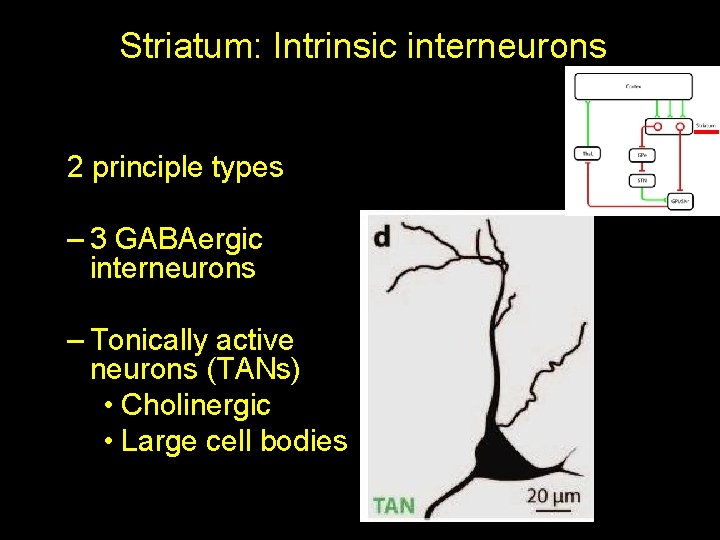
Striatum: Intrinsic interneurons 2 principle types – 3 GABAergic interneurons – Tonically active neurons (TANs) • Cholinergic • Large cell bodies
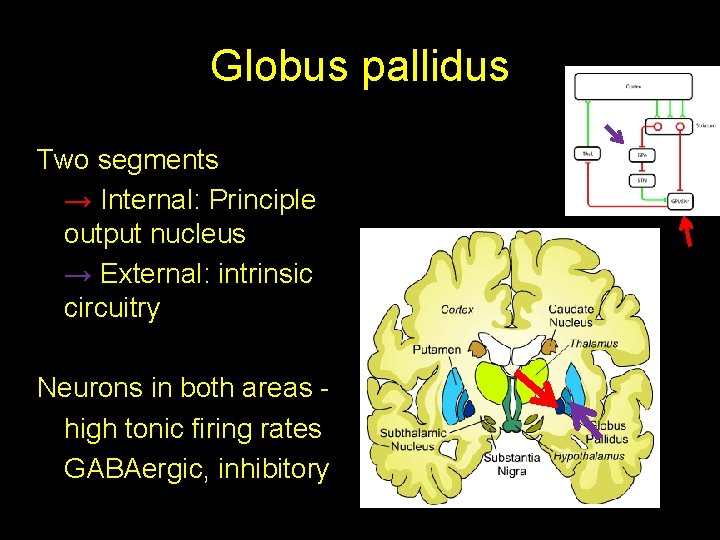
Globus pallidus Two segments → Internal: Principle output nucleus → External: intrinsic circuitry Neurons in both areas high tonic firing rates GABAergic, inhibitory
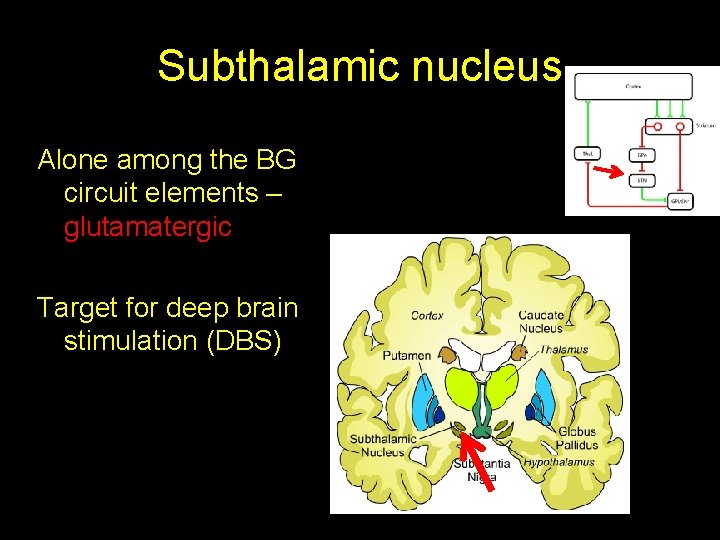
Subthalamic nucleus Alone among the BG circuit elements – glutamatergic Target for deep brain stimulation (DBS)
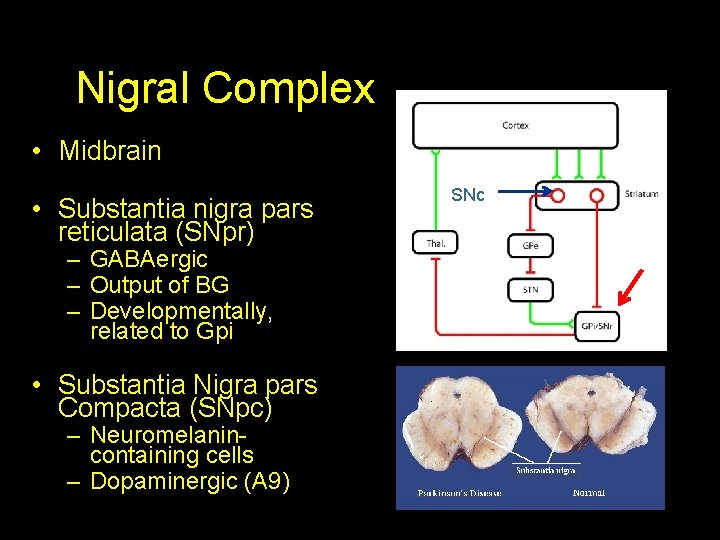
Nigral Complex • Midbrain • Substantia nigra pars reticulata (SNpr) – GABAergic – Output of BG – Developmentally, related to Gpi • Substantia Nigra pars Compacta (SNpc) – Neuromelanincontaining cells – Dopaminergic (A 9) SNc

Basal ganglia connectivity Cortical input Thalamus Cortex Subthalamic nucleus
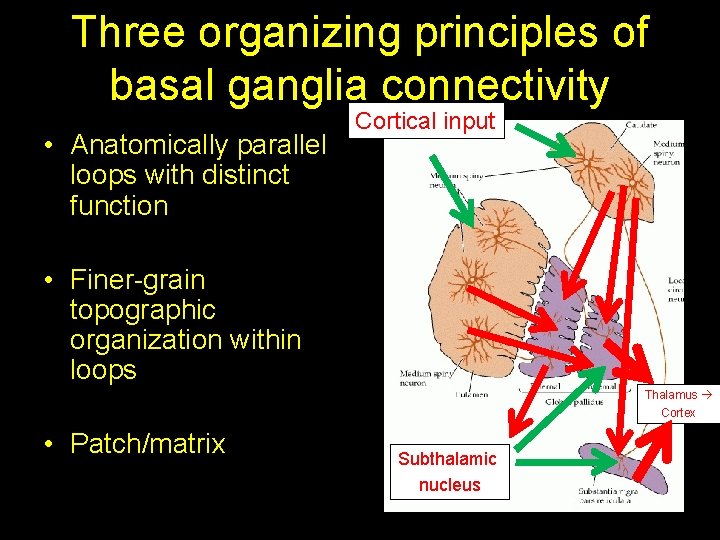
Three organizing principles of basal ganglia connectivity • Anatomically parallel loops with distinct function Cortical input • Finer-grain topographic organization within loops Thalamus Cortex • Patch/matrix Subthalamic nucleus
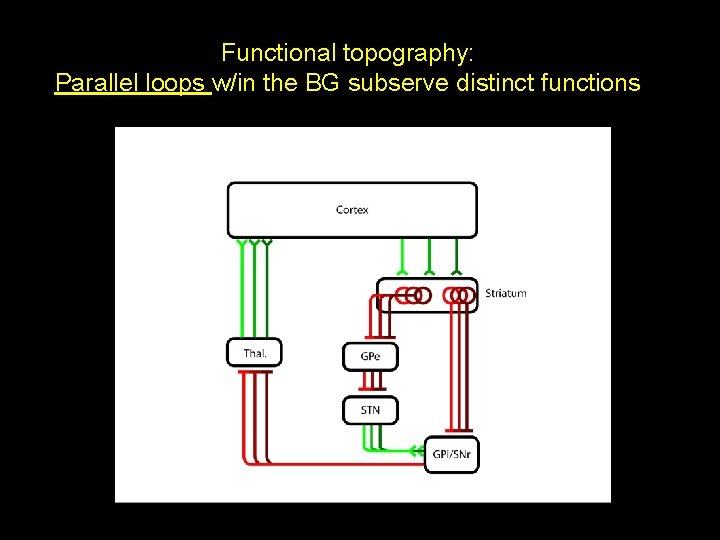
Functional topography: Parallel loops w/in the BG subserve distinct functions

Functional topography: Parallel loops w/in the BG subserve distinct functions • 4 pathways: – Skeletomotor – Oculomotor channel – Association • Behavior, learning, cognition – Limbic • Addiction, emotional behavior • J. H. Martin, Neuroanatomy: Text and Atlas 2 nd Ed. , 1996
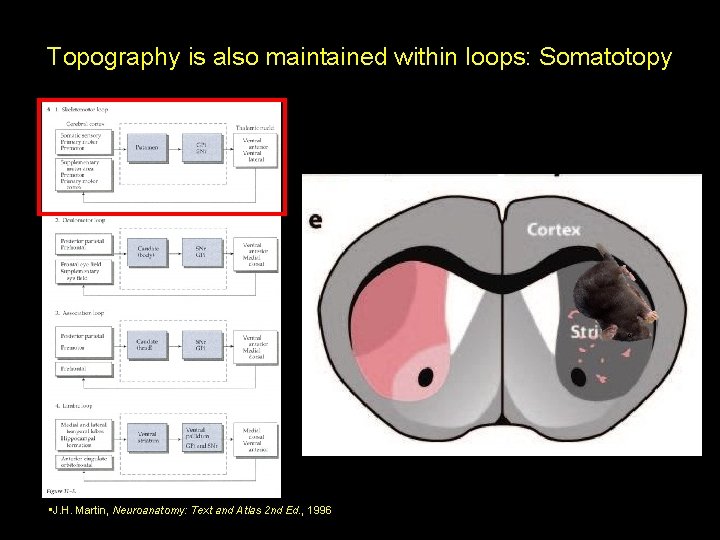
Topography is also maintained within loops: Somatotopy • J. H. Martin, Neuroanatomy: Text and Atlas 2 nd Ed. , 1996
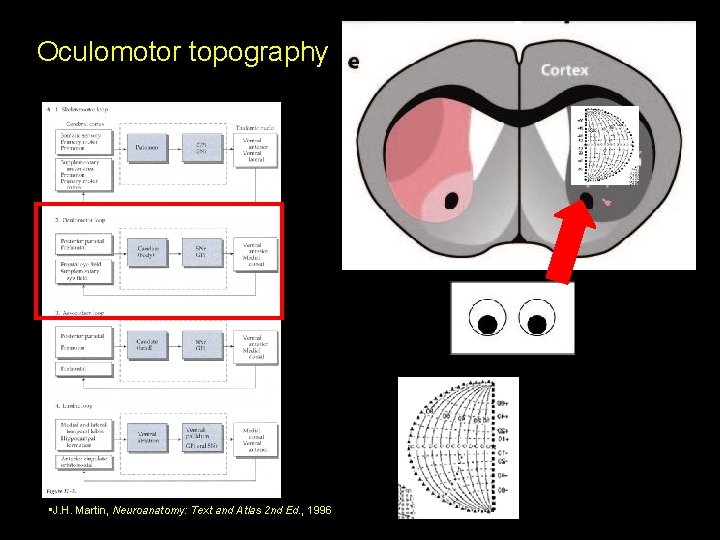
Oculomotor topography • J. H. Martin, Neuroanatomy: Text and Atlas 2 nd Ed. , 1996
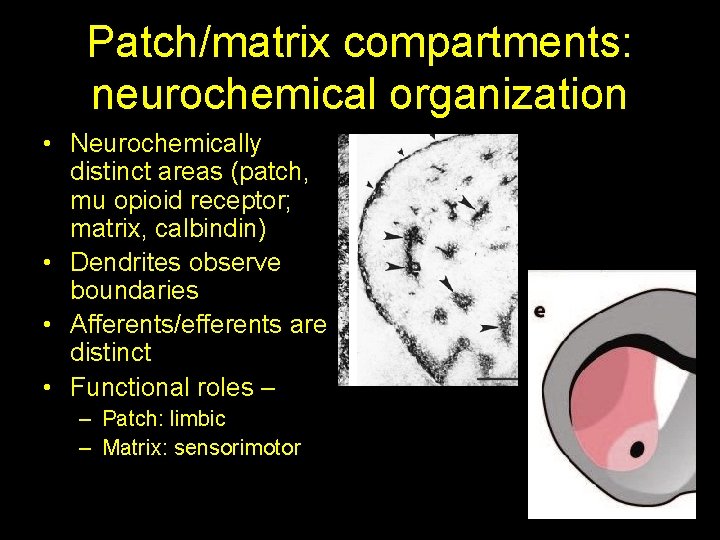
Patch/matrix compartments: neurochemical organization • Neurochemically distinct areas (patch, mu opioid receptor; matrix, calbindin) • Dendrites observe boundaries • Afferents/efferents are distinct • Functional roles – – Patch: limbic – Matrix: sensorimotor
Outline 1. Anatomy a. BG components b. Anatomical connectivity 2. Modulating action through disinhibition 3. Direct and Indirect Pathways 4. Action Selection 5. Neuromodulators 6. Pathology
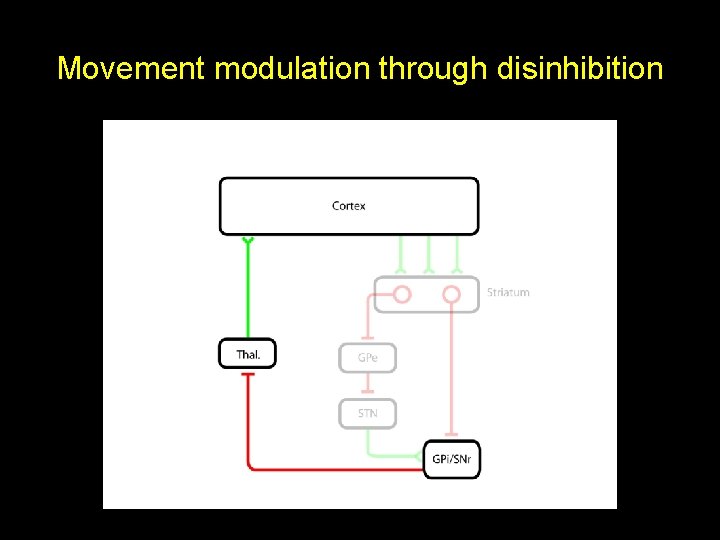
Movement modulation through disinhibition
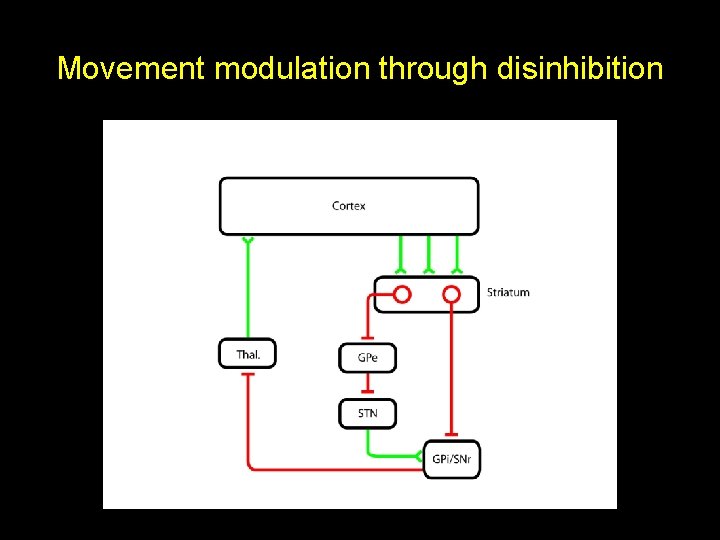
Movement modulation through disinhibition
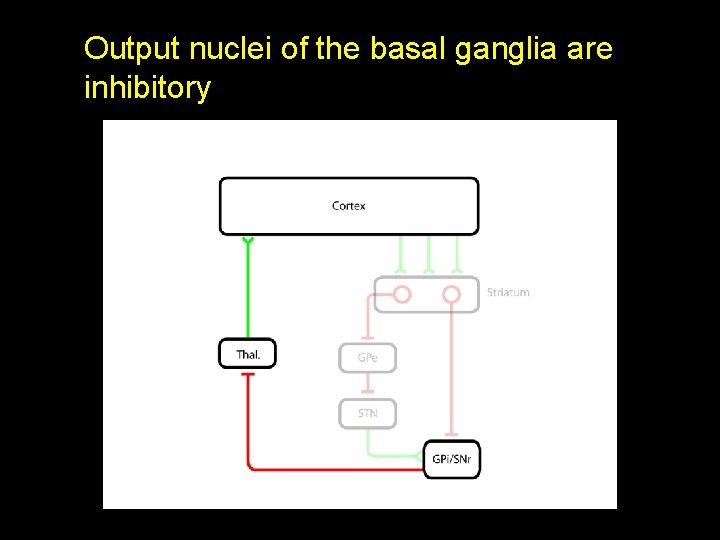
Output nuclei of the basal ganglia are inhibitory
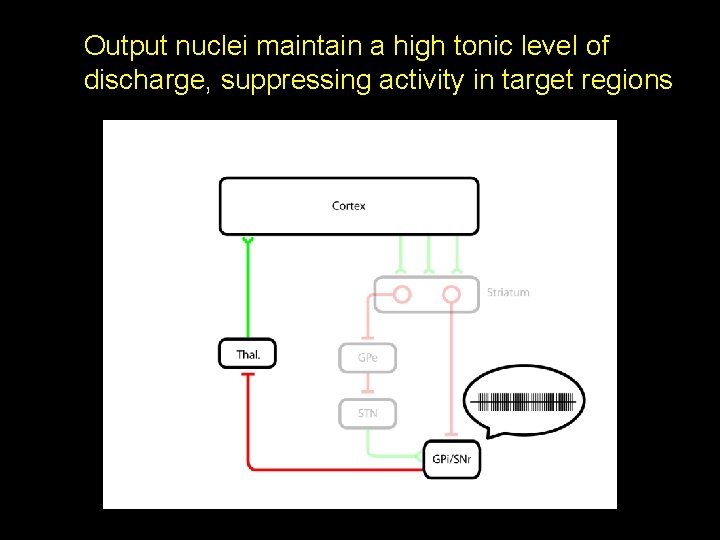
Output nuclei maintain a high tonic level of discharge, suppressing activity in target regions
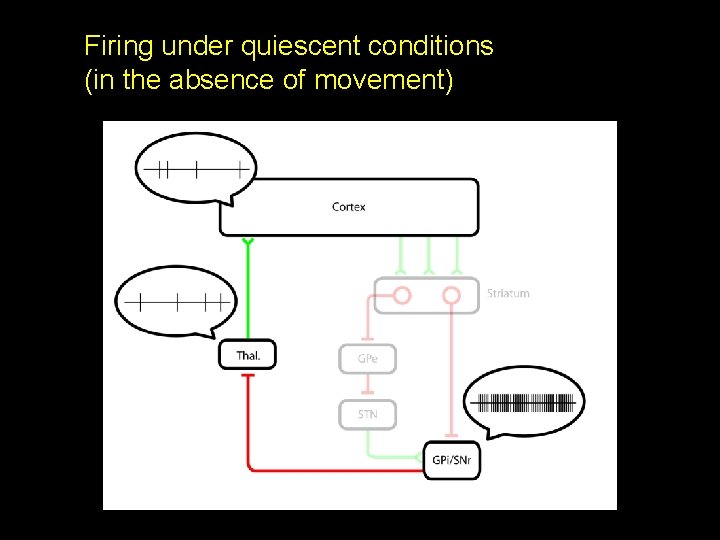
Firing under quiescent conditions (in the absence of movement)
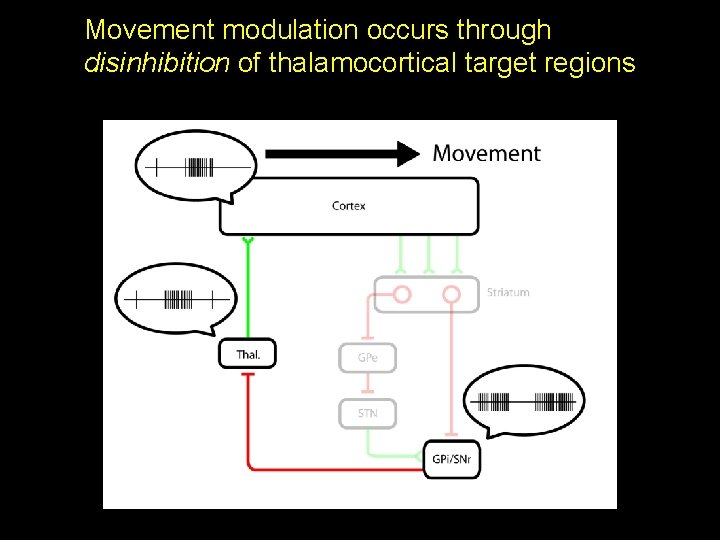
Movement modulation occurs through disinhibition of thalamocortical target regions
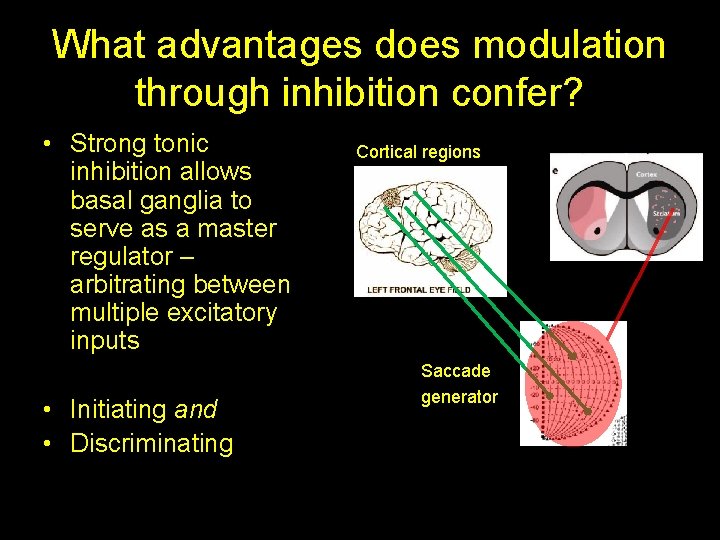
What advantages does modulation through inhibition confer? • Strong tonic inhibition allows basal ganglia to serve as a master regulator – arbitrating between multiple excitatory inputs • Initiating and • Discriminating Cortical regions Saccade generator
Basal ganglia: movement modulation through disinhibition 1. Output nuclei of the basal ganglia are inhibitory 2. Output nuclei maintain a high tonic level of discharge, suppressing activity in target regions 3. Phasic decrease in firing rate transiently releases target regions from inhibition. 4. Disinhibited thalamocortical circuit discharges, promoting movement.
Outline 1. Anatomy a. BG components b. Anatomical connectivity 2. Modulating action through disinhibition 3. Direct and Indirect Pathways 4. Action Selection 5. Neuromodulators 6. Pathology
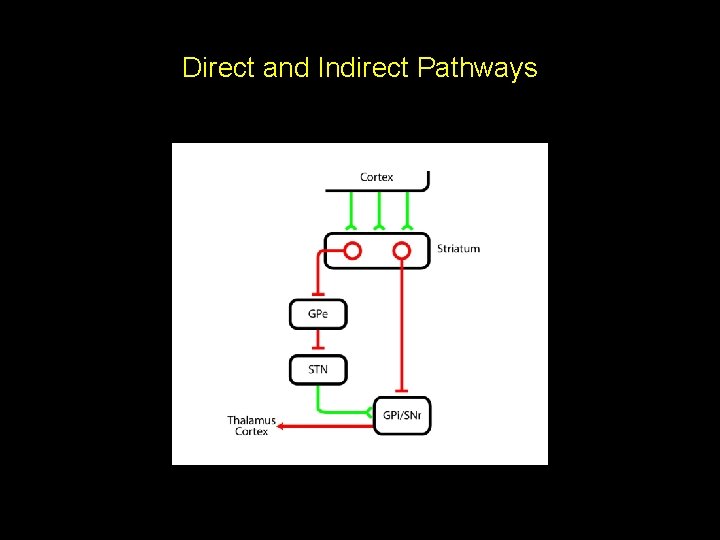
Direct and Indirect Pathways

Direct Pathway
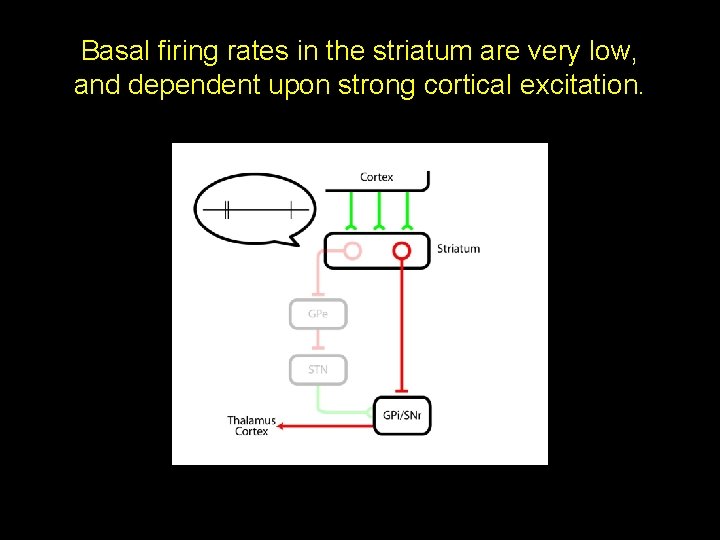
Basal firing rates in the striatum are very low, and dependent upon strong cortical excitation.
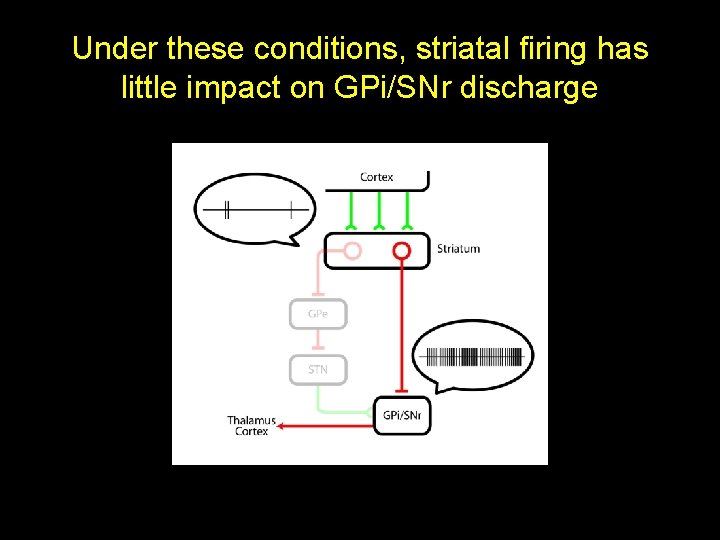
Under these conditions, striatal firing has little impact on GPi/SNr discharge
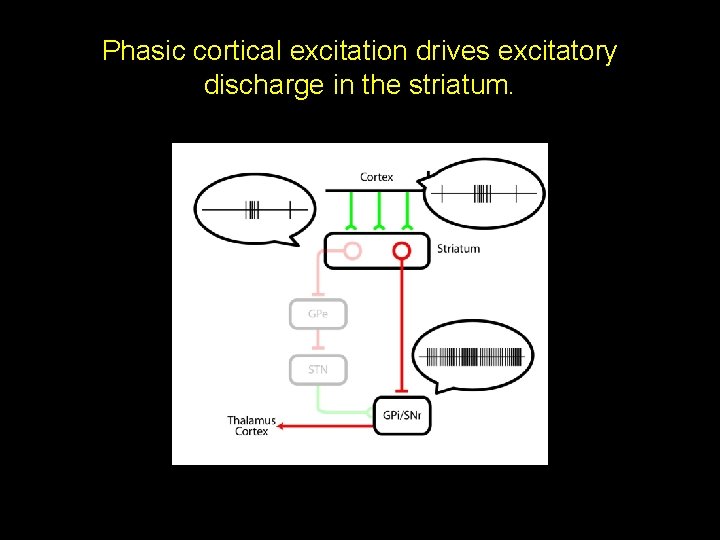
Phasic cortical excitation drives excitatory discharge in the striatum.
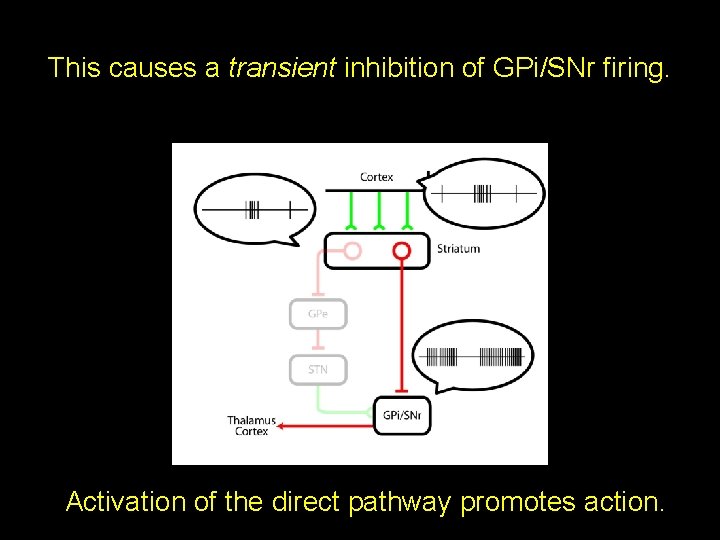
This causes a transient inhibition of GPi/SNr firing. Activation of the direct pathway promotes action.

Indirect pathway
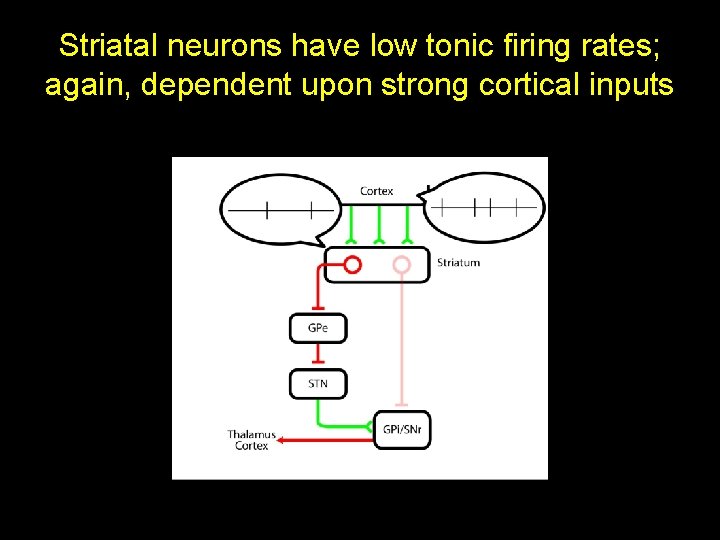
Striatal neurons have low tonic firing rates; again, dependent upon strong cortical inputs
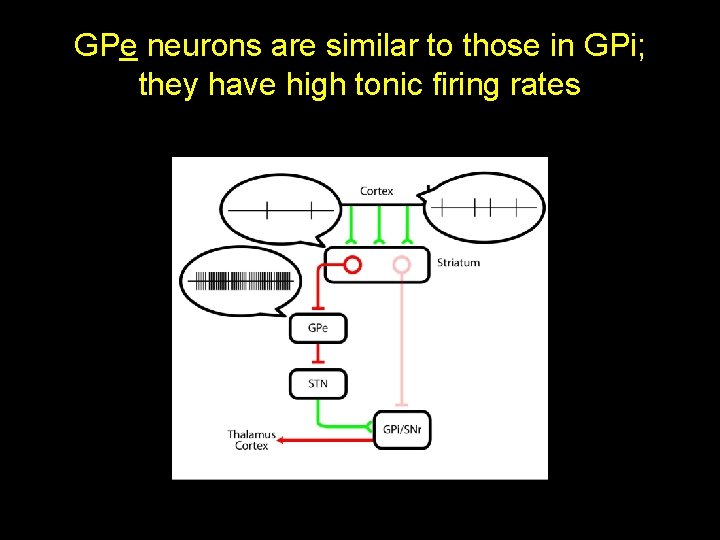
GPe neurons are similar to those in GPi; they have high tonic firing rates
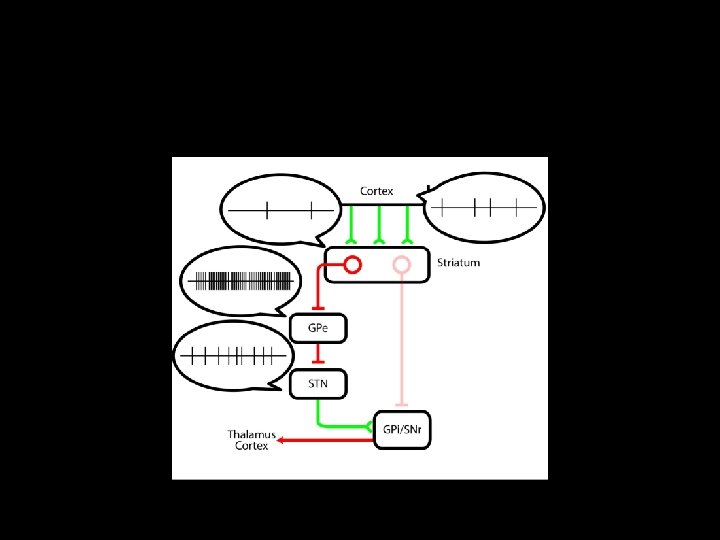
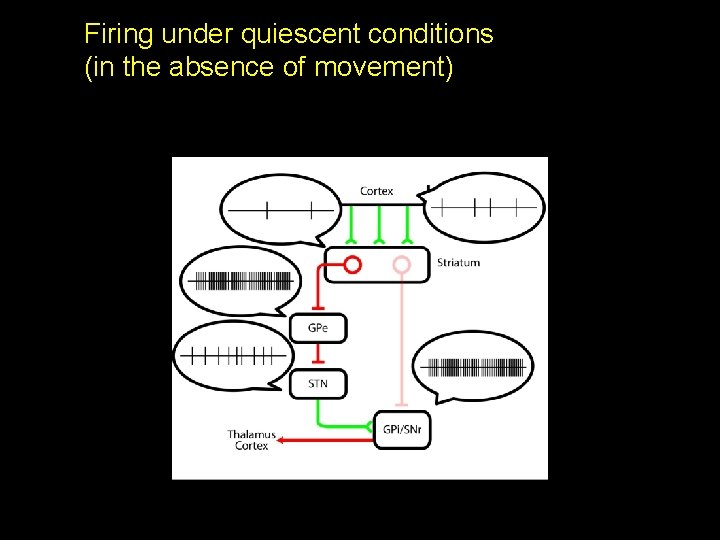
Firing under quiescent conditions (in the absence of movement)
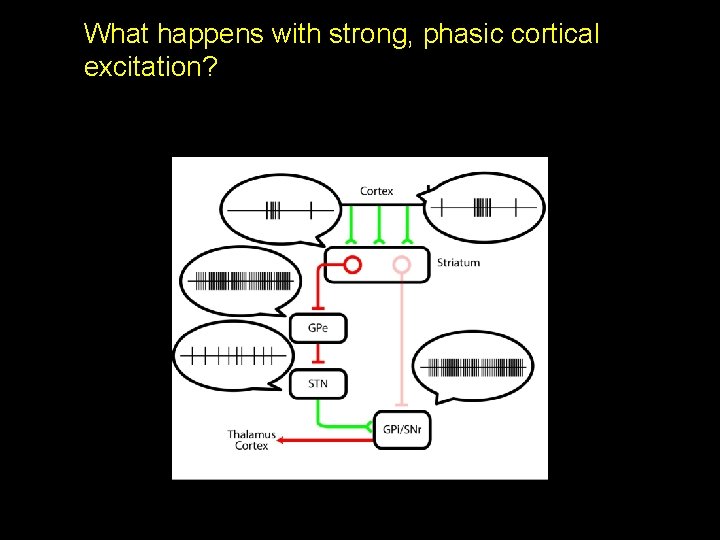
What happens with strong, phasic cortical excitation?
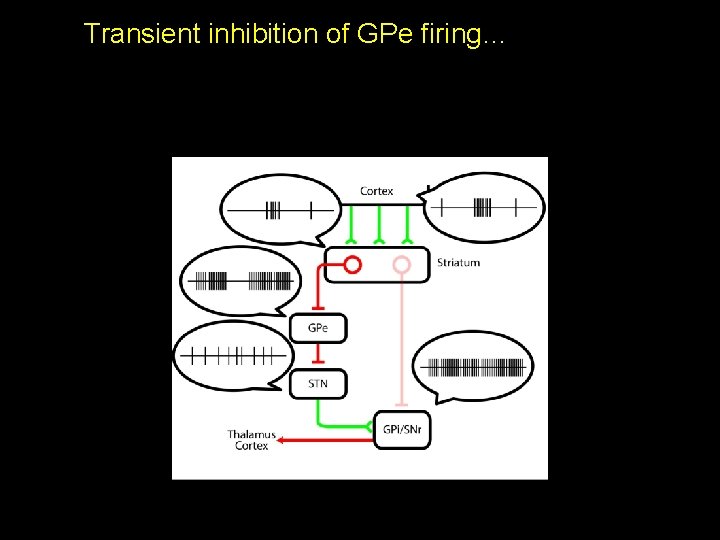
Transient inhibition of GPe firing…
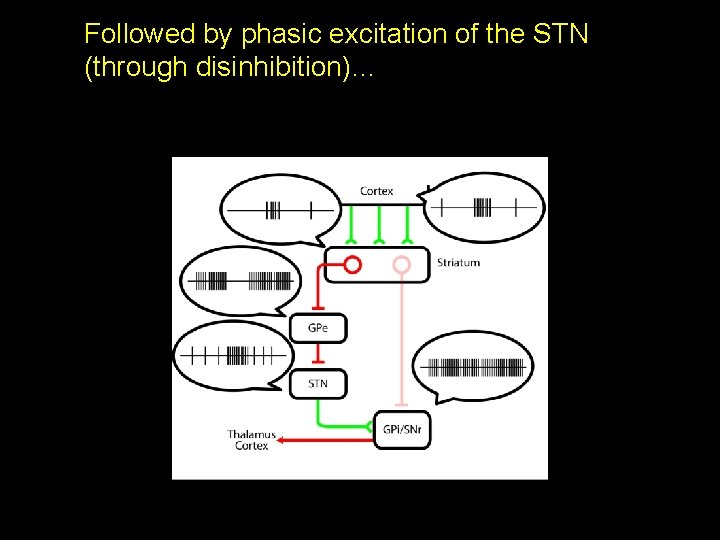
Followed by phasic excitation of the STN (through disinhibition)…
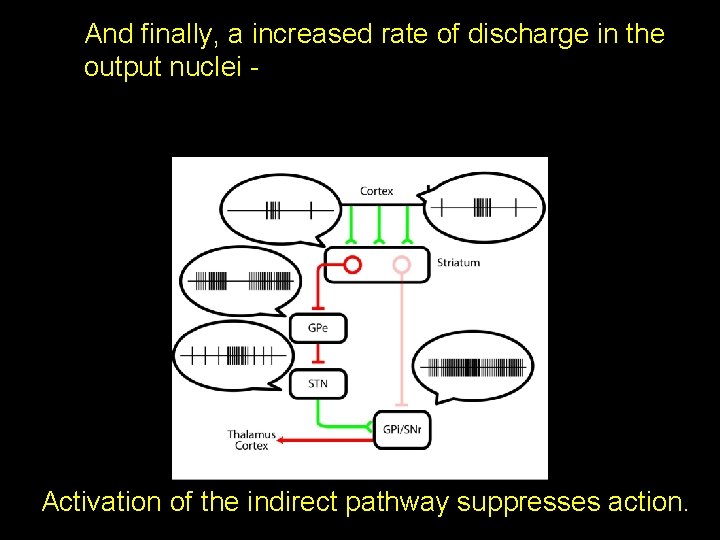
And finally, a increased rate of discharge in the output nuclei - Activation of the indirect pathway suppresses action.
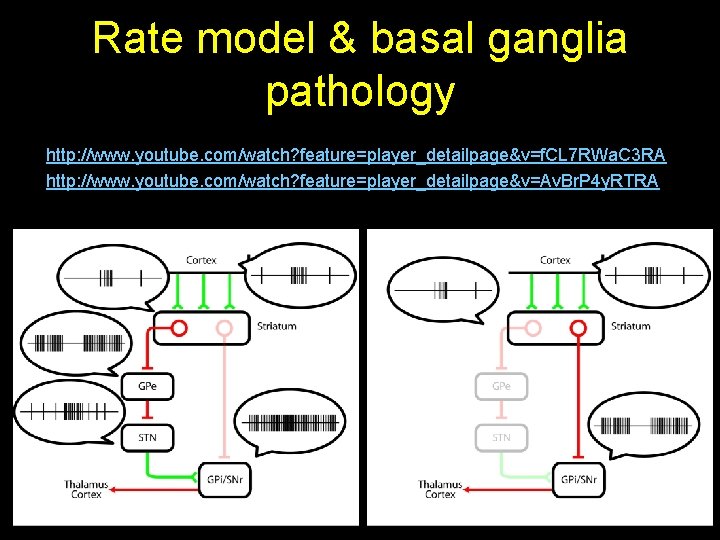
Rate model & basal ganglia pathology http: //www. youtube. com/watch? feature=player_detailpage&v=f. CL 7 RWa. C 3 RA http: //www. youtube. com/watch? feature=player_detailpage&v=Av. Br. P 4 y. RTRA
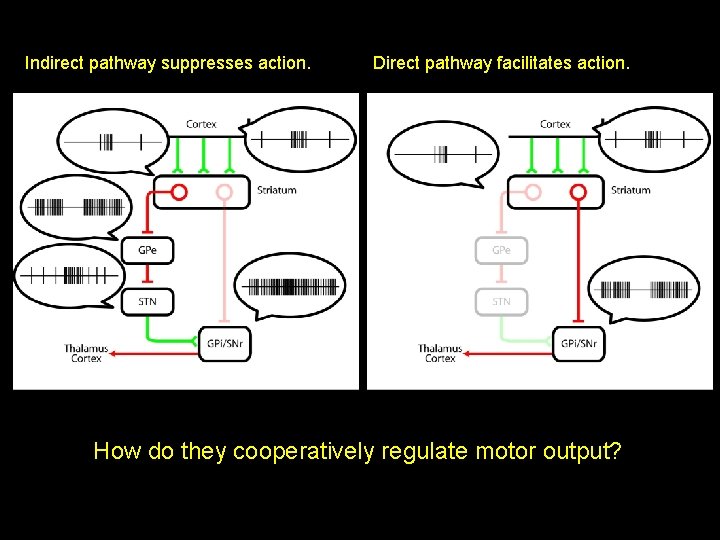
Indirect pathway suppresses action. Direct pathway facilitates action. How do they cooperatively regulate motor output?
Outline 1. Anatomy a. BG components b. Anatomical connectivity 2. Modulating action through disinhibition 3. Direct and Indirect Pathways 4. Action Selection 5. Neuromodulators 6. Pathology
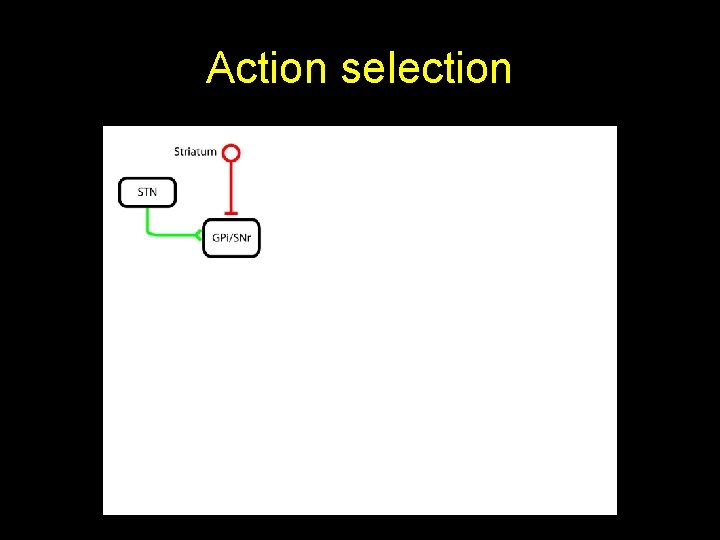
Action selection
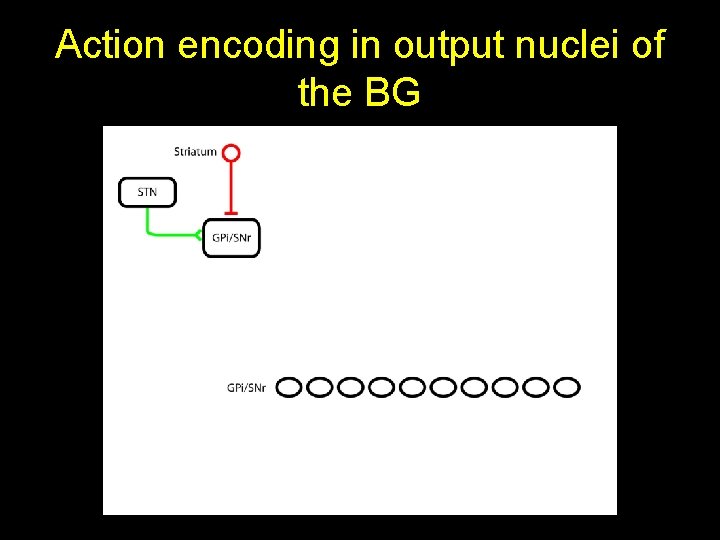
Action encoding in output nuclei of the BG
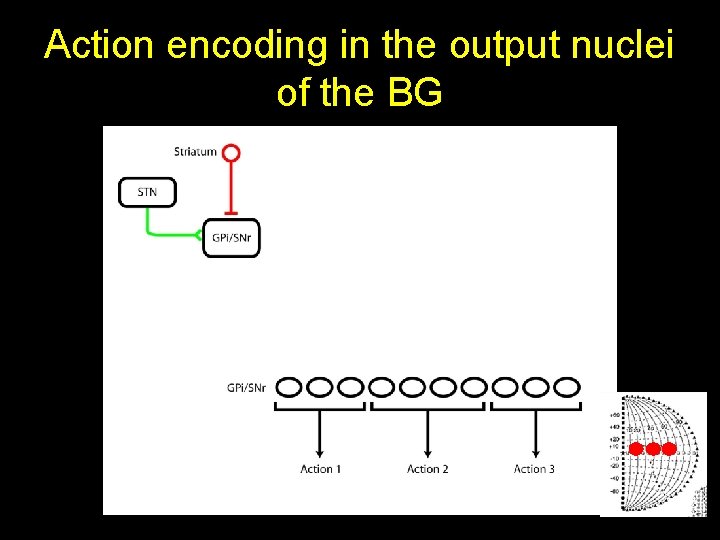
Action encoding in the output nuclei of the BG
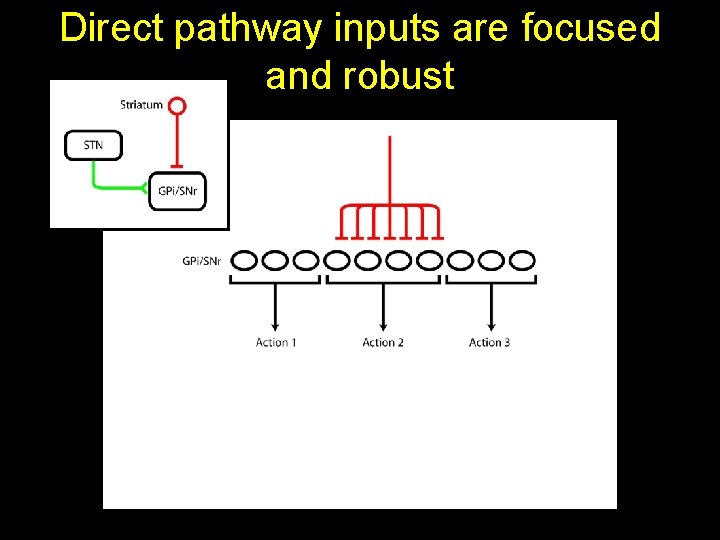
Direct pathway inputs are focused and robust
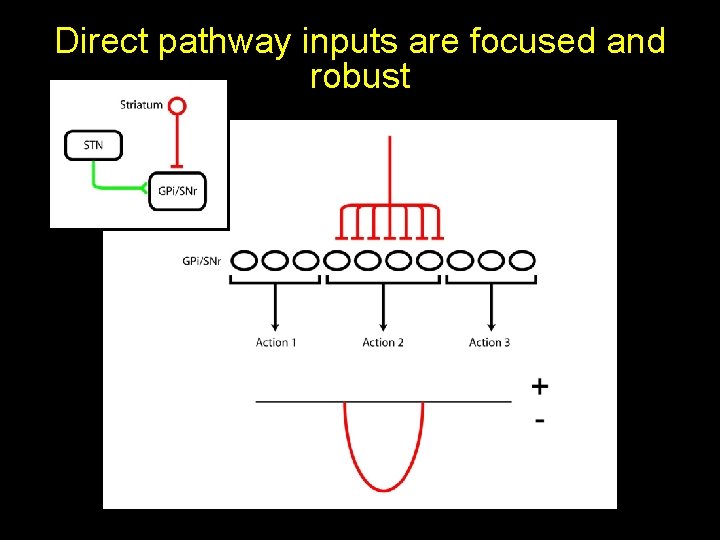
Direct pathway inputs are focused and robust
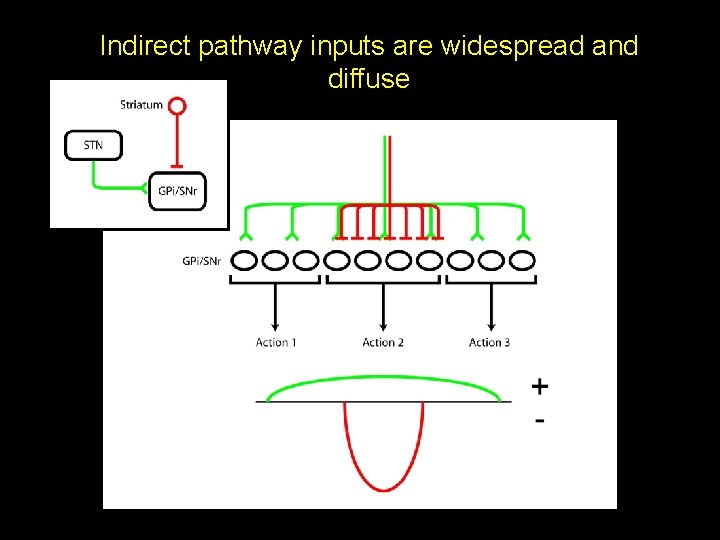
Indirect pathway inputs are widespread and diffuse
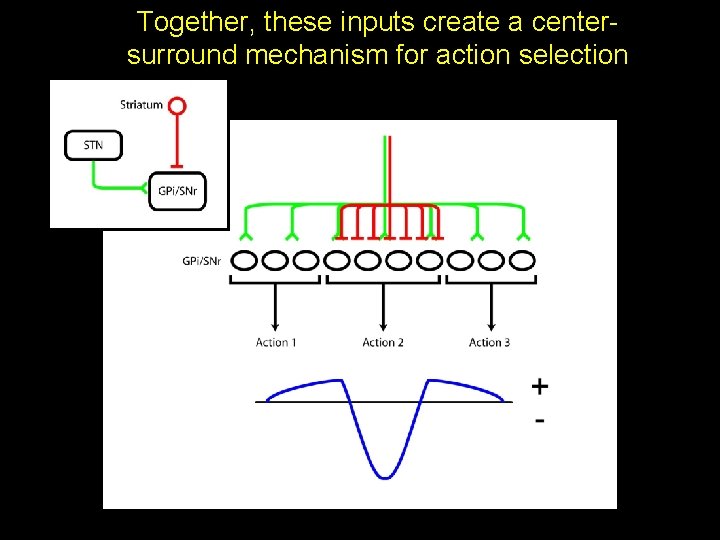
Together, these inputs create a centersurround mechanism for action selection
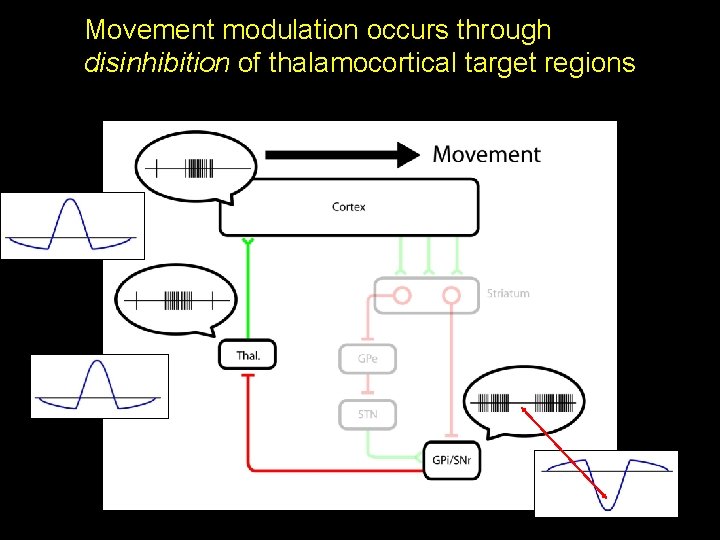
Movement modulation occurs through disinhibition of thalamocortical target regions
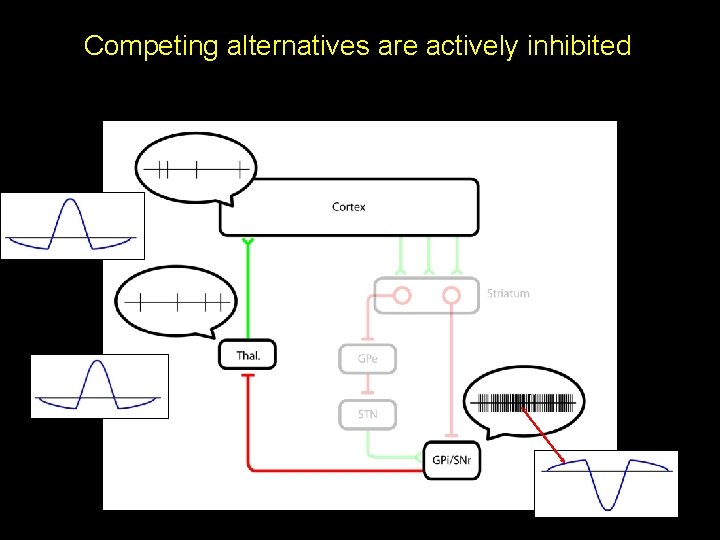
Competing alternatives are actively inhibited
Why do we need to ‘sharpen’ selection mechanisms? • Multiple/ambiguous stimuli in our environment often demand our attention/action (e. g. , visual stimuli) • However, we’re often confined to making a single action to address these stimuli (e. g. , a saccade). • Particularly where conflicting needs are present, action may require active inhibition
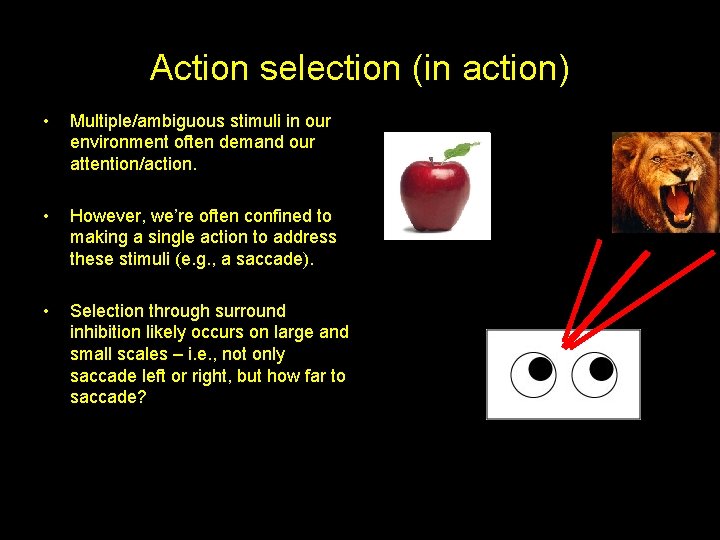
Action selection (in action) • Multiple/ambiguous stimuli in our environment often demand our attention/action. • However, we’re often confined to making a single action to address these stimuli (e. g. , a saccade). • Selection through surround inhibition likely occurs on large and small scales – i. e. , not only saccade left or right, but how far to saccade?
Direct and indirect pathways together facilitate action selection • Activation of direct pathway facilitates movement • Activation of indirect pathway suppresses movement • Direct output makes focal inhibitory contact on GPi/SNr • Indirect output makes diffuse, widespread excitatory contact on GPi/SNr • Co-activation of these pathways facilitates action selection through center-surround mechanism
Outline 1. Anatomy a. BG components b. Anatomical connectivity 2. Modulating action through disinhibition 3. Direct and Indirect Pathways 4. Action Selection 5. Neuromodulators 6. Pathology
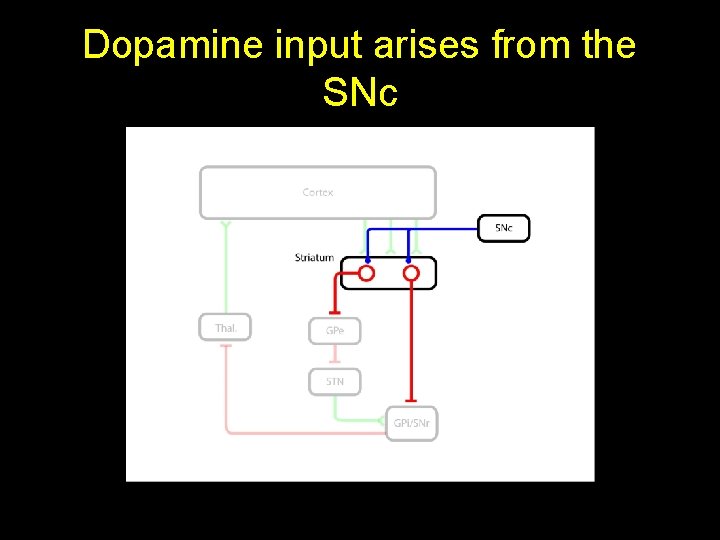
Dopamine input arises from the SNc
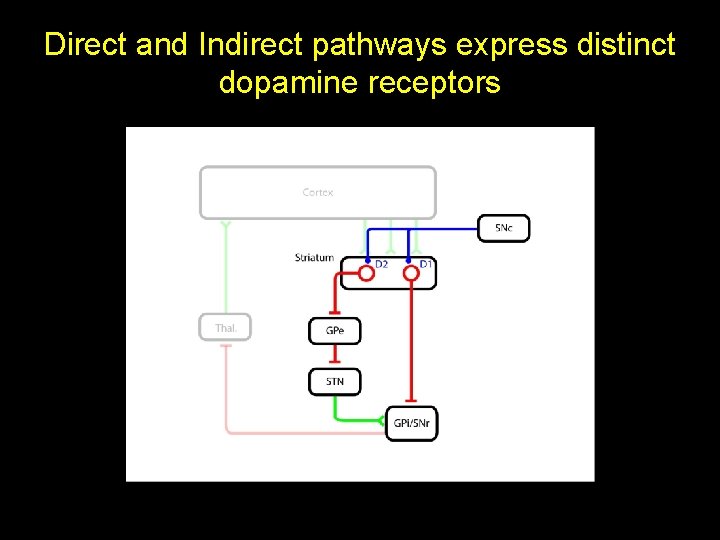
Direct and Indirect pathways express distinct dopamine receptors
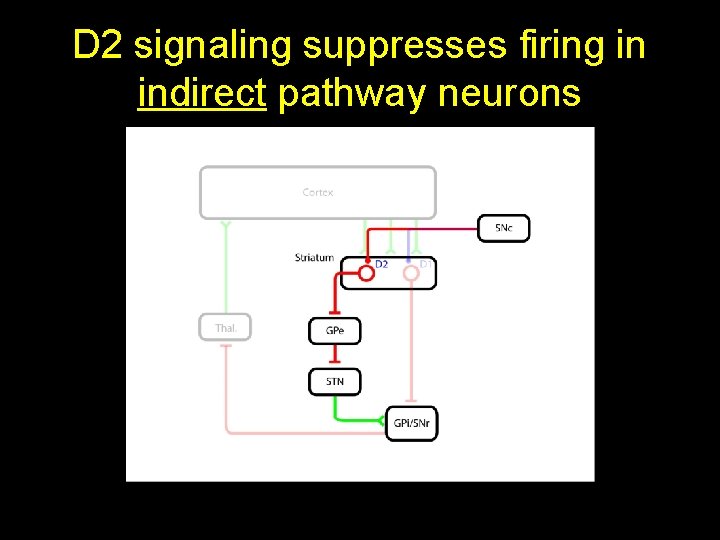
D 2 signaling suppresses firing in indirect pathway neurons
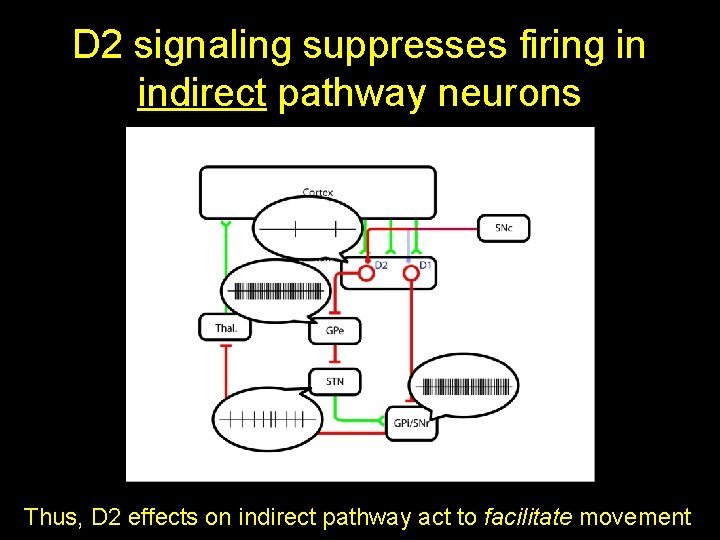
D 2 signaling suppresses firing in indirect pathway neurons Thus, D 2 effects on indirect pathway act to facilitate movement
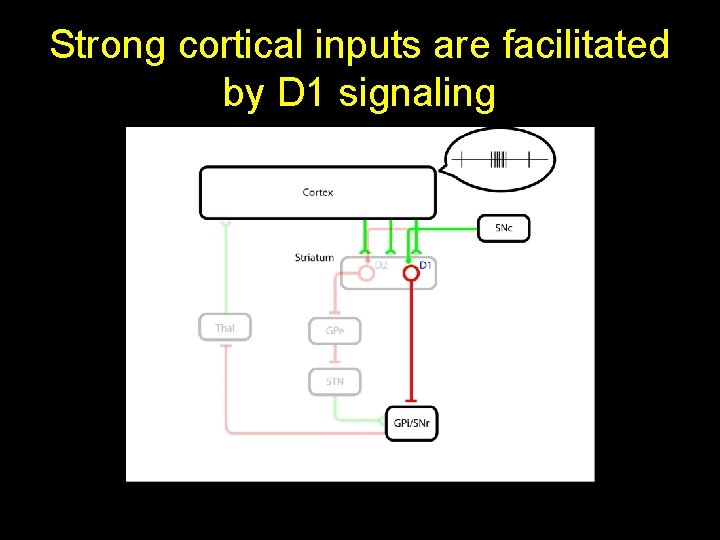
Strong cortical inputs are facilitated by D 1 signaling
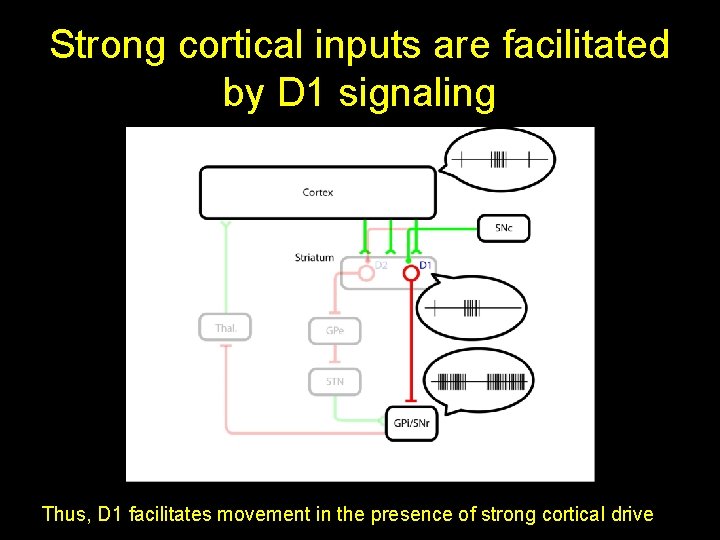
Strong cortical inputs are facilitated by D 1 signaling Thus, D 1 facilitates movement in the presence of strong cortical drive
Up and down states/DA action • D 1 receptor signaling - In down state, increases voltage-dependent K+ current - In up state, increases voltage-dependent Ca++ current • D 2 – Generally inhibit firing by decreasing Ca++ currents.
Dopamine effects on direct and indirect pathways • Dopamine signaling through D 2 receptors in the indirect pathway suppresses striatal activity • Dopamine signaling through D 1 receptors in the direct pathway: – Facilitates strong, phasic inputs – Suppresses weak inputs

Acetylcholine effects
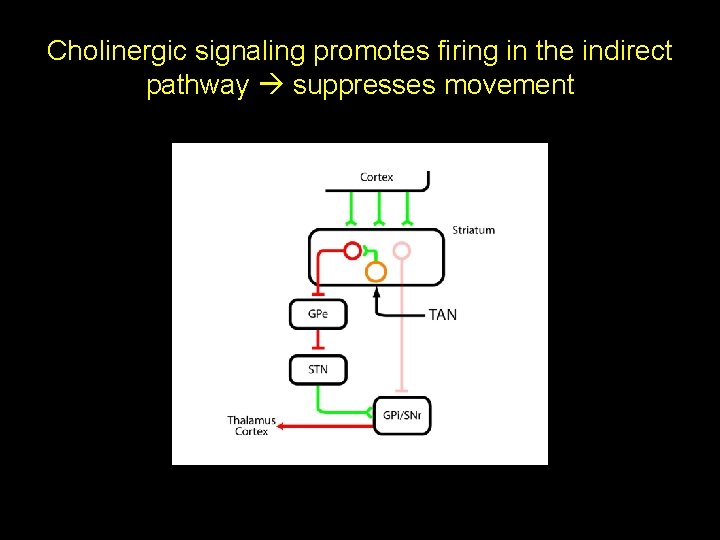
Cholinergic signaling promotes firing in the indirect pathway suppresses movement
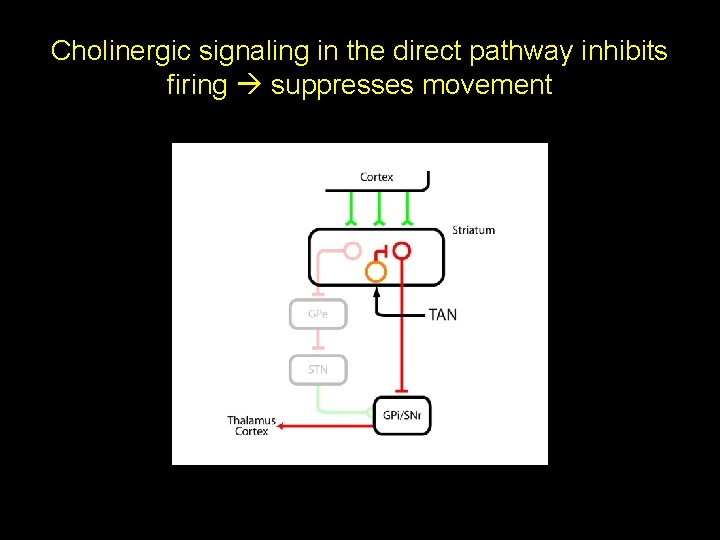
Cholinergic signaling in the direct pathway inhibits firing suppresses movement
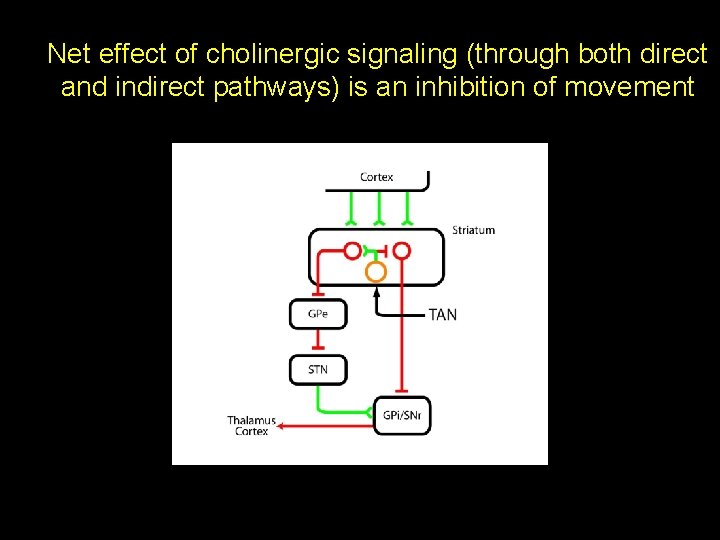
Net effect of cholinergic signaling (through both direct and indirect pathways) is an inhibition of movement
Under what conditions do DA, ACh neurons fire? • Both neurons are sensitive to rewardrelated stimuli, particularly rewardpredictive cues (i. e. , Pavlov’s bell). • However their response differs: – DA neurons increase firing – ACh neurons decrease firing • Net effect: facilitation of movement in response to reward predictive cues
Examples of DA firing/release Tomorrow’s paper discussion!
Outline 1. Anatomy a. BG components b. Anatomical connectivity 2. Modulating action through disinhibition 3. Direct and Indirect Pathways 4. Action Selection 5. Neuromodulators 6. Pathology
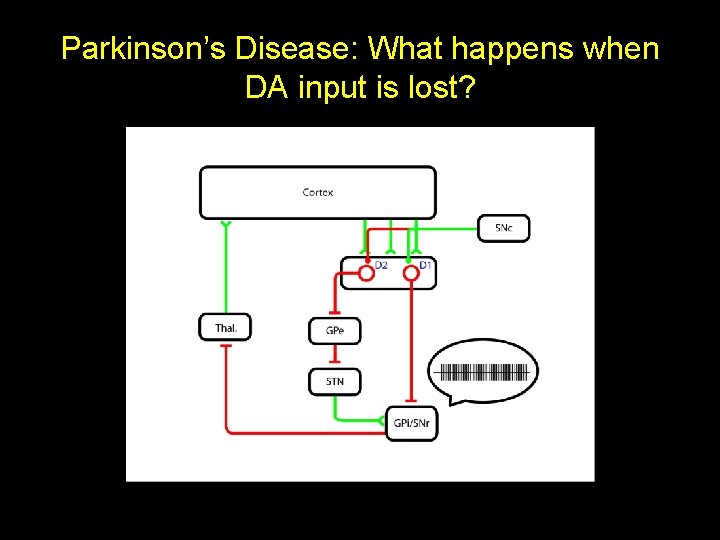
Parkinson’s Disease: What happens when DA input is lost?
Parkinson’s Disease: What happens when DA input is lost? http: //www. youtube. com/watch? feature=player_detailpage&v=3 Vrn. Otm. ZBtc
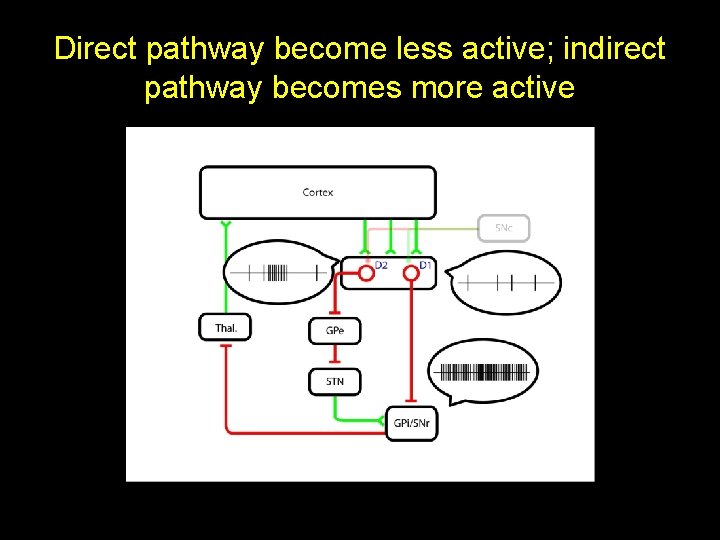
Direct pathway become less active; indirect pathway becomes more active
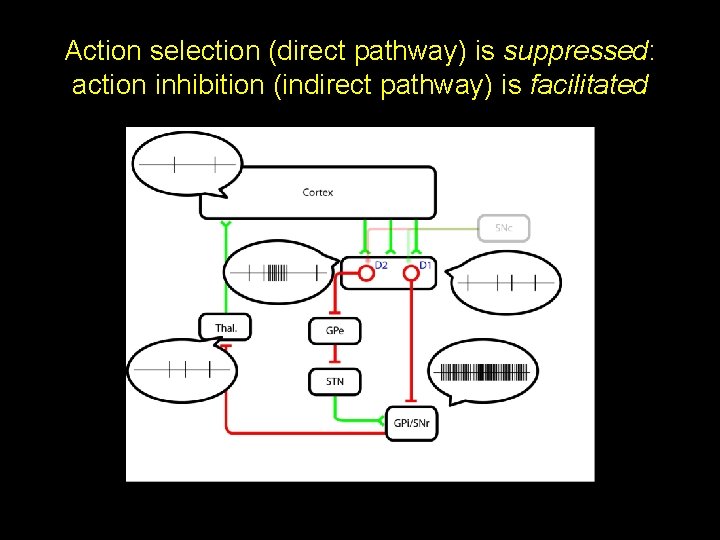
Action selection (direct pathway) is suppressed: action inhibition (indirect pathway) is facilitated
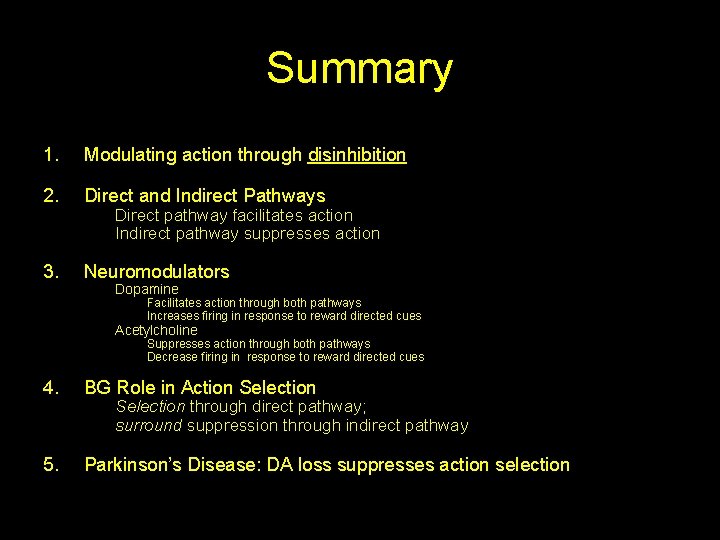
Summary 1. Modulating action through disinhibition 2. Direct and Indirect Pathways 3. Neuromodulators Direct pathway facilitates action Indirect pathway suppresses action Dopamine Facilitates action through both pathways Increases firing in response to reward directed cues Acetylcholine Suppresses action through both pathways Decrease firing in response to reward directed cues 4. BG Role in Action Selection 5. Parkinson’s Disease: DA loss suppresses action selection Selection through direct pathway; surround suppression through indirect pathway
Limitations • • • ‘Rate model’ does little to explain other BG-related phenomena, such as tremor…though this model been very useful Dopamine function is not confined to facilitating action – very likely plays an important role in learning. BG function is not confined to regulation of movement!
References • Kandel is fine for the basics • Excellent review of BG function and role of BG in guiding reward-directed (eye) movements: – Hikosaka 2001, Physiological Reviews - Role of the Basal Ganglia in the Control of Purposive Saccadic Eye Movements • General review of striatal function: – Kreitzer Annu. Rev. Neurosci. 2009. 32: 127– 47, Physiology and Pharmacology of Striatal Neurons
- Slides: 81