
Functional Abdominal Pain John Rosen MD Ashish Chogle
Functional Abdominal Pain John Rosen, MD Ashish Chogle, MD Ann & Robert H. Lurie Children’s Hospital of Chicago 2013 Resident Education Series Reviewed by Melissa Jensen, MD of the Professional Education Committee
Case • 14 y/o female with weekly periumbilical pain that improves after bowel movements for the past 3 months – What additional information would you like to know? – What are your next steps? Functional Abdominal Pain 2
Presentation • Pain at least weekly longer than 2 months • May be associated with disability – Missing school, stopping activities – Other pain, headache, sleep disturbance – Decreased quality of life, depression, anxiety • No warning signs Functional Abdominal Pain 3
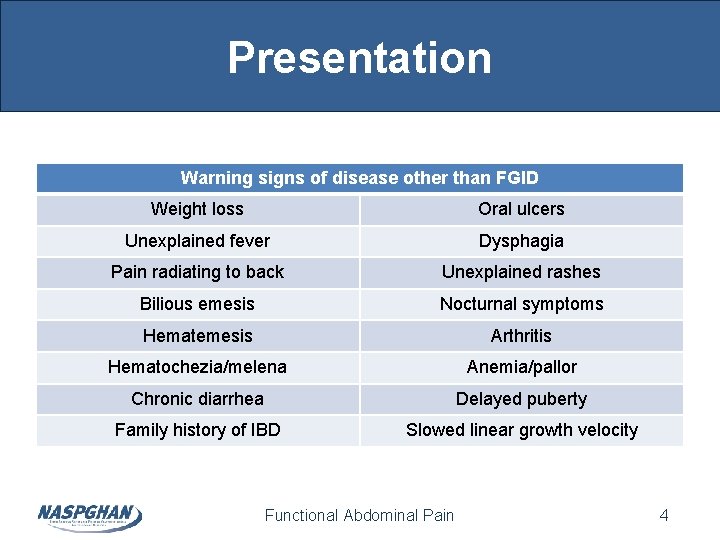
Presentation Warning signs of disease other than FGID Weight loss Oral ulcers Unexplained fever Dysphagia Pain radiating to back Unexplained rashes Bilious emesis Nocturnal symptoms Hematemesis Arthritis Hematochezia/melena Anemia/pallor Chronic diarrhea Delayed puberty Family history of IBD Slowed linear growth velocity Functional Abdominal Pain 4

Classification • Non-organic Psychiatric Made up/Faking • Functional Intestinal Disorders (FGID) – body’s normal activities (ie. motility, visceral sensation) are impaired, but no abnormality can be identified on diagnostic blood tests, radiography, or endoscopy – symptom-based diagnosis – mechanism unknown • possible dysmotility, inflammation, central or peripheral sensitization – etiology unknown • possible impact of early life events, infection, psychosocial, genetics Functional Abdominal Pain 5
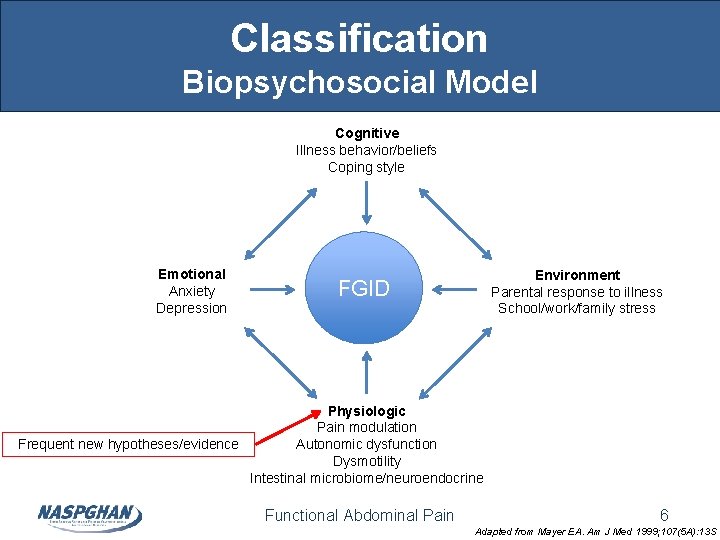
Classification Biopsychosocial Model Cognitive Illness behavior/beliefs Coping style Emotional Anxiety Depression Environment Parental response to illness School/work/family stress FGID Physiologic Pain modulation Frequent new hypotheses/evidence Autonomic dysfunction Dysmotility Intestinal microbiome/neuroendocrine Functional Abdominal Pain 6 Adapted from Mayer EA. Am J Med 1999; 107(5 A): 13 S
Diagnosis • Symptom-based diagnostic criteria • If no red flags, and if Rome criteria are met, no diagnostic tests recommended – consider likelihood of differential given symptoms and age – consider relatively prevalent diagnoses • celiac disease, lactose intolerance, h. pylori – avoid unnecessary expense and risk Functional Abdominal Pain 7
Diagnosis • Rome Foundation http: //www. romecriteria. org/ – Nonprofit, first diagnostic criteria in 1989 – International expert panel, consensus model • Adult and pediatric, separate recommendations • Current recommendations from Rome-III (2006) • Next recommendations in 2014 – Symptom-based criteria • Diagnostic Questionnaire for the Pediatric Functional Gastrointestinal Disorders (QPGS-III) Functional Abdominal Pain 8
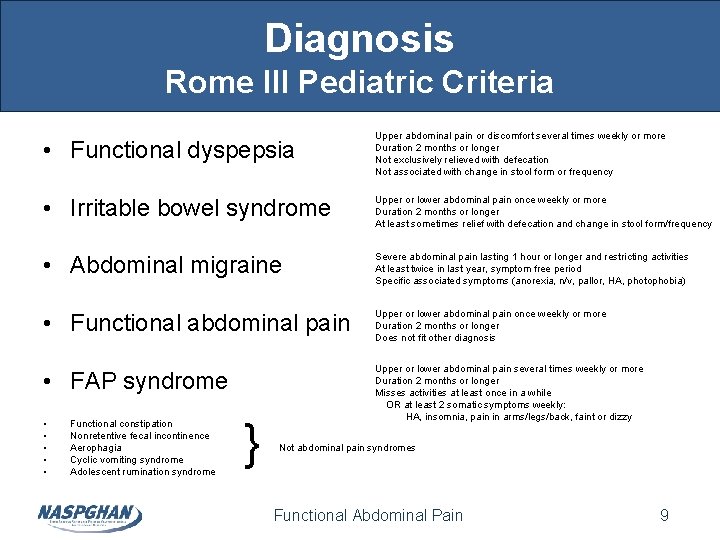
Diagnosis Rome III Pediatric Criteria • Functional dyspepsia Upper abdominal pain or discomfort several times weekly or more Duration 2 months or longer Not exclusively relieved with defecation Not associated with change in stool form or frequency • Irritable bowel syndrome Upper or lower abdominal pain once weekly or more Duration 2 months or longer At least sometimes relief with defecation and change in stool form/frequency • Abdominal migraine Severe abdominal pain lasting 1 hour or longer and restricting activities At least twice in last year, symptom free period Specific associated symptoms (anorexia, n/v, pallor, HA, photophobia) • Functional abdominal pain Upper or lower abdominal pain once weekly or more Duration 2 months or longer Does not fit other diagnosis • FAP syndrome Upper or lower abdominal pain several times weekly or more Duration 2 months or longer Misses activities at least once in a while OR at least 2 somatic symptoms weekly: HA, insomnia, pain in arms/legs/back, faint or dizzy • • • Functional constipation Nonretentive fecal incontinence Aerophagia Cyclic vomiting syndrome Adolescent rumination syndrome } Not abdominal pain syndromes Functional Abdominal Pain 9
Treatment • Reassurance and education! – Eliminate fear of unknown • Validate that symptoms are real, but not dangerous – For sake of patient and parent – Return to regular activities and return to school • Biopsychosocial approach • Evidence for medical therapies in pediatrics is not strong – Mostly extrapolated from adult data – Weigh risk vs. possible benefit – Short trial of empiric therapy and discontinuation if no response Functional Abdominal Pain 10
Treatment Psychotherapy • Biofeedback • Relaxation • Family therapy • Hypnotherapy • Cognitive behavioral therapy Functional Abdominal Pain 11
Treatment Dietary • Low-FODMAP – Fermentable Oligosaccharides, Disaccharides, Monosaccharides, And Polyols – Poor absorption and rapid fermentation • Fiber – either supplement or low fiber • Specific elimination – Gluten – Lactose Functional Abdominal Pain 12
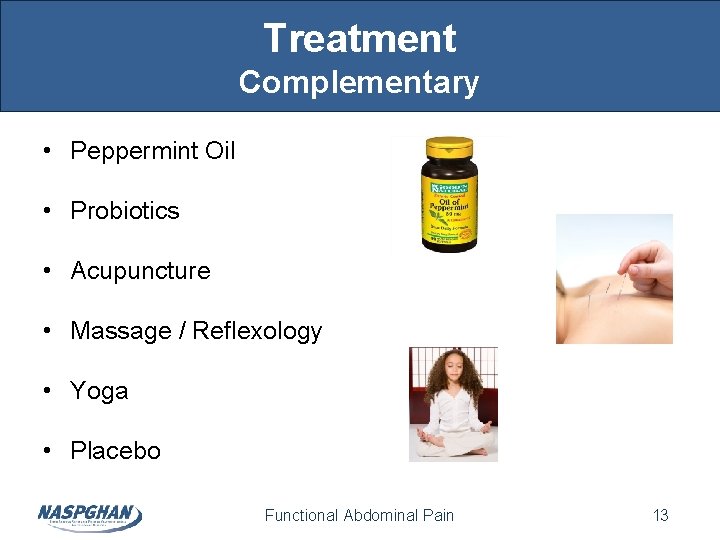
Treatment Complementary • Peppermint Oil • Probiotics • Acupuncture • Massage / Reflexology • Yoga • Placebo Functional Abdominal Pain 13
Therapy Pharmacologic • SSRI, tricyclic antidepressant (TCA) – Amitriptyline (Elavil) best studied in pediatrics (no effect) – Lower dose than used for depression – EKG prior to TCA treatment to evaluate for long QT syndrome • Prokinetics – EES (Eryped), metoclopramide (Reglan) Functional Abdominal Pain 14
Therapy Pharmacologic • Anticholinergics – Dicyclomine (Bentyl), Hyoscyamine (Levsin) – Cyproheptadine (Periactin), also antiserotonergic • H 2 blocker, proton-pump inhibitor • Analgesics (ie. NSAID, opioid) – Typically not necessary/effective Functional Abdominal Pain 15
Therapy Specific to Abdominal Migranes • Similar to headache migraine therapy • Abortive – Ondansetron (Zofran) – Sumatriptan (Imitrex) • Prophylactic – – Amitriptyline Cyproheptadine Propranolol Phenobarbital Functional Abdominal Pain 16
Prognosis • 1/3 of children with FGID may have IBS as adults • Expensive – Missed school/work, unnecessary diagnostic tests • Debilitating – Decreased Qo. L, depression, anxiety • However, most improve over time – No validated predictors of disease course Functional Abdominal Pain 17
Case Follow-up • 14 y/o female with weekly periumbilical pain that improves after bowel movements – Met Rome III criteria for irritable bowel syndrome – Treated with dietary modifications and relaxation psychotherapy with improvement in symptoms Functional Abdominal Pain 18
Summary • FGIDs are symptom-based diagnoses • If no “red-flags”, few/no diagnostic tests needed • Etiology is multifactorial, incompletely understood • Many therapies available, but evidence is limited • Consider needs/desires of patient and family and use biopsychosocial approach Functional Abdominal Pain 19
Selected References • Biopsychosocial model Engel. Science. 1977; 196(4286): 129 -36. • Neonate/toddler FGID Hyman, Milla, Benninga et al. Gastroenterol. 2006; 130: 1519– 26. • Child/adolescent FGID Rasquin, Di Lorenzo, Forbes et al. Gastroenterol. 2006; 130: 1527– 37. • QPGS-III http: //www. romecriteria. org/criteria/ or Walker, Rasquin. QPGS-III in: Drossman ed. Rome III: The Functional Gastrointestinal Disorders. 3 rd ed. 2006. 963 -90. • Treatment options Whitfield, Shulman. Pediatr Ann. 2009; 38(5): 288– 94. Bonilla, Saps. J Pediatr Gastroenterol Nutr. 2011 Dec; 53 Suppl 2: S 38 -40. • Low FODMAP diet Magge, Lembo. Gastroenterol and Hepatol. 2012. 8(11): 739 -45. • Psychotherapy for FGID Brent, Lobato, J Pediatr Gastroenterol Nutr. 2009; 48(1): 13 -21. • Amitriptyline pediatric RCT Saps, Youssef, Miranda et al. Gastroenterol. 2009; 137(4): 1261 -9. • “Functional Disorders of the Abdomen” Powerpoint Slide Set, Children’s Hospital of Philadelphia, Gastroenterology Fellows et al. Functional Abdominal Pain 20
- Slides: 20