
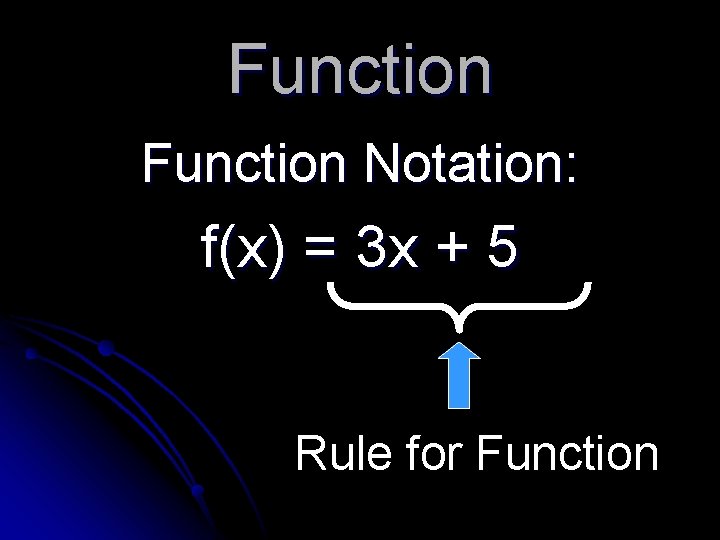
Function Notation fx 3 x 5 Rule for

- Slides: 27
Function Notation: f(x) = 3 x + 5 Rule for Function
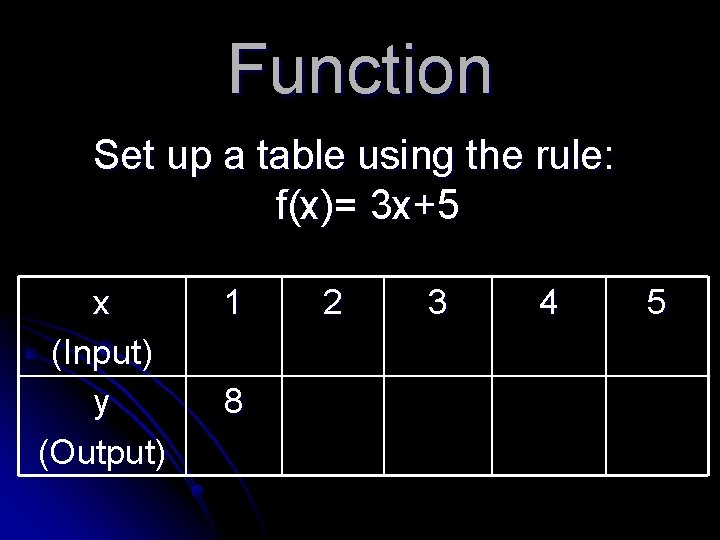
Function Set up a table using the rule: f(x)= 3 x+5 x (Input) y (Output) 1 8 2 3 4 5
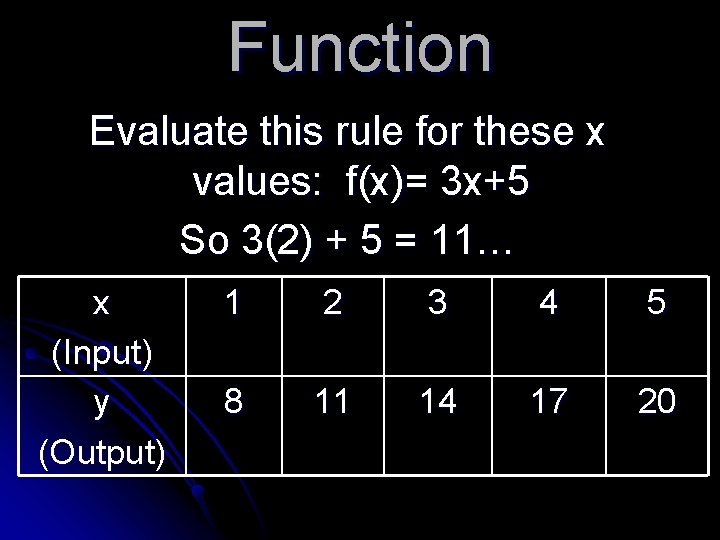
Function Evaluate this rule for these x values: f(x)= 3 x+5 So 3(2) + 5 = 11… x (Input) y (Output) 1 2 3 4 5 8 11 14 17 20
Patterns are functions. They’re predictable.
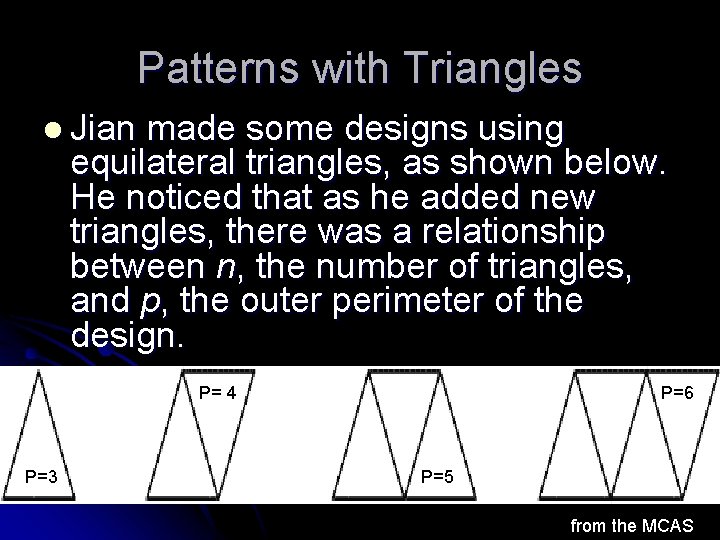
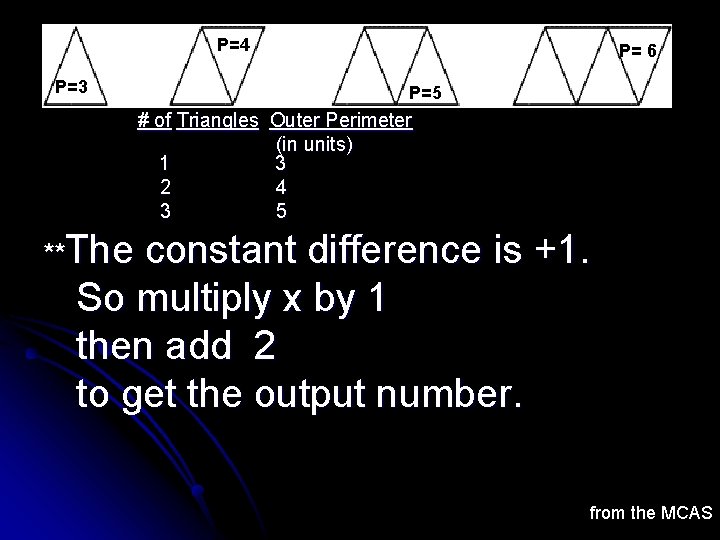
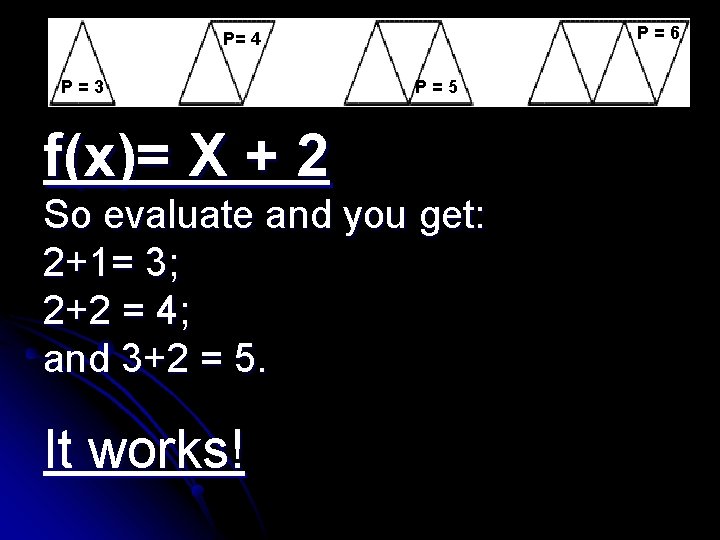
Patterns with Triangles l Jian made some designs using equilateral triangles, as shown below. He noticed that as he added new triangles, there was a relationship between n, the number of triangles, and p, the outer perimeter of the design. P= 4 P=3 P=6 P=5 from the MCAS
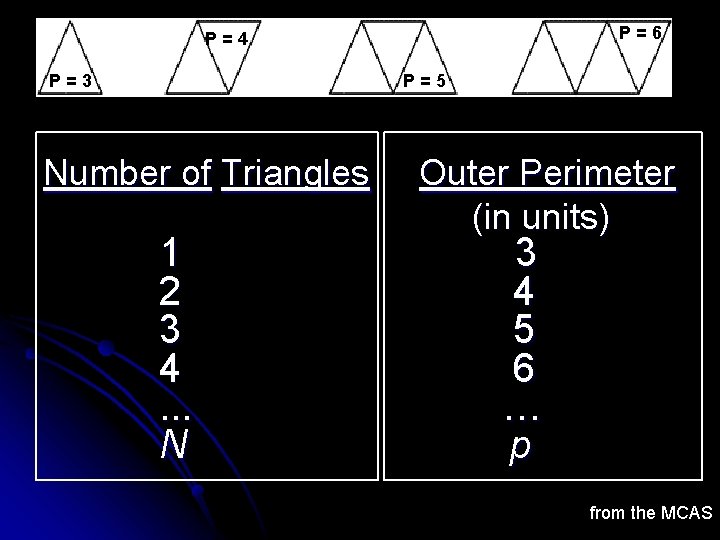
P=6 P=4 P=3 P=5 Number of Triangles 1 2 3 4. . . N Outer Perimeter (in units) 3 4 5 6 … p from the MCAS
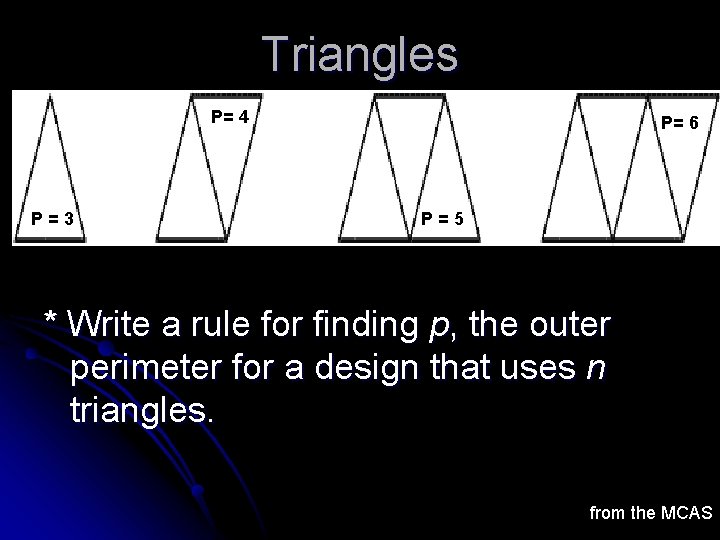
Triangles P= 4 P=3 P= 6 P=5 P= 5 * Write a rule for finding p, the outer perimeter for a design that uses n triangles. from the MCAS
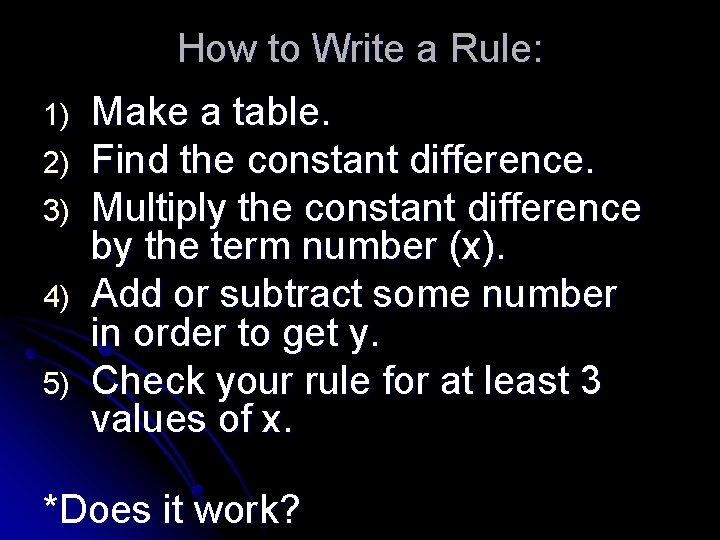
How to Write a Rule: 1) 2) 3) 4) 5) Make a table. Find the constant difference. Multiply the constant difference by the term number (x). Add or subtract some number in order to get y. Check your rule for at least 3 values of x. *Does it work?
P=4 P=3 P= 6 P=5 # of Triangles Outer Perimeter (in units) 1 3 2 4 3 5 **The constant difference is +1. So multiply x by 1 then add 2 to get the output number. from the MCAS
P=6 P= 4 P=3 P=5 f(x)= X + 2 So evaluate and you get: 2+1= 3; 2+2 = 4; and 3+2 = 5. It works!
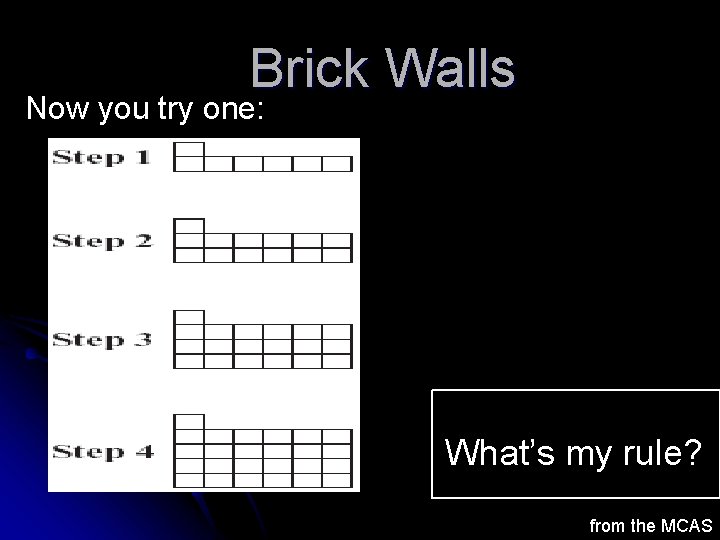
Brick Walls Now you try one: What’s my rule? from the MCAS
How to Write a Rule: 1) 2) 3) 4) 5) Make a table. Find the constant difference. Multiply the constant difference by the term number (x). Add or subtract some number in order to get y. Check your rule for at least 3 values of x. *Does it work?
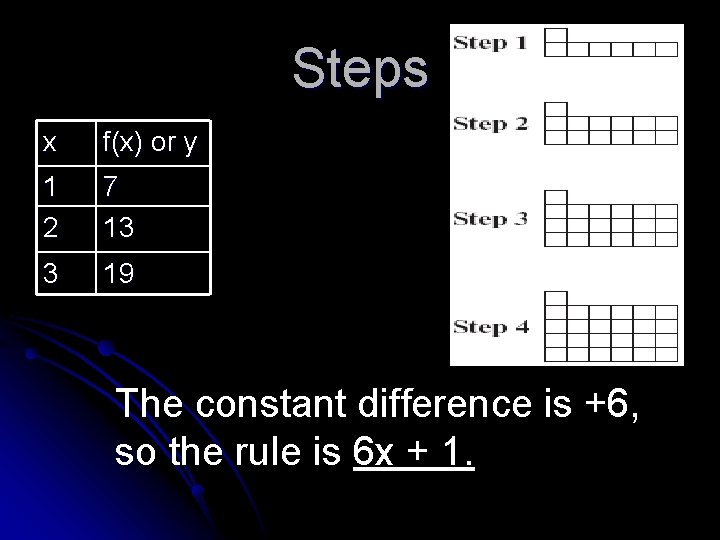
Steps x f(x) or y 1 2 7 13 3 19 The constant difference is +6, so the rule is 6 x + 1.
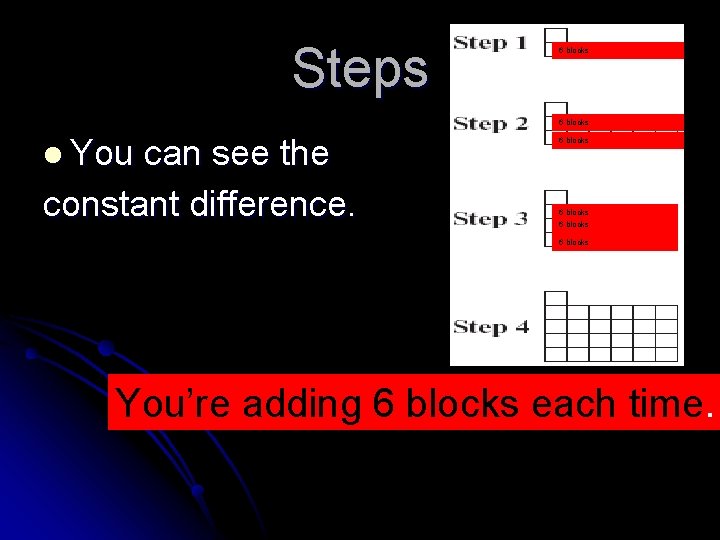
Steps 6 blocks l You can see the constant difference. 6 blocks You’re adding 6 blocks each time.
Patterns in Tables A city planner created a table to show the total number of seats for different numbers of subway cars. Copy the table. l What is the rule? from the MCAS
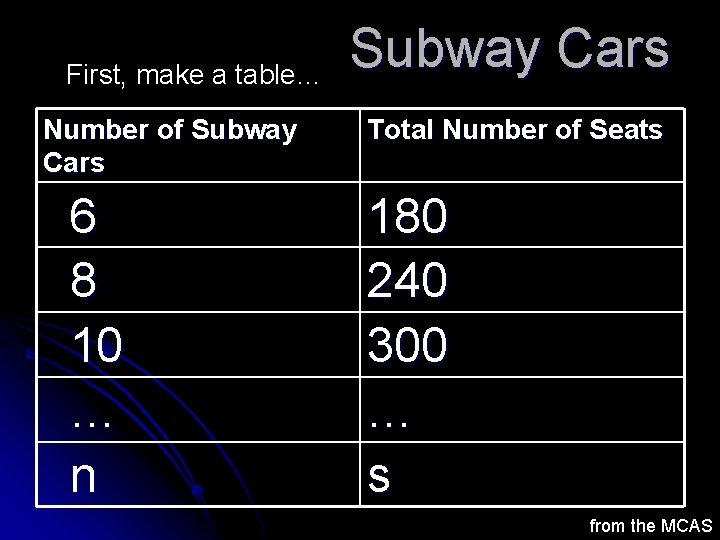
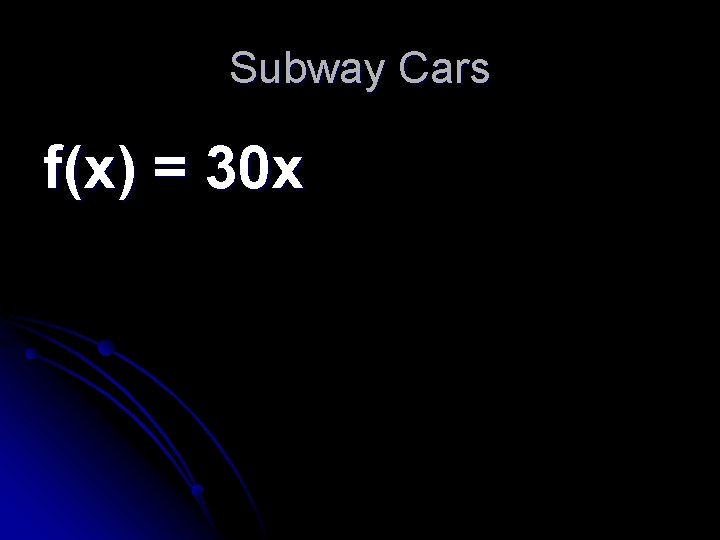
First, make a table… Number of Subway Cars 6 8 10 … n Subway Cars Total Number of Seats 180 240 300 … s from the MCAS
Subway Cars f(x) = 30 x
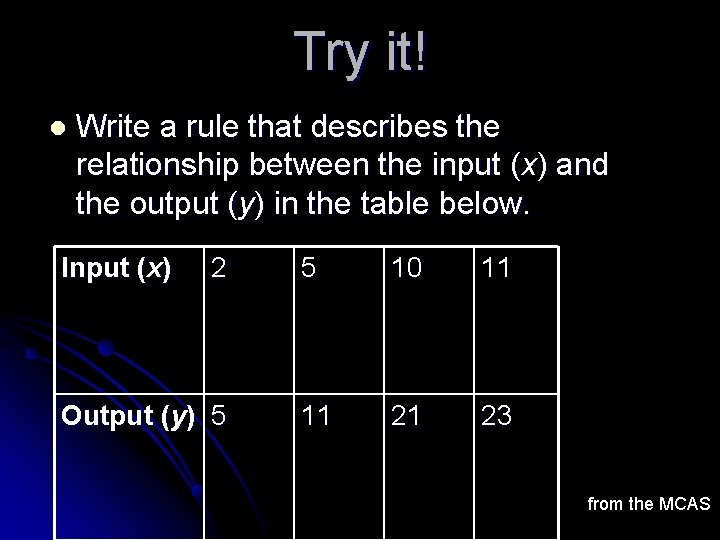
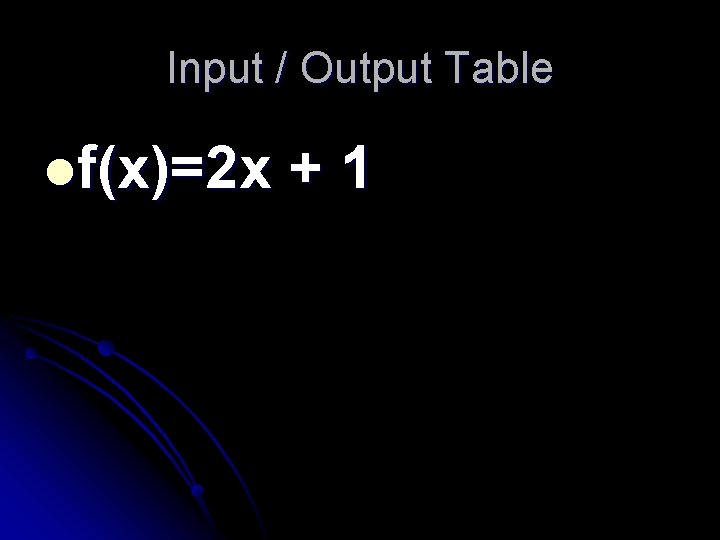
Try it! l Write a rule that describes the relationship between the input (x) and the output (y) in the table below. Input (x) 2 Output (y) 5 5 10 11 11 21 23 from the MCAS
Input / Output Table lf(x)=2 x +1
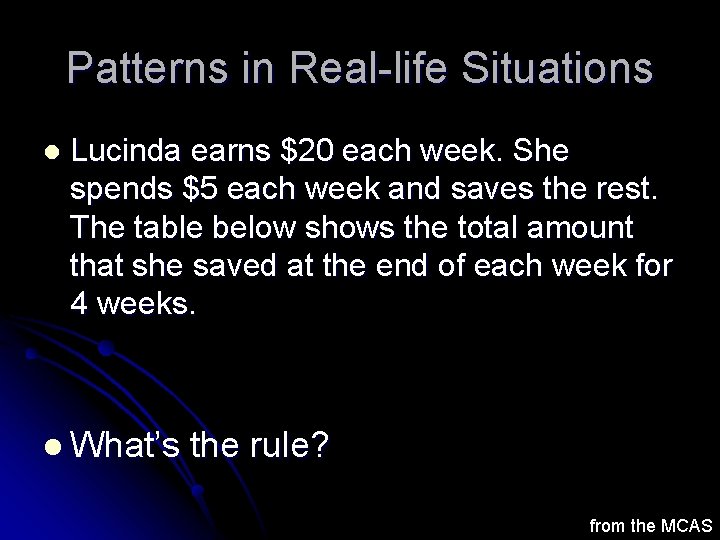
Patterns in Real-life Situations l Lucinda earns $20 each week. She spends $5 each week and saves the rest. The table below shows the total amount that she saved at the end of each week for 4 weeks. l What’s the rule? from the MCAS
Lucinda’s Savings f(x) = $15 x from the MCAS
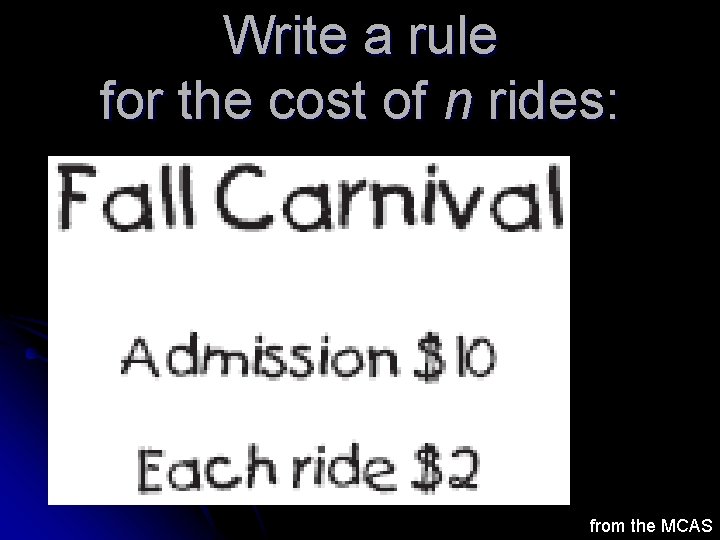
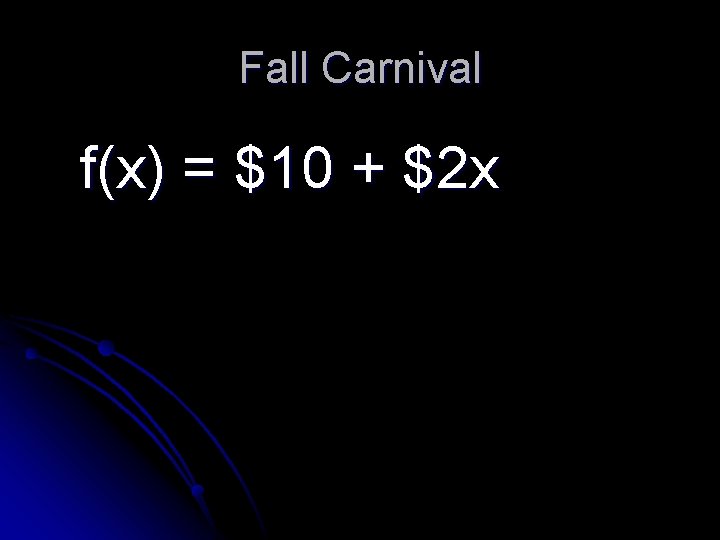
Write a rule for the cost of n rides: from the MCAS
Fall Carnival f(x) = $10 + $2 x
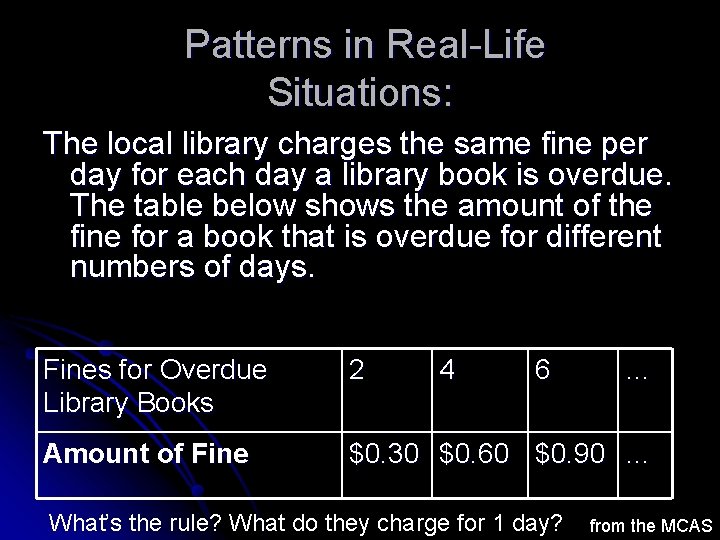
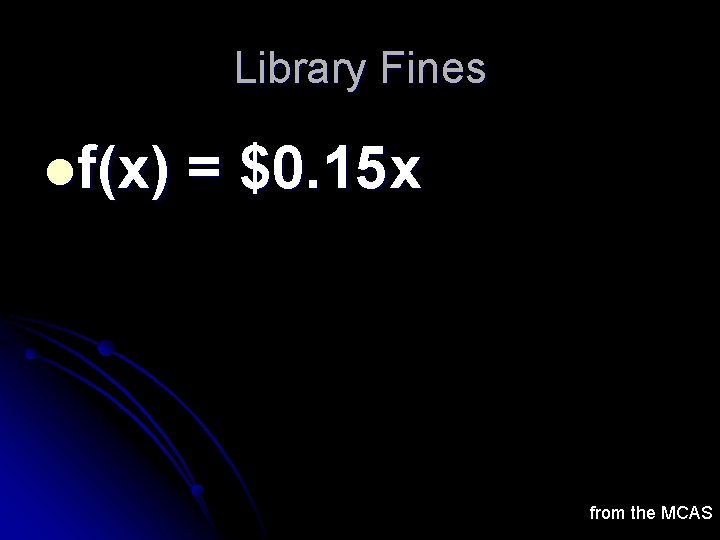
Patterns in Real-Life Situations: The local library charges the same fine per day for each day a library book is overdue. The table below shows the amount of the fine for a book that is overdue for different numbers of days. Fines for Overdue Library Books 2 4 6 Amount of Fine $0. 30 $0. 60 $0. 90 … What’s the rule? What do they charge for 1 day? … from the MCAS
Library Fines lf(x) = $0. 15 x from the MCAS
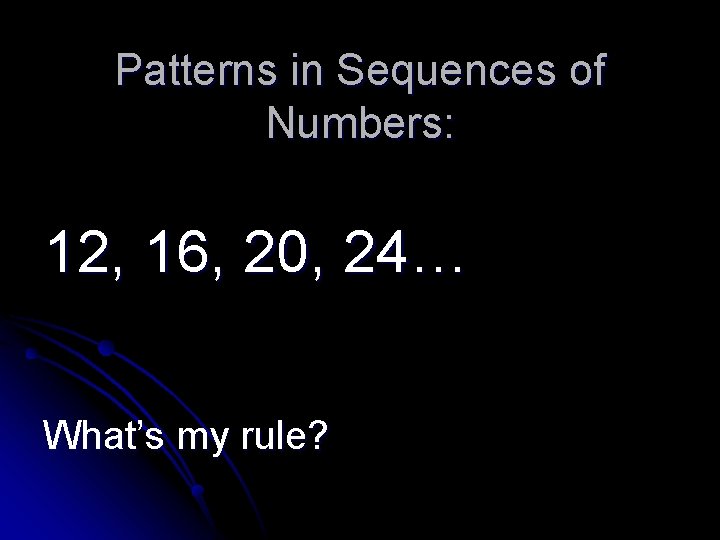
Patterns in Sequences of Numbers: 12, 16, 20, 24… What’s my rule?
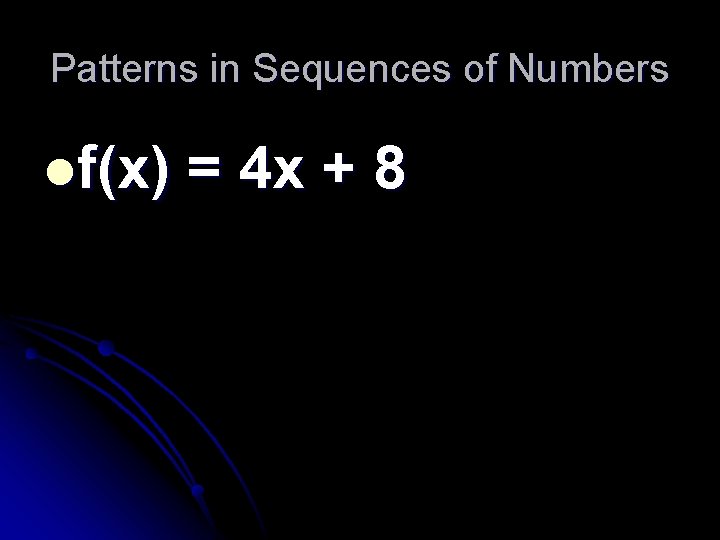
Patterns in Sequences of Numbers lf(x) = 4 x + 8