
Function Gambaran fungsi OUTPUT INPUT ArgumenParameter FUNCTION Return
Function
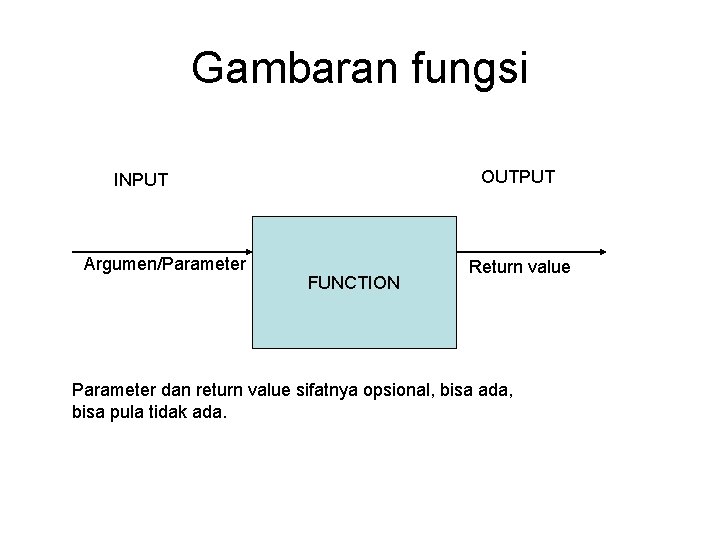
Gambaran fungsi OUTPUT INPUT Argumen/Parameter FUNCTION Return value Parameter dan return value sifatnya opsional, bisa ada, bisa pula tidak ada.
What is a function? • The function is one of the most basic things to understand in C programming. • A function is a sub-unit of a program which performs a specific task. • We have already (without knowing it) seen one function from the C library – printf. • We need to learn to write our own functions. • Functions take arguments (variables) and may return an argument. • Think of a function as extending the C language to a new task. • Or perhaps variables are NOUNS functions are VERBS.
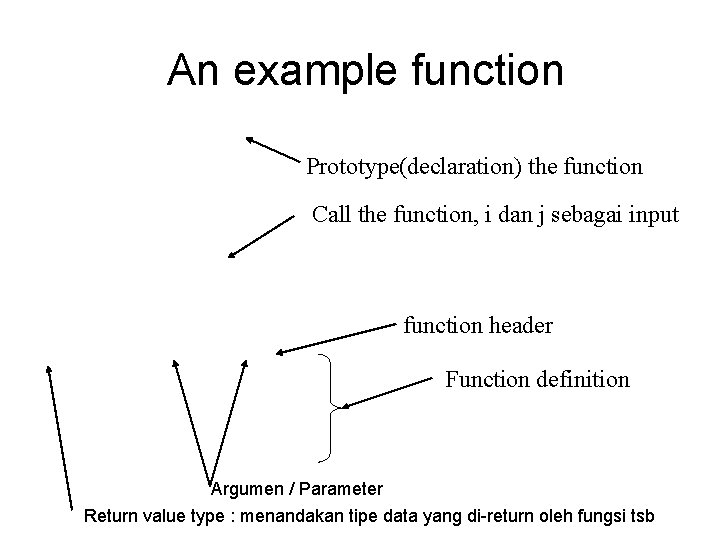
An example function Prototype(declaration) the function Call the function, i dan j sebagai input function header Function definition Argumen / Parameter Return value type : menandakan tipe data yang di-return oleh fungsi tsb
Mengenai Prototype fungsi • Prototype fungsi harus dituliskan dalam source code jika penulisan fungsi ada di bawah fungsi lain yang memanggil fungsi tsb • Tidak wajib dituliskan jika penulisan fungsi itu di atas fungsi lain yg memanggil fungsi tsb
What are these prototype things? • A prototype tells your C program what to expect from a function - what arguments it takes (if any) and what it returns (if any) • Prototypes should go before main() • #include finds the prototypes for library functions (e. g. printf) • A function MUST return the variable type we say that it does in the prototype.
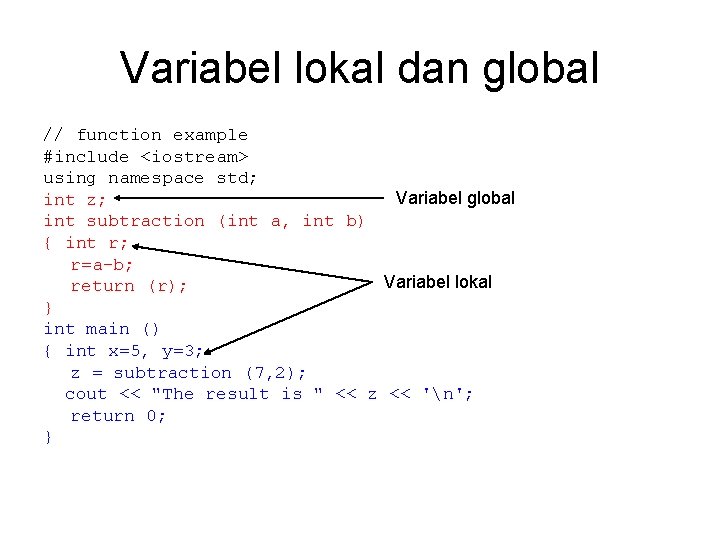
Variabel lokal dan global // function example #include <iostream> using namespace std; Variabel global int z; int subtraction (int a, int b) { int r; r=a-b; Variabel lokal return (r); } int main () { int x=5, y=3; z = subtraction (7, 2); cout << "The result is " << z << 'n'; return 0; }
Variabel lokal dan global • Variabel global akan tetap dialokasikan di memori selama program masih berjalan • Variabel lokal hanya dialokasikan di memori ketika fungsi dijalankan • Ketika suatu fungsi selesai dieksekusi, variable lokal di dalamnya akan dihancurkan (destroyed) dihapus dari memori • Jadi penggunaan var lokal lebih hemat memori
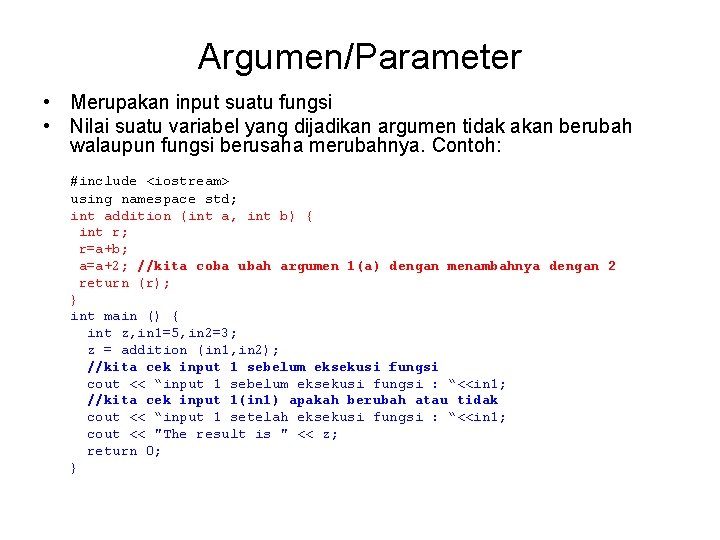
Argumen/Parameter • Merupakan input suatu fungsi • Nilai suatu variabel yang dijadikan argumen tidak akan berubah walaupun fungsi berusaha merubahnya. Contoh: #include <iostream> using namespace std; int addition (int a, int b) { int r; r=a+b; a=a+2; //kita coba ubah argumen 1(a) dengan menambahnya dengan 2 return (r); } int main () { int z, in 1=5, in 2=3; z = addition (in 1, in 2); //kita cek input 1 sebelum eksekusi fungsi cout << “input 1 sebelum eksekusi fungsi : “<<in 1; //kita cek input 1(in 1) apakah berubah atau tidak cout << “input 1 setelah eksekusi fungsi : “<<in 1; cout << "The result is " << z; return 0; }
Argumen output • Argumen sebenarnya juga bisa dijadikan output suatu fungsi (akan dijelaskan pada materi yg akan datang)
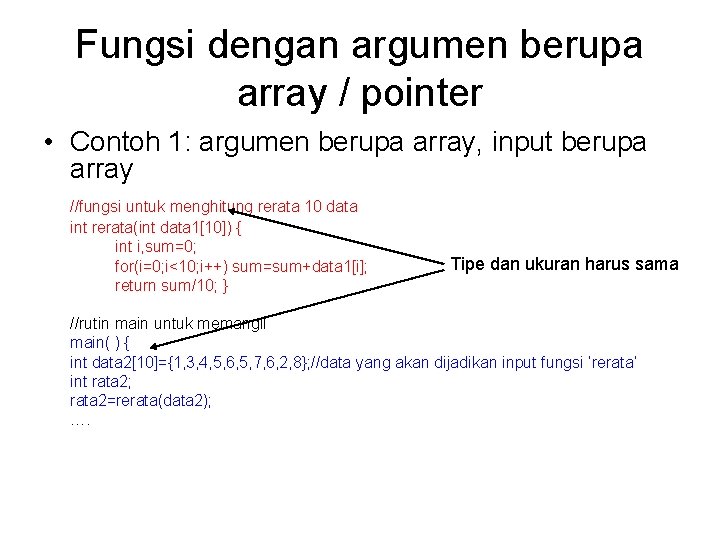
Fungsi dengan argumen berupa array / pointer • Contoh 1: argumen berupa array, input berupa array //fungsi untuk menghitung rerata 10 data int rerata(int data 1[10]) { int i, sum=0; for(i=0; i<10; i++) sum=sum+data 1[i]; return sum/10; } Tipe dan ukuran harus sama //rutin main untuk memangil main( ) { int data 2[10]={1, 3, 4, 5, 6, 5, 7, 6, 2, 8}; //data yang akan dijadikan input fungsi ‘rerata’ int rata 2; rata 2=rerata(data 2); ….
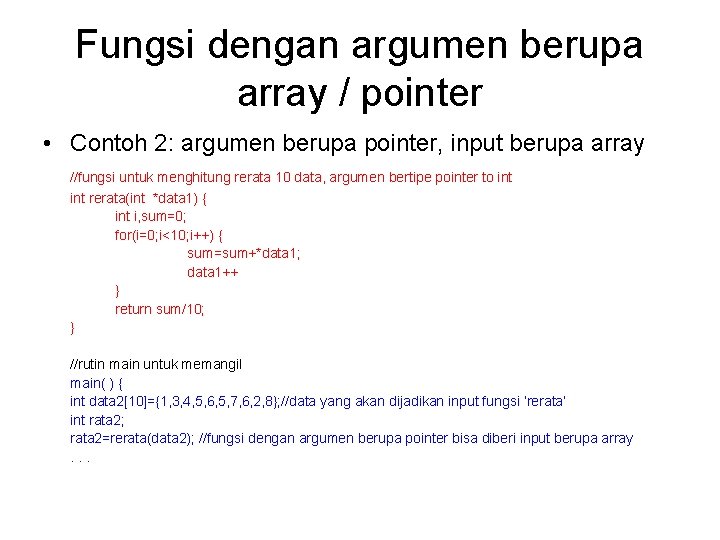
Fungsi dengan argumen berupa array / pointer • Contoh 2: argumen berupa pointer, input berupa array //fungsi untuk menghitung rerata 10 data, argumen bertipe pointer to int rerata(int *data 1) { int i, sum=0; for(i=0; i<10; i++) { sum=sum+*data 1; data 1++ } return sum/10; } //rutin main untuk memangil main( ) { int data 2[10]={1, 3, 4, 5, 6, 5, 7, 6, 2, 8}; //data yang akan dijadikan input fungsi ‘rerata’ int rata 2; rata 2=rerata(data 2); //fungsi dengan argumen berupa pointer bisa diberi input berupa array. . .
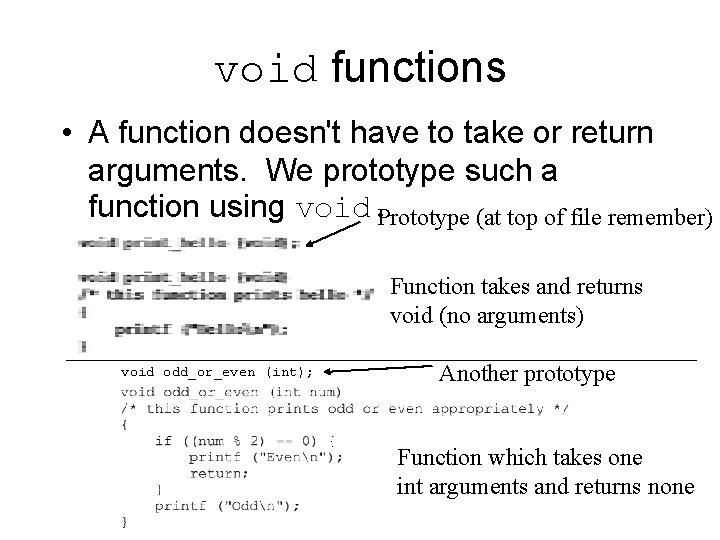
void functions • A function doesn't have to take or return arguments. We prototype such a function using void. Prototype (at top of file remember) Function takes and returns void (no arguments) void odd_or_even (int); Another prototype Function which takes one int arguments and returns none
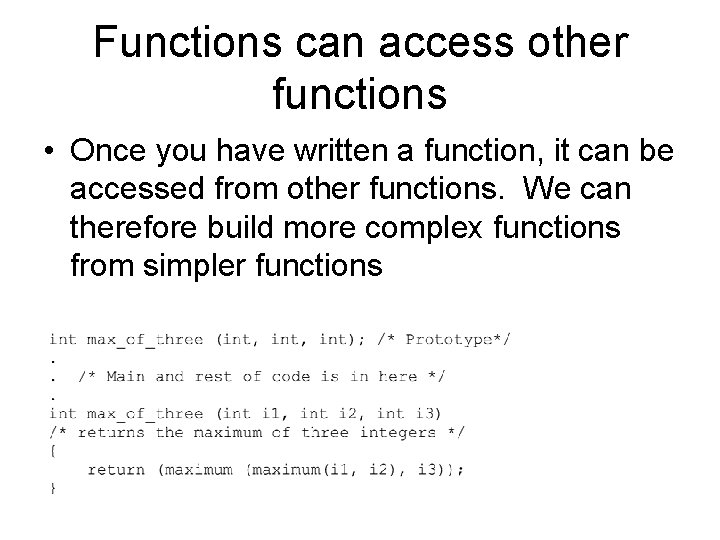
Functions can access other functions • Once you have written a function, it can be accessed from other functions. We can therefore build more complex functions from simpler functions
Notes about functions • A function can take any number of arguments mixed in any way. • A function can return at most one argument. • When we return from a function, the values of the argument HAVE NOT CHANGED. • We can declare variables within a function just like we can within main() - these variables will be deleted when we return from the function
Where do functions go in the program • Generally speaking it doesn't matter too much. • main() is a function just like any other (you could even call it from other functions if you wanted. • It is common to make main() the first function in your code. • Functions must be entirely separate from each other. • Prototypes must come before functions are used. • A usual order is: Prototypes THEN main THEN other functions.
- Slides: 16