
Function Definition A Powerful Problem or Opportunity Analysis
Function Definition A Powerful Problem or Opportunity Analysis Technique Gregg Motter@MSU. EDU © G. A. Motter, 2006 & 2008
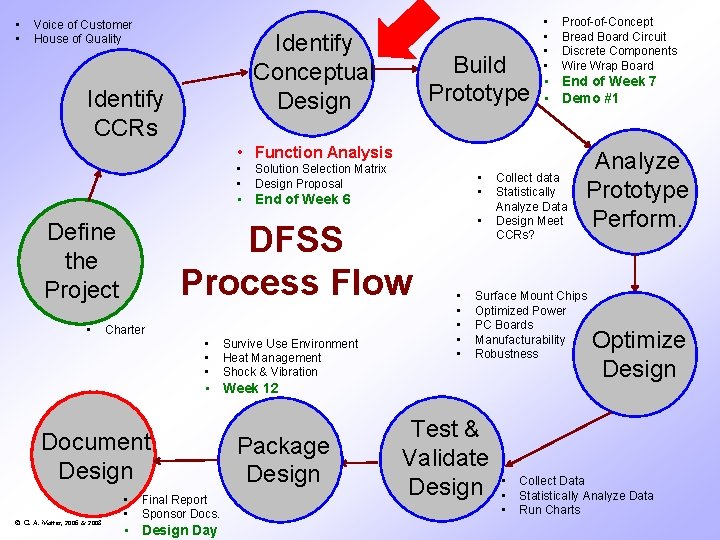
• • Voice of Customer House of Quality Identify Conceptual Design Identify CCRs Build Prototype • • Proof-of-Concept Bread Board Circuit Discrete Components Wire Wrap Board • End of Week 7 • Demo #1 • Function Analysis • • Solution Selection Matrix Design Proposal • • • End of Week 6 Define the Project • DFSS Process Flow Charter • • • Survive Use Environment Heat Management Shock & Vibration • • • Collect data Statistically Analyze Data Design Meet CCRs? Surface Mount Chips Optimized Power PC Boards Manufacturability Robustness • Week 12 Document Design © G. A. Motter, 2006 & 2008 • • Final Report Sponsor Docs. • Design Day Package Design Analyze Prototype Perform. Test & Validate Design • • • Optimize Design Collect Data Statistically Analyze Data Run Charts
Objectives • Learn “Best Practices” to Define Functions • Identify Basic and Secondary Functions • Develop a FAST Diagram • Intro. to Value Engineering • Assign Homework FAST: Function Analysis System Technique © G. A. Motter, 2006 & 2008
Function Definition • Describes a product in terms of an Active Verb and a Measurable Noun • Provides a complete understanding of the basic reason(s) something exist • Explore new ways to deliver Customer Satisfaction – Improved performance – Lower cost © G. A. Motter, 2006 & 2008
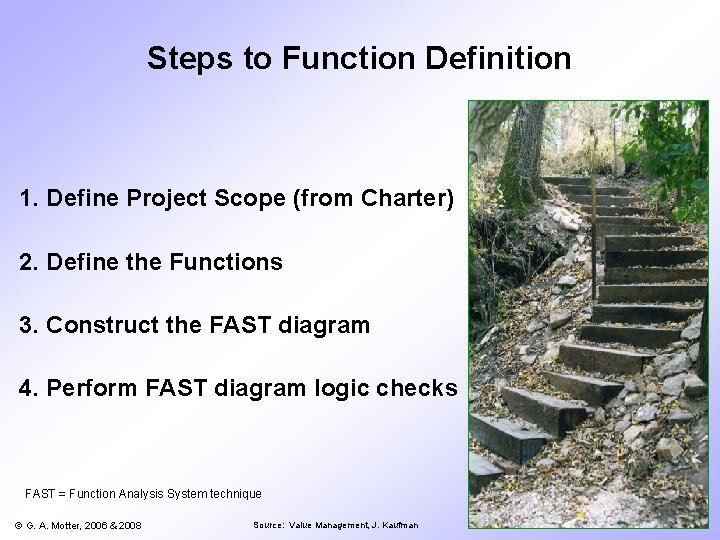
Steps to Function Definition 1. Define Project Scope (from Charter) 2. Define the Functions 3. Construct the FAST diagram 4. Perform FAST diagram logic checks FAST = Function Analysis System technique © G. A. Motter, 2006 & 2008 Source: Value Management, J. Kaufman
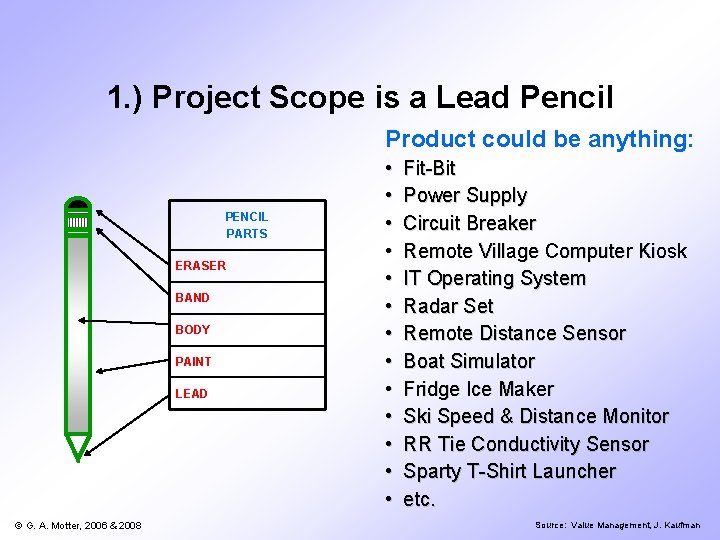
1. ) Project Scope is a Lead Pencil Product could be anything: PENCIL PARTS ERASER BAND BODY PAINT LEAD © G. A. Motter, 2006 & 2008 • • • • Fit-Bit Power Supply Circuit Breaker Remote Village Computer Kiosk IT Operating System Radar Set Remote Distance Sensor Boat Simulator Fridge Ice Maker Ski Speed & Distance Monitor RR Tie Conductivity Sensor Sparty T-Shirt Launcher etc. Source: Value Management, J. Kaufman
2. ) Define Functions for Project Functions are defined in two word phrases 1. Active Verb: – Describes the specific action we plan to carry out to achieve our intended purpose 2. Measurable Noun – Defines the object (Noun) onto which the action operates Any Verb and Noun may be combined to describe the Function Acid Test – “Does it describe what something actually does in the system under study? ” © G. A. Motter, 2006 & 2008 Refer to Appendix for “proven useful” Verbs and Nouns
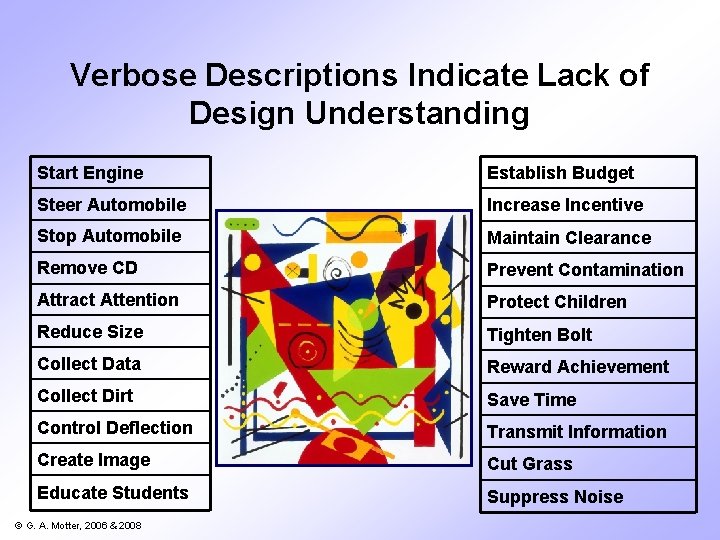
Verbose Descriptions Indicate Lack of Design Understanding Start Engine Establish Budget Steer Automobile Increase Incentive Stop Automobile Maintain Clearance Remove CD Prevent Contamination Attract Attention Protect Children Reduce Size Tighten Bolt Collect Data Reward Achievement Collect Dirt Save Time Control Deflection Transmit Information Create Image Cut Grass Educate Students Suppress Noise © G. A. Motter, 2006 & 2008
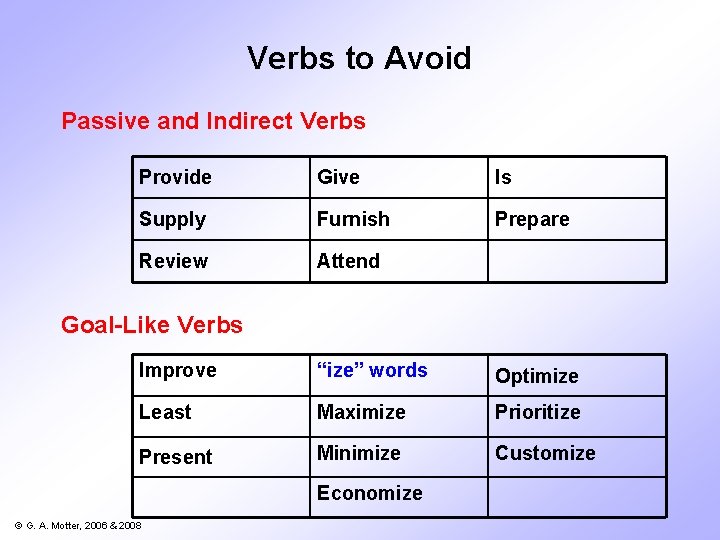
Verbs to Avoid Passive and Indirect Verbs Provide Give Is Supply Furnish Prepare Review Attend Goal-Like Verbs Improve “ize” words Optimize Least Maximize Prioritize Present Minimize Customize Economize © G. A. Motter, 2006 & 2008
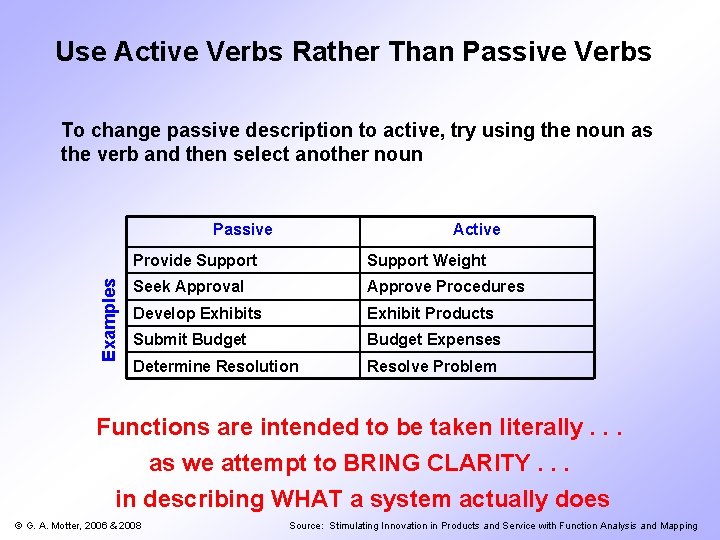
Use Active Verbs Rather Than Passive Verbs To change passive description to active, try using the noun as the verb and then select another noun Examples Passive Active Provide Support Weight Seek Approval Approve Procedures Develop Exhibits Exhibit Products Submit Budget Expenses Determine Resolution Resolve Problem Functions are intended to be taken literally. . . as we attempt to BRING CLARITY. . . in describing WHAT a system actually does © G. A. Motter, 2006 & 2008 Source: Stimulating Innovation in Products and Service with Function Analysis and Mapping
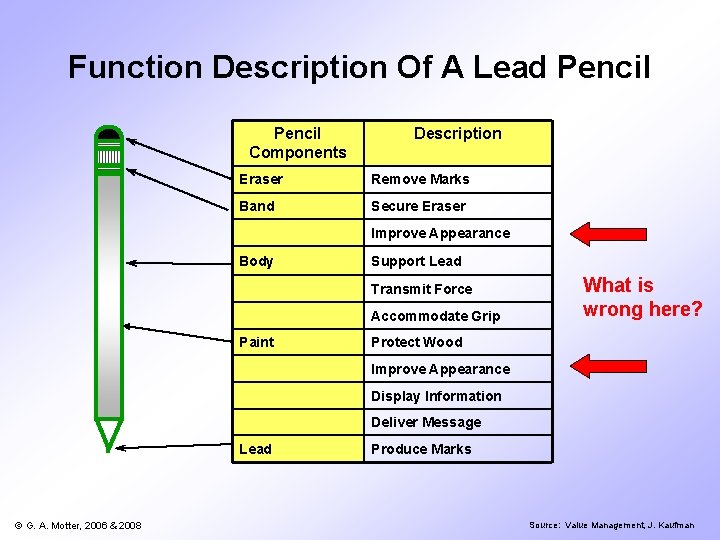
Function Description Of A Lead Pencil Components Description Eraser Remove Marks Band Secure Eraser Improve Appearance Body Support Lead Transmit Force Accommodate Grip Paint What is wrong here? Protect Wood Improve Appearance Display Information Deliver Message Lead © G. A. Motter, 2006 & 2008 Produce Marks Source: Value Management, J. Kaufman
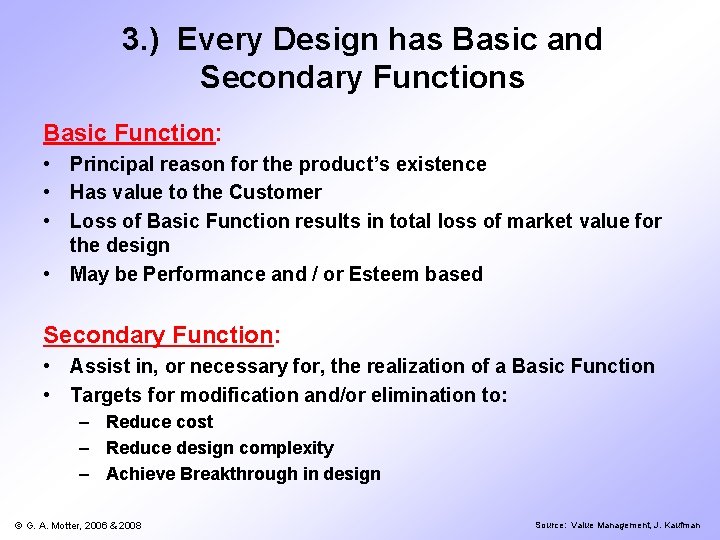
3. ) Every Design has Basic and Secondary Functions Basic Function: • Principal reason for the product’s existence • Has value to the Customer • Loss of Basic Function results in total loss of market value for the design • May be Performance and / or Esteem based Secondary Function: • Assist in, or necessary for, the realization of a Basic Function • Targets for modification and/or elimination to: – Reduce cost – Reduce design complexity – Achieve Breakthrough in design © G. A. Motter, 2006 & 2008 Source: Value Management, J. Kaufman
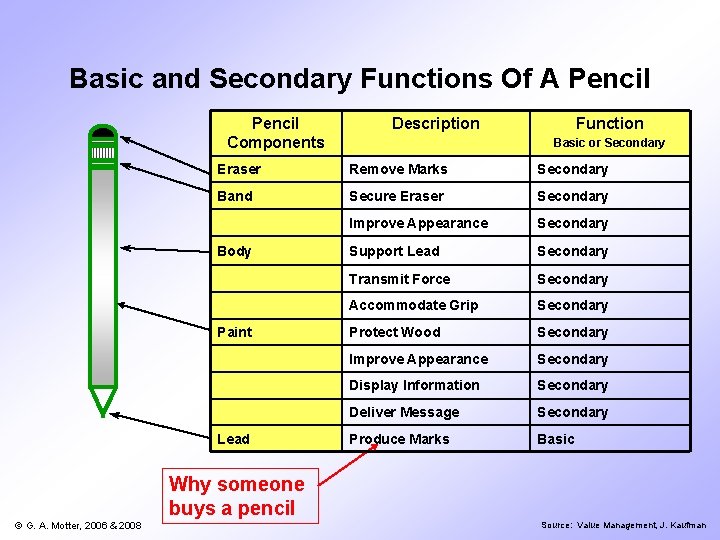
Basic and Secondary Functions Of A Pencil Components Description Function Basic or Secondary Eraser Remove Marks Secondary Band Secure Eraser Secondary Improve Appearance Secondary Support Lead Secondary Transmit Force Secondary Accommodate Grip Secondary Protect Wood Secondary Improve Appearance Secondary Display Information Secondary Deliver Message Secondary Produce Marks Basic Body Paint Lead Why someone buys a pencil © G. A. Motter, 2006 & 2008 Source: Value Management, J. Kaufman
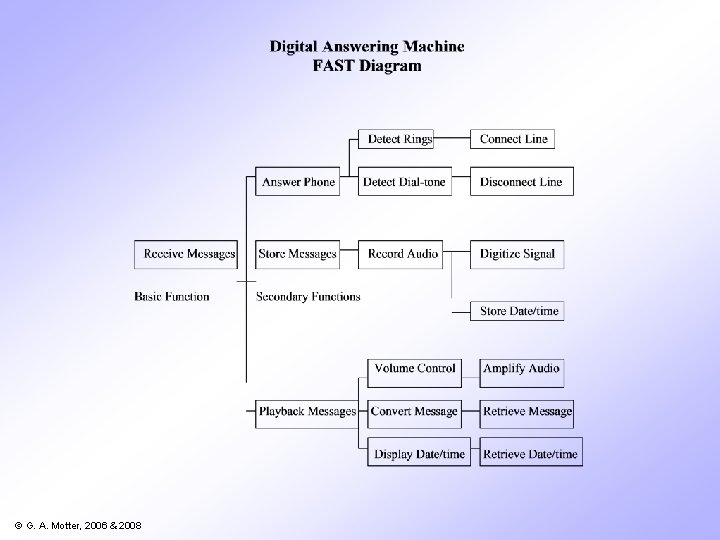
3) Construct the FAST Diagram – Visual layout (Tree Diagram) of product’s Functions – Starts with the Basic Function, and builds to the right with supporting or Secondary Functions Why do a FAST Diagram? – Understand Functions to be eliminated, or improved, to deliver Basic Function(s) © Motter, 2006 &2006 2008 & 2008 © G. G. A. A. Motter,
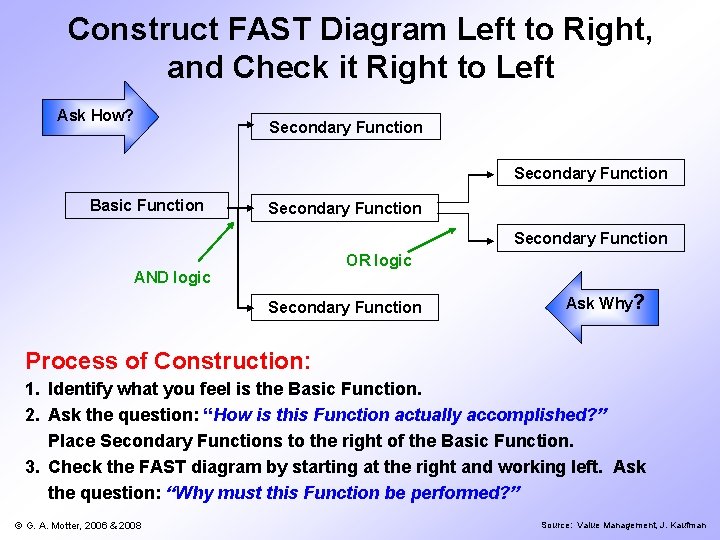
Construct FAST Diagram Left to Right, and Check it Right to Left Ask How? Secondary Function Basic Function Secondary Function OR logic AND logic Secondary Function Ask Why? Process of Construction: 1. Identify what you feel is the Basic Function. 2. Ask the question: “How is this Function actually accomplished? ” Place Secondary Functions to the right of the Basic Function. 3. Check the FAST diagram by starting at the right and working left. Ask the question: “Why must this Function be performed? ” © G. A. Motter, 2006 & 2008 Source: Value Management, J. Kaufman
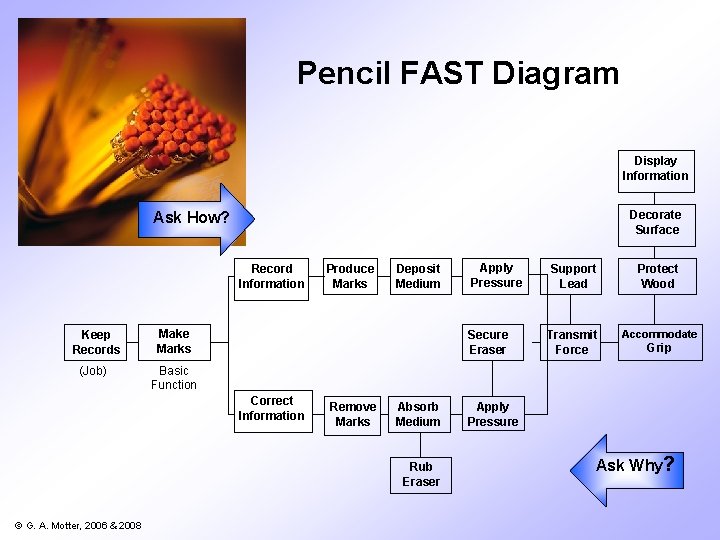
Pencil FAST Diagram Display Information Decorate Surface Ask How? Record Information Keep Records (Job) Produce Marks Deposit Medium Make Marks Secure Eraser Support Lead Protect Wood Transmit Force Accommodate Grip Basic Function Correct Information Remove Marks Absorb Medium Rub Eraser © G. A. Motter, 2006 & 2008 Apply Pressure Ask Why?
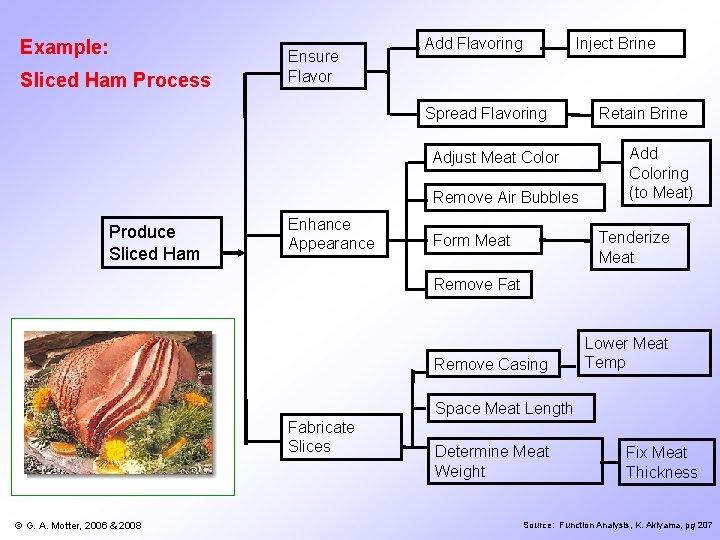
Example: Sliced Ham Process Ensure Flavor Add Flavoring Inject Brine Spread Flavoring Adjust Meat Color Remove Air Bubbles Produce Sliced Ham Enhance Appearance Retain Brine Add Coloring (to Meat) Tenderize Meat Form Meat Remove Fat Remove Casing Lower Meat Temp Space Meat Length Fabricate Slices © G. A. Motter, 2006 & 2008 Determine Meat Weight Fix Meat Thickness Source: Function Analysis, K. Akiyama, pg 207
Four Rules of Function Definition 1) Once defined, Basic Function does not change. . . becomes principle work a system does. Example: flashlight is expected to emit light 2) Cost contribution of a Basic Function is a minimal percentage of total system cost 3) Can not sell supporting Secondary Functions without performing Basic Function satisfactorily 4) Loss of Basic Function(s) results in total loss of market value. Example: Rolex watch that does not display correct time © G. A. Motter, 2006 & 2008
4. ) FAST Diagram Logic Checks q Double check tree diagram “How? ” and “Why? ” logic. q Identify possible Secondary Functions for elimination? q Test by removing Secondary Function, and ask the “How ? ” and “Why ? ” logic questions. q Check “AND” logic and “OR” logic diagramming. q Ensure project Scope lines are clearly drawn. © G. A. Motter, 2006 & 2008
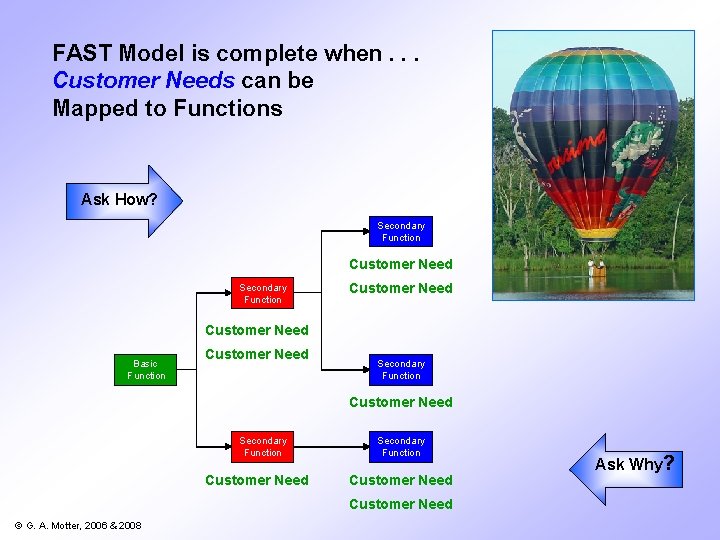
FAST Model is complete when. . . Customer Needs can be Mapped to Functions Ask How? Secondary Function Customer Need Basic Function Customer Need Secondary Function Customer Need © G. A. Motter, 2006 & 2008 Ask Why?
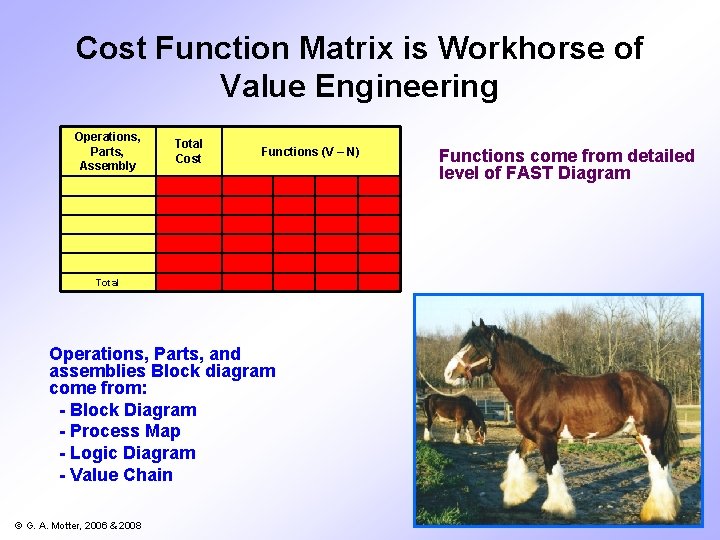
Cost Function Matrix is Workhorse of Value Engineering Operations, Parts, Assembly Total Cost Functions (V – N) Total Operations, Parts, and assemblies Block diagram come from: - Block Diagram - Process Map - Logic Diagram - Value Chain © G. A. Motter, 2006 & 2008 Functions come from detailed level of FAST Diagram
Cost – Function Matrix Identifies Areas of Opportunity Steps to Create Matrix: 1. ) List major operations, parts, or assemblies in left hand column 2. ) List total cost for each group in adjacent column 3. ) Place Functions across top from FAST Diagram 4. ) Identify Functions contributing to each line of cost (indicate with dot in cell) 5. ) Determine portion of cost associated with each function 6. ) Sum Functional cost 7. ) Calculate Function % 8. ) Show Function % on FAST diagram © G. A. Motter, 2006 & 2008
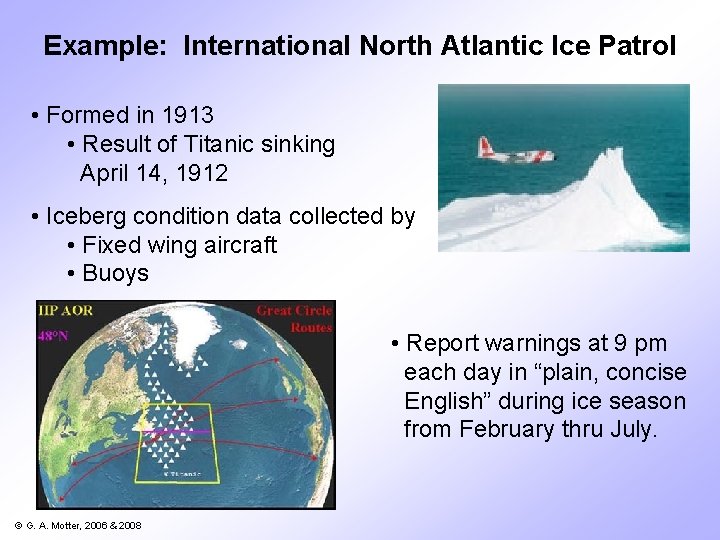
Example: International North Atlantic Ice Patrol • Formed in 1913 • Result of Titanic sinking April 14, 1912 • Iceberg condition data collected by • Fixed wing aircraft • Buoys • Report warnings at 9 pm each day in “plain, concise English” during ice season from February thru July. © G. A. Motter, 2006 & 2008
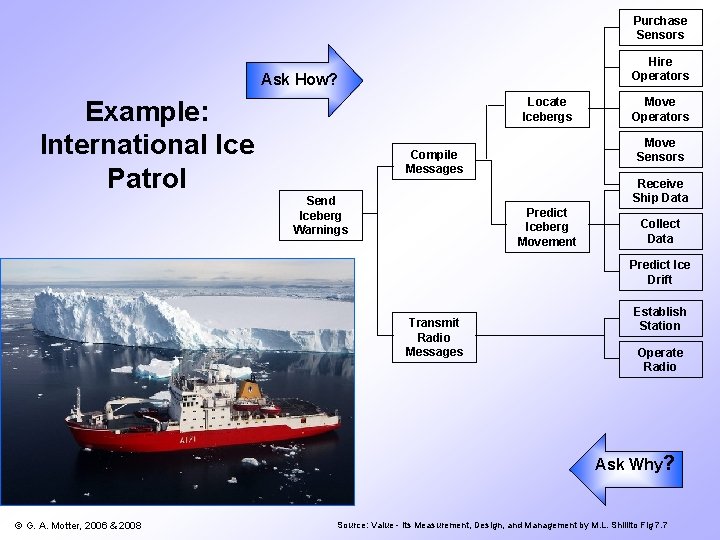
Purchase Sensors Hire Operators Ask How? Locate Icebergs Example: International Ice Patrol Move Operators Move Sensors Compile Messages Receive Ship Data Send Iceberg Warnings Predict Iceberg Movement Collect Data Predict Ice Drift Transmit Radio Messages Establish Station Operate Radio Ask Why? © G. A. Motter, 2006 & 2008 Source: Value - Its Measurement, Design, and Management by M. L. Shillito Fig 7. 7
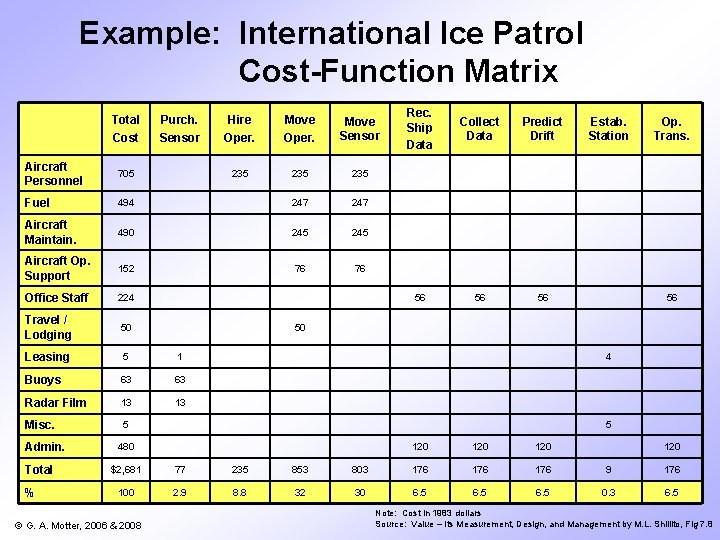
Example: International Ice Patrol Cost-Function Matrix Total Cost Purch. Sensor Hire Oper. Move Sensor 235 235 Aircraft Personnel 705 Fuel 494 247 Aircraft Maintain. 490 245 Aircraft Op. Support 152 76 76 Office Staff 224 Travel / Lodging 50 Leasing 5 1 Buoys 63 63 Radar Film 13 13 Misc. 5 Admin. Total % Rec. Ship Data Collect Data Predict Drift 56 56 56 Estab. Station Op. Trans. 56 50 4 5 480 120 120 $2, 681 77 235 853 803 176 176 9 176 100 2. 9 8. 8 32 30 6. 5 0. 3 6. 5 © G. A. Motter, 2006 & 2008 Note: Cost in 1983 dollars Source: Value – Its Measurement, Design, and Management by M. L. Shillito, Fig 7. 8
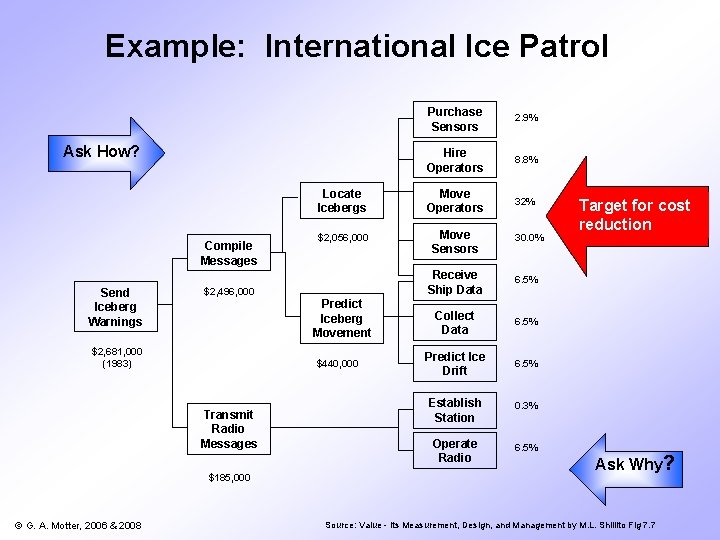
Example: International Ice Patrol Purchase Sensors 2. 9% Hire Operators 8. 8% Locate Icebergs Move Operators 32% $2, 056, 000 Move Sensors 30. 0% Receive Ship Data 6. 5% Collect Data 6. 5% Predict Ice Drift 6. 5% Establish Station 0. 3% Operate Radio 6. 5% Ask How? Compile Messages Send Iceberg Warnings $2, 496, 000 Predict Iceberg Movement $2, 681, 000 (1983) $440, 000 Transmit Radio Messages $185, 000 © G. A. Motter, 2006 & 2008 Target for cost reduction Ask Why? Source: Value - Its Measurement, Design, and Management by M. L. Shillito Fig 7. 7
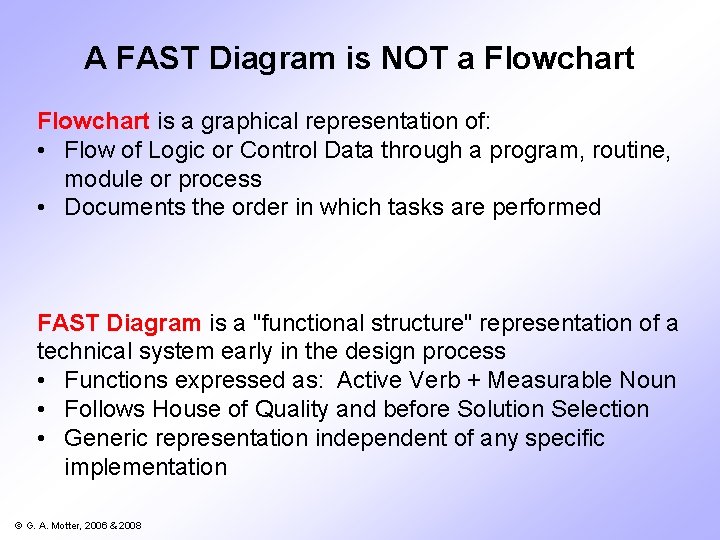
A FAST Diagram is NOT a Flowchart is a graphical representation of: • Flow of Logic or Control Data through a program, routine, module or process • Documents the order in which tasks are performed FAST Diagram is a "functional structure" representation of a technical system early in the design process • Functions expressed as: Active Verb + Measurable Noun • Follows House of Quality and before Solution Selection • Generic representation independent of any specific implementation © G. A. Motter, 2006 & 2008
Homework Assignment Objective • Develop a FAST Diagram for your ECE 480 Senior Design Project Instructions • Provide an Elevator Speech (few sentences describing your Project objectives) to orient me in grading this assignment • Follow Step-By-Step process in slides • Refer to examples and list of useful Verbs and Nouns in Slides and Appendix • Only diagram a maximum of 3 levels of Secondary Functions beyond Basic Function(s) Deliverables • Typed FAST Diagram in Word, Excel, or Power. Point from each Team • E-Mail Diagram to G. Motter at motter@MSU. edu and to Dr. Albrecht Due Date • One week from today © G. A. Motter, 2006 & 2008
Questions? © G. A. Motter, 2006 & 2008
Appendix: Classic Text Book Examples • Useful Verbs and Nouns • FAST Diagram Examples © G. A. Motter, 2006 & 2008
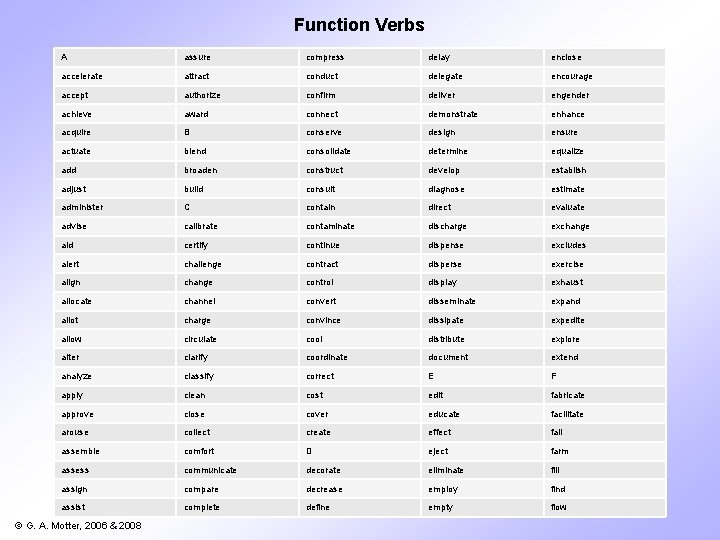
Function Verbs A assure compress delay enclose accelerate attract conduct delegate encourage accept authorize confirm deliver engender achieve award connect demonstrate enhance acquire B conserve design ensure actuate blend consolidate determine equalize add broaden construct develop establish adjust build consult diagnose estimate administer C contain direct evaluate advise calibrate contaminate discharge exchange aid certify continue dispense excludes alert challenge contract disperse exercise align change control display exhaust allocate channel convert disseminate expand allot charge convince dissipate expedite allow circulate cool distribute explore alter clarify coordinate document extend analyze classify correct E F apply clean cost edit fabricate approve close cover educate facilitate arouse collect create effect fail assemble comfort D eject farm assess communicate decorate eliminate fill assign compare decrease employ find assist complete define empty flow © G. A. Motter, 2006 & 2008
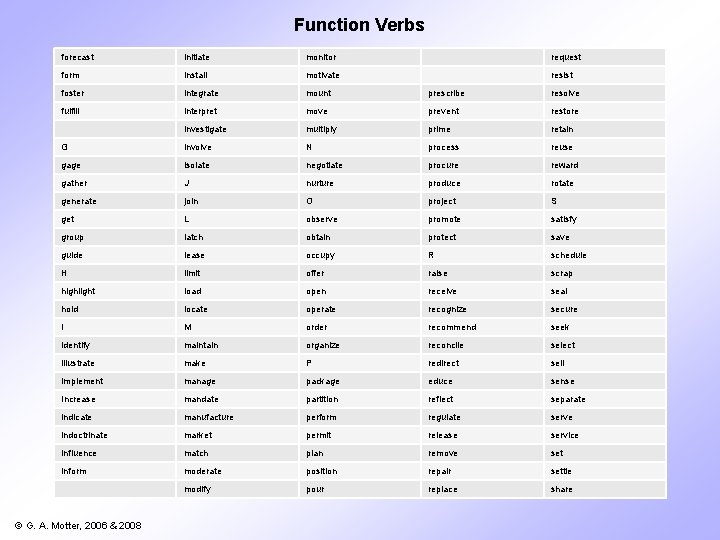
Function Verbs forecast initiate monitor request form install motivate resist foster integrate mount prescribe resolve fulfill interpret move prevent restore investigate multiply prime retain G involve N process reuse gage isolate negotiate procure reward gather J nurture produce rotate generate join O project S get L observe promote satisfy group latch obtain protect save guide lease occupy R schedule H limit offer raise scrap highlight load open receive seal hold locate operate recognize secure I M order recommend seek identify maintain organize reconcile select illustrate make P redirect sell implement manage package educe sense Increase mandate partition reflect separate indicate manufacture perform regulate serve indoctrinate market permit release service influence match plan remove set inform moderate position repair settle modify pour replace share © G. A. Motter, 2006 & 2008
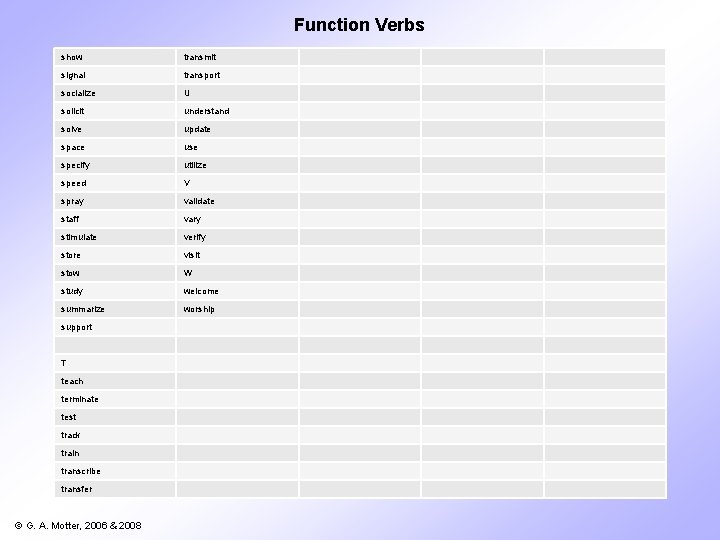
Function Verbs show transmit signal transport socialize U solicit understand solve update space use specify utilize speed V spray validate staff vary stimulate verify store visit stow W study welcome summarize worship support T teach terminate test track train transcribe transfer © G. A. Motter, 2006 & 2008
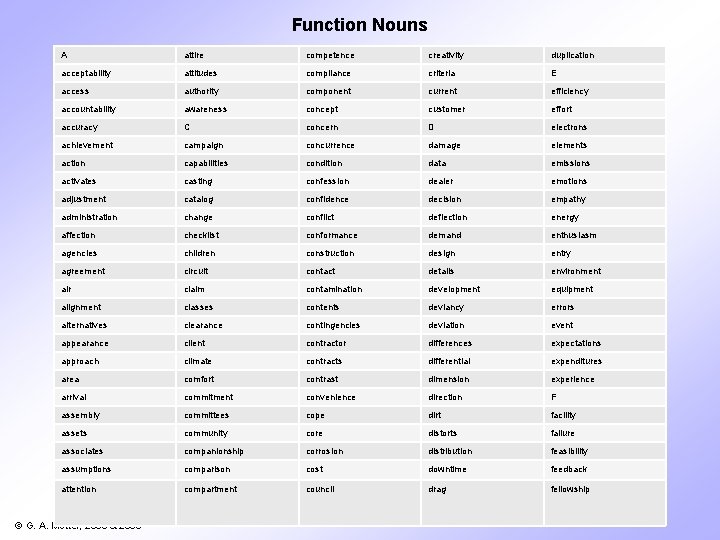
Function Nouns A attire competence creativity duplication acceptability attitudes compliance criteria E access authority component current efficiency accountability awareness concept customer effort accuracy C concern D electrons achievement campaign concurrence damage elements action capabilities condition data emissions activates casting confession dealer emotions adjustment catalog confidence decision empathy administration change conflict deflection energy affection checklist conformance demand enthusiasm agencies children construction design entry agreement circuit contact details environment air claim contamination development equipment alignment classes contents deviancy errors alternatives clearance contingencies deviation event appearance client contractor differences expectations approach climate contracts differential expenditures area comfort contrast dimension experience arrival commitment convenience direction F assembly committees cope dirt facility assets community core distorts failure associates companionship corrosion distribution feasibility assumptions comparison cost downtime feedback attention compartment council drag fellowship © G. A. Motter, 2006 & 2008
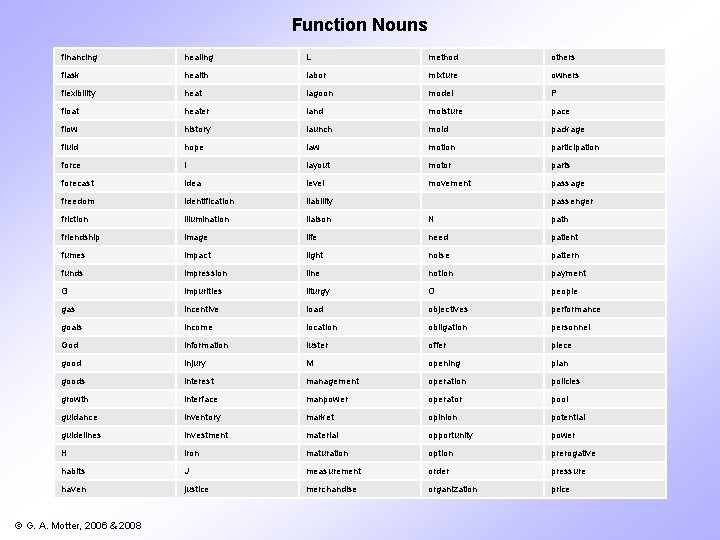
Function Nouns financing healing L method others flask health labor mixture owners flexibility heat lagoon model P float heater land moisture pace flow history launch mold package fluid hope law motion participation force I layout motor parts forecast idea level movement passage freedom identification liability friction illumination liaison N path friendship image life need patient fumes impact light noise pattern funds impression line notion payment G impurities liturgy O people gas incentive load objectives performance goals income location obligation personnel God information luster offer piece good injury M opening plan goods interest management operation policies growth interface manpower operator pool guidance inventory market opinion potential guidelines Investment material opportunity power H iron maturation option prerogative habits J measurement order pressure haven justice merchandise organization price © G. A. Motter, 2006 & 2008 passenger
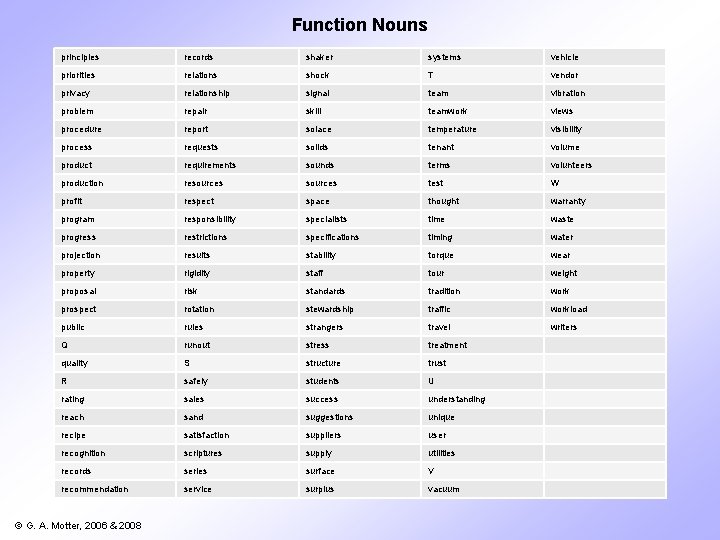
Function Nouns principles records shaker systems vehicle priorities relations shock T vendor privacy relationship signal team vibration problem repair skill teamwork views procedure report solace temperature visibility process requests solids tenant volume product requirements sounds terms volunteers production resources test W profit respect space thought warranty program responsibility specialists time waste progress restrictions specifications timing water projection results stability torque wear property rigidity staff tour weight proposal risk standards tradition work prospect rotation stewardship traffic workload public rules strangers travel writers Q runout stress treatment quality S structure trust R safely students U rating sales success understanding reach sand suggestions unique recipe satisfaction suppliers user recognition scriptures supply utilities records series surface V recommendation service surplus vacuum © G. A. Motter, 2006 & 2008
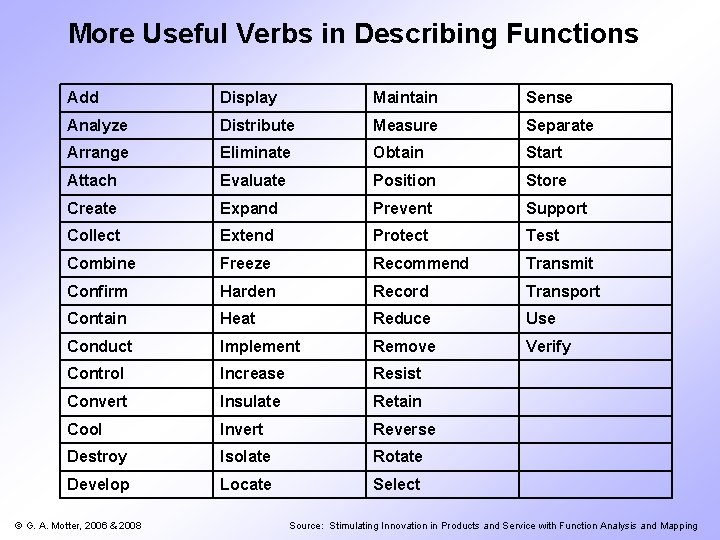
More Useful Verbs in Describing Functions Add Display Maintain Sense Analyze Distribute Measure Separate Arrange Eliminate Obtain Start Attach Evaluate Position Store Create Expand Prevent Support Collect Extend Protect Test Combine Freeze Recommend Transmit Confirm Harden Record Transport Contain Heat Reduce Use Conduct Implement Remove Verify Control Increase Resist Convert Insulate Retain Cool Invert Reverse Destroy Isolate Rotate Develop Locate Select © G. A. Motter, 2006 & 2008 Source: Stimulating Innovation in Products and Service with Function Analysis and Mapping
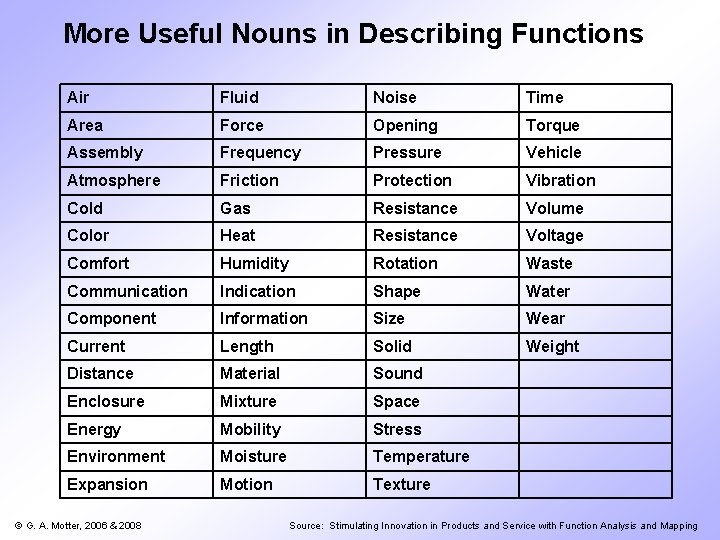
More Useful Nouns in Describing Functions Air Fluid Noise Time Area Force Opening Torque Assembly Frequency Pressure Vehicle Atmosphere Friction Protection Vibration Cold Gas Resistance Volume Color Heat Resistance Voltage Comfort Humidity Rotation Waste Communication Indication Shape Water Component Information Size Wear Current Length Solid Weight Distance Material Sound Enclosure Mixture Space Energy Mobility Stress Environment Moisture Temperature Expansion Motion Texture © G. A. Motter, 2006 & 2008 Source: Stimulating Innovation in Products and Service with Function Analysis and Mapping
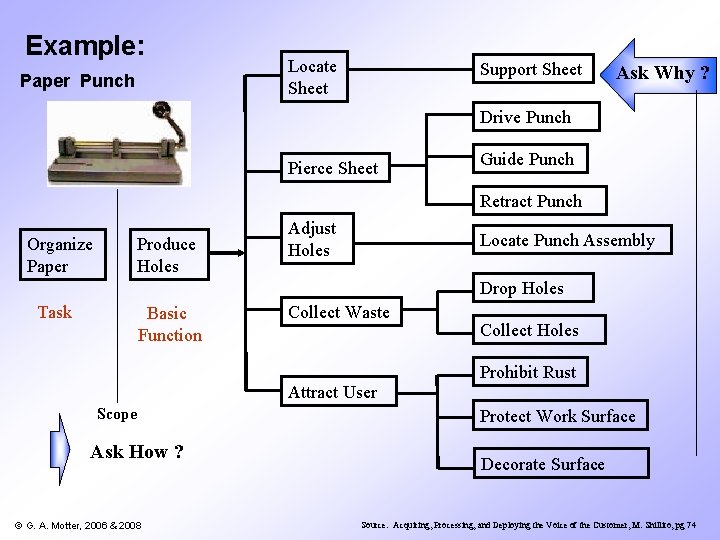
Example: Paper Punch Locate Sheet Support Sheet Ask Why ? Drive Punch Pierce Sheet Guide Punch Retract Punch Organize Paper Produce Holes Adjust Holes Locate Punch Assembly Drop Holes Task Basic Function Collect Waste Attract User Scope Ask How ? © G. A. Motter, 2006 & 2008 Collect Holes Prohibit Rust Protect Work Surface Decorate Surface Source: Acquiring, Processing, and Deploying the Voice of the Customer, M. Shillito, pg 74
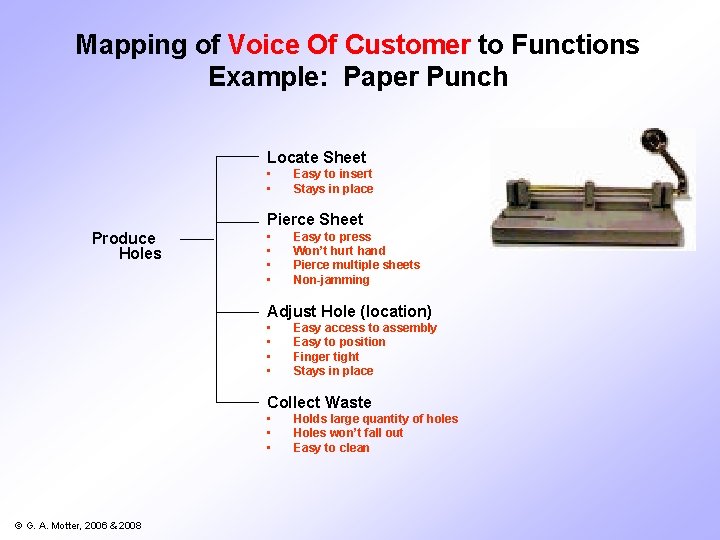
Mapping of Voice Of Customer to Functions Example: Paper Punch Locate Sheet • • Easy to insert Stays in place Pierce Sheet Produce Holes • • Easy to press Won’t hurt hand Pierce multiple sheets Non-jamming Adjust Hole (location) • • Easy access to assembly Easy to position Finger tight Stays in place Collect Waste • • • © G. A. Motter, 2006 & 2008 Holds large quantity of holes Holes won’t fall out Easy to clean
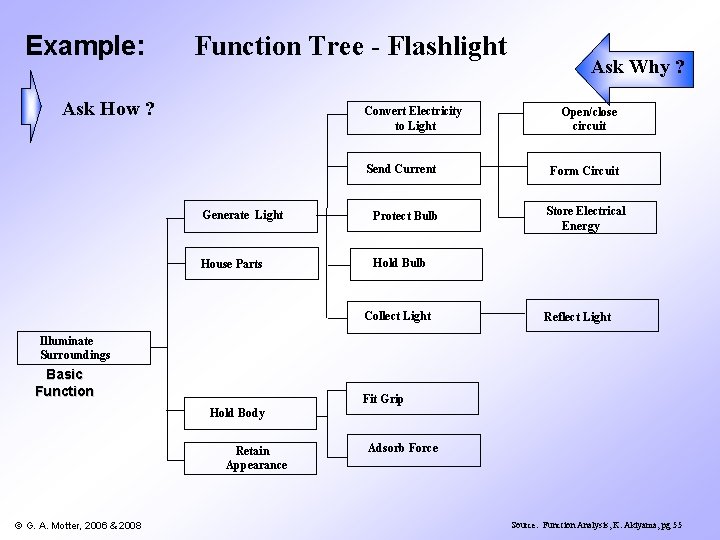
Example: Function Tree - Flashlight Ask How ? Convert Electricity to Light Send Current Generate Light Protect Bulb House Parts Hold Bulb Collect Light Ask Why ? Open/close circuit Form Circuit Store Electrical Energy Reflect Light Illuminate Surroundings Basic Function Fit Grip Hold Body Retain Appearance © G. A. Motter, 2006 & 2008 Adsorb Force Source: Function Analysis, K. Akiyama, pg 55
Appendix Past ECE 480 Project Examples © G. A. Motter, 2006 & 2008
Refrigerator Ice Level Detection © G. A. Motter, 2006 & 2008
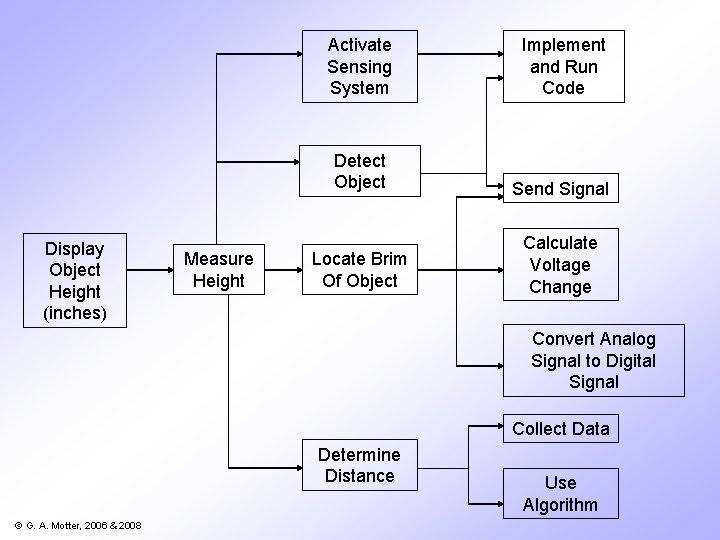
Display Object Height (inches) Measure Height Activate Sensing System Implement and Run Code Detect Object Send Signal Locate Brim Of Object Calculate Voltage Change Convert Analog Signal to Digital Signal Collect Data Determine Distance © G. A. Motter, 2006 & 2008 Use Algorithm
© G. A. Motter, 2006 & 2008

ECE 480 Active EMI Filter © Motter, 2006 &2006 2008 & 2008 © G. G. A. A. Motter,
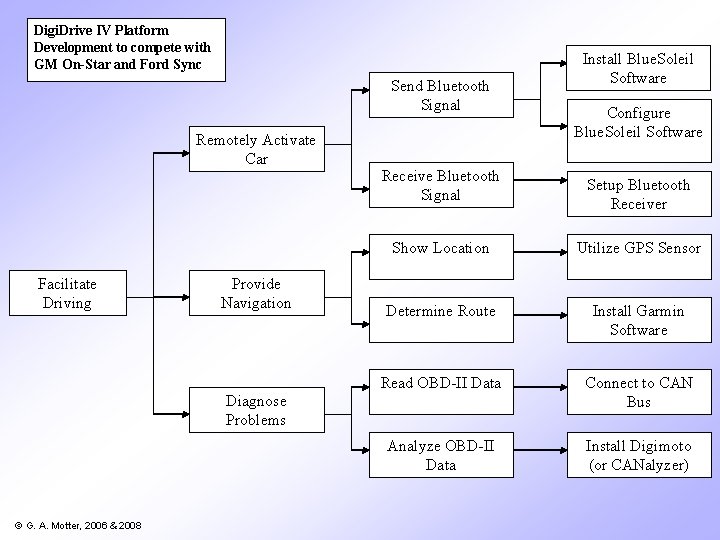
Digi. Drive IV Platform Development to compete with GM On-Star and Ford Sync Send Bluetooth Signal Remotely Activate Car Facilitate Driving Provide Navigation Receive Bluetooth Signal Configure Blue. Soleil Software Setup Bluetooth Receiver Show Location Utilize GPS Sensor Determine Route Install Garmin Software Read OBD-II Data Connect to CAN Bus Analyze OBD-II Data Install Digimoto (or CANalyzer) Diagnose Problems © G. A. Motter, 2006 & 2008 Install Blue. Soleil Software
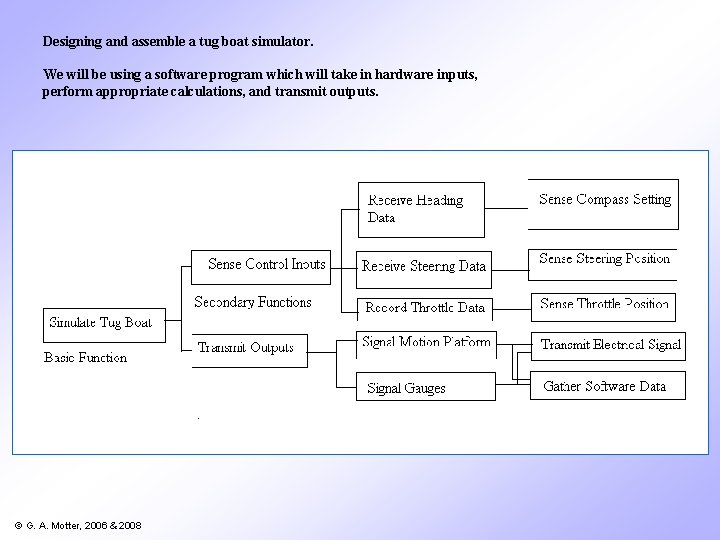
Designing and assemble a tug boat simulator. We will be using a software program which will take in hardware inputs, perform appropriate calculations, and transmit outputs. © G. A. Motter, 2006 & 2008
Detecting an audio signal of a siren external to a vehicle and warning the driver of the proximal emergency vehicle. © G. A. Motter, 2006 & 2008
- Slides: 49