
Fun With Summations Computer Science Department University of



- Slides: 33
Fun With Summations Computer Science Department University of Central Florida COP 3502 – Computer Science I
Announcement n Summation Homework n There is a NEW, albeit small, homework assignment n n It is on the course website under “Assignments” Purpose: force you to practice summations Why? n n n © Jonathan Cazalas Many reasons Including the FACT that they will be on Exam 1! Due date: IN CLASS, on Wednesday n n Just summation problems to work out (meaning in two days, on 2/15) Exam is Friday! Start studying now! Fun With Summations page 2
Summations n Is this a Math class? n Why do we study summations? n In order to effectively approximate algorithms, n we NEED mathematical tools n n So for iterative algorithms n n We use summations as the tool (discussed today) For recursive algorithms, this doesn’t work n n © Jonathan Cazalas It is not always as simply as doing a 4 second examination of a for loop and deciphering the Big-O time We need yet another tool Recurrence relations (coming after the exam) Fun With Summations page 3
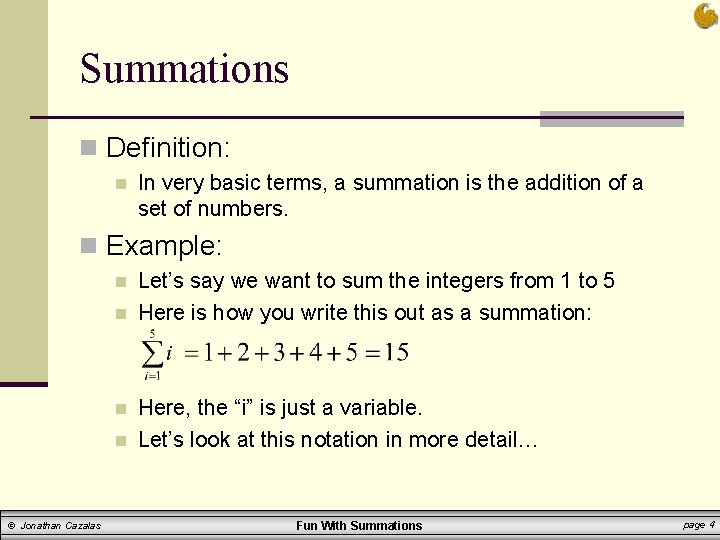
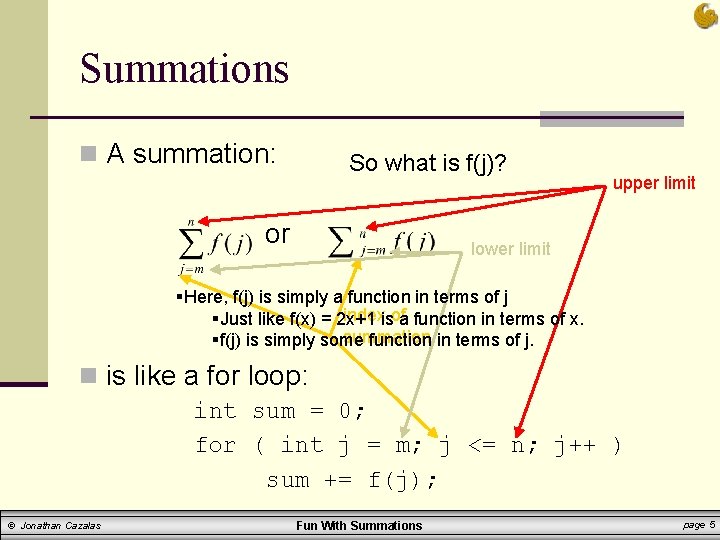
Summations n Definition: n In very basic terms, a summation is the addition of a set of numbers. n Example: n n © Jonathan Cazalas Let’s say we want to sum the integers from 1 to 5 Here is how you write this out as a summation: Here, the “i” is just a variable. Let’s look at this notation in more detail… Fun With Summations page 4
Summations n A summation: So what is f(j)? or upper limit lower limit §Here, f(j) is simply a function in terms of j indexisofa function in terms of x. §Just like f(x) = 2 x+1 summation §f(j) is simply some function in terms of j. n is like a for loop: int sum = 0; for ( int j = m; j <= n; j++ ) sum += f(j); © Jonathan Cazalas Fun With Summations page 5
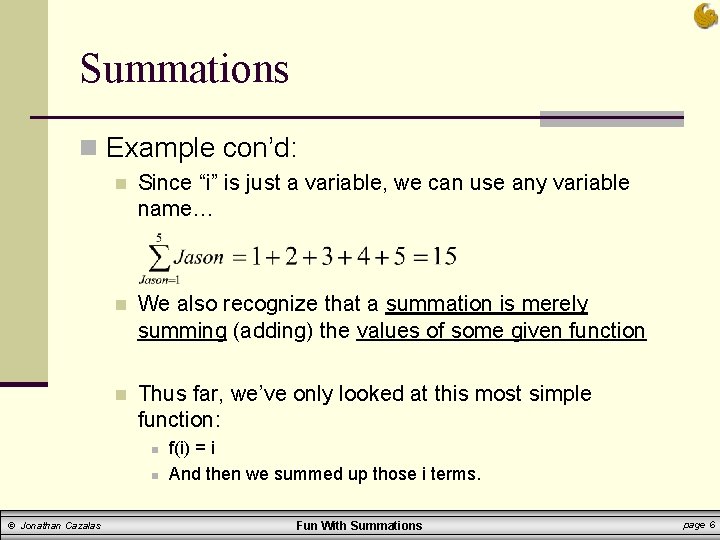
Summations n Example con’d: n Since “i” is just a variable, we can use any variable name… n We also recognize that a summation is merely summing (adding) the values of some given function n Thus far, we’ve only looked at this most simple function: n n © Jonathan Cazalas f(i) = i And then we summed up those i terms. Fun With Summations page 6
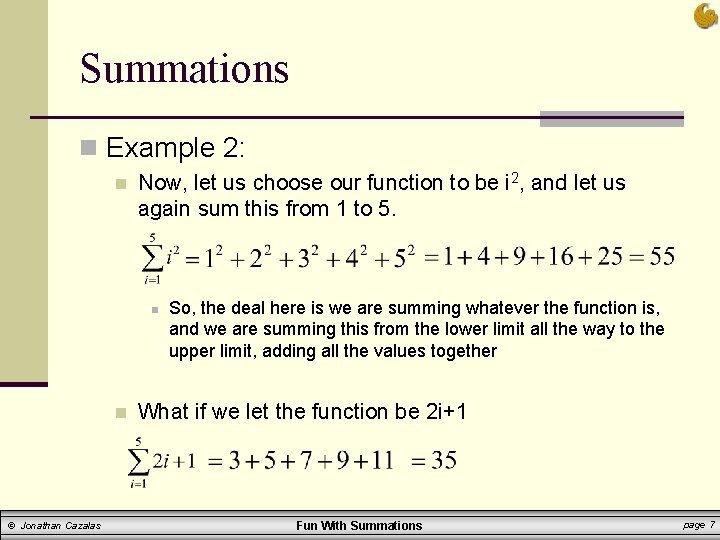
Summations n Example 2: n Now, let us choose our function to be i 2, and let us again sum this from 1 to 5. n n © Jonathan Cazalas So, the deal here is we are summing whatever the function is, and we are summing this from the lower limit all the way to the upper limit, adding all the values together What if we let the function be 2 i+1 Fun With Summations page 7
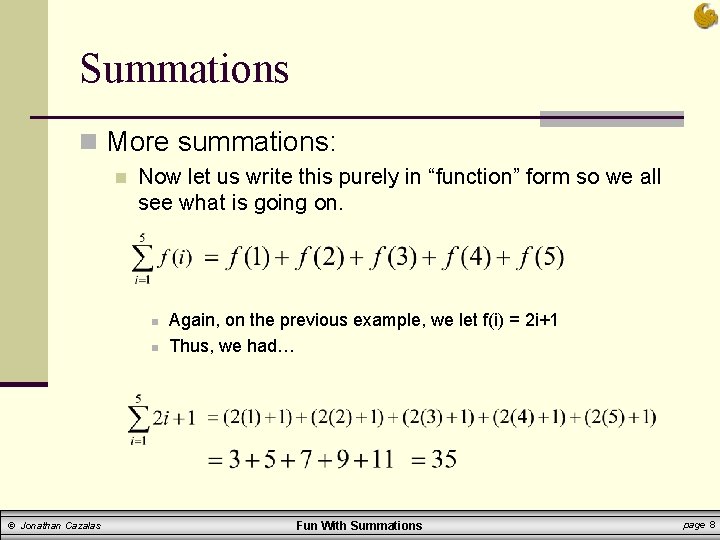
Summations n More summations: n Now let us write this purely in “function” form so we all see what is going on. n n © Jonathan Cazalas Again, on the previous example, we let f(i) = 2 i+1 Thus, we had… Fun With Summations page 8
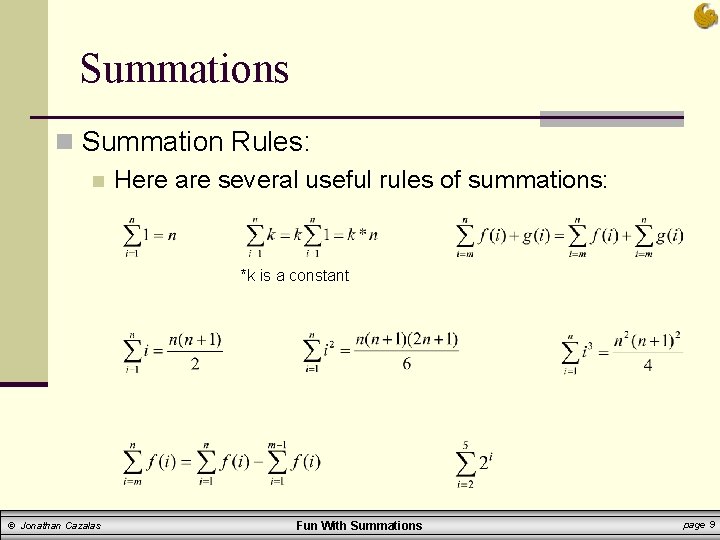
Summations n Summation Rules: n Here are several useful rules of summations: *k is a constant © Jonathan Cazalas Fun With Summations page 9
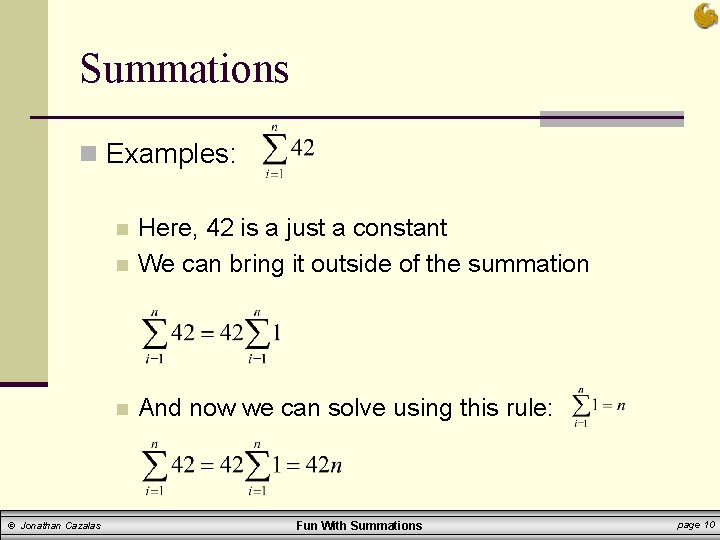
Summations n Examples: n Here, 42 is a just a constant We can bring it outside of the summation n And now we can solve using this rule: n © Jonathan Cazalas Fun With Summations page 10
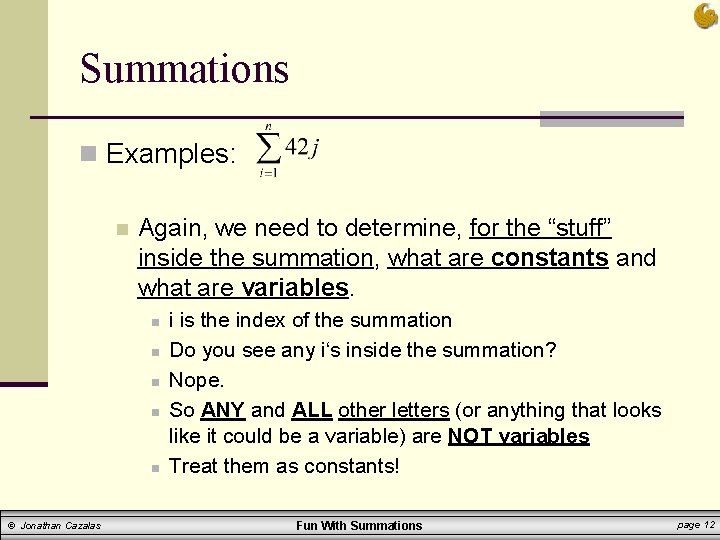
Summations n Examples: n Again, we need to determine, for the “stuff” inside the summation, what are constants and what are variables. n n n © Jonathan Cazalas We know 42 is a constant. What about j? j is also a constant! Why? The only time that letters (inside the summation) count as variables are when they are the EXACT SAME letter as the index of the summation Fun With Summations page 11
Summations n Examples: n Again, we need to determine, for the “stuff” inside the summation, what are constants and what are variables. n n n © Jonathan Cazalas i is the index of the summation Do you see any i‘s inside the summation? Nope. So ANY and ALL other letters (or anything that looks like it could be a variable) are NOT variables Treat them as constants! Fun With Summations page 12
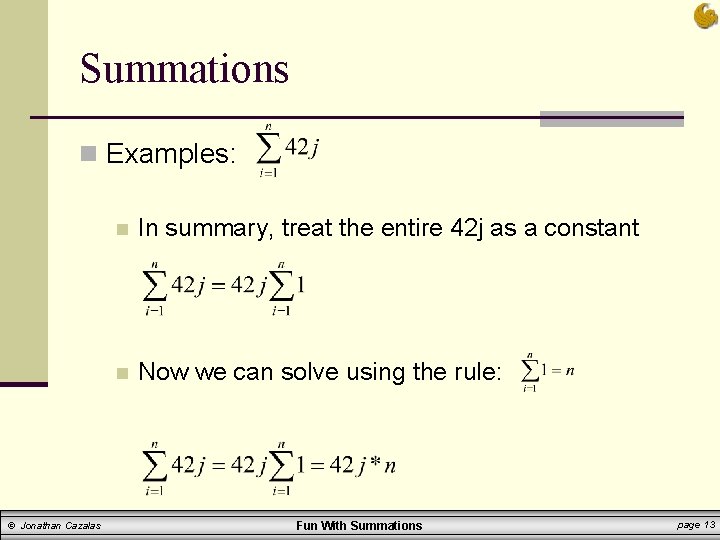
Summations n Examples: © Jonathan Cazalas n In summary, treat the entire 42 j as a constant n Now we can solve using the rule: Fun With Summations page 13
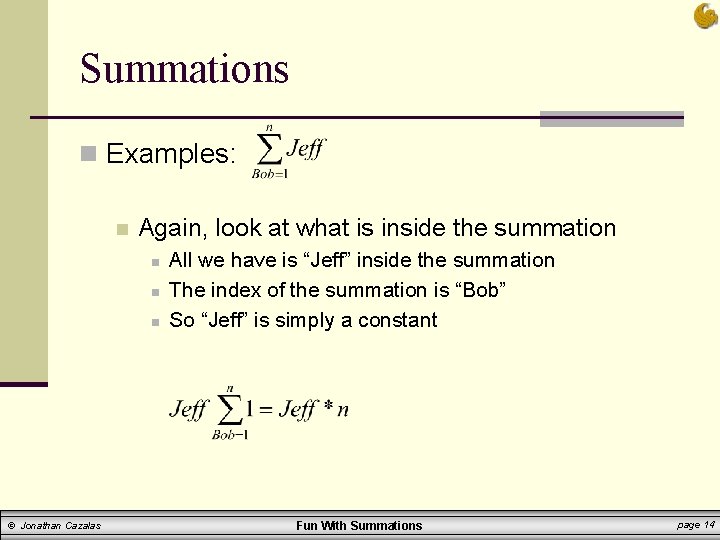
Summations n Examples: n Again, look at what is inside the summation n © Jonathan Cazalas All we have is “Jeff” inside the summation The index of the summation is “Bob” So “Jeff” is simply a constant Fun With Summations page 14
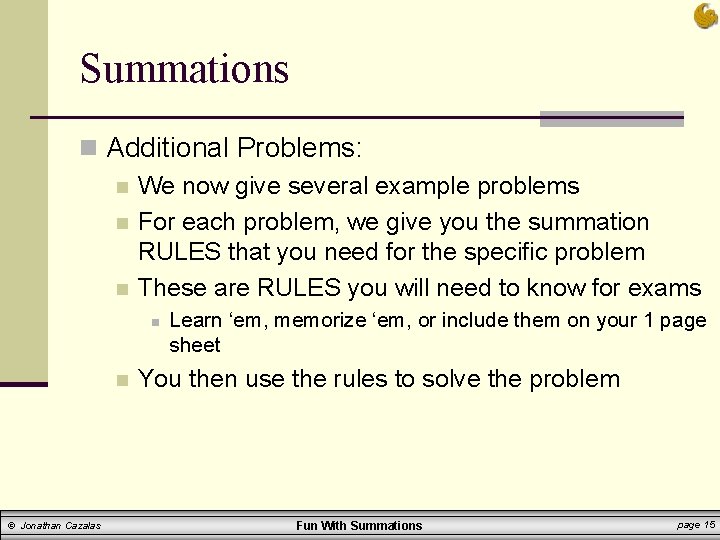
Summations n Additional Problems: n We now give several example problems n For each problem, we give you the summation RULES that you need for the specific problem n These are RULES you will need to know for exams n n © Jonathan Cazalas Learn ‘em, memorize ‘em, or include them on your 1 page sheet You then use the rules to solve the problem Fun With Summations page 15
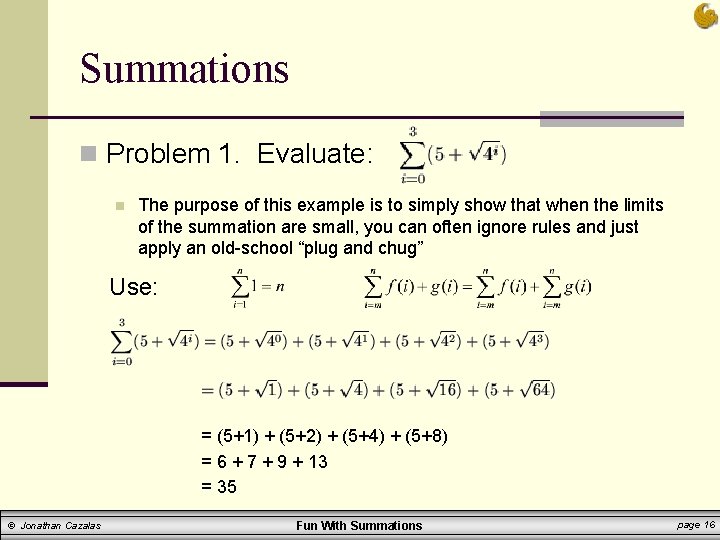
Summations n Problem 1. Evaluate: n The purpose of this example is to simply show that when the limits of the summation are small, you can often ignore rules and just apply an old-school “plug and chug” Use: = (5+1) + (5+2) + (5+4) + (5+8) = 6 + 7 + 9 + 13 = 35 © Jonathan Cazalas Fun With Summations page 16
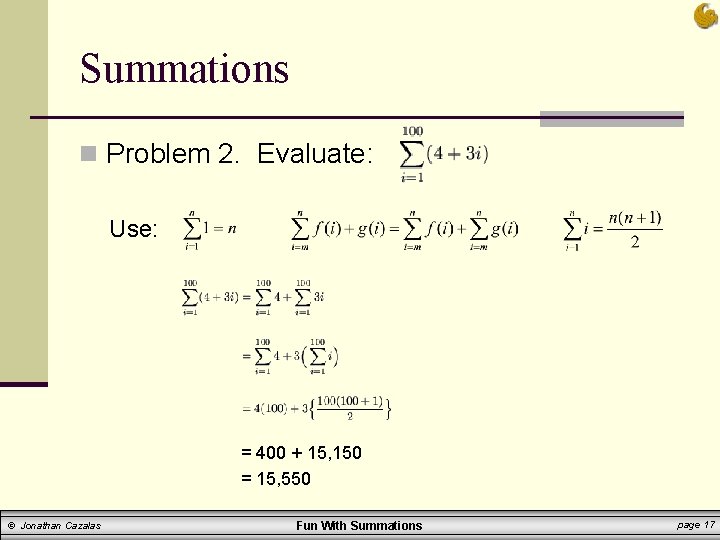
Summations n Problem 2. Evaluate: Use: = 400 + 15, 150 = 15, 550 © Jonathan Cazalas Fun With Summations page 17
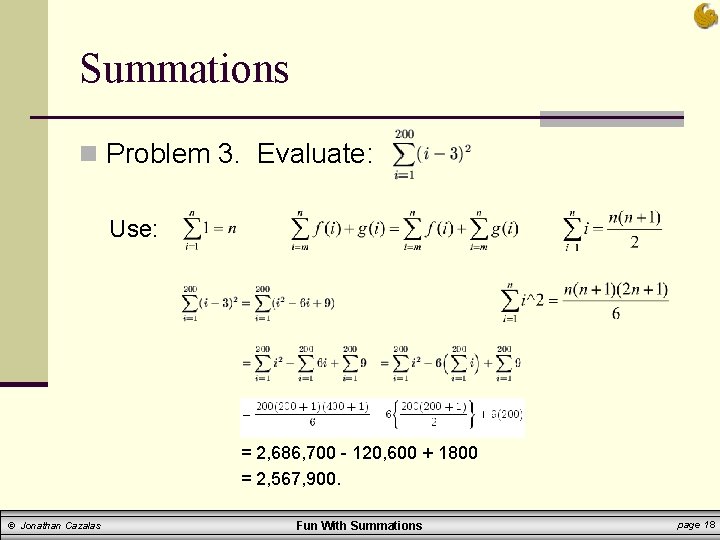
Summations n Problem 3. Evaluate: Use: = 2, 686, 700 - 120, 600 + 1800 = 2, 567, 900. © Jonathan Cazalas Fun With Summations page 18
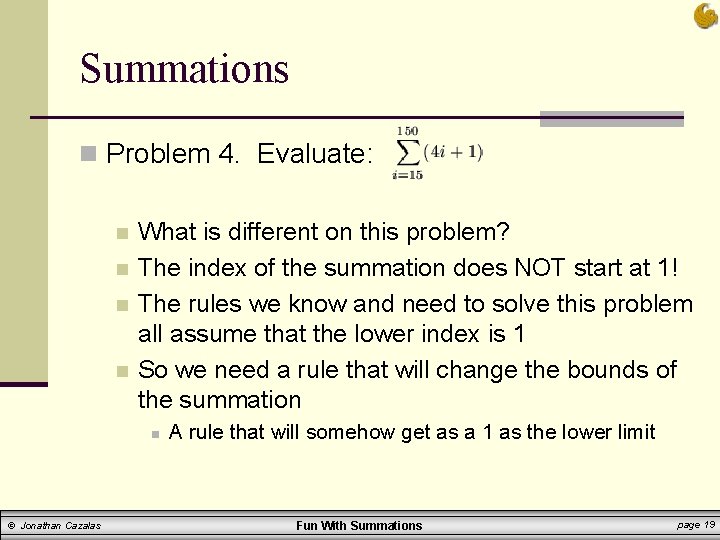
Summations n Problem 4. Evaluate: n n What is different on this problem? The index of the summation does NOT start at 1! The rules we know and need to solve this problem all assume that the lower index is 1 So we need a rule that will change the bounds of the summation n © Jonathan Cazalas A rule that will somehow get as a 1 as the lower limit Fun With Summations page 19
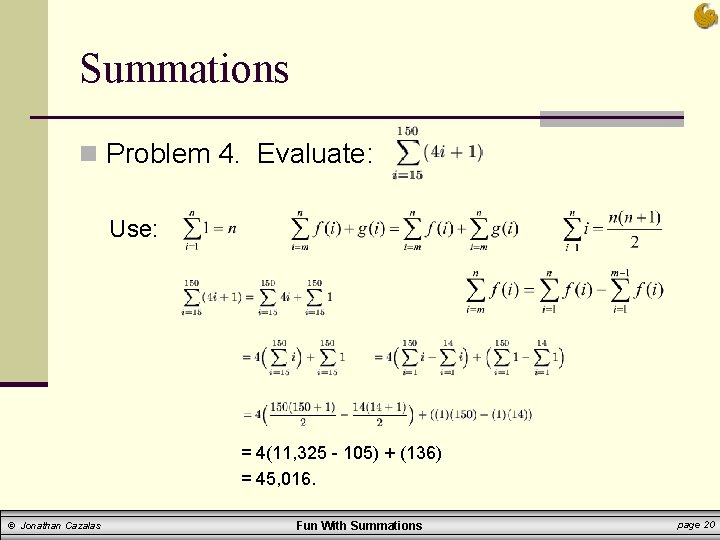
Summations n Problem 4. Evaluate: Use: = 4(11, 325 - 105) + (136) = 45, 016. © Jonathan Cazalas Fun With Summations page 20
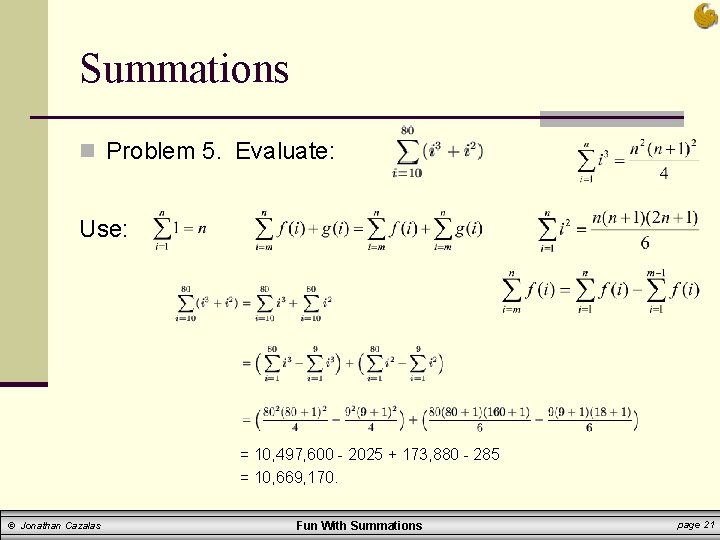
Summations n Problem 5. Evaluate: Use: = 10, 497, 600 - 2025 + 173, 880 - 285 = 10, 669, 170. © Jonathan Cazalas Fun With Summations page 21
Brief Interlude: Human Stupidity © Jonathan Cazalas Fun With Summations page 22
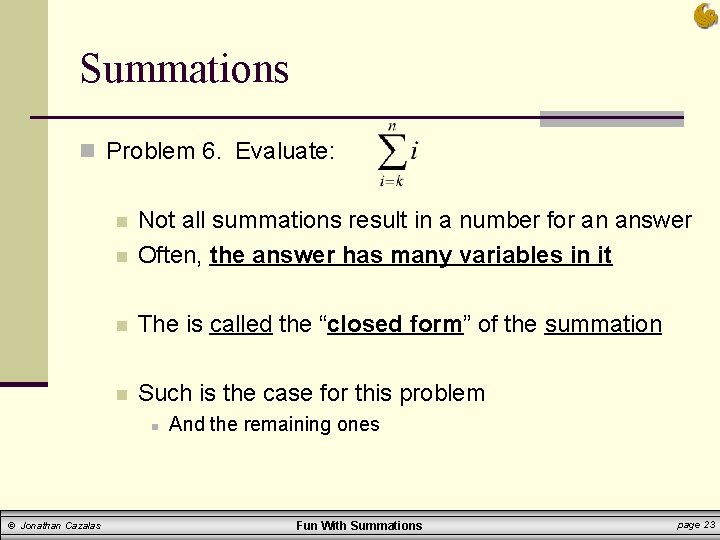
Summations n Problem 6. Evaluate: n Not all summations result in a number for an answer Often, the answer has many variables in it n The is called the “closed form” of the summation n Such is the case for this problem n n © Jonathan Cazalas And the remaining ones Fun With Summations page 23
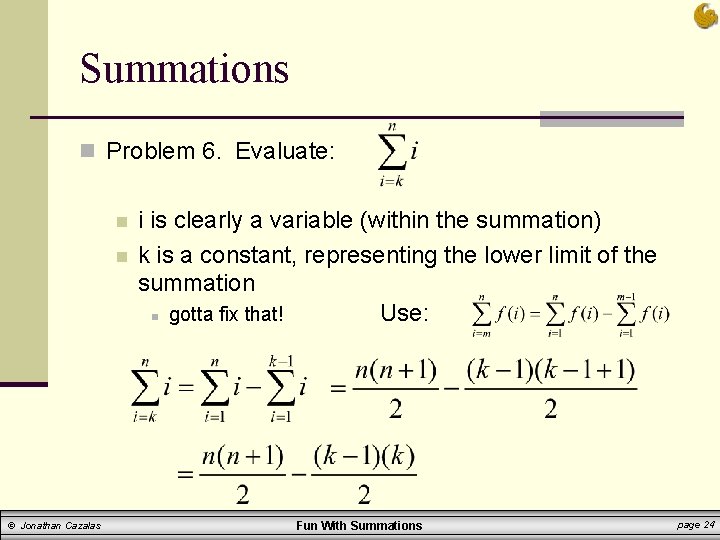
Summations n Problem 6. Evaluate: n n © Jonathan Cazalas i is clearly a variable (within the summation) k is a constant, representing the lower limit of the summation Use: n gotta fix that! Fun With Summations page 24
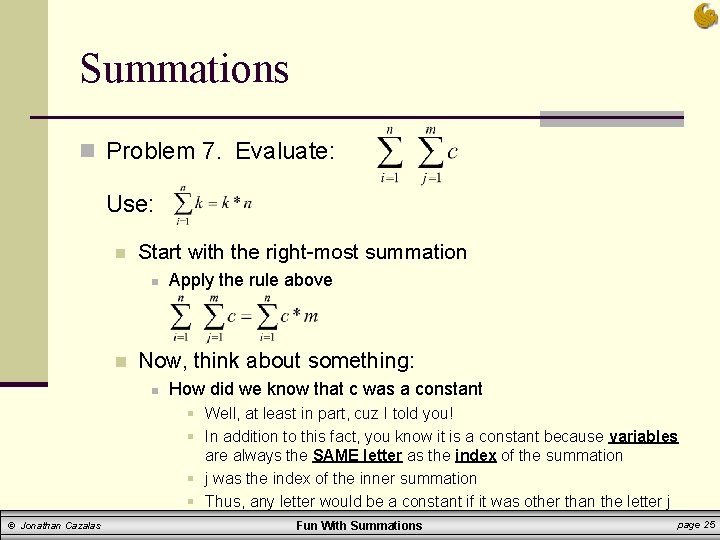
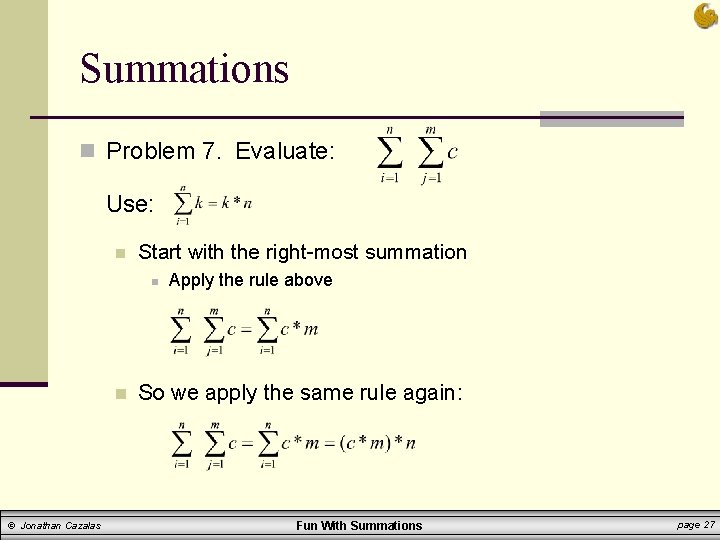
Summations n Problem 7. Evaluate: Use: n Start with the right-most summation n n Apply the rule above Now, think about something: n How did we know that c was a constant § Well, at least in part, cuz I told you! § In addition to this fact, you know it is a constant because variables are always the SAME letter as the index of the summation § j was the index of the inner summation § Thus, any letter would be a constant if it was other than the letter j © Jonathan Cazalas Fun With Summations page 25
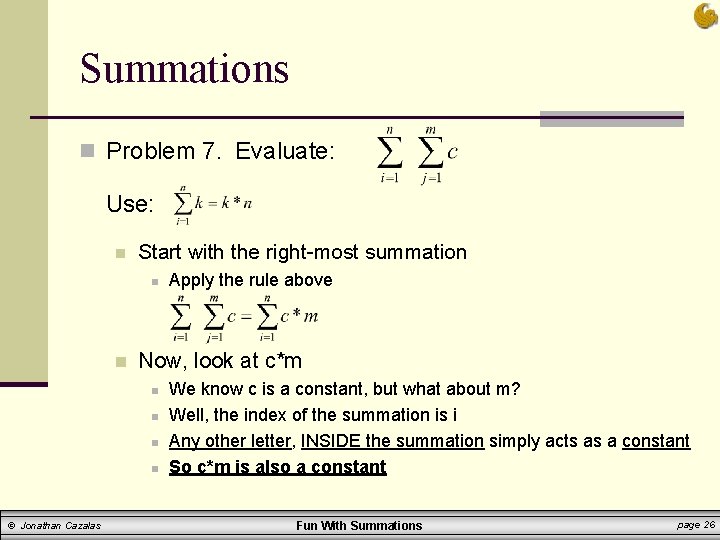
Summations n Problem 7. Evaluate: Use: n Start with the right-most summation n n Now, look at c*m n n © Jonathan Cazalas Apply the rule above We know c is a constant, but what about m? Well, the index of the summation is i Any other letter, INSIDE the summation simply acts as a constant So c*m is also a constant Fun With Summations page 26
Summations n Problem 7. Evaluate: Use: n Start with the right-most summation n n © Jonathan Cazalas Apply the rule above So we apply the same rule again: Fun With Summations page 27
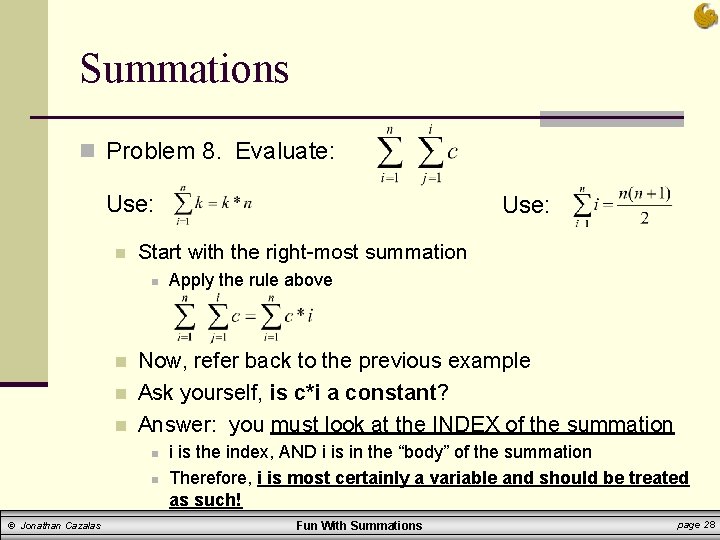
Summations n Problem 8. Evaluate: Use: n Start with the right-most summation n n Apply the rule above Now, refer back to the previous example Ask yourself, is c*i a constant? Answer: you must look at the INDEX of the summation n n © Jonathan Cazalas Use: i is the index, AND i is in the “body” of the summation Therefore, i is most certainly a variable and should be treated as such! Fun With Summations page 28
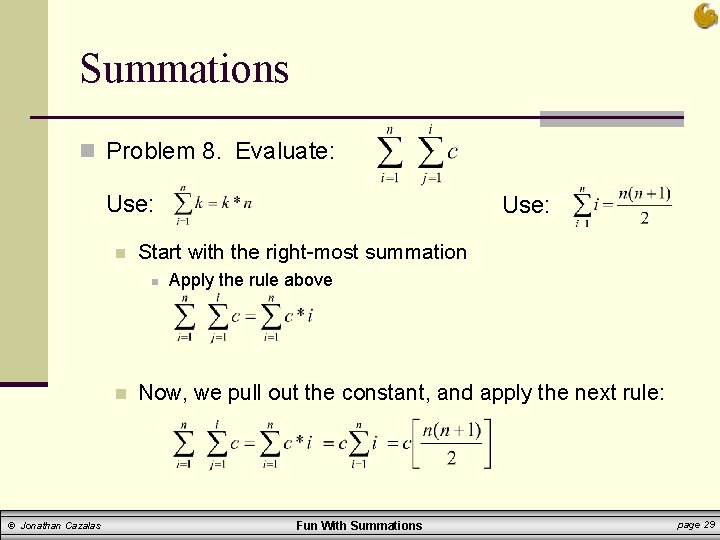
Summations n Problem 8. Evaluate: Use: n Start with the right-most summation n n © Jonathan Cazalas Use: Apply the rule above Now, we pull out the constant, and apply the next rule: Fun With Summations page 29
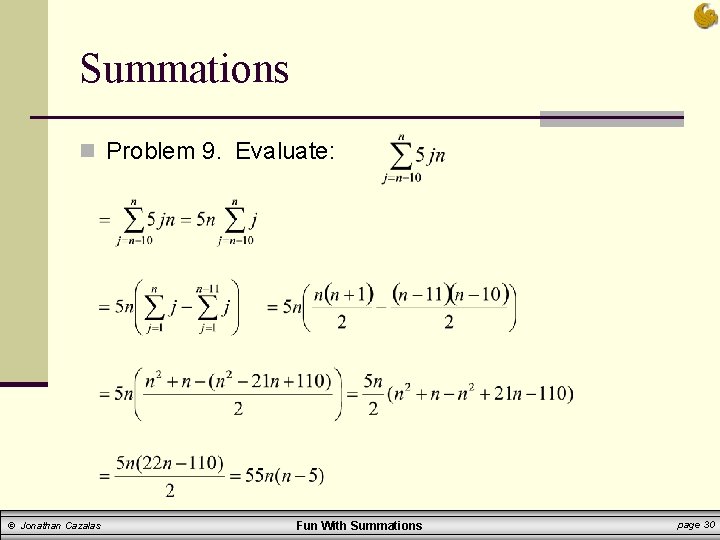
Summations n Problem 9. Evaluate: © Jonathan Cazalas Fun With Summations page 30
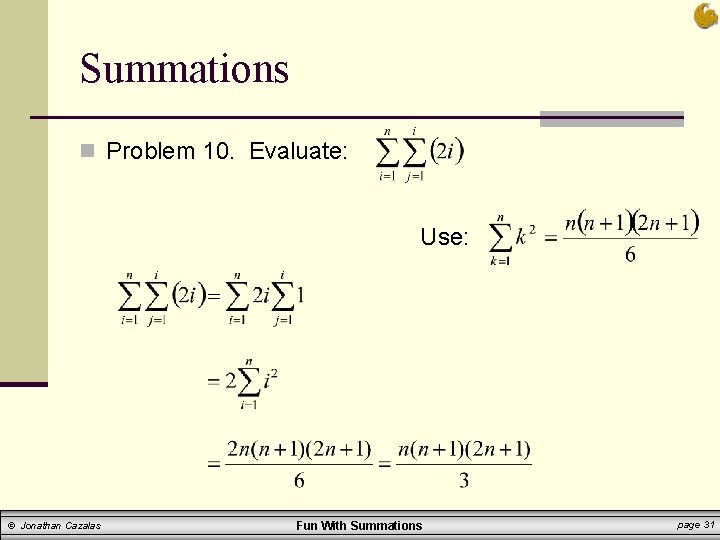
Summations n Problem 10. Evaluate: Use: © Jonathan Cazalas Fun With Summations page 31
Daily Demotivator © Jonathan Cazalas Fun With Summations page 32
Fun With Summations Computer Science Department University of Central Florida COP 3502 – Computer Science I