
Fun facts Skeleton is the bony framework of
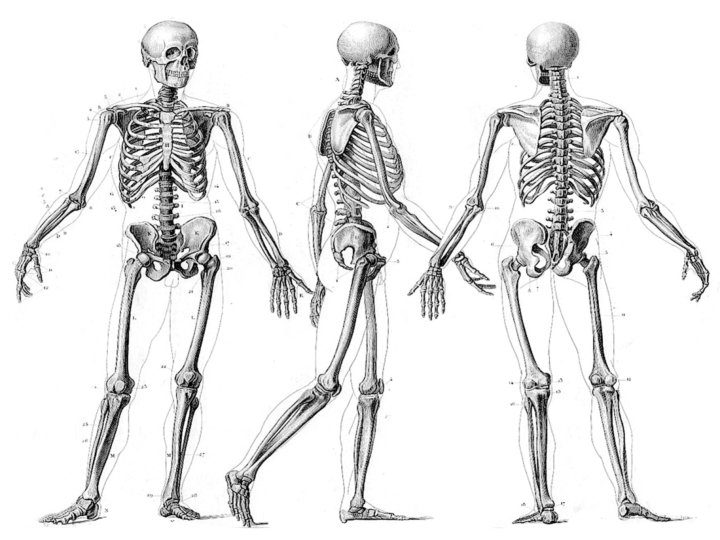
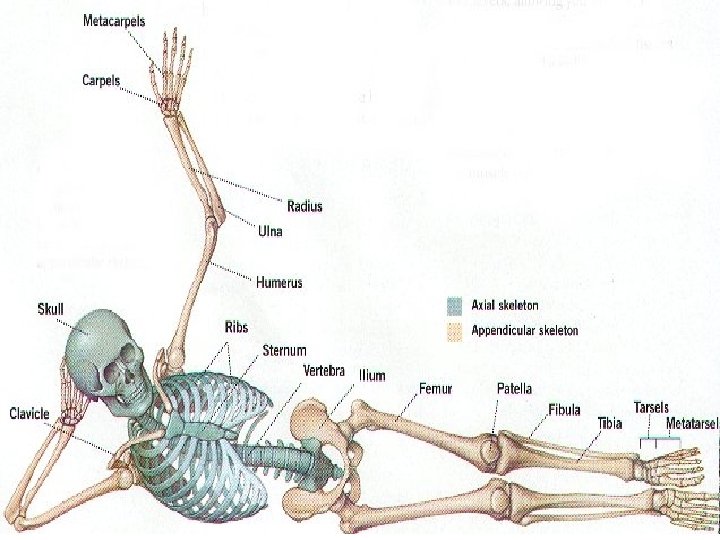
Fun facts! • Skeleton is the bony framework of the body • 206 bones in an adult • Four Functions: – Support structure and shape – Protect vital organs – Movement and anchorage of the muscles • Tendons • Ligaments – Mineral storage, calcium and phosphorus – Blood cell formation, hematopoiesis

Bone Composition • Collagen-chief organic constituent (protein) • Inorganic calcium salts • Cells – Osteoblasts – Osteocytes – Osteoclast • Periosteum

Bone Classification
Bone Classification (cont. ) • • • Long Short Flat Irregular Sesamoid
Bone Formation https: //www. youtube. com/watch? v=-hlip 8 ag. QIA 1. Initially collagen fibers secreted by fibroblasts 2. Cartilage deposited between the fibers 3. Skeleton is fully formed by second month of development (all cartilage) 4. After the eighth week of fetal development, ossification begins 5. Childhood and adolescence-ossification exceeds bone loss 6. Early adulthood through middle age-ossification equals bone loss 7. After 35, bone loss exceeds ossification
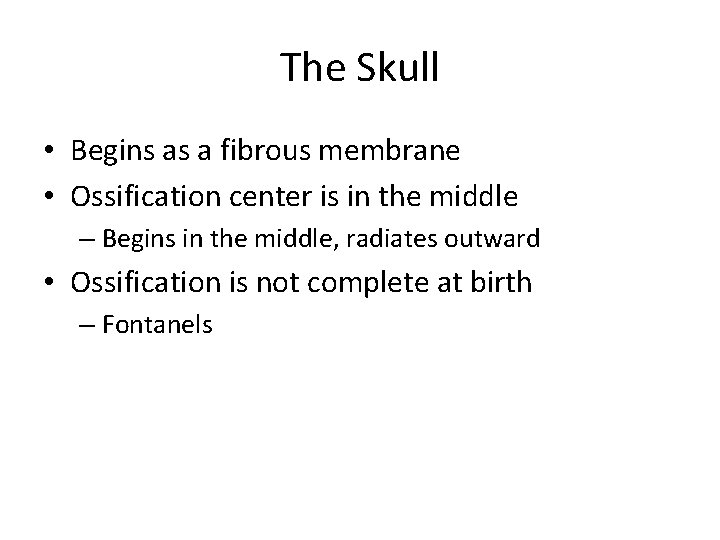
The Skull • Begins as a fibrous membrane • Ossification center is in the middle – Begins in the middle, radiates outward • Ossification is not complete at birth – Fontanels
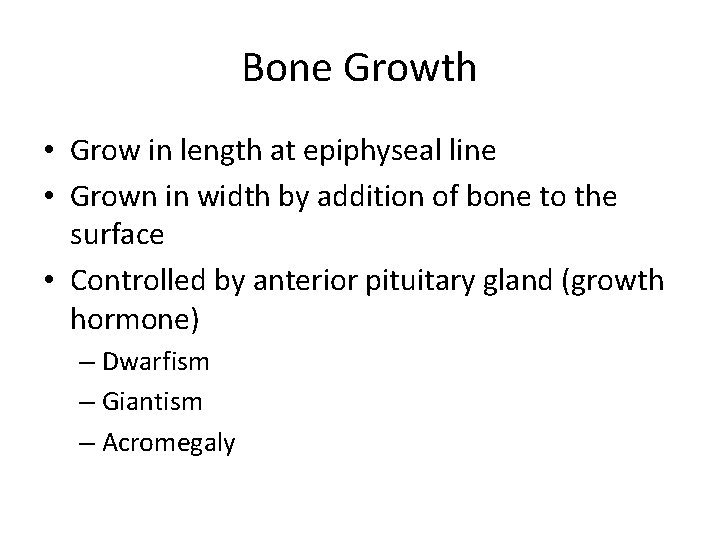
Bone Growth • Grow in length at epiphyseal line • Grown in width by addition of bone to the surface • Controlled by anterior pituitary gland (growth hormone) – Dwarfism – Giantism – Acromegaly
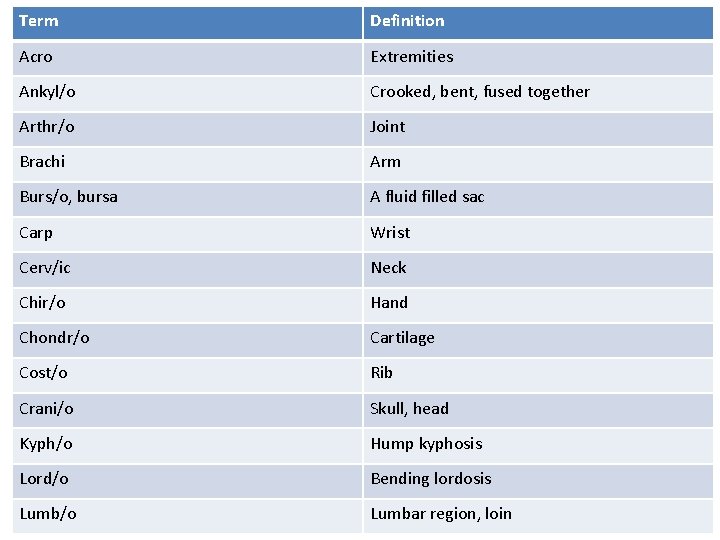
Term Definition Acro Extremities Ankyl/o Crooked, bent, fused together Arthr/o Joint Brachi Arm Burs/o, bursa A fluid filled sac Carp Wrist Cerv/ic Neck Chir/o Hand Chondr/o Cartilage Cost/o Rib Crani/o Skull, head Kyph/o Hump kyphosis Lord/o Bending lordosis Lumb/o Lumbar region, loin
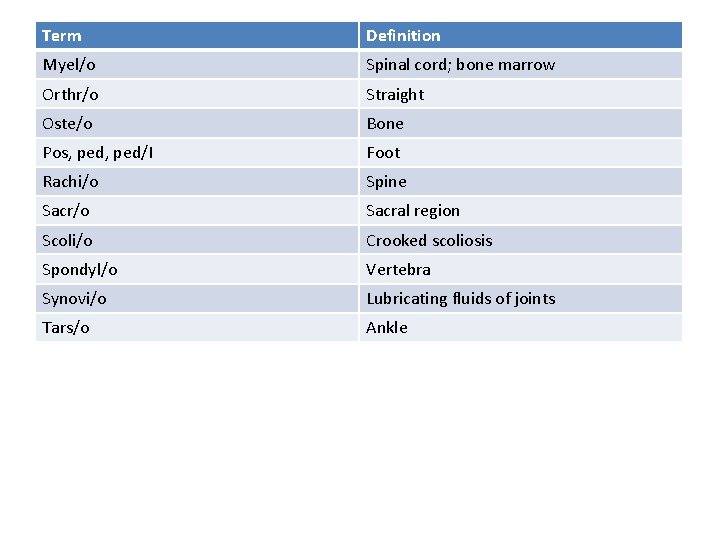
Term Definition Myel/o Spinal cord; bone marrow Orthr/o Straight Oste/o Bone Pos, ped/I Foot Rachi/o Spine Sacr/o Sacral region Scoli/o Crooked scoliosis Spondyl/o Vertebra Synovi/o Lubricating fluids of joints Tars/o Ankle
Bone Markings • Join one bone to another • Provide surface of attachment for muscles • Create an opening for the passage of blood vessels and nerves • Used as landmarks

Bone Markings (examples) • Process-bony prominence • Condyle-rounded, bucklelike prominence usually at a point of articulation • Epicondyle-small projection • Head-rounded, articulating process at the end of a bone • Spine-sharp, slender projection • Tubercle-small, rounded process

Bone Markings (cont. ) • Tuberosity-large, rounded process • Trochanter-large process for muscle attachment • Fossa-depression or hollow • Foramen-a hole • Crest-a sharp ridge

Bone Markings (cont. ) • Line-ridge of bone that is less prominent than a crest • Meatus-tube-like passage • Sinus/antrum-cavity within a bone • Depression-hollow region or opening • Fissure-narrow, slit-like opening • Sulcus-a groove • Facet-small area on a bone
Bone Marrow • Yellow marrow – Medullary cavity of long bone – Fat storage • Red marrow-hematopoietic tissue – In children-all cancellous bone – In adults-cancellous bone of the vertebrae, hips, sternum, ribs, cranial bones, proximal ends of femur, humerus – Forms RBCs, platelets, some WBCs; destroys some old RBCs and some foreign material
- Slides: 21