
Fun Facts about the Fibonacci Sequence v Before
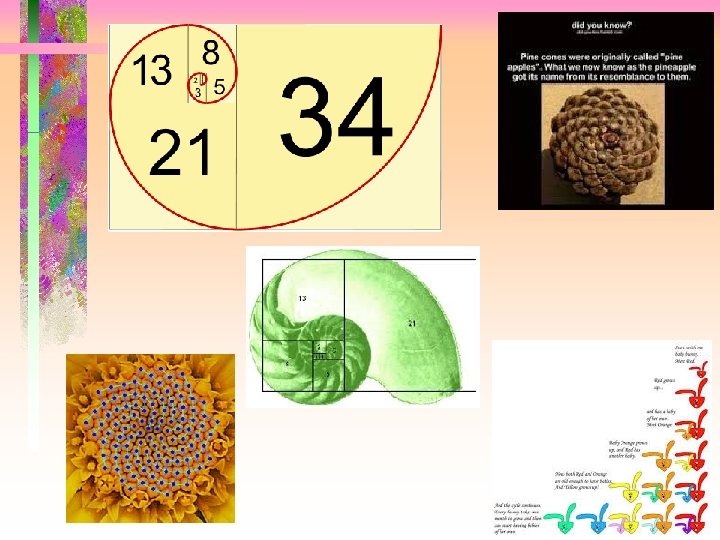
Fun Facts about the Fibonacci Sequence v Before the Fibonacci Sequence was known in Europe, it was used in ancient India for the metrical sciences, also known as prosody (the study of poetic meter). v If you divide a Fibonacci number by the number before it, (as n approaches infinity) the ratios produced settle into what is known as the Golden Ratio or the Golden Number (approximately 1. 618034). v It was used by Fibonacci to illustrate an idealization of rabbit population growth. It has also been applied to cow population and honey bee populations. v - Two consecutive Fibonacci numbers have been found in tree branches, the number of leaves on a stem, the structure of pineapples and artichokes, etc. v Sometimes the Fibonacci numbers are called pine cone numbers because of their application to the structure of pine cones. v If you construct a set of rectangles in a spiral formation using Fibonacci numbers as unit lengths, the resulting spiral is very similar to the spirals on snail and other shells. v The Fibonacci Sequence has been used in the visual arts because it is believed to produce aesthetically appealing images. One of the most famous artists (and mathematicians!) who used the Fibonacci Sequence in his art is Leonardo da Vinci. v It has also been used in music, most notably by Mozart.

Investigating Sequences and Series
Arithmetic Sequences
Arithmetic Sequences Every day a radio station asks a question for a prize of $150. If the 5 th caller does not answer correctly, the prize money increased by $150 each day until someone correctly answers their question.
Arithmetic Sequences Make a list of the prize amounts for a week (Mon - Fri) if the contest starts on Monday and no one answers correctly all week.
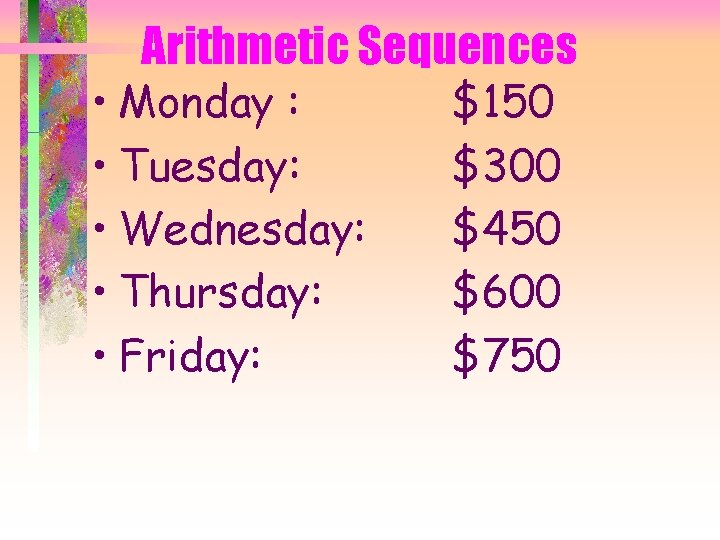
Arithmetic Sequences • Monday : • Tuesday: • Wednesday: • Thursday: • Friday: $150 $300 $450 $600 $750
Arithmetic Sequences • These prize amounts form a sequence, more specifically each amount is a term in an arithmetic sequence. To find the next term we just add $150.
Definitions • Sequence: a list of numbers in a specific order. • Term: each number in a sequence
Definitions • Arithmetic Sequence: a sequence in which each term after the first term is found by adding a constant, called the common difference (d), to the previous term.
Explanations • 150, 300, 450, 600, 750… • The first term of our sequence is 150, we denote the first term as a 1. • What is a 2? • a 2 : 300 (a 2 represents the 2 nd term in our sequence)
Explanations • a 3 = ? a 4 = ? • a 3 : 450 a 4 : 600 a 5 = ? a 5 : 750 • an represents a general term (nth term) where n can be any number.
Explanations • Sequences can continue forever. We can calculate as many terms as we want as long as we know the common difference in the sequence.
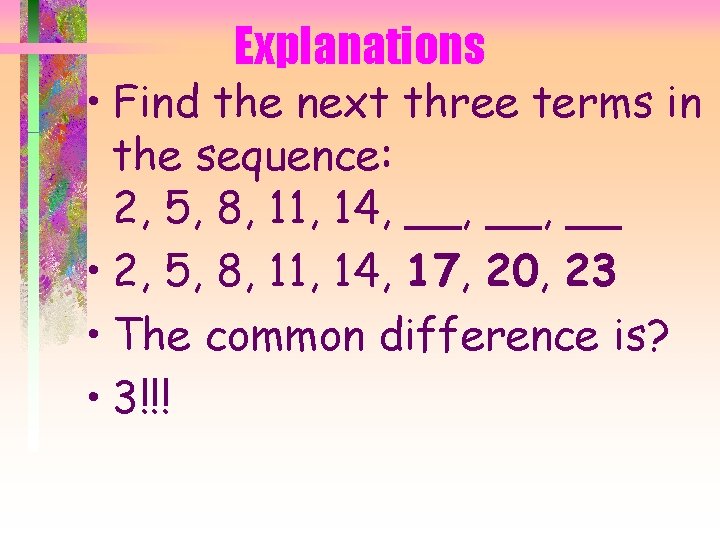
Explanations • Find the next three terms in the sequence: 2, 5, 8, 11, 14, __, __ • 2, 5, 8, 11, 14, 17, 20, 23 • The common difference is? • 3!!!
Explanations • To find the common difference (d), just subtract any term from the term that follows it. • FYI: Common differences can be negative.
Formula • What if I wanted to find the 50 th (a 50) term of the sequence 2, 5, 8, 11, 14, …? Do I really want to add 3 continually until I get there? • There is a formula for finding the nth term.
Formula • Let’s see if we can figure the formula out on our own. • a 1 = 2, to get a 2 I just add 3 once. To get a 3 I add 3 to a 1 twice. To get a 4 I add 3 to a 1 three times.
Formula • What is the relationship between the term we are finding and the number of times I have to add d? • The number of times I had to add is one less then the term I am looking for.
Formula • So if I wanted to find a 50 then how many times would I have to add 3? • 49 • If I wanted to find a 193 how many times would I add 3? • 192
Formula • So to find a 50 I need to take d, which is 3, and add it to my a 1, which is 2, 49 times. That’s a lot of adding. • But if we think back to elementary school, repetitive adding is just multiplication.
Formula • 3 + 3 + 3 = 15 • We added five terms of three, that is the same as multiplying 5 and 3. • So to add three forty-nine times we just multiply 3 and 49.
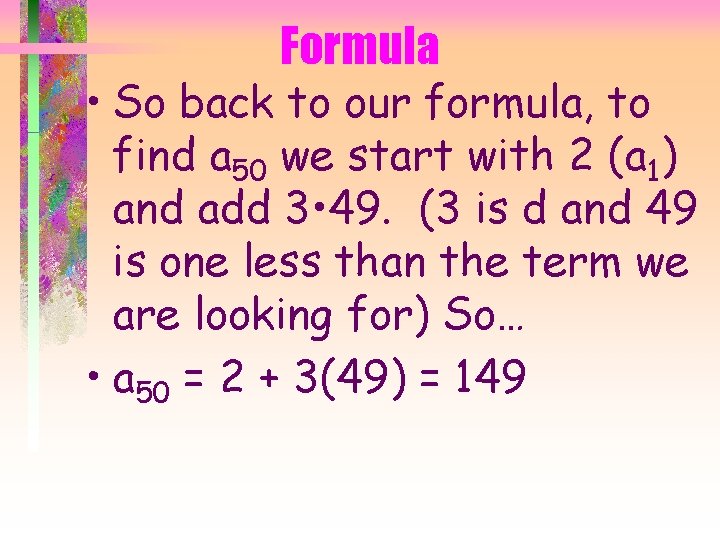
Formula • So back to our formula, to find a 50 we start with 2 (a 1) and add 3 • 49. (3 is d and 49 is one less than the term we are looking for) So… • a 50 = 2 + 3(49) = 149
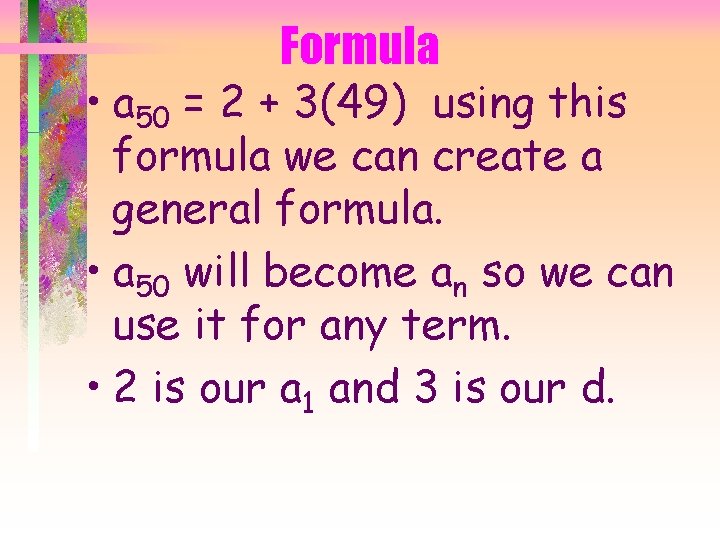
Formula • a 50 = 2 + 3(49) using this formula we can create a general formula. • a 50 will become an so we can use it for any term. • 2 is our a 1 and 3 is our d.
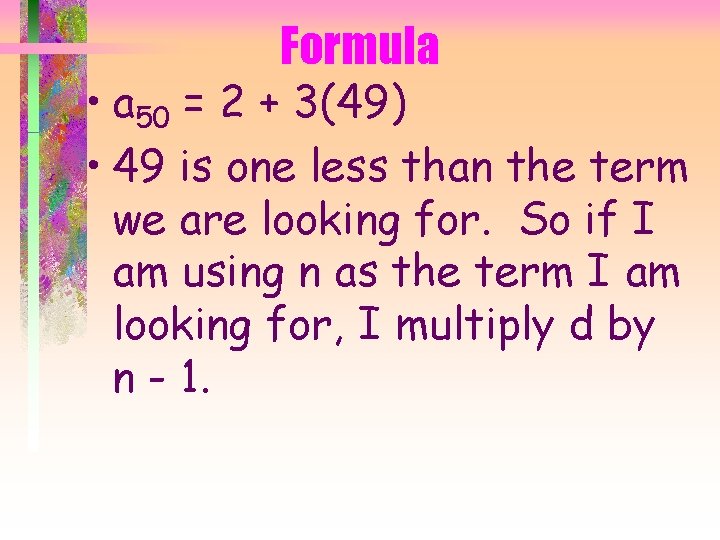
Formula • a 50 = 2 + 3(49) • 49 is one less than the term we are looking for. So if I am using n as the term I am looking for, I multiply d by n - 1.
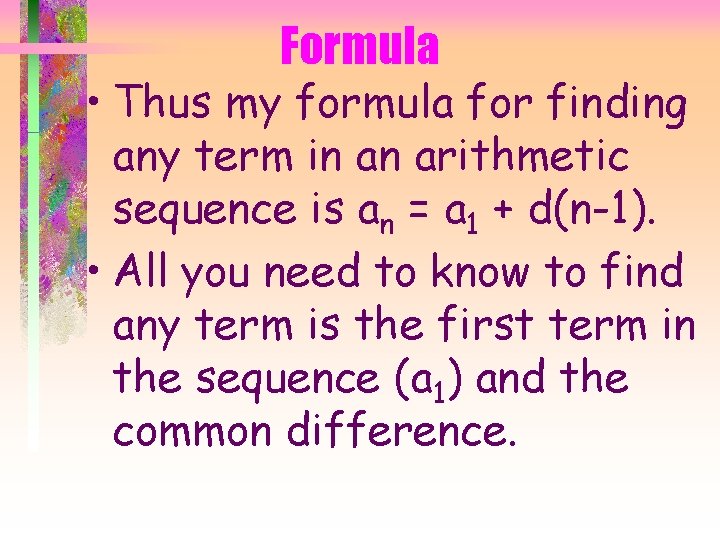
Formula • Thus my formula for finding any term in an arithmetic sequence is an = a 1 + d(n-1). • All you need to know to find any term is the first term in the sequence (a 1) and the common difference.
Example - 1 • Let’s go back to our first example about the radio contest. Suppose no one correctly answered the question for 15 days. What would the prize be on day 16?
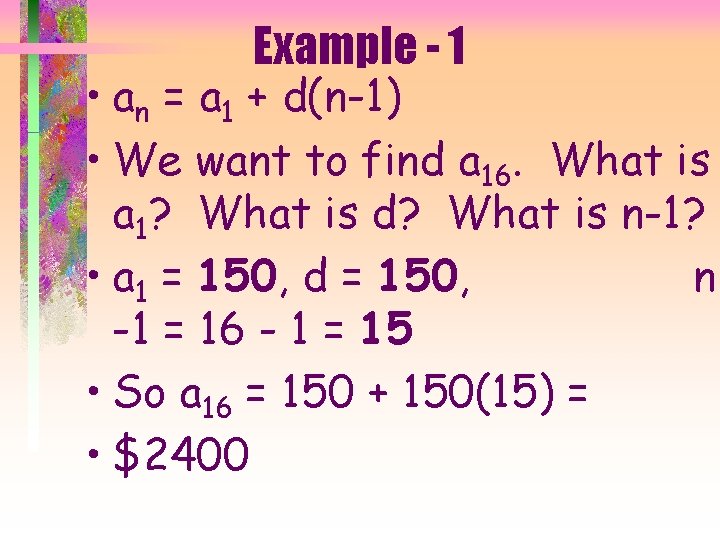
Example - 1 • an = a 1 + d(n-1) • We want to find a 16. What is a 1? What is d? What is n-1? • a 1 = 150, d = 150, n -1 = 16 - 1 = 15 • So a 16 = 150 + 150(15) = • $2400
Example - 2 • 17, 10, 3, -4, -11, -18, … • What is the common difference? • Subtract any term from the term after it. • -4 - 3 = -7 • d = - 7
Example - 3 • 72 is the __ term of the sequence -5, 2, 9, … • We need to find ‘n’ which is the term number. • 72 is an, -5 is a 1, and 7 is d. Plug it in.
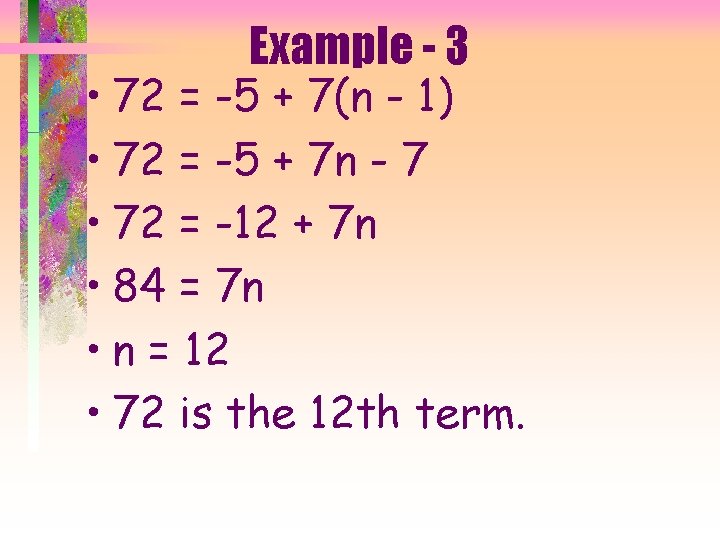
Example - 3 • 72 = -5 + 7(n - 1) • 72 = -5 + 7 n - 7 • 72 = -12 + 7 n • 84 = 7 n • n = 12 • 72 is the 12 th term.

Arithmetic Series

Arithmetic Series • The African-American celebration of Kwanzaa involves the lighting of candles every night for seven nights. The first night one candle is lit and blown out.
Arithmetic Series • The second night a new candle and the candle from the first night are lit and blown out. The third night a new candle and the two candles from the second night are lit and blown out.
Arithmetic Series • This process continues for the seven nights. • We want to know the total number of lightings during the seven nights of celebration.
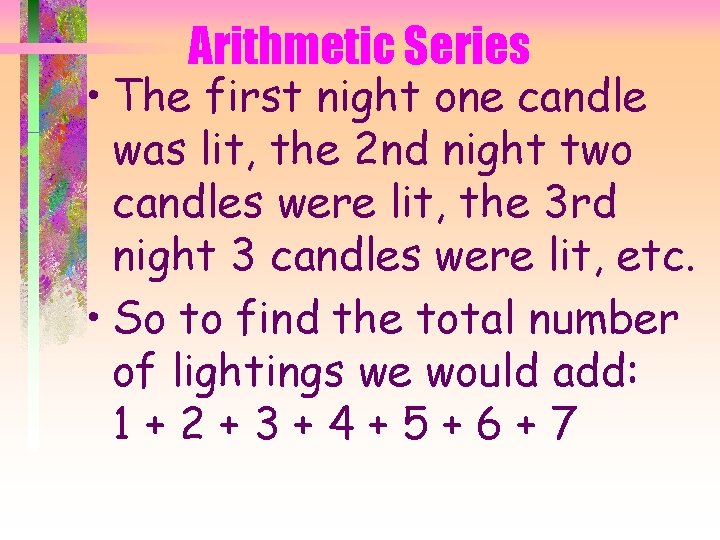
Arithmetic Series • The first night one candle was lit, the 2 nd night two candles were lit, the 3 rd night 3 candles were lit, etc. • So to find the total number of lightings we would add: 1+2+3+4+5+6+7
Arithmetic Series • 1 + 2 + 3 + 4 + 5 + 6 + 7 = 28 • Series: the sum of the terms in a sequence. • Arithmetic Series: the sum of the terms in an arithmetic sequence.
Arithmetic Series • Arithmetic sequence: 2, 4, 6, 8, 10 • Corresponding arith. series: 2 + 4 + 6 + 8 + 10 • Arith. Sequence: -8, -3, 2, 7 • Arith. Series: -8 + -3 + 2 + 7
Arithmetic Series • Sn is the symbol used to represent the first ‘n’ terms of a series. • Given the sequence 1, 11, 21, 31, 41, 51, 61, 71, … find S 4 • We add the first four terms 1 + 11 + 21 + 31 = 64
Arithmetic Series • Find S 8 of the arithmetic sequence 1, 2, 3, 4, 5, 6, 7, 8, 9, 10, … • 1 + 2 + 3 + 4 + 5 + 6 + 7 + 8 = • 36
Arithmetic Series • What if we wanted to find S 100 for the sequence in the last example. It would be a pain to have to list all the terms and try to add them up. • Let’s figure out a formula!! : )
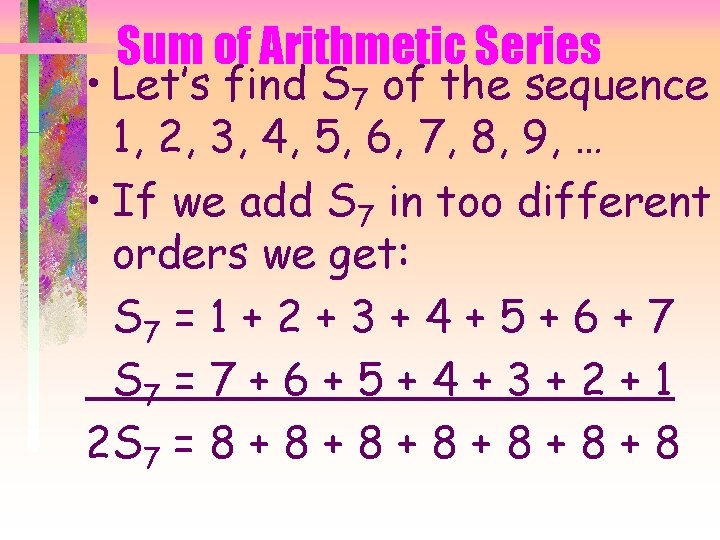
Sum of Arithmetic Series • Let’s find S 7 of the sequence 1, 2, 3, 4, 5, 6, 7, 8, 9, … • If we add S 7 in too different orders we get: S 7 = 1 + 2 + 3 + 4 + 5 + 6 + 7 S 7 = 7 + 6 + 5 + 4 + 3 + 2 + 1 2 S 7 = 8 + 8 + 8 + 8
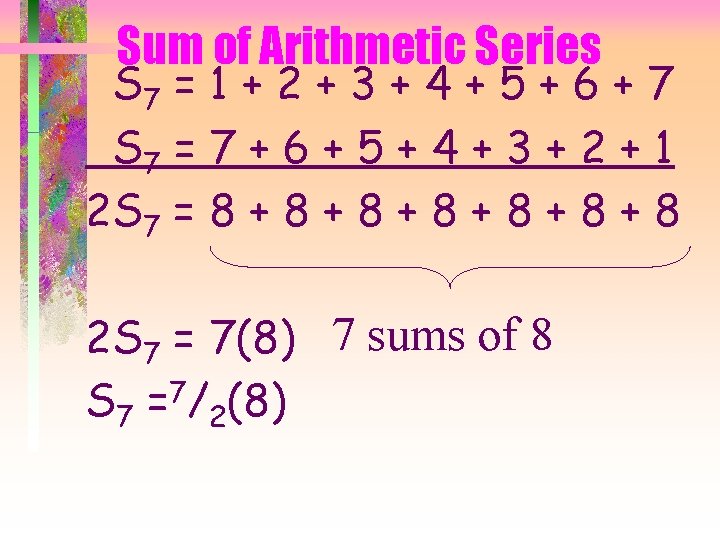
Sum of Arithmetic Series S 7 = 1 + 2 + 3 + 4 + 5 + 6 + 7 S 7 = 7 + 6 + 5 + 4 + 3 + 2 + 1 2 S 7 = 8 + 8 + 8 + 8 2 S 7 = 7(8) 7 sums of 8 7 S 7 = /2(8)
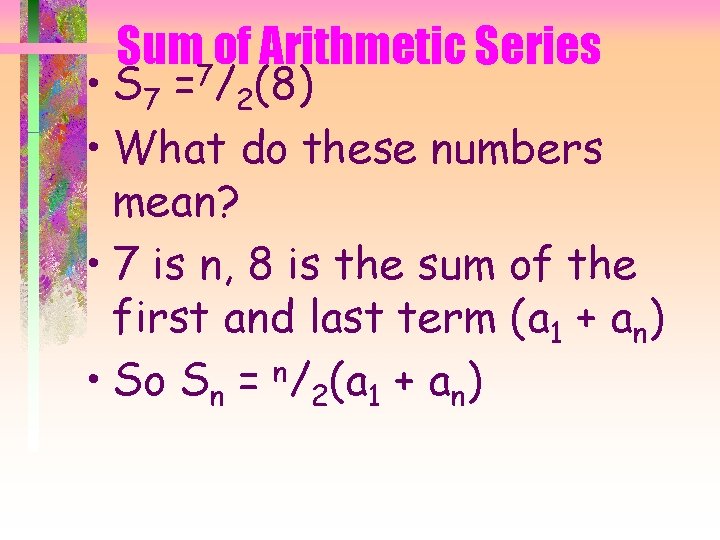
Sum 7 of Arithmetic Series • S 7 = /2(8) • What do these numbers mean? • 7 is n, 8 is the sum of the first and last term (a 1 + an) • So Sn = n/2(a 1 + an)
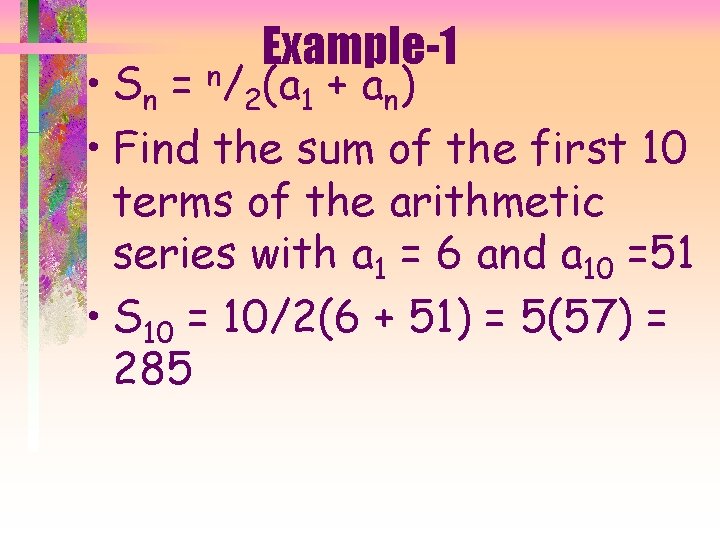
Example-1 • Sn = n/2(a 1 + an) • Find the sum of the first 10 terms of the arithmetic series with a 1 = 6 and a 10 =51 • S 10 = 10/2(6 + 51) = 5(57) = 285
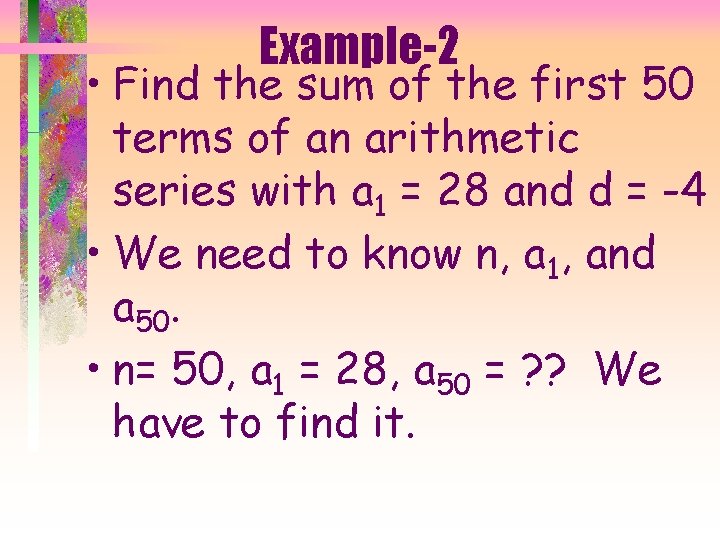
Example-2 • Find the sum of the first 50 terms of an arithmetic series with a 1 = 28 and d = -4 • We need to know n, a 1, and a 50. • n= 50, a 1 = 28, a 50 = ? ? We have to find it.
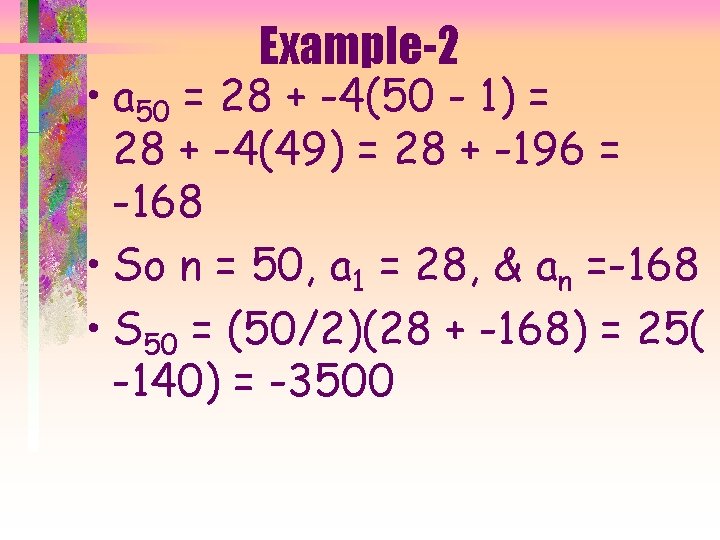
Example-2 • a 50 = 28 + -4(50 - 1) = 28 + -4(49) = 28 + -196 = -168 • So n = 50, a 1 = 28, & an =-168 • S 50 = (50/2)(28 + -168) = 25( -140) = -3500
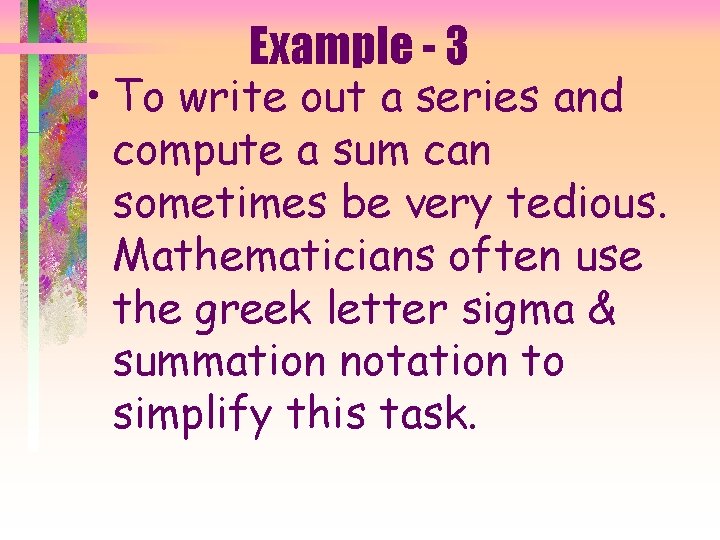
Example - 3 • To write out a series and compute a sum can sometimes be very tedious. Mathematicians often use the greek letter sigma & summation notation to simplify this task.
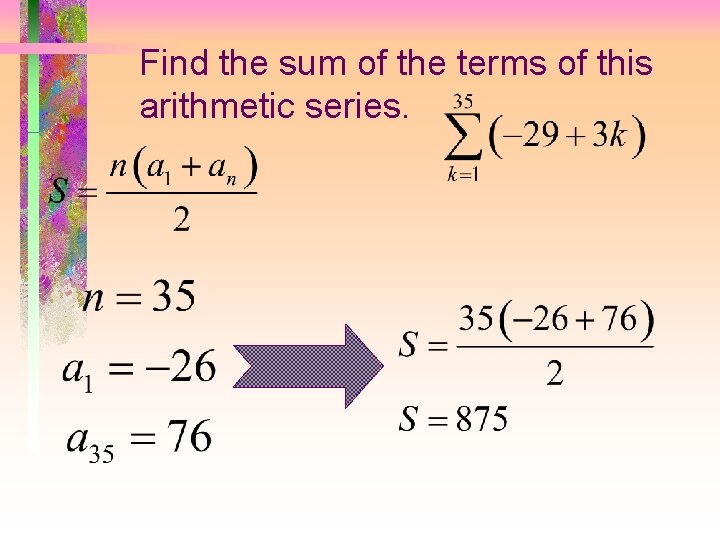
Find the sum of the terms of this arithmetic series.
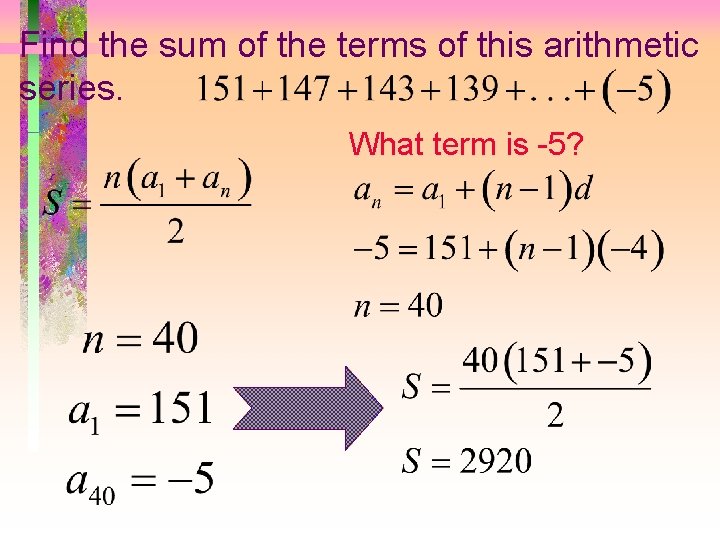
Find the sum of the terms of this arithmetic series. What term is -5?
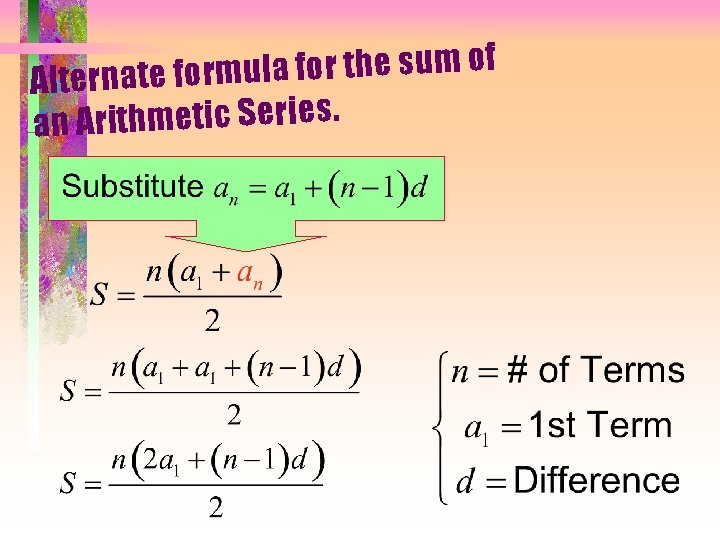
f o m u s e h t r o f a l u Alternate form. s e i r e S c i t e m h t i r A an
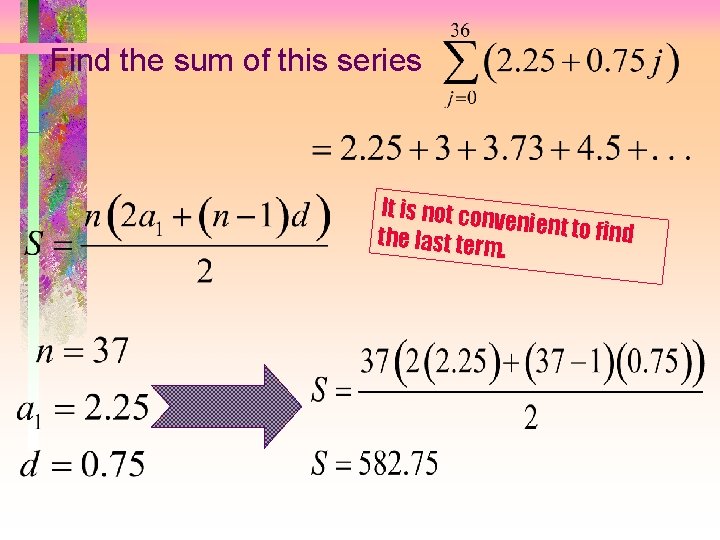
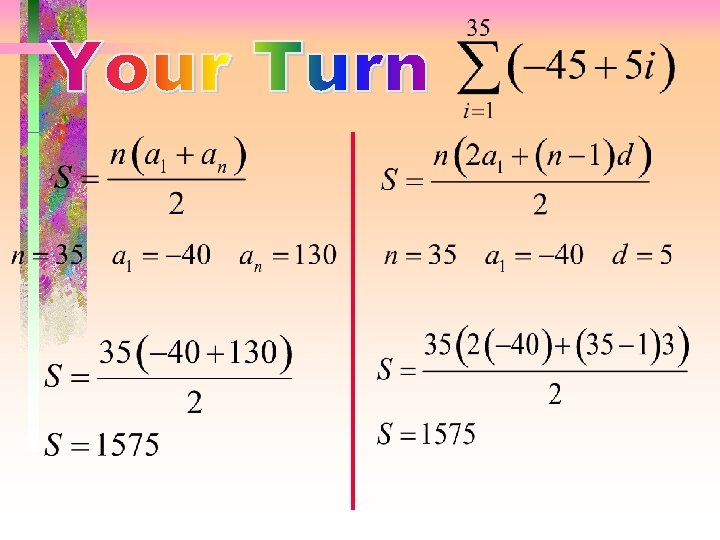
Find the sum of this series It is not con venient to fi nd the last term.

Geometric Sequences

Geometric. Sequence • What if your pay check started at $100 a week and doubled every week. What would your salary be after four weeks?
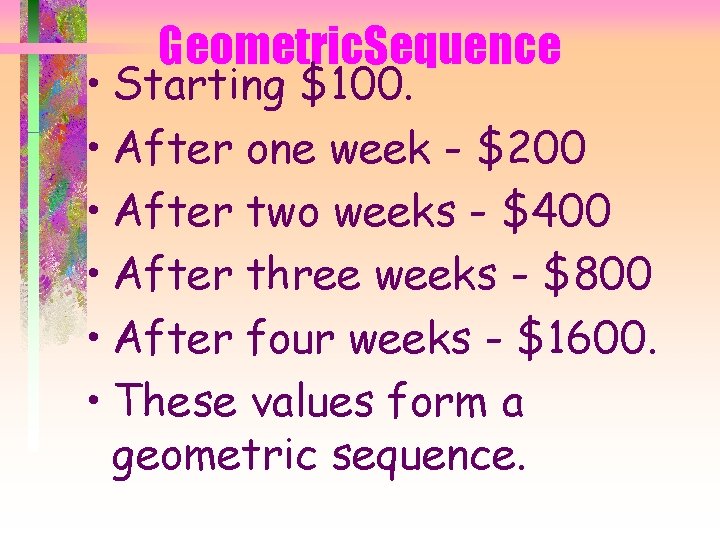
Geometric. Sequence • Starting $100. • After one week - $200 • After two weeks - $400 • After three weeks - $800 • After four weeks - $1600. • These values form a geometric sequence.
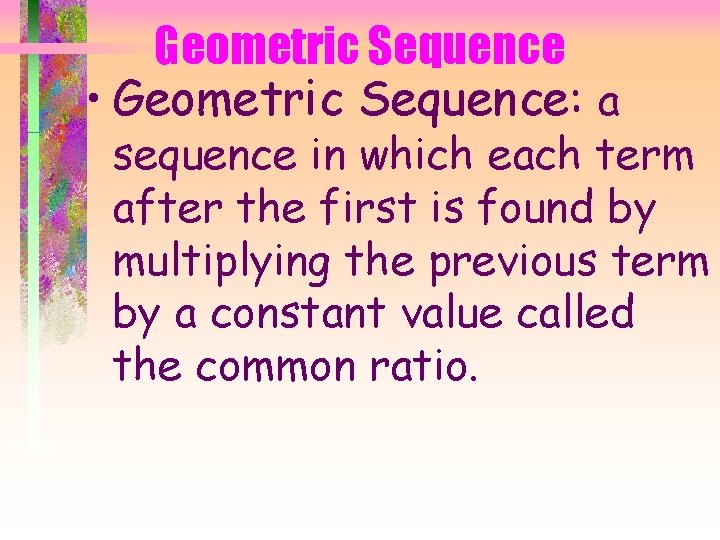
Geometric Sequence • Geometric Sequence: a sequence in which each term after the first is found by multiplying the previous term by a constant value called the common ratio.
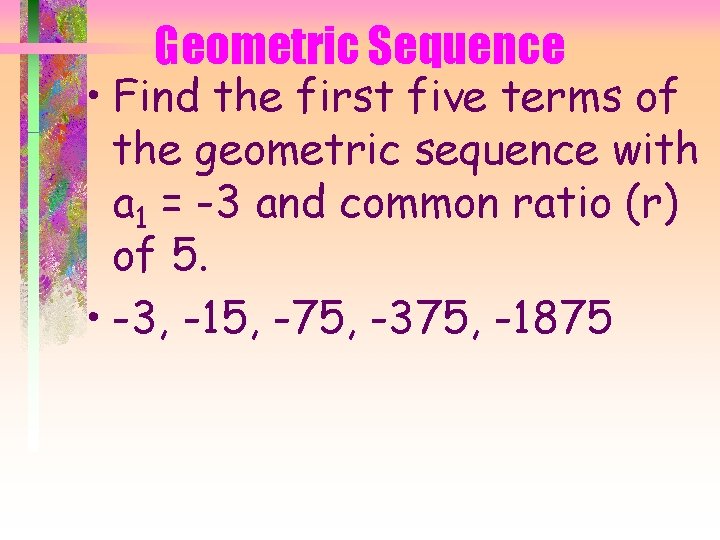
Geometric Sequence • Find the first five terms of the geometric sequence with a 1 = -3 and common ratio (r) of 5. • -3, -15, -75, -375, -1875
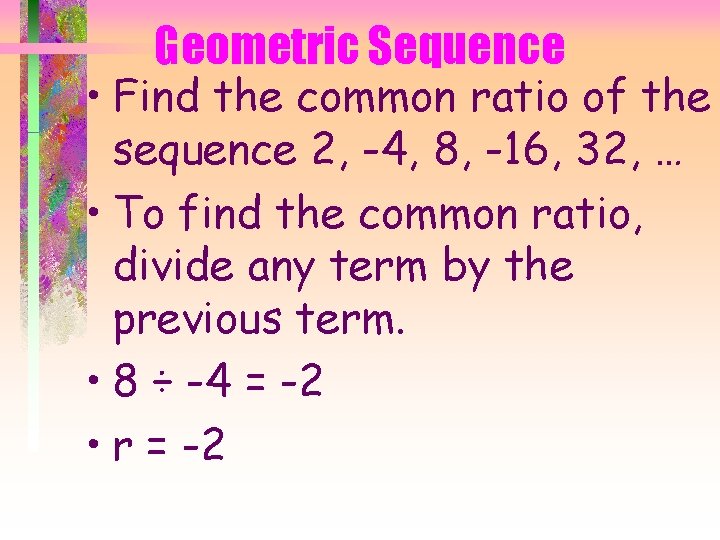
Geometric Sequence • Find the common ratio of the sequence 2, -4, 8, -16, 32, … • To find the common ratio, divide any term by the previous term. • 8 ÷ -4 = -2 • r = -2
Geometric Sequence • Just like arithmetic sequences, there is a formula for finding any given term in a geometric sequence. Let’s figure it out using the pay check example.
Geometric Sequence • To find the 5 th term we look 100 and multiplied it by two four times. • Repeated multiplication is represented using exponents.
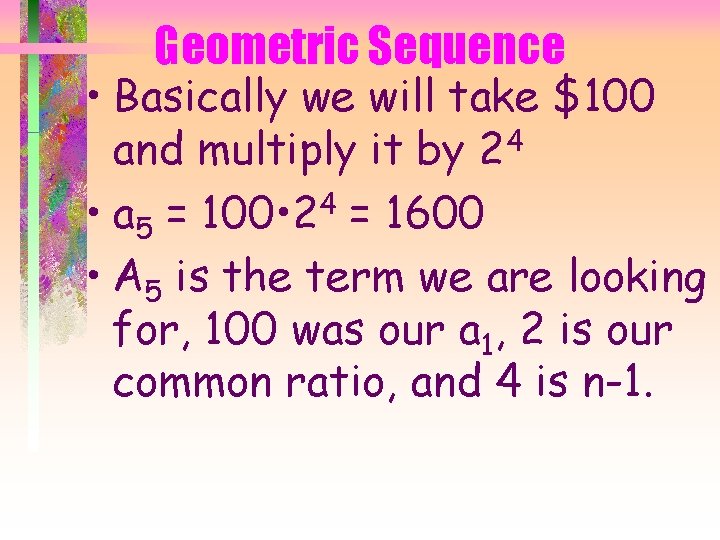
Geometric Sequence • Basically we will take $100 4 and multiply it by 2 • a 5 = 100 • 24 = 1600 • A 5 is the term we are looking for, 100 was our a 1, 2 is our common ratio, and 4 is n-1.
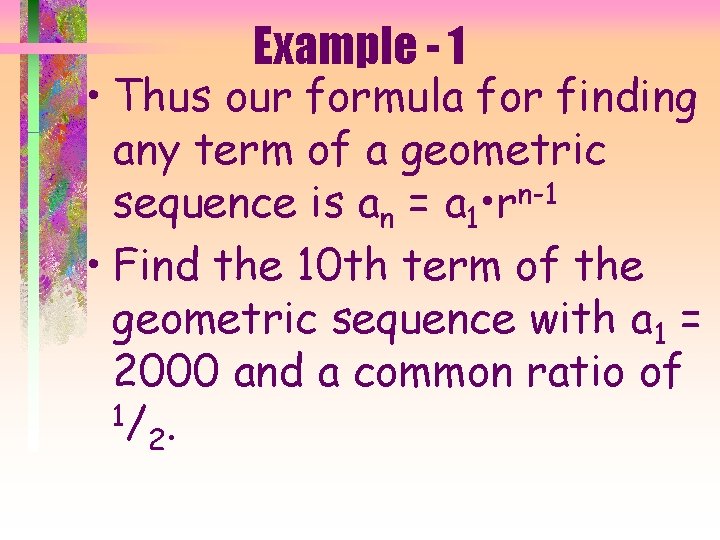
Example - 1 • Thus our formula for finding any term of a geometric n-1 sequence is an = a 1 • r • Find the 10 th term of the geometric sequence with a 1 = 2000 and a common ratio of 1/. 2
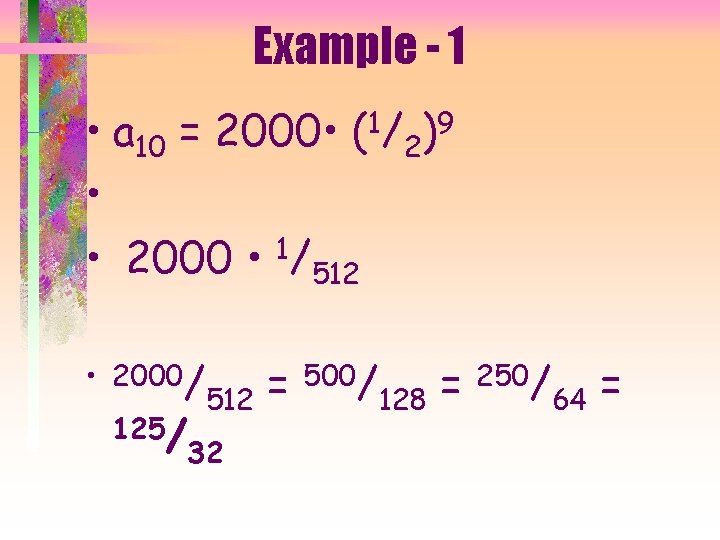
Example - 1 • a 10 = 2000 • (1/2)9 • 1 • 2000 • /512 • 2000/ 125/ 500/ 250/ = = 512 128 64 = 32
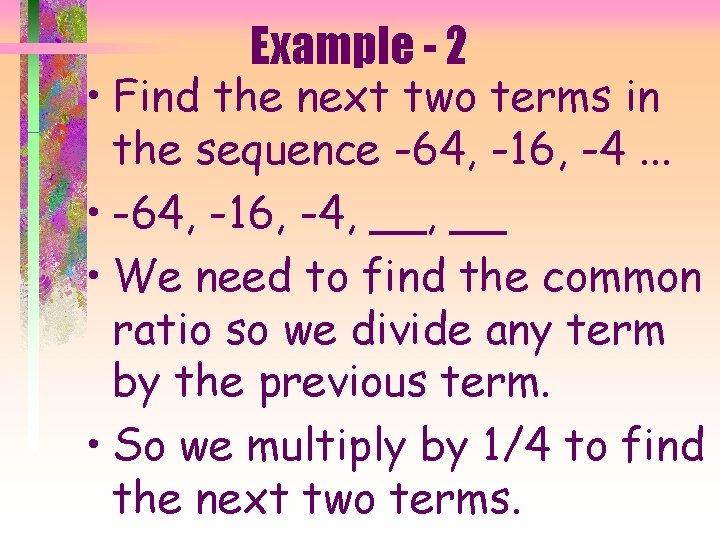
Example - 2 • Find the next two terms in the sequence -64, -16, -4. . . • -64, -16, -4, __ • We need to find the common ratio so we divide any term by the previous term. • So we multiply by 1/4 to find the next two terms.
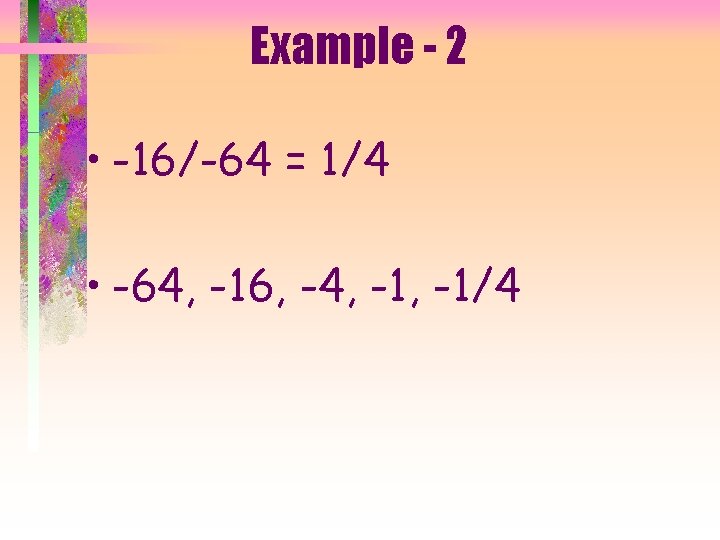
Example - 2 • -16/-64 = 1/4 • -64, -16, -4, -1/4

Geometric Series
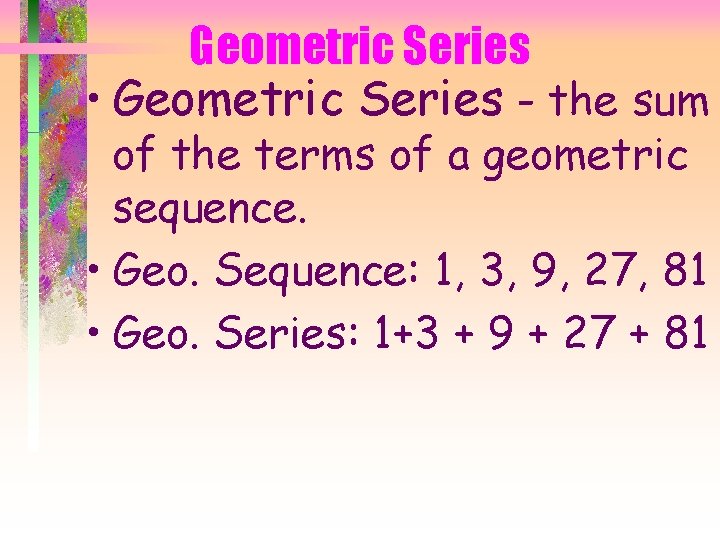
Geometric Series • Geometric Series - the sum of the terms of a geometric sequence. • Geo. Sequence: 1, 3, 9, 27, 81 • Geo. Series: 1+3 + 9 + 27 + 81
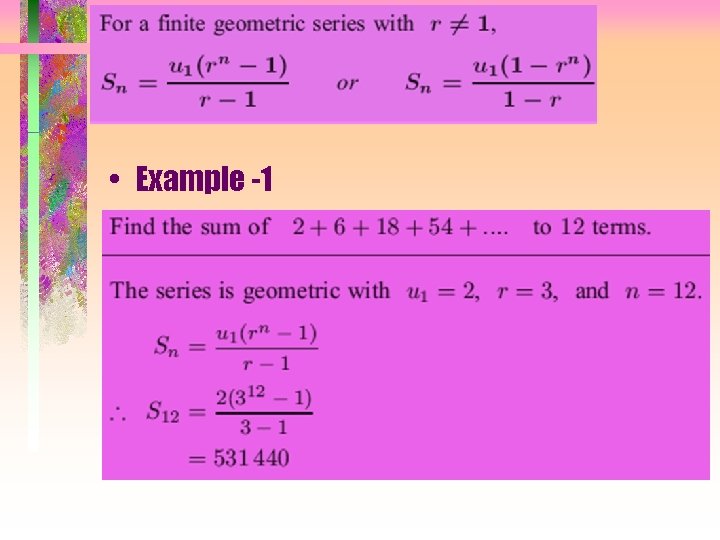
• Example -1
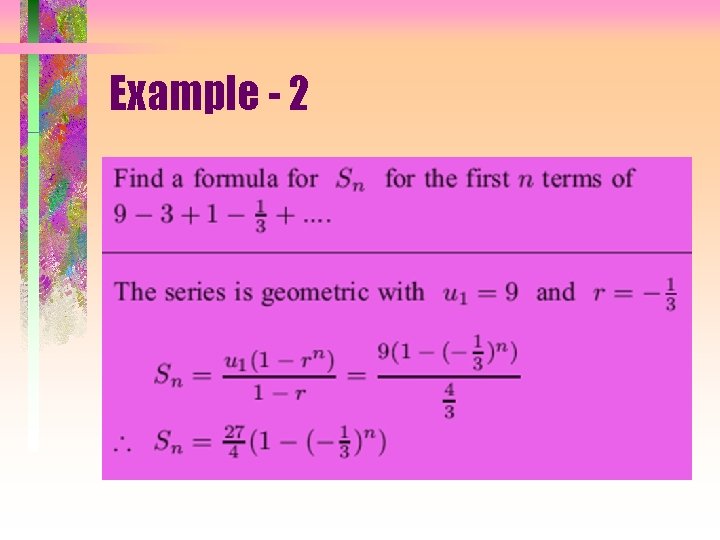
Example - 2
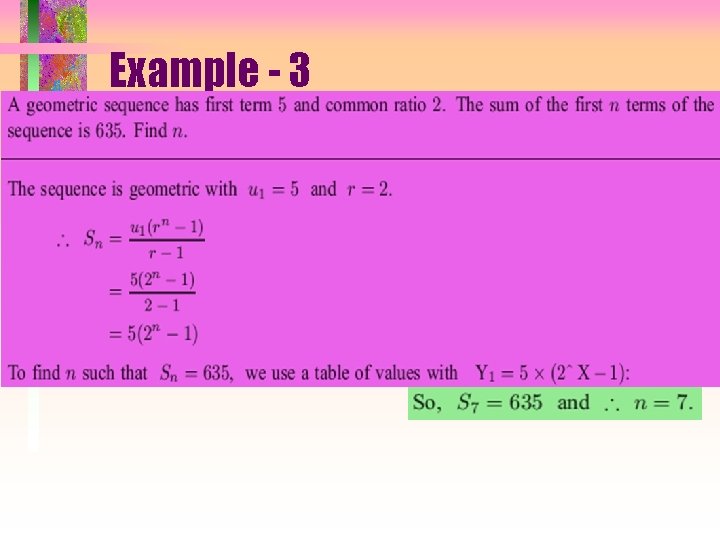
Example - 3
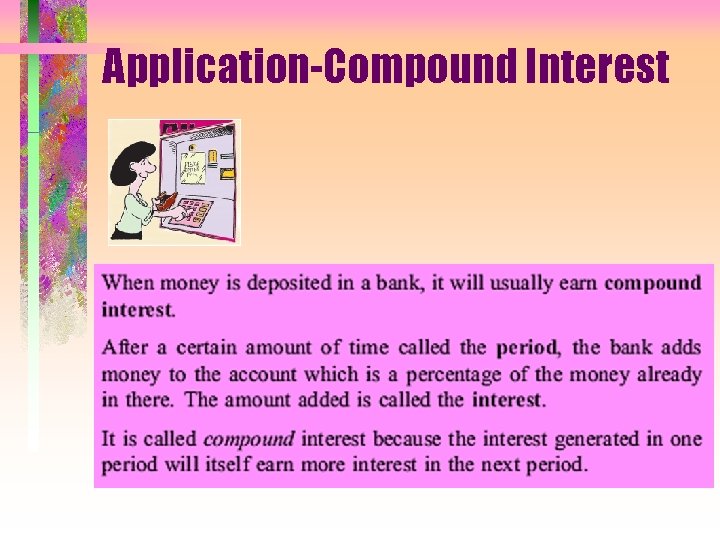
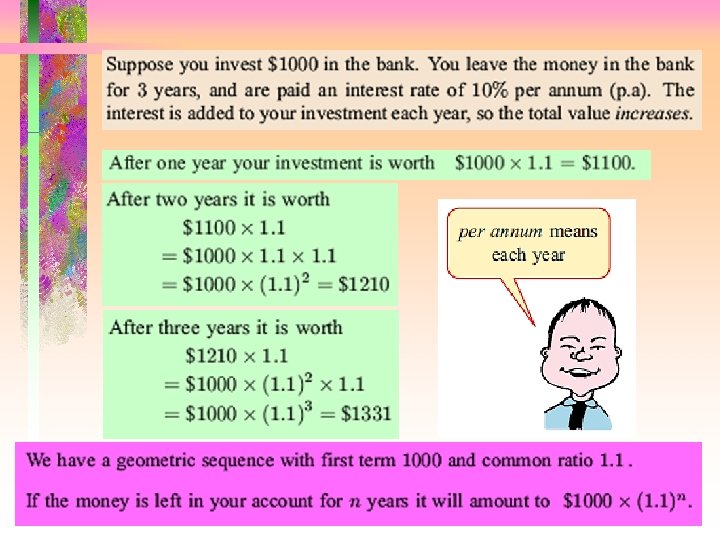
Application-Compound Interest
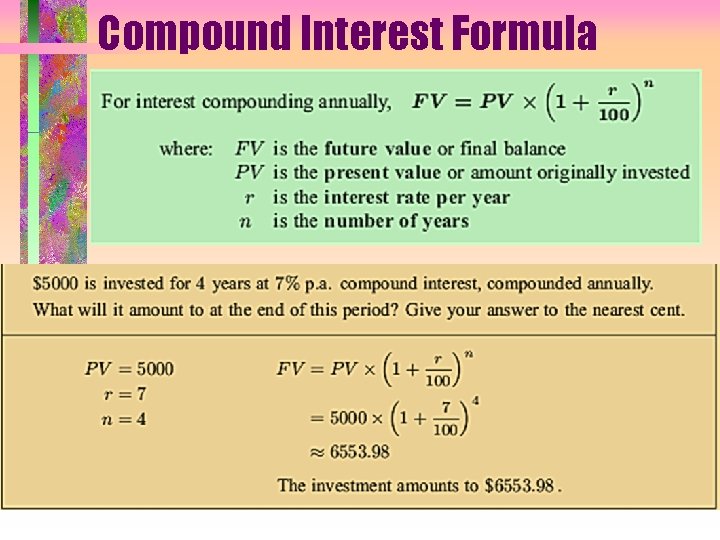
Compound Interest Formula
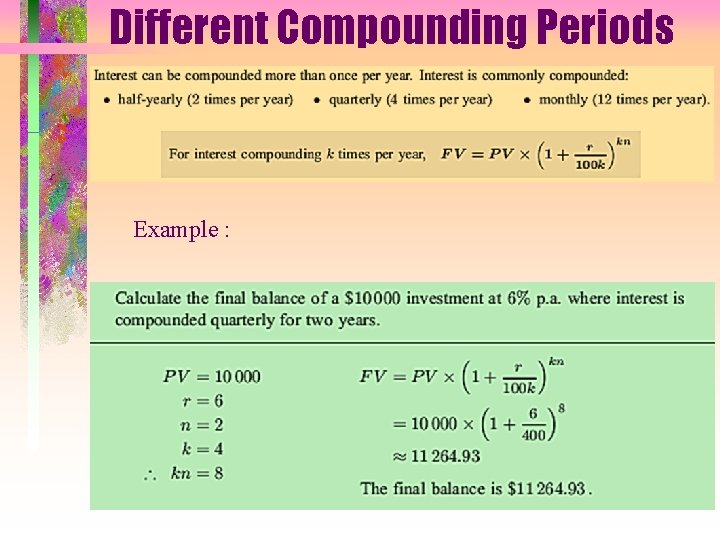
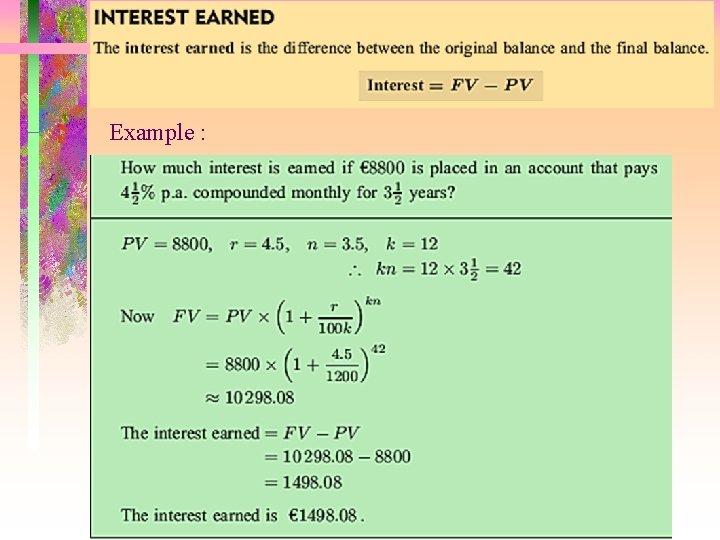
Different Compounding Periods Example :
Example :
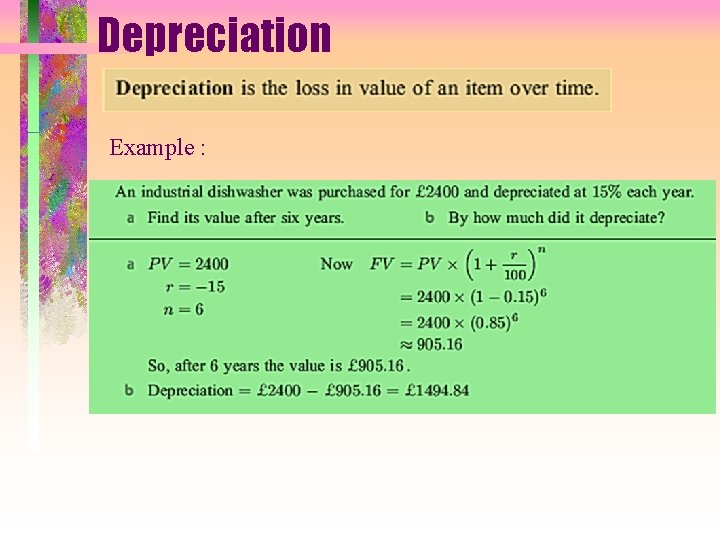
Depreciation Example :
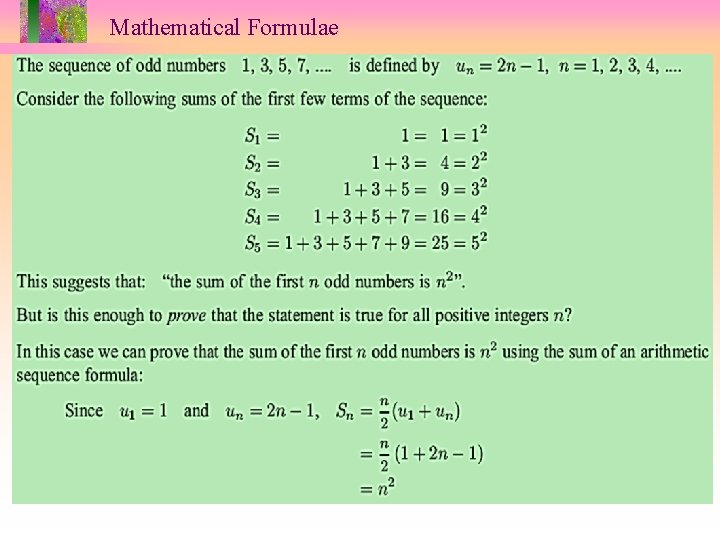
Mathematical Formulae

Something to think about…. . • Can we prove that a statement is true in all cases by checking that it is true for some specific cases? • How do we know when we have proven a statement to be true?
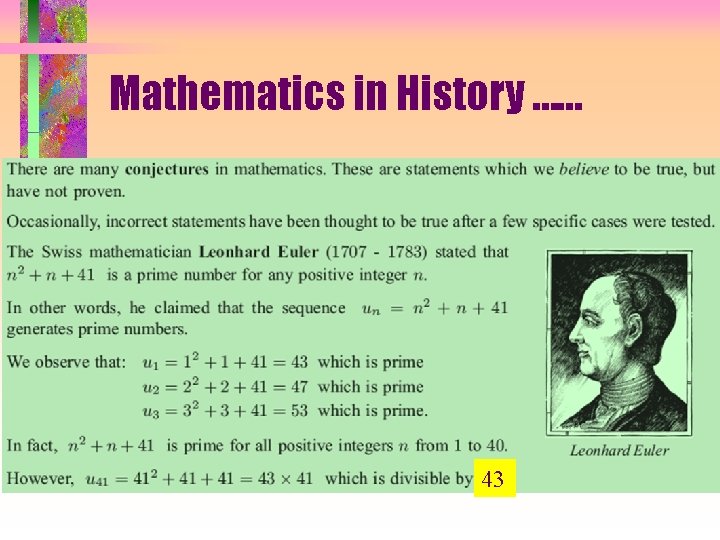
Mathematics in History …… 43
- Slides: 79