
FUN FACT The 3 most valuable brand names

FUN FACT The 3 most valuable brand names on earth: Apple, Microsoft, and Coca-Cola.
Virology n DEFINITION – the study of viruses and virus-like agents. n n n Structure Classification and evolution Methods of multiplication Diseases Techniques to isolate/culture Use in research and therapy
Virology n n n VIRUS (from the latin virus meaning toxin or poison) is a microscopic infectious agent that is an obligatory intracellular parasite. VIRUSES infect all types of organisms from animals and plants to bacteria Viruses lack organelles
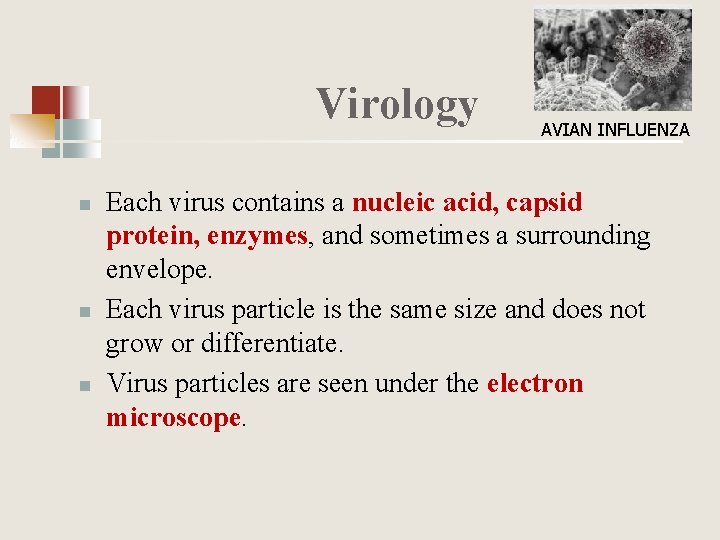
Virology n n n AVIAN INFLUENZA Each virus contains a nucleic acid, capsid protein, enzymes, and sometimes a surrounding envelope. Each virus particle is the same size and does not grow or differentiate. Virus particles are seen under the electron microscope.
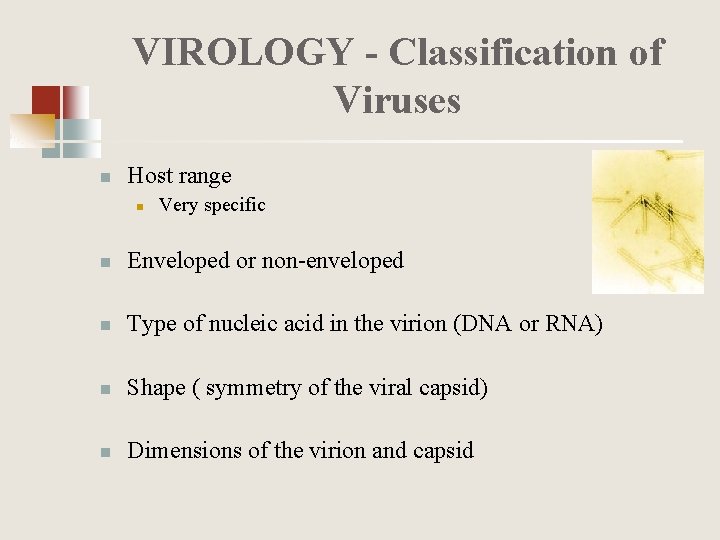
VIROLOGY - Classification of Viruses n Host range n Very specific n Enveloped or non-enveloped n Type of nucleic acid in the virion (DNA or RNA) n Shape ( symmetry of the viral capsid) n Dimensions of the virion and capsid
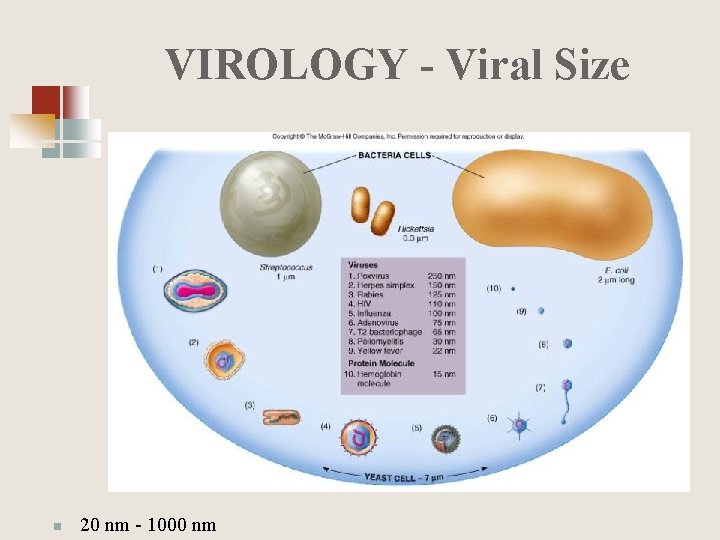
VIROLOGY - Viral Size n 20 nm - 1000 nm
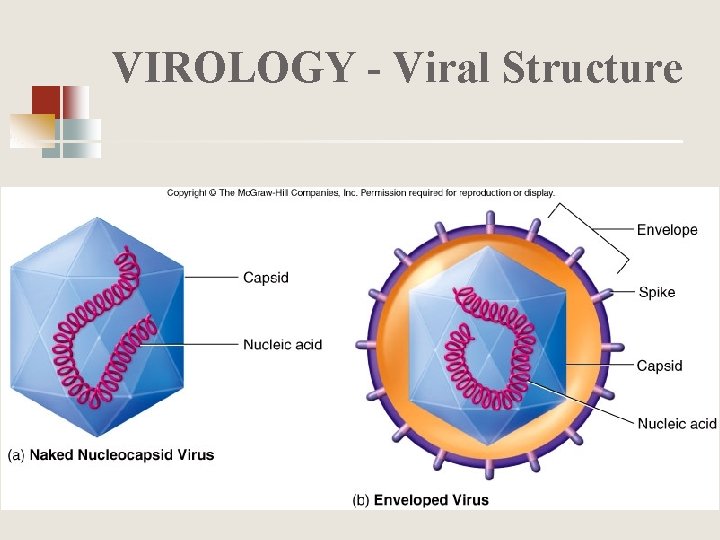
VIROLOGY - Viral Structure
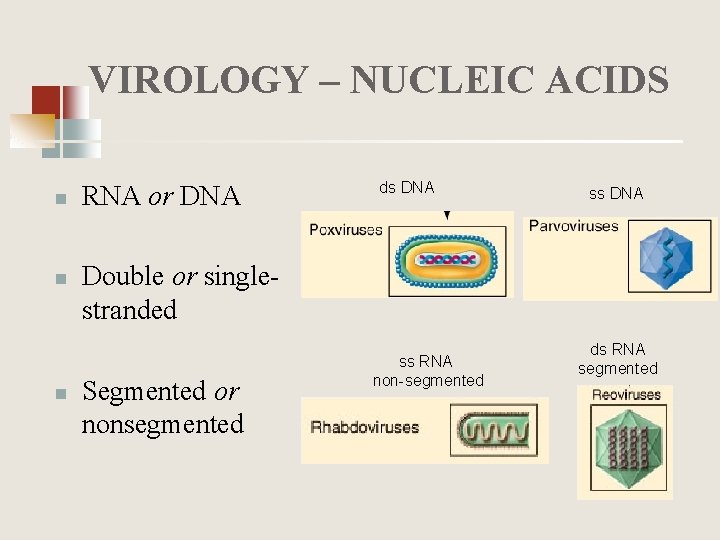
VIROLOGY – NUCLEIC ACIDS n n n RNA or DNA ds DNA ss DNA Double or singlestranded Segmented or nonsegmented ss RNA non-segmented ds RNA segmented
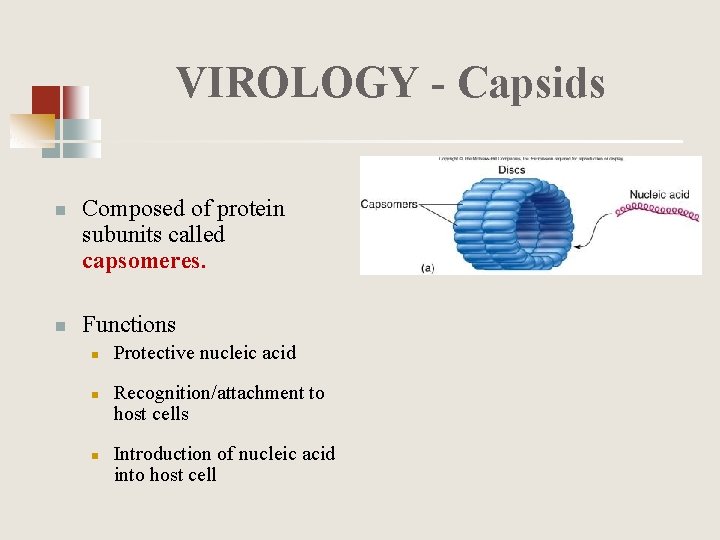
VIROLOGY - Capsids n n Composed of protein subunits called capsomeres. Functions n n n Protective nucleic acid Recognition/attachment to host cells Introduction of nucleic acid into host cell
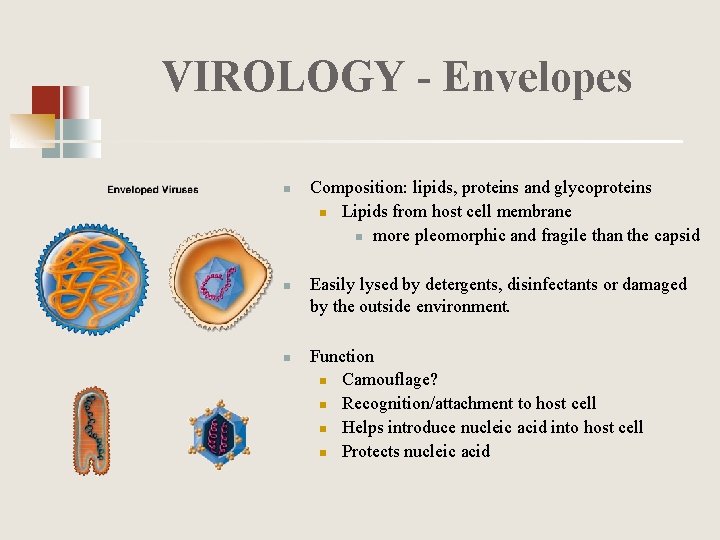
VIROLOGY - Envelopes n n n Composition: lipids, proteins and glycoproteins n Lipids from host cell membrane n more pleomorphic and fragile than the capsid Easily lysed by detergents, disinfectants or damaged by the outside environment. Function n Camouflage? n Recognition/attachment to host cell n Helps introduce nucleic acid into host cell n Protects nucleic acid

Viral Shape Helical (ex: rabies, ebola) Polyhedra. I/icosohedral (ex: adenovirus, poliovirus)

Viral Shape Complex (ex: bacteriophage)
Animal RNA Viruses Retr slow Para diste rinde Coro Rhab
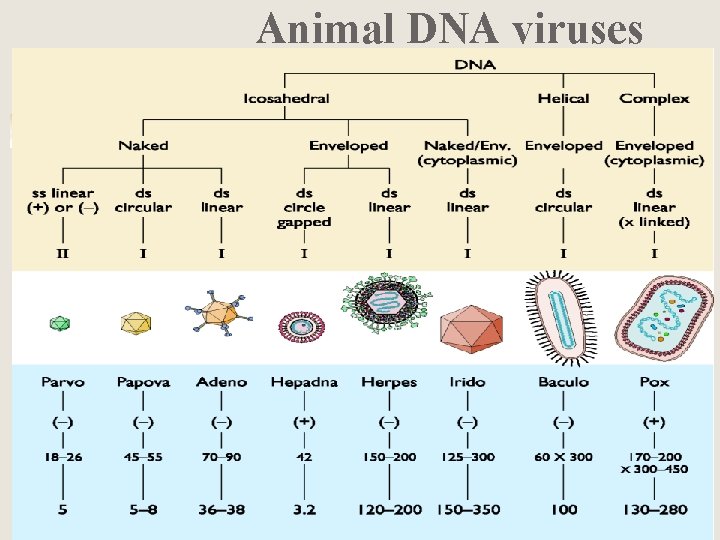
Animal DNA viruses
VIROLOGY – Multiplication of Animal Viruses n Transmission: n n Attachment/Penetration: n n n aerosols, break in skin, fluids (blood, saliva, sexual contact) bind to specific surface receptors Entry: fuse with or engulfed by the plasma membrane Release: n lyse cells or bud through (plasma) membrane Several hundred in one cell during one replication cycle of several hours.
Viral Life Cycle – 5 steps n n n Entry into host cell Uncoating Replication of nucleic acids & production of proteins Maturation/assembly Release of virus
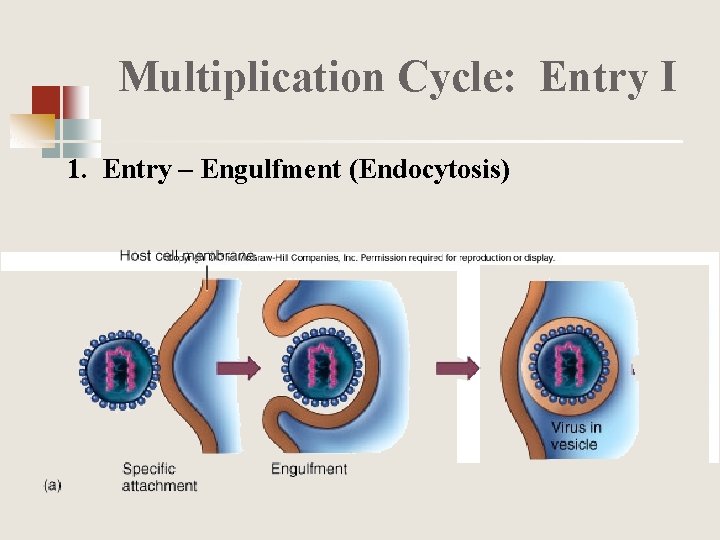
Multiplication Cycle: Entry I 1. Entry – Engulfment (Endocytosis)
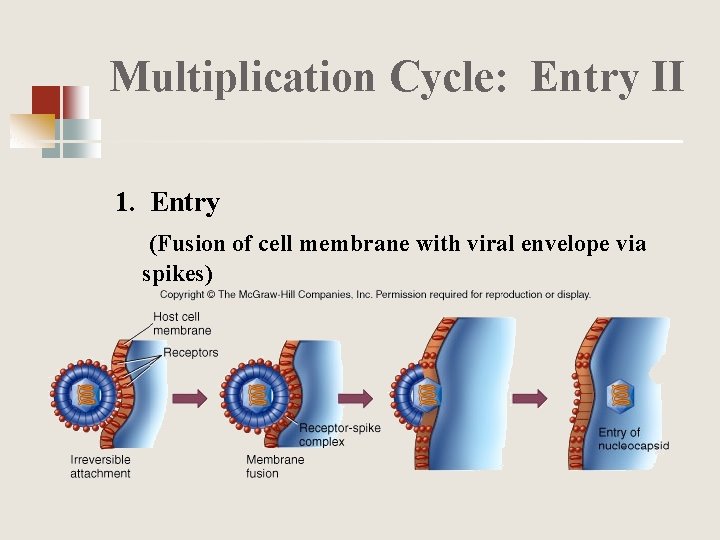
Multiplication Cycle: Entry II 1. Entry (Fusion of cell membrane with viral envelope via spikes)
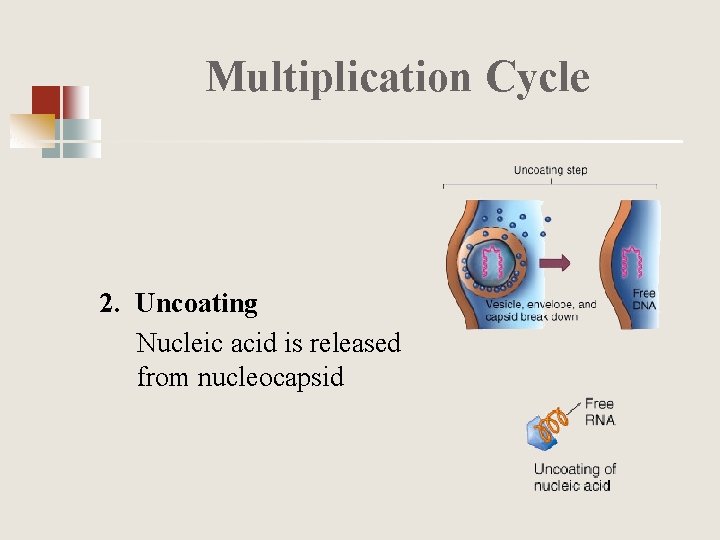
Multiplication Cycle 2. Uncoating Nucleic acid is released from nucleocapsid
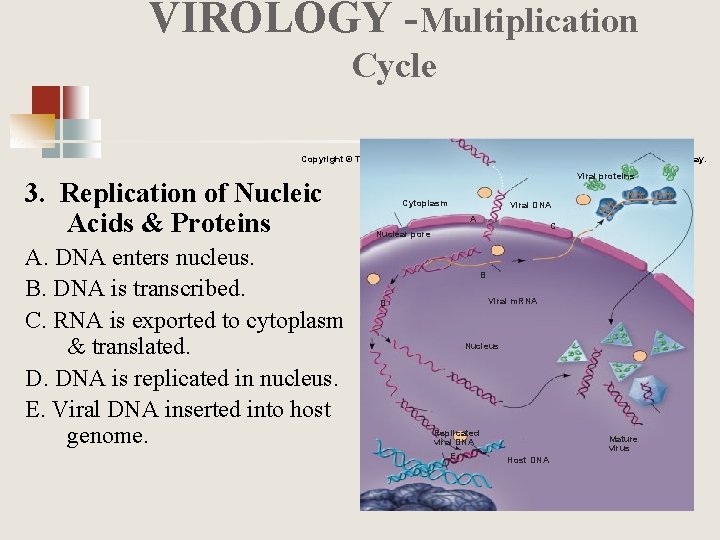
VIROLOGY -Multiplication Cycle Copyright © The Mc. Graw-Hill Companies, Inc. Permission required for reproduction or display. 3. Replication of Nucleic Acids & Proteins A. DNA enters nucleus. B. DNA is transcribed. C. RNA is exported to cytoplasm & translated. D. DNA is replicated in nucleus. E. Viral DNA inserted into host genome. Viral proteins Cytoplasm Viral DNA A C Nuclear pore B Viral m. RNA D Nucleus Replicated viral DNA E Mature virus Host DNA

VIROLOGY -Multiplication Cycle Copyright © The Mc. Graw-Hill Companies, Inc. Permission required for reproduction or display. Viral proteins Cytoplasm Viral DNA Nuclear pore 4. Maturation/Assembly n New nucleocapsids selfassemble Viral m. RNA Nucleus 5 Replicated viral DNA Mature virus Host DNA
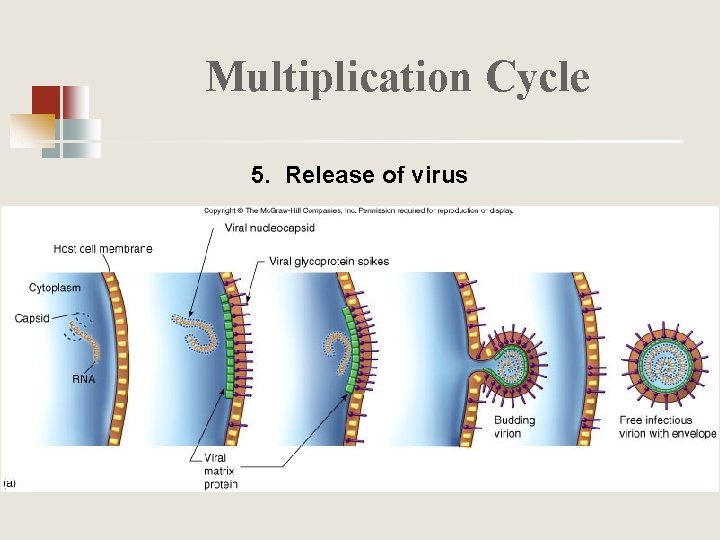
Multiplication Cycle 5. Release of virus
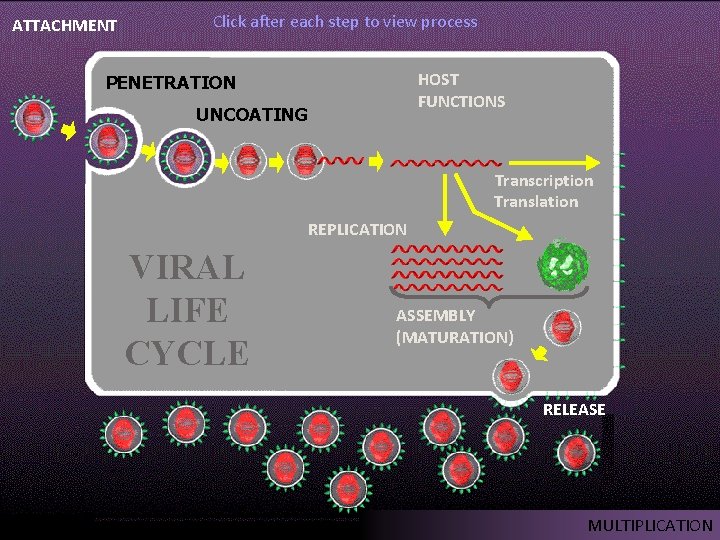
ATTACHMENT Click after each step to view process HOST FUNCTIONS PENETRATION UNCOATING Transcription Translation REPLICATION VIRAL LIFE CYCLE ASSEMBLY (MATURATION) RELEASE 23 MULTIPLICATION
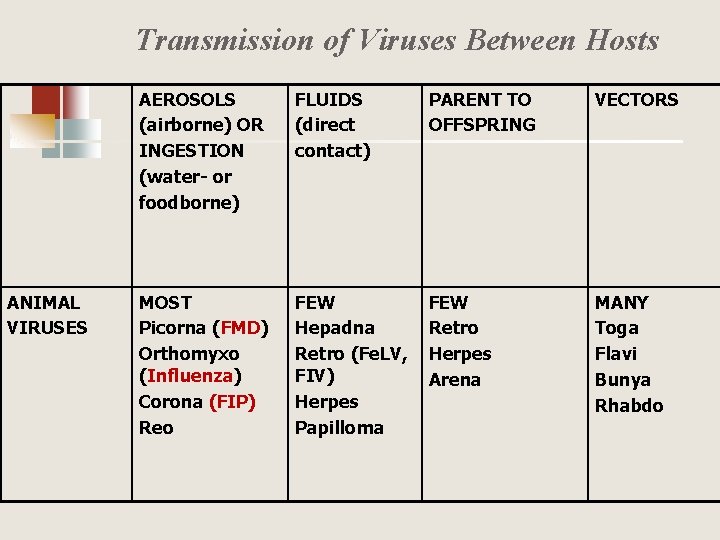
Transmission of Viruses Between Hosts ANIMAL VIRUSES AEROSOLS (airborne) OR INGESTION (water- or foodborne) FLUIDS (direct contact) PARENT TO OFFSPRING VECTORS MOST Picorna (FMD) Orthomyxo (Influenza) Corona (FIP) Reo FEW Hepadna Retro (Fe. LV, FIV) Herpes Papilloma FEW Retro Herpes Arena MANY Toga Flavi Bunya Rhabdo
VIROLOGY - Outcomes of Animal Virus Infections n Acute Infection n n Latent Infections n n Virus has a short duration and often not fatal, and disappears when the disease process ends. n ( ex: parvovirus, measles in people) Virus can remain in equilibrium with the host and not actually produce disease for a long period, often many years. n ( ex: human herpes simplex, Feline Herpes) Persistent/Chronic Infections n Virus is often fatal and occurs gradually over a long period. n ( ex: HIV/AIDS, Fe. LV, FIV (Feline immuodeficiency virus)
Methods of diagnosis for viral diseases n I. Serology n n ELISA Antibody titers Virus isolation II. Cytology or Histology
Serology n n Look for viral antigens or anti-viral antibodies A four fold or greater rise in antibody titer between two serum specimens provides a positive diagnosis. n Paired sera, the first taken as early as possible in the illness and the second 10 to 14 days after the onset of symptoms.
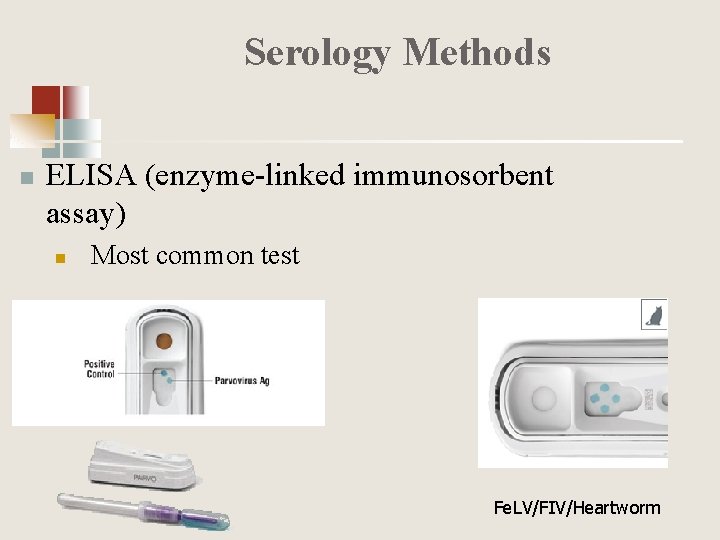
Serology Methods n ELISA (enzyme-linked immunosorbent assay) n Most common test Fe. LV/FIV/Heartworm
Histology and cytology n Inclusion bodies - nuclear or cytoplasmic aggregates, usually proteins n They usually represent sites of viral multiplication n Negri bodies - a particular type of cytoplasmic inclusion
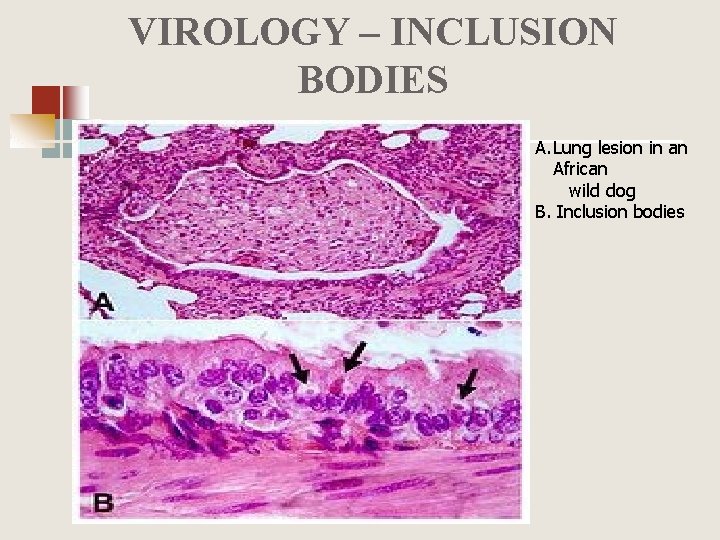
VIROLOGY – INCLUSION BODIES A. Lung lesion in an African wild dog B. Inclusion bodies
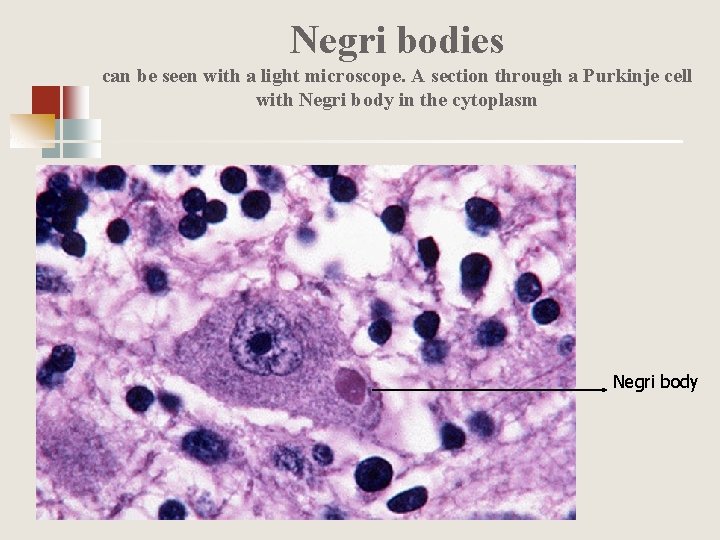
Negri bodies can be seen with a light microscope. A section through a Purkinje cell with Negri body in the cytoplasm Negri body
PREVENTION n n Isolation of animals to keep them free from infection. Vaccination against likely infections. Notification of reportable diseases
References n n http: //www. pitt. edu/~super 1/lecture/lec 3331 /004. htm http: //www. idexx. com/view/xhtml/en_us/s mallanimal/in-house-diagnostics. jsf
- Slides: 33