
Fully Homomorphic Encryption Craig Gentry IBM T J
Fully Homomorphic Encryption Craig Gentry IBM T. J. Watson Research Center March 2017 Spring School on Lattice-Based Crypto, Oxford
Homomorphic Encryption at a High Level
![Alice’s BOX Public Key Encryption (PKE) [DH 76, RSA 77]](http://slidetodoc.com/presentation_image_h/7312671028b2911c2e3169c3d82f73c1/image-3.jpg "Alice’s BOX Public Key Encryption (PKE) [DH 76, RSA 77]")
Alice’s BOX Public Key Encryption (PKE) [DH 76, RSA 77]
![Public-Key Homomorphic Encryption (HE) [RAD 78] GL Ac OV m ce EBO es ss](http://slidetodoc.com/presentation_image_h/7312671028b2911c2e3169c3d82f73c1/image-4.jpg "Public-Key Homomorphic Encryption (HE) [RAD 78] GL Ac OV m ce EBO es ss")
Public-Key Homomorphic Encryption (HE) [RAD 78] GL Ac OV m ce EBO es ss sa t X ge o s
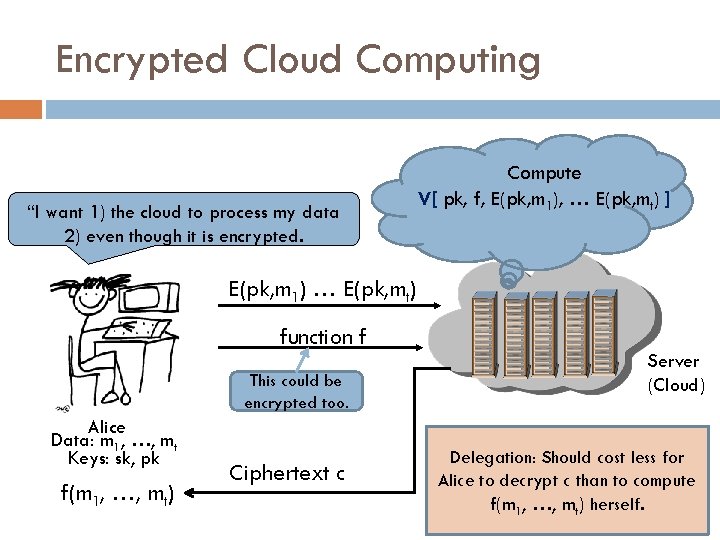
Encrypted Cloud Computing “I want 1) the cloud to process my data 2) even though it is encrypted. Compute V[ pk, f, E(pk, m 1), … E(pk, mt) ] E(pk, m 1) … E(pk, mt) function f This could be encrypted too. Alice Data: m 1, …, mt Keys: sk, pk f(m 1, …, mt) Ciphertext c Server (Cloud) Delegation: Should cost less for Alice to decrypt c than to compute f(m 1, …, mt) herself.

The Homomorphism in HE
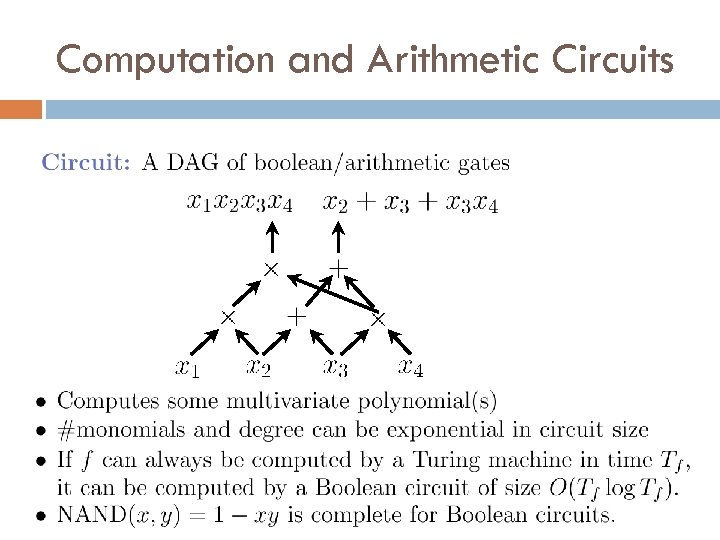
Computation and Arithmetic Circuits
Functionality
Processing (Unencrypted) Data Forget encryption for a moment… How does your compute a function? Basically, by working on bits, 1’s and 0’s. Using bit operations – for example, AND(b 1, b 2)=1 if b 1=b 2=1; otherwise, equals 0. AND(b 1, b 2)= b 1×b 2. XOR(b 1, b 2)=0 if b 1=b 2; equals 1 if b 1≠b 2. XOR(b 1, b 2)= b 1+b 2 (modulo 2)
Computing General Functions {ADD, MULT} are Turing-complete (over any ring). Take any (classically) efficiently computable function. Express it as a poly-size circuit of ADD and MULT gates. Circuits vs. Turing machines (about the same): Circuit size = O(Tf log Tf) Tf = time to compute f on a TM
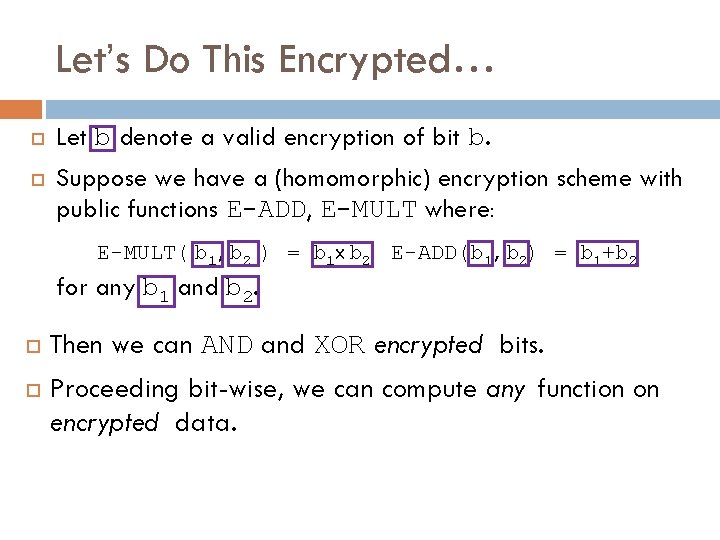
Let’s Do This Encrypted… Let b denote a valid encryption of bit b. Suppose we have a (homomorphic) encryption scheme with public functions E-ADD, E-MULT where: E-MULT( b 1, b 2 ) = b 1 x b 2 E-ADD(b 1, b 2) = b 1+b 2 for any b 1 and b 2. Then we can AND and XOR encrypted bits. Proceeding bit-wise, we can compute any function on encrypted data.
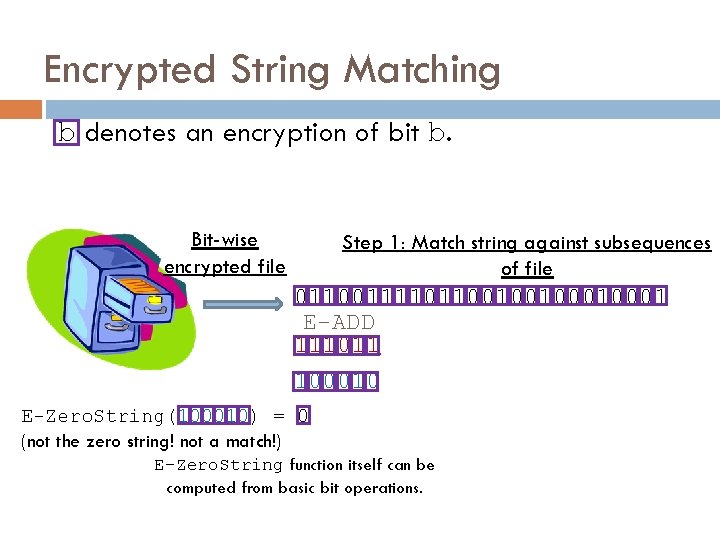
Encrypted String Matching b denotes an encryption of bit b. Bit-wise encrypted file Step 1: Match string against subsequences of file 0110011110110010010001 E-ADD 111011 100010 E-Zero. String(100010) = 0 (not the zero string! not a match!) E-Zero. String function itself can be computed from basic bit operations.

Encrypted String Matching b denotes an encryption of bit b. Bit-wise encrypted file Step 2: Aggregate info about the subsequences 0110011110110010010001 111011 111011 E-OR(00000010…) = 1 (string is in the encrypted file!) 00000010 E-OR can also be computed from basic bit operations.
Properties and Limitations
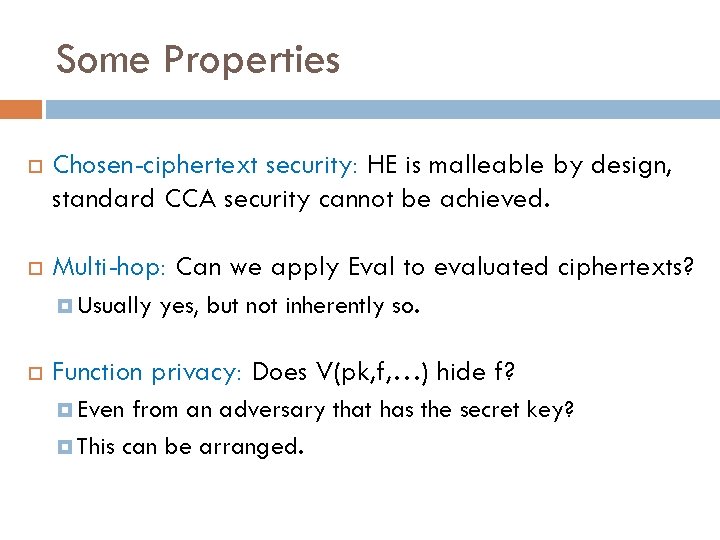
Some Properties Chosen-ciphertext security: HE is malleable by design, standard CCA security cannot be achieved. Multi-hop: Can we apply Eval to evaluated ciphertexts? Usually yes, but not inherently so. Function privacy: Does V(pk, f, …) hide f? Even from an adversary that has the secret key? This can be arranged.
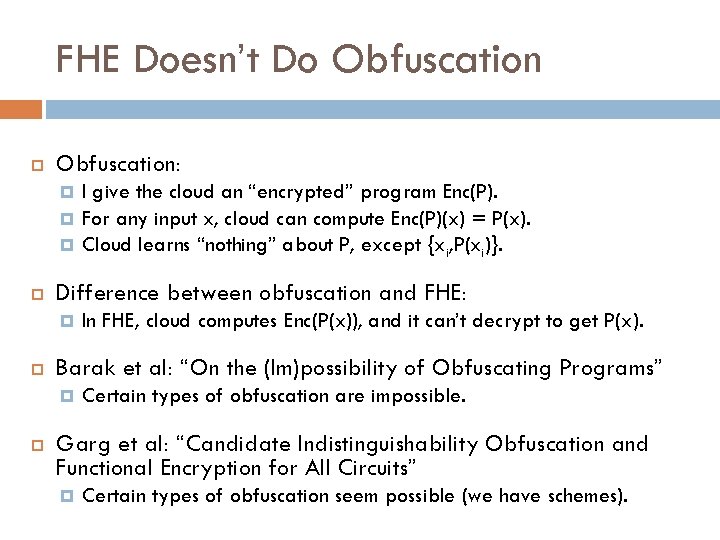
FHE Doesn’t Do Obfuscation: Difference between obfuscation and FHE: In FHE, cloud computes Enc(P(x)), and it can’t decrypt to get P(x). Barak et al: “On the (Im)possibility of Obfuscating Programs” I give the cloud an “encrypted” program Enc(P). For any input x, cloud can compute Enc(P)(x) = P(x). Cloud learns “nothing” about P, except {xi, P(xi)}. Certain types of obfuscation are impossible. Garg et al: “Candidate Indistinguishability Obfuscation and Functional Encryption for All Circuits” Certain types of obfuscation seem possible (we have schemes).
FHE Doesn’t Do RAM Circuits vs. RAMs: Circuits are powerful: Circuit-size ≈ TM complexity. But random-access machines compute some functions much faster than a TM or circuit (Binary search) Can’t do “random access” on encrypted data without leaking some information (not surprising) What we can do: Oblivious RAM: But this is a very interactive protocol between client and server where server can’t tell what client is computing Use Obfuscation to do ORAM: Intuitively, obfuscation allows addresses in memory to be revealed “noninteractively”.
FHE Doesn’t Do Multi-Key FHE Different clients encrypt data under different FHE keys. Later, cloud “combines” data encrypted under different keys: Encpk 1, …, pkt(f(m 1, …, mt)) ← Eval(pk 1, …pkt, f, c 1, …ct). FHE doesn’t do this “automatically”. But, now we have a couple of schemes that do this.

Pop Quiz! How can HE be secure?

HE Security: A Paradox?
Constructing HE: An Early Attempt
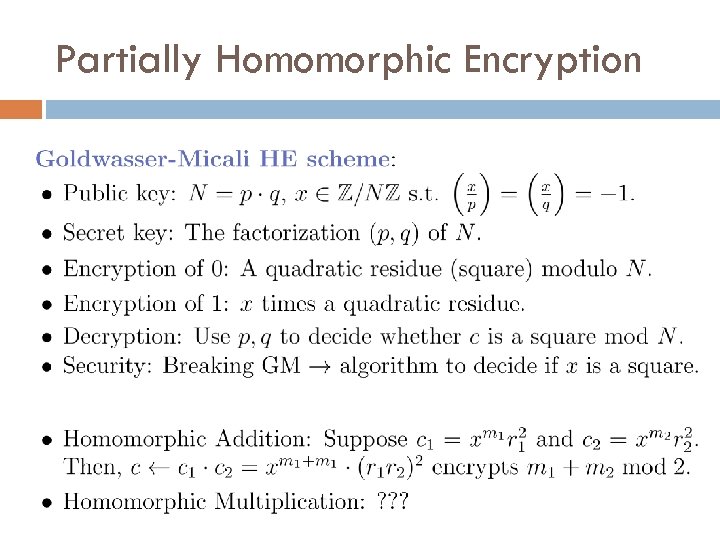
Partially Homomorphic Encryption
Constructing HE: Attempts Using Ring Homomorphisms
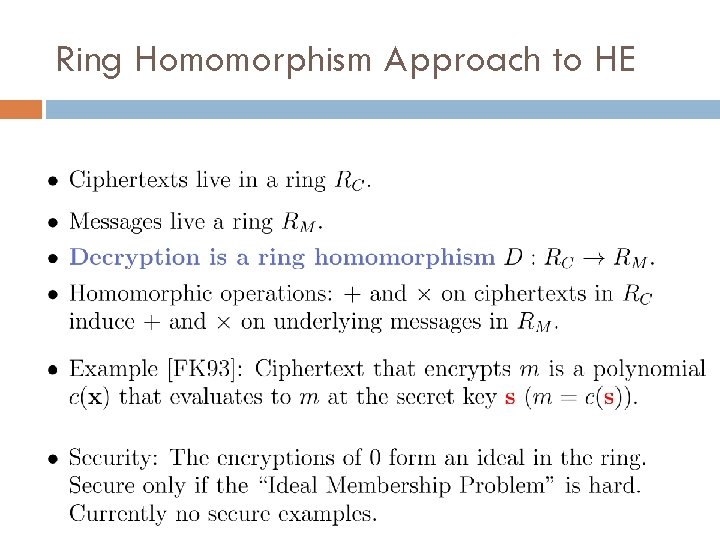
Ring Homomorphism Approach to HE
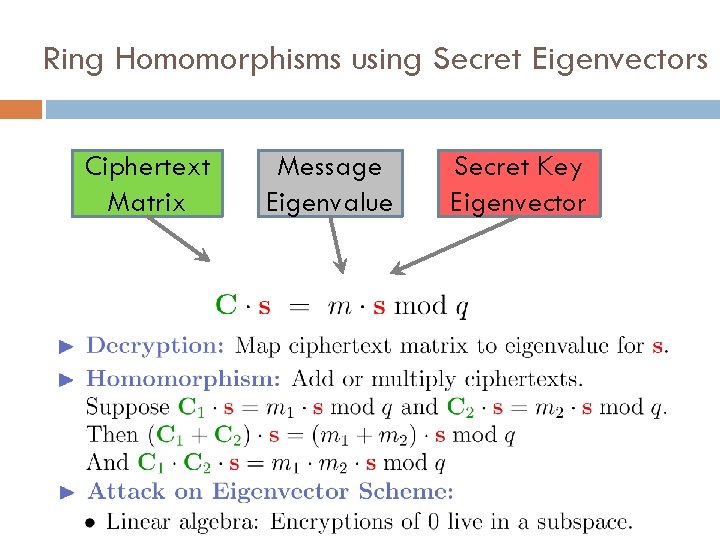
Ring Homomorphisms using Secret Eigenvectors Ciphertext Matrix Message Eigenvalue Secret Key Eigenvector
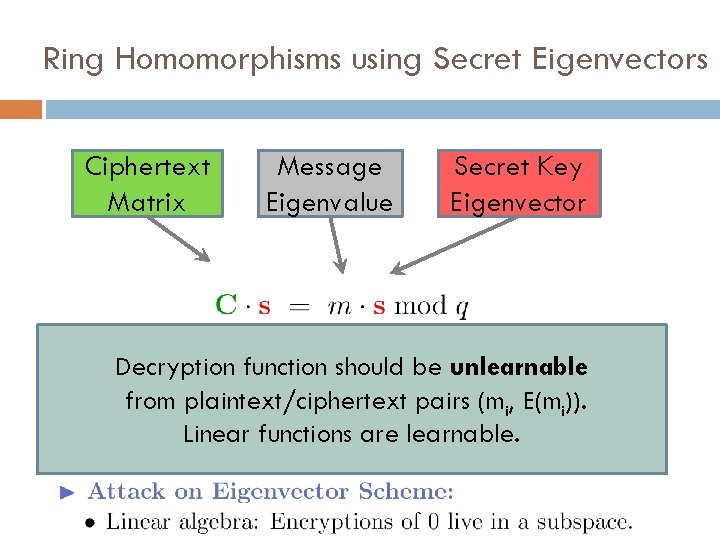
Ring Homomorphisms using Secret Eigenvectors Ciphertext Matrix Message Eigenvalue Secret Key Eigenvector Decryption function should be unlearnable from plaintext/ciphertext pairs (mi, E(mi)). Linear functions are learnable.
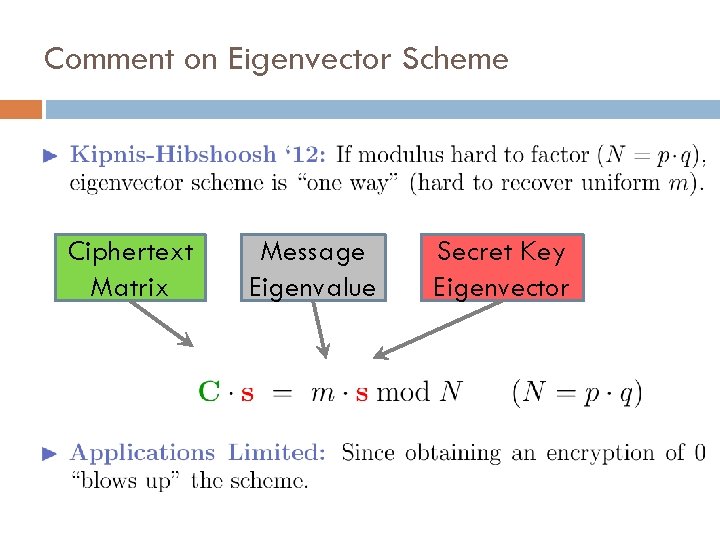
Comment on Eigenvector Scheme Ciphertext Matrix Message Eigenvalue Secret Key Eigenvector
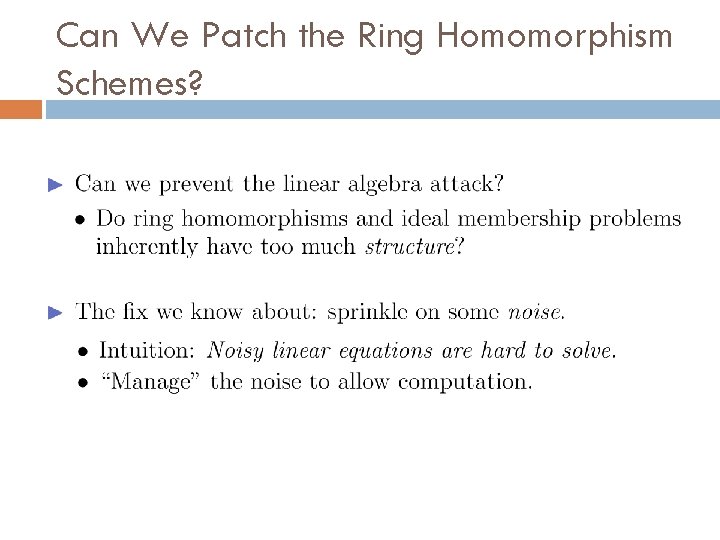
Can We Patch the Ring Homomorphism Schemes?
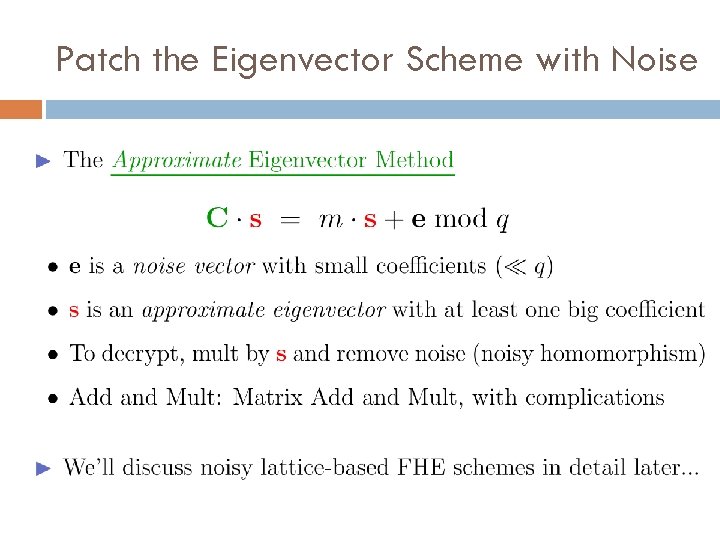
Patch the Eigenvector Scheme with Noise
![Bootstrapping: From Bounded to Unbounded Depth [G 09]](http://slidetodoc.com/presentation_image_h/7312671028b2911c2e3169c3d82f73c1/image-30.jpg "Bootstrapping: From Bounded to Unbounded Depth [G 09]")
Bootstrapping: From Bounded to Unbounded Depth [G 09]
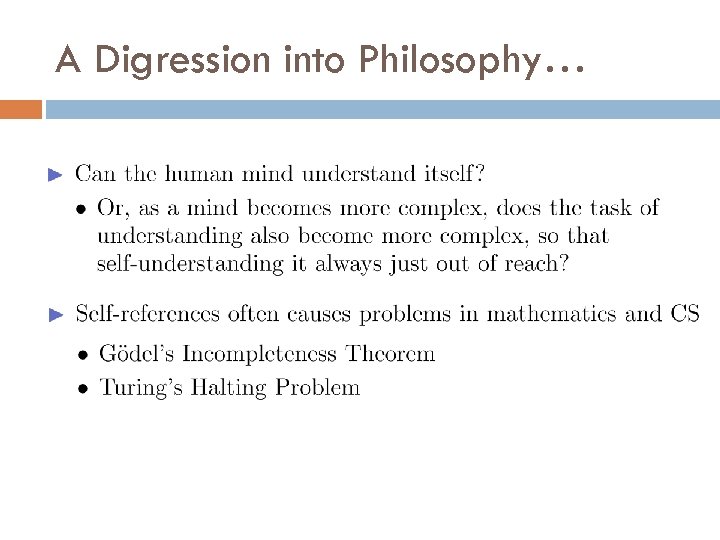
A Digression into Philosophy…
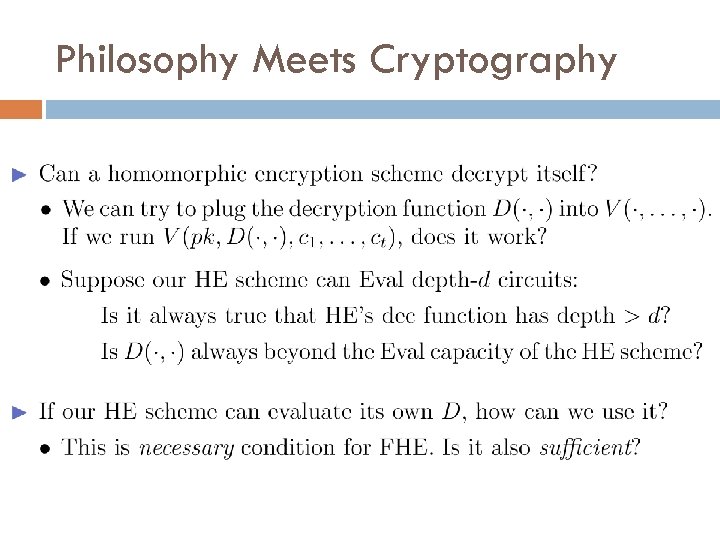
Philosophy Meets Cryptography
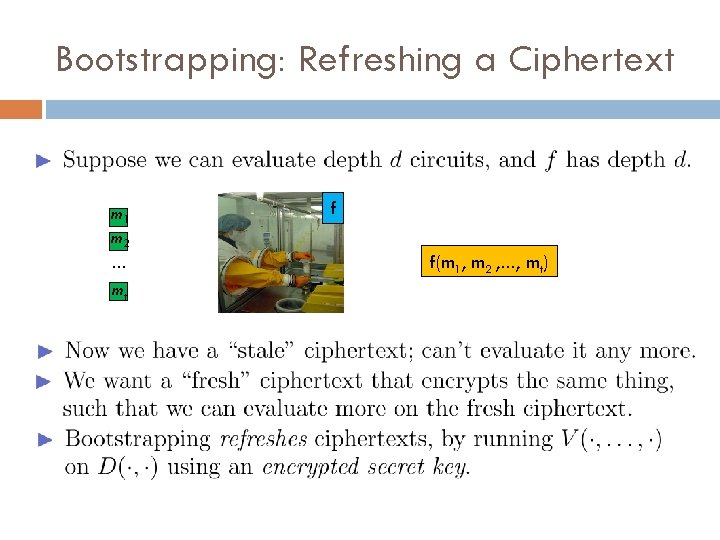
Bootstrapping: Refreshing a Ciphertext m 1 m 2 … mt f f(m 1, m 2 , …, mt)
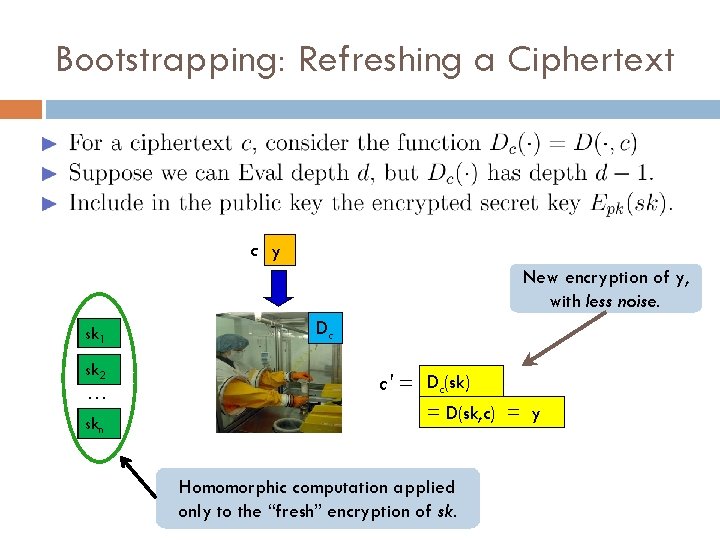
Bootstrapping: Refreshing a Ciphertext c y New encryption of y, with less noise. sk 1 sk 2 … skn Dc c' = Dc(sk) = D(sk, c) = y Homomorphic computation applied only to the “fresh” encryption of sk.
![Bootstrapping Theorem (Informal) [G 09]](http://slidetodoc.com/presentation_image_h/7312671028b2911c2e3169c3d82f73c1/image-35.jpg "Bootstrapping Theorem (Informal) [G 09]")
Bootstrapping Theorem (Informal) [G 09]
Current Performance / Practicality Focusing on the HELib (HE Library) open-source implementation by Halevi and Shoup
![Usable Homomorphic Encryption 2009 -10: Plausibility [GH’ 11] A single bit operation takes 30](http://slidetodoc.com/presentation_image_h/7312671028b2911c2e3169c3d82f73c1/image-37.jpg "Usable Homomorphic Encryption 2009 -10: Plausibility [GH’ 11] A single bit operation takes 30")
Usable Homomorphic Encryption 2009 -10: Plausibility [GH’ 11] A single bit operation takes 30 minutes 2011 -2012: “Real Circuits” [GHS’ 12] A 30, 000 -gate in 36 hours 2013 -today: Usability HElib [HS’ 14]: IBM’s open-source FHE implementation Basis for “generic” FHE computation An “assembly language” for FHE Implements Security The Brakerski-Gentry-Vaikuntanathan (BGV) scheme based on ring LWE (RLWE) same 30, 000 -gate circuit in 4 -15 minutes
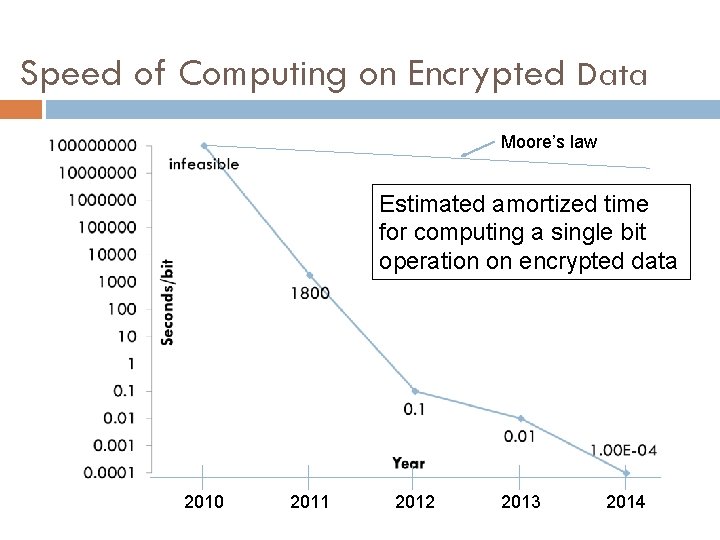
Speed of Computing on Encrypted Data Moore’s law Estimated amortized time for computing a single bit operation on encrypted data 2010 2011 2012 2013 2014
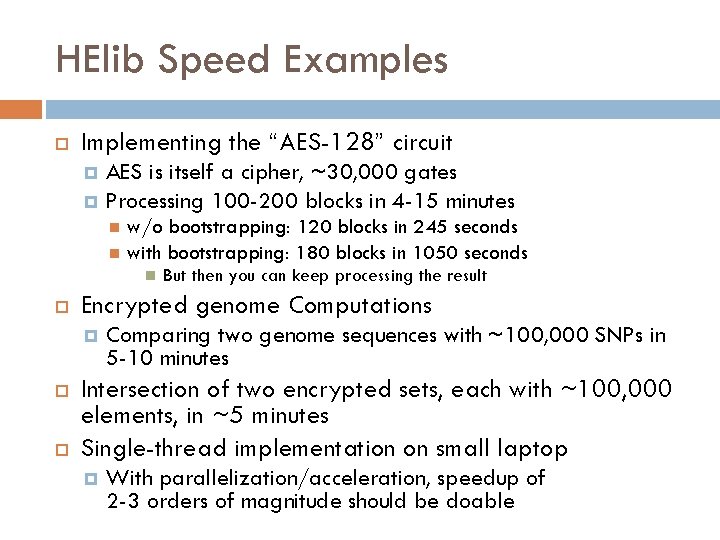
HElib Speed Examples Implementing the “AES-128” circuit AES is itself a cipher, ~30, 000 gates Processing 100 -200 blocks in 4 -15 minutes w/o bootstrapping: 120 blocks in 245 seconds with bootstrapping: 180 blocks in 1050 seconds Encrypted genome Computations But then you can keep processing the result Comparing two genome sequences with ~100, 000 SNPs in 5 -10 minutes Intersection of two encrypted sets, each with ~100, 000 elements, in ~5 minutes Single-thread implementation on small laptop With parallelization/acceleration, speedup of 2 -3 orders of magnitude should be doable
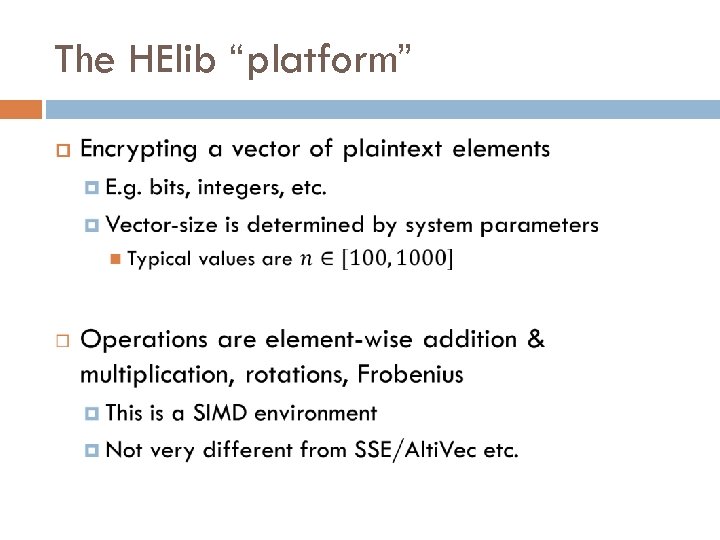
The HElib “platform”
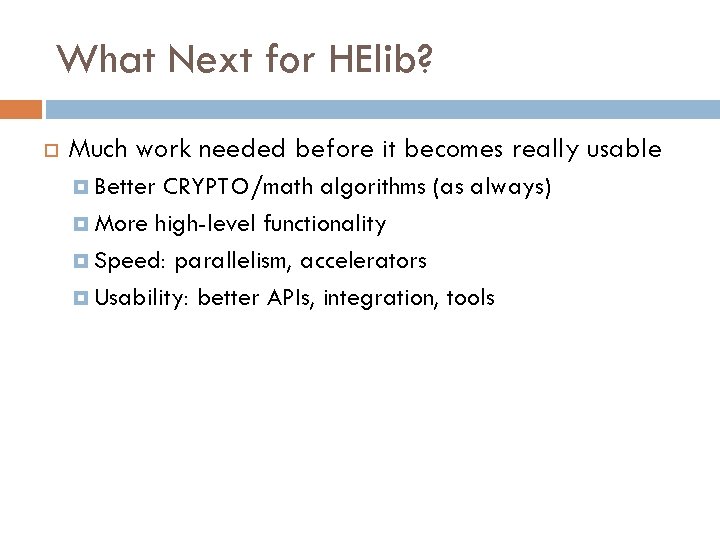
What Next for HElib? Much work needed before it becomes really usable Better CRYPTO/math algorithms (as always) More high-level functionality Speed: parallelism, accelerators Usability: better APIs, integration, tools
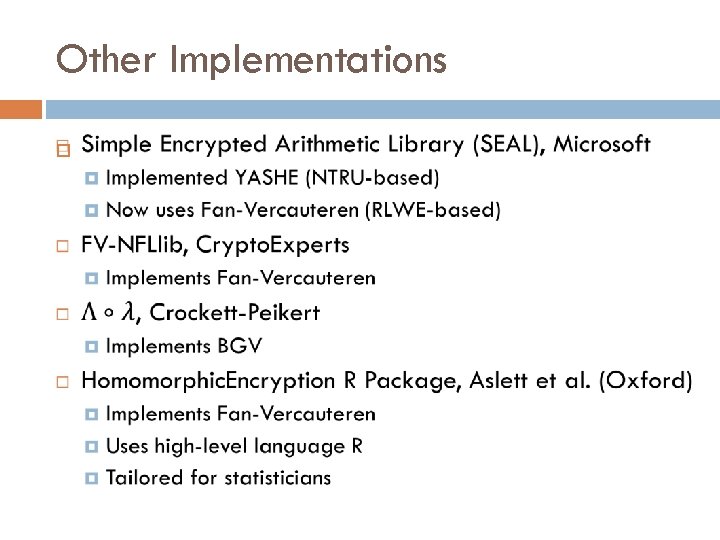
Other Implementations
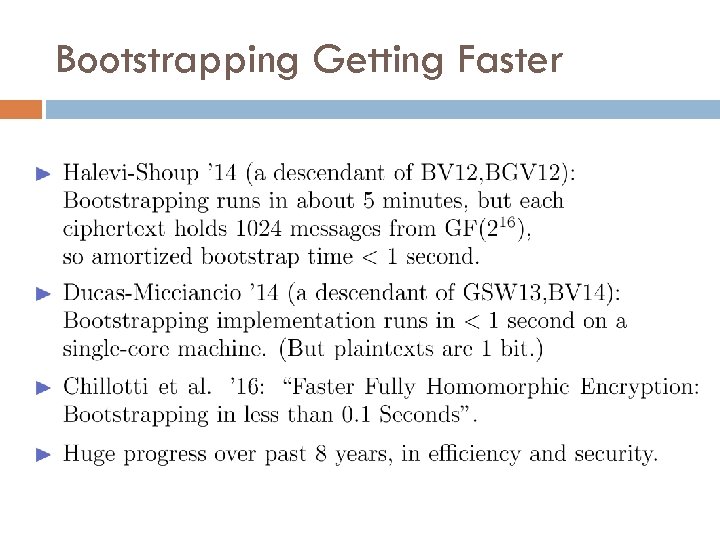
Bootstrapping Getting Faster

Thank You! Questions? E M I T I RE D P X E ?
- Slides: 44