
Fullduplex Backscatter for 1 W Vincent Liu Vamsi
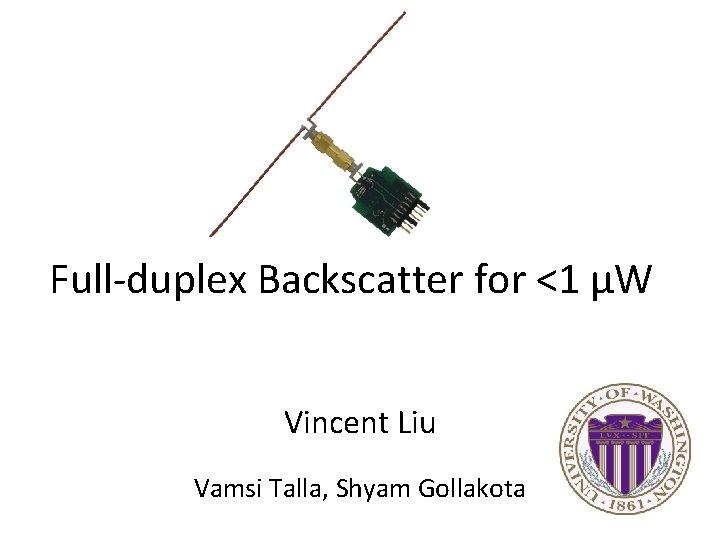
Full-duplex Backscatter for <1 μW Vincent Liu Vamsi Talla, Shyam Gollakota
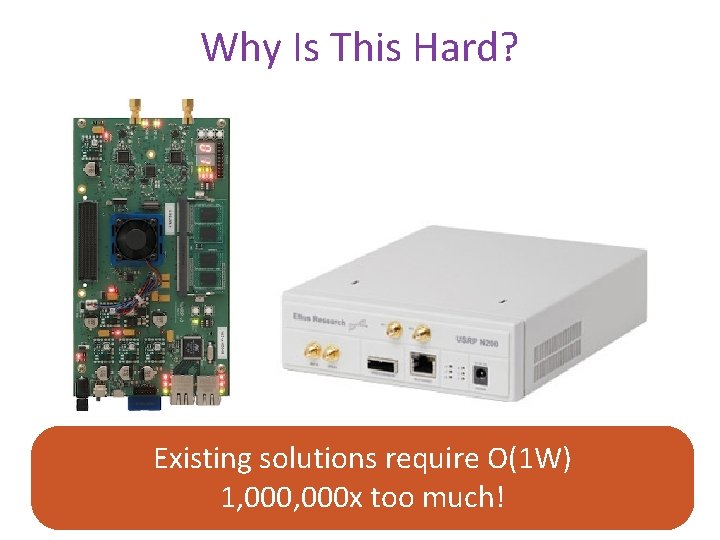
Why Is This Hard? Existing solutions require O(1 W) 1, 000 x too much!
Full-duplex Backscatter First full-duplex design for battery-free devices Same frequency, single antenna
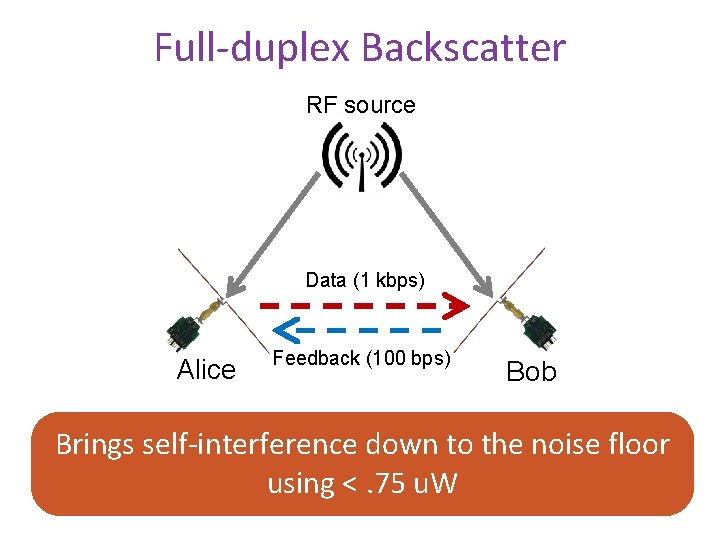
Full-duplex Backscatter RF source Data (1 kbps) Alice Feedback (100 bps) Bob Brings self-interference down to the noise floor using <. 75 u. W
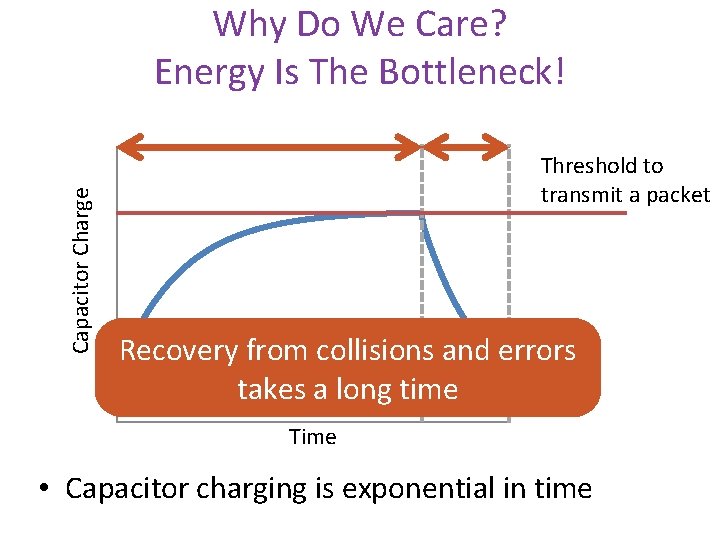
Capacitor Charge Why Do We Care? Energy Is The Bottleneck! Threshold to transmit a packet Recovery from collisions and errors takes a long time Time • Capacitor charging is exponential in time
Why Do We Care? Energy Is The Bottleneck! • Full-duplex can help fix this problem • Instantaneous feedback enables a better network – Collision detection (100 x recharge time reduction) – Error correction (10 x overhead reduction for every packet)
• How do we get full-duplex on battery-free devices? • How do we use instantaneous feedback to design a power-efficient network stack?
• How do we get full-duplex on battery-free devices? • How do we use instantaneous feedback to design a power-efficient network stack?
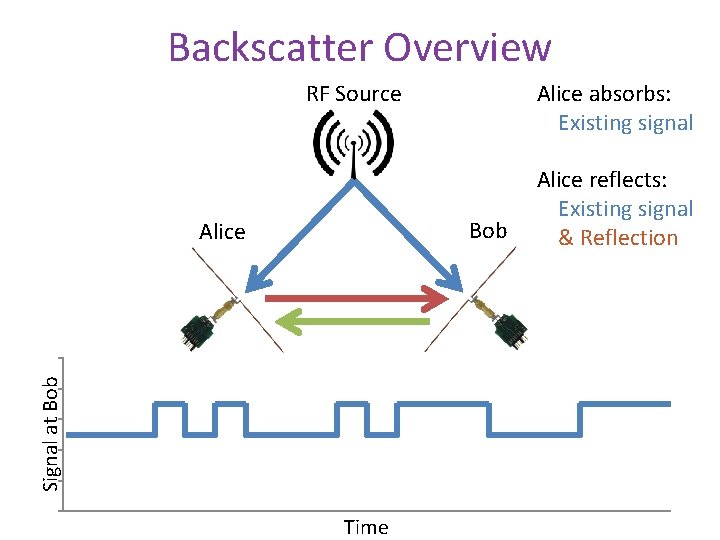
Backscatter Overview Alice absorbs: Existing signal RF Source Bob Signal at Bob Alice Time Alice reflects: Existing signal & Reflection
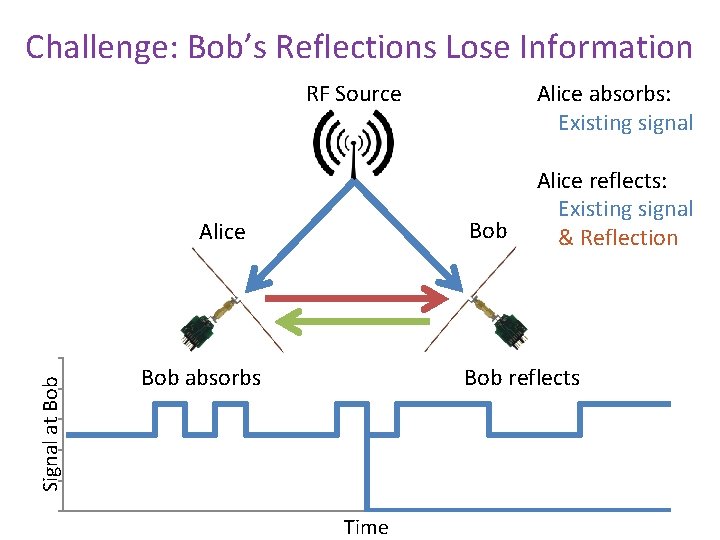
Challenge: Bob’s Reflections Lose Information RF Source Bob Alice Signal at Bob Alice absorbs: Existing signal Bob absorbs Alice reflects: Existing signal & Reflection Bob reflects Time
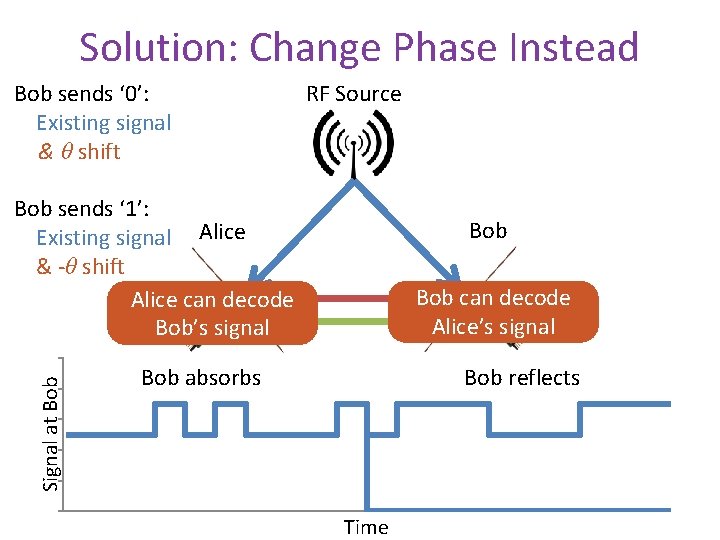
Solution: Change Phase Instead Bob sends ‘ 0’: Existing signal & θ shift RF Source Signal at Bob sends ‘ 1’: Existing signal Alice & -θ shift Alice can decode Bob’s signal Bob can decode Alice’s signal Bob absorbs Bob reflects Time
Practically, phase modulation is imperfect Residual interference
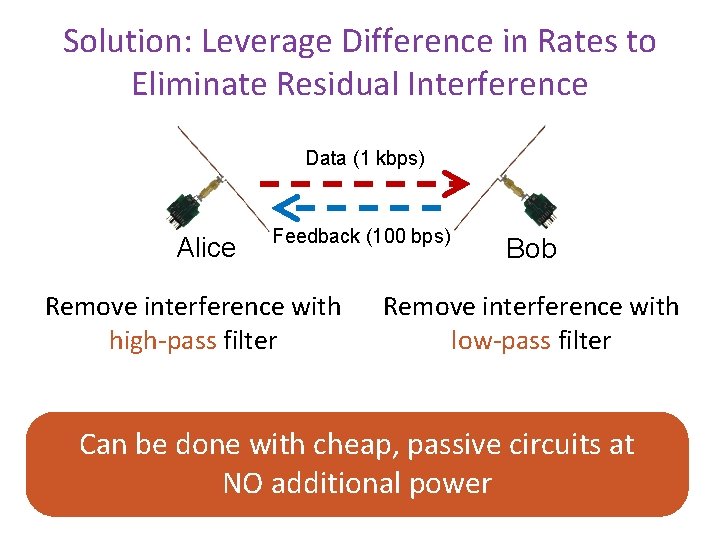
Solution: Leverage Difference in Rates to Eliminate Residual Interference Data (1 kbps) Alice Feedback (100 bps) Remove interference with high-pass filter Bob Remove interference with low-pass filter Can be done with cheap, passive circuits at NO additional power
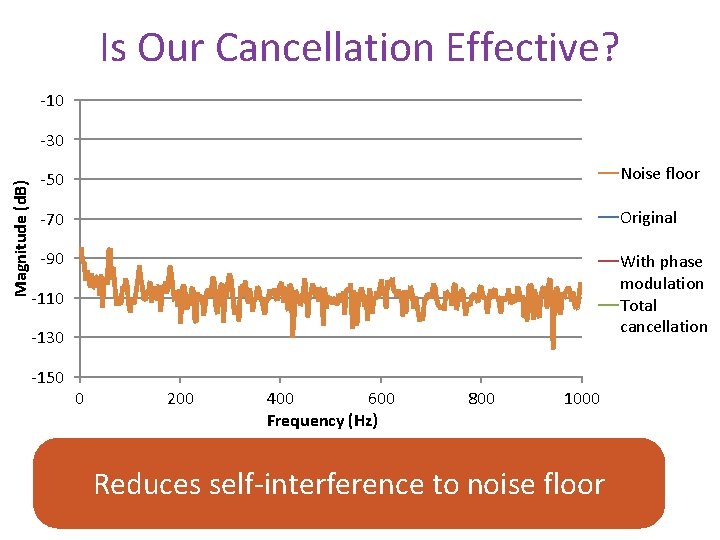
Is Our Cancellation Effective? -10 Magnitude (d. B) -30 -50 Noise floor -70 Original -90 With phase modulation Total cancellation -110 -130 -150 0 200 400 600 Frequency (Hz) 800 1000 Reduces self-interference to noise floor
• How do we get full-duplex on battery-free devices? • How do we use instantaneous feedback to design a power-efficient network stack?
Challenge: Energy Is the Bottleneck • Recovery from collisions/errors takes a long time • We use Full-duplex Backscatter to achieve instantaneous feedback
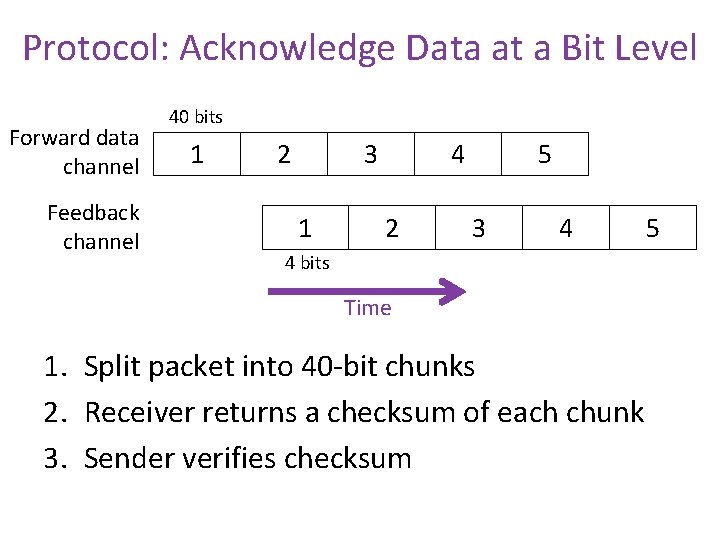
Protocol: Acknowledge Data at a Bit Level Forward data channel Feedback channel 40 bits 1 2 3 1 4 2 5 3 4 4 bits Time 1. Split packet into 40 -bit chunks 2. Receiver returns a checksum of each chunk 3. Sender verifies checksum 5
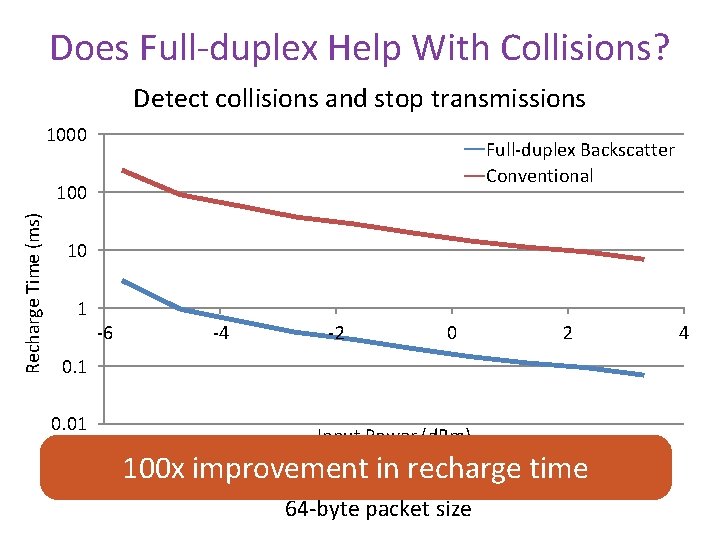
Does Full-duplex Help With Collisions? Detect collisions and stop transmissions 1000 Full-duplex Backscatter Conventional Recharge Time (ms) 100 10 1 -6 -4 -2 0 2 0. 1 0. 01 Input Power (d. Bm) 100 x improvement in recharge time 64 -byte packet size 4
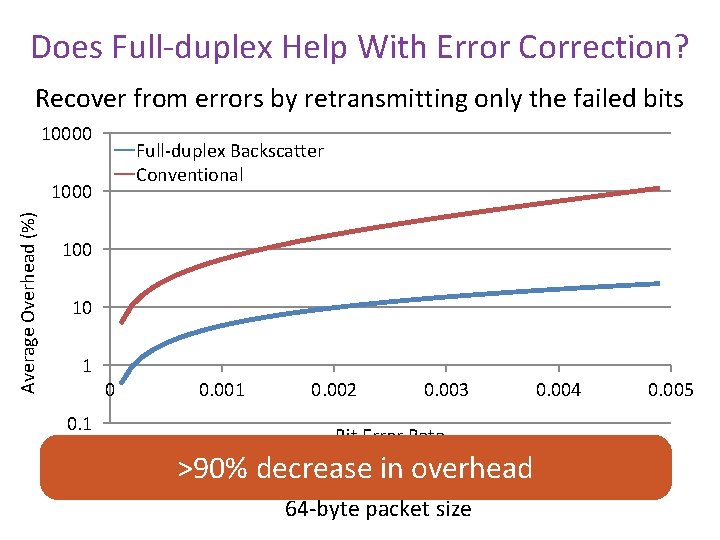
Does Full-duplex Help With Error Correction? Recover from errors by retransmitting only the failed bits 10000 Full-duplex Backscatter Conventional Average Overhead (%) 1000 10 1 0 0. 1 0. 002 0. 003 Bit Error Rate >90% decrease in overhead 64 -byte packet size 0. 004 0. 005
Conclusion • We show – The first full-duplex design for battery-free devices – A power-efficient network stack that has significant gains across the board • Re-design networking primitives with power as a first-class citizen – MIMO (SIGCOMM’ 14), coding (SIGCOMM’ 14), UWB (? ), TCP/IP (? ), …

- Slides: 21