
Full waveform inversion methods for source and media
- Slides: 1
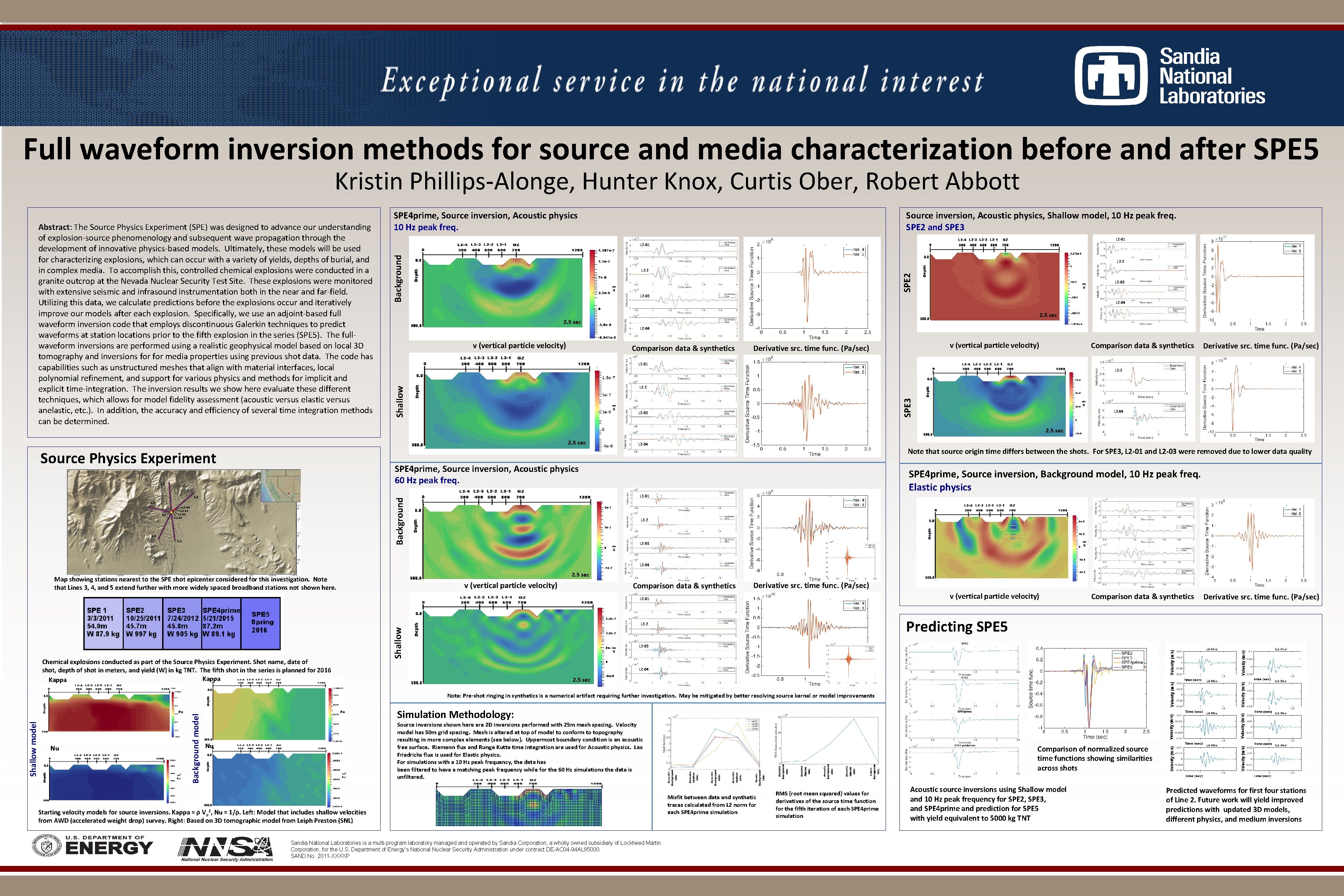
Full waveform inversion methods for source and media characterization before and after SPE 5 Kristin Phillips-Alonge, Hunter Knox, Curtis Ober, Robert Abbott Source inversion, Acoustic physics, Shallow model, 10 Hz peak freq. SPE 2 and SPE 3 L 2 -01 Background L 2 -01 L 2 -2 SPE 2 L 2 -03 L 2 -04 2. 5 sec L 2 -04 v (vertical particle velocity) Comparison data & synthetics v (vertical particle velocity) Derivative src. time func. (Pa/sec) Comparison data & synthetics Derivative src. time func. (Pa/sec) L 2 -01 L 2 -2 SPE 3 L 2 -2 Shallow Abstract: The Source Physics Experiment (SPE) was designed to advance our understanding of explosion-source phenomenology and subsequent wave propagation through the development of innovative physics-based models. Ultimately, these models will be used for characterizing explosions, which can occur with a variety of yields, depths of burial, and in complex media. To accomplish this, controlled chemical explosions were conducted in a granite outcrop at the Nevada Nuclear Security Test Site. These explosions were monitored with extensive seismic and infrasound instrumentation both in the near and far-field. Utilizing this data, we calculate predictions before the explosions occur and iteratively improve our models after each explosion. Specifically, we use an adjoint-based full waveform inversion code that employs discontinuous Galerkin techniques to predict waveforms at station locations prior to the fifth explosion in the series (SPE 5). The fullwaveform inversions are performed using a realistic geophysical model based on local 3 D tomography and inversions for media properties using previous shot data. The code has capabilities such as unstructured meshes that align with material interfaces, local polynomial refinement, and support for various physics and methods for implicit and explicit time-integration. The inversion results we show here evaluate these different techniques, which allows for model fidelity assessment (acoustic versus elastic versus anelastic, etc. ). In addition, the accuracy and efficiency of several time integration methods can be determined. SPE 4 prime, Source inversion, Acoustic physics 10 Hz peak freq. L 2 -03 L 2 -04 2. 5 sec Source Physics Experiment L 2 -04 Note that source origin time differs between the shots. For SPE 3, L 2 -01 and L 2 -03 were removed due to lower data quality SPE 4 prime, Source inversion, Acoustic physics 60 Hz peak freq. SPE 4 prime, Source inversion, Background model, 10 Hz peak freq. Elastic physics Background L 2 -01 L 2 -2 L 2 -03 L 2 -04 2. 5 sec Map showing stations nearest to the SPE shot epicenter considered for this investigation. Note that Lines 3, 4, and 5 extend further with more widely spaced broadband stations not shown here. v (vertical particle velocity) Comparison data & synthetics Derivative src. time func. (Pa/sec) v (vertical particle velocity) L 2 -01 Shallow Derivative src. time func. (Pa/sec) Predicting SPE 5 L 2 -2 Chemical explosions conducted as part of the Source Physics Experiment. Shot name, date of shot, depth of shot in meters, and yield (W) in kg TNT. The fifth shot in the series is planned for 2016 Kappa Comparison data & synthetics L 2 -03 L 2 -04 2. 5 sec Nu Background model Shallow model Note: Pre-shot ringing in synthetics is a numerical artifact requiring further investigation. May be mitigated by better resolving source kernal or model improvements Simulation Methodology: Source inversions shown here are 2 D inversions performed with 25 m mesh spacing. Velocity model has 50 m grid spacing. Mesh is altered at top of model to conform to topography resulting in more complex elements (see below). Uppermost boundary condition is an acoustic free surface. Riemann flux and Runge Kutta time integration are used for Acoustic physics. Lax Friedrichs flux is used for Elastic physics. For simulations with a 10 Hz peak frequency, the data has been filtered to have a matching peak frequency while for the 60 Hz simulations the data is unfiltered. Nu Starting velocity models for source inversions. Kappa = ρ Vp 2, Nu = 1/ρ. Left: Model that includes shallow velocities from AWD (accelerated weight drop) survey. Right: Based on 3 D tomographic model from Leiph Preston (SNL) Sandia National Laboratories is a multi-program laboratory managed and operated by Sandia Corporation, a wholly owned subsidiary of Lockheed Martin Corporation, for the U. S. Department of Energy’s National Nuclear Security Administration under contract DE-AC 04 -94 AL 85000. SAND No. 2011 -XXXXP Comparison of normalized source time functions showing similarities across shots Misfit between data and synthetic traces calculated from L 2 norm for each SPE 4 prime simulation RMS (root mean squared) values for derivatives of the source time function for the fifth iteration of each SPE 4 prime simulation Acoustic source inversions using Shallow model and 10 Hz peak frequency for SPE 2, SPE 3, and SPE 4 prime and prediction for SPE 5 with yield equivalent to 5000 kg TNT Predicted waveforms for first four stations of Line 2. Future work will yield improved predictions with updated 3 D models, different physics, and medium inversions