
Full Remote Alignment System FRAS specification and interfaces

- Slides: 17
Full Remote Alignment System (FRAS) specification and interfaces Hélène Mainaud Durand Review of HL-LHC Alignment and Internal Metrology (WP 15. 4) logo area
Outline § Introduction to the FRAS § Associated aspects § Impact on equipment logo area Hélène Mainaud Durand, 26/08/2019 2
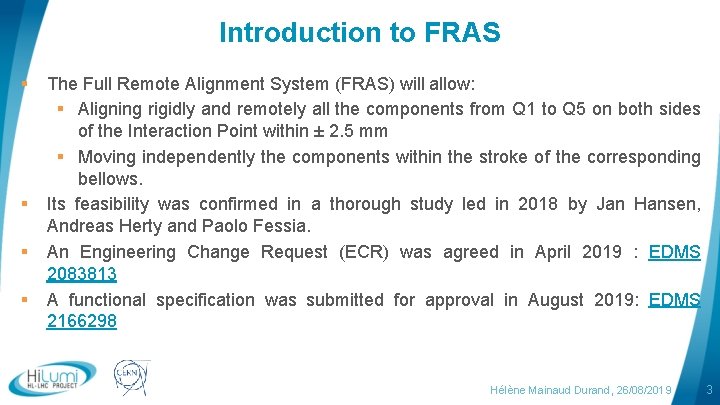
Introduction to FRAS § § The Full Remote Alignment System (FRAS) will allow: § Aligning rigidly and remotely all the components from Q 1 to Q 5 on both sides of the Interaction Point within ± 2. 5 mm § Moving independently the components within the stroke of the corresponding bellows. Its feasibility was confirmed in a thorough study led in 2018 by Jan Hansen, Andreas Herty and Paolo Fessia. An Engineering Change Request (ECR) was agreed in April 2019 : EDMS 2083813 A functional specification was submitted for approval in August 2019: EDMS 2166298 logo area Hélène Mainaud Durand, 26/08/2019 3
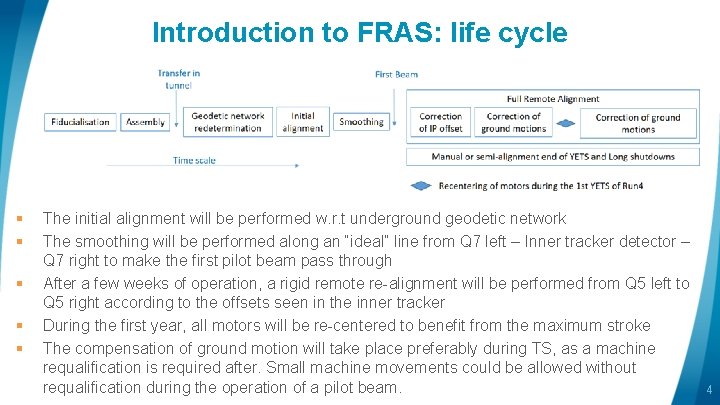
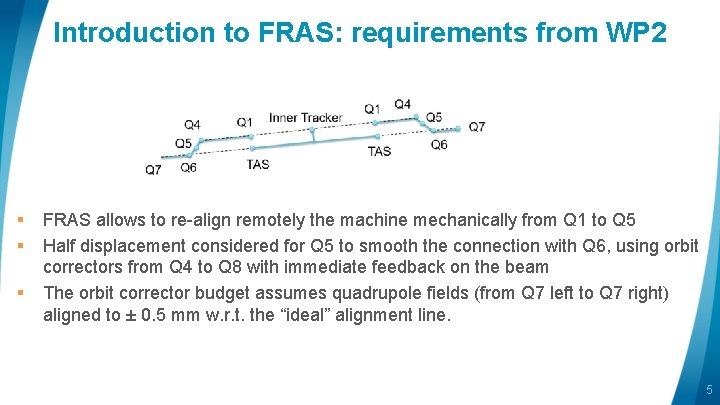
Introduction to FRAS: life cycle § § § The initial alignment will be performed w. r. t underground geodetic network The smoothing will be performed along an “ideal” line from Q 7 left – Inner tracker detector – Q 7 right to make the first pilot beam pass through After a few weeks of operation, a rigid remote re-alignment will be performed from Q 5 left to Q 5 right according to the offsets seen in the inner tracker During the first year, all motors will be re-centered to benefit from the maximum stroke The compensation of ground motion will take place preferably during TS, as a machine requalification logo is required after. Small machine movements could be allowed without area requalification during the operation of a pilot beam. 4
Introduction to FRAS: requirements from WP 2 § § § FRAS allows to re-align remotely the machine mechanically from Q 1 to Q 5 Half displacement considered for Q 5 to smooth the connection with Q 6, using orbit correctors from Q 4 to Q 8 with immediate feedback on the beam The orbit corrector budget assumes quadrupole fields (from Q 7 left to Q 7 right) aligned to ± 0. 5 mm w. r. t. the “ideal” alignment line. logo area 5
Introduction to FRAS: some definitions § Alignment of a component: determination of its position and adjustment of its position. § Manual alignment: alignment requiring human intervention in the tunnel § Semi-manual alignment: alignment requiring human intervention in the tunnel, made faster by installing temporary motors for the adjustment. § Remote alignment: alignment of a component performed remotely (with no human intervention in the tunnel), using sensors to determine logo the position of the component and motors to adjust it. area 6
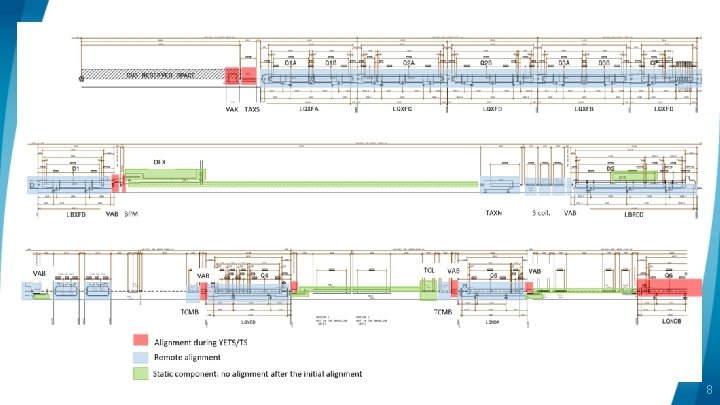
Introduction to FRAS: solution proposed LSS components classified into different types, considering the level of radiation in the area, the ground motion expected, the associated alignment requirements and their aperture: § Components needing to be aligned from the CCC (remote alignment) § Components aligned only during LSs or YETS (semi-manual or manual alignment) § Components that will not be aligned anymore after their initial alignment (static alignment) logo area Hélène Mainaud Durand, 26/08/2019 7
Introduction to FRAS: classification logo area 8
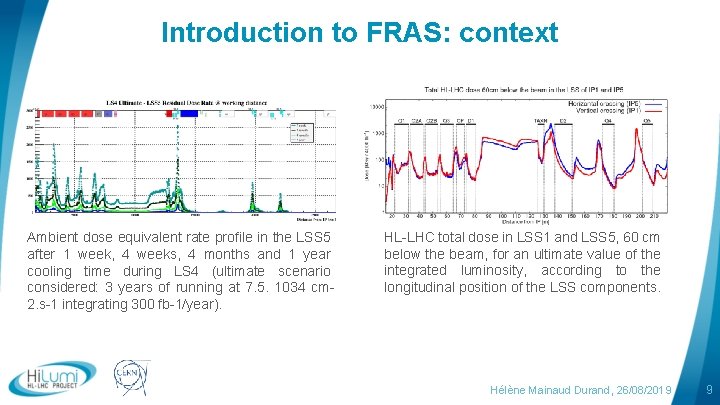
Introduction to FRAS: context Ambient dose equivalent rate profile in the LSS 5 after 1 week, 4 weeks, 4 months and 1 year cooling time during LS 4 (ultimate scenario considered: 3 years of running at 7. 5. 1034 cm 2. s-1 integrating 300 fb-1/year). logo area HL-LHC total dose in LSS 1 and LSS 5, 60 cm below the beam, for an ultimate value of the integrated luminosity, according to the longitudinal position of the LSS components. Hélène Mainaud Durand, 26/08/2019 9
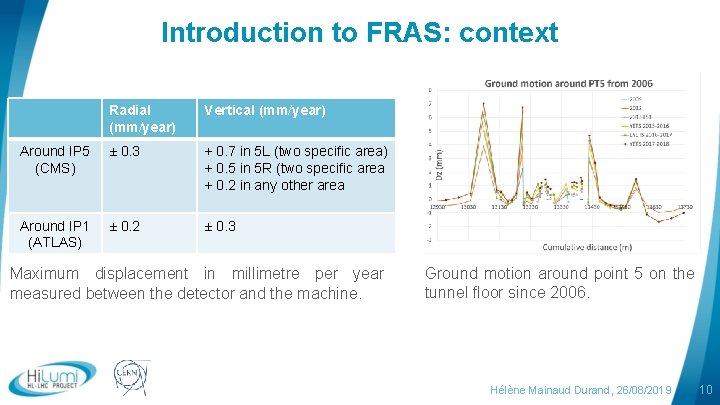
Introduction to FRAS: context Radial (mm/year) Vertical (mm/year) Around IP 5 (CMS) ± 0. 3 + 0. 7 in 5 L (two specific area) + 0. 5 in 5 R (two specific area + 0. 2 in any other area Around IP 1 (ATLAS) ± 0. 2 ± 0. 3 Maximum displacement in millimetre per year measured between the detector and the machine. logo area Ground motion around point 5 on the tunnel floor since 2006. Hélène Mainaud Durand, 26/08/2019 10
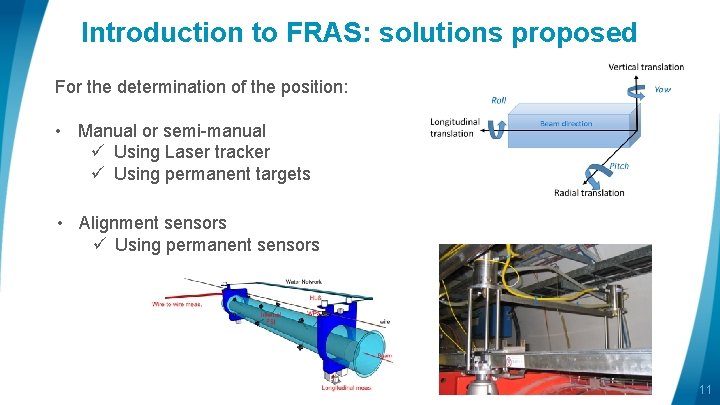
Introduction to FRAS: solutions proposed For the determination of the position: • Manual or semi-manual ü Using Laser tracker ü Using permanent targets • Alignment sensors ü Using permanent sensors logo area 11
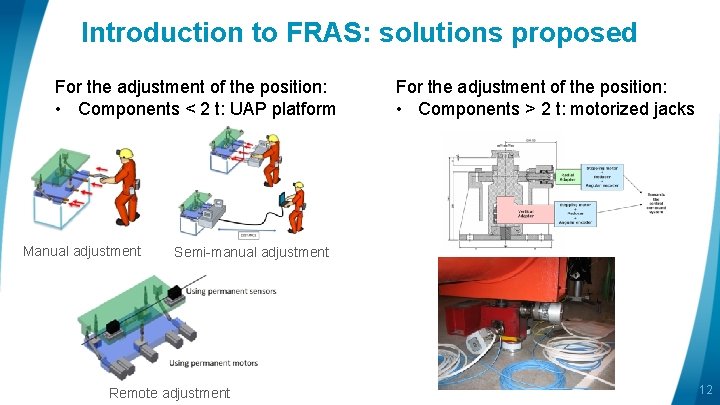
Introduction to FRAS: solutions proposed For the adjustment of the position: • Components < 2 t: UAP platform Manual adjustment logo area For the adjustment of the position: • Components > 2 t: motorized jacks Semi-manual adjustment Remote adjustment 12
FRAS & associated aspects § Reliability: Alignment sensors and motors located in the tunnel shall be free of maintenance during HL-LHC life time, as no corrective maintenance will be possible except at the end of YETS and LS. § Maintainability: All sensors and motors will be designed in such a way that they can be removed (and re-installed) in less than 3’ from their supports or interface, using kinematic mounts and/or screws usable by robots. § Inspectability: A final inspectability will be performed on all sensors and motors after less than 1 year of operation, when the level of radiations is still acceptable. Possibility to perform later on the inspectability with methods developed on collimators with robots (switch control, grease control). logo area 13
FRAS & associated aspects § Installation: The installation of all FRAS components will take place when the components are not yet interconnected, at warm, in order to have the possibility to perform insitu validation tests that will have no impact on bellows or on the alignment of the adjacent components. § Cabling: All cables and associated racks needed for FRAS have been mentioned in DICs issued in March 2019. § Logistics: The FRAS shall not interfere with the areas reserved for the transport of accelerators components in the tunnel. The FRA equipment shall not interfere with the volume reserved for the transport, or it shall be installed after transport, once in the tunnel FRAS equipment shall not affect the handling activities and shall be easily logo dismountable. area 14
FRAS & associated aspects Machine protection aspects Protection shall be implemented to avoid that: § Nearby elements move independently in a critical way, putting at risk the machine integrity § That the machine can be moved in non-safe conditions § One first injection interlock shall be on WPS readings (delta between a stop) § One second interlock shall be a key-type interlock in the CCC to prevent any displacements on motors during operation. § Maskable hardware interlocks to the LHC beam interlock system shall be provided to set interlocks whenever the remote adjustment systems are powered. Theses interlocks shall ensure that the remote system is only used with setup beam intensity. § Tracking and logging of the movement of the components/interconnections logo area 15
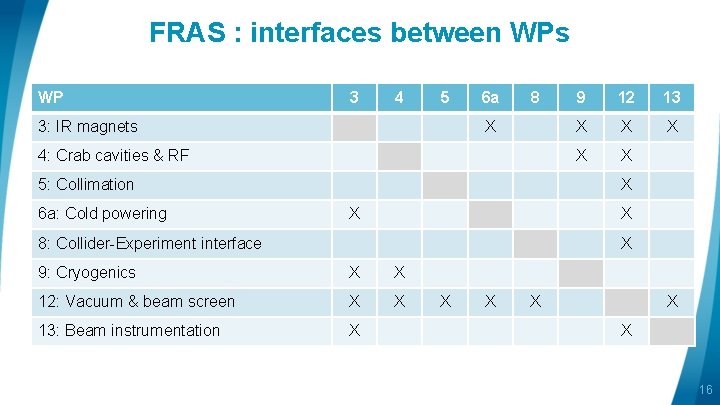
FRAS : interfaces between WPs WP 3 4 5 3: IR magnets 6 a 8 X 4: Crab cavities & RF 5: Collimation 6 a: Cold powering 12 13 X X X X 8: Collider-Experiment interface X 9: Cryogenics X X 12: Vacuum & beam screen X X 13: Beam instrumentation X logo area 9 X X X 16
Thank you very much logo area 17